
seangabb
Published 11 Feb 2021The Crusades are the defining event of the Middle Ages. They brought the very different civilisations of Western Europe, Byzantium and Islam into an extended period of both conflict and peaceful co-existence. Between January and March 2021, Sean Gabb explored this long encounter with his students. Here is one of his lectures. All student contributions have been removed.
(more…)
May 10, 2022
The Crusades: Part 4 — Life in Outremer
Comments Off on The Crusades: Part 4 — Life in Outremer
May 7, 2022
The Crusades: Part 3 — The Crusader States
seangabb
Published 6 Feb 2021The Crusades are the defining event of the Middle Ages. They brought the very different civilisations of Western Europe, Byzantium and Islam into an extended period of both conflict and peaceful co-existence. Between January and March 2021, Sean Gabb explored this long encounter with his students. Here is one of his lectures. All student contributions have been removed.
(more…)
Comments Off on The Crusades: Part 3 — The Crusader States
May 5, 2022
Belisarius: The Last Battle
Epic History TV
Published 29 Apr 2022Thank you to our video sponsor Displate. Get exclusive discounts on metal posters, including original EHTV artwork, using this link:
https://displate.com/epichistorytv?ar…Big thanks to Legendarian for Total War: Attila gameplay footage, check out his YouTube channel here: https://www.youtube.com/channel/UCOI2…
Big thanks also to our series consultant Professor David Parnell of Indiana University Northwest, who you can follow on Twitter here: https://twitter.com/byzantineprof
Total War: Attila gameplay footage used with kind permission of Creative Assembly – buy the game here: https://geni.us/qDreR
Support Epic History TV on Patreon from $1 per video, and get perks including ad-free early access & votes on future topics https://www.patreon.com/EpicHistoryTV
🎨 Original artwork by Miłek Jakubiec https://www.artstation.com/milek
📚Recommended reading (as an Amazon Associate I earn from qualifying purchases):
📖 Procopius, History of the Wars https://geni.us/L3Pgc
📖 The Wars of Justinian by Michael Whitby https://geni.us/Xxrd3
📖 Rome Resurgent by Peter Heather https://geni.us/ZFoU1
📖 The Armies of Ancient Persia: the Sassanians by Kaveh Farrokh https://geni.us/jMQo3z
📖 Late Roman Cavalryman AD 236–565 (Osprey) by Simon MacDowall https://geni.us/XMGl👕 Buy EHTV t-shirts, hoodies, mugs and stickers here! teespring.com/en-GB/stores/epic-histo…
🎶Music from Filmstro: https://filmstro.com/?ref=7765
Get 20% off an annual license with this exclusive code:EPICHISTORYTV_ANN“Rites” by Kevin MacLeod https://incompetech.filmmusic.io/song…
License: https://filmmusic.io/standard-license#EpicHistoryTV #RomanEmpire #EasternRomanEmpire #Justinian #Belisarius #ByzantineEmpire
Comments Off on Belisarius: The Last Battle
May 3, 2022
The Crusades: Part 2 – The First Crusade
seangabb
Published 5 Feb 2021The Crusades are the defining event of the Middle Ages. They brought the very different civilisations of Western Europe, Byzantium and Islam into an extended period of both conflict and peaceful co-existence. Between January and March 2021, Sean Gabb explored this long encounter with his students. Here is one of his lectures. All student contributions have been removed.
(more…)
Comments Off on The Crusades: Part 2 – The First Crusade
April 26, 2022
The Crusades: Part 1 – The Long Prehistory
seangabb
Published 23 Jan 2021The Crusades are the defining event of the Middle Ages. They brought the very different civilisations of Western Europe, Byzantium and Islam into an extended period of both conflict and peaceful co-existence. Between January and March 2021, Sean Gabb explored this long encounter with his students. Here is one of his lectures. All student contributions have been removed.
(more…)
Comments Off on The Crusades: Part 1 – The Long Prehistory
April 19, 2022
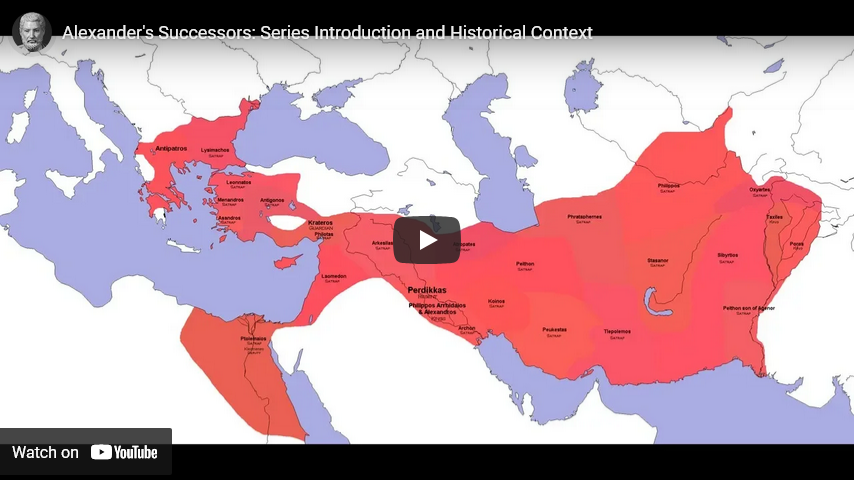
Alexander’s Successors (the Diadochi): Series Introduction and Historical Context
Thersites the Historian
Published 24 Nov 2018This video introduces my series on Alexander’s Successors by talking about what the series will be like and by going through the historical context that the viewer might need to understand the age of the Successors.
Patreon link: https://www.patreon.com/thersites
PayPal link: paypal.me/thersites
Twitter link: https://twitter.com/ThersitesAthens
Minds.com link: https://www.minds.com/ThersitestheHis…
Steemit/dtube link: https://steemit.com/@thersites/feed
Backup Channel: https://www.youtube.com/channel/UCUrD…
Comments Off on Alexander’s Successors (the Diadochi): Series Introduction and Historical Context
April 11, 2022
Republic to Empire: The Ides of March to Actium
seangabb
Published 13 Mar 2021In 120 BC, Rome was a republic with touches of democracy. A century later, it was a divine right military dictatorship. Between January and March 2021, Sean Gabb explored this transformation with his students. Here is one of his lectures. All student contributions have been removed.
(more…)
Comments Off on Republic to Empire: The Ides of March to Actium
March 27, 2022
Book Review: The Uzi Submachine Gun Examined, by David Gaboury
Forgotten Weapons
Published 13 Aug 2017The UZI Submachine Gun: Examined is a newly published book this year by David Gaboury — long time owner and operator of the uzitalk.com forum. Until now there has not really been any substantive written reference material on the Uzi, but Gaboury has certainly changed that!
The Uzi has not really seen many major variations in its design beyond the Uzi/Mini Uzi/Micro Uzi scaling (and the semiauto and full auto variations of each), but it has lived two rather distinct lives. One is the Uzi as a global military arm, and the other is the Uzi as an American commercial product — and this book covers both in excellent detail.
On the military side, the book begins with a substantial chapter on the initial development of the Uzi and Israeli submachine gun trials. A remarkably wide variety of guns were considered by the Israeli armed forces, and the trial ultimately came down to two domestic designs. The influence of the Czech ZK-476 and SA vz 23/4/5/6 designs are well explained, and much of the mythology about where the design came from is dispelled. Gaboury makes good use of both original documentary sources and firsthand conversation with those who were involved at the time to tell this story.
With the gun accepted, in production, and becoming very popular with Israeli troops, international sales become a possibility. Gaboury covers the adoption of the gun by the Dutch armed forces, followed by the German and South African militaries — as well as the licensed production by FN. He also examines other copies and adaptations, including Croatian, Japanese, and Chinese.
The second half of the Uzi story is that of its sale in the United States (including the use by US security organizations including the Secret Service). This is a story every bit as complex and detailed as the international military use of the gun, as US legal changes in 1968, 1986, 1989, 1994, and 2004 all play a major role in dictating changes that must be made to the guns for import and sale. In particular, Gaboury has detailed chapters on the major sellers of Uzis in the US — Action Arms, Group Industries, and Vector Arms (as well as many other smaller players).
While there may not be many major variations of the Uzi, there are a multitude of smaller changes to individual parts in both design and production technique, and Gaboury covers these in remarkable detail. If there is a flaw to the book, it is not in lack of detail, but perhaps in a bit of dryness to the writing. The information is clearly presented, but not particularly engaging to the reader who is only mildly interested in the subject. This is a minor criticism, however, and the book is an outstanding reference for anyone who has, well, really any questions at all about the Uzi.
http://www.patreon.com/ForgottenWeapons
Cool Forgotten Weapons merchandise! http://shop.bbtv.com/collections/forg…
If you enjoy Forgotten Weapons, check out its sister channel, InRangeTV! http://www.youtube.com/InRangeTVShow

Comments Off on Book Review: The Uzi Submachine Gun Examined, by David Gaboury
March 19, 2022
Belisarius: War & Plague
Epic History TV
Published 18 Mar 2022Download Endel here, first 100 downloads get 1 week of free audio experiences!
https://app.adjust.com/b8wxub6?campai…Big thanks to Legendarian for Total War: Attila gameplay footage, check out his YouTube channel here: https://www.youtube.com/channel/UCOI2…
Big thanks also to our series consultant Professor David Parnell of Indiana University Northwest, who you can follow on Twitter here: https://twitter.com/byzantineprof
Total War: Attila gameplay footage used with kind permission of Creative Assembly – buy the game here: https://geni.us/qDreR
Support Epic History TV on Patreon from $1 per video, and get perks including ad-free early access & votes on future topics https://www.patreon.com/EpicHistoryTV
🎨 Original artwork by Miłek Jakubiec https://www.artstation.com/milek
📚 Recommended reading (as an Amazon Associate I earn from qualifying purchases):
📖 Procopius, History of the Wars https://geni.us/L3Pgc
📖 The Wars of Justinian by Michael Whitby https://geni.us/Xxrd3
📖 Rome Resurgent by Peter Heather https://geni.us/ZFoU1
📖 The Armies of Ancient Persia: the Sassanians by Kaveh Farrokh https://geni.us/jMQo3z
📖 Late Roman Cavalryman AD 236–565 (Osprey) by Simon MacDowall https://geni.us/XMGl👕 Buy EHTV t-shirts, hoodies, mugs and stickers here! teespring.com/en-GB/stores/epic-histo…
🎶Music from Filmstro: https://filmstro.com/?ref=7765
Get 20% off an annual license with this exclusive code:EPICHISTORYTV_ANN“Rites” by Kevin MacLeod https://incompetech.filmmusic.io/song…
License: https://filmmusic.io/standard-license#EpicHistoryTV #RomanEmpire #EasternRomanEmpire #Justinian #Belisarius #ByzantineEmpire #Romans #Ostrogoths
Comments Off on Belisarius: War & Plague
February 7, 2022
Justinian I, 527-565: Wars
Thersites the Historian
Published 21 Sep 2017In this video, I look at the wars of conquest waged by the Emperor Justinian and explore whether or not these conflicts advanced the long-term interests of the Byzantine state.
Comments Off on Justinian I, 527-565: Wars
January 5, 2022
History Summarized: The Ottoman Empire
Overly Sarcastic Productions
Published 5 Oct 2018Leave it to the furniture boys to pioneer a Comfort-First attitude towards Imperialism.
Join Blue in investigating the history of the Ottoman empire, and find out why “The Sick Man of Europe” is more than their nickname implies.
Further reading: Osman’s Dream by Caroline Finkel
Famous Turkish Song — Gunduz Gece: https://www.youtube.com/watch?v=2UcbH…
PATREON: www.patreon.com/OSP
MERCH LINKS:
Shirts – https://overlysarcasticproducts.threa…
All the other stuff – http://www.cafepress.com/OverlySarcas…Find us on Twitter @OSPYouTube!
Comments Off on History Summarized: The Ottoman Empire
January 3, 2022
How did the Greeks and Romans count Years?
toldinstone
Published 31 Dec 2021The AD/CE system we use to date the year was introduced — more or less by accident — during the Middle Ages. Before its invention, the classical world used a wide range of dating systems.
Please consider supporting this channel on Patreon:
https://www.patreon.com/toldinstoneIf you liked this video, you might also enjoy my book Naked Statues, Fat Gladiators, and War Elephants: Frequently Asked Questions about the Ancient Greeks and Romans:
https://www.amazon.com/Naked-Statues-…
If you’re so inclined, you can follow me elsewhere on the web:
https://www.reddit.com/r/AskHistorian…
https://www.instagram.com/toldinstone/
https://www.goodreads.com/author/show…Chapters:
0:00 Introduction
0:51 Ancient Greek Calendars
1:42 Counting by Olympiads
2:22 The Seleucid Era
2:56 Consular Dating
3:26 Ab Urbe Condita
4:28 Indictions
4:56 Christian Chronology
5:40 Anno Domini
7:00 Conclusion
Comments Off on How did the Greeks and Romans count Years?
January 1, 2022
A 4000 Year Old Recipe for the Babylonian New Year
Tasting History with Max Miller
Published 29 Dec 2020Help Support the Channel with Patreon: https://www.patreon.com/tastinghistory
Tasting History Merchandise: crowdmade.com/collections/tastinghistoryFor further reading on these recipes visit: https://www.academia.edu/40639453/Foo…
Follow Tasting History here:
Instagram: https://www.instagram.com/tastinghist…
Twitter: https://twitter.com/TastingHistory1
Reddit: r/TastingHistory
Discord: https://discord.gg/d7nbEpyTasting History’s Amazon Wish List: https://www.amazon.com/hz/wishlist/ls…
LINKS TO INGREDIENTS & EQUIPMENT**
Canon EOS M50 Camera: https://amzn.to/3amjvwu
Canon EF 50mm Lens: https://amzn.to/3iCrkB8
Le Creuset Dutch Oven 7.25 qt: https://amzn.to/3mLkWJFLINKS TO SOURCES**
https://www.academia.edu/40639453/Foo…
Gojko Barjamovic: https://nelc.fas.harvard.edu/people/g…
Myths from Mesopotamia translated by Stephanie Dalley: https://amzn.to/2Kvzr7b
Babylon by Paul Kriwaczek: https://amzn.to/37GJRJT
The Oldest Cuisine in the World by Jean Bottéro: https://amzn.to/2Jf1eIm
The Babylonian Akitu Festival by Svend Aage Pallis: https://amzn.to/2M5hZa7
The Babylonian New Year Festival by Karel Van Der Toorn: https://brill.com/view/book/edcoll/97…**Amazon offers a small commission on products sold through their affiliate links, so each purchase made from this link, whether this product or another, will help to support this channel with no additional cost to you.
Editor: WarwicSN – https://www.youtube.com/WarwicSN
Subtitles: Jose MendozaDISH NAME
ORIGINAL c.1740BC RECIPE (From The Yale Babylonian Tablets)
Tuh’u sirum saqum izzaz me tukan lipia tanaddi tusammat tabatum sikara susikillum egegerum kisibirrum smidu kamunum alutum tukammas-ma karsum hazannum teterri kisibirrum ina muhhi sipki tusappah suhutinnu kisibirrum isarutu tanaddi.Tuh’u. Lamb leg meat is used. Prepare water. Add fat. Sear. Add in salt, beer, onion, arugula, cilantro, samidu, cumin, and beets. Put the ingredients in the cooking vessel and add crushed leek and garlic. Sprinkle the cooked mixture with coriander on top. Add suhutinnu and fresh cilantro.
MODERN RECIPE
INGREDIENTS
– 1lb (450g) Leg of Lamb Chopped into bite size pieces.
– 3-4 Tablespoon Oil or Rendered Fat
– 1 ½ teaspoons Salt
– 2 Cups (475ml) Water
– 12 oz (350ml) Beer – (A sour beer and German Weissbier are recommended, but any non-hoppy beer will suffice)
– 1 Large Onion Chopped
– 2 Cups Arugula Chopped
– 3/4 Cup Cilantro Chopped
– 2 Teaspoons Cumin Seeds crushed
– 2 Large Beets (approx. 4 cups) Chopped
– 1 Large Leek Minced
– 3 cloves Garlic,
– 1 Tablespoon Dry Coriander Seeds
– Additional Chopped Cilantro for garnish
– Samidu* (Something akin to 1 Persian Shallot)
– Suhutinnu* (Something akin to Egyptian Leek for garnish)
*These ingredients have no definite translation; the shallot and leek are the best guesses of scholars at Yale and Harvard Universities)METHOD
1. Add the oil/fat to a large pot and set over high heat. Sear the lamb for several minutes in the oil until lightly browned.
2. Add the onions and let cook for 5 minutes, then add the beets and let cook for 5 minutes. Then add the salt, beer, arugula, cilantro, samidu (shallot) and cumin and bring to a boil. Mash the garlic into a paste and mix with the leek, then add to the pot.
3. Lower heat to medium and let simmer for approximately 1 hour, or until the beets and meat are cooked to your liking.
4. Once cooked, dish it into a bowl and sprinkle with coriander seeds. Garnish with fresh cilantro and suhutinnu (leek)PHOTO CREDITS
Crocus: By Safa.daneshvar – Own work, CC BY-SA 3.0, http://bit.ly/3hfNN7F
Statue of Nabu: By Osama Shukir Muhammed Amin FRCP(Glasg) – Own work, CC BY-SA 4.0, http://bit.ly/2KodVkV
Temple of Nabu at Borsippa: Osama Shukir Muhammed Amin FRCP(Glasg), CC BY-SA 4.0 https://creativecommons.org/licenses/…, via Wikimedia Commons
Ishtar Gate: Joyofmuseums, CC BY-SA 4.0 https://creativecommons.org/licenses/…, via Wikimedia Commons
King Marduk-zakir-shumi: By Osama Shukir Muhammed Amin FRCP(Glasg)Throne Dais of Shalmaneser III at the Iraq Museum.jpg, CC BY 4.0, http://bit.ly/3nMw22j#tastinghistory #babylon #akitu

Comments Off on A 4000 Year Old Recipe for the Babylonian New Year
December 27, 2021
Prince Philip was born in Greece, but was never “of Greece”
Aris Roussinos outlines the surprisingly complex history of Prince Philip’s family in Greece and explains why His Royal Highness could never really be considered Greek, despite the tabloid nickname “Phil the Greek”:

HRH Prince Philip, the Duke of Edinburgh, Colonel-in-Chief of the Royal Canadian Regiment, presenting the 3rd Battalion with their Regimental Colours, 17 April 2013. (via Wikipedia)
Though most people know that Prince Philip was born in Greece and almost immediately exiled, the precise circumstances of this leaving of his native country are surprisingly obscure. How many are aware, for example, that if Ataturk had lost the 1921 Battle of the Sakarya River, outside Ankara, not only would modern Turkey not exist, but neither would Princes Charles, William and Harry?
The existence of our future kings is the chance product of the tumult accompanying the collapse of the Ottoman Empire. It is a dramatic illustration of the Butterfly Effect, whereby random events on one corner of the European continent totally reshaped timelines on the other: indeed, we could declare the prime mover in the events that placed the Duke of Edinburgh as our Queen’s consort to be an aggrieved Greek monkey.
On 2 October, 1920, Prince Philip’s uncle, King Alexander of Greece, was taking the air in the grounds of the royal palace of Tatoi, outside Athens. His German Shepherd dog, Fritz, attacked a Barbary Macaque belonging to a member of his staff. As the King rushed to extract the screaming monkey from Fritz’s jaws, the macaque’s furious mate sunk its teeth into the king’s leg. Alexander contracted sepsis, and died just over three weeks later, throwing Greece into a succession crisis, and totally reordering the subsequent history of the Near East. As Churchill later wrote, “it is perhaps no exaggeration to remark that a quarter of a million persons died of this monkey’s bite”.
King Alexander’s septic leg, like the rest of the Greek royal family, possessed not a drop of Hellenic blood — something Prince Philip reportedly made clear to a Greek visitor to Buckingham Palace who dared to claim ethnic kinship with his host. Back when the small Balkan nation finally won its independence from the Ottoman Empire, in 1831, the European Great Powers had decided on the Bavarian Wittelsbach dynasty to rule the poor and volatile Greeks. When the Wittelsbach King Otto was forced from his throne by the revolution of 1862, the Great Powers reconvened, and chose the 17-year old Prince William of Denmark, Prince Philip’s grandfather, as Greece’s new king. As he would later instruct his children, “You must never forget that you are foreigners in this country, but you must make them [the Greeks] forget it.”
After the disastrous war against the Turks, six military leaders were tried and executed by firing squad, and Prince Philip’s father Prince Andrew, was accused of disobeying an order while in command of a Greek corps:
As the historian Michael Llewellyn-Smith noted in his excellent book on Greece’s Asia Minor campaign Ionian Vision, “whether or not Andrew had been guilty of insubordination, it was an absurd charge to bring fifteen months after the event, given that he had not been relieved of his command at the time.” On 3 December, Andrew took the stand. A staff officer, Colonel Kalogeras, stated that Andrew had refused to attack despite direct orders. Colonel Sariyannis and General Papoulas both attested that if Andrew had carried out Papoulas’ orders, the Greeks would have won the day at Sakarya. Andrew was unanimously found guilty of disobedience and abandoning his post and sentenced to be stripped of his rank and banished permanently from Greece.
Andrew expected to be executed in his cell at any moment. However, in the background, the Greek revolutionary General Nikaloaos Plastiras, a future three-time Prime Minister of Greece, had been negotiating with the British government, which had broken off formal diplomatic relations with Greece since the execution of the Six. They agreed that Andrew would be permitted to leave Greece on a British warship.
And so, a few months after his birth, Prince Philippos of Greece left Mon Repos, Corfu and Greece on the British destroyer HMS Calypso, along with his mother and father and into a life of exile. Philippos was, famously, carried onto the warship in an orange crate instead of a cot. His father Prince Andrew settled into a life of exile in France, writing a book Towards Disaster, translated by Philip’s mother Princess Alice, which aimed to justify his actions at Sakarya as necessary to avoid a pointless loss of life in a losing battle. When the monarchy was restored in Greece, Andrew refused a commission for Philip in the Hellenic Navy, saying “Never the Greek Navy! In the Greek Navy after a bit they would throw him out – that’s what they did to me, not once, as you know, or twice, but three times!”
Instead, Philip served gallantly in the Royal Navy during the Second World War, and was awarded the Greek War Cross for his actions at Cape Matapan. While his son Prince Charles became a benefactor of the Greek monastic republic of Mount Athos and frequent visitor to Corfu, and who is widely considered to be a Phillhellene with a strong mystical attachment to the Greek Orthodox faith of his grandparents, Prince Philip described himself as “a discredited Balkan prince of no particular merit or distinction”. For despite his nickname as “Phil the Greek”, he felt no great affection for the country and the uneasy crown it offered its foreign rulers. As he once said of the land of his birth and the mercurial people it contains, “I certainly never felt nostalgic about Greece. A grandfather assassinated and a father condemned to death does not endear me to the perpetrators.”
Comments Off on Prince Philip was born in Greece, but was never “of Greece”
December 22, 2021
The Nazi-Islam Alliance? – Amin al-Husseini – WW2 Biography Special
World War Two
Published 21 Dec 2021Amin al-Husseini is one of the leading figures in global Islam. He’s an Arab nationalist, an anti-Semite, and anti-Zionist. But he’s also willing to work with imperialist powers if it suits him. He’s been loyal to the Ottomans and the British. In 1941, he throws his lot in with Hitler and the Nazis.
(more…)
Comments Off on The Nazi-Islam Alliance? – Amin al-Husseini – WW2 Biography Special


