Epimetheus
Published 3 Aug 2019The First Professional Army in History, The Ancient Assyrian Army
Sources:
The Ancient Assyrians by Mark Healy
Warfare in the Ancient World by John Hackett
A History of the Ancient Near East by Marc Van Der MieroopVideo on History of the Assyrian Empire From the Old Empire to the Neo-Assyrian Empire
https://youtu.be/aT57dnlo-TwThis video is sponsored by my Patrons over on Patreon
https://www.patreon.com/Epimetheus1776
May 4, 2021
What was the first professional army in History?
May 1, 2021
Rulers Who Were Actually Good — History Hijinks
Overly Sarcastic Productions
Published 30 Apr 2021History is full of Rulers, but most of them (especially some famous ones) can be Kind Of Terrible upon closer inspection. So let’s take a look at two kings we can actually consider to be Good — not perfect, not blameless, but a heck of a lot more virtuous than the average ruler, that’s for sure.
This topic was requested by our patron Duncan! Thank you for your patronage, and for the topic suggestion.
SOURCES & Further Reading: The Great Courses Plus lectures “Being Persian” by Robert Garland, “The Persian Era” by Jean-Pierre Isbouts, “Saladin: Chivalry and Conquest – 1187” by Eamonn Gearon, and “Saladin and the Defeat of the Crusaders” by Dorsey Armstrong.
Our content is intended for teenage audiences and up.
TRACKLIST: “Monkeys Spinning Monkeys,” “Pippin the Hunchback” Kevin MacLeod (incompetech.com)
Licensed under Creative Commons: By Attribution 4.0 License
https://creativecommons.org/licenses/…PATREON: https://www.Patreon.com/OSP
PODCAST: https://overlysarcasticpodcast.transi…
DISCORD: https://discord.gg/osp
MERCH LINKS: http://rdbl.co/ospOUR WEBSITE: https://www.OverlySarcasticProductions.com
Find us on Twitter https://www.Twitter.com/OSPYouTube
Find us on Reddit https://www.Reddit.com/r/OSP/
April 5, 2021
Did the Trojan War Really Happen?
Kings and Generals
Published 13 Aug 2020Kings and Generals’ historical animated documentary series continues with a video on the Trojan War, as we talk about the historicity of the conflict between Trojans and the Greeks depicted in the immortal Iliad of Homer. We also cover the Mycenaean and Hittite civilizations. How did this story come to be? Is it just a myth or is there historical proof that it happened? What does archeology tell us about the conflict at the end of the Bronze age? Were Hector, Achilles, Helen and Paris even real?
Support us on Patreon: http://www.patreon.com/KingsandGenerals or Paypal: http://paypal.me/kingsandgenerals We are grateful to our patrons and sponsors, who made this video possible: https://docs.google.com/document/d/1o…
Art and animation: Oğuz Tunç http://bit.ly/2H6oRjw
Script: Leo Stone
Narration: Officially Devin (https://www.youtube.com/user/OfficiallyDevin)✔ Merch store ► teespring.com/stores/kingsandgenerals
✔ Podcast ► Google Play: http://bit.ly/2QDF7y0 iTunes: https://apple.co/2QTuMNG
✔ Twitter ► https://twitter.com/KingsGenerals
✔ Instagram ► http://www.instagram.com/Kings_GeneralsProduction Music courtesy of Epidemic Sound: http://www.epidemicsound.com
#Documentary #Troy #Greece
March 25, 2021
The Crusade That Ruined Everything
KnowledgeHub
Published 16 Jan 2017Sign Up For One Free Month of ‘The Great Courses Plus’ http://ow.ly/uz5c307Lfvl
The Fourth Crusade was a blunder of epic proportions and ended up ruining one of the greatest empires ever seen in Western civilization. While the Crusades can be tales of knights and religious battle, this was a war of infighting, petty deals and financial debt.
Follow on Twitter: https://twitter.com/AltHistoryHub
Music by Holfix: https://www.youtube.com/user/holfix
The second channel from AlternateHistoryHub. Since I can’t talk about everything on that channel, I decided to have a channel where I can? Geography, history, economics? I can talk about anything, as long as it’s knowledge!
I discuss the different parts of history and try to bring a new perspective on education taught in schools.
March 20, 2021
History RE-Summarized: The Age of Augustus
Overly Sarcastic Productions
Published 19 Mar 2021Many Romans had conquered the Republic, but nobody could keep it, until Augustus. In the half century after the assassination of Caesar, his adoptive son would fundamentally transform the Roman state: expanding it, reforming it, and bringing it under the control of one man. The Age of Augustus found Rome a Republic and left it an Empire.
This video is a Remastered, Definitive Edition of three previous videos from this channel — History Summarized: “Augustus Versus The Assassins”, “Augustus Versus Antony”, and “How Augustus Made An Empire”. This video combines them all into one narrative, fully upgrading all of the visuals and audio. If you want more Histories to be Re-Summarized, please comment and let me know!
SOURCES & Further Reading: The Age of Augustus by Werner Eck, Augustus and the Creation of the Roman Empire by Ronald Mellor, Cleopatra: A Life by Stacy Schiff, Virgil’s Aeneid, Polybius’ Histories, Livy’s Ab Urbe Condita, Plutarch’s Parallel Lives, SPQR by Mary Beard, Rome: A History in Seven Sackings by Matt Kneale, (and also my degree in Classical Studies).
SECTION TIME-CODES:
0:00 1 — Octavian V. the Assassins
07:40 2 — Octavian V. Antony
17:36 3 — Augustus as EmperorOur content is intended for teenage audiences and up.
PATREON: https://www.Patreon.com/OSP
PODCAST: https://overlysarcasticpodcast.transi…
DISCORD: https://discord.gg/osp
MERCH LINKS: http://rdbl.co/osp
OUR WEBSITE: https://www.OverlySarcasticProductions.com
Find us on Twitter https://www.Twitter.com/OSPYouTube
Find us on Reddit https://www.Reddit.com/r/OSP/
The rise of Turkish leader Recep Tayyip Erdogan
Scott Alexander reviews Soner Cagaptay’s recent book The New Sultan: Erdogan And The Crisis Of Modern Turkey:
If you only learn one thing from this post: it’s pronounced “air-do-wan”.
If you learn two things from this post, learn that, plus how a country which starts out as a flawed but somewhat-liberal democracy can lapse into near-dictatorship over the course of a few years.
I got The New Sultan: Erdogan And The Crisis Of Modern Turkey because, as a libertarian, I spend a lot of time worrying about the risk that my country might backslide into illiberal repression. To develop a better threat model, I wanted to see how this process has gone in other countries, what the key mistakes were, and whether their stories give any hints about how to prevent it from happening here. Recep Tayyip Erdogan transformed Turkey from a flawed democracy to a partial dictatorship over the past few decades, and I wanted to know more about how.
As an analysis of the rise of a dictator, this book fails a pretty basic desideratum: it seems less than fully convinced the dictator’s rise was bad. Again and again I found myself checking to make sure I hadn’t accidentally picked up a pro-Erdogan book. I didn’t; author Soner Cagaptay is a well-respected Turkey scholar in a US think tank who’s written other much more critical things. The fact is, Erdogan’s rise is inherently a pretty sympathetic story. If he’d died of a heart attack in 2008, we might remember him as a successful crusader against injustice, a scrappy kid who overcame poverty and discrimination to become a great and unifying leader.
I want to go into some of this in more depth, because I think this is the main reason why Erdogan’s example doesn’t generalize to other countries. What went wrong in Turkey was mostly Turkey-specific, a reckoning for Turkey’s unique flaws. Erdogan rose to power on credible promises to help people disenfranchised by the old system; by the time he turned the tables and started disenfranchising others in turn, it was too late to root him out. If there’s a general moral here, it’s that having the “good guys” oppress and censor the “bad guys” is fun while it lasts, but it’s hard to know whether you’re building up a karmic debt, or when you’re going to have to pay the piper.
Given how hard it is to convince people of that moral, let’s go through the full story in more detail.
And given that it’s impossible to discuss modern Turkey without at least briefly touching on the founder of the country, here’s an amusing apocryphal story about “The Father of the Turks”:
Medieval Turkey was dominated by the Ottoman Empire, officially an Islamic caliphate though in practice only inconsistently religious, ruled by autocratic sultans and a dizzying series of provincial governors. As time passed, they fell further and further behind Western Europe; by World War I, they were a mess. As the stress of the war caused the empire to fracture, General Mustafa Kemal seized power, reorganized the scraps of Ottoman Anatolia into modern Turkey, and was renamed ATATURK, meaning “Father of Turks”.
Ataturk was born in Ottoman-controlled Greece, and was typical of a class of military officers at the time who were well-educated and “Europeanized”. He wanted to turn backwards Turkey into an advanced Western country — and Western countries were mostly secular. He saw Islam — the religion of the old Ottoman Empire — as a roadblock, and passed various laws meant to relegate it to the margins of public life.
(my favorite Ataturk story, probably apocryphal, was that he passed a law banning women from wearing hijabs. Nobody followed it and the police wouldn’t enforce it, so he passed a second law requiring prostitutes to wear hijabs, after which other women abandoned them. As far as I can tell this is an urban legend, but it captures the spirit of the sort of measures he took to drag Turkey, kicking and screaming, into secular modernity.)
The Uzi Submachine Gun: Excellent or Overrated?
Forgotten Weapons
Published 5 Mar 2018The Israeli Uzi has become a truly iconic submachine gun through both its military use and its Hollywood stunts — but how effective is it really?
I found this fully automatic Uzi Model A to be actually rather better than I had expected. Despite the uncomfortable sharp metal stock, the rate of fire and large sights make this a relatively easy gun to shoot. Not one of the absolute best, but certainly above average.
http://www.patreon.com/ForgottenWeapons
Cool Forgotten Weapons merch! http://shop.bbtv.com/collections/forg…
If you enjoy Forgotten Weapons, check out its sister channel, InRangeTV! http://www.youtube.com/InRangeTVShow
Contact:
Forgotten Weapons
6281 N Oracle #36270
Tucson, AZ 85704
March 7, 2021
Seeking the origin of Vitis vinifera, the grape vine used for most wine
A mailing from Kacaba Vineyards included a link to this Wine Folly article by Madeline Puckette discussing the origins of the grapes we use for the vast majority of table wines:
Where did wine come from? It wasn’t France. Nor was it Italy. Vitis vinifera, also known as “the common wine grape,” has an unexpected homeland! Let’s dive into the origin of wine.
Current evidence suggests wine grapes originated in West Asia.
Map by Wine Folly based on Google Earth imagery.Where is The True Origin of Wine?
Current evidence suggests that wine originated in West Asia including Caucasus Mountains, Zagros Mountains, Euphrates River Valley, and Southeastern Anatolia. This area spans a large area that includes the modern day nations of Armenia, Azerbaijan, Georgia, northern Iran, and eastern Turkey.
Ancient wine production evidence dates between 6,000 BC and 4,000 BC, and includes an ancient winery site in Armenia, grape residue found in clay jars in Georgia, and signs of grape domestication in eastern Turkey. We still haven’t pin-pointed the specific origin of wine, but we think we know who made it!
The Shulaveri-Shomu people (or “Shulaveri-Shomutepe Culture”) are thought to be the earliest people making wine in this area. This was during the Stone Age (neolithic period) when people used obsidian for tools, raised cattle and pigs, and most importantly, grew grapes.
March 4, 2021
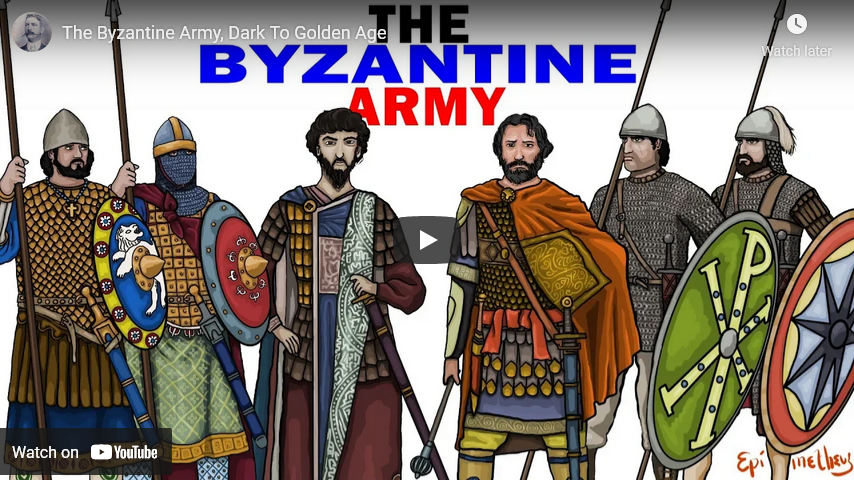
How the Roman Army Became the Byzantine Army
Kings and Generals
Published 2 Mar 2021Video is Sponsored by Ridge Wallet: https://www.ridge.com/KINGSANDGENERALS Use Code “
KINGSANDGENERALS” for 10% off your order!The Kings and Generals animated historical documentary series on the evolution of the Roman Army continues with the first episode of the series on the Army of the Eastern Roman Empire — the Byzantine Empire. In this episode, we’ll mainly focus on how the Roman army was transformed into the Byzantine army and talk about the armies of Justinian and Belisarius described by Procopius.
Support us on Patreon: http://www.patreon.com/KingsandGenerals or Paypal: http://paypal.me/kingsandgenerals. We are grateful to our patrons and sponsors, who made this video possible: https://docs.google.com/document/d/1o…
The video was made by our Arb Paninken http://bit.ly/2Ow3oC8, while the script was developed by Leo Stone. This video was narrated by Officially Devin (https://www.youtube.com/user/OfficiallyDevin)
✔ Merch store ► teespring.com/stores/kingsandgenerals
✔ Podcast ► Google Play: http://bit.ly/2QDF7y0 iTunes: https://apple.co/2QTuMNG
✔ Twitter ► https://twitter.com/KingsGenerals
✔ Instagram ► http://www.instagram.com/Kings_GeneralsProduction Music courtesy of Epidemic Sound: http://www.epidemicsound.com
#Documentary #Byzantines #Romans
March 1, 2021
Why the Bronze Age Collapse matters today. Dr. Eric Cline (If Civilization Collapsed Would We Know?)
Study of Antiquity and the Middle Ages
Published 13 Jun 2020Ladies and Gentlemen we arrive finally to the part of our series that you have all been waiting for! And that is the Bronze Age Collapse and here to guide us through it is none other than Dr. Eric Cline, the rock star archaeologist, historian and author of none other than 1177 BC!
He will give us an overview history of the collapse along with sharing his own personal views on the subject! Guiding us briefly through archaeology, trade, national politics, and contact in the ancient Mediterranean we will get a nice picture of the Bronze Age and how it all came crashing down in a perfect storm of events. But what is ever more awesome is he even gives us the inside scoop on why he wrote 1177 BC? And how he did it!
But at the end of this episode we come to our modern world and Dr. Cline explains why the Bronze Age Collapse matters today. What we need to look at when comparing it to our modern world and the current events and impacts affecting our world. Did the peoples living through the Bronze Age Collapse know they were living in a collapse? And he asks a delicate and intense question and that is if civilization collapsed today would we know?
Check out our new store! teespring.com/stores/the-history-shop
Support Dr. Eric Cline at the links below!
Personal web page: https://ehcline.com
Get all of his books here at his Amazon Author page:
https://www.amazon.com/s?i=stripbooks…GW pages:
https://cnelc.columbian.gwu.edu/eric-…https://anthropology.columbian.gwu.ed…
https://gwu.academia.edu/EricCline
Image credits: Manna Nader, Gabana Studios Cairo
Hittite 3D City and intro footage credits: 3D reconstruction of Imperial Hittite Karkemish by Giampaolo Luglio, Turco-Italian Archaeological Expedition to Karkemish directed by Nicolò Marchetti (University of Boologna)
KARKEMISH (Carchemish) 1300 BC (3D) – The Southern Capital of the Empire Hittite
Music Attribution: Herknungr – Megaliths | Dark Neolithic Meditive Shamanic Ambient Music https://youtu.be/oc8FQwNjPu0
February 26, 2021
QotD: “What have the Romans ever done for us?”
REG: They’ve bled us white, the bastards. They’ve taken everything we had, and not just from us, from our fathers, and from our fathers’ fathers.
LORETTA: And from our fathers’ fathers’ fathers.
REG: Yeah.
LORETTA: And from our fathers’ fathers’ fathers’ fathers.
REG: Yeah. All right, Stan. Don’t labour the point. And what have they ever given us in return?!
XERXES: The aqueduct?
REG: What?
XERXES: The aqueduct.
REG: Oh. Yeah, yeah. They did give us that. Uh, that’s true. Yeah.
COMMANDO #3: And the sanitation.
LORETTA: Oh, yeah, the sanitation, Reg. Remember what the city used to be like?
REG: Yeah. All right. I’ll grant you the aqueduct and the sanitation are two things that the Romans have done.
MATTHIAS: And the roads.
REG: Well, yeah. Obviously the roads. I mean, the roads go without saying, don’t they? But apart from the sanitation, the aqueduct, and the roads–
COMMANDO: Irrigation.
XERXES: Medicine.
COMMANDOS: Huh? Heh? Huh…
COMMANDO #2: Education.
COMMANDOS: Ohh…
REG: Yeah, yeah. All right. Fair enough.
COMMANDO #1: And the wine.
COMMANDOS: Oh, yes. Yeah…
FRANCIS: Yeah. Yeah, that’s something we’d really miss, Reg, if the Romans left. Huh.
COMMANDO: Public baths.
LORETTA: And it’s safe to walk in the streets at night now, Reg.
FRANCIS: Yeah, they certainly know how to keep order. Let’s face it. They’re the only ones who could in a place like this.
COMMANDOS: Hehh, heh. Heh heh heh heh heh heh heh.
REG: All right, but apart from the sanitation, the medicine, education, wine, public order, irrigation, roads, a fresh water system, and public health, what have the Romans ever done for us?
XERXES: Brought peace.
REG: Oh. Peace? Shut up!
Monty Python’s Life of Brian, 1979.
February 25, 2021
QotD: Islam and the impact of the Enlightenment
In private, however, or when addressing his soldiers, Napoleon was contemptuous of the Islamic word. “You have come to this country,” he told his army before the battle of the Pyramids, “to save the inhabitants from barbarism, and to bring civilisation to the Orient.” This was why, in addition to muskets, cannon and cavalry, he had brought with him to Egypt a printing press, a hot-air balloon and a small army of intellectuals.
The blaze of the Enlightenment, although it might seem to have been lit in Europe, was not just for Europeans. All the world had the potential to share in its radiance. Illumination was the same wherever it manifested itself, and this meant that in Peking as in Paris, in Baghdad as in Bordeaux, there were sages more than qualified to rank alongside Voltaire and Diderot.
The Enlightenment, far from ranking as something parochial and culturally contingent, was properly a global phenomenon. These various dogmas, which the philosophes had tended to take for granted, had then been given a new and militant edge by the French Revolution. That religion was superstition; that rights were universal; that equality, individual liberty and freedom of expression were simultaneously natural and sacred: these were the convictions that had inspired in the citizens of revolutionary France their continent-shaking sense of certitude. Thrones had been toppled; abbeys demolished; the detritus of a benighted past erased. And if in Europe, then why not further afield? The Rights of Man were for everyone, after all, or they were nothing. “Any law that violates them,” as Robespierre had put it, “is fundamentally unjust and tyrannical. Indeed, it is not law at all.”
This sense of missionary purpose, which inspired in those who felt it an ambition to bring the entire world from darkness into light, outlasted the execution of Robespierre, the defeat of Napoleon, the seeming triumph of reaction across post-revolutionary Europe. In 1854, when the Ottoman Empire was facing a critical threat from Russia, France joined Britain in insisting as a condition of its entry into the Crimean War that the slave trade across the Black Sea be abolished.
Also abolished was the jizya, a tax on Jews and Christians that reached back to the very beginnings of Islam, and was directly mandated by the Qur’an. Such measures, to the Ottomans, risked immense embarrassment. The effect, after all, was to reform Islamic jurisprudence according to the standards of non-believers. It was, for Muslim traditionalists, an ominous straw in the wind. Over the course of the century and more that followed, the weathering effects of Western hegemony on the practices that Muslims believed they had inherited from Muhammad — the Sunnah — became more and more pronounced.
Tom Holland, “The age-old tension between Islam and France”, UnHerd, 2020-11-02.
February 11, 2021
The Zionism of Albert Einstein | BETWEEN 2 WARS: ZEITGEIST! I E.11 – Spring 1921
TimeGhost History
Published 10 Feb 2021Albert Einstein may be renowned for his work in the field of science, but this season he is fundraising for a new Jewish university. Charity isn’t the only activity on the cards in the United States this season however, much more tragic events are also afoot …
Join us on Patreon: https://www.patreon.com/TimeGhostHistory
Hosted by: Indy Neidell
Written by: Francis van Berkel
Director: Astrid Deinhard
Producers: Astrid Deinhard and Spartacus Olsson
Executive Producers: Astrid Deinhard, Indy Neidell, Spartacus Olsson, Bodo Rittenauer
Creative Producer: Maria Kyhle
Post-Production Director: Wieke Kapteijns
Research by: Francis van Berkel
Image Research by: Daniel Weiss
Edited by: Daniel Weiss
Sound design: Marek KamińskiColorizations:
– Daniel Weiss – https://www.facebook.com/TheYankeeCol…
– Dememorabilia – https://www.instagram.com/dememorabilia/
– Daniel HassSources:
Some images from the Library of CongressFrom the Noun Project:
– Death by Adrien Coquet
– Ukraine by Lluisa Iborra, ES
– Immigrants by Luis Prado
– sun by MRFA
– Wine by Made
– orange By lieuchien, SG
– Champagne By Pete BakerSoundtracks from Epidemic Sound and ODJB
– “One More for the Road” – Golden Age Radio
– “Dawn Of Civilization” – Jo Wandrini
– “London” – Howard Harper-Barnes
– “Ominous” – Philip Ayers
– “Prescient” – Howard Harper-Barnes
– “Not Safe Yet” – Gunnar Johnsen
– “Document This 1” – Peter Sandberg
– “Growing Doubt” – Wendel Scherer
– “Tiger Rag” – ODJB
– “It’s Not a Game” – Philip AyersArchive by Screenocean/Reuters https://www.screenocean.com.
A TimeGhost chronological documentary produced by OnLion Entertainment GmbH.
From the comments:
TimeGhost History
2 days ago
In the year that Buck’s Fizz is born, the USA promises to be a hotbed of funding for Albert Einstein. But for the nation’s black population, this season will brutally prove that the USA is still lightyears from any semblance of racial equality. Further highlighting this racial inwardness will be legislation to curb immigration. Clearly, America is still a long way from being the Land of the Free.Raunchy literature, Broadway and Buck’s Fizz will also make an appearance this season, tune in to find out how!
February 9, 2021
History Summarized: Alexander the Great
Overly Sarcastic Productions
Published 19 Sep 2017Linguistically speaking, Alexander means “Defender of Men” from the Greek “alexo“, defend, and “aner/ander“, man. I’ll never be able to not internally think of his name as just meaning “Alex-Man”.
Oh, yeah, also he conquered an empire or something? IDK. I stopped paying attention after his bland name.
PATREON: www.patreon.com/OSP
MERCH LINKS:
Shirts – https://overlysarcasticproducts.threa…
All the other stuff – http://www.cafepress.com/OverlySarcas…Find us on Twitter @OSPYouTube!
February 3, 2021
Fatah demands that Britain return Big Ben to its original Jerusalem home
Daniel Greenfield unravels the historical misconceptions that informed the demand:

“Big Ben” by kev_zilla is licensed under CC BY-NC-ND 2.0
“The Jerusalem Clock is hidden in London today,” Fatah, the political movement behind the PLO and the Palestinian Authority, asserts in a post titled, “Jerusalem Stolen Clock”.
It goes on to claim that the British military ordered the clock tower dismantled. Then the “British moved the clock first to a new tower across from the municipality of Jerusalem, and transferred it to the British Museum in London, to become the famous British icon, ‘Big Ben’.”
How did Big Ben, which was built in 1859, become a Muslim clock tower from the 20th century?
There are some other slight differences between London’s Big Ben and the “stolen clock” such as the fact that Big Ben is 316 feet tall while the “Palestinian” clock tower was only 42 feet.
But the story of the “Palestinian clock” is also the story of the entire myth of “Palestine”.
When you believe that the Jerusalem of King David and King Solomon was originally yours, you can just as easily believe that London’s Big Ben was originally the property of “Palestine”.
The “Palestinian clock” is as real as “Palestine”. The myth of a “Palestinian” people propounded by Fatah which has spent decades killing over it is also the story of the “Palestinian clock”.
There’s no more of a “Palestinian” people who were dispossessed by the Jews than Big Ben is a “Palestinian” clock stolen and passed off as London’s Big Ben. Both are fake history built out of resentments and garbled stories whose context has been lost, but whose hatreds remain real.
There were never any Palestinians. When the clock was built the region had been part of the Ottoman Empire, the last Caliphate until ISIS. The caliphates had settled it with Arab Muslim clans who dominated Christian refugees fleeing Muslim persecution, along with groups of other minorities from escaped slaves to gypsies, along with the indigenous Jewish population.
The Ottomans had become obsessed with clock towers as a symbol of their empire. But the Ottomans hadn’t invented them, they had adopted them from Europe, and planted them in major cities of the empire to create a common sense of time and belonging for their subjects.
Sultan Abdul Hamid II, the last real sultan of the empire, obsessively erected clock towers to show off how modern the Ottoman Empire was. But by then the Empire was anything but modern and Hamid’s clock tower craze was powered by his German allies. Kaiser Wilhelm II gave Hamid a batch of clocks at the turn of the century which the Turks put into clock towers.
The Ottoman Empire erected some of its clock towers in Israel. These clock towers utilized the talents and funds of the indigenous Jewish and the Arab Muslim settler population. The clock tower projects in Israel began in 1901 which is also the date when Wilhelm sent Hamid a whole bunch of clocks. One of these clock towers was stuck on Jerusalem’s Jaffa Gate which Hamid had previously cut a hole in so that the Kaiser could enter Jerusalem in his tall plumed helmet.
H/T to Kate at SDA for the link.