
World War Two
Published Mar 8, 2024In March 1945, the first Jewish unit in the Allied forces reaches the frontline. Before fighting the Nazis, the men spent years battling against the policies of the British government. After the war, they will take vengeance on the perpetrators of the Holocaust and join the Zionist movement in building and fighting for Israel.
(more…)
March 9, 2024
The Jewish Avengers Who Hunted Nazi Murderers
Comments Off on The Jewish Avengers Who Hunted Nazi Murderers
March 6, 2024
QotD: Mansa Musa’s disastrous foreign aid to Cairo
Mansa Musa’s good intentions may be the first case in history of failed foreign aid. Known as the “Lord of the Wangara Mines”, Mansa Musa I ruled the Empire of Mali between 1312 and 1337. Trade in gold, salt, copper, and ivory made Mansa Musa the richest man in world history.
As a practicing Muslim, Mansa Musa decided to visit Mecca in 1324. It is estimated that his caravan was composed of 8,000 soldiers and courtiers — others estimate a total of 60,000 — 12,000 slaves with 48,000 pounds of gold and 100 camels with 300 pounds of gold each. For greater spectacle, another 500 servants preceded the caravan, and each carried a gold staff weighing between 6 and 10.5 pounds. When totaling the estimates, he carried from side to side of the African continent approximately 38 tons of the golden metal, the equivalent today of the gold reserves in Malaysia’s central bank — more than countries like Peru, Hungary or Qatar have in their vaults.
On his way, the Mansa of Mali stayed for three months in Cairo. Every day he gave gold bars to the poor, scholars, and local officials. Mansa’s emissaries toured the bazaars paying at a premium with gold. The Arab historian Al-Makrizi (1364-1442) relates that Mansa Musa’s gifts “astonished the eye by their beauty and splendor”. But the joy was short-lived. So much was the flow of golden metal that flooded the streets of Cairo that the value of the local gold dinar fell by 20 percent and it took the city about 12 years to recover from the inflationary pressure that such a devaluation caused.
Orestes R Betancourt Ponce de León, “5 Historic Examples of Foreign Aid Efforts Gone Wrong”, FEE Stories, 2021-06-06.
March 3, 2024
March 2, 2024
QotD: Early siege warfare
In many ways the choice of where to begin following that process of evolution is arbitrary. We could in theory start anywhere from the very distant past or only very recently, but in this case I think it makes sense to begin with the early Near Eastern iron age because of the nature of our evidence. While it is clear that siege warfare must have been an important part of not only bronze age warfare but even pre-bronze age warfare, sources for the details of its practice in that era are sparse (in part because, as we’ll see, siege warfare was a sort of job done by lower status soldiers who often didn’t figure much into artwork focused on royal self-representation and legitimacy-building).
But as we move into the iron age, the dominant power that emerges in the Near East is the (Neo-)Assyrian Empire, the rulers of which make a point of foregrounding their siegecraft as part of a broader program of discouraging revolt by stressing the fearsome abilities of the Assyrian army (which in turn had much of its strength in its professional infantry). Consequently, we have some very useful artistic depictions of the Assyrian army doing siege work and at the same time some incomplete but still very useful information about the structure of the army itself. Moreover, it is just as the Assyrian Empire’s day is coming to a close (collapse in 609) that the surviving source base begins to grow markedly more robust (particularly, but not exclusively, in Greece), giving us dense descriptions of siege work (and even some manuals concerning it) in the following centuries, which we can in turn bring to the Assyrian evidence to better understand it. So this is a good place to start because it is the earliest point where we are really on firm ground in terms of understanding siegecraft in some detail. This does mean we are starting in medias res, with sophisticated states already using complex armies to assault fairly complex, sophisticated fortifications, which is worth keeping in mind.
That said, it should be noted that this is hardly beginning at the beginning. The earliest fortifications in most regions of the world were wooden and probably very simple (often just a palisade with perhaps an elevated watch-post), but by the late 8th century, well-defended sites (like walled cities) already sported sophisticated systems of stone walls and towers for defense. That caveat is in turn necessary because siegecraft didn’t evolve the same way everywhere: precisely because this is a system of antagonistic co-evolution it means that in places where either offensive or defensive methods (or technologies) took a different turn, one can end up with very different results down the line (something we’ll see especially with gunpowder).
Bret Devereaux, “Collections: Fortification, Part I: The Besieger’s Playbook”, A Collection of Unmitigated Pedantry, 2021-10-29.
Comments Off on QotD: Early siege warfare
February 27, 2024
Greek History and Civilisation, Part 4 – The Ancient Greeks: The Great Invasion
seangabb
Published Feb 18, 2024This fourth lecture in the course deals with the Persian invasion of Greece in 480 BC, ending with the glory of Thermopylae and the burning of Athens.
(more…)
Comments Off on Greek History and Civilisation, Part 4 – The Ancient Greeks: The Great Invasion
February 21, 2024
Greek History and Civilisation, Part 3 – The Ancient Greeks: Rising Tensions with Persia
seangabb
Published Feb 18, 2024This third lecture in the course deals with the rise of the Persian Empire, and the growing tensions between the Persians and the Greeks, culminating in an account of the Battle of Marathon in 490 BC.
(more…)
Comments Off on Greek History and Civilisation, Part 3 – The Ancient Greeks: Rising Tensions with Persia
February 15, 2024
Israel as an “Eschatological Garrison State”
Big Serge outlines why Israel was compelled by its geostrategic position to react as strongly as possible to the October 7th atrocities along the southern border with Gaza:
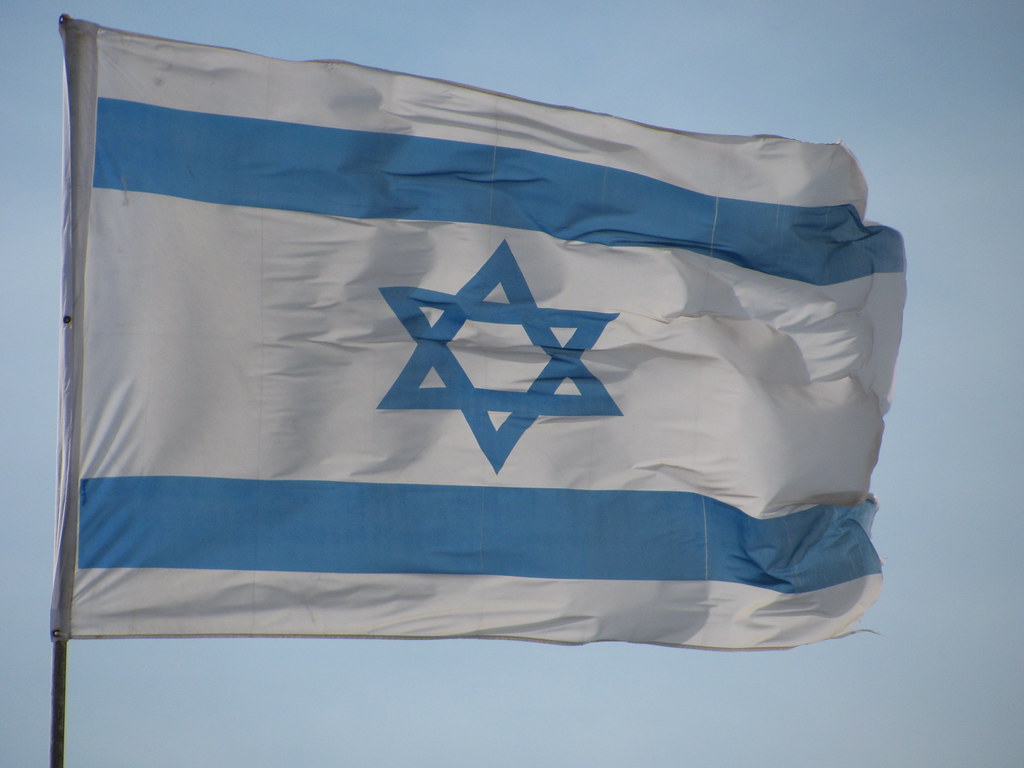
“Israeli flag, Tel Aviv, Star of David” by Tim Pearce, Los Gatos is licensed under CC BY 2.0 
 .
.
It is almost impossible to find a dispassionate analysis of the Israeli-Arab conflict, simply because it sits directly upon a concatenation of ethno-religious fault lines. Palestinians are the object of concern for many of the world’s nearly two billion Muslims, particularly in the Arab world, who tend to view Gaza’s suffering and humiliation as their own. Israel, on the other hand, is a subject of rare agreement between American evangelicals (who believe that the nation state of Israel has relevance to Armageddon and the fate of Christianity) and the more secular American governing blob, which treats Israel as an American outpost in the Levant. To this, we can add the emerging religion of anti-colonialism, which views Palestine as something like the next great liberation project, akin to ending apartheid in South Africa or Gandhi’s campaign for Indian independence.
My goal is not to convince any of the aforementioned people that their views are wrong, per se. Instead, I would like to argue that, despite these many powerful emotional-religious currents, much of the Israeli-Arab conflict can be understood in fairly mundane geopolitical terms. Despite the enormous psychological stakes that billions of people have in the subject matter, it still unfolds itself to a relatively dispassionate analysis.
The root of the problems lay in the peculiar nature of the Israeli state. Israel is not a normal country. By this, I mean neither that it is a special, providential country (as an American evangelical might say), nor that it is a uniquely wicked root of all evil. Rather, it is extraordinary in two important ways that relate to its function and geopolitical calculus, rather than its moral content.
First, Israel is an Eschatological Garrison State. This is a particular form of state which perceives itself as a sort of redoubt against the end of all things, and accordingly becomes highly militarized and highly willing to dispense military force. Israel is not the only such state to have existed in history, but it is the only obvious one extant today.
A historical comparison may help explain. In 1453, when the Ottoman Empire at last overran Constantinople and brought an end to the millennia-old Roman imperium, early medieval Russia found itself in a unique position. With the fall of the Byzantines (and the previous schism with western papal Christianity), Russia was now the only Orthodox Christian power remaining in the world. This fact created a sense of world-historic religious siege. Surrounded on all sides by Islam, Roman Catholicism, and Turko-Mongol Khanates, Russia became a prototypical Eschatological Garrison State, with a high degree of cooperation between Church and State and an extraordinary level of military mobilization. The character of the Russian state was indelibly formed by this sense of being besieged, of being the last redoubt of authentic Christianity, and the consequent need to extract a high volume of manpower and taxes to defend the garrison state.
Israel is much the same, though its sense of eschatological terror is of a more ethno-religious sort. Israel is the only Jewish state in the world, founded in the shadow of Auschwitz, besieged on all sides by states with which it has fought several wars. Whether this justifies the kinetic aspects of Israeli foreign policy is not the point. The simple fact is that this is Israel’s innate self conception. It is an eschatological redoubt for a Jewish population that sees itself as having nowhere else to go. If one refuses to acknowledge the central Israeli geopolitical premise — that they would do anything to avoid a return to Auschwitz — one will never make sense of their actions.
January 31, 2024
The rise of the “Technical”
Kulak at Anarchonomicon considers the innovation and adaptability that Chad’s ragtag forces displayed in the late 1980s to drive Libyan forces out of their territory, specifically the military use of Toyota pickup trucks as improvised gun carriages:
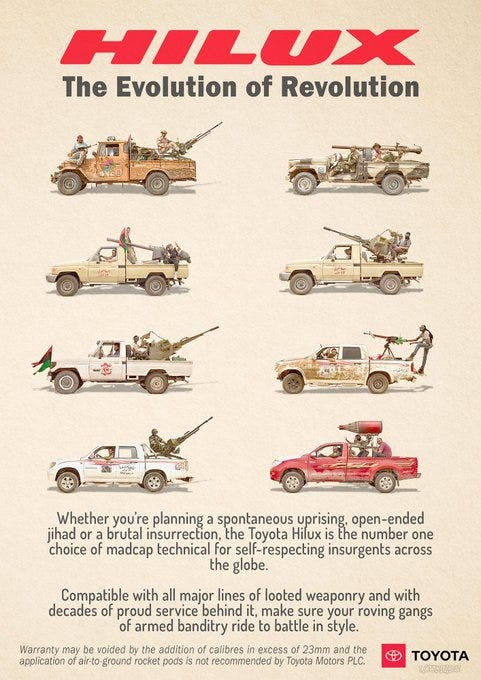
The Great Toyota War of 1987 was the final phase of the Chadian-Libyan conflict. Gadhafi’s Libyan forces by all rights should have dominated the vast stretches of desert being fought over: the Chadian military was less than a 3rd the size of the Libyan, and the Libyans were vastly better equipped fielding hundreds of tanks and armored personnel carriers, in addition to dozens of aircraft … to counter this the Chadians did something unique … They mounted the odds and ends heavy weapons systems they had in the truck beds of their Toyota pickups, and using the speed and maneuverability of the Toyotas, managed to outperform Libya’s surplus tanks and armored vehicles. By the end of the Chadian assault to retake their northern territory, the Libyans had suffered 7500 casualties to the Chadians 1000, with the Libyan defeat compounded by the loss of 800 armored vehicles, and close to 30 aircraft captured or destroyed.
The maneuverability and speed of the pickups made them incredibly hard to hit, and the tanks in particular struggled to get a sight picture … strafing within a certain range the pickups moved faster across the horizon than the old soviet tanks’ main gun could be hand cranked around to shoot them.
Since then Technology has become the backbone of insurgencies, militias, poorer militaries, and criminal cartels around the world. The ready availability of civilian pickups, with the ability of amateur mechanics to mount almost any weapon system in their truck-bed means that this incredibly simple system is about the most cost-effective and easy way for a small force to make the jump to mounted combat and heavy weapon.
But these weapons are far less asymmetric than motorcycles. The increasing importance of mobility means even the most advanced armies are getting in on the game. The US Army is currently converting a portion of its Humvees to have their rear seat and trunk cut out for a truck bed so that they can run a mobile light artillery out of it:
Popular Mechanics article – https://www.popularmechanics.com/military/weapons/a28288/hawkeye-humvee-mounted-howitzer/
The importance of instant maneuverability far outstretches any advantage armor can give in this application. Since artillery shells are radar-detectable, and, follow a parabolic arc, their origin point is easily calculable. Thus shoot and Scoot tactics are necessary since it may only be a minute or two from firing a volley that counter artillery fire might be inbound.
Aside from The bemused jokes that the US is finally catching up with the tech Chad had in the 80s, The truth is most advanced forces have always had something light with a heavy gun that can travel at highway speeds … the fact the US is now converting Humvees to have full light artillery pieces is only really a continuation of the trend of semi-auto grenade launchers, TOW missiles, or anti-tank guns being placed on light fast vehicles since WW2.
The remarkable thing about the technical isn’t that they’re some unique capability militaries can’t use … most poorer countries field something equivalent (the Libyans seemed to have screwed up the unit composition of their force) … Rather the unique advantage is how easy and cheap they are for non-conventional or poorer forces to home assemble.
US combat-ready Humvees cost the military into the hundreds of thousands of dollars, a cost that is presumably even higher as they’re modified to carry heavy weapons systems.
As ridiculous as a Toyota with an Air-to-Ground rocket pod, or a repurposed anti-air gun might be, they’re cheap. The pickup truck new is $20,000-50,000, though I suspect any irregular force would pay closer to 1000-5,000 for something decades old, if they pay at all. Likewise, they’re trivial to source, which is good if sanctions or anti-money laundering laws are trying to stop you from buying anything, and as the Chadians proved: pretty much any captured or surplus heavy weapon will go on it.
This gets irregular forces into the mounted combat game … but it does slightly more than that. Pickup trucks, as any perturbed Prius driver will tell you, are shockingly common … perhaps one in 10 or more vehicles out there are some form of pickup truck. This not only makes them easy to source, but it disguises them and allows them to operate hidden amongst the rolling stock of civilian vehicles, requiring either visual identification or extensive intelligence work to tell them from mere civilians.
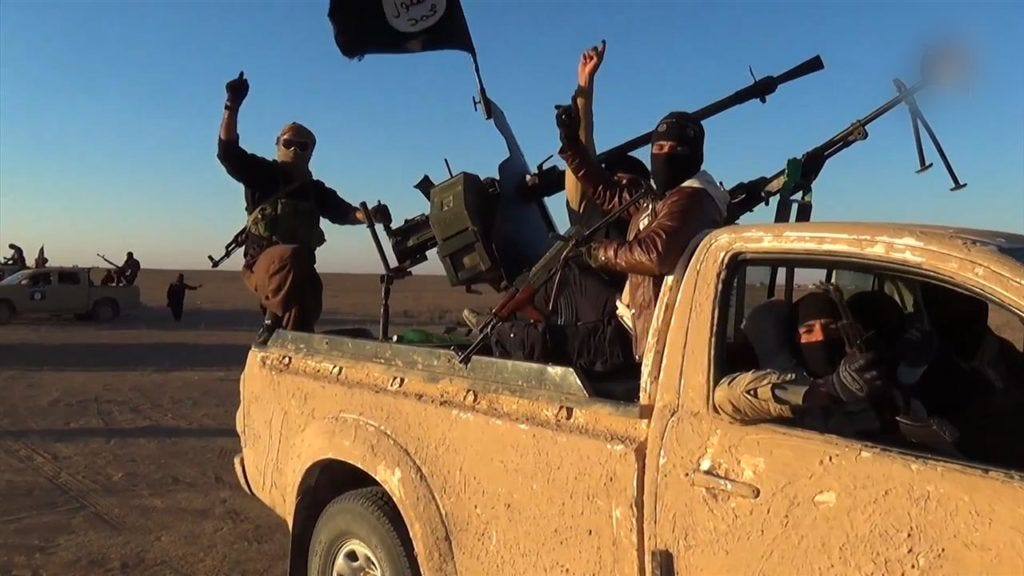
ISIS forces near Mosul shortly after its fall.
This combination of mobility, resemblance to civilian vehicles, and ability to deploy heavy weapons was used to devastating effect by the Islamic State during the 2014 Fall of Mosul. Striking quickly while Iraqi national tanks were deployed elsewhere the small Islamic force entered the city at 2:30 am, striking in small convoys that overwhelmed checkpoints with their firepower, executing and torturing captured Iraqi soldiers and targeted enemies as they went. Even after taking into account desertions and “ghost soldiers” (fake soldiers meant to pad unit numbers so corrupt officials could collect their pay) which significantly reduced the 30,000 Iraqi army and 30,000 police within the city … Even after allowing for all that, the Iraqi national forces still outnumbered the 800-1500 ISIS fighters at a rate of 15 to 1.
YET ISIS was able to achieve a total victory and take the whole of the city within 6 days.
2 years later it would take the Iraqi government with American backing 9 months to retake it.
How? How does a force of 1500 at most, most without any formal training, overwhelm and defeat a force of 12,000-23,000, which at least has some training, better equipment, and has an entire state behind it? How did ISIS do this entirely without air support? Even as the Iraqi government bombed them from helicopters?
How did they take in 6 days what would take the Iraqi government with full American backing 9 months to retake?
Well, they made the Iraqis break and run.

Comments Off on The rise of the “Technical”
January 30, 2024
York University’s CUPE local apparently cribs their homework from the Völkischer Beobachter
York University’s contract and part-time instructors are represented by CUPE local 3903, who’ve distributed an eye-openingly anti-semitic document with the (implied) order to interrupt normal tutorials and replace the content with Palestinian propaganda:
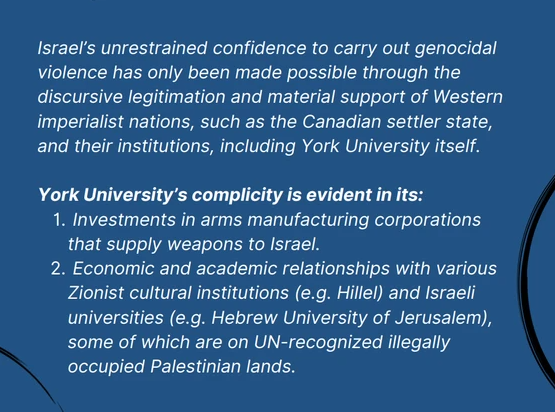
Detail from an official “toolkit” distributed to York University contract and part-time faculty which claims that their employer is complicit in “genocide” by the mere tolerance of Jewish groups on campus.
Photo by A Toolkit on Teaching Palestine
A new toolkit circulated to York University teaching assistants instructs them to denounce Israel at every available opportunity, even when it has no apparent relevance to the subject being studied.
“Let us collectively divert this week’s tutorials to teaching on Palestinian liberation,” reads the 15-page document circulated by CUPE 3903, the union representing York’s contract and part-time faculty.
The document adds that tutorials should be diverted to condemnations of the “Zionist Israeli state” regardless of the course that the TA is supposed to be discussing.
“It is a medical issue. An arts issue. A feminist issue. A society issue. A political issue. A cultural issue. A geography issue. An engineering issue. An architecture issue,” it reads.
The document is filled with claims denouncing Israel as a genocidal “colonial project”. Canada is treated much the same, and is referred to alternately as the “Canadian settler state” or “Turtle Island”.
The mere presence of Jewish groups on campus is also referred to as evidence of York University’s “complicity” in genocide.
The document denounces the existence of sanctioned “Zionist cultural institutions”, making explicit reference to Hillel, the world’s go-to Jewish campus organization. York is also called an accessory to genocide because of its research links with the Hebrew University of Jerusalem.
The pamphlet even provides a script for TAs to read as they inform students that the tutorial will be cancelled in favour of becoming a “teach-in … for liberation.”
“Today, I open up our classroom to bring our attention on Gaza, to speak up and stand in solidarity with the Palestinian liberation movement, and contribute in ending Canada’s and York’s complicity with genocide and the settler-colonial occupation of Palestinian land and life,” reads one introductory line.
Comments Off on York University’s CUPE local apparently cribs their homework from the Völkischer Beobachter
January 19, 2024
Those passionate Houthi and the Blowfish fans
Chris Selley wonders why the rest of the Canadian legacy media are being so careful to proactively curate and “contextualize” the violent and hateful message of the pro-Hamas and pro-Houthi protesters in our cities:

The Houthi Ansarullah “Al-Sarkha” banner. Arabic text:
الله أكبر (Allah is the greatest)
الموت لأمريكا (death to America)
الموت لإسرائيل (death to Israel)
اللعنة على اليهود (a curse upon the Jews)
النصر للإسلام (victory to Islam)
Image and explanatory text from Wikimedia Commons.
The record will show I had little sympathy for the Ottawa convoy crowd, especially once they had made their point and refused to go away. You can’t occupy the downtown of a G7 capital for a month. Sorry, you just can’t.
At the same time, I cringed at the media’s fevered attempts to cast the entire crowd as neo-Nazi oafs, based on what seems to have been two observed flags — one Confederate, one Nazi.
I recalled this while watching video footage of protesters in Toronto over the weekend chanting “Yemen, Yemen, make us proud! Turn another boat around!” Because the Houthis, who control Yemen’s Red Sea coast and have been waging war on commercial shipping, are about as neo-Nazi as it gets in the world nowadays.
The movement’s official slogan: “Allahu Akbar! Death to America! Death to Israel! Curse the Jews! Victory for Islam!” As if to drive home the point, there is ample video evidence of Houthi fighters chanting that slogan with their hands raised skywards in a Nazi salute.
The Houthis use child soldiers (as video evidence also makes horrifyingly plain). They are literally slavers. I have seen it suggested, by way of context, that they really don’t have that many slaves. Just a few slaves. It’s so hard to get good help.
But I haven’t seen anyone try to “contextualize” the Houthi slogan, the way Palestinian supporters will tell you “from the river to the sea” isn’t a call for Israel’s destruction and cheering for “intifada” doesn’t mean further terrorist attacks against Jews. Perhaps it’s just too big a job for even the most dedicated and creative of apologists.
Outside of the Postmedia empire, so far as I can see, not a single Canadian media outlet has seen fit to mention the chanting in Toronto streets in support of a rabidly antisemitic death cult. You can read several articles, however, about how Canadian media are terribly biased against the Palestinian cause. It’s ludicrous.
A nice little illustration, as the National Post‘s Tristin Hopper noted in November: When the convoy crowd appropriated Terry Fox’s statue, just opposite Parliament Hill, for their “mandate freedom” message, the Laurentian bubble nearly burst with righteous fury. When pro-Palestinian protesters draped a keffiyeh over Fox’s shoulders and had their kids pose with him, there was all but total silence.
Of course, flamboyant media double-standards aren’t the worst of our problems.
Comments Off on Those passionate Houthi and the Blowfish fans
January 13, 2024
History RE-Summarized: The Byzantine Empire
Overly Sarcastic Productions
Published 29 Sept 2023The Byzantines (Blue’s Version) – a project that took an almost unfathomable amount of work and a catastrophic 120+ individual maps. I couldn’t be happier.
SOURCES & Further Reading:
“Byzantium” I, II, and III by John Julius Norwich, The Byzantine Republic: People and Power in New Rome by Anthony Kaldellis, The Alexiad by Anna Komnene, Osman’s Dream: The History of the Ottoman Empire by Caroline Finkel, Sicily: An Island at the Crossroads of History by John Julius Norwich, A History of Venice by John Julius Norwich. I also have a degree in classical civilization.Additionally, the most august of thanks to our the members of our discord community who kindly assisted me with so much fantastic supplemental information for the scripting and revision process: Jonny, Catia, and Chehrazad. Thank you for reading my nonsense, providing more details to add to my nonsense, and making this the best nonsense it can be.
(more…)
Comments Off on History RE-Summarized: The Byzantine Empire
January 10, 2024
The problem of engaging with “the great classical works”
The first book review for 2024 at Mr. and Mrs. Psmith’s Bookshelf is a look at Xenophon’s Education of Cyrus by John Psmith:
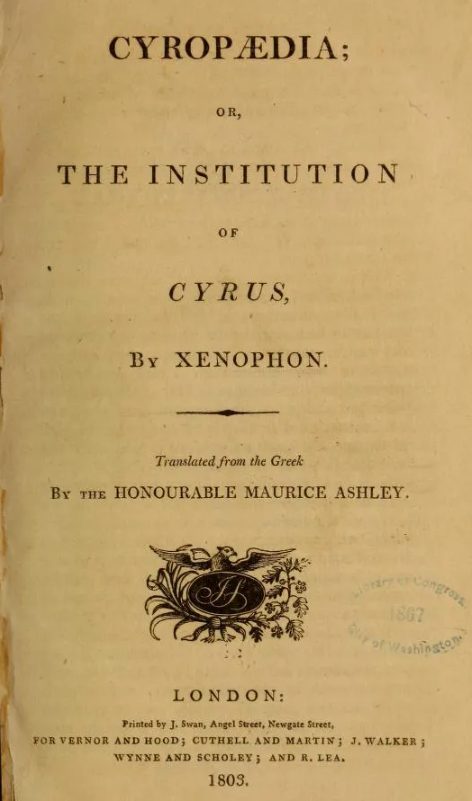
It is easier, given his nature, for a human being to rule all the other kinds of animals than to rule human beings. But when we reflected that there was Cyrus, a Persian, who acquired very many people, very many cities, and very many nations, all obedient to himself, we were thus compelled to change our mind to the view that ruling human beings does not belong among those tasks that are impossible … We know that Cyrus, at any rate, was willingly obeyed by some, even though they were distant from him by a journey of many days; by others, distant by a journey even of months; by others, who had never yet seen him; and by others, who knew quite well that they would never see him. Nevertheless, they were willing to submit to him.
I am not well-read in the classics. My excuse ultimately boils down to the same argument that all the classicists give for why you should be well-read in the classics: reading a book that has been widely admired for a very long time isn’t just reading a book, it’s entering into a “great conversation” taking place across the aeons. I feel awkward reading a book like that without knowing something about the commentaries on the book, all the people it has influenced, all the people who influenced it, the commentaries on the commentaries, and so on. It’s exhausting and overwhelming, and when I ignore all that and plunge ahead, I often don’t enjoy the book and then I feel dumb. A “great conversation” sounds nice, but only if you’re one of the participants and you actually get the inside jokes and references. Otherwise it’s as alienating and isolating as showing up to a party where you don’t know anybody, and where everybody else has already been chatting for a few thousand years.
I don’t remember who recommended Xenophon’s Cyropaedia to me or how it wound up on my reading list, but when it finally made its way to the top of my stack, I saw it and shuddered. How could I possibly appreciate this semi-fictionalized biography of the founder of the Persian Empire without first being familiar with Xenophon’s work as a mercenary for one of Cyrus the Great’s distant descendants? Or with all the ways he was riffing on and responding to the political philosophy of his frenemy Socrates? Or with the complicated politics of the Peloponnesian War, and the way that Xenophon, an Athenian exile and the original Sparta-boo, was actually writing PR for King Agesilaus II, but concealing it within a story about the exotic Persians?1 Or with how this book led to the creation of an entire major genre of books in the Middle Ages? Or with the most famous and subversive instance of that genre, Machiavelli’s The Prince, and with all the hundreds of subsequent works reacting and responding to that one?
You see the problem? One could very easily conclude that it would be impossible for me to appreciate this book. Fortunately, I ignored all that and read it anyway. No doubt I missed all kinds of subtle layers of meaning and nuance, but even read on a totally superficial level by an ignoramus, this book rocks.
The title has the word “education” in it, but the book covers Cyrus’s entire life and reign, and only the first section concerns his education in the literal sense. That first section is very important to what comes next, though, so I’m going to dwell on it a bit. Cyrus, along with the other Persian boys of his social class, is being trained to lead. And so their education is centered around having lots of opportunities to judge, instruct, and coerce others; but also opportunities to serve and obey. If you’re old enough, you might remember when the education of the American leadership class worked this way too, but even those of you who are younger have seen vestiges of it in the bizarrely disproportionate weight given to extracurriculars in US college admissions.
1. If you’re an American, then you’re already familiar with this trick. Most of our debates about the virtues and vices of other nations are just thinly-veiled attempts to “own” domestic political opponents.
Comments Off on The problem of engaging with “the great classical works”
January 5, 2024
Qatar’s Aggies
In The Free Press, Eli Lake discusses the deal between Texas A&M and the Qatari government that gives the Qatar Foundation — run by the Qatari royal family — full ownership of any intellectual property developed at the Qatari campus of the university:

Texas A&M’s Nuclear Engineering and Science Center in College Station, Texas.
Photo via Texas A&M
What does Qatar get for its investment in U.S. universities? The answer may surprise you. In addition to the prestige and the influence of affiliating one’s national philanthropy with elite schools, Qatar is also accumulating the kind of technical research that was once the prize of American universities.
Consider Texas A&M University, one of the best places in the country to study nuclear engineering. Last month, The Free Press obtained exclusive access to a copy of the latest contract between Texas A&M and the Qatar Foundation that shows all of the intellectual property developed at the university’s campus in Doha belongs to the Qatar Foundation, a national philanthropy owned by the country’s royal family.
“The Qatar Foundation shall own the entire right, title, and interest in all Technology and Intellectual Property developed at (Texas A&M University Qatar) or under the auspices of its Research Program, other than those developed by non-TAMUQ employees and without financial support from the Qatar Foundation or any of its affiliates,” says the contract, dated May 25, 2021.
This kind of arrangement is common for large research universities in America. But TAMUQ is not your ordinary university. It is entirely funded by the Qatar Foundation. Kelly Brown, a spokeswoman for Texas A&M, told me that Qatar “pays for all faculty and staff salaries” as well as the physical campus, labs and equipment, housing, transportation, and travel allowances for professors.
It’s no small matter. The intellectual property generated by Texas A&M University in Qatar, or TAMUQ, includes highly sensitive research in a variety of fields ranging from computer science to bioengineering. Last year, TAMUQ inked an agreement to develop projects with a subsidiary of Barzan Holdings, Qatar’s largest arms manufacturer.
Andre Conradie, the CEO of the joint venture between Barzan and Germany’s Rheinmetall, said at the time, “This partnership will encourage the development of technological and operational capabilities to enhance military protection.”
As one of the country’s premier schools in nuclear engineering, Texas A&M has access to two nuclear reactors in Texas not affiliated with the U.S. government. In December, the National Nuclear Security Administration renewed a contract for the university, along with the University of California and Battelle Memorial Institute, to manage the Los Alamos National Laboratory, which involves oversight of teams who design and maintain nuclear weapons for the U.S. government.
Comments Off on Qatar’s Aggies
December 13, 2023
“Harvard stands firmly behind President Claudine Gay”
 Chris Bray discusses the sure-to-be-continued saga of a plagiarist — who’s also a full-time water-carrier for terrorism — who happens (for the moment) to head
 HAMAS University Harvard University:
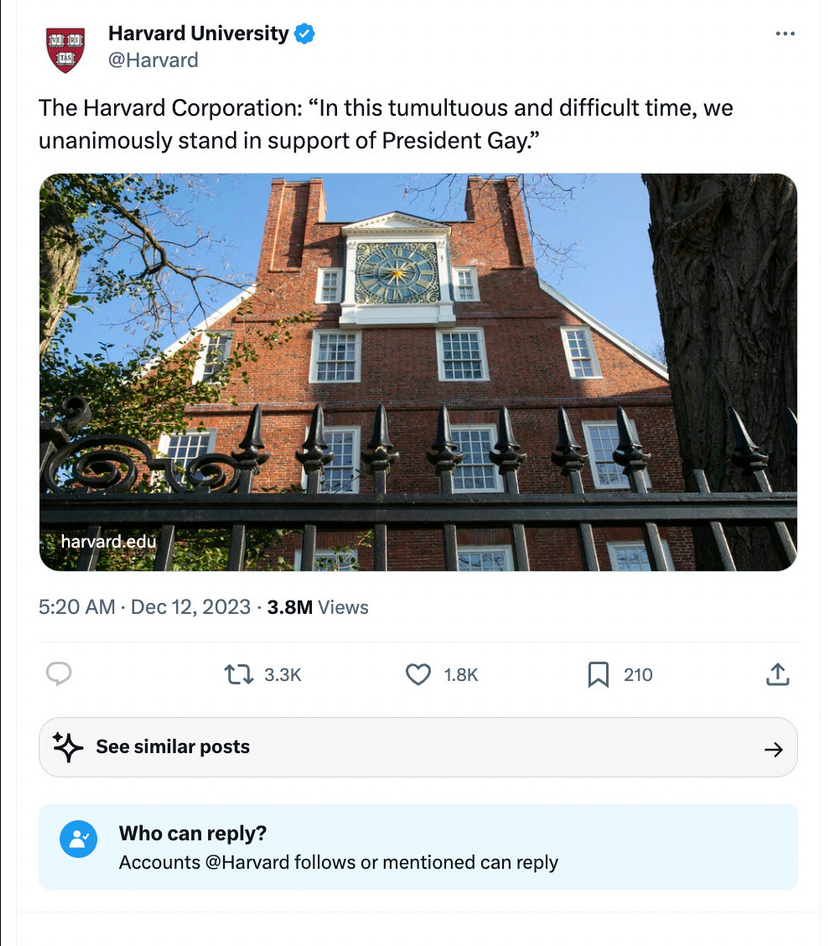
Harvard stands firmly behind President Claudine Gay, a remarkably undistinguished scholar and academic leader who has been lavishly overpraised and promoted beyond her ability for three decades. They do this, they have just explained, because Harvard is deeply committed to a culture of academic freedom, open discourse, and cultural pluralism:
In this tumultuous and difficult time, we unanimously stand in support of President Gay. At Harvard, we champion open discourse and academic freedom, and we are united in our strong belief that calls for violence against our students and disruptions of the classroom experience will not be tolerated. Harvard’s mission is advancing knowledge, research, and discovery that will help address deep societal issues and promote constructive discourse, and we are confident that President Gay will lead Harvard forward toward accomplishing this vital work.
And so here’s the tweet — I insist on still calling them tweets — in which Harvard announces that it has posted its public letter on its insistent promotion of open and constructive discourse:
We stand for open discourse! (Replies are closed.)
Coprophagiacs eat so much shit that it stops being shit, and just becomes the thing they eat. Every word of a statement from the enormously high-status trustees of an enormously high-status institution is just ludicrous. They self-refute, casually, without noticing.
Every day now, I think about a term that lawyers use: a colorable argument. If you have a colorable argument, you can file your lawsuit without being instantly thrown out of the courtroom. You may not have the winning argument, and you may not even have a really good argument, yet, but you have enough of an argument that you can start. Then, through the discovery process and with some luck and hard work, maybe you can build the actual winning argument. But for now, you have some not-totally-implausible factish claims, and you can more or less connect it all to a law of some kind, and you can walk into the courtroom without the judge bursting into laughter. You have a colorable argument; you have the bare minimum.
Look how much of the culture is made up of people who don’t have a colorable argument. Look how much total nonsense streams by.
Now, about those plagiarism allegations against the president of what is alleged to be one of the nation’s most prestigious universities:
With regard to President Gay’s academic writings, the University became aware in late October of allegations regarding three articles. At President Gay’s request, the Fellows promptly initiated an independent review by distinguished political scientists and conducted a review of her published work. On December 9, the Fellows reviewed the results, which revealed a few instances of inadequate citation. While the analysis found no violation of Harvard’s standards for research misconduct, President Gay is proactively requesting four corrections in two articles to insert citations and quotation marks that were omitted from the original publications.
She did absolutely nothing wrong, and that’s why she’s requesting corrections on 18% of her exceptionally thin scholarly record. No big deal, she’s just correcting “citations and quotation marks that were omitted”. Who omitted them? That’s the wrong question, see, because what happened is just that they “were omitted”. The quotation marks didn’t insert themselves. I demand that the quotation marks be denied tenure for wandering away from the page!
Comments Off on “Harvard stands firmly behind President Claudine Gay”
December 12, 2023
Canadian politics – if you don’t like something, call it some kind of “genocide”
Tristin Hopper on the political mis-use of the technical term “genocide”, to the point that it’s almost become routine to describe something you oppose as a “genocide”:
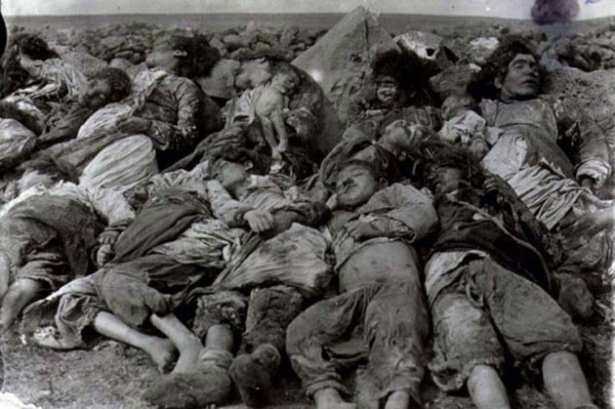
Victims of genocide
Photo by Cantetik2 via Wikimedia Commons.
In recent weeks, it’s become popular among Canada’s activist groups and even mainstream politicians to accuse Israel of “genocide”. In a since-deleted Thursday evening social media post, for one, NDP MP Don Davies accused Israel of “cultural genocide” against Palestinians. The United Church of Canada has also begun using the g-word in its official literature.
The charge doesn’t hold up on any material grounds. Unlike most genocided people, the Palestinian population has been soaring dramatically ever since the 1960s — all while retaining their traditional language and religion. Israel’s prosecution of its current conflict against Hamas, meanwhile, has featured any number of factors that are markedly out-of-step with an attempted genocide, including detailed evacuation orders and a rate of civilian casualties markedly lower than the global average.
But the charge doesn’t need to make sense, because it turns out Canada has been abusing the term “genocide” for quite some time. Coined amidst the Second World War by Polish lawyer Raphael Lemkin, “genocide” refers to the intentional destruction of an entire demographic of people.
While the most notable genocides involve systematized mass-murder, it’s not a requirement. As per the official definition struck in the immediate aftermath of the Holocaust, genocide can also include attempts to erase a people via birth control or indirect methods such as famine. It’s on these grounds that Canada has officially accused China of genocide regarding its Uyghur minority. Although Beijing is not mass-murdering the Uyghurs, they are rounding them up into “re-education” camps and mandating forced sterilization with the explicit intention of destroying the Uyghur way of life.
But among Western academic and activist circles, “genocide” has now been stretched to apply to almost anything, from emissions policy to the ethnic ratios in prisons. Below, a not-at-all comprehensive list of just how much of Canadian life has been accused of being genocidal.
Comments Off on Canadian politics – if you don’t like something, call it some kind of “genocide”


