
Linen fabrics are produced from the fibers of the flax plant, Linum usitatissimum. This common flax plant is the domesticated version of the wild Linum bienne, domesticated in the northern part of the fertile crescent no later than 7,000 BC, although wild flax fibers were being used to produce textiles even earlier than that. Consequently the use of linen fibers goes way back. In fact, the oldest known textiles are made from flax, including finds of fibers at Nahal Hemar (7th millennium BC), Çayönü (c. 7000 BC), and Çatalhöyük (c. 6000 BC). Evidence for the cultivation of flax goes back even further, with linseed from Tell Asward in Syria dating to the 8th millennium BC. Flax was being cultivated in Central Europe no later than the second half of the 7th millennium BC.
Flax is a productive little plant that produces two main products: flax seeds, which are used to produce linseed oil, and the bast of the flax plant which is used to make linen. The latter is our focus here so I am not going to go into linseed oil’s uses, but it should be noted that there is an alternative product. That said, my impression is that flax grown for its seeds is generally grown differently (spaced out, rather than packed together) and generally different varieties are used. That said, flax cultivated for one purpose might produce some of the other product (Pliny notes this, NH 19.16-17)
Flax was a cultivated plant (which is to say, it was farmed); fortunately we have discussed quite a bit about farming in general already and so we can really focus in on the peculiarities of the flax plant itself; if you are interested in the activities and social status of farmers, well, we have a post for that. Flax farming by and large seems to have involved mostly the same sorts of farmers as cereal farming; I get no sense in the Greco-Roman agronomists, for instance, that this was done by different folks. Flax farming changed relatively little prior to mechanization; my impression reading on it is that flax was farmed and gathered much the same in 1900 BC as it was in 1900 AD. In terms of soil, flax requires quite a lot of moisture and so grows best in either deep loam or (more commonly used in the ancient world, it seems) alluvial soils; in both cases, it should be loose, unconsolidated “sandy” (that is, small particle-sized) soil. Alluvium is loose, often sandy soil that is the product of erosion (that is to say, it is soil composed of the bits that have been eroded off of larger rocks by the action of water); the most common place to see lots of alluvial soil are in the flood-plains of rivers where it is deposited as the river floods forming what is called an alluvial plain.
Thus Pliny (NH 19.7ff) when listing the best flax-growing regions names places like Tarragona, Spain (with the seasonally flooding Francoli river) or the Po River Basin in Italy (with its large alluvial plain) and of course Egypt (with the regular flooding of the Nile). Pliny notes that linen from Sætabis in Spain was the best in Europe, followed by linens produced in the Po River Valley, though it seems clear that the rider here “made in Europe” in his text is meant to exclude Egypt, which would have otherwise dominated the list – Pliny openly admits that Egyptian flax, while making the least durable kind of linen (see below on harvesting times) was the most valuable (though he also treats Egyptian cotton which, by his time, was being cultivated in limited amounts in the Nile delta, as a form of flax, which obviously it isn’t). Flax is fairly resistant to short bursts of mild freezing temperatures, but prolonged freezes will kill the plants; it seems little accident that most flax production seems to have happened in fairly warm or at least temperate climes.
Flax is (as Pliny notes) a very fast growing plant – indeed, the fastest growing crop he knew of. Modern flax grown for fibers is generally ready for harvesting in roughly 100 days and this accords broadly with what the ancient agronomists suggest; Pliny says that flax is sown in spring and harvested in summer, while the other agronomists, likely reflecting practice further south suggest sowing in late fall and early winter and likewise harvesting relatively quickly. Flax that is going to be harvested for fibers tended to be planted in dense bunches or rows (Columella notes this method but does not endorse it, De Rust. 2.10.17). The reason for this is that when placed close together, the plants compete for sunlight by growing taller and thinner and with fewer flowers, which maximizes the amount of stalk per plant. By contrast, flax planted for linseed oil is more spaced out to maximize the number of flowers (and thus the amount of seed) per plant.
Once the flax was considered ready for harvest, it was pulled up out of the ground (including the root system) in bunches in handfuls rather than as individual plants […] and then hung to dry. Both Pliny and Columella (De Rust. 2.10.17) note that this pulling method tended to tear up the soil and regarded this as very damaging; they are on to something, since none of the flax plant is left to be plowed under, flax cultivation does seem to be fairly tough on the soil (for this reason Columella advises only growing flax in regions with ideal soil for it and where it brings a good profit). The exact time of harvest varies based on the use intended for the flax fibers; harvesting the flax later results in stronger, but rougher, fibers. Late-pulled flax is called “yellow” flax (for the same reason that blond hair is called “flaxen” – it’s yellow!) and was used for more work-a-day fabrics and ropes.
Bret Devereaux, “Collections: Clothing, How Did They Make It? Part I: High Fiber”, A Collection of Unmitigated Pedantry, 2021-03-05.
November 20, 2023
QotD: Flax and linen in the ancient and medieval world
November 18, 2023
Believe all women … unless they’re Israeli
In The Line, Kristin Raworth and Ariella Kimmel protest against the objectively pro-Hamas silence of so many feminist organizations about the terror attacks of October 7th:
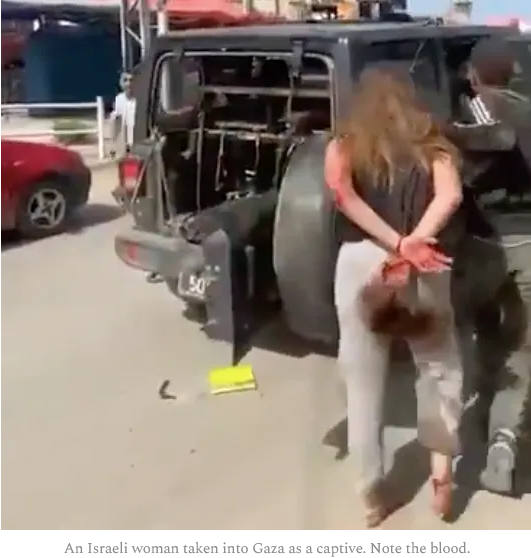
On October 7th, 2023, Hamas terrorists infiltrated Israel and committed the worst massacre of Jews in a single day since the Holocaust. More than just a massacre, Hamas tortured their victims, including brutally raping women, young and old. Yet the silence of many women’s organizations and leading voices who stand tall, claiming to be “strong feminists”, is deafening.
When the #MeToo movement started, the mantra was “believe all women”. As high-profile women spoke out, the feminist movement stood with them. So why, in the wake of the most horrific terrorist attack in Israel’s history, which included rape, do these women not deserve the same solidarity?
A month later it is not just the complete silence of the women’s organizations that causes pain, it is the active justification and gaslighting of the Jewish community, which has including denying the truth of what happened on October 7th, by demanding proof, rather than believing survivors. Many may recognize these tactics as those used as abusers against their victims in cases of domestic and sexual violence, a tactic that has become known as “DARVO” — Deny, Attack, and Reverse, Victim Offender.
When reports first surfaced of the sexual assaults committed by Hamas, many of us took to Twitter, the only place where we knew to raise our voices. Immediately our replies were filled with folks who otherwise would believe survivors, but were seemingly comfortable demanding immediate forensic evidence in this case. Survivor accounts were not enough; even a video released by the Israeli government that painted a clear picture of Hamas’ brutality was not enough. Hamas terrorists themselves recounting their actions was not enough.
Sarah Jama, an MPP in Ontario, has gone so far to publicly state that the accounts of rape are a lie pushed forward by the “zionist lobby”.
We have seen people like Ghada Sasa, a former board member of Canadians for Justice and Peace in the Middle East, going on a podcast and not just claiming that Hamas treated civilians fairly, but that Israel was to blame for the massacre at the Nova music festival.
Meanwhile member of Parliament Niki Ashton claimed that a “feminist government” would call for a ceasefire; yet she has not once condemned the use of rape by Hamas as a war crime. This is a highly selective read of feminism.
November 17, 2023
Israeli government responds strongly to Justin Trudeau’s accusations of deliberate killings of civilians
I guess the electoral calculus shows that there aren’t enough Jewish votes to be gained by backing Israel, so Justin Trudeau is going for the Islamic vote instead:
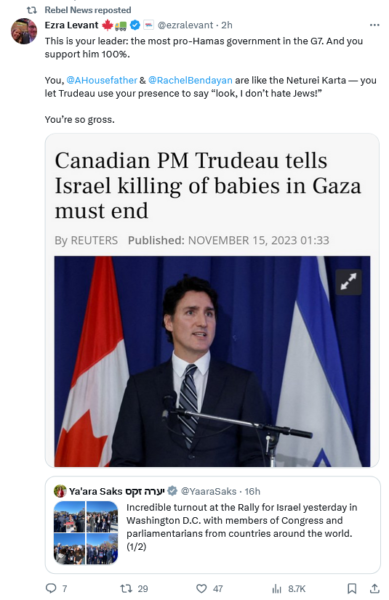
It’s not typical that an Israeli leader will issue an English-language excoriation of a friendly government in a time of war, but this week Israeli Prime Minister Benjamin Netanyahu made an exception for Prime Minister Justin Trudeau.
“While Israel is doing everything to keep civilians out of harm’s way, Hamas is doing everything to keep them in harm’s way,” said Netanyahu in a statement addressed to the Canadian leader. He added, “the forces of civilization must back Israel in defeating Hamas barbarism.”
.@JustinTrudeau It is not Israel that is deliberately targeting civilians but Hamas that beheaded, burned and massacred civilians in the worst horrors perpetrated on Jews since the Holocaust.
While Israel is doing everything to keep civilians out of harm’s way, Hamas is doing …
— Benjamin Netanyahu – בנימין נתניהו (@netanyahu) November 15, 2023
Netanyahu was reacting to prepared remarks Trudeau delivered in B.C. where he accused Israel of killing “women, children and babies”. The statement — which did not place any blame on Hamas for the carnage — urged Israel to exercise “maximum restraint” as “the world was watching”.
It’s but the latest incident in an official Trudeau government response to the Israel-Hamas conflict that has been checkered by confusion, contradiction — and a noticeable alienation from Canada’s usual international allies.
In the first days after the Oct. 7 massacres, Canada was left out of a strongly worded joint statement issued by five fellow members of the G7.
“The terrorist actions of Hamas have no justification, no legitimacy and must be universally condemned,” read the statement co-signed by the leaders of the U.S., U.K., Germany, Italy and France. The statement then urged Israel to “set the conditions for a peaceful and integrated Middle East region.”
Ottawa explained that the statement was issued by Quint – an organization of five countries separate from the G7 that has never included Canada.
But while it might make sense for Quint to exclude its other G7 ally, Japan, it’s more conspicuous that the co-signers never called the G7 member with a substantial Jewish population and a lengthy history of diplomatic support for Israel.
And while Trudeau’s official reaction to the Oct. 7 massacres carried much of the same sentiments, it did include a routine equivocation absent from the Quint statement: Israel had a right to defend itself “in accordance with international law”.
November 15, 2023
Can we criticize the Climate Goblin now?
Brendan O’Neill asks if it’s allowed to criticized Greta “The Climate Goblin” Thunberg now:

Can we criticise Greta Thunberg now? For a time, anyone who raised even the mildest objection to the pint-sized prophetess of doom risked being damned as a bully. Surely this moratorium on Greta-scepticism will end following her platforming – to use woke lingo – of an activist with very iffy views. An activist who has trivialised the Holocaust and seems pretty chilled about Hamas’s pogrom of 7 October. Calling out Greta for her fact-lite blather about the planet being “on fire” may have been forbidden – pulling her up for hanging out with Holocaust relativists must not be.
Thunberg has made waves by switching her focus from saving the planet to saving Gaza. Like every other Gen Zer with a TikTok and an insatiable urge to signal his / her / zir virtue to the world, she’s become an overnight authority on Israel-Palestine. She posed with a placard saying “Stand with Gaza“. She turned Fridays for Future – where pious rich kids bunk off school to raise awareness about climate change – into “Justice for Palestine” stunts. And on Sunday, she made a climate protest in Amsterdam pretty much all about Palestine.
She invited activists to the stage. One was Sara Rachdan, a Palestinian studying in Amsterdam. It didn’t take German newspaper Bild long to discover that Ms Rachdan holds views which – how should we put this? – are not very pleasant. On Hamas’s pogrom, Ms Rachdan said: “This is finally Palestinians taking action [against] the occupation”. She’s dabbled in Holocaust denigration. She shared a blood-spattered graphic comparing Israel’s actions in Gaza with the Nazis’ actions in Auschwitz. Repulsively, it implies the Jewish State is worse than the Nazis. Where 127 kids a day were killed in Auschwitz, 178 a day are currently dying in Israel’s war in Gaza, it alleges.
Shorter version: the Jews are more accomplished child-killers than even Hitler’s henchmen were. This is rank Holocaust relativism. Comparing the greatest crime in history to this horrendous war denudes that crime of its unique horror. It renders it ordinary. It was no big deal – just the same kind of thing you see on your TV screens every night from Gaza. The implication of moral equivalence between the Nazis’ minutely planned gassing of Jewish children and the deaths of Palestinian kids as a terrible byproduct of Israel’s war on Hamas is beyond immoral. It is the gravest of inversions, treating the Jewish State’s war against anti-Semitic mass murderers as indistinguishable from the Nazis’ acts of anti-Semitic mass murder.
Of course, there’s nothing to suggest Greta shares Ms Rachdan’s views. But isn’t her woke generation obsessed with “platforming”, with only rubbing shoulders with the perfectly politically correct and no one else? Indeed, Thunberg ostentatiously flounced out of the Edinburgh Book Festival earlier this year because it received funding from a firm that invests in fossil fuels. Take oil money and she’ll dodge you like the plague; describe an anti-Semitic pogrom as an act of resistance and she’s all over you like a cheap suit. Care to explain, Greta?
November 14, 2023
The deep cognitive dissonance of “Queers for Palestine”
In Quillette, Armin Navabi points out the utter absurdity of a group of self-identified queers actively supporting the terror organization running the Gaza Strip, which would execute as many of them as came within its power:
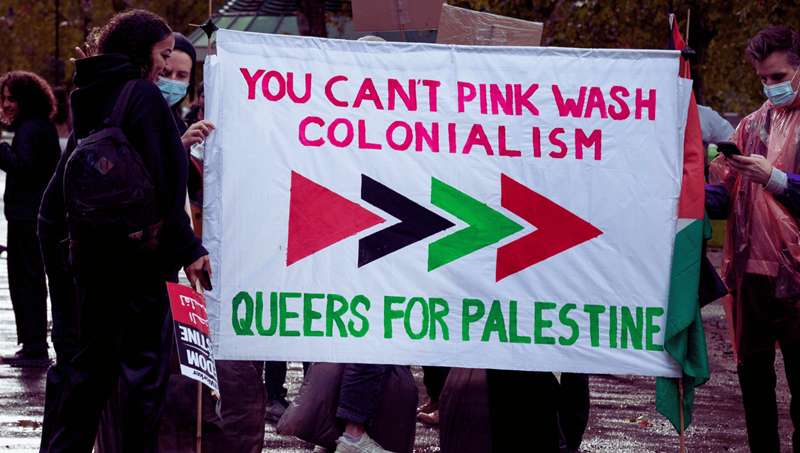
Leftists in English-speaking nations tend to see Palestinians (including Hamas) as an oppressed, brown victim class, whose freedom-fighting “resistance” against their oppressive, white, US-backed colonizers in Israel is a righteous cause with which to stand in solidarity. This facile view of the long-standing conflict in the Middle East leads to confused and contradictory thinking, as seen in the incoherent slogan (and now meme) “Queers for Palestine“, emblazoned on banners brandished at anti-Israel rallies.
“Queers for Palestine” attempts to meld LGBT advocacy with Palestinian liberation, a juxtaposition that has precipitated a whirlwind of criticism and ridicule, since LGBT rights scarcely exist within the Muslim world; and the Palestinian territories are no exception. The slogan has been widely satirized. Variations like “Chickens for KFC” and “Blacks for the KKK” highlight its proponents’ basic lack of awareness of just how incompatible the values of the Western left are with those of the Islamic right they so readily champion.
The reality of the situation could not be starker. Though there is room for improvement in Israeli attitudes towards these issues, Israel is at the forefront of LGBT rights in the Middle East. In Israel, LGBT people are visible members of society with legal protections and civil rights, and are accepted by a plurality of its citizens.
Palestine is quite a different story. A 2021 report on LGBT acceptance by UCLA’s Williams Institute rated Israel 44th out of the 175 countries/territories they examined. Palestine came in at number 130, behind Russia, Saudi Arabia, and the Democratic Republic of the Congo. Georgetown University likewise placed Palestine 160th out of 170 countries on their women’s peace and security index, in company with most of the countries in that region. Amnesty International‘s 2020 report on human rights highlights the fact that, in Gaza, male same-sex relationships are punishable by up to 10 years’ imprisonment and points out the conspicuous absence of legal protections against anti-LGBT discrimination and harassment. This lack of civil rights has led hundreds of gay and bisexual Palestinians to flee to Israel to escape persecution. One such refugee, Ahmad Abu Marhia, a 25-year-old gay Palestinian man, was living under asylum in Israel when, in 2022, he was kidnapped and beheaded in the West Bank city of Hebron. His murderers uploaded footage of the killing to social media.
Every time these disparities are mentioned, critics are quick to lob accusations of “pinkwashing” — a concept invented to frame any discussion of Israel’s progressive stance on LGBT issues as a distraction from their mistreatment of Palestinians. But the fact remains that these “Queers for Palestine” could march in Pride parades in Israel if they wanted to. In Palestine, they’d be killed.
Another disconcerting element of “Queers for Palestine” is that the slogan popped up in prominent left-wing anti-Israel/pro-Palestine rallies in the immediate aftermath of Hamas’s terrorist attacks, before Israel had even had the chance to respond. There is no way to interpret this slogan and the surrounding leftist fervor except as a signal of support not merely for Palestine, but specifically for Hamas, a jihadist movement with the explicit aim of eradicating the state of Israel. It’s imperative to understand that Hamas, as detailed in its 1988 Covenant, is propelled by a fundamentalist Islamist ideology whose goal is not only to eliminate all Jews but to conquer the world — just like ISIS. Senior Hamas official Mahmoud al-Zahar has stated on record, “The entire planet will be under our law, there will be no more Jews or Christian traitors”.
Western support for Hamas, under the guise of support for Palestinian liberation, betrays an ignorance of the deep-seated radical Islamist ethos driving that organization, which, if left unchecked, would jeopardize the very freedoms cherished by LGBT people across the developed world. Anyone who doubts this should try being gay, bi, or trans in most of the Middle East and North Africa’s (MENA) Muslim-majority countries. Almost all these nations have laws that criminalize both homosexuality and transsexuality, some of which carry the death penalty. Human Rights Watch’s report “Everyone Wants Me Dead” succinctly encapsulates in its title alone the perilous environment faced by LGBT individuals in these regions.
November 12, 2023
“When I use a word … it means just what I choose it to mean”
Andrew Sullivan on how our “elites” now live in a world that the renowned Oxford academic Charles Lutwidge Dodgson1 predicted in his writings a century and a half ago:
“Israeli flag, Tel Aviv, Star of David” by Tim Pearce, Los Gatos is licensed under CC BY 2.0 
 .
.
The word “genocide” may be the one rendered most meaningless in our discourse. It has some steep competition, of course. “White supremacy” now means asking someone to show up on time. “Trauma” means being referred to with the wrong pronoun. And “genocide” can, among other things, mean debating experimental sex reassignment procedures for children. (Go look up #transgenocide on Twitter and weep.)
But the supporters of Hamas and of the Palestinians have seized the g-word with particular zeal. And who can blame them? There’s a real, adolescent frisson in accusing the victims of the worst genocide in modern history of being genocidal themselves. “Israel, we charge you with genocide” is a common chant in many of the pro-Palestinian protests. “Genocide Joe” has been trending on Twitter. Eight hundred artists signed an open letter calling the Israeli counteract in Gaza “a genocide”. Yale professor Zareena Grewal channeled much of the “decolonizing” left: “Israeli [sic] is a murderous, genocidal settler state and Palestinians have every right to resist through armed struggle”.
It’s not just the activists. Congresswoman Tlaib has accused Biden of “funding Netanyahu’s genocide”, and said “We are literally watching people commit genocide” — referring to the blast next to a Gaza hospital caused by a Hamas rocket. Congresswoman Omar retweeted a photo of dead kids with the caption “CHILD GENOCIDE IN PALESTINE” — but the photo was from a 2013 chemical weapons attack in Syria. A State Department official tweeted that Biden is “complicit in genocide”. A UN official just quit his post, adding:
In just 4 weeks, Israel with US backing has cut off food, water, power & then brutally exterminated more than 10,000 imprisoned civilian men, women & children in Gaza, destroyed their homes, churches, mosques, schools & hospitals because they are Palestinians. Name it? #Genocide.
The devastation in Gaza is horrifying to watch, worse than horrifying. Anyone who isn’t deeply troubled by the mass death has lost humanity. But the UN official, and all those echoing him, are full of it. The basic definition of “genocide” provided by the State Department is “the deliberate killing of a large number of people from a particular nation or ethnic group with the aim of destroying that nation or group.”
The key, defining thing here is the aim. Horrifying massacres may or may not be genocidal, depending on the intention. The Hiroshima bomb, for example, was devastating, but it was aimed at ending the war, not obliterating the Japanese people as a race. And if Israel were interested in the “genocide” of Palestinian Arabs, it has had the means to accomplish it for a very long time. And yet, for some reason, the Arab population of Israel and the occupied territories has exploded since 1948, and the Arabs in Israel proper have voting rights, and a key presence in the Knesset.
This is not to exonerate Israel entirely. I’ve had strong words for the Netanyahu governments over the years. And Israeli politicians, on the far right, have used foul rhetoric and deemed the Palestinians subhuman in some respects. Bibi swiftly suspended a rogue minister for saying a nuke could be dropped on Gaza. There are anti-Arab maniacs among the West Bank settlers and in Bibi’s cabinet. But a policy of Arab genocide? Please.
The only people actively and proudly engaged in genocide are Hamas. The marchers on the streets this weekend will not be opposing genocide; they will be defending its perpetrators. It’s right there in the Hamas founding charter:
[All of Israel, Gaza and the West Bank is] consecrated for future Moslem generations until Judgement Day. It, or any part of it, should not be squandered: it, or any part of it, should not be given up. … The Day of Judgement will not come about until Moslems fight the Jews (killing the Jews), when the Jew will hide behind stones and trees. The stones and trees will say O Moslems, O Abdulla, there is a Jew behind me, come and kill him.
This is not mere rhetoric. On October 7, we saw what genocide is in practice. Hamas didn’t kill civilians as a tragic consequence of attacks on military targets. Its torture and murder of Jewish civilians was its core mission. And if Hamas had the capacity, they would gladly enact a second Holocaust, and they have proudly said so, with even more sadism than the Nazis. They would kill every Jew they could.
1. Lewis Carroll, “an English author, poet, mathematician and photographer. His most notable works are Alice’s Adventures in Wonderland (1865) and its sequel Through the Looking-Glass (1871). He was noted for his facility with word play, logic, and fantasy. His poems ‘Jabberwocky’ (1871) and ‘The Hunting of the Snark’ (1876) are classified in the genre of literary nonsense.” (Wiki)
November 8, 2023
Details from the day of the Hamas terror attack on Israel
Matt Gurney in The Line:
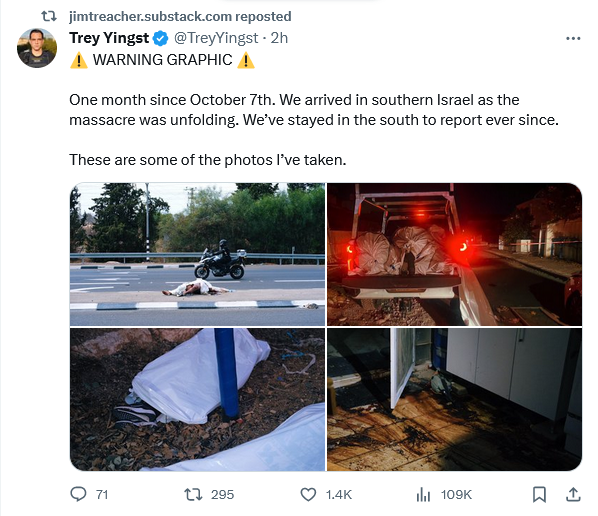
On Nov. 6, one-month-less-a-day after the Hamas assault on southern Israel, I was one of a small number of journalists to receive a briefing by a senior Israeli government official at the Israeli consulate in Toronto. Part of the briefing was the showing of a film, approximately 42 minutes long, that contained video and audio records of the attack. The sights and sounds came from many sources, including home security footage, survivor footage, surveillance cameras at private residences, military facilities and in public places, as well as cameras and Go-Pro-style body worn cameras carried by Hamas. Later in the film, we also see footage taken by Israeli first responders — some of it informally, via body worn cameras and smartphones, but some of it also deliberately and meticulously, as part of the documenting of the attack’s aftermath. The video also included audio portions of what the Israeli government claims is intercepted Hamas communications sent during the attack.
I have to preface this near the top: I can’t vouch for the authenticity of the videos, or of the translations. I believe that the videos are authentic and the translations accurate — the latter is easier, since it has by now been shown to enough people that any false translations would have been noted by members of the audience, but I don’t speak Hebrew or Arabic, and had to rely on the captions. As for the videos, while some of what I saw on Monday was new to me, other clips have already been shared widely on social media. There’s a decent chance you’ve seen some of them, too. For further disclosure, many of the clips are very short — a few seconds each. The Israelis said that in many cases, they are only choosing to release what the families of victims have agreed to allow to be shown. That’s an editorial decision, and I haven’t seen the unedited videos. I can’t tell you what I wasn’t shown.
So if you’re absolutely determined to find a way to discredit or dismiss everything I’m about to say, I’ll keep it easy for you. I saw what was presented to me, by Israel, and have little ability to independently confirm any of it.
If you’re interested in hearing what I saw, though, here it is.
I should start by telling you I don’t plan to dwell on all the atrocities or try to summarize the whole 42 minutes of carnage I watched in any kind of coherent sequence. It’s not that the atrocities aren’t important — they’re obviously the central point of the briefing for reporters, and what I was asked to bear witness to. My thinking is simply this: much of what I could tell you has been summarized elsewhere. The global media first saw this film, in Israel, two weeks ago; some of my Ottawa-based colleagues saw it last week. If you’re looking for a summary of the contents, those exist already. I don’t think you’d benefit from just another version of that, and I know I wouldn’t enjoy writing one. So in the main, I’ll avoid long, descriptive passages where I tell you what I saw. I’ll try to offer something different.
But first, let’s get this out of the way. I confess that I was afraid when the video started. Simple fear. Fear I’d crack, fear I’d have to look away, fear I’d somehow fail to meet the moment. I don’t know if that was a rational fear — what the hell does meeting the moment even mean? — but I was afraid. I was afraid from the moment I was asked to attend and said yes. As the film began, though, I found many of the videos less graphic than I’d feared, and actually less graphic than some of what I’d already seen and written about. No one should mistake me — the videos are graphic, some of them extremely so. But in many cases, the videos are taken from too far away or from an unsteady camera (particularly the body worn ones) and many of the worst gruesome details are thus obscured or missed.
Not all of them. Lord no, not all. But some. That helped.
November 3, 2023
QotD: The use of Epigraphy and Papyrology in interpreting and understanding the ancient and classical world
Let’s start with the most text-like subcategories, beginning with epigraphy. Epigraphy is the study of words carved into durable materials like stone or metal. For cultures that do this (so, Mesopotamians, Egyptians, Greeks, Romans: Yes! Gauls, pre-Roman Iberians, ancient Steppe nomads: No!), epigraphy provides new texts to read and unlike the literary texts, we are discovering new epigraphic texts all the time. The downside is that the types of texts we recover epigraphically are generally very limited; mostly what we see are laws, decrees and lists. Narrative accounts of events are very rare, as is the epigraphic preservation of literature (though this does happen, particularly in Mesopotamia with texts written on clay tablets). That makes epigraphy really valuable as a source of legal texts (especially in Greece and Rome), but because the texts in question tend to be very narrowly written (again, we’re talking about a single law or a single decree; imagine trying to understand an act of Congress renaming a post office if you didn’t [know] what Congress was or what a post office was) without a lot of additional context, you often need literary texts to give you the context for the new inscription you are looking at.
The other issue with epigraphy is that it is very difficult to read and use, both because of wear and damage and also because these inscriptions were not always designed with readability in mind (most inscriptions are heavily abbreviated, written INALLCAPSWITHNOSPACESORPUNCTUATIONATALL). Consequently, getting from “stone with some writing on it” to an edited, usable Greek or Latin text generally requires specialists (epigraphers) to reconstruct the text, reconstructing missing words (based on the grammar and context around them) and making sense of what is there. Frankly, skilled epigraphers are practically magicians in terms of being able figure out, for instance, the word that needs to fit in a crack on a stone based on the words around it and the space available. Fortunately, epigraphic texts are published in a fairly complex notation system which clearly delineates the letters that are on the stone itself and those which have been guessed at (which we then all have to learn).
Related to this is papyrology and other related forms of paleography, which is to say the interpretation of bits of writing on other kinds of texts, though for the ancient Mediterranean this mostly means papyrus. The good news is that there is a fairly large corpus of this stuff, which includes a lot of every day documents (tax receipts! personal letters! census returns! literary fragments!). The bad news is that it is almost entirely restricted to Egypt, because while papyrus paper was used far beyond Egypt, it only survives in ultra-dry conditions like the Egyptian desert. Moreover, you have all of these little documents – how do you know if they are typical? Well, you need a very large sample of them. And then we’re back to preservation because the only place you have a very large sample is Egypt, which is strange. Unfortunately, Egypt is quite possibly the strangest place in the Ancient Mediterranean world and so papyrological evidence is frequently plagued by questions of applicability: sure we have good evidence on average household size in Roman Egypt, but how representative is that of the Roman Empire as a whole, given that Egypt is such an unusual place?
Outside of Egypt and a handful of sites (I can think of two) in England? Almost nothing. To top it all off, papyrology shares epigraphy’s problem that these texts are difficult and often require specialists to read and reconstruct them due to damage, old scripts and so on. The major problem is that the quantity of recovered papyrus has vastly outstripped the number of trained papyrologists, bottle-necking this source of evidence (also a lot of ancient papyri get traded on the antiquities black market, potentially destroying their provenance, and there is a special level in hell for people who buy black market antiquities).
Bret Devereaux, “Fireside Friday: March 26, 2021 (On the Nature of Ancient Evidence”, A Collection of Unmitigated Pedantry, 2021-03-26.
November 2, 2023
With progressive allies like these …
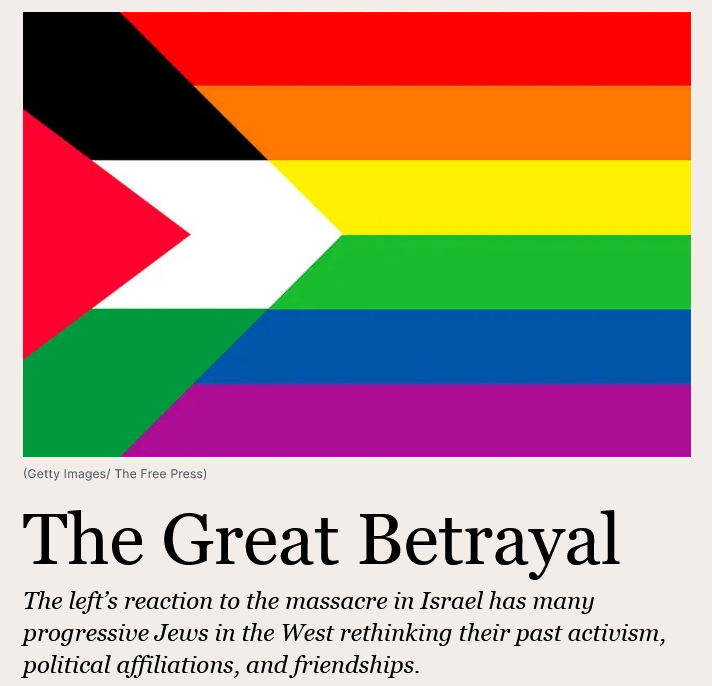
In The Free Press, Suzy Weiss and Francesca Block record the reactions of progressive Jews who are waking up to discover that their “allies” hate them and want them dead:
After Donald Trump was elected, Emily Rose, 51, flew to New York with her daughters to walk in the Women’s March. She demonstrated on the streets of Minneapolis, where she lives, in the days after George Floyd’s murder. She donated money to small, black-led movements and social justice organizations that she believed in. She unlearned and then re-educated herself, as white Americans were instructed to, and read the teachings of anti-racist scholars like Ta-Nehisi Coates.
But then, after the massacre in Israel on October 7, when some 1,400 Jews were brutally murdered, not to mention the rapes, beheadings, and instances of torture, Rose began to notice something odd from the cohort of fellow progressives she admired: they were cheering for the other side.
“I started to see these intelligent, educated people, whose mission is to make our system better for people of color, suddenly posting all this anti-Israel, pro-Palestinian stuff,” Rose said. “I’m not changing my values, but screw the allyship. I will not stop fighting, because I believe in the causes themselves. But as for going out of my way to support, to post, to give money? I’m done.”
While professional politicos, like DSA founder Maurice Isserman, are publicly stepping down from their parties and denouncing organizations that justify, or even cheer, the events of October 7, and wealthy Jewish donors claw back their millions from elite universities that they say helped foment antisemitism on their campuses, there’s a quieter, more personal reckoning happening among progressive Jews. Like Rose, they feel betrayed by a left that they thought would have their backs.
Dov, 30, a Canadian musician who didn’t want to share her last name for privacy reasons, is transgender and a self-proclaimed “political progressive”. Since October 7, she says, “Every time I open Instagram I’m just like, blocking or deleting people that I thought I knew.” She calls anti-Zionism “cloaked antisemitism”.
Josh Gilman, 37, who lives in Arizona and prides himself on having friends across the political spectrum, says he has been muting even close friends who espouse anti-Zionist views. “I don’t need the emotional distress,” he told The Free Press. “If there’s someone who is truly my friend, it makes me feel that they very much don’t understand who I am as a person.” He’s cut out people he had invited to dinner at his home, and who he had trusted around his family and children.
“There’s a line in the sand, which is Israel,” he said.
Nate Clark, 34, lives in Virginia. He’s marched for gay rights, and in 2020, for the removal of statues of Confederate soldiers in his home state. He said his choice to stand up for others is rooted in his Jewish identity.
“As a Jew, I feel like it would be weird if I went to Germany and took a right turn down Hitler Avenue or saw a statue of Eichmann, and then hear people claim ‘Oh, it’s our history. We’re just proud of our history’?” he told me.
Since October 7, he’s found himself “politically homeless”.
October 31, 2023
As we’re always told in a pious tone of voice, “violence never settles anything”
Chris Bray, ever the iconoclast, begs to differ:
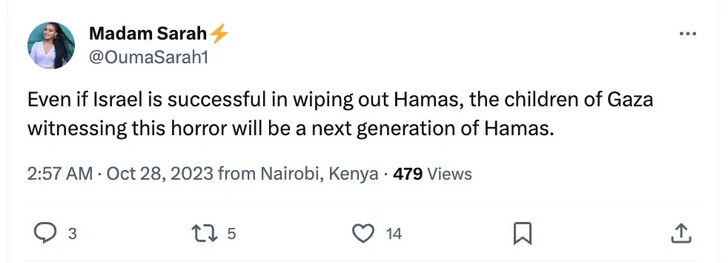
One of the things everyone knows about Gaza is that the Israeli attack is just creating more violence, as the next generation of Palestinians watches the bombs fall. Inevitably, the story goes, the young are learning hate and rage, and will pay it forward. Here’s the upscale think tank version of the argument, under the headline, “Israel risks creating a newly traumatized and radicalized generation of Palestinians”:
What will remain of Gaza’s population, and among Palestinians elsewhere in the occupied West Bank and East Jerusalem and inside Israel proper, will be a newly traumatized and radicalized generation of youth, none of whom were born or of voting age when Hamas was elected … As a result, Hamas’s self-declared raison d’etre — “resisting the [Israeli] occupation with all means and methods” — will only grow in the minds of Palestinian youth. This will render unsuccessful Israel’s attempts to eliminate Hamas militarily.
Here’s an example of the Twitter rando version, which you’ll see over and over again if you engage with social media at all:
But is that true? Without advocating for brutality, I find myself looking for historical examples and mostly coming up with the opposite. To start managing the “yes, but” up front, there are many ways of waging war, and the extractive nation-building warfare of an imperial constabulary — low-grade fighting, prolonged counterinsurgency without decisive violence — does seem to often lead to more violence and “blowback” over time. But what Israel is doing now in Gaza seems like something else entirely.
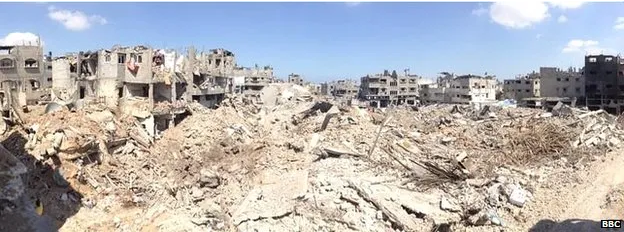
If this violence will create “the next generation of Hamas”, then the children of the Germans who were firebombed in Dresden and Hamburg should be constantly strapping on suicide vests and attacking Ramstein air base. After the Wounded Knee massacre, it shouldn’t be safe for white settlers to live near the Lakota, and South Dakota should be a hellscape. Or consider North Vietnam, which won its war: “The US carried out more than a million bombing raids during the 20-year conflict, dropping some 5 million tonnes of ordnance on the Southeast Asian country.” After the war, a substantial Vietnamese population resettled in California. Violence trains the next generation to hate, right? So the Vietnamese must constantly attack Orange County.
The horror of total war has mostly not seemed to produce more violence. It seems to have mostly left later generations brutalized and horrified, and highly unlikely to go on fighting. Waging war decisively seems to be historically … decisive? The experience of crushing defeat seems to be a cycle-breaker, and even a horrifyingly costly victory — as for the North Vietnamese — seems to limit the appetite of next generations for more war.
Japan nurtured a profoundly violent warrior culture for a long time, with the nation’s soldiers serving as brutal invaders and horrible occupiers, then faced a ghastly campaign of firebombing and two nuclear bombs. Japan no longer has a brutal martial culture; the next generations didn’t become the new warriors. The currently popular theory says that they had to: the children witnessing this horror will be the next generation of militants, because trauma teaches violence. Tomorrow’s Hamas comes from today’s JDAMs. The people who lost World War II don’t seem to prove that theory.
Someone is going to say in the comments that I have blood on my fangs, but the point isn’t to cheerlead for the killing in Gaza. The point is to consider evidence about what comes next, and to ask what the comparable examples are. Is it factually true that youth, traumatized by war, become the violent next generation? We ran this experiment a lot in the twentieth century, and I think we have some strong hints at a consistent answer.
As Robert Heinlein had retired Lt. Col. Jean V. Dubois say to his History and Moral Philosophy class in Starship Troopers:
Anyone who clings to the historically untrue — and thoroughly immoral — doctrine that “violence never settles anything” I would advise to conjure the ghosts of Napoleon Bonaparte and the Duke of Wellington and let them debate it. The ghost of Hitler could referee, and the jury might well be the Dodo, the Great Auk and the Passenger Pigeon. Violence, naked force, has settled more issues in history than has any other factor, and the contrary opinion is wishful thinking at its worst. Breeds that forget this basic truth have always paid for it with their lives and their freedoms.
October 28, 2023
Israel’s Zugzwang
Not being a huge chess nerd, I’d never encountered the term “zugzwang” before, but as Niall Ferguson and Jay Mens explain here, it’s an appropriate way to characterize the situation Israel finds itself in at the moment:
Zugzwang is one of the ultimate challenges for a chess player. In zugzwang, a player is in a situation where any move can only weaken one’s position and carries the risk of checkmate — but not moving isn’t an option. Beyond the intrinsic horror of Hamas’s October 7 massacre, it is now obvious that the attack was designed to provoke Israel into reacting. The extent of the zugzwang is increasingly clear, and Israel has few good options. Nor does the United States.
No one should have been surprised by the attacks on Israel by Hamas and Palestinian Islamic Jihad (PIJ). Over the last year, there have been more than a dozen public meetings between Iranian officials and the leaders of Hamas, Hezbollah, and PIJ. Enormous quantities of men and matériel have moved from Iraq into Syria, with other matériel arriving by land and air to Lebanon. Hezbollah and the Iranian Revolutionary Guards Corps (IRGC), the common thread of the region’s so-called “Axis of Resistance”, have worked to build and consolidate enormous bunkers and fortifications across Syria along with Hezbollah. Some anticipated another Lebanon War, others expected another Gaza War, and others expected a Third Intifada. The only thing few — if any — expected was a design to drag Israel into all these battles and several more at once.
The Imperative to Act
In the aftermath of October 7, Israel must strike back. Propelled by nationwide rage, a new government of national unity in Jerusalem has vowed to destroy Hamas. If that is the true goal, a ground operation in Gaza is necessary. Such an operation began in Israel on Friday night. The very nature of urban warfare means that it will have an enormous human cost and an uncertain duration. And this is not just urban warfare: there are two Gazas — the aboveground and the underground network of tunnels where Hamas’s men and weapons are stored.
And time is not on Israel’s side. International support is already waning, and nowhere more than in the Arab world. Egypt and Jordan, Israel’s most important security partners in the region, have already accused Israel of planning the ethnic cleansing of Gaza. Worse still, the operation will tie down a significant portion of Israel’s manpower and assets. Israel will, as a result, be especially vulnerable to the risk of overextension.
Gaza isn’t the only problem. There is also the West Bank, where unrest is already growing and where the Palestinian Authority is at risk of collapse. Then, to the north, Hezbollah has its vast arsenal of rockets, drones, men, and missiles in Lebanon, while on the Syrian border tens of thousands of Iraqi militants have amassed with the goal of “liberating” the Golan. Thousands more Iranian-made drones and ballistic missiles are spread out across dozens of bases in Iraq, Syria, and Yemen. For that reason, Israel now relies on American support. Jerusalem is likely waiting for the last of American reinforcements — including another carrier strike group — to arrive in the region prior to launching its attack. But is there an alternative?
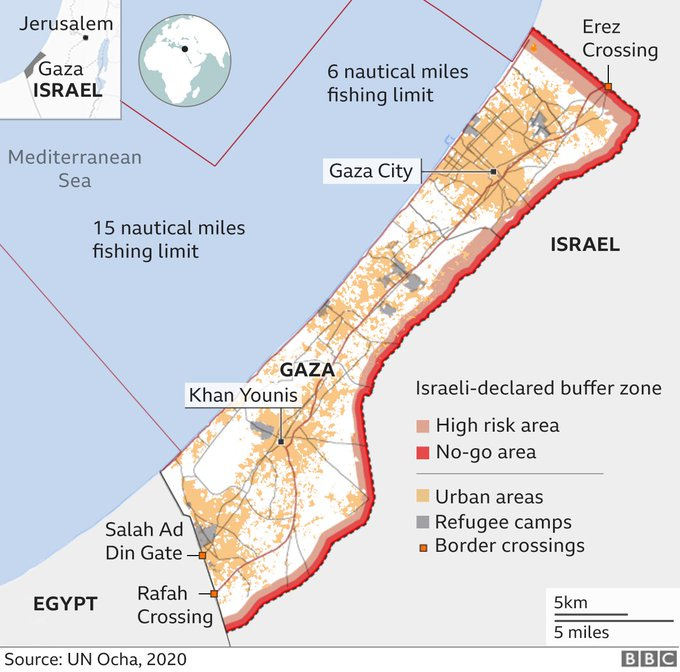
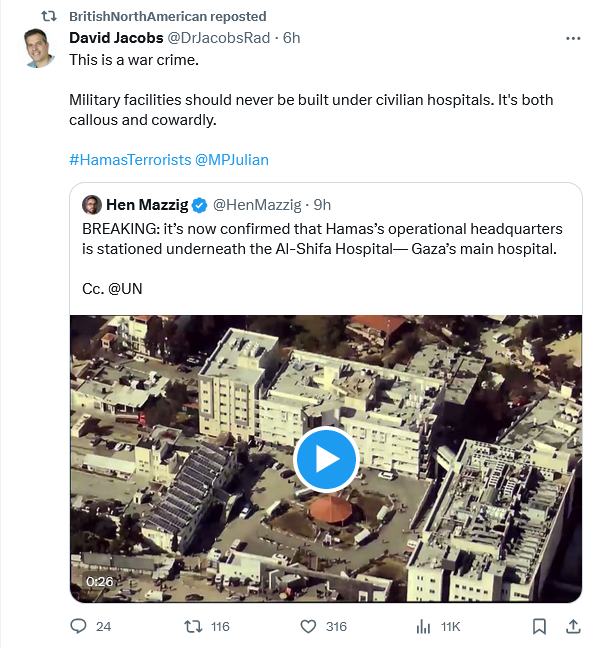
Of course, it’s widely believed that Hamas deliberately positions its facilities to make Israeli attacks less likely due to the elevated risk of unacceptable levels of collateral damage … like this:
October 25, 2023
Housing for Hamas leadership … in London
In the non-paywalled part of a post from Ed West, we have a look at the terrible conditions leaders for Hamas and other terrorist organizations have to put up with in the embattled suburbs of … London:
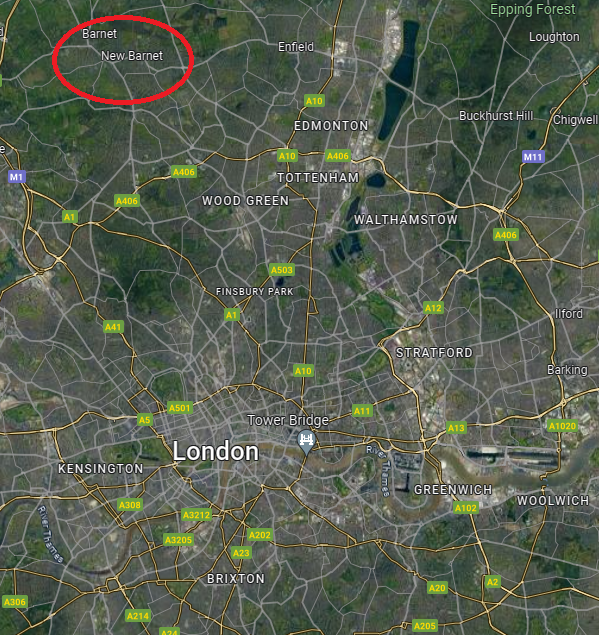
Barnet, to those unfamiliar with this corner of the world, is the most Jewish borough in Britain, an area of north-west London often described as “leafy” and including both pleasant inner suburbs like Finchley as well as areas of genuine countryside. The migration of eastern European Jews in the capital followed an anticlockwise direction from impoverished Whitechapel in east London up through Hackney and Haringey in the north, with Barnet the next stop.
It is also, strangely, home to a leading fundraiser for Hamas, the terrorist group responsible for the murder of 1,400 people in southern Israel earlier this month and quite explicitly committed to the eradication of Jews in the Holy Land.
What with London house prices being what they are, you wonder how he managed it, but of course Muhammad Qassem Sawalha, who “ran the group’s terrorist operations in the West Bank”, according to the Sunday Times, managed to buy his property with help from the council.
Despite being a known and wanted terrorist, Sawalha was allowed to settle in Britain in the 1990s and obtain British citizenship. He continued to work for Hamas, holding talks about committing terrorist acts and laundering money for the group, according to the US Department of Justice. In 2009 he signed the Istanbul Declaration which praised God for having “routed the Zionist Jews”, and called for a “Third Jihadist Front” to be “opened in Palestine alongside Iraq and Afghanistan”, according to the paper.
All the while he was benefitting from Britain’s social housing system. In 2003, Barnet Council made him a council tenant and he was housed in a two-storey property with a garden and garage in the borough, where he still lives.
Two years ago, Sawalha and his wife used the Right to Buy scheme to acquire their home for £320,700, with Barnet Council giving them a £112,300 discount on its market value.
This is despite the fact that in 2006 Panorama reported that Sawalha was “said to have masterminded much of Hamas’ political and military strategy” and that, “although he was known to MI5, the ‘authorities let him operate freely here'”. Not just let him operate freely, but sort him out with a house – and if you think this sounds insane, it is not at all uncommon.
Sawalha’s old comrade, the famous hook-handed hate preacher Abu Hamza, was also given a huge house courtesy of the British taxpayer. The Egyptian was allowed to live rent-free in a five-bedroom house in what the Mail described as “upmarket Shepherd’s Bush”, a phrase I would have found astonishing to read as a teenager in west London.
Shepherd’s Bush is next door to super-rich Holland Park, and private property is extremely expensive there – but it also has high levels of social housing, as with much of central London, so “upmarket” might be stretching it.
Progressive support for Hamas, despite (or even because of) the atrocities
In The Line, Jen Gerson outlines the dilemma many on the left find themselves in, as the Hamas atrocities in Israel attract loud cheering from other sections of the left:
The shockingly broad support for Hamas is a full mask-off moment for a big chunk of the modern North American left, and I think most ordinary people are recoiling from what the self-styled progressive movement has revealed itself to be.
I do wish to be fair. I believe a lot of lefties were caught up in the latest Hamas incursion, and expressed support for it before we had a full view of how brutal and, yes, barbaric it was. I also assume that a lot of lefties are well-meaning, and struggle to acknowledge the significant overlap between a noble Palestinian cause in abstract, and the violent resistance movement that seeks to support its ends. I suspect very few have read Hamas’ charter, which is explicitly and openly genocidal. This is not a militancy that is engaging in violence with the ultimate goal of a peaceful, two-state solution. Hamas — the political entity running Gaza, whether we like that fact or not — wants to run the Jews into the sea, and to establish a theocratic Islamic state in its stead.
There is nothing more bizarre than seeing pictures of soft-headed proggies holding signs like “Queers for Palestine,” seemingly oblivious to the fact that a Palestine run by Hamas is one in which the Queers would be pushed from the top floors of whatever is left of Gaza’s multi-story buildings once Israel is done bombing them. One can be deeply sympathetic to the plight of Palestinians as a people while noting that there is nothing liberal, humane or progressive about Hamas’ actual, stated goals, let alone its recent actions.
The fact that this terrorist organization has garnered so much public support from the likes of unions, professors and groups like Black Lives Matter, is darkly ironic.
Let’s look at a few examples; CUPE was, perhaps, the most infamous supporter of Palestinian “resistance” in the hours after it had been revealed that Hamas militants had killed more than 1,000 Jewish civilians, and taken hostage hundreds more. Fred Hahn, Ontario’s CUPE president, reveled in the news last Sunday, noting that he was thankful for “the power of resistance around the globe.” And: “From the river to the sea, Palestine will be free” — presumably (?) unaware that this is a phrase that is commonly associated with the destruction of Israel.
Hahn did apologize. Sorta. “My social media posts became a giant lightning rod for both legitimate anger, and also for bad faith actors with a divisive agenda.” Sure, Fred. Timing and those with a divisive agenda. That’s what got ya.
This week, we had a student group at Toronto Metropolitan University issue a public statement insisting “Israel not a country, but rather the brand of a settler colony” and supporting “all forms of Palestinian resistance and efforts toward liberation”. Credit is due for not mincing words. There is no mealy equivocation between Hamas and the innocent people of Palestine, here.
“All” “resistance” is legitimate.
[…]
I could go on, but I trust you get the point. None if it is compatible with cheering on atrocities — literal violence of the the most base and brutal kind. Justifying rape and baby beheading is irreconcilable with a version of the “left” that presents itself as secular, humane, compassionate, and committed to social justice.
Ordinary people see this, and the dissonance is jarring.
So how do we reconcile it? Well, try this on: Support for Palestinian resistance reveals this lefty jargon for the straightforward power play that it always was.
The activist left doesn’t actually believe that “words are literal violence”, and never did. The weaponization of compassion, the cancelling, the de-platforming — these are tactics. It’s never been about creating a more harmonious and tolerant world, nor protecting innocent students from harmful opinions; it’s about winning. Re-setting the Overton window by bullying dissenters. Dismantling the old power hierarchies — and replacing them with new ones. These politics exist to ensure that anybody who disagreed with the new order and its values was too intimidated to speak up for fear of being labelled a bigot, a racist, a transphobe, whatever, whatever
Violence, harassment, and threats have always been acceptable tactics to this crowd, provided these measures were applied to the right people for the right causes.
There is a reason why this ideology found such fertile soil in universities, and particularly in elite universities. (And it’s no coincidence that the most expensive institutions of education also happen to be clearinghouses for Palestinian support.) At the risk of stating the obvious, universities don’t just exist to educate students, they exist to instruct society’s future scions in the language, manners, and political views that signal acceptance in the ruling class. That’s what elite schools to do. It’s why major corporations and most media institutions have likewise followed suit. It’s power all the way down. .
October 20, 2023
Look at Life – Oil Aboard (1963)
Classic Vehicle Channel
Published 18 Apr 2020The oil industry and the manufacture of fuel.
October 19, 2023
Why there are no regional refuges available to Gazan civilians
Ed West outlines the sad story of Palestinian civilians uprooted from their homes by the many conflicts that have convulsed the region:
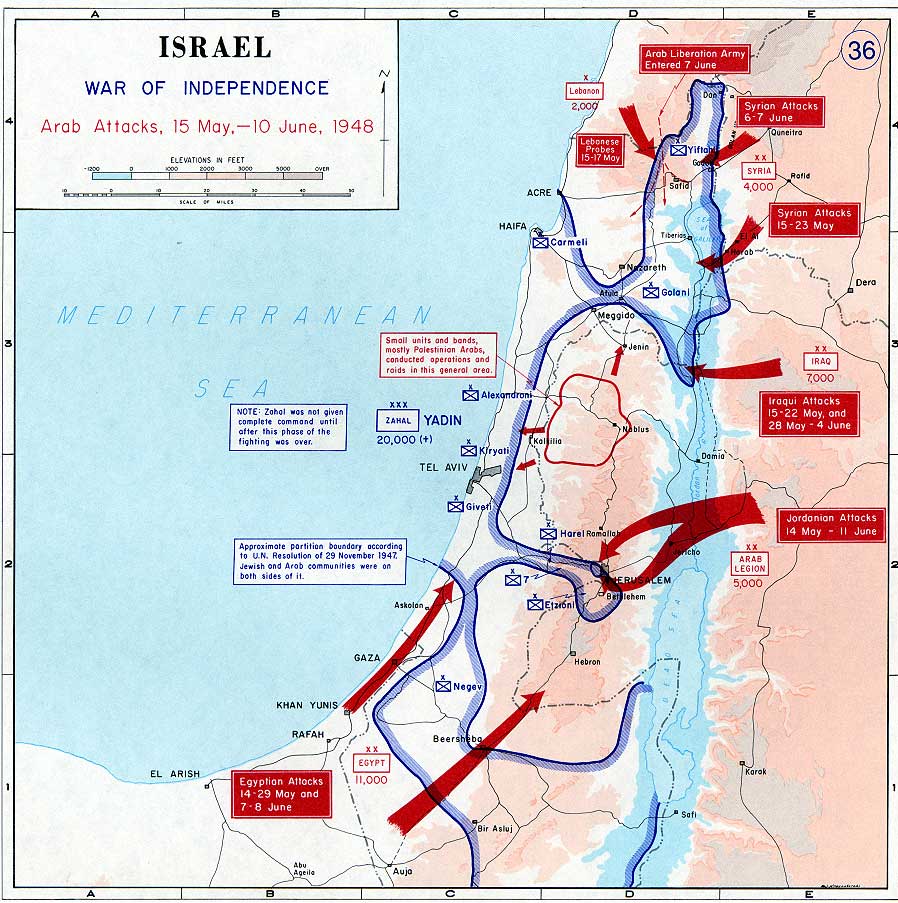
Arab attacks in May and June 1948.
United States Military Academy Atlas, Link.
It is generally a good idea for refugees to be housed in neighbouring countries rather than on different continents, for a number of reasons, but we should be wary of casually stating that Arab states should house Gazans. In a difficult region many of these countries have already put themselves under enormous strain through acts of immense generosity, and none more so than Jordan.
[…]
The survival of Jordan’s monarchy has been one of the more surprising outcomes of the past few decades, and experts have repeatedly bet against it. The country has an unusually bad hand in many ways. Situated beside the disputed Holy Land, it lacks the natural resources of neighbouring Saudi Arabia and Iraq, while also being more remote than Lebanon or Syria, which had long been at the heart of Mediterranean trading networks and far more plugged into European markets.
But most of all it has suffered the destabilising effect of refugees. Abdullah is named after his great-grandfather, the first King of Jordan, whose assassination in 1951 forms the opening of Hussein’s autobiography; indeed he calls it “the most profound influence of my life”. He was just 15 years-old when he travelled with his grandfather to Jerusalem to perform Friday prayers, where the monarch was shot dead by a Palestinian. The gunman then fired at Hussein but the bullet struck a medal his grandfather had given him.
Abdullah I had ruled the new kingdom for just five years, and it endured an incredibly bad start with defeat in the 1948 Arab-Israeli war, which led to a surge of refugees. Estimates of exact numbers seem to vary hugely, but in Lion of Jordan, Avi Shlaim writes that 700,000 Palestinians left in 1948, and of these “450,000 ended up in Jordan, which did more than any other Arab state to help them resettle and integrate with the rest of society”.
He wrote: “The refugees in Jordan wanted to preserve their separate Palestinian identity, but this ran counter to Abdullah’s policy of ‘Jordanization’.” He gave them citizenship rights “but the refugees were a great burden on the weak Jordanian economy; it simply did not have the financial resources to cope with a humanitarian tragedy on such a vast scale.” Many ended up in resentful poverty and “the Palestinians thus became an important factor in domestic Jordanian politics”.
Another source suggests that in 1949, “Jordan welcomed approximately 900,000 refugees by amending the country’s 1928 Law of Nationality to grant equal citizenship to Palestinians; the 1954 Law of Jordanian Nationality later extended citizenship to Palestinians who arrived in Jordan after the 1949 addendum.”
After another defeat against Israel in 1967, up to 300,000 displaced Palestinians in the West Bank retained Jordanian citizenship, and today around 40% of the Jordanian population descend from Palestinian refugees, although the figure may be higher (again, they vary hugely). What seems certain is that about 40% of displaced Palestinians and their descendants live in Jordan, with another 10% in Syria (although many of those have since fled to Lebanon).
The Hashemites, unlike some Arab countries, were keen to integrate the newcomers and to avoid them having to endure a permanent refugee existence; that is why three-quarters of Palestinians in Jordan are Jordanian citizens, although Palestinians from Gaza aren’t, that area having been part of Egypt before the Six-Day War.
In contrast Palestinians who fled to Syria were not given citizenship, for all the talk of solidarity, and often remained in refugee camp-cities for decades (many of which were heavily affected by the Syrian war).
In Lebanon it was even worse; there the Palestinians could neither gain citizenship, nor in many cases access things like healthcare, education or work. The situation here was uniquely dangerous, because their arrival tipped the country’s incredibly delicate balance between Christians, Shia, Sunni and Druze; in 1975 the country descended into civil war, a horror that saw a modern example of shibboleths where Christian militiamen would present tomatoes to suspected Palestinians and ask them to pronounce the name.
This refugee surge had a destabilising effect on Jordan. Already in 1958 things were so bad that Hussein hoped to form a tripartite union with Saudi Arabia and Iraq to counter the influence of Gamal Abdel Nasser’s Egypt. Neither neighbour was too keen on the idea, and Saudi prince Abd al-Ilah remarked that “Hussein’s trouble stemmed from the fact that 70 per cent of his subjects were Palestinians with no loyalty to the throne”.
But in 1970, three years after the Six-Day War, it reached a crisis point, with the British ambassador commenting that “the mixture became so volatile that the container exploded”. There now came full civil war in Jordan between the army and the Palestinian fedayeen.
Jordan had become home to the Palestinian Liberation Organisation, but this umbrella group was itself split into different factions, Fatah being the largest and most moderate. They were reluctant to get involved in the internal affairs of other Arab states, but this was not the case with the more extreme Popular Front for the Liberation of Palestine led by Dr George Habash (who, as his name suggests, was a Christian) and the Marxist-Leninist Popular Democratic Front for the Liberation of Palestine (yes, it does get very Life of Brian).


