Quotulatiousness

November 23, 2023

QotD: The Austrian and Chicago schools of economics

Filed under: Economics, History, Liberty, Quotations — Tags: , , , — Nicholas @ 01:00

[Bureaucracies will always expand far beyond the “problem” they were instituted to address] was, anyway, the view of that “Austrian school economist”, Ludwig von Mises, proponent like the rest in that school of “classical liberalism”. His hatred of bureaucracy was a wonderful, animated thing. In his great book, Human Action, and many others, he could become almost boring on the topic. What distinguishes the Austrian school from, say, the famous Chicago school of Milton Friedman and his ilk, was its European origin. (They were, however, consciously allied.) The “Austrians” go back, to Catholic antecedents, and their interests are not reducible to “pure economics” (scare quotes because there is no such thing). Over time it extended to broad social questions, and through a constant interest in the history of ideas. These were multilingual and multicultural, in the manner of the old Habsburg empire; where our American classical liberalism has been almost unilingually English, provincially distrustful of foreign thinkers, and buzzing with statistics. (You’ll need a degree in math.)

War propelled the “Austrian” thinkers westward, and the fall of the Berlin wall propelled the “Chicago” school east. The terms no longer have geographical significance.

What all classical liberals have in common is the passionate vindication and defence of human freedom. That is what makes them, unlike progressives, readable in subsequent generations. Their subject matter cannot become dated. The “Austrians” are also necessary to understand modern history, positively as well as negatively, in the evolution of, for instance, the Christian Democratic movement that conceived a peaceful post-war Europe, in defiance of secularizing bureaucratic trends and mass-man “ideals”. Alas, this was overall defeated by the Eurocratic trend-setters, determined to build a magnificent autocratic monument to themselves.

I have the most enchanting memory of opening the box that contained an American reprint of Human Action (big thick book), which I had ordered at the age of fifteen. I no longer own a copy, but gather it still stands as a monument to the resistance — a study of “praxeology”, or purposeful human choices, stretching so wide that even religion and morality could be touched. (Conventional economics has no time for either.) A half-century later, I can even remember the construction of an earnest reading list, that was soon abandoned when I went on the road.

One may see the great division in Western thought and politics, which the Austrian-school Friedrich Hayek traced back to Bacon and Descartes, and can be traced farther to the Nominalists of the later Middle Ages. Humans live in freedom and make choices, to be restrained only by the plainest moral codes. Or, by the alternative thesis, we are components of a machine, which the man with Power can monkey with, by implanting stimuli here and there.

We are creatures of God, or — we are replaceable parts in a bureaucracy.

David Warren, “Austrian schoolboy”, Essays in Idleness, 2019-09-17.

November 21, 2023

“I couldn’t believe I was sitting in a court room where the prosecution discussed the interpretation of Bible verses”

Filed under: Europe, Law, Liberty, Politics, Religion — Tags: , , — Nicholas @ 04:00

In First Things, Sean Nelson recounts the trials of Päivi Räsänen, a Finnish parliamentarian who has been through several years of legal tribulation for expressing her religious views publicly:

Päivi Räsänen, Finnish parliamentarian
Finnish government photo via Wikimedia Commons.

“Blessed is the man who perseveres in the trial,” declares the Epistle of James. Finnish Member of Parliament Päivi Räsänen should count herself doubly blessed this week. She has now persevered through two trials over more than four years of legal troubles brought on merely for expressing her Christian faith. Following both trials, she has not only been acquitted, but also has been a shining example of a modern Christian life fearlessly lived.

On Tuesday, a Finnish Court of Appeal unanimously found MP Räsänen not guilty under Finland’s “hate speech” laws. If the decision stands — there is still a possibility of appeal to Finland’s Supreme Court — it will represent a bulwark for Christians and all people of good will wishing to live out their faith and contribute to social conversations over contentious issues.

Räsänen’s legal saga began on June 17, 2019. On that day, she tweeted a criticism of her church’s participation in a Helsinki Pride parade. She also included a picture of verses from her home Bible. Her case has come to be known as the “Bible Trial”.

Because she is a long-serving member of Parliament and a former Minister of the Interior, her tweet drew the ire of Finnish officials. While an initial police investigation found nothing criminal in her tweet — even writing that sounds absurd — the prosecutor’s office re-opened the matter to comb through her entire history of public utterances. The Helsinki prosecutor came back with an allegedly offensive pamphlet published in 2004 and a live radio interview from 2019. Räsänen was then charged with three counts of “hate speech” under a criminal code provision originally related to war crimes.

During her first trial in January 2022, the Helsinki prosecutor probed Räsänen with theological questions. Was it really possible to separate sin from the sinner, and condemn the former while loving the latter? Basic Christian belief rests on the distinction, as Räsänen explained, but the prosecutor was not convinced. Räsänen reflected at the time, “I couldn’t believe I was sitting in a court room where the prosecution discussed the interpretation of Bible verses”.

In March 2022, the trial court delivered a resounding victory for Räsänen, unanimously finding her not guilty. “It is not for the district court to interpret biblical concepts,” it said.

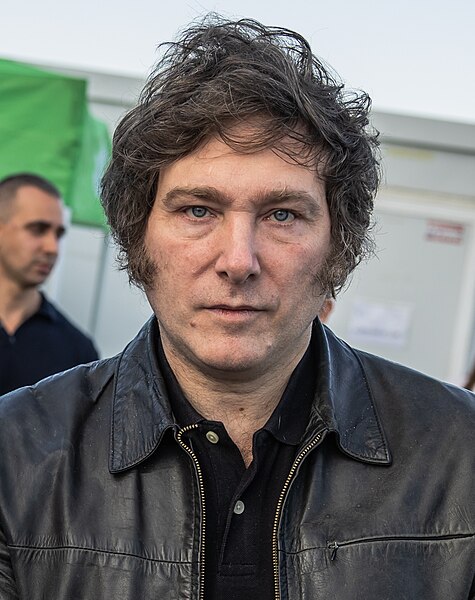
Javier Gerardo Milei, President-elect of Argentina

Filed under: Americas, Economics, Liberty, Politics — Tags: , , , — Nicholas @ 03:00

On the current evidence, Argentina has finally decided to turn away from both communism and Peronism to try something radically different in the person of newly elected Javier Gerardo Milei, variously described (disapprovingly) in the English-language press as “far right”, “extreme right”, “Trump-like”, and most alarmingly, “libertarian”. Here’s what Wikipedia had to say about him (before the edit wars get serious on his page):

Javier Milei, 8 October 2022.
Photo attributed to Vox España via Wikimedia Commons.

Javier Gerardo Milei (/miˈleɪ/ mee-LAY, Spanish pronunciation: [xaˈβjeɾ xeˈɾaɾðo miˈlej]; born 22 October 1970) is an Argentine politician, economist, and author who is the President-elect of Argentina.[1] Before rising to political prominence, Milei initially gained notability as an economist, as the author of multiple books on economics and politics, and for his distinct political philosophy.

As an economist, Milei is a vocal proponent of the Austrian School. He has critiqued the fiscal policies of various Argentine administrations and he advocates for reduced government spending. As a university professor, he has taught courses in macroeconomics, economic growth, microeconomics, and mathematics for economists.[2] He is also the author of numerous books and has hosted radio programs, including Demoliendo mitos and Cátedra libre. In 2021, he entered politics and was elected as a national deputy representing the City of Buenos Aires for La Libertad Avanza. During his tenure, he limited his legislative activities to voting, focusing instead on critiquing what he describes as Argentina’s political elite and its propensity for high government spending. Milei has pledged not to raise taxes and has donated his national deputy salary through a monthly raffle. He was a presidential candidate in the upcoming 2023 general election,[3] with Victoria Villarruel as his vice-presidential running mate.[4] He advanced to the run-off of the presidential election, in which he faced Sergio Massa.[5] On 19 November 2023, he won the run-off election with 56% of the vote to Massa’s 44% to become President-elect.[6]

David Warren certainly seems to like the cut of Milei’s jib:

Mr Milei not only swept the “youth” vote, but he did that while declaring: “Killing children is not a human right!” He mocked an accumulation of political corrections, while dropping a few more “flinch bombs” worthy of the XVIIth-century bishops who evangelized that country.

The outgoing president, another tedious Peronist like our pope, shared the old presidential palace with decorative plants. Carlos, my correspondent, claims that he could make Justin Trudeau look intelligent. If true, this would be an extraordinary accomplishment. He also leaves an amazing national debt, hyperinflation, energy shortages, &c.

Mr Milei seems to have won as Mr Trump once did in the United States: by not flinching. A point may be reached in national decline when even the young will pitch out the Peronistas. Godspeed to them, when they reach this point.

Nevertheless, one must continue to despise politics. Carlos echoes Borges: “No matter how bad an Argentine government is, the next will be worse”.

The Buenos Aires Times, quoted by Brian Peckford:

Milei promised to return Argentina, one of the richest countries in the world a century ago, to its former glory, after decades of stagnation, mostly under the populist Peronist coalition – big on welfare and government spending.

The president-elect vowed “a limited government, respect for private property and free trade. The model of decadence has come to an end. There is no way back.”

Milei offered special thanks to former president Mauricio Macri and failed opposition presidential candidate Patricia Bullrich, who threw their support behind him after defeat in the first round and helped bring over their voters to his force.

He also thanked scrutineers from his party and those from the opposition PRO party that had worked to protect and count votes at polling stations.

Milei ended his speech with his traditional trademark rallying call: “Viva la libertad carajo!” (“fucking long live freedom”).

News of the libertarian’s victory prompted wild scenes from supporters on the streets of Buenos Aires. The area around the Hotel Libertador, his traditional bunker for election night, was swamped by revellers celebrating his win.

It’s often said that socialists will dismiss any failures by socialist governments by declaring that it wasn’t “real socialism”. This is equally true for other political and philosophical beliefs:

November 16, 2023

Why progressives love all forms of public transit

Theophilus Chilton reminds conservatives and other non-progressives that trains, buses, and other forms of mass transit are beloved of the left at least partly because the more people depend on it, the more control the government gains over their freedom of movement:

TTCImages by Canadian8958
Wikimedia Commons

Ask most people on the broad Right what they think about public transportation and they’d probably tell you that they don’t like it. And it’s not just because of the smell and the gum stuck to the seats. Most of us, deep down inside, at least in some subconscious way, feel that mass public transportation is just a little bit communist.

[…]

This is probably much of the reason why we’re in love with the automobile. With the wide-open spaces and abundant road system we enjoy in America, most Rightists would never dream of trying to force everyone to use an archaic, 19th century technology like trains now that we don’t have to. The automobile is a symbol of freedom. You can go wherever there’s a road, no matter how big or small, when you’re in an automobile. You’re not boxed in with dozens of other people on a line that goes one place only. This is why we generally tend to view air travel as a necessary evil — if somebody invented a car that could get us from Boston to Los Angeles in six hours for a business meeting, we’d probably opt for that instead of getting groped by your friendly neighborhood TSA agent.

Progressive leftists know all of this. They know that the freedom to travel where we want, when we want, how we want, is a psychological buttress to our sense of liberty. Pod-people stay put and go where they’re told. Free men hop into their ’67 Mustang and lay rubber in front of a Dairy Queen three towns over from their own.

Hence, in their never-ending quest to gain total control over our lives, the Left has been putting into play a number of plans designed to limit our freedom of travel.

In case you weren’t aware, one of the purposes served by forcing gasoline prices sky-high is to make private automobile travel prohibitively expensive for more and more people. This has been a major thrust in the “global warming” nonsense that the Left has pushed as well — cars supposedly account for the lion’s share of carbon dioxide emissions (even though they actually don’t), so their use needs to be reduced. Way back in the Obama administration, somebody in the Congressional Budget Office accidentally let the cat out of the bag that it would be a great, absolutely smashing, idea to tax Americans for each mile they drive. Every so often the idea gets resurrected in the media, but thankfully doesn’t seem to have gotten much traction yet. Of course, this is essentially what already happens to us anywise, since we have to pay taxes on each gallon we buy to drive those miles. Presumably, this mileage tax would be added on top of the gas taxes already in place.

The whole point to this is not to “stop global warming”. Let’s face it, those in the know at the top of the progressive hierarchy know that global warming is a hoax. They know it’s just prole-feed for the useful idiots in their own ranks and for the easily swayable among the public at-large. The point to inducing people to stop driving cars is not to save the earth, but to reduce the freedom of movement that people have. Take away cars and you take away the ability of most people to travel for pleasure. You take away their means of conveniently conducting much of their commerce and other business. You would prevent them from being able to have forest hideaways and beach homes. In short, you prevent the middle and working classes from having the same things that the rich can have, you keep them from having lifestyles that even begin to approach the type, if not the extent, of the global transnational elite. Most of all, you would take away that psychological sense of freedom that the ability to move about unhindered gives to people. It’s about forcing us all into the Agenda 2030 “You’ll own nothing and be happy” scenarios that the globalist world-planners have prepared for us.

More recently, and more concretely, is the Congressional effort (which ineffectual Republicans failed to stop) that would direct automobile manufacturers to include a “kill switch” into all vehicles made after 2026, a device which would allow authorities to shut down a vehicle remotely. Ostensibly, the reason would be if the driver is acting like he or she is driving while impaired (i.e. it’s FoR yoUr SaFeTy!!1!). Of course, we know the actual reason is to provide bureaucrats and functionaries in the managerial state the means to freeze the movement of dissidents and others who run afoul of the Regime’s dictates. Don’t think they’d do that? Well, these are the same people who just put the infant son of a J6 defendant on the no-fly terrorist watch list.

So, what would have to replace private automobile travel, once nobody but the super-rich will be allowed it? Public mass transportation, of course. Buses, light rail, subways. This has already largely happened to those poor unfortunates who dwell within our large cities and for whom the lack of parking, expensive personal property taxes, and archaic road systems have already removed the automobile from being a viable alternative. The lefties work to extend this system even to places, such as smaller cities, the suburbs, and even the exurbs, where such systems normally would not be “needed” or desired. Make parking in the city so scarce as to be impossible to find, or so expensive that you’d rather take the bus. Provide “free” bus service (paid for by the taxes of productive, automobile-driving people, of course) to encourage people to stop polluting. In several places, the lefties keep trying to push their light rail boondoggles so that the system can be extended between cities — no more need to have people killing Mother Gaia with highway driving. These public systems are there to take up the slack once private transportation is turned into road pizza.

So how does this affect our freedom? Well, it’s because of the fact that mass transportation is inherently restrictive in its approach to people delivery. A bus route can’t include every single possible place that people might want to get on or off the bus. It only follows certain routes. Same with AmTrak, with light rail, subways, etc. It’s easier, then, to control the access which people have to transportation.

November 14, 2023

QotD: Don’t bother trying to reason someone out of a position they never reasoned themselves into

Filed under: Liberty, Politics, Quotations — Tags: , — Nicholas @ 01:00

Forget political philosophy; that stuff is way down the line. The first thing to do is to counter Leftism’s emotional appeal. For as much as we all recognize that the Left runs on nothing but spite and envy, it’s remarkable how few people really acknowledge this. Trying to reason a fanatic out of his fanaticism is like asking your cat to factor quadratics — not only can’t he do it, he’s not even able to comprehend that you’re asking him to do something. It doesn’t compute.

We’re dealing with emotion, kameraden. Think of your last big fight with your girlfriend, and let me know how well your unassailable facts, your airtight logic, worked out for you.

That’s the reason the old Right (back when that term meant something) lost every fight with the Left. Even when they saw it, they didn’t really grasp it. For instance, there’s a reason I’ve never read a single other word by Henry Hazlitt, though he was a big league public intellectual in his day — he saw, but he didn’t know:

    The whole gospel of Karl Marx can be summed up in a single sentence: Hate the man who is better off than you are. Never under any circumstances admit that his success may be due to his own efforts, to the productive contribution he has made to the whole community. Always attribute his success to the exploitation, the cheating, the more or less open robbery of others. Never under any circumstances admit that your own failure may be owing to your own weakness, or that the failure of anyone else may be due to his own defects – his laziness, incompetence, improvidence, or stupidity.

That’s the best definition of “Leftism” ever penned. It describes Social Justice Warriors perfectly, though it was written in 1946. And still Hazlitt, like all his brethren on the Right, still kept trying to reason Leftists out of their Leftism.

Severian, “Crossing the Bar”, Rotten Chestnuts, 2021-04-06.

October 5, 2023

“Canada, where truck drivers are Nazis and Nazis are war heroes”

Filed under: Cancon, Law, Liberty, Politics — Tags: , , , — Nicholas @ 05:00

Donna LaFramboise on the “Coutts Four” — bona fide political prisoners of the Canadian state:

Gord Magill has a lengthy article over at Newsweek titled Meet the Four Men Being Held as Political Prisoners in Canada. These individuals are jointly accused of conspiring to murder police officers during a protest in Coutts, Alberta around the same time that the Freedom Convoy truckers were in Ottawa.

That’s a very serious charge, of course, but evidence appears scarce. I’ve not personally investigated this matter, but a former Toronto police detective named Donald Best has. In July, he outlined a long list of concerns, in addition to pointing out that “Everybody makes bail in Canada” — including the man “currently accused of the first degree murder of Toronto Police officer Jeffrey Northrup”.

Yet the Coutts men — three of whom have no criminal record — have been held without bail for nearly 600 days. Since they are legally innocent until proven guilty, this is horrifying.

As Gord writes in Newsweek, we are a country in which hard-working Canadians are called Nazis by the same Prime Minister whose government recently recognized an actual Nazi with a standing ovation in the House of Commons. What a strange state of affairs.

After speaking to each of the Coutts four, Gord provides a wealth of new info about them. These are working class guys — a power lineman, the owner of a small construction company, a master electrician, and a contractor. Three of them have children as young as 9, 10, and 11. Gord says only two of them “knew each other prior to their arrest”. It’s difficult to imagine a more unlikely group of cop-murder conspiracists.

September 19, 2023

QotD: Logical consistency isn’t their jam

Filed under: Government, Liberty, Politics, Quotations, USA, Weapons — Tags: , , , , — Nicholas @ 01:00

The same people who last week were screeching about the government having concentration camps now want me to give my AR15s to that same government.

The same people who last month were hyperventilating about the government slaughtering black people now expect me to surrender my guns to that same government.

The same people who last year were setting stuff on fire and yipping about the government rounding up the gays and Muslims for liquidation now think it’s a good idea for me to just hand over my rifles to that same government.

You chuckleheads need to make up your damned minds.

Lawdog, “You know what I find …”, The Lawdog Files, 2019-08-07.

September 10, 2023

QotD: The hill people and the valley people

Filed under: China, Europe, History, Liberty, Quotations — Tags: , , , , , — Nicholas @ 01:00

There’s a clichéd history of civilization which goes something like: once upon a time all human beings lived in wandering hunter-gatherer bands where everybody was directly involved in food production. Then while sojourning through a fertile river valley, some of these groups discovered agriculture. The relative predictability and reliability of farming, coupled with the much higher caloric yield per hour of labor,1 made it possible to support a denser population, and for only a portion of it to be directly involved in food production. The rest of them could become soldiers, artisans, priests, and scribes. They could develop technology, pass on their knowledge through writing, and develop complex systems of taxation, bureaucracy, and forced labour. Along the way, they made picturesque little walled farming villages […]

This is not their story. Instead it’s the story of the people who live in the hills behind that village. Without knowing anything at all about the place that picture depicts, you can probably tell me a lot about the people in those hills. Hill people are hill people, the world over. What are the odds that they’re clannish? Xenophobic? Backwards! Unusual family structures. Economically immiserated (probably due to their own paranoia and indolence). Deviant in their religious, commercial, and sexual practices. Illiterate, or at best poorly-read. They also probably talk funny. Basically they’re barbarians, but not the impressive kind who ride out of the steppe to massacre and enslave the soft city-dwellers. No, something more like living fossils — our ancestors were once like that, but then they got with the program. Well if they could do it, why don’t those hill dwellers move down here too, like normal people?2 They’re up to no good up there.

That’s certainly been the traditional view from the valleys, and there’s some truth to it, but there’s one important detail that we valley-dwellers get wrong. Far from being aboriginal holdovers of some previous phase of humanity, it’s relatively easy to determine from genetic, linguistic, and archaeological evidence that the hill people are largely descended from … the valley people!3 But … that would mean that there are people who look around at our beautiful civilization and reject its fruits — you know, art, technology, fusion cuisine, and uh … taxation, conscription, epidemic disease, corvée labour … How dare they!

You would never know it from reading the reports of the valley-bureaucrats, but the great agricultural civilizations of classical antiquity were in a near-constant state of panic over people wandering away from their farms and becoming barbarians.4 There are estimates that over the course of the empire something like twenty-five percent of the inhabitants of Roman border provinces quietly slipped across the limes for the proud life of the savage. In Ancient China, the movement was more cyclical — in times of war, or epidemic, or famine, entire villages might give up rice agriculture and vanish into the hills. Then, when the situation had stabilized, the human tide would reverse, and the hills would disgorge barbarians eager to be Sinicized (or really re-Sinicized, as their parents and grandparents had been). In both these cases and more, the boundary between “civilized” and “savage” was a great deal more porous, and the flow a great deal more bi-directional than we might realize. Like a single substance in two phases, now boiling, now condensing, changing back and forth in response to changes in the temperature.

So why then is it that hill people5 the world over have so much in common? Scott argues pretty convincingly that something like convergent cultural evolution for ungovernability is at work — that is, the qualities we stereotypically associate with backwards and barbarous peoples are precisely the traits that make one difficult to administer and tax. Some examples of this are very obvious to see — for instance physical dispersal in difficult terrain makes it harder to be surveilled, measured, or conscripted. Scott also talks a lot about the crops that hill people like to grow, and how the world over they tend to be either crops that are amenable to swiddening and don’t require irrigation, or things like tubers that mature underground and can be harvested at irregular times. Both patterns make it easy to lie about how much food you’ve planted and where, hence difficult for others to tax or control you.

What about illiteracy? Scott finds that many hill people around the world have oral legends about how they once had writing, but no longer do. Of course this is exactly what we would expect if, contrary to the usual story, the hill people are not the ancestors of the valley people, but their descendants. Yet the question remains, why give up writing? Scott posits several benefits of illiteracy: one is just that the inability to write removes any temptation to keep written records of anything, and written records are the kind of thing that can be used against you by a tax collector or an army recruiter.

But more fundamentally, a reliance on oral history and genealogy and legend is powerful precisely because these things are mutable and can be changed according to political convenience. Anybody who’s read ancient Chinese accounts of the steppe peoples or Roman discussions of Germanic barbarians has probably recoiled from the confusing profusion of tribes, peoples, and nations; the same ethnonyms popping in and out of existence over a vast area, or referring to a band of a few hundred one year and a nation of millions a decade later. Scott argues that the reason we see this is that the very notion of stable ethnic identity is a fundamentally “valley” conceit. Out in the hills or on the far wild plains, people exist in more of a quantum superposition of identities, and the nonsensical patterns you see in the histories come from imperial ethnographers feverishly making classical measurements in a double-slit experiment and trying to jam the results into a sensible form.

John Psmith, “REVIEW: The Art of Not Being Governed by James C. Scott”, Mr. and Mrs. Psmith’s Bookshelf, 2023-01-16.


    1. Scott has yet another book about how this important detail of the stock story is totally false. In Scott’s telling, early agriculture produced fewer calories per hour of work than hunting and foraging. The entire increase in social complexity associated with primitive agriculture came not from a food surplus, but from the fact that it was easier to measure how much food everybody was producing and confiscate a portion of it.

    2. Maybe then one of their descendants can go to Yale Law School and write a book about it.

    3. Next time you’re driving through Montana, try to count how many people are transplants from New York or California.

    4. Once you know this fact, you can go back and read those classical texts esoterically, and nervous panic over people defecting from civilization is practically all you will see.

    5. I’ve used “hill people” throughout this review as a synecdoche for groups that have rejected a life-pattern involving settled agriculture and tax-paying, but as Scott points out there are many kind of terrain unsuitable or difficult for state administration. Marshes have historically been another magnet for those rejecting polite society, as have deserts and open plains.

August 29, 2023

The Souls of Black Folk by W.E.B. Du Bois “runs so fantastically counter to the entire ideology of ‘decolonise'”

Filed under: Books, Britain, Education, History, Liberty, USA — Tags: , , , , — Nicholas @ 09:10

In Spiked, Brendan O’Neill finds himself surprised at the inclusion of a very unusual book on a list demanded by those pushing for “decolonization” of university curricula:

W.E.B. Du Bois by James E. Purdy, 1907, gelatin silver print, from the National Portrait Gallery which has explicitly released this digital image under the CC0 license.
Wikimedia Commons.

“Decolonise the curriculum” is a movement that wants university courses to focus less on dead white European males and more on writers of colour. Its argument is that black students need texts that speak directly to them. They need books by authors who look like them. They need books about experiences and ideas they can more readily relate to than they can the stuff written about in “high white culture”. Black students must be able to recognise themselves in what they study, we’re told, or else they’ll feel cheated and demeaned.

I was surprised to find that one of the leading decolonise movements, at the University of Edinburgh, was arguing for WEB Du Bois’ 1903 book, The Souls of Black Folk, to be included on the English curriculum. The activists said it was unreasonable to expect black students to engage with so many white authors. They also need to engage with people like Du Bois, in whose work they might “recognise themselves”. I was surprised, not because I think The Souls of Black Folk shouldn’t be on more university courses – absolutely it should. No, it’s because The Souls of Black Folk runs so fantastically counter to the entire ideology of “decolonise”. It made me wonder if these activists have even read it. Du Bois’ book contains some of the finest arguments you will ever read against the idea that high culture is a white thing that others cannot connect with.

One of my favourite passages in the book, from the chapter on what kind of education black men are fit for, touches on this very question. Here Du Bois makes his critique of those in his own time who were arguing that blacks only require basic education and industrial training. He describes his own experience of higher learning, writing:

    I sit with Shakespeare and he winces not. Across the colour line I move arm in arm with Balzac and Dumas … From out the caves of evening that swing between the strong-limbed earth and the tracery of the stars, I summon Aristotle and Aurelius and they come all graciously with no scorn or condescension.

That passage, Du Bois’ moving belief that Shakespeare does not wince at him, captures a central thread of his writing: universalism. Du Bois agitates against accommodating to segregation or low expectations, and argues for the rights of “black folk” to assimilate into the spoils of civilisation; to become, as he puts it, “co-workers in the kingdom of culture”. To those in the late 1800s and early 1900s who argued that black people needed a targeted form of culture, one specific to their needs and capacities, Du Bois said: “We daily hear that an education that encourages aspiration, that sets the loftiest of ideals and seeks as an end culture and character rather than breadwinning, is the privilege of white men, and the danger and delusion of black men.”

Du Bois insisted that it is only through assimilation into the “kingdom of culture” that self-knowledge and self-improvement can truly occur. As he wrote: “Wed with Truth, I dwell above the veil.” The veil he’s referring to is the veil of colour, the one that separated blacks from whites in post-slavery America. For Du Bois, that veil was best lifted via assimilation into the American republic’s political universe and its realm of culture.

Du Bois’ critique of the notion that high culture was for white men, and would prove mystifying to black men, has sadly been superseded by an “anti-racism” with an entirely different outlook. Now, the supposedly radical stance is to believe that high culture is disorientating for black people, and possibly even damaging to their self-esteem, and therefore they require something more targeted. In short, they need release from the kingdom of culture. That, in essence, is what the decolonise movement desires: the “liberation” of non-white peoples from the cultural gains of Western civilisation. Behold the crisis of universalist belief.

QotD: Private versus public decision-making

Filed under: Economics, Government, Liberty, Quotations — Tags: , — Nicholas @ 01:00

Those who wish to turn ever-more decision-making power over to government – and, hence, to take such power from individuals operating in their private spheres (including, but not limited to, private markets) – believe this bizarre notion: when Jones has the power to spend Smith’s money and to order Smith about, Smith’s welfare is improved compared to when the power to spend Smith’s money and to determine how Smith will act is reserved to Smith, with Jones’s authority confined to his – Jones’s – own business.

In private-property markets each individual has the power to say “no”, and when each individual says “yes”, that individual spends only his or her own money. Also, in private-property markets each individual’s choices are significant: if Smith chooses to buy a new car, Smith gets the new car that he chooses; if Smith chooses not to buy a new car, Smith gets no new car.

These basic features of private-property markets, along with a handful of other features that are embodied in the common law, ensure not that markets operate “perfectly”, but that the market process is always in action to generally improve the operation and outcomes of markets.

The political marketplace is nearly the exact opposite. In the political marketplace, Jones spends Smith’s money, and Smith has no real power to say no. Nor [are] Smith’s choices ever genuinely significant (unless, of course, Smith becomes one of the relatively small percentage of people who succeed in grabbing hold of political power).

If a malevolent all-powerful being were intent on designing a market that is destined to abuse the vast bulk of people, that devil could do no better than to impose on his victims majoritarian politics largely unconstrained by constitutional rules. This devil – being, of course, ill-mannered, and evilly-intentioned – would seek to destroy private-property markets.

Don Boudreaux, “Bonus Quotation of the Day…”, Café Hayek, 2019-07-31.

August 18, 2023

QotD: Everyone’s a woke cop

The woke world is a world of snitches, informants, rats. Go to any space concerned with social justice and what will you find? Endless surveillance. Everybody is to be judged. Everyone is under suspicion. Everything you say is to be scoured, picked over, analyzed for any possible offense. Everyone’s a detective in the Division of Problematics, and they walk the beat 24/7. You search and search for someone Bad doing Bad Things, finding ways to indict writers and artists and ordinary people for something, anything. That movie that got popular? Give me a few hours and 800 words. I’ll get you your indictments. That’s what liberalism is, now — the search for baddies doing bad things, like little offense archaeologists, digging deeper and deeper to find out who’s Good and who’s Bad. I wonder why people run away from establishment progressivism in droves.

I read about the PWR BTTM accusations. They’re disturbing. I take them seriously. But these guys have had their careers erased overnight, and the idea that we have any responsibility to give them the chance to defend themselves is treated like you took part in their alleged crimes. You simply cannot say, in polite society, “basic fairness requires us to avoid a rush to judgment and to give people the right to respond to accusations”. To do so gets you lumped in with the criminals. Like a friend of mine said, “the only acceptable reaction to an accusation is enthusiastic and unqualified acceptance”. I don’t know how people can simultaneously talk about prison abolition and restoring the idea of forgiveness to literal criminal justice and at the same time turn the entire social world into a kangaroo court system. Like I wrote once, we can’t simultaneously be a movement based on rehabilitation and restorative justice AND a viciously judgmental moral aristocracy. You know who thinks everybody’s guilty until proven innocent? Cops. You know who thinks people don’t deserve the right to defend themselves? Cops. You know who says those who defend basic fairness and due process are as bad as criminals themselves? Cops.

Freddie deBoer, “Planet of Cops”, reposted by Jesse Singal, originally published 2017-05-17.

August 9, 2023

QotD: The “Merry Pranksters”

Filed under: Books, History, Liberty, Quotations, USA — Tags: , , , , — Nicholas @ 01:00

Ken Kesey, graduating college in Oregon with several wrestling championships and a creative writing degree, made a classic mistake: he moved to the San Francisco Bay Area to find himself. He rented a house in Palo Alto (this was the 1950s, when normal people could have houses in Palo Alto) and settled down to write the Great American Novel.

To make ends meet, he got a job as an orderly at the local psych hospital. He also ran across some nice people called “MKULTRA” who offered him extra money to test chemicals for them. As time went by, he found himself more and more disillusioned with the hospital job, finding his employers clueless and abusive. But the MKULTRA job was going great! In particular, one of the chemicals, “LSD”, really helped get his creative juices flowing. He leveraged all of this into his Great American Novel, One Flew Over The Cuckoo’s Nest, and became rich and famous overnight.

He got his hands on some extra LSD and started distributing it among his social scene – a mix of writers, Stanford graduate students, and aimless upper-class twenty-somethings. They all agreed: something interesting was going on here. Word spread. 1960 San Francisco was already heavily enriched for creative people who would go on to shape intellectual history; Kesey’s friend group attracted the creme of this creme. Allan Ginsberg, Hunter S. Thompson, and Wavy Gravy passed through; so did Neil Cassady (“Dean Moriarty”) Jack Keroauc’s muse from On The Road. Kesey hired a local kid and his garage band to play music at his acid parties; thus began the career of Jerry Garcia and the Grateful Dead.

Sometime in the early 1960s, too slow to notice right away, they transitioned from “social circle” to “cult”. Kesey bought a compound in the redwood forests of the Santa Cruz Mountains, an hour’s drive from SF. Beatniks, proto-hippies, and other seekers – especially really attractive women – found their way there and didn’t leave. Kesey and his band, now calling themselves “the Merry Pranksters”, accepted all comers. They passed the days making psychedelic art (realistically: spraypainting redwood trees Day-Glo yellow), and the nights taking LSD in massive group therapy sessions that melted away psychic trauma and the chains of society and revealed the true selves buried beneath (realistically: sitting around in a circle while people said how they felt about each other).

What were Kesey’s teachings? Wrong question – what are anyone’s teachings? What were Jesus’ teachings? If you really want, you can look in the Bible and find some of them, but they’re not important. Any religion’s teachings, enumerated bloodlessly, sound like a laundry list of how many gods there are and what prayers to say. The Merry Pranksters were about Kesey, just like the Apostles were about Jesus. Something about him attracted them, drew them in, passed into them like electricity. When he spoke, you might or might not remember his words, but you remembered that it was important, that Something had passed from him to you, that your life had meaning now. Would you expect a group of several dozen drug-addled intellectuals in a compound in a redwood forest to have some kind of divisions or uncertainty? They didn’t. Whenever something threatened to come up, Kesey would say — the exact right thing — and then everyone would realize they had been wrong to cause trouble.

Scott Alexander, “Book Review: The Electric Kool-Aid Acid Test”, Slate Star Codex, 2019-07-23.

July 10, 2023

QotD: Liberal and conservative views on innovation

Filed under: History, Liberty, Politics, Quotations, Technology — Tags: , , , , — Nicholas @ 01:00

Liberals and conservatives don’t just vote for different parties — they are different kinds of people. They differ psychologically in ways that are consistent across geography and culture. For example, liberals measure higher on traits like “openness to new experience” and seek out novelty. Conservatives prefer order and predictability. Their attachment to the status quo is an impediment to the re-ordering of society around new technology. Meanwhile, the technologists of Silicon Valley, while suspicious of government regulation, are still some of the most liberal people in the country. Not all liberals are techno-optimists, but virtually all techno-optimists are liberals.

A debate on the merits of change between these two psychological profiles helps guarantee that change benefits society instead of ruining it. Conservatives act as gatekeepers enforcing quality control on the ideas of progressives, ultimately letting in the good ones (like democracy) and keeping out the bad ones (like Marxism). Conservatives have often been wrong in their opposition to good ideas, but the need to win over a critical mass of them ensures that only the best-supported changes are implemented. Curiously, when the change in question is technological rather than social, this debate process is neutered. Instead, we get “inevitablism” — the insistence that opposition to technological change is illegitimate because it will happen regardless of what we want, as if we were captives of history instead of its shapers.

This attitude is all the more bizarre because it hasn’t always been true. When nuclear technology threatened Armageddon, we did what was necessary to limit it to the best of our ability. It may be that AI or automation causes social Armageddon. No one really knows — but if the pessimists are right, will we still have it in us to respond accordingly? It seems like the command of the optimists to lay back and “trust our history” has the upper hand.

Conservative critics of change have often been comically wrong — just like optimists. That’s ultimately not so interesting, because humans can’t predict the future. More interesting have been the times when the predictions of the critics actually came true. The Luddites were skilled artisans who feared that industrial technology would destroy their way of life and replace their high-status craft with factory drudgery. They were right. Twentieth century moralists feared that the automobile would facilitate dating and casual sex. They were right. They erred not in their predictions, but in their belief that the predicted effects were incompatible with a good society. That requires us to have a debate on the merits — about the meaning of the good life.

Nicholas Phillips, “The Fallacy of Techno-Optimism”, Quillette, 2019-06-06.

July 4, 2023

QotD: The (arguments over the) founding of America

Filed under: History, Liberty, Politics, Quotations, USA — Tags: , , , , — Nicholas @ 01:00

You could of course say that the ideals of universal equality and individual liberty in the Declaration of Independence were belied and contradicted in 1776 by the unconscionable fact of widespread slavery, but that’s very different than saying that the ideals themselves were false. (They were, in fact, the most revolutionary leap forward for human freedom in history.) You could say the ideals, though admirable and true, were not realized fully in fact at the time, and that it took centuries and an insanely bloody civil war to bring about their fruition. But that would be conventional wisdom — or simply the central theme of President Barack Obama’s vision of the arc of justice in the unfolding of the United States.

No, in its ambitious and often excellent 1619 Project, the New York Times wants to do more than that. So it insists that the very ideals were false from the get-go — and tells us this before anything else. Even though those ideals eventually led to the emancipation of slaves and the slow, uneven and incomplete attempt to realize racial equality over the succeeding centuries, they were still “false when they were written”. America was not founded in defense of liberty and equality against monarchy, while hypocritically ignoring the massive question of slavery. It was founded in defense of slavery and white supremacy, which was masked by highfalutin’ rhetoric about universal freedom. That’s the subtext of the entire project, and often, also, the actual text.

Hence the replacing of 1776 (or even 1620 when the pilgrims first showed up) with 1619 as the “true” founding. “True” is a strong word. 1776, the authors imply, is a smoke-screen to distract you from the overwhelming reality of white supremacy as America’s “true” identity. “We may never have revolted against Britain if the founders had not understood that slavery empowered them to do so; nor if they had not believed that independence was required in order to ensure that slavery would continue. It is not incidental that 10 of this nation’s first 12 presidents were enslavers, and some might argue that this nation was founded not as a democracy but as a slavocracy,” Hannah-Jones writes. That’s a nice little displacement there: “some might argue”. In fact, Nikole Hannah-Jones is arguing it, almost every essay in the project assumes it — and the New York Times is emphatically and institutionally endorsing it.

Hence the insistence that everything about America today is related to that same slavocracy — biased medicine, brutal economics, confounding traffic, destructive financial crises, the 2016 election, and even our expanding waistlines! Am I exaggerating? The NYT editorializes: “No aspect of the country that would be formed here has been untouched by the years of slavery that followed … it is finally time to tell our story truthfully”. Finally! All previous accounts of American history have essentially been white lies, the NYT tells us, literally and figuratively. All that rhetoric about liberty, progress, prosperity, toleration was a distraction in order to perpetrate those lies, and make white people feel better about themselves.

Andrew Sullivan, “The New York Times Has Abandoned Liberalism for Activism”, New York, 2019-09-13.

May 30, 2023

Ban all the words!

Chris Bray reflects on the historical context of literature bans:

Before the Civil War, Southern states banned abolitionist literature. That ban meant that postmasters (illegally!) searched the mail, seized anti-slavery tracts, and burned them. And it meant that people caught with abolitionist pamphlets faced the likelihood of arrest. The District of Columbia considered a ban, then didn’t pass the thing, but Reuben Crandall was still arrested and tried for seditious libel in 1833 when he was caught with abolitionist literature. He was acquitted, then died of illness from a brutal pre-trial detention. Seizure, destruction, arrest: abolitionist literature was banned.

The Soviet writer Yevgeny Zamyatin wrote a 1924 novel, We, depicting a world in which an all-powerful government minutely controlled every aspect of life for an enervated population, finding as an endpoint for their ideological project a surgery that destroyed the centers of the brain that allowed ordinary people to have will and imagination. The Soviet government banned Zamyatin’s work: They seized and destroyed all known copies, told editors and publishers the author was no longer to allowed to publish, and sent Zamyatin into exile, where he died without ever seeing his own country again. Seizure, destruction, exile: Yevgeny Zamyatin’s work was banned.

During World War I, the federal government banned literature that discouraged military service, including tracts that criticized conscription. Subsequently, “socialists Charles Schenck and Elizabeth Baer distributed leaflets declaring that the draft violated the Thirteenth Amendment prohibition against involuntary servitude”. They were arrested, convicted, and imprisoned. The Supreme Court upheld the conviction. Anti-conscription literature was banned: It was seized and destroyed, and people caught distributing it were sent to prison.

In 2023, the tedious midwit poet Amanda Gorman posted on Twitter that she was “gutted” — the standard emotion for tedious midwits — to discover that one of her poems had been “banned” by a school in Florida. The news media raced to proclaim that Florida schools are banning books, the leading edge of the Ron DeSantis fascist wave.

As others have already said, Gorman’s boring poem was moved from an elementary school library shelf to a middle school library shelf, without leaving the library

« Newer PostsOlder Posts »

Powered by WordPress