[In the 1960s and 70s,] smoking was rapidly becoming an expensive vice … so expensive, in fact, that shaving a few cents per pack could make a real difference in your daily quality of life. If you could get your smokes off the back of a truck at even 30 cents per pack …
At that point, the Powers That Be were in trouble. Butt-smuggling was cutting into their projected tax revenues — tax revenues which, being governments, they’d already spent several years in advance. That’s bad.
Much worse, though, was the realization that, the more people bought their smokes off the back of a truck in Weehawken, the more those people realized that 99% of law “enforcement” is really “convincing people to voluntarily comply with the law”. As they should’ve realized from Prohibition back in the Twenties, and would soon have the opportunity to learn again with the War on Drugs, 1980-present, lifestyle laws are effectively unenforceable. Not even the most draconian techno-fascists, armed with 100% realtime surveillance, can stop people from getting high off something.
And that’s the worst knock-on effect of all, because the attempt turns “getting high” into a rebellious little thrill. You’re not just getting drunk / burning one down / smoking a Mob-supplied cigarette, you’re sticking it to The Man. If you don’t believe me, watch what happens to pot consumption in college towns once it’s fully legalized. Hint: It’s the same thing that happens to college kids’ alcohol consumption after they turn 21 — now that the cheap little thrill of being the rebel with the fake ID is gone, drinking loses a lot of its charm. Similarly, 99% of the “legalize it!” crowd’s “arguments” are just virtue signaling — they’re letting you know what rebels they are by breaking the pot laws. If you really want to cut down the consumption of intoxicants in a college town, at least, simply legalize ’em all. Your few true addicts will provide a spectacular lesson in Darwinism to the student body, but the vast majority of kids will be all but straight-edge.
Severian, “The Mob, Faux-tism, and the Ever-Rising Costs of Compliance”, Founding Questions, 2021-02-02.
January 2, 2024
QotD: Cigarette smuggling and the powers-that-be
December 28, 2023
“Lich and Barber … now hold the record for the longest “mischief” trial in Canadian history”
“Autonomous Truck(er)s” describes the “Lawfare Archipelago” as Justin Trudeau’s government persecutes Tamara Lich and Chris Barber for their part in organizing the Freedom Convoy movement in 2022:

It has been almost two years since Canada’s Freedom Convoy took the country, and the world, by storm. In what has been hailed around the globe as the most popular protest anywhere against the international Covid Regime, represented in Canada by the venal and vindictive Prime Minister Justin Trudeau, the Truckers of the Freedom Convoy still occupy a place as heroes to millions.
Everyone remembers how the Freedom Convoy was crushed by Trudeau’s invocation of the Emergency Measures Act, and how bank accounts were frozen, credit cards, insurance, the entire financial lives of hundreds of people that were completely shut down. The police crackdown on peaceful protesters, smashing of windows and other vandalism committed against the protesters vehicles, trampling people with horses, the beatings, the arrests; an overwhelmingly disproportionate and wholly unnecessary asymmetric response.
In December of 2023, however, a number of those truckers and their supporters are still facing adversity and punishment, including potential jail time, with ongoing court cases, and in the situation with The Coutts 4, a trial which hasn’t even started yet.
These cases are illustrative of the corruption of the Canadian political system, the media, the courts and ‘justice system’, and the subversion of some of the founding pillars of western civilization.
Canada is no longer a free country by any stretch of the imagination.
Part 1 : Tamara Lich and Chris Barber
On Thursday, November 30, just a few weeks ago, I traveled to Ottawa to take part in an interview for a documentary film being made by former CBC journalist and now freelance podcaster Trish Wood, whose working title is The Trials of Tamara Lich. Trish had stumbled upon my writings and podcasts here at Substack, and invited me on her show to discuss the situation with the Coutts men being held as political prisoners. Impressed with my work on that, as well as my history in trucking and perspectives on the deeper meaning behind the Freedom Convoy, she wanted me to appear in this documentary; I was honored to be asked and happy to oblige.
As of this writing, the trial is on Christmas break, and may, possibly resume in March 2024. It should be noted that for the primary charges that Lich and Barber are facing, in their roles as organizers of the Ottawa portion of The Convoy, a 100% peaceful protest whose only acts of violence or property damage came at the hands of the police, they now hold the record for the longest ‘mischief’ trial in Canadian history.
Given the actions of our government, perhaps it is they who should be the accused.
Chris “Big Red” Barber, a trucker from Saskatchewan who specializes in hauling oversize agricultural equipment, became one of the faces of the Freedom Convoy through his frequent TikTok videos, sharing news about the protest to his many followers online.
It is these TikTok videos that appear to be the bulk of the evidence the Crown has against Mr Barber, though sharing information on a publicly available platform seems the kind of “crime” one would expect to be prosecuted in the country where TikTok is headquartered, The People’s “Republic” of China. The basic dictatorship, we should recall, that is “admired” by Prime Minister Trudeau.
Quelle surprise, coming from Cuba’s most infamous son.
The deeply unsurprising lack of evidence on the part of the Crown is one reason why this case continues nearly two years later; Trudeau, and the Laurentian Elite by whom he was groomed for glory, cannot accept that they went way out over their skis in the gross mismanagement of Covid, and their utterly disgusting treatment of the Freedom Convoy.
An example must be made of Barber and Lich, who are both facing ten years in prison should the Crown get the convictions they desire. “Copping a Tenner”, as they used to call a trip to one of Stalin’s Gulag Camps, is quite a cost to satiate Trudeau’s latent authoritarian proclivities and his narcissistic vanity. One wonders if this is not also an effort to prove to his real constituency, the forces of global corporatism and control exemplified by WEF leader Klaus Schwab, that Trudeau will preserve the image of the brand.
December 15, 2023
Bill S-210 “isn’t just a slippery slope, it is an avalanche”
You sometimes get the impression that the only person in Ottawa who actually pays attention to online privacy issues is Michael Geist:

“2017 Freedom of Expression Awards” by Elina Kansikas for Index on Censorship https://flic.kr/p/Uvmaie (CC BY-SA 2.0)
After years of battles over Bills C-11 and C-18, few Canadians will have the appetite for yet another troubling Internet bill. But given a bill that envisions government-backed censorship, mandates age verification to use search engines or social media sites, and creates a framework for court-ordered website blocking, there is a need to pay attention. Bill S-210, or the Protecting Young Persons from Exposure to Pornography Act, was passed by the Senate in April after Senators were reluctant to reject a bill framed as protecting children from online harm. The same scenario appears to be playing out in the House of Commons, where yesterday a majority of the House voted for the bill at second reading, sending it to the Public Safety committee for review. The bill, which is the brainchild of Senator Julie Miville-Duchêne, is not a government bill. In fact, government ministers voted against it. Instead, the bill is backed by the Conservatives, Bloc and NDP with a smattering of votes from backbench Liberal MPs. Canadians can be forgiven for being confused that after months of championing Internet freedoms, raising fears of censorship, and expressing concern about CRTC overregulation of the Internet, Conservative MPs were quick to call out those who opposed the bill (the House sponsor is Conservative MP Karen Vecchio).
I appeared before the Senate committee that studied the bill in February 2022, where I argued that “by bringing together website blocking, face recognition technologies, and stunning overbreadth that would capture numerous mainstream services, the bill isn’t just a slippery slope, it is an avalanche”. As I did then, I should preface criticism of the bill by making it clear that underage access to inappropriate content is indeed a legitimate concern. I think the best way to deal with the issue includes education, digital skills, and parental oversight of Internet use including the use of personal filters or blocking tools if desired. Moreover, if there are Canadian-based sites that are violating the law in terms of the content they host, they should absolutely face investigation and potential charges.
However, Bill S-210 goes well beyond personal choices to limit underage access to sexually explicit material on Canadian sites. Instead, it envisions government-enforced global website liability for failure to block underage access, backed by website blocking and mandated age verification systems that are likely to include face recognition technologies. The government establishes this regulatory framework and is likely to task the CRTC with providing the necessary administration. While there are surely good intentions with the bill, the risks and potential harms it poses are significant.
The basic framework of Bill S-210 is that it creates an offence for any organization making available sexually explicit material to anyone under the age of 18 for commercial purposes. The penalty for doing so is $250,000 for the first offence and up to $500,000 for any subsequent offences. Organizations (broadly defined under the Criminal Code) can rely on three potential defences:
- The organization instituted a “prescribed age-verification method” to limit access. It would be up to the government to determine what methods qualify with due regard for reliability and privacy. There is a major global business of vendors that sell these technologies and who are vocal proponents of this kind of legislation.
- The organization can make the case that there is “legitimate purpose related to science, medicine, education or the arts”.
- The organization took steps required to limit access after having received a notification from the enforcement agency (likely the CRTC).
The enforcement of the bill is left to the designated regulatory agency, which can issue notifications of violations to websites and services. Those notices can include the steps the agency wants followed to bring the site into compliance. This literally means the government via its regulatory agency will dictate to sites how they must interact with users to ensure no underage access. If the site fails to act as instructed within 20 days, the regulator can apply for a court order mandating that Canadian ISPs block the site from their subscribers. The regulator would be required to identify which ISPs are subject to the blocking order.
December 7, 2023
QotD: Displacing the “little platoons”
Janice Rogers Brown, “A Whiter Shade of Pale”, a speech to the Federalist Society, 2000-04-11.
November 30, 2023
Why Wilders’ PPV appealed to Dutch voters and why the establishment is utterly horrified
In The Free Press, Ayaan Hirsi Ali and Evelyn Markus explain why Geert Wilders’ Party for Freedom took so many seats in the Dutch elections:

Geert Wilders, leader of the Dutch Party for Freedom (PVV).
Photo by Wouter Engler via Wikimedia Commons.
It was in 2004, the same year that Theo van Gogh was brutally murdered, that Geert Wilders saw his opening.
Though Wilders had been in Dutch politics for a long time, that year Wilders left the VVD — the center-right party where he served alongside Ayaan — and branched out on his own with a new party, the Party for Freedom. The key issue that led to his break was that Wilders refused to countenance the possibility of EU membership for Turkey (which the VVD was willing to accept as long as certain conditions were met).
Almost immediately, Wilders became the most controversial man in Dutch politics. He urged the banning of the Quran and a halt to the construction of new mosques. He railed against what he described as the “Islamization of the Netherlands”. When he asked a crowd in 2014 whether they wanted “more or fewer” Moroccans, the crowd chanted “fewer”, and Wilders replied that this was something that would be arranged. Prosecutors argued this constituted an illegal collective insult, and the Dutch High Court ultimately ruled that Wilders was guilty, but without sentencing him to a penalty.
It was easy to be scandalized by Wilders. The press and the political class certainly were. Some publicly supported Wilders’ prosecution in the “fewer Moroccans” case.
We disagreed — and still do — with Wilders’ calls for blanket bans on additional asylum seekers, with the notion of banning the Quran (let alone any book), and with his consistent failure to draw a distinction between Islam and Islamism.
But we understand how and why his message resonated with the public.
While elites over the past two decades have told the public to ignore their lying eyes, Wilders continued to emphasize the hot-button subjects that resonated with the public: the struggling economy, the importance of borders, the risks of devolving too much power to Brussels, the threat of Islamism, and the challenge of mass migration.
While elites told the public that opposing migration was xenophobic, ordinary people noticed structural changes in their country and felt they — the public — had not been adequately consulted. In the 1960s, 60,000 Muslims lived in the Netherlands; today there are around 1.2 million, thanks to massive chain migration, asylum, and a high birth rate. (Fewer than 50,000 Jews remain in the country.)
While political elites told the public to be tolerant of Islam, in keeping with a long-standing tradition of religious tolerance, ordinary people saw that Islamists were increasingly well-entrenched in the country, a point even made by Dutch intelligence officials. Although Wilders’ rhetoric can be uninhibited and extreme, he articulates a general and perfectly legitimate feeling among voters who know that Islamism is a threat to their way of life and want to oppose it. (Wilders has been the subject of sustained Islamist threats and has had to live his life within a tight security bubble because of them.)
While elites told the public that giving more power to the EU was an unqualified good, ordinary people took a more nuanced view. When we left the Netherlands in the early 2000s, the Dutch were solidly pro-EU. Today, although most Dutch voters do not wish to leave the EU, there are growing concerns that, especially when it comes to migration and borders, too much authority has been ceded to supranational institutions.
Over the years, we have heard more and more friends express private sympathy with Geert Wilders. And it should be noted that during the most recent campaign, he toned down some of his more extreme rhetoric. Previously, his party called for a “Ministry of Re-migration and De-Islamization”. That is no longer the case. Similarly, the phrase “Islam is not a religion, but a totalitarian ideology”, which was previously part of the election manifesto, was scrapped. This time around, Wilders emphasized his commitment to working within the Dutch coalition system, which he conceded would require him to make compromises in order to be able to govern.
The recent aggressive and occasionally violent pro-Palestinian demonstrations in the Dutch streets — as elsewhere — may have been the final blow that led to last week’s landslide. It’s worth noting that Wilders’ voters do not fit a crude stereotype — he won the most votes of any party among voters between the ages of 18 and 35.
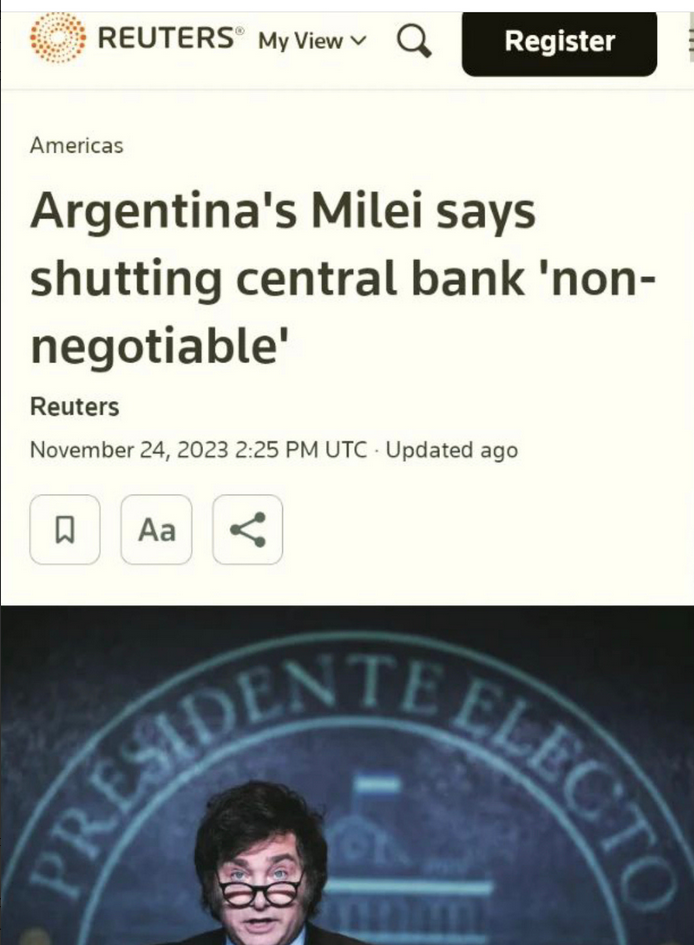
The challenge facing Javier Milei
Craig Pirrong outlines just how much work Argentinian President-Elect Javier Milei will have to accomplish to begin to bring Argentina’s government in line with his electoral mandate:

When I wrote Milei is not a leftist, let’s say that rather understates the matter. Milei loathes leftists and leftism, and repeatedly refers to them on television and in public appearances in scatalogical terms, calling them “leftards”. He despises collectivism, and asserts bluntly that leftists are out to destroy you. His mission is to destroy them first.
As someone so vehemently hostile to the left and well outside conventional political categories, Milei’s victory has triggered a mass moral panic, especially in the media. The New York Times coverage was (unintentionally) hilarious: “Some voters were turned off by his past outbursts and extreme comments over years of work as a television pundit and personality.” Well, obviously a lot more weren’t, but I guess one has to take solace where one can, eh, NYT?
Milei’s agenda is indeed a radical one, especially for a statist basket case like Argentina. To combat the country’s massive (140 per cent annualised) inflation, Milei says he will dollarise the economy and eliminate (“burn down”) the central bank. He also wants to reduce radically the role of the state in Argentina’s economy. He says he wants to “chainsaw” the government – and emphasises the point by campaigning with an actual chainsaw.
His election on this programme sparked a rally in Argentine financial markets, with government debt rising modestly and stock prices rallying smartly.
Will Milei be able to deliver? Some early commentary has doubted his ability to govern based on the fact that his party’s representation in the legislature is well below a majority. That may be an issue, but not the major obstacle to Milei’s ability to transform Argentina into what it was at the dawn of the 21st century: an advanced, rapidly growing economy and a relatively free society.
The real obstacle is one that is faced by anti-statists everywhere – the bureaucracy. (I do not say “civil service” because that phrase is at best aspirational and more realistically a patent falsehood. Akin to the Holy Roman Empire that was neither holy nor Roman, the “civil service” is neither civil nor a service.)
Argentina’s bloated state is its own clientele with its own interests, mainly self-preservation and an expansion of its powers. Moreover, it has created a whole host of patronage clients in business and labour. Milei’s agenda is anathema to this nexus of public and private interests. They will make war to the knife to subvert it.
Even a president with an electoral mandate faces formidable obstacles to implementing his agenda. The most important obstacle is what economists call an “agency problem”. The bureaucrats are agents of the chief executive, but it can be nigh unto impossible to get these agents to implement the executive’s directives if they don’t want to. Their incentives are not aligned with the executive, and are often antithetical. As a result, they resist and often act at cross purposes with the executive.
The modern chief executive’s power to force his bureaucratic agents to toe the line is severely circumscribed. At best, the executive can make appointments at the upper levels of the bureaucracy (such as the heads of ministries or departments), but the career bureaucrats who can make or break the executive’s policy are beyond his reach, and not subject to any punishment if they subvert the executive’s agenda.
November 28, 2023
Geert Wilders
Mark Steyn on the suddenly fascinating-to-American-media Dutch politician Geert Wilders, with whom he has had a long association:
Geert Wilders, leader of the Dutch Party for Freedom (PVV).
Photo by Wouter Engler via Wikimedia Commons.
Times are bad, and the respectable chaps are explicit about their eagerness to make them more so — more mass immigration, more green bollocks, more “digital identity”, more “variants” and more “public health”, more mutilation and sterilisation of your middle-schoolers …
This last week I’ve received a bazillion queries demanding to know what I make of Geert Wilders. It’s true that a lot of commentary on his victory is close to witless: in America, he is apparently “the Dutch Trump” — because they’re both, er, blond. As David Reaboi pointed out on Twitter, Wilders has been a thorn in the side of the Dutch state since the days when “Trump was donating to Democrats”. In 2005, when The Donald was still sufficiently “respectable” that Hillary Clinton attended his wedding, Wilders had already been expelled from his party for objecting to Turkish membership of the European Union.
So he’s been at this a long time – and yours truly goes back a long way with him. He did me the great honour of inviting me to write the introduction to his book, Marked for Death, which is a cracking read — not just my bit, but his parts too: Geert writes way better in English than most anglo politicians do. (We have a few copies at the SteynOnline bookstore, and I’ll even sign it for you: the perfect Christmas gift for the “far right” members of your family.)
But here’s the most relevant aspect of how Wilders was ahead of the game. I try not to let my own twelve years in the dank septic tank of Washington pseudo-justice get to me, but, as you know, for me the only salient point about this US election season is that the multitudes of prosecutors and judges of the American state are willing to torture the plain meaning of the nation’s laws in order to get Trump convicted of … something, anything, as long as it gets him banged up in gaol for the rest of his days.
This is the central fact of our increasingly post-democratic age: the criminalisation of political opposition. If you’re in European-style multi-party systems, they’ll deny you bank accounts and seize your kids’ iPads, and if necessary find twenty coppers to jump you in the street. But, if you’re in America’s bloody awful frozen two-party system, the leader of Party A will unleash the resources of the world’s most lavishly funded Deep State on the leader of Party B and persuade anyone around him to cop a plea on crimes they didn’t commit — mainly because those crimes don’t actually exist.
In that sense, rather than Geert being the Dutch Trump, Trump is the American Geert. Until Biden came along, no other settled western democracy had been as zealous as the Netherlands in prosecuting opposition politicians for their policy platforms.
November 27, 2023
“A law for which no enforcement mechanism exists is not a law. It is a LARP or a declaration of feeling”
Kulak takes on politics and violence:
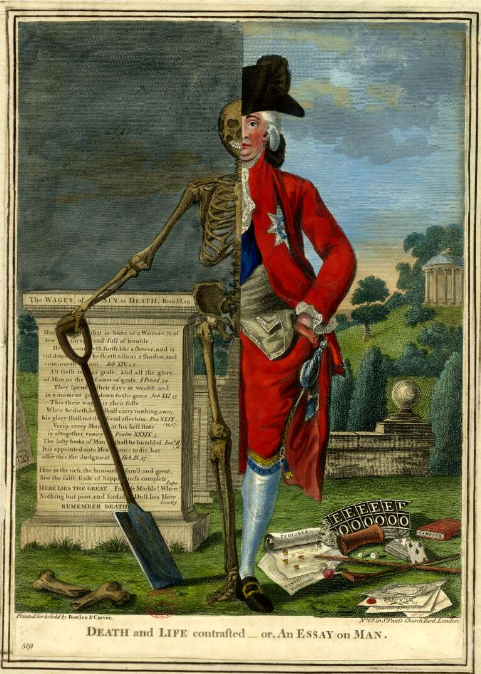
“Death and Life constrasted … or, an Essay on Man” by Robert Dighton, 1784.
British Museum number 1935,0522.3.55.
The power of any law comes from the fact that armed men stand ready to commit an escalating series of violence against those who do not comply. And even the lightest touch, subtlest “Nudge” laws gain their power via subtly manipulating the circumstances in which violence by state is already applied. (When you fill out the tax form you must fill out or be dragged to prison, this new law will let you fill in a box to receive $200 back if you have a dog … whom the IRS would shoot before taking you to prison if you had not surrendered the money to them in the first place)
To say someone has political power whether a voter, an activist, or a politician … is to say they can effect political outcomes such that they can make violence more or less likely to be exercised against someone.
If your political activism and activity is not connected to any mechanism to commit violence, whether through the states agents, or through an illegal organization … you are not a political actor. You are a “citizen”, “voter”, “activist”, “politician” in the same way the madman at the asylum is “Napoleon”, you may play-act with the symbols of power … but you do not interact with it.
All Political Discussion Terminates in Violence
All discussions of politics is inevitably, and CAN ONLY BE, a conspiracy to commit violence, whether legally through the state, illegally through some form of direct action or “terrorism”, or Stochastically through some impact on the culture or wider discussion which will make the prior two more likely or effect their nature.
If your supposedly political speaking’s have no connection to state or non-state “policy” Ie. Violence … then they are not political. You are engaged in fantasy at best, grovelling at worst.
This is why so many in the safety brigade and regime are not incorrect when they call the political speech of their opponents “Dangerous” or a form of “violence” all political speech is necessarily, by the nature of being political, directed to altering the atmosphere, calculus, mechanisms, and willing committal of state and non-state violence.
.
None of this should be shocking
Clausewitz observed “War is politics by other means”
Vladimir Lenin observed the inverse: “Politics is warfare by other means”
In both they merely restated Hobbes: The state of nature is a state of war and peace is merely an artifice mutually consented to by all sides under a sovereign … which can be unilaterally terminated at will by any party, and rationally must be terminated in any one of a thousand circumstances.
That Rights and Liberties are “Given by God” is a euphemism for the violence and threat implicit in the claims of free men.
The founders saying their rights were “endowed by God”, was no different than Carolus Rex declaring he was “Chosen by Heaven” … It was a euphemism and a flex that their violence and dominance of fate had left them masters of their domain, and that they’d meet any challenge with as much violence as a crusader or Inquisitor would visit upon a heretic challenger.
November 26, 2023
It’s apparently political earthquake season
Elizabeth Nickson wonders if you can feel the Earth shaking in your area:
Did you hear the roar on the streets when Milei won Argentina? It built and built, and then everyone was out on the streets shouting, from windows, inside shops, houses. It is the future, all over the world. The Netherlands on Friday. Same same. Universal rejoicing.
Absurdistan does a solid line in doom, but our firmly held first principle is that every single one of us should be two or three times as rich, with massively increased scope and ability to do the things we want to do. Defeating the criminal cartel that runs Big Pharma, Big Ag, Big Government, Big Tech and Big Charity will light up the galaxy if not the universe. And … this. Especially this:
Unlike almost everyone in the media, Absurdistan knows regulation is the principal reason we are hornswoggled serfs. Even Trump’s team was surprised at the economic boom that came from his mild de-regulation; they thought tax relief was the key. It was important, none of us should be paying more than 25% in taxes, if that, but the regulation! You have no earthly idea how fiendish it has become until you start a business or require permission to create anything in the material world. Few journalists ever do that, the most they do is join a bank in “communications”, design an app or website, do PR, or “consult”. They are virtually, to a man or woman, children in the real world. So no one reports on the most brutal crippler of every man, woman and child on earth. Equally, virtually no writer I read has any grasp on the ingenuity, the creativity, the strength of the ordinary man. They all seem to think we need guidance from them, which is laughable. They have screwed up everything so utterly, we teeter daily on the edge of fiscal catastrophe.
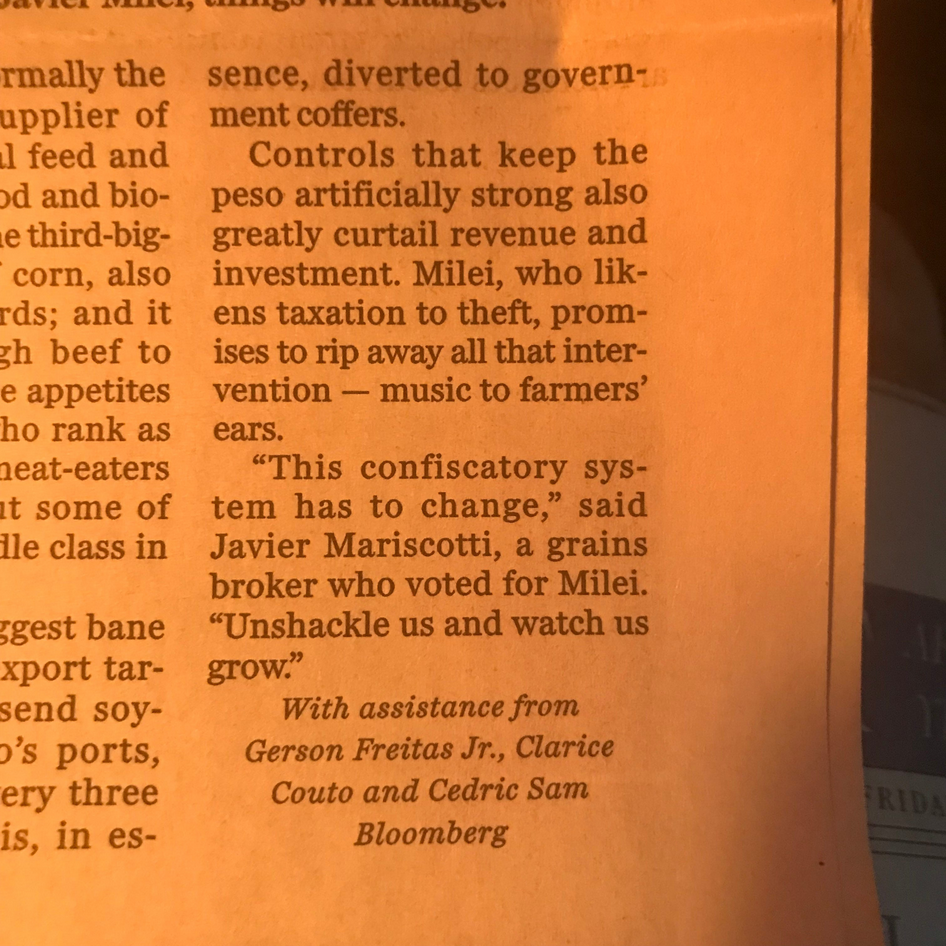
Bloomberg reports on Milei victory
When Vivek Ramaswamy proposed instantly firing 50% of federal bureaucrats on Day One, I stood on my office chair and cheered.
When Javier Milei tore strips of paper representing government ministries off the whiteboard, I had to go out and run around the house a few times.
Africa is not limited by anything but confiscatory corrupt government, as asserted by Magatte Wade in her new book. Wade should be running things in Africa, which is polluted by commies, plutocrats, crooked multinationals, ravening bureaucrats, corrupt politicians and the brutalist green movement. The Chinese would stun the world if they could get rid of the vicious predatory communist regime that enslaves every man, woman and child. And not in the sense that they are “taking over”.
The mop-up will take decades. But unpicking the bad regs and shooing the bad legislators off to permanent exile, prosecuting the army of government thieves, and creating a multi-polar world, will be more absorbing than our endless self-cherishing, self-indulgence. Have we not all shopped enough? We have powerful enemies, but they are fully aware of how destructive they have been, their guilt written on their exhausted pouchy faces.
Trump is a symptom, not a cause
People fighting the Borg wish for leaders but this is not a movement that requires leadership by anyone but each and every one of us. Trump is a symptom, not a cause. This is multi-headed, like Medusa, representing tens, hundreds of millions of individuals saying NO. Real politicians like Mike Johnson, Geert Wilders, Pierre Poilievre, Javier Milei, and Danielle Smith are listening to us and stepping up.

November 23, 2023
QotD: The Austrian and Chicago schools of economics
War propelled the “Austrian” thinkers westward, and the fall of the Berlin wall propelled the “Chicago” school east. The terms no longer have geographical significance.
What all classical liberals have in common is the passionate vindication and defence of human freedom. That is what makes them, unlike progressives, readable in subsequent generations. Their subject matter cannot become dated. The “Austrians” are also necessary to understand modern history, positively as well as negatively, in the evolution of, for instance, the Christian Democratic movement that conceived a peaceful post-war Europe, in defiance of secularizing bureaucratic trends and mass-man “ideals”. Alas, this was overall defeated by the Eurocratic trend-setters, determined to build a magnificent autocratic monument to themselves.
I have the most enchanting memory of opening the box that contained an American reprint of Human Action (big thick book), which I had ordered at the age of fifteen. I no longer own a copy, but gather it still stands as a monument to the resistance — a study of “praxeology”, or purposeful human choices, stretching so wide that even religion and morality could be touched. (Conventional economics has no time for either.) A half-century later, I can even remember the construction of an earnest reading list, that was soon abandoned when I went on the road.
One may see the great division in Western thought and politics, which the Austrian-school Friedrich Hayek traced back to Bacon and Descartes, and can be traced farther to the Nominalists of the later Middle Ages. Humans live in freedom and make choices, to be restrained only by the plainest moral codes. Or, by the alternative thesis, we are components of a machine, which the man with Power can monkey with, by implanting stimuli here and there.
We are creatures of God, or — we are replaceable parts in a bureaucracy.
David Warren, “Austrian schoolboy”, Essays in Idleness, 2019-09-17.
November 21, 2023
“I couldn’t believe I was sitting in a court room where the prosecution discussed the interpretation of Bible verses”
In First Things, Sean Nelson recounts the trials of Päivi Räsänen, a Finnish parliamentarian who has been through several years of legal tribulation for expressing her religious views publicly:

Päivi Räsänen, Finnish parliamentarian
Finnish government photo via Wikimedia Commons.
“Blessed is the man who perseveres in the trial,” declares the Epistle of James. Finnish Member of Parliament Päivi Räsänen should count herself doubly blessed this week. She has now persevered through two trials over more than four years of legal troubles brought on merely for expressing her Christian faith. Following both trials, she has not only been acquitted, but also has been a shining example of a modern Christian life fearlessly lived.
On Tuesday, a Finnish Court of Appeal unanimously found MP Räsänen not guilty under Finland’s “hate speech” laws. If the decision stands — there is still a possibility of appeal to Finland’s Supreme Court — it will represent a bulwark for Christians and all people of good will wishing to live out their faith and contribute to social conversations over contentious issues.
Räsänen’s legal saga began on June 17, 2019. On that day, she tweeted a criticism of her church’s participation in a Helsinki Pride parade. She also included a picture of verses from her home Bible. Her case has come to be known as the “Bible Trial”.
Because she is a long-serving member of Parliament and a former Minister of the Interior, her tweet drew the ire of Finnish officials. While an initial police investigation found nothing criminal in her tweet — even writing that sounds absurd — the prosecutor’s office re-opened the matter to comb through her entire history of public utterances. The Helsinki prosecutor came back with an allegedly offensive pamphlet published in 2004 and a live radio interview from 2019. Räsänen was then charged with three counts of “hate speech” under a criminal code provision originally related to war crimes.
During her first trial in January 2022, the Helsinki prosecutor probed Räsänen with theological questions. Was it really possible to separate sin from the sinner, and condemn the former while loving the latter? Basic Christian belief rests on the distinction, as Räsänen explained, but the prosecutor was not convinced. Räsänen reflected at the time, “I couldn’t believe I was sitting in a court room where the prosecution discussed the interpretation of Bible verses”.
In March 2022, the trial court delivered a resounding victory for Räsänen, unanimously finding her not guilty. “It is not for the district court to interpret biblical concepts,” it said.
Javier Gerardo Milei, President-elect of Argentina
On the current evidence, Argentina has finally decided to turn away from both communism and Peronism to try something radically different in the person of newly elected Javier Gerardo Milei, variously described (disapprovingly) in the English-language press as “far right”, “extreme right”, “Trump-like”, and most alarmingly, “libertarian”. Here’s what Wikipedia had to say about him (before the edit wars get serious on his page):

Javier Milei, 8 October 2022.
Photo attributed to Vox España via Wikimedia Commons.
Javier Gerardo Milei (/miˈleɪ/ mee-LAY, Spanish pronunciation: [xaˈβjeɾ xeˈɾaɾðo miˈlej]; born 22 October 1970) is an Argentine politician, economist, and author who is the President-elect of Argentina.[1] Before rising to political prominence, Milei initially gained notability as an economist, as the author of multiple books on economics and politics, and for his distinct political philosophy.
As an economist, Milei is a vocal proponent of the Austrian School. He has critiqued the fiscal policies of various Argentine administrations and he advocates for reduced government spending. As a university professor, he has taught courses in macroeconomics, economic growth, microeconomics, and mathematics for economists.[2] He is also the author of numerous books and has hosted radio programs, including Demoliendo mitos and Cátedra libre. In 2021, he entered politics and was elected as a national deputy representing the City of Buenos Aires for La Libertad Avanza. During his tenure, he limited his legislative activities to voting, focusing instead on critiquing what he describes as Argentina’s political elite and its propensity for high government spending. Milei has pledged not to raise taxes and has donated his national deputy salary through a monthly raffle. He was a presidential candidate in the upcoming 2023 general election,[3] with Victoria Villarruel as his vice-presidential running mate.[4] He advanced to the run-off of the presidential election, in which he faced Sergio Massa.[5] On 19 November 2023, he won the run-off election with 56% of the vote to Massa’s 44% to become President-elect.[6]
David Warren certainly seems to like the cut of Milei’s jib:
Mr Milei not only swept the “youth” vote, but he did that while declaring: “Killing children is not a human right!” He mocked an accumulation of political corrections, while dropping a few more “flinch bombs” worthy of the XVIIth-century bishops who evangelized that country.
The outgoing president, another tedious Peronist like our pope, shared the old presidential palace with decorative plants. Carlos, my correspondent, claims that he could make Justin Trudeau look intelligent. If true, this would be an extraordinary accomplishment. He also leaves an amazing national debt, hyperinflation, energy shortages, &c.
Mr Milei seems to have won as Mr Trump once did in the United States: by not flinching. A point may be reached in national decline when even the young will pitch out the Peronistas. Godspeed to them, when they reach this point.
Nevertheless, one must continue to despise politics. Carlos echoes Borges: “No matter how bad an Argentine government is, the next will be worse”.
The Buenos Aires Times, quoted by Brian Peckford:
Milei promised to return Argentina, one of the richest countries in the world a century ago, to its former glory, after decades of stagnation, mostly under the populist Peronist coalition – big on welfare and government spending.
The president-elect vowed “a limited government, respect for private property and free trade. The model of decadence has come to an end. There is no way back.”
Milei offered special thanks to former president Mauricio Macri and failed opposition presidential candidate Patricia Bullrich, who threw their support behind him after defeat in the first round and helped bring over their voters to his force.
He also thanked scrutineers from his party and those from the opposition PRO party that had worked to protect and count votes at polling stations.
Milei ended his speech with his traditional trademark rallying call: “Viva la libertad carajo!” (“fucking long live freedom”).
News of the libertarian’s victory prompted wild scenes from supporters on the streets of Buenos Aires. The area around the Hotel Libertador, his traditional bunker for election night, was swamped by revellers celebrating his win.
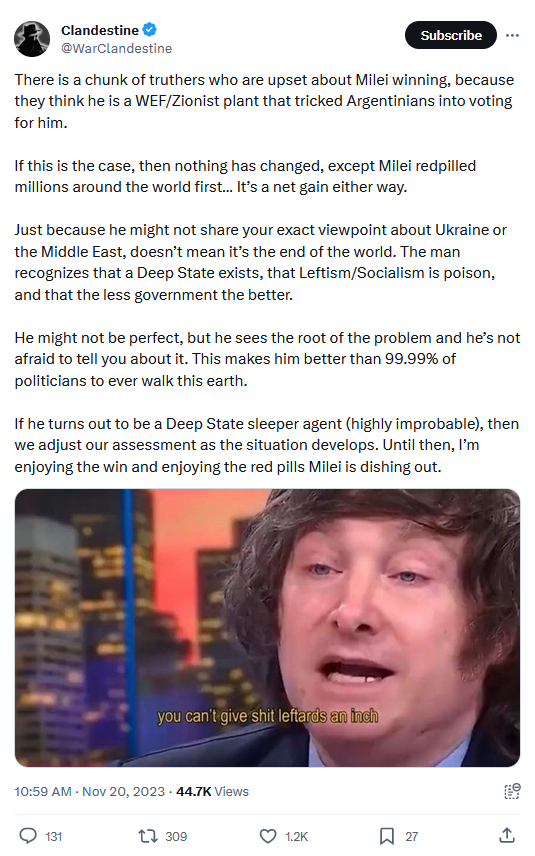
It’s often said that socialists will dismiss any failures by socialist governments by declaring that it wasn’t “real socialism”. This is equally true for other political and philosophical beliefs:
November 16, 2023
Why progressives love all forms of public transit
Theophilus Chilton reminds conservatives and other non-progressives that trains, buses, and other forms of mass transit are beloved of the left at least partly because the more people depend on it, the more control the government gains over their freedom of movement:

TTCImages by Canadian8958
Wikimedia Commons
Ask most people on the broad Right what they think about public transportation and they’d probably tell you that they don’t like it. And it’s not just because of the smell and the gum stuck to the seats. Most of us, deep down inside, at least in some subconscious way, feel that mass public transportation is just a little bit communist.
[…]
This is probably much of the reason why we’re in love with the automobile. With the wide-open spaces and abundant road system we enjoy in America, most Rightists would never dream of trying to force everyone to use an archaic, 19th century technology like trains now that we don’t have to. The automobile is a symbol of freedom. You can go wherever there’s a road, no matter how big or small, when you’re in an automobile. You’re not boxed in with dozens of other people on a line that goes one place only. This is why we generally tend to view air travel as a necessary evil — if somebody invented a car that could get us from Boston to Los Angeles in six hours for a business meeting, we’d probably opt for that instead of getting groped by your friendly neighborhood TSA agent.
Progressive leftists know all of this. They know that the freedom to travel where we want, when we want, how we want, is a psychological buttress to our sense of liberty. Pod-people stay put and go where they’re told. Free men hop into their ’67 Mustang and lay rubber in front of a Dairy Queen three towns over from their own.
Hence, in their never-ending quest to gain total control over our lives, the Left has been putting into play a number of plans designed to limit our freedom of travel.
In case you weren’t aware, one of the purposes served by forcing gasoline prices sky-high is to make private automobile travel prohibitively expensive for more and more people. This has been a major thrust in the “global warming” nonsense that the Left has pushed as well — cars supposedly account for the lion’s share of carbon dioxide emissions (even though they actually don’t), so their use needs to be reduced. Way back in the Obama administration, somebody in the Congressional Budget Office accidentally let the cat out of the bag that it would be a great, absolutely smashing, idea to tax Americans for each mile they drive. Every so often the idea gets resurrected in the media, but thankfully doesn’t seem to have gotten much traction yet. Of course, this is essentially what already happens to us anywise, since we have to pay taxes on each gallon we buy to drive those miles. Presumably, this mileage tax would be added on top of the gas taxes already in place.
The whole point to this is not to “stop global warming”. Let’s face it, those in the know at the top of the progressive hierarchy know that global warming is a hoax. They know it’s just prole-feed for the useful idiots in their own ranks and for the easily swayable among the public at-large. The point to inducing people to stop driving cars is not to save the earth, but to reduce the freedom of movement that people have. Take away cars and you take away the ability of most people to travel for pleasure. You take away their means of conveniently conducting much of their commerce and other business. You would prevent them from being able to have forest hideaways and beach homes. In short, you prevent the middle and working classes from having the same things that the rich can have, you keep them from having lifestyles that even begin to approach the type, if not the extent, of the global transnational elite. Most of all, you would take away that psychological sense of freedom that the ability to move about unhindered gives to people. It’s about forcing us all into the Agenda 2030 “You’ll own nothing and be happy” scenarios that the globalist world-planners have prepared for us.
More recently, and more concretely, is the Congressional effort (which ineffectual Republicans failed to stop) that would direct automobile manufacturers to include a “kill switch” into all vehicles made after 2026, a device which would allow authorities to shut down a vehicle remotely. Ostensibly, the reason would be if the driver is acting like he or she is driving while impaired (i.e. it’s FoR yoUr SaFeTy!!1!). Of course, we know the actual reason is to provide bureaucrats and functionaries in the managerial state the means to freeze the movement of dissidents and others who run afoul of the Regime’s dictates. Don’t think they’d do that? Well, these are the same people who just put the infant son of a J6 defendant on the no-fly terrorist watch list.
So, what would have to replace private automobile travel, once nobody but the super-rich will be allowed it? Public mass transportation, of course. Buses, light rail, subways. This has already largely happened to those poor unfortunates who dwell within our large cities and for whom the lack of parking, expensive personal property taxes, and archaic road systems have already removed the automobile from being a viable alternative. The lefties work to extend this system even to places, such as smaller cities, the suburbs, and even the exurbs, where such systems normally would not be “needed” or desired. Make parking in the city so scarce as to be impossible to find, or so expensive that you’d rather take the bus. Provide “free” bus service (paid for by the taxes of productive, automobile-driving people, of course) to encourage people to stop polluting. In several places, the lefties keep trying to push their light rail boondoggles so that the system can be extended between cities — no more need to have people killing Mother Gaia with highway driving. These public systems are there to take up the slack once private transportation is turned into road pizza.
So how does this affect our freedom? Well, it’s because of the fact that mass transportation is inherently restrictive in its approach to people delivery. A bus route can’t include every single possible place that people might want to get on or off the bus. It only follows certain routes. Same with AmTrak, with light rail, subways, etc. It’s easier, then, to control the access which people have to transportation.
November 14, 2023
QotD: Don’t bother trying to reason someone out of a position they never reasoned themselves into
We’re dealing with emotion, kameraden. Think of your last big fight with your girlfriend, and let me know how well your unassailable facts, your airtight logic, worked out for you.
That’s the reason the old Right (back when that term meant something) lost every fight with the Left. Even when they saw it, they didn’t really grasp it. For instance, there’s a reason I’ve never read a single other word by Henry Hazlitt, though he was a big league public intellectual in his day — he saw, but he didn’t know:
The whole gospel of Karl Marx can be summed up in a single sentence: Hate the man who is better off than you are. Never under any circumstances admit that his success may be due to his own efforts, to the productive contribution he has made to the whole community. Always attribute his success to the exploitation, the cheating, the more or less open robbery of others. Never under any circumstances admit that your own failure may be owing to your own weakness, or that the failure of anyone else may be due to his own defects – his laziness, incompetence, improvidence, or stupidity.
That’s the best definition of “Leftism” ever penned. It describes Social Justice Warriors perfectly, though it was written in 1946. And still Hazlitt, like all his brethren on the Right, still kept trying to reason Leftists out of their Leftism.
Severian, “Crossing the Bar”, Rotten Chestnuts, 2021-04-06.
October 5, 2023
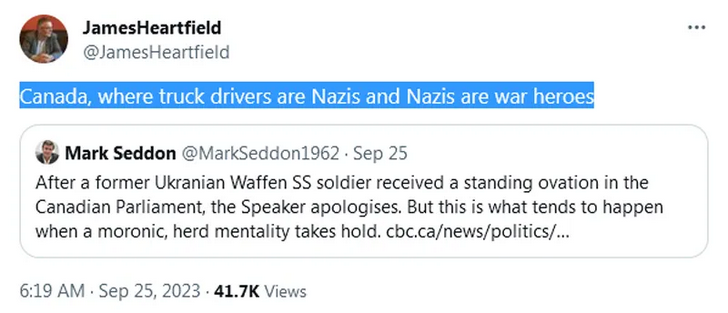
“Canada, where truck drivers are Nazis and Nazis are war heroes”
Donna LaFramboise on the “Coutts Four” — bona fide political prisoners of the Canadian state:
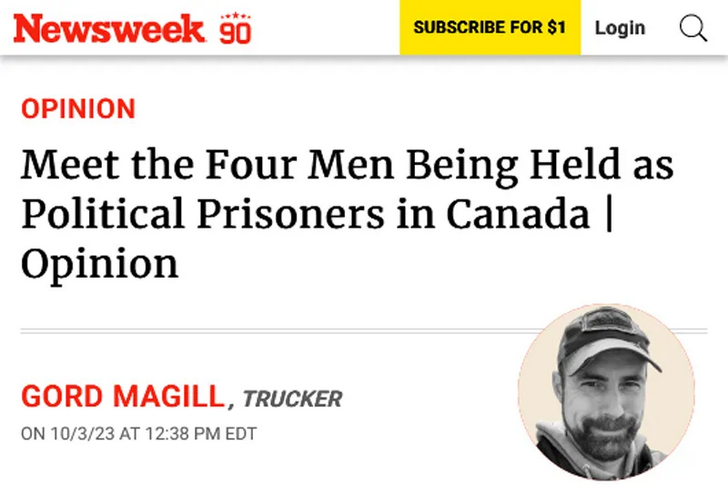
Gord Magill has a lengthy article over at Newsweek titled Meet the Four Men Being Held as Political Prisoners in Canada. These individuals are jointly accused of conspiring to murder police officers during a protest in Coutts, Alberta around the same time that the Freedom Convoy truckers were in Ottawa.
That’s a very serious charge, of course, but evidence appears scarce. I’ve not personally investigated this matter, but a former Toronto police detective named Donald Best has. In July, he outlined a long list of concerns, in addition to pointing out that “Everybody makes bail in Canada” — including the man “currently accused of the first degree murder of Toronto Police officer Jeffrey Northrup”.
Yet the Coutts men — three of whom have no criminal record — have been held without bail for nearly 600 days. Since they are legally innocent until proven guilty, this is horrifying.
As Gord writes in Newsweek, we are a country in which hard-working Canadians are called Nazis by the same Prime Minister whose government recently recognized an actual Nazi with a standing ovation in the House of Commons. What a strange state of affairs.
After speaking to each of the Coutts four, Gord provides a wealth of new info about them. These are working class guys — a power lineman, the owner of a small construction company, a master electrician, and a contractor. Three of them have children as young as 9, 10, and 11. Gord says only two of them “knew each other prior to their arrest”. It’s difficult to imagine a more unlikely group of cop-murder conspiracists.