Quotulatiousness

March 18, 2013

Will the Cyprus bailout set the fuse to a new Great Depression?

Filed under: Economics, Europe, History — Tags: , , , — Nicholas @ 00:01

History may not repeat itself, but it’s quite likely that it paraphrases itself instead:

So, this is going to be a very sour reading of what has happened in Cyprus this weekend. It will also be a very partisan one, possibly even a partial one. But if Milton Friedman and Anna Schwartz were right in their insistence that it was actually the Federal Reserve that caused the Great Depression (which is something that Ben Bernanke himself has insisted that the Fed will not repeat) then one way of interpreting what has happened is that the European Central Bank has just set us all up for another Depression. The trigger is that “tax” of a little over 6% on all depositors.

This isn’t an analysis that you’ll be able to get all economists to sign up to. But the basic story told by Friedman and Schwartz in A Monetary History of the United States was that the 1929 crash was indeed a serious crash. But it would not have led to the Great Depression without the Federal Reserve making some serious mistakes. Two of which were to allow the intertwined collapses of both the money supply and the banking system. Given that it is the banks that create credit and thus the wider money supply they are, to a great extent, the same thing.

[. . .]

But please note the central part of Friedman’s argument. Yes, there was the crash. Yes, there would have been a deep and painful recession as a result. But the tipping of that recession into depression was a result of the cascading series of bank failures in the absence of deposit insurance: that led to the calamitous shrinking of credit and the money supply.

So let us now look at Europe and the eurozone. Certainly there’s been a crash (or even a Crash). We’ve so far avoided the depression part (although not everywhere. Greece is certainly in one, Spain possibly and looking out my window at rural Portugal I see certain signs of a reversion to a non-cash economy.) but the important question is whether we manage to continue to do so?

[. . .]

Yes, I do know, they’ve called it a tax: but here we’ve got to make reference to that duck thing. The difference between a 6% or more “tax” on your bank deposit and a failure of the previously agreed deposit insurance to protect your deposit is quackery enough that it’s a duck.

As I’ve said before the importance of this is moot at present. It depends on who believes what. If the citizenry believe that they don’t have deposit insurance any more (whether we call this a tax or a duck) then we will see more mass withdrawals from banks and we will see more bank failures. And cascading bank failures are exactly the thing that will tumble us into a new depression.

March 17, 2013

Celebrating 60 years of being Stalin-free

Filed under: History, Russia — Tags: , , , — Nicholas @ 11:19

In Reason, Cathy Young looks at the bloody legacy of the Soviet dictator and his startling popularity in modern day Russia (and the west):

The 60th anniversary of the death of one of history’s most murderous tyrants has passed with relatively little notice. Yet the shadow of Soviet dictator Joseph Stalin, who died on March 5, 1953, still hangs over post-communist Russia — and has yet to face proper judgment in the West. This is one bloody ghost still waiting for its final exorcism.

During the years of his absolute rule over the Soviet Union from 1928 to 1953, Stalin was responsible for the deaths of at least 20 million people. They included victims of state-engineered famines, particularly in Ukraine, intended to starve the peasantry into submission to collective farming; people from all walks of life shot on trumped-up charges of subversive activities; and others sent to the Siberian labor camps known as the gulag, never to return. Untold millions who survived lost years of their lives to the gulag. (Among the latter were my own paternal grandparents, who were arrested in 1947 and released after Stalin’s death; ironically, unlike most of their fellow prisoners, they were actually guilty as charged — of “betraying the motherland” by trying to escape the Soviet Union and go to Palestine.)

If there was ever a true devil in the flesh, Stalin was one of the prime candidates for the title. A tyrant with a deeply sadistic streak, he reportedly howled with laughter when told about the final moments of a former associate who had been promised clemency in exchange for a false confession and vainly begged his executioners to “please call Comrade Stalin” and clear up the misunderstanding. He jailed the wives of several men in his inner circle, presumably just for the pleasure of seeing his underlings squirm and showing them who’s boss.

Yet four years ago, this monster came close to being chosen as history’s greatest Russian in a nationwide Internet and telephone vote. Though the voting was not representative, actual polls also yield discouraging results. In a survey conducted last month by the Levada Center, a respected independent polling firm, almost one in 10 Russians said that Stalin’s role in Russia’s history was “entirely positive” while another 40 percent saw it as “mostly positive.” Fewer than a third believed it was entirely or mostly negative, while the rest were not sure.

Debunking St. Patrick

Filed under: Europe, History, Religion — Tags: , , — Nicholas @ 10:02

In Slate, David Plotz separates the myth from what is known about the real St. Patrick:

Today we raise a glass of warm green beer to a fine fellow, the Irishman who didn’t rid the land of snakes, didn’t compare the Trinity to the shamrock, and wasn’t even Irish. St. Patrick, who died 1,507, 1,539, or 1,540 years ago today — depending on which unreliable source you want to believe — has been adorned with centuries of Irish blarney. Innumerable folk tales recount how he faced down kings, negotiated with God, tricked and slaughtered Ireland’s reptiles.

The facts about St. Patrick are few. Most derive from the two documents he probably wrote, the autobiographical Confession and the indignant Letter to a slave-taking marauder named Coroticus. Patrick was born in Britain, probably in Wales, around 385 A.D. His father was a Roman official. When Patrick was 16, seafaring raiders captured him, carried him to Ireland, and sold him into slavery. The Christian Patrick spent six lonely years herding sheep and, according to him, praying 100 times a day. In a dream, God told him to escape. He returned home, where he had another vision in which the Irish people begged him to return and minister to them: “We ask thee, boy, come and walk among us once more,” he recalls in the Confession. He studied for the priesthood in France, then made his way back to Ireland.

He spent his last 30 years there, baptizing pagans, ordaining priests, and founding churches and monasteries. His persuasive powers must have been astounding: Ireland fully converted to Christianity within 200 years and was the only country in Europe to Christianize peacefully. Patrick’s Christian conversion ended slavery, human sacrifice, and most intertribal warfare in Ireland. (He did not banish the snakes: Ireland never had any. Scholars now consider snakes a metaphor for the serpent of paganism. Nor did he invent the Shamrock Trinity. That was an 18th-century fabrication.)

March 6, 2013

Magnificent Machines – The Golden Age of the British Sports Car

Filed under: Britain, History — Tags: — Nicholas @ 00:01

March 5, 2013

David Friedman reviews The Birth of the West by Paul Collins

Filed under: Books, Europe, France, Germany, History, Media, Religion — Tags: , , , — Nicholas @ 10:21

David Friedman on the recent book The Birth of the West: Rome, Germany, France, and the Creation of Europe in the Tenth Century, by Paul Collins.

Take five or six soap operas set in central and western Europe in the 10th century. Chop in pieces, stir, and glue together more or less at random. You now have something reasonably close to the picture that emerges from The Birth of the West, 427 pages of 10-century history as presented by the Australian author and broadcaster Paul Collins. The reader is left wondering whether the chaos is a bug or a feature, a failure of the author to shape his material into a coherent story or a deliberate attempt to show the reader the chaos of the period.

[. . .]

The most interesting thing about the book may be what it implies about how much we do not know. Thus, for instance, Collins offers a lurid account of Theodora and Marizia, a mother and daughter heavily involved in papal politics. (Marizia was supposedly the mistress at age 14 of an 80-year-old pope.) He then mentions that his source was writing 50 years after the events he describes, that another source presents a much more attractive picture, and that both have axes to grind. But he goes on to treat the first account as accurate. He offers a glowing portrait of Theophano, a Byzantine princess who became the wife of Otto II and mother of Otto III, dismissing a much more critical picture from a contemporary source. A historian with a different set of biases could have given us an equally convincing version in which some of the good guys and bad guys switched hats.

[. . .]

Collins presents the conventional view of the dominant role of religion in medieval Europe, cites several books by the French medievalist Georges Duby, but not the one in which Duby argues that the picture is badly distorted by the fact that almost all of our sources are clerical. The point is relevant for modern sources as well: Collins himself spent much of his life as a Catholic priest before resigning over a dispute with the Vatican and taking up a second career as writer and broadcaster.

None of that means that the story he tells is wrong. The modern reader inclined to take any single historical view as gospel might consider how much disagreement there is on issues for which we have enormously better information — the Vietnam War, say, or the evaluation of controversial political figures such as FDR, Reagan, or Thatcher. It does not even mean that the book should have been written differently. The story Collins tells is confusing enough as is; it would be far more confusing if he had tried to keep all of the alternative narratives going at once. And, to his credit, while he tells a single story, he makes it clear that alternatives exist — almost all of my critical comments are based on information he himself presents. I would not recommend the book as light reading, but it does provide a vivid picture of the century.

February 27, 2013

RIP Allan B. Calhamer

Filed under: Gaming, History — Tags: , , , , — Nicholas @ 14:33

The creator of the game Diplomacy died this week:

I was a big fan of the game for many years, even publishing a play-by-mail “zine”, as I mentioned a couple of months back:

Long ago, in the days before personal computers were ubiquitous, there were “zines” (short for magazines, correctly reflecting both non-professional status and less-than-totally-serious content). There was a wide variety of zines for all sorts of interests — rather like the back corners of the internet today, except they were physically distributed using the post office (and therefore had to stay within certain boundaries to be safe). Clive and I used to publish a zine for postal Diplomacy:

Infidel 11 cover
Download PDF
Infidel 12 cover
Download PDF

Update: Should have included a hat-tip to John Kovalic, who linked to a highly appropriate Dork Tower strip from last year.

Update, the second: The Chicago Sun-Times obituary:

To people in La Grange Park, Allan B. Calhamer was the guy who delivered the mail.

But to those who have played Diplomacy — the popular board game he invented while a law student at Harvard — Mr. Calhamer, who died Monday, was a geek god.

Back in the Fortran era, the game was a sort of board-game version of TV’s Survivor set in pre-World War I Europe, with its shifting alliances, deception and back-stabbing.

[. . .]

In an article he wrote for diplomacy-archive.com, Mr. Calhamer said the game can “make some people almost euphoric and causes others to shake like a leaf.”

“It’s pitiless because, in the game Diplomacy, there will be one winner,” said game designer Steve Jackson, founder of Steve Jackson Games. “You negotiate, you make deals, you lie.”

Game experts and industry analysts say “Dip” influenced generations of designers.

More than 50 years after Mr. Calhamer invented it, enthusiasts still engage in Diplomacy all-nighters, their long stretches of quiet strategizing punctuated by occasional shouts like: “You gave me your word you would attack Berlin!” And: “My own mother took part of Russia from me!” That’s according to chatter on boardgamegeek.com.

The game is jokingly referred to as a pastime that has been “Destroying Friendships since 1959,” said Mike Webb, vice president of marketing and data services for Alliance Game Distributors.

February 26, 2013

Kipling rediscovered

Filed under: Britain, History, Media — Tags: , — Nicholas @ 17:27

In the Guardian, Alison Flood talks about the newly discovered Rudyard Kipling poems:

Kipling scholars are celebrating the publication of lost poems by the author whose exhortations in “If” to “keep your head when all about you / Are losing theirs and blaming it on you” are regularly voted the nation’s favourite poem. Discovered by the American scholar Thomas Pinney in an array of hiding places including family papers, the archive of a former head of the Cunard Line and during renovations at a Manhattan house, more than 50 previously unpublished poems by Rudyard Kipling will be released for the first time next month.

The collection includes several poems dating from the first world war, which Kipling initially supported, helping his son John to gain a commission in the Irish Guards.

A short poem, “The Gambler”, finishes with the couplet: “Three times wounded; three times gassed / Three times wrecked – I lost at last”, while another fragment runs: “This was a Godlike soul before it was crazed / No matter. The grave makes whole.”

After his son’s death at the Battle of Loos in 1915, Kipling regretted his earlier enthusiasm for the conflict, writing in his “Epitaphs of the War”: “If any question why we died / Tell them, because our fathers lied”.

Why did Machiavelli write The Prince?

Filed under: Books, History, Italy, Media — Tags: , , , — Nicholas @ 10:45

In History Today, Alexander Lee discusses the situation in Florence leading up to the time when Niccolò Machiavelli wrote his (in)famous work:

In 1512, however, everything fell apart. After a series of military defeats, Soderini was forced from office. With the help of Pope Julius II, Giuliano di Lorenzo de’ Medici was installed as the de facto ruler of Florence. The Republic collapsed.

Immediately, Giuliano purged the government and instituted a city-wide witch-hunt. As a prominent republican, Machiavelli was summarily dismissed from his positions in late 1512, and in 1513, a warrant was issued for his arrest. Accused of plotting against the Medici, he was tortured using a cruel technique known as the ‘strappado’ — which left his shoulders dislocated, and his whole body in excruciating pain — before being released and exiled to his country estate.

It was at this point that Machiavelli penned The Prince. Broken, depressed, and penniless, he saw it as his best chance of getting into the Medici’s good books, and of recouping his losses. Dedicating the book first to Giuliano di Lorenzo de’ Medici — the very man who had destroyed his life — and, after Giuliano’s death, to his nephew, Lorenzo, Machiavelli set out to provide not just a guide to princely government, but a positive justification of all of the terrible things to which he had fallen victim. Much like a fallen Politburo members at a Soviet show trial, Machiavelli defended his persecution in the hope of securing favour. Only later did he feel safe enough to express his republican sympathies more openly.

February 25, 2013

What Argo doesn’t show about “The Canadian Caper” of 1979

Filed under: Cancon, History, Middle East, USA — Tags: , , , , , — Nicholas @ 13:15

In Maclean’s, one of the American diplomats who took part in the actual hostage drama in Tehran provides a bit of supplementary material to the film Argo:

Ben Affleck’s Argo has stormed box offices, collected awards [. . .] yet Canadians of a certain age may find themselves thinking: This is not quite how I remember those days. I was there when Iranians took over the American Embassy in Tehran, and it is not quite how I remember them either. Argo is terrific entertainment, but it tells only a part of our story, and says nothing at all about many of the real heroes — most Canadian — who helped rescue us. Before Argo came along, our rescue was routinely called the “Canadian Caper.” It still should be. The operation consisted of four distinct phases. Three were almost entirely Canadian, and only one involved significant U.S. assistance.

For those not of a certain age, a brief summary is a good starting point. Nov. 4, 1979 brought cold rain and hinted of trouble of a different sort. Two weeks earlier, then-president Jimmy Carter decided to admit the former shah of Iran to the U.S. for cancer treatment. Iranians were outraged; many suspected it was a plot by the U.S. Central Intelligence Agency to remove Iran’s new ruler, Ayatollah Ruhollah Khomeini, and put the shah back in charge. Protests outside Tehran’s U.S. Embassy had become daily occurrences. That November morning, demonstrators climbed the gate and soon controlled the compound.

[. . .]

Phase four always receives the least attention. The U.S. government was desperate to keep the CIA’s role secret, rightly fearing its disclosure might endanger the hostages (who weren’t freed until 1981). This concern was sufficiently real that we were asked to live under false names in Florida until the hostages were set free. I was looking forward to seeing how many speeding tickets my alter ego could accumulate, but La Presse decided to publish Jean Pelletier’s story once the Canadian Embassy in Tehran had closed. We came home to a rousing reception and the Canadians were asked to claim complete credit for our escape. That job understandably fell to ambassador Taylor, who spent the better part of a year on the rubber chicken circuit at receptions to honour the Canadian government and people for helping us. Some have said he did the job too well, or failed to share the credit with other embassy staff. My own experience contradicts this. I heard Taylor speak several times. He always mentioned his staff. I also tried, during press interviews I gave, to mention others, particularly the Sheardowns. My comments were edited out. It seemed the press could handle only one hero at a time. Unfortunately, this meant John Sheardown, who was indispensable in phase one, became invisible in phase four. I truly believe John did not care. He did his duty as he saw it. For those who loved and respected him, it was painful.

[. . .]

As I wrote at the beginning, Argo is a wonderful film. Not because it is historically accurate, but because, aside from its technical brilliance, it reminds us of a time when ordinary people performed great deeds, and two neighbours that feud over many small and not so small things came together and did something magnificent. Maybe it didn’t change history, but for we six house guests it was truly life changing. And it was, and should always remain, the Canadian Caper.

February 22, 2013

Ford’s wage-doubling myth

Filed under: Business, History, USA — Tags: , , , — Nicholas @ 00:02

In the Financial Post, Philip Cross explains the myth and reality of Ford’s famous wage-doubling ploy:

Start with the premise that Ford raised wages to increase purchasing power. As the Fortune article documents, before raising wages, Ford already had doubled output of the Model T with his innovative use of the moving assembly line, without adding to employment. The moving assembly line is what Ford deserves accolades for. To get an idea of how revolutionary it was, Ford built just over a quarter of a million cars in 1914, as much as the rest of the industry combined, but with 80% fewer workers. In other words, productivity already had doubled, allowing Ford to double wages without increasing labour costs.

And he needed to raise wages. Employee turnover at the Highland Park Model T assembly plant hit 370% in the year before the wage increase, clearly symptomatic of a dysfunctional internal labour market. That means Ford incurred the cost of hiring 52,000 people in 1913 to fill 14,000 jobs. The real reason Ford hiked wages was to reduce the cost of this turnover, not a soft-hearted desire to transfer purchasing power from management Scrooges to the Cratchits of the world.

The plan worked like a charm, as turnover plunged to 16% after wages were doubled, reducing labour costs despite the wage hike. Saying he did it to raise purchasing power was just good public relations. Who wants to advertise that their workplace was so disagreeable they could not keep workers for more than a few weeks at a time?

[. . .]

Ford is still reaping good publicity from the notion its founder spread joy and good cheer in the workplace by raising wages. Its website marvels that “newspapers from all the world reported the story as an extraordinary gesture of goodwill.” The universal appeal of this fable, repeated today by gullible journalists like those at Fortune, is probably because it feeds everyone’s fantasy that one day you’ll show up at work and get that long overdue raise, without your firm compromising its competitive position.

February 19, 2013

Horns on Viking helmets? Let’s all agree to blame Wagner…

Filed under: Europe, History, Media — Tags: , , — Nicholas @ 11:37

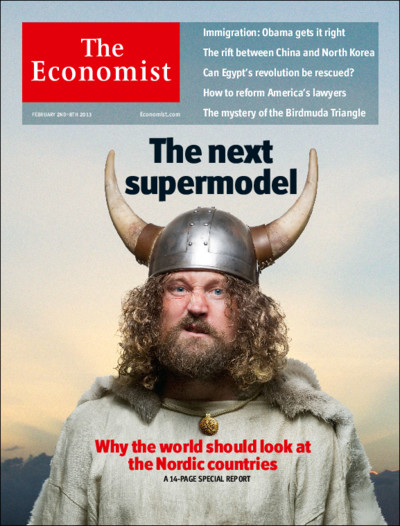
In The Economist, a sort-of-apology for perpetuating the myth that Vikings wore helmets with horns:

Economist cover with Viking horns

The practice of burying the dead with their goods has left archaeologists with lots of evidence about the Vikings, who were arguably the first maritime superpower. Unfortunately, few Viking helmets survive intact. The small sample size cannot prove the point definitively, but they are all horn-free.

Why, then, do cartoon Vikings, Scandinavian football fans and Economist covers persist in giving their helmets horns? As in the rest of Europe, Scandinavia saw an upsurge of interest during the 19th century in home-grown cultural traditions and images. Folk dances, songs, sagas — all were revived and celebrated. The 18th century had seen most of Europe trying to imitate sophisticated Parisian fashions. Now trolls were cool. Where there were gaps in the historical record, artists often used their imagination to reinvent traditions. Painters began to show Vikings with horned helmets, evidently inspired by Wagner’s costume designer, Professor Carl Emil Doepler, who created horned helmets for use in the first Bayreuth production of “Der Ring des Nibelungen” in 1876, as a reader points out in a letter we publish this week. (For the full story, see Roberta Frank, “The Invention of the Viking Horned Helmet“, published in International Scandinavian and Medieval Studies in Memory of Gerd Wolfgang Weber, 2000.)

February 17, 2013

A shocking, lurid tale of depravity that transfixed Victorian London

Filed under: Britain, History, Law, Liberty — Tags: , , , , — Nicholas @ 12:15

In History Today, Richard Canning reviews a new book on the trial of Frederick Park and Ernest Boulton, aka Mrs Fanny Graham and Miss Stella Boulton in 1871:

McKenna provides what is certainly the definitive account of the Boulton/Park story, drawn not only from contemporary journalism but also from the full legal transcript, a miraculous survivor housed in Kew’s National Archives. It is a miserable tale, if leavened both by McKenna’s dramatic verve and, during the show trial held in Westminster Hall, by Fanny and Stella’s black humour. The establishment account – that the pair’s persistent cross-dressing importuning was a scandal to public morals that must be stopped – soon breaks down. McKenna shows clearly how the men were effectively set up and, to some degree, even entrapped.

Police confidence in pressing the serious charge of ‘conspiracy to solicit, induce, procure and endeavour to persuade persons unknown to commit buggery’ (as opposed to the minor offence of outraging public decency) was nonetheless misplaced. Buggery had until lately incurred the death penalty and still carried a lifelong penal sentence. No such charge had been brought for 240 years. The problem which attended the endless, farcical medical examinations of Boulton and Park reflected sodomy’s millennial history as the nameless or invisible crime. Few Victorian doctors could claim to have seen evidence of the extreme anal dilation which purportedly occurred after the ‘insertion of a foreign body’. Of the half dozen who inspected the pair – both inveterate sodomites, as McKenna concedes – only one remained certain that the corporeal evidence supported conviction. They were acquitted and the notion that ‘the impurities of Continental cities’ had reached London was rooted in legal terms for a quarter-century – if paradoxically seeming somehow to be affirmed.

McKenna lays bare a fascinating tapestry of interrelated personal histories, only partially capable of reconstruction. Frederick’s elder brother Harry, already twice disgraced, was hiding in Scotland under an assumed name. Their father, a judge, was urgently shipped off to South Africa during the trial of his younger son. Impressively, Frederick’s mother – amusingly a literal ‘Mary Ann’ – took to the stand to defend his moral character. So successful was she that the identification of Frederick/’Fanny’ as a theatrical mother’s boy exonerated him entirely from the imputation of vice.

It turns out it actually was the Burmese equivalent of Al Capone’s vault

Filed under: Asia, Britain, History, Military, WW2 — Tags: , , — Nicholas @ 11:51

Back in early January, the archaeological dig for buried WW2 Spitfires was announced:

Then, the doubts began to grow:

And now, even the sponsoring organization says there are no buried Spitfires after all:

A global video gaming company that funded a high-profile hunt for dozens of World War II-era British fighters in Myanmar has some bad news for aviation enthusiasts: It says none of the legendary planes are buried in the Southeast Asian country.

Excavation teams carrying out surveys on the ground, however, said Saturday that they would not give up the search.

The hunt for the lost planes was launched amid hope that as many as 140 rare Spitfires were hidden in crates in pristine condition in three locations in Myanmar.

But the Belarusian video gaming company Wargaming.net, which had backed the venture, said in a statement late Friday that the planes were never even delivered to the country by Allied forces as the war drew to a close nearly 70 years ago.

“The Wargaming team now believes, based on clear documentary evidence, as well as the evidence from the fieldwork, that no Spitfires were delivered in crates and buried” in Myanmar between 1945 and 1946, the statement said.

I’d been rather doubtful of the story from the start — even though it would have been awesomely cool to find a stash of Spitfires.

February 16, 2013

The socialist origins of Mussolini’s Fascist Italy

Filed under: Europe, History, Italy, Politics, WW2 — Tags: , , , , — Nicholas @ 11:13

Everyone “knows” that Fascism is an ideology of the extreme right, and Communism is an ideology of the extreme left. Benito Mussolini’s fascist state was bankrolled by big business and the Catholic Church to suppress the democratic demands of the workers in the wake of the First World War. Except that isn’t actually true:

… Mussolini was every bit as much as man of the Left as contemporaries such as Eugene V. Debs. He was what would later come to be known as a “red diaper baby” (meaning the child of revolutionary socialist parents). As a young man, Mussolini himself was a Marxist, fervently anticlerical, went to Switzerland to evade compulsory military service, and was arrested and imprisoned for inciting militant strikes. Eventually, he became a leader in Italy’s Socialist Party and he was imprisoned once again in 1911 for his antiwar activities related to Italy’s invasion of Libya. Mussolini was so prominent a socialist at this point in his career that he won the praise of Lenin who considered him to be the rightful head of a future Italian socialist state.

[. . .]

When the Italian Fascist movement was founded in 1919, most of its leaders and theoreticians were, like Mussolini himself, former Marxists and other radical leftists such as proponents of the revolutionary syndicalist doctrines of Georges Sorel. The official programs issued by the Fascists, translations of which are included in Norling’s book, reflected a standard mixture of republican and socialist ideas that would have been common to any European leftist group of the era. If indeed the evidence is overwhelming that Fascism has its roots on the far Left, then from where does Fascism’s reputation as a rightist ideology originate?

[. . .]

During its twenty-three years in power, Mussolini’s regime certainly made considerable concessions to traditionally conservative interests such as the monarchy, big business, and the Catholic Church. These pragmatic accommodations borne of political necessity are among the evidences typically offered by leftists as indications of Fascism’s rightist nature. Yet there is abundant evidence that Mussolini essentially remained a socialist throughout the entirety of his political life. By 1935, thirteen years after Mussolini seized power in the March on Rome, seventy-five percent of Italian industry had either been nationalized outright or brought under intensive state control. Indeed, it was towards the end of both his life and the life of his regime that Mussolini’s economic policies were at their most leftist.

After briefly losing power for a couple of months during the summer of 1943, Mussolini returned as Italy’s head of state with German assistance and set up what came to be called the Italian Social Republic. The regime subsequently nationalized all companies employing more than a hundred workers, redistributed housing that was formerly privately owned to its worker occupants, engaged in land redistribution, and witnessed a number of prominent Marxists joining the Mussolini government, including Nicola Bombacci, the founder of the Italian Communist Party and a personal friend of Lenin. These events are described in considerable detail in Norling’s work.

It would appear that the historic bitter rivalry between Marxists and Fascists is less a conflict between the Left and the Right, and more of a conflict between erstwhile siblings on the Left. This should come as no particular surprise given the penchant of radical leftist groupings for sectarian blood feuds. Indeed, it might be plausibly argued that leftist ”anti-fascism” is rooted in jealously of a more successful relative as much as anything else.

Nova Scotia Islands

Filed under: Cancon, History, Media — Tags: , — Nicholas @ 10:34

I got a press release to let me know that “Nova Scotia Islands” will be shown on CBC this Sunday. It looks interesting:

Nova Scotia Islands will have its world broadcast premiere on Sunday, February 17, 2013 at 12 Noon on CBC TV’s Land & Sea.

Islands are part of the geography and history of the Maritimes, nowhere more so than Nova Scotia. Jutting out into the Atlantic Ocean, there are more than 3,800 islands that lie scattered along nearly 5,000 miles of coastline.

Nova Scotia Islands is a half hour documentary that explores some of the most interesting islands in the province, their little known histories, and in some cases their uncertain futures.

« Newer PostsOlder Posts »

Powered by WordPress