Quotulatiousness

February 13, 2013

Amity Shlaes on Coolidge

Filed under: Books, History, Media, Politics, USA — Tags: , — Nicholas @ 11:21

Ed Driscoll has an interview with author Amity Shlaes at PJMedia:

MR. DRISCOLL: How long after finishing The Forgotten Man did you start work on Coolidge, and how did you do your research?

MS. SHLAES: I think I started working on Coolidge while I was writing The Forgotten Man because I wrote one draft of Forgotten Man, this history in the 1930s. And then I thought well, this doesn’t work narratively because I didn’t describe what the change was from; where they started, what were their premises. Their premises were the premises of the ’20s and, you know, the ’20s premises were maybe smaller government is better, maybe still the pendulum of government action, reduce uncertainty in the policy environment so that a business can go forward. All these ideas were ideas from the ’20s, and whose ideas were they? Well, they were Calvin Coolidge’s and before Coolidge, Harding’s ideas. But mostly Coolidge’s, I think he’s the hero of the ’20s.

So I went back at the very last minute with Forgotten Man and put Coolidge in and he felt just right. I really liked him. And I thought well, we don’t — we don’t appreciate him much and what I learned in that short look for writing the new beginning to Forgotten Man made me want to go back and give him his own show.

MR. DRISCOLL: Coolidge is sadly remembered today by many people for only one quote and that’s “The business of America is business,” which is actually a bastardization of what Coolidge really said. Could you place that quote into context?

MS. SHLAES: Yes, that’s from a nice speech to newspaper people, actually. And he says the chief business of America is business, and he also says the chief ideal of Americans is idealism. So there’s a yoking together of two concepts, if you go back and read the whole speech, and it’s not fair to paint him as a only capitalism or capitalism to the exclusion of other areas. He’s not like Ayn Rand, for example, because he always tends to bring in the spiritual — other spheres in — and he doesn’t think only capitalism always prevails. He sees a balance. What he doesn’t like is when capitalism or business intrudes upon spiritual. And that’s very different from modern libertarianism.

So anyway it’s all there and that’s — he was extremely idealistic and extremely spiritual, some would say pious. Herbert Hoover called him a fundamentalist, and that was not a compliment coming from Herbert Hoover.
The Jazz Sweatshop (or the Harvard University of Jazz)

Filed under: History, Media, USA — Tags: , , — Nicholas @ 00:01

In the New York Review of Books, Christopher Carroll discusses the great Charles Mingus:

Mingus (1922-1979) would have turned ninety last year, and in celebration, Mosaic has released The Jazz Workshop Concerts: 1964-1965, a new box set with rare and previously unreleased performances by some of Mingus’s greatest ensembles. These concerts, recorded near the apex of Mingus’s career, are visceral and often unvarnished. At times, the music here can be forbidding — several tracks run beyond thirty minutes — and though it may not be as uniformly polished as some of his studio albums, at its best this set captures an element of shock and surprise that Mingus’s studio recordings sometimes don’t.

“Mingus music,” as he called it, was so complex and so much an extension of his own personality that it was largely played only by his own group, the Jazz Workshop. Turnover in the Workshop was high, partly because he couldn’t afford to pay his musicians very well, partly because the experience was so grueling (members called it the Jazz Sweatshop), and partly because so many of them, after sharpening their skills with Mingus, went on to lead their own bands (Gary Giddins once called it the Harvard University of Jazz).

Even with Mingus at the helm playing bass (and sometimes piano), Workshop performances often resembled practice sessions more than concerts. He did everything in his power to push his players beyond their limits: while a musician was soloing, he might double the tempo, cut it in half, or drop the accompaniment of the bass, drums, and piano entirely, all without warning. Often, players would buckle under the pressure and songs would grind to a halt, with Mingus screaming recriminations and heaping shame on everyone in sight. But sometimes his musicians would rise to the challenge, and it was the possibility of this transcendence that gave Jazz Workshop performances such an electrifying sense of expectation and adventure.

February 12, 2013

The Bluenose II in court

Filed under: Cancon, History, Law — Tags: , , , — Nicholas @ 12:14

The descendents of the designer of the original Bluenose are in court to demand the “copyright, and the moral rights in the copyright work” of the vessel which probably should be called the “Bluenose III“:

The Bluenose sank to the bottom in 1946; the replica Bluenose II was built in 1963, and then rebuilt in recent years and launched from the Lunenburg wharf this past September amid much fanfare and, as the province’s accountants could tell you, serious cost overruns.

No matter. This was a gala affair. Only Joan Roué and her father, Lawrence J. Roué — grandson of William J. Roué — were not among the smiling guests and proceeded to file suit against the province, the boat designers and boat builders in October, alleging that despite “the province owning the vessel … Joan and Lawrence Roué allege that they are respectively entitled to the copyright, and the moral rights in the copyright work” associated with the latest incarnation of the famous schooner.

To which the province responded — and I am paraphrasing here — “are you people kidding me?” while contending in court filings that William J. Roué’s storied original design perhaps wasn’t all that original to begin with, and, even if it were a singular masterpiece, that he had already been paid for it decades ago.

I posted about the “new” Bluenose II last year, explaining why I think they should have incremented the number in the vessel’s official name:

Wooden sailing ships are subject to far more wear and tear than modern vessels: they’re like the old tale of the farmer’s axe (even though everything’s been replaced over time, it’s still the same axe). This means that heritage sailing ships need lots of careful maintenance throughout their lives, and major re-builds at long intervals. In the case of Nova Scotia’s iconic Bluenose II, however, it’s sometimes more than a “rebuild” […] So, just to sum up: she’s being built to a different design (even though outward appearance is much the same), using different materials. In what way can you call her the same ship? The point made in the article, that the masts and sails were some of the “originals” being re-used is odd: those are among the parts that need replacing more often. And the mahogany and walnut saved from the last boat are almost certainly decorative elements, not structural ones.

Calvin Coolidge — The Great Refrainer

Filed under: Books, History, Media, Politics, USA — Tags: , , , , — Nicholas @ 11:37

Amity Shlaes has written a new biography on President Calvin Coolidge, reviewed here by Gene Healy:

If there was ever a time when the president could simply preside, it has long passed. As early as the Eisenhower era, political scientist Clinton Rossiter observed that the public had come to see the federal chief executive as “a combination of scoutmaster, Delphic oracle, hero of the silver screen, and father of the multitudes.” Under the pressure of public demands, the office had accrued a host of responsibilities over and above its constitutional ones: “World Leader,” “Protector of the Peace,” “Chief Legislator,” “Manager of Prosperity,” “Voice of the People,” and more.

To that daunting portfolio add “Feeler-in-Chief,” a term coined in all earnestness by The New York Times‘s Maureen Dowd in 2010 while lashing out at Barack Obama for being insufficiently emotive about the BP oil spill. Obama, she wrote, had “resisted fulfilling a signal part of his job: being a prism in moments of fear and pride, reflecting what Americans feel so they know he gets it.”

Poor MoDo would have kicked the cat in sheer frustration if confronted by the implacable, inscrutable Calvin Coolidge, whose reaction to the job’s more unreasonable demands was a Bartleby-like “I prefer not to.”

[. . .]

Here was “a rare kind of hero: a minimalist president,” Shlaes argues. And though history remembers “Silent Cal” mostly for his reticence and frequent napping, Shlaes reminds us that “inaction betrays strength.” In politics, it’s often easier to “do something,” however unwise, than it is to hold firm: “Coolidge is our great refrainer.”

Alas, after Coolidge‘s elegant introduction, the sledding gets much tougher. Long stretches of this 456-page tome read like an info-dump from Shlaes’s clearly formidable research files. Like the hardscrabble farmers of Plymouth Notch, you need to set your jaw grimly and persevere through a long winter of sentences that should have been left on the cutting room floor, like: “Coolidge met with [Budget Director Herbert] Lord six times and reduced a tariff on paintbrush handles by half, his second cut that year, the other a reduction in duty on live bob quail.” Shlaes should have followed the example of her famously taciturn subject, who in his 1915 opening address as president of the Massachusetts Senate delivered a crisp little homily of 44 words, ending in “above all things, be brief.”

Still, the level of detail she provides inspires reflection on the vast gulf between today’s GOP and the grand party of old. Presidents Warren Harding and Calvin Coolidge cut taxes and shrank spending. They were pro-peace and anti-wiretapping. They embraced “normalcy” instead of stoking fear. And — go figure — they were also popular. Today’s Republicans could profit from studying their example.

Palestine as a useful symbol, but Palestinians as inconvenient “guests”

Filed under: History, Middle East, Politics — Tags: , , , , , , — Nicholas @ 09:28

Strategy Page on the paradoxical Arab view of Palestine as worth fighting for, but actual living Palestinians as less-than-welcome pests (or worse):

While most Arabs will admit they hate Israel, they will also deny that this has anything to do with anti-Semitism and has everything to do with the Palestinians. This is not true, as Arabs have long demonstrated a hostility towards the Jews, something which is part of their religion. It’s in their scriptures, the stories of how Jews refused to support Mohammed, the founder of Islam. Long held grudges are popular in this part of the world.

Meanwhile, there are many more recent reasons for Arabs to dislike the Palestinians. When the state of Israel was established in 1947 there began a series of bad decisions by Arab governments that are setting records for failure. Although the UN tried to broker the creation of Israel, Arab nations misjudged their own power and told Arabs in Israel to flee their homes, so that the Arab armies could come in and kill all the Jews. When that didn’t work, the Arabs refused to absorb the 600,000 Arab refugees, and continues to treat (actually, mistreat) them as refugees. At the same time, the Arabs expelled 600,000 Jews who had been living among them for centuries. Most of these Jews went to Israel and become Israelis, and prospered.

Thus began decades of hostility between Palestinians and the rest of the Arab world. The Palestinians that fled to Lebanon proceeded to trigger a 15 year long civil war (1975-90) that devastated the country and left in place a Shia militia in the south (Hezbollah) that prevents the country from being truly united. The Palestinians that fled to Jordan eventually (1970) staged an uprising against the king, and were defeated and largely expelled. The Palestinians that went to Kuwait welcomed the Iraqi invasion of 1990 because Saddam Hussein had always been very loud about wanting to destroy Israel. When Arab and Western troops tossed Saddam out of Kuwait five months later, the Palestinians were forced to flee the vengeance of the Kuwaitis. The Palestinians that went to Iraq also had to flee in 2003, because they had helped Saddam terrorize the Shia and Kurdish majority and were, well, you know the story.

February 6, 2013

English accents, circa 1483

Filed under: Britain, History — Tags: , , , — Nicholas @ 00:02

I’m afraid the coverage of the discovery and identification of the remains of Richard III have done bad things to the newspapers. We’re starting to see articles like this posted:

King Richard III was ‘a brummie’
King Richard III would have spoken with a Birmingham accent, according to a language expert.

Dr Philip Shaw, from the University of Leicester’s School of English, used two letters penned by the last king of the Plantagenet line more than 500 years ago to try to piece together what the monarch would have sounded like.

He studied the king’s use of grammar and spelling in postscripts on the letters.

The university has now released a recording of Dr Shaw mimicking King Richard reading extracts from those letters.

Despite being the patriarch of the House of York, the king’s accent “could probably associate more or less with the West Midlands” than from Yorkshire or the North of England, said Dr Shaw.

Wow. This must have been a long, painstaking effort to pin down the linguistic “tics” that help indicate a person’s natural speaking habits. What were the key elements that indicated Good King Richard was a “Brummie”?

“… there is also at least one spelling he employs that may suggest a West Midlands accent.”

That’s it? One spelling variation that “suggests” he would pronounce that one word in a similar manner to the modern Birmingham style? Gah!

February 5, 2013

What did King Richard III look like?

Filed under: Britain, History, Science — Tags: , , — Nicholas @ 09:33

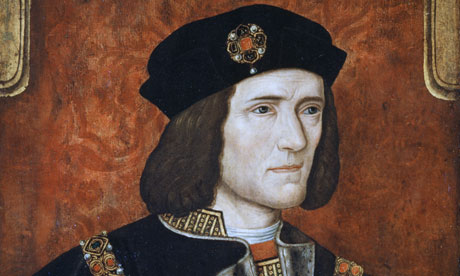
A facial reconstruction based on the skull of Richard III:

A facial reconstruction based on the skull of Richard III has revealed how the English king may have looked.

The king’s skeleton was found under a car park in Leicester during an archaeological dig.

The reconstructed face has a slightly arched nose and prominent chin, similar to features shown in portraits of Richard III painted after his death.

Historian and author John Ashdown-Hill said seeing it was “almost like being face to face with a real person”.

The development comes after archaeologists from the University of Leicester confirmed the skeleton found last year was the 15th Century king’s, with DNA from the bones having matched that of descendants of the monarch’s family.

I was unable to find an image of the reconstruction that is okay to use, but you can see various pictures on Google Image Search.

I was getting hungry after reading the first two paragraphs…

Filed under: Asia, Food, History, India — Tags: — Nicholas @ 00:01

What is curry and where did it come from?

What is curry? Today, the word describes a bewildering number of spicy vegetable and meat stews from places as far-flung as the Indian subcontinent, the South Pacific, and the Caribbean Islands. There is little agreement about what actually constitutes a curry. And, until recently, how and when curry first appeared was a culinary mystery as well.

The term likely derives from kari, the word for sauce in Tamil, a South-Indian language. Perplexed by that region’s wide variety of savory dishes, 17th-century British traders lumped them all under the term curry. A curry, as the Brits defined it, might be a mélange of onion, ginger, turmeric, garlic, pepper, chilies, coriander, cumin, and other spices cooked with shellfish, meat, or vegetables.

Those curries, like the curries we know today, were the byproduct of more than a millennium of trade between the Indian subcontinent and other parts of Asia, which provided new ingredients to spice up traditional Indian stews. After the year 1000, Muslims brought their own cooking traditions from the west, including heavy use of meat, while Indian traders carried home new and exotic spices like cloves from Southeast Asia. And when the Portuguese built up their trading centers on the west coast of India in the 16th century, they threw chilies from the New World into the pot. (Your spicy vindaloo may sound like Hindi, but actually the word derives from the Portuguese terms for its original central ingredients: wine and garlic.)

But the original curry predates Europeans’ presence in India by about 4,000 years. Villagers living at the height of the Indus civilization used three key curry ingredients — ginger, garlic, and turmeric — in their cooking. This proto-curry, in fact, was eaten long before Arab, Chinese, Indian, and European traders plied the oceans in the past thousand years.

February 4, 2013

University of Leicester confirms that the remains are those of King Richard III

Filed under: Britain, History, Science — Tags: , , , — Nicholas @ 09:16

BBC News rounds up the details:

A skeleton found beneath a Leicester car park has been confirmed as that of English king Richard III.

Experts from the University of Leicester said DNA from the bones matched that of descendants of the monarch’s family.

Lead archaeologist Richard Buckley, from the University of Leicester, told a press conference to applause: “Beyond reasonable doubt it’s Richard.”

Richard, killed in battle in 1485, will be reinterred in Leicester Cathedral.

Mr Buckley said the bones had been subjected to “rigorous academic study” and had been carbon dated to a period from 1455-1540.

Dr Jo Appleby, an osteo-archaeologist from the university’s School of Archaeology and Ancient History, revealed the bones were of a man in his late 20s or early 30s. Richard was 32 when he died.

Battle wounds

His skeleton had suffered 10 injuries, including eight to the skull, at around the time of death. Two of the skull wounds were potentially fatal.

One was a “slice” removing a flap of bone, the other caused by bladed weapon which went through and hit the opposite side of the skull, a depth of more than 10cms (4ins).

Dr Appleby said: “Both of these injuries would have caused an almost instant loss of consciousness and death would have followed quickly afterwards.

“In the case of the larger wound, if the blade had penetrated 7cm into the brain, which we cannot determine from the bones, death would have been instantaneous.”

Other wounds included slashes or stabs to the face and the side of the head.

Update: New Scientist still has concerns that the trail of evidence is not strong enough to constitute proof of identity:

Mitochondrial DNA is passed down the maternal line and has 16,000 base pairs in total. Typically, you might expect to get 50 to 150 fragments from a 500-year-old skeleton, says Ian Barnes at Royal Holloway, University of London, who was not involved in the research. “You’d want to get sequences from lots of those fragments,” he says. “There’s a possibility of mitochondrial mutations arising in the line from Richard III.”

“It’s intriguing to be sure,” says Mark Thomas at University College London. It is right that they used mitochondrial DNA based on the maternal line, he says, since genealogical evidence for the paternal lineage cannot be trusted.

But mitochondrial DNA is not especially good for pinpointing identity. “I could have the same mitochondrial DNA as Richard III and not be related to him,” says Thomas.

The researchers used the two living descendents to “triangulate” the DNA results. The evidence will rest on whether Ibsen and his cousin have sufficiently rare mtDNA to make it unlikely that they both match the dead king by chance.

February 2, 2013

Hidden under Britain’s defence HQ: Henry VIII’s wine cellar

Filed under: Architecture, Britain, History, Military, Wine — Tags: , — Nicholas @ 11:44

It’s not open to the general public — and given what’s built on top of it, that’s probably no surprise:

Like the Pentagon, its better-known counterpart in the United States, Britain’s Ministry of Defence building is a fairly mundane, if gigantic, office block camouflaging a much more exciting subterranean realm of secret tunnels, bunkers, and — at least in the MoD’s case — a perfectly preserved Tudor wine cellar.

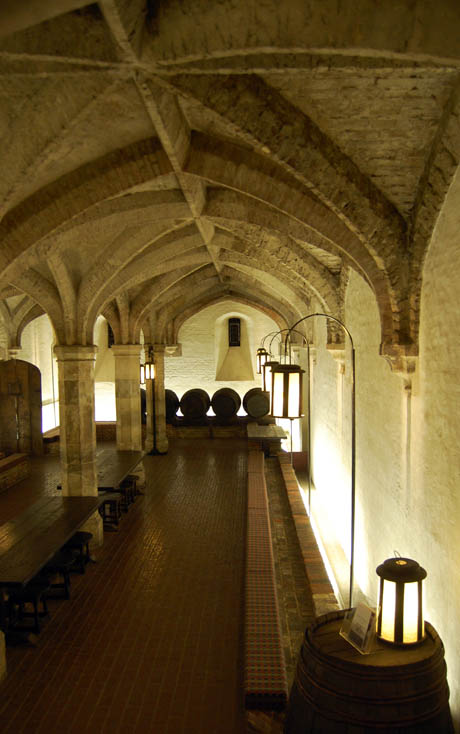
IMAGE: Henry VIII’s wine cellar, photograph by Nicola Twilley. The cellar is apparently occasionally used to host Ministry of Defence dinners and receptions, but is otherwise off-limits to the public other than by special request.

IMAGE: Henry VIII’s wine cellar, photograph by Nicola Twilley. The cellar is apparently occasionally used to host Ministry of Defence dinners and receptions, but is otherwise off-limits to the public other than by special request.

This stone-ribbed, brick-vaulted undercroft was built in the early 1500s by Cardinal Wolsey, as part of a suite of lavish improvements to York Place, the Westminster residence of the archbishops of York since the thirteenth century. The additions, which also included a gallery, presence chamber, and armoury, were intended to make York Place into a palace splendid enough to host the King. They succeeded well beyond Wolsey’s intentions: when Wolsey fell from favour, due to his inability to secure the papal annulment Henry VIII needed in order to marry Anne Boleyn, the King decided to move in.

[. . .]

York Place became the Palace of Whitehall, the principal residence of the English monarchy in London for nearly two hundred years, and Wolsey’s expansive cellar (he apparently received the first delivery of Champagne ever exported to England) became King Henry VIII’s Wine Cellar, the name by which it is still known today.

In Tudor times, the wine was stored in barrels, which presented a certain problem for service: “The barrels are historical reconstructions to represent how wine was stored in Tudor times. Henry VIII’s court consumed something like 300 barrels of wine each year, mostly exported from France and delivered to the palace by river. Interestingly, the wine was drunk very young by today’s standards — an August harvest might be on the table by November — and it was carefully blended with water, honey, and spices to mask its increasing sourness, as half-drunk casks allowed air into contact with the wine, which gradually oxidised into vinegar.”

January 31, 2013

The “clean” side of archaeology

Filed under: History, Science, Technology — Tags: , , , — Nicholas @ 09:11

BBC News has an interesting segment on how digital technology is changing the field of archaeology:

Archaeologists may not need to get their hands so dirty any more, thanks to the kind of digital technology being pioneered at Southampton University.

Its ‘µ-VIS Centre for Computed Tomography’ possesses the largest, high energy scanner of its kind in Europe: a ‘micro-CT’ machine manufactured by Nikon.

Capable of resolutions better than 0.1mm — the diameter of a human hair — it allows archaeologists to carefully examine material while still encased in soil.

Using visualisation software, archaeologists can then analyse their finds in 3D. This keeps the material in its original form, and postpones any commitment to the painstaking process of excavation by hand.

Video of the machine in operation at the BBC News site.

January 29, 2013

Economic analysis of Imperial Rome

Filed under: Economics, Europe, History — Tags: , , , , , — Nicholas @ 09:43

A post by Jasmine Pui at History Today discusses a new online tool for economic analysis of the Roman Empire:

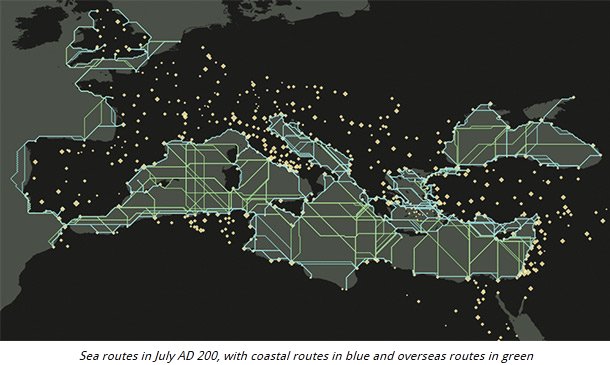
Sea routes in July AD 200

A recently launched online interactive research source, ORBIS, the Stanford Geospatial Network Model of the Roman World, has made it possible to analyse data about the Roman Empire in new ways that reveal the fragility of Roman communication and freight systems. Conventional maps are often unable to capture the environmental constraints that govern the flows of people, goods and information. Museum and ancient sites usually include titbits of information about the wide-ranging origins of artefacts, hinting at the relative cost of goods and labour in the Roman era, but factors such as sailing times and inland routes for freight cannot be precisely revealed through archaeological finds, Roman coins, taxation records or riot reports.

The first resource of its kind, ORBIS offers comprehensive graphic tools to portray the transport and communication infrastructure that underpinned the Roman Empire’s existence. By typing in a starting point, destination, an imagined weight of goods to transport and the time of year, the site shows whether such a movement would have been feasible and at what cost. Studying movement during the course of the empire’s existence suggests it was far more difficult to hold an empire together than to expand one. There are few scenarios where marching and conquering is not easier and less costly than moving goods and slaves between regions. Cost, rather than distance, was the principal determinant of connectivity in the Roman world.

ORBIS is based on a simplified version of the giant network of cities, roads, rivers and sea lanes that framed movement across the Roman Empire. The Stanford team has relied on data such as historical tide and weather information, size and grade of road surfaces and an average walking distance of 30 kilometres per day. Hundreds of cities, ports and routes, vehicle speeds for ships, ox carts and horses, as well as the variable cost of transport have been logged. The data mainly focuses on the period around AD 200, when Septimius Severus expanded control of Africa and Roman power was at one of its peaks.

January 28, 2013

Anthropology of the hacker community

Filed under: Books, History, Media, Technology — Tags: , , , — Nicholas @ 09:17

ESR reviews a new book about hackers:

My usual audience is well aware why I am qualified to review Gabriella Coleman’s book, Coding Freedom, but since I suspect this post might reach a bit beyond my usual audience I will restate the obvious. I have been operating as the hacker culture’s resident ethnographer since around 1990, consciously applying the techniques of anthropological fieldwork (at least as I understood them) to analyze the operation of that culture and explain it to others. Those explanations have been tested in the real world with large consequences, including helping the hacker culture break out of its ghetto and infect everything that software touches with subversive ideas about open processes, transparency, peer review, and the power of networked collaboration.

Ever since I began doing my own ethnographic work on the hacker culture from the inside as a participant, I have keenly felt the lack of any comparable observation being done by outsiders formally trained in the techniques of anthropological fieldwork. I’m an amateur, self-trained by reading classic anthropological studies and a few semesters of college courses; I know relatively little theory, and have had to construct my own interpretative frameworks in the absence of much knowledge about how a professional would do it.

Sadly, the main thing I learned from reading Gabriella Coleman’s new book, Coding Freedom, is that my ignorance may actually have been a good thing for the quality of my results. The insight in this book is nearly smothered beneath a crushing weight of jargon and theoretical elaboration, almost all of which appears to be completely useless except as a sort of point-scoring academic ritual that does less than nothing to illuminate its ostensible subject.

[. . .]

Far too much of the book exhibits this kind of theory-induced blindness. I am inclined to blame not Coleman for it but rather the people who trained and indoctrinated her in how to think and write like a ‘real’ anthropologist. If Coding Freedom is really the sort of book anthropology wants its bright young things to emit, the field is in desperately bad shape — far too inward-looking, over-abstract, mired in self-reference and tail-chasing, obsessed with politicized modes of non-explanation. I would actually prefer the theory that Coleman is a dimwit who has emitted a sort of unintentional parody of real anthropology if I could make myself believe it, but I can’t — her best moments seem too lucid for that.

She is very perceptive, for example, about the central role of hacker humor in promoting social bonding and affirming the culture’s values (I’ve explored this theme myself). Her ground-level reporting about the emotional atmosphere of hacker conferences and demonstrations is acute. Her discussion of how hackers as a culture have bootstrapped themselves to a state of legal literacy in order to fight their corner of the intellectual-property wars gives one of the gifts that ethnography should — to help us see how remarkable and interesting are practices we might otherwise take for granted.

There is even one significant thing I learned from this book, or at least learned to see in a new way. I hadn’t noticed before how ritualized the practice of writing damning comments about bad code is. Coleman is right that they display a level of pointed and deliberate rudeness that their authors would not employ face-to-face, and she is right about how and why the culture gives permission for this behavior.

January 25, 2013

Even before “The internet is for porn”, mainframe computers were for cheesecake

Filed under: History, Media, Technology — Tags: , , — Nicholas @ 09:47

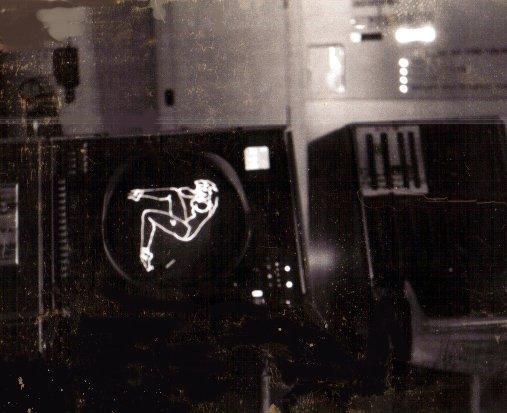
The very first human image displayed on a computer was a pinup girl:

First human image on a computer

During a time when computing power was so scarce that it required a government-defense budget to finance it, a young man used a $238 million military computer, the largest such machine ever built, to render an image of a curvy woman on a glowing cathode ray tube screen. The year was 1956, and the creation was a landmark moment in computer graphics and cultural history that has gone unnoticed until now.

Using equipment designed to guard against the apocalypse, a pin-up girl had been drawn.

She was quite probably the first human likeness to ever appear on a computer screen.

She glowed.

[. . .]

In early 1959, 21-year-old Airman First Class Lawrence A. Tipton snapped the only known photo of this pin-up program in action at Ft. Lee. The photo shows the tube of an SD console displaying the outline of woman with her arms held high, cradling her head while emphasizing her bosom. She reclines awkwardly, her legs splayed apart in an uncomfortable but provocative pose that smacks of mid-century pin-up art.

“One day I decided to take pictures for posterity’s sake,” recalls Tipton, “And those two Polaroids are the only ones that made it out of the building.” The other Polaroid is a self-portrait of Tipton himself sitting in front of the AN/FSQ-7’s Duplex Maintenance Console. “We used the Polaroid cameras to take pictures of anomaly conditions. When the computers would malfunction, you’d take pictures of those main consoles to diagnose the conditions.”

January 23, 2013

How easy would it be to fake the 1969 Apollo 11 moon landing?

Filed under: History, Media, Space — Tags: , , , , — Nicholas @ 11:13

H/T to Kathy Shaidle, who writes:

Remember: Conspiracy theories are history for stupid people. They provide idiots with the thrilling sensation that they’re smarter than everyone else, and are a seductive distraction from real problems.

As the (liberal) filmmaker says:

“They lead you to sell your soul for the comfort of being a rebel.”

That’s what Satan did.

« Newer PostsOlder Posts »

Powered by WordPress