
Drachinifel
Published 16 Feb 2022Today we take an overview look at the history of Chatham Royal Dockyard and some of what you can find today at in its preserved premises!
Visit the dockyard – https://thedockyard.co.uk/
(more…)
September 21, 2025
Chatham Dockyard – Half a millennium of supporting the Royal Navy
Comments Off on Chatham Dockyard – Half a millennium of supporting the Royal Navy
QotD: Herbert Hoover, an epitaph
Hoover was a man who did everything wrong. He was the quintessential High Modernist. He was arrogant, he was authoritarian, he didn’t listen to anyone, he put no effort into pleasing people or making his ideas more palatable. He never solicited stakeholders’ opinions. He lied like a rug, constantly and egregiously. He lived his life like a caricature of exactly the sort of person who should fail at philanthropy and become a horror story to warn future generations.
But he won anyway. He started from a measly few million dollars and beat out Rockefellers and Carnegies to become the most successful philanthropist in early 20th century history. Whyte’s estimate of 100 million lives saved seems much too high; there were only 100 million people in Europe total during the relevant period. But even during his own time, people universally credited him with saving millions. And he did it again and again and again. I didn’t even have space to talk about the time he saved the Southern United States from a giant flood, or half a dozen other impressive accomplishments. Maybe the rules are wrong. Maybe all of this stuff about how authoritarian approaches never work, and you need to let the people you are helping lead the way, is all just modern prejudices, and putting a brilliant and very rich engineer in charge of a hypercentralized organization is just as good as any other way of doing things.
But even this I find less interesting than his psychology. He combined a personal callousness with a love for all humanity. When he was inspecting mines in Australia, he fired the worst-performing X% of workers. One worker begged him to reconsider – he had a family to support. Hoover raised $300 for the man’s family – a lot of money at the time! Probably more than Hoover made in a month! – but fired him anyway. In 1932, when the Bonus Army marched on Washington, Hoover was adamant that he would not give these men – poor, starving veterans – a single cent more than they were entitled to by their existing benefits. But he also instructed his staff to go around to their encampments and give them food and supplies in secret.
Sometimes his stubborness calls to mind the fictional Inspector Javert, who refuses to bend the law for any reason. In this model, Hoover sympathizes with everybody, but his honor forbids him to bend the rules in favor of underperforming employees or protesters who want more than their contracts entitle them to. But this picture of a hyper-honorable Hoover crashes into his constant willingness to lie, cheat, and bend the rules in his own favor. Sometimes his lies are for the greater good, like when he tells Britain that Germany is preparing to feed Belgium. Other times they seem entirely selfish, like his various Chinese mining scams. The best that can be said about Hoover is that if he decides a principle is involved, he sticks to it.
And this is actually really good! Again and again through the book, Hoover feels like the only person with a moral compass. When it is in everyone’s strategic interest to let Belgium starve, Hoover is the only one who is able to keep fixated on the potential human toll. When it is in everyone’s interest to let the USSR starve, only Hoover – despite his fanatical anti-communism – is able to stick to the frame where the Russians are human beings and politics is beside the point. When Americans are starving during the Great Depression …
… okay, Hoover totally dropped the ball on that one. In fact, one of his Democratic opponents wrote something about how maybe if unemployed American workers pretended to be Belgians, they could get Hoover’s sympathy. I don’t have a great explanation for this. But Hoover’s weak and inconsistent sympathies are often enough to let him outdo everyone else. Or at least, he is uncorrelated with everyone else and succeeds when they fail. Again and again Hoover is accused of treating people like numbers on a piece of paper. But if this is true, it seems to be linked to the reverse talent – the ability to remember that numbers on a piece of paper represent people, even when other people would rather forget.
I’m equally confused about Hoover’s politics, although it’s not really his fault. The whole era confuses me. The Progressives, Hoover’s own faction, seem clearly related to modern progressives. But they also give me more of a technophile, rationalist feel than their modern counterparts. Am I imagining things? If not, where did this go?
And how did Hoover so deftly merge authoritarian centralizing technocratic engineer side with his small-government individual-freedom pro-capitalism side? Maybe it wasn’t that deft? Maybe he started his life as a centralizing technocrat, then made a 180 after becoming a small-government individualist helped him dunk on FDR more effectively? But it didn’t feel that way. It felt like all of it was coming from some central set of core beliefs throughout his life.
[…]
I get the impression that Kenneth Whyte is a bit of a revisionist historian, too sympathetic to his subject to tell his story the way everyone else does. But at least in Whyte’s telling, the Hoover presidency was a great missed opportunity, or at least a fulcrum of history. If a few key economic events had been a few months off in one direction or the other, FDR might have been a footnote to history, and a four-term President Hoover might have left an indelible mark on America. Instead of a New Deal, we might have gotten a optimistic small-government technocratic meritocracy that was able to merge the best aspects of a dying frontier America with the best aspects of the industrial age.
In one of the most poignant passages in the book, Commerce Secretary Hoover fires back at his socialist critics. He points out that of the top dozen US officials – the President, VP, and ten Cabinet Secretaries – eight, including himself, had begun as manual laborers and worked their way up. That was the America Hoover was working to defend. He lost, and now we have this shitshow. But it’s hard to begrudge him the attempt.
Scott Alexander, “Book Review: Hoover”, Slate Star Codex, 2020-03-17.
Comments Off on QotD: Herbert Hoover, an epitaph
September 20, 2025
Feds move to neuter the “notwithstanding clause” to frustrate Alberta
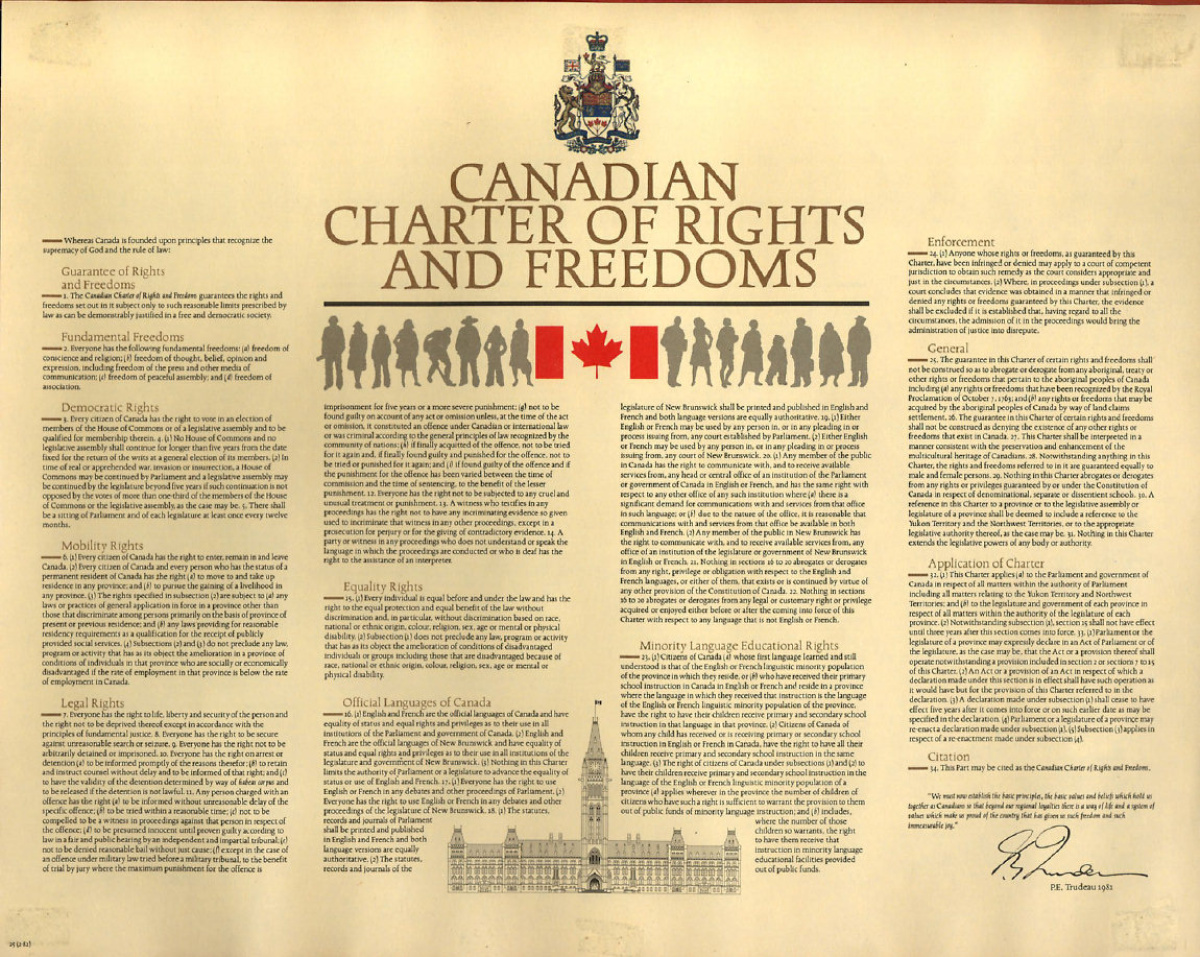
To be honest, I wasn’t a fan of the Charter of Rights and Freedoms when it was forced down our throats in 1982, on the basis that if Pierre Trudeau thought it was a good idea then it must be the opposite. All these years later, although I’m still not a huge fan, I support the provinces who now need to combat Mark Carney’s minority Liberal government’s attempt to use the Supreme Court to limit or eliminate the provinces’ use of the notwithstanding clause:
You might be hearing a lot about the notwithstanding clause these days and wondering what is going on. The fact is, the Carney government is trying to change the constitution via a Supreme Court case on Bill 21 – a heinous bill in my opinion – but not an excuse to scrap or weaken the notwithstanding clause.
We’ve been here before with this debate before and I’m still of the same position, leave the clause alone.
It was in 2018 that Ontario Premier Doug Ford was looking to use the notwithstanding clause to shrink the size of Toronto city council. He should never have had to do this, but a lower court ruled that Ford’s actions were unconstitutional.
Which is really weird because the constitution is clear, municipalities are creations of the province. A provincial government can merge municipal governments, they can even abolish them if they wish.
Eventually, a higher court overturned the very politically driven decision against Ford, but for a time, he seemed to need the notwithstanding clause, otherwise known as section 33 of the Charter of Rights and Freedoms.
I’ll never understand why some claim the notwithstanding clause is against the Charter when it is part of the Charter.
On the social media site formerly known as Twitter, Sean Speer notes the Liberals seem to be taken by surprise at the negative reactions to their plans:
I suspect that non-conservatives are a bit surprised by the magnitude of the reaction to the Carney government’s factum on the notwithstanding clause. That’s mainly because I think liberals and progressives don’t quite understand how much the past decade or two of judicial activism has come to animate Canadian conservatism. Even as a somewhat moderate conservatism, I admit to being radicalized on these issues.
The Carter decision on MAID was a key moment in this evolution. Not necessarily because of the issue per se — though a lot of us oppose it. But mainly because it was such a naked example of judicial lawmaking. The clearest case that it’s just power and politics all the way down.
After having ruled that there was no right to physician-assisted death in the Charter, just over twenty years later the Supreme Court unanimously decided there was indeed such a right.
There had been no constitutional amendment in the meantime. Parliament had considered the issue and carefully and consistently voted against it. And yet nine judges decided that the right should exist and so they created one.
If the judiciary isn’t merely protecting constitutionally-prescribed rights but manufacturing them based on the political preferences of judges themselves—if it’s in effect just politics from the bench — then we might as well have the politicians who we’ve duly elected to be making these decisions for us.
Before Carter I would have said that I was broadly supportive of S.33 as part of our constitutional order but today it’s much bigger part of my core political identity as the only check we have on judicial politicking.
The Carney government’s factum then isn’t just objectionable because it threatens to constrain the notwithstanding clause but precisely because it invites the Supreme Court to once again alter the constitution in its own image.
Brian Peckford, the last surviving signatory to the patriation of the Constitution in 1982:
Tragically, it is not surprising that we see this further emasculation of our 1982 Constitution.
It has been ongoing almost since its inception. Witness the 1985 Court Opinion twisting the meaning of the opening words: “the Supremacy of God”.
And the constant distortions ever since, accelerated during the false covid crisis.
This is The Tyranny of The Judiciary —The Destruction Of Parliamentary Democracy!
How important is Section 32 — the notwithstanding clause?
There would be no Constitution Act 1982 — no Charter of Rights and Freedoms without Section 32.
When PM Trudeau Sr. tried to unilaterally Patriate the Constitution and failed miserably because of the Provinces’ opposition before the Courts, he validated the suspicion most Premiers had about the Federal Government and its intentions during that time. The ability of the Provinces to continue democratically to initiate specific exemptions was crucial to solidify the federal nature of this country.
The Supreme Court was right in Sept 1981 in denying the Federal Government such sweeping powers.
None of the 10 First Ministers who signed the Patriation Agreement intended for this Section to be amended in any other way except by the Amending Formula that was achieved for the first time in our history in that Agreement.
The Federal Justice Minister’s action to ask the court is wrong — totally against the intent of those who authored the Patriation Agreement and defies and denigrates one of major accomplishments of 1982, The Amending Formula, a crucial part of the earlier 1981 Agreement, the foundation document, “The Patriation Agreement”.
The Canadian Press carries this:
OTTAWA — The federal government’s request to Canada’s top court for limits on the notwithstanding clause isn’t only about Quebec’s secularism law, Justice Minister Sean Fraser said on Thursday.
In a media statement, Fraser said he hopes the Supreme Court’s eventual decision “will shape how both federal and provincial governments may use the notwithstanding clause for years to come”.
Excuse me, Mr Fraser, this is the job, the solemn responsibility, for Canada’s Elected First Ministers and Their elected Parliaments not the Judiciary. Making law is the job of the elected, interpreting law the role of the Judiciary.
This brazen action of the Federal Government would enlarge the Judiciary power to make law — it deciding the powers of The Governments of this Nation.
Ironic in the extreme it is to ponder that Canada sought for decades to find an amending formula — self criticizing itself for not having a legitimate avenue for Constitutional Change.
Now that it has such an avenue instead of using it, it cowardly asks The Court?
Should not a majority of the Provinces have to agree — that’s what the Supreme Court said in 1981?
Hence, the Supreme Court, consistent with it predecessor views of 1981 should refrain from hearing the matter, and inform the Governments that it is they who have the power through the legitimate constitutional process present in the Constitution to make such significant change ie the powers of the Governments, adhering to Section 38, the Amending Formula.
Comments Off on Feds move to neuter the “notwithstanding clause” to frustrate Alberta
Dutch Navy Luger: From World War One to the End of Neutrality
Forgotten Weapons
Published 12 May 2025The Dutch Navy first acquired Luger pistols in 1918 specifically for its aviators. They had 12 German P04 Lugers taken from a German submarine stranded in the (neutral) Netherlands, and 28 more were purchased from DWM in 1918 to round out the 40 guns needed to equip the Naval Air Service. The pistol was formally adopted as Automatische Pistool Nr.1. In 1928, the Dutch Army adopted the 1906 New Model Luger for its own service, and the Navy decided to update its revolvers at the same time. The Navy opted not to get grip safeties, and so took a copy of the German P08 model instead of what the Army had. The first order was placed in 1928 through BKIW in Germany, and deliveries would run until 1939 with a total of 2654 delivered before German invaded in May 1940.
Dutch Army Luger trials:
• Politicians Ruin Everything: Dutch Lu…Dutch East Indies Lugers:
• Lugers for the Dutch East Indies Army
(more…)
Comments Off on Dutch Navy Luger: From World War One to the End of Neutrality
September 19, 2025
Edmund Burke, lawfare, and the East India Company
In The Coolidge Review, Amity Shlaes discusses “the most outrageous campaign of lawfare in the history of the Anglosphere”, as Edmund Burke assailed Warren Hastings, the first governor general of India:
Why do even principled statesmen — and there are some in this administration, too — not dig in their heels and try to arrest the chain of revenge? Why do even cautious, logical men and women succumb to the passion of lawfare?
The most outrageous campaign of lawfare in the history of the Anglosphere, the impeachment and trial of the first governor general of India, Warren Hastings, was mounted by Mr. Incrementalism himself, Edmund Burke. The father of modern conservatism spent nearly a decade of his time in Parliament—from 1787 to 1795—crusading against Hastings, antagonizing allies all around.
Impeaching the “Wicked Wretch”
There were reasons to investigate what was going on in India: Hastings exploited the fact that the East India Company was, at that time, an adjunct of the Crown. That connection between a powerful company and a government — a far more powerful company than, say, Intel — was the trouble, for as Burke would put it, it created “a state in disguise of a merchant“.
Burke chose to prosecute Hastings — and failed. The “wicked wretch”, one of Burke’s slime phrases for Hastings, emerged from the ordeal with a pension, not a conviction. Burke biographer Russell Kirk has argued that the public flaying of Hastings served posterity — in England at least. After Burke’s death, at “every grammar and public school”, the story of Burke and Hastings “impressed upon the boys who would become colonial officers or members of Parliament some part of Burke’s sense of duty and consecration in the civil social order”. That slowed another chain, the chain of abuse by Britons of Indians. After Burke, England recognized that, as Kirk puts it, she had a “duty to her subject peoples in the East”.
Still, even Kirk’s excellent biography leaves readers wondering: Was Hastings truly the archest of the arch villains, as Burke maintained? And is this the right way to go about it all? A book that Burke penned in the same years that he waged his Hastings war, Reflections on the Revolution in France, influenced a far greater number, and in a greater number of lands, than the Hastings story. Burke might have had the same reach with a Reflections on the Abuses of the East India Company.
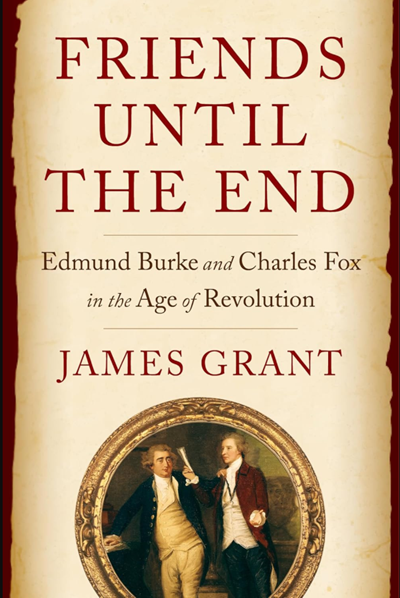
All the more welcome then is James Grant’s Friends Until the End, which gives the best-yet account of the chain reaction in Burke’s soul that drove him to weaponize government, what his crusade cost him, and what such crusades may cost all of us.
[…]
Next, however, came a challenge that deeply frustrated Burke. Scanning the empire’s horizon for a place to commence a model reform, Fox and Burke settled on the East India Company, which abused the some thirty million Indians it oversaw with the same admixture of plunder, condescension, and cruelty familiar to Catholics of Ireland. The pair put their hearts into the Indian reform: Fox promised a “great and glorious” reform to save “many, many millions of souls”. They also put their minds into the project. To track the East India Company, Burke personally purchased sufficient shares to win him rights to attend and vote at quarterly meetings. He steeped himself in knowledge of a land he’d never seen, learning names of “numerous Indian nawabs, rajas, nizams, subahs, sultans, viziers, and begums“.
Such prep work, as Grant points out, enabled the Whigs to identify the correct solution: de-mercantilization. “Separate the company’s two incompatible missions: sovereign rule and moneymaking”, Grant writes. The compromised statute that emerged from the House of Commons was not as neat: A seven-man commission would rule India, while a board would govern East India’s commercial operations. But the commercial board would be a subsidiary to the commission. And in marshaling their votes for the measure, the pair still confronted the formidable obstacle of East India shareholders in Britain, furious at the threat to their fortunes that such reform represented. Fox might emancipate Hindus, their opponent William Pitt warned, but he must also “take care that he did not destroy the liberties of Englishmen”.
The king and his allies in any case defeated Fox’s India Bill, as it was known, in the House of Lords. The king, who had that prerogative, booted Fox and Burke from paid posts. In the 1784 general election, Burke held on to his seat in Parliament, as did Fox (by a hair), but so many Whigs, now labeled “Fox’s martyrs”, were ousted by voters from Parliament that the Whigs’ opponent, Pitt, became prime minister. Burke’s disillusionment ran deep: “I consider the House of Commons as something worse than extinguishd”, he wrote.
It was thus, at the age of fifty-nine and merely an opposition parliamentarian, that Burke risked his high-stakes lawfare. He commenced impeachment proceedings with a four-day anti-Hastings polemic. Of course, Burke universalized his point: The Hastings trial was “not solely whether the prisoner at the bar be found innocent or guilty, but whether millions of mankind shall be made miserable or happy”. And of course he raised the stakes for fellow lawmakers by appealing to their honor: “Faults this nation may have; but God forbid we should pass judgment upon people who framed their laws and institutions prior to our insect origin of yesterday!” The House must join him in impeachment, the Lords convict Hastings.
The House did join him, handing to the Lords charges that Hastings had “desolated the most flourishing provinces”, “pressed, ruined, and destroyed the natives of those provinces”, and violated “the most solemn treaties”. In thousands of hours of speeches before a jury from the House of Lords, the eager prosecutor, Burke, dwelt on Hastings’s cruelty to the Rohillas, an Afghan tribe from land bordering Nepal. He also charged that Hastings had taken revenge on a crooked tax collector, Nandakumar, for alleging that he — Hastings — had taken a bribe, seeing to it that Nandakumar was convicted and hanged for forgery. Not all of this was proven. And, as the jury of Lords slowly considered the charges, as the months and years passed, Burke found himself more and more isolated. Fox, Burke’s initial ally in the undertaking, faded. By the time the Lords’ jury voted not to convict, eight years on, a full third of their original number had already passed away.
Comments Off on Edmund Burke, lawfare, and the East India Company
What Medieval Fast Food Restaurants Were Like
Tasting History with Max Miller
Published 15 Apr 2025Golden brown fried pastries filled with a fruit and spice paste
City/Region: Paris
Time Period: c. 1393Fast food has been around since the Middle Ages, and while a lot has changed in food production and cooking in the last six hundred years or so, then, as now, you could get a fried apple pie.
Rissoles were fried filled pastries (modern versions are usually some kind of filling rolled in breadcrumbs and fried), and they could be made savory or sweet. These ones are made with roasted apples, raisins, figs, and sweet spices. I chose cinnamon, ginger, and nutmeg, but you can choose whatever spices you like.
It is common that rissoles are made of figs, raisins, roast apples, and nuts peeled to imitate pine nuts, and powder of spices [and a little fine salt]; and let the paste be well saffroned and then let them be fried in oil [and sugar them].
— Le Ménagier de Paris, c. 1393
Comments Off on What Medieval Fast Food Restaurants Were Like
September 18, 2025
Stop calling it “Turtle Island”
At Woke Watch Canada, Igor Stravinsky strenuously objects to calling North America “Turtle Island” and all the other woke shibboleths of the modern progressive cant:

As another school year rolls out, we can hope a more honest and realistic portrait of Canadian history will start to take shape in our schools. Students have been brainwashed into believing that Canada was a racist state bent on the extermination of Indigenous people, who were peaceful and wise, living in harmony with nature and each other. But reconciliation between Indigenous and non-Indigenous people is only possible if we base policy and action on the truth, not fairy tales, hearsay, anecdotes, or ideologies. We need facts, evidence, and reasoned debate. A good start would be for people to stop referring to North America as “Turtle Island”.
Calling it that is essentially to call the current geopolitical organization of the world invalid. If Canada, the United States, and other Western countries are in fact illegitimate, then that means national and international laws are also null and void. So, unless you are the direct descendent of an aboriginal person who was alive before first contact with Europeans, you are just a guest here — a second-class citizen at best. Non-Indigenous Canadians will simply never accept that. Nor should they.
In any case, “Turtle Island” is a nonsensical name on several levels. Firstly, North America is a continent, not an island. It is connected to South America by the Isthmus of Panama, which means it is not even surrounded by water. In any case an island is defined as a land mass surrounded by water that is part of a tectonic plate such as Greenland which is part of the North American Plate, thus is not a continent.
Then there is the fact that Indigenous North Americans were oblivious to the geography of the vast continent on which they lived. Like people everywhere in the distant past, they only knew the area they lived in, which could be substantial in the case of nomads, but was still a tiny fraction of North America’s 20+ million square kilometers. Of course, they knew nothing about the geography of the world with its 7 continents and 5 oceans.
Most importantly, the Turtle Island creation story is a myth believed by a particular cultural group. There is nothing wrong with believing in myths: I personally believe in the myth of human rights, as most Canadians do (pre-contact Indigenous people certainly did not). Myths are powerful: Our common belief in human rights has helped to make the Western world contain the safest and most prosperous societies ever. But when our institutions subscribe to myths not shared by the majority of Canadians, they are choosing to elevate one culture’s belief system above all others.
In the past, the Christian religion was regarded as the one true religion in Canada by most people, and the spiritual beliefs of Indigenous people were often denigrated as primitive superstition. But elevating Indigenous spirituality in our secularized 21st century world by treating it as a knowledge acquisition system equivalent to (or superior to) the scientific method is an attempt to correct for that past ethnocentrism. This is Critical Theory in action: It always strives to alleviate past wrongs with present wrongs, a formula for social disaster if ever there was one.
“The British fleet is strong and at the ready” (1939)
British Pathé
Published 12 Nov 2020GAUMONT BRITISH NEWSREEL (REUTERS)
Comprehensive documentary of the Royal Navy in the lead up to war
Full Description:
SLATE INFORMATION: Britain’s Navy Ready for Any Challenge, The Combined Fleets Filmed by Gaumont-British News
Comprehensive documentary of the British fleet and their preparedness for action including shots of numerous ships at sea and at anchor, sailors on deck, aircraft on deck, ship’s guns, officers in quarters, destroyers, aircraft flying off deck and landing on water
Archive: Reuters
Archive managed by: British Pathé
Comments Off on “The British fleet is strong and at the ready” (1939)
QotD: Americans, poker, and chess
J.H. Donner, “The King: Chess Pieces”, New In Chess, 2008.
September 17, 2025
The Korean War Week 65: Another Bloody Ridge Begins? – September 16, 1951
The Korean War by Indy Neidell
Published 16 Sep 2025Bloody Ridge is barely over, but orders have come for the UN forces to already attack the next ridge to the north, and UN planes violating the Kaesong neutral zone sabotage Matt Ridgway’s plans for conquest.
Chapters
00:00 Hook
00:49 Recap
01:27 Van Fleet’s Planning
08:44 The War and the Conference
14:28 Summary
14:46 Conclusion
15:20 Call to Action
(more…)
Comments Off on The Korean War Week 65: Another Bloody Ridge Begins? – September 16, 1951
QotD: Indecision
“It’s not that he makes bad decisions; it’s that he doesn’t make any decisions at all.”
Any time you see that situation in a manager, any manager, it is a flashing neon sign of incompetence.
One of the reasons why Marxists make such poor managers is that if they are presented with a situation which cannot be addressed by Party doctrine, they are largely indecisive. Even worse, if that doctrine runs counter to good management, they will use that as the underpinning for their indecisiveness. We saw this a lot under Obama, who was pathetically underqualified as a manager, having had no executive experience in his entire life before becoming POTUS. More often than not, when faced with a decision, he simply froze and allowed events to dictate the outcome, even if that outcome was inimical to the interests of the country he was supposed to be governing. (And to prove my point above, his Marxist doctrine held that the United States was a malignant force in world affairs, so allowing harm to befall the country was — to his mind — actually the proper thing to do as it “corrected” or atoned for America’s past sins.)
Kim du Toit, “Failure”, Splendid Isolation, 2020-06-04.
September 16, 2025
Fenian Needham Conversion: Just the Thing for Invading Canada
Forgotten Weapons
Published 10 May 2025The Fenian Brotherhood was formed in the US in 1858, a partner organization to the Irish Republican Brotherhood. The groups were militant organizations looking to procure Irish independence from the British, and they found significant support among the Irish-American immigrant community. In November 1865 they purchased some 7500 1861- and 1863-pattern muskets left over from Civil War production, and used them to invade Canada in April 1866. The idea was to capture the country and then trade it to the British in exchange for Irish independence … but the invasion went quite badly. The Fenians briefly held Fort Erie, but were pushed out after a few hours and largely arrested by American forces.
The Fenians’ muskets were confiscated, but all returned by the end of 1866 in exchange for promised Irish-American support of embattled President Johnson. By 1868, the group was making plans for another attempt at conquering Canada. This time they would have better arms — they obtained a disused locomotive factory in Trenton NJ and set up the Pioneer Arms Works to convert 5,020 muskets into centerfire Needham Conversion breechloaders. These were given chambers that could fire standard .58 centerfire ammunition, or the .577 Snider ammunition that the Fenians expected to be able to procure once in Canada. Most of the guns also had their stocks cut, to allow them to be packed in shorter crates for transit. These usually have a distinctive “V” cut in the stock, which was spliced back together before use.
When the second invasion came in April 1870, it was again a failure. Only 800-1000 men turned out of the 5,000+ expected. They were scattered among several different muster points on the border, and the Canadians were once again aware of their plans. The most substantial fight was at a place called Eccles Hill, where the Missisiquoi Home Guard was ready and waiting for them with good Ballard rifles. Upon crossing the border, the Fenians were soundly defeated.
This second time, the guns were confiscated and not returned. Instead, the Watervliet Arsenal sold them as surplus in 1871. They were purchased by Schuyler, Hartley & Graham for commercial resale, and thanks to that several hundred remain in collector hands today.
(more…)
Comments Off on Fenian Needham Conversion: Just the Thing for Invading Canada
QotD: The Dictatorship in the late Roman Republic
For Sulla, the purpose of using the dictatorship was to offer his reforms to the Republic some degree of legitimacy (otherwise why not just force them through purely by violence without even the fig leaf of law). Sulla was a reactionary who quite clearly believed in the Republic and seems to have been honestly and sincerely attempting to fix it; he was also a brutal, cruel and inhuman man who solved all of his problems with a mix of violence and treachery. While we can’t read Sulla’s mind on why he chose this particular form, it seems likely the aim here was to wash his reforms in the patina of something traditional-sounding in order to give them legitimacy so that they’d be longer lasting, so that Sulla’s own memory might be a bit less tarnished and to make it harder for a crisis like this to occur again.
And it failed at all three potential goals.
When it comes to the legitimacy of Sulla’s reforms and the memory that congealed around Sulla himself, it is clear that he was politically toxic even among many more conservative Romans. A younger Cicero was already using Sulla’s memory to tarnish anyone associated with him in 80, casting Chrysogonus, Sulla’s freedman, as the villain of the Pro Roscio Amerino, delivered in that year. In the sources written in the following decades at best Sulla is a touchy subject best avoided; when he is discussed, it is as a villain. Our later sources on Sulla are uniform in seeing his dictatorship as lawless. Moreover, his own reforms were picked apart by his former lieutenants, with key provisions being repealed before he was even dead (in 78 BC so that’s not a long time).
Finally, of course, far from securing the Republic, Sulla’s dictatorship provided the example and opened the door for more mayhem. Crucially, Sulla had not fixed the army problem and in fact had made it worse. You may recall one benefit of the short dictatorship is that no dictator – indeed, no consul or praetor either – would be in office long enough to secure the loyalty of his army against the state. But in the second and early first century that system had broken down. Gaius Marius had been in continuous military command from 107 to 100. Moreover, the expansion of Rome’s territory demanded more military commands than there were offices and so the Romans had begun selecting proconsuls and propraetors (along with the consuls and praetors) to fill those posts. Thus Sulla was (as a result of the Social War in Italy) a legate in 90, a propraetor in 89, and consul in 88 and so had been in command for three consecutive years (albeit the first as a legate) when he decided to turn his army – which had just, under his command, besieged the rebel stronghold of Nola – against Rome in 88, precisely because his political enemies in Rome had revoked his proconsular command for 87 (by roughing up the voters, to be clear). And then Sulla has that same army under his command as a proconsul from 87 to 83, so by the time he marches on Rome the second time with the intent to mass slaughter his enemies, his soldiers have had more than half a decade under his command to develop that ironclad loyalty (and of course a confidence that if Sulla didn’t win, their service to him might suddenly look like a crime against the Republic).
Sulla actually made this problem worse, because one of the things he legislated by fiat as dictator was that the consuls were now to always stay in Italy (in theory to guard Rome, but guard it with what, Sulla never seems to have considered). That, along with Sulla having butchered quite a lot of the actual experienced and talented military men in the Senate, left a Senate increasingly reliant on special commands doled out to a handful of commanders for long periods, leading (through Pompey‘s unusual career, holding commands in more years than not between 76 and 62) to Julius Caesar being in unbroken command of a large army in Gaul from 58 to 50, by which point that army was sufficiently loyal that it could be turned against the Republic, which of course Caesar does in 49.
For Caesar, the dictatorship seems to have been purely a tool to try to legitimate his own permanent control over the Roman state. Caesar is, from 49 to 44, only in Rome for a few months at a time and so it isn’t surprising that at first he goes to the expedient of just having his appointment renewed. But it is remarkable that his move to dictator perpetuo comes immediately after the “trial balloon” of making Caesar a Hellenistic-style king (complete with a diadem, the clear visual marker of Hellenistic-style kingship) had failed badly and publicly (Plut. Caes. 61). Perhaps recognizing that so clearly foreign an institution would be a non-starter in Rome – unpopular even among the general populace who normally loved Caesar – he instead went for a more Roman-sounding institution, something with at least a pretense of tradition to it.
And if the goal was to provide himself with some legitimacy, the effort clearly catastrophically backfired. The optics of the dictatorship were, at this point, awful; as noted, the only real example anyone had to work with was Sulla, and everyone hated Sulla. Many of Caesar’s own senatorial supporters had probably been hoping, given Caesar’s repeatedly renewed dictatorship, that he would eventually at least resign out of the office (as Sulla had done), allowing the machinery of the Republic – the elections, office holding and the direction of the Senate – to return. Declaring that he was dictator forever, rather than cementing his legitimacy clearly galvanized the conspiracy to have him assassinated, which they did in just two months.
It is striking that no one after Caesar, even in the chaotic power-struggle that ensued, no one attempted to revive the dictatorship, or use it as a model to institutionalize their power, or employ its iconography or symbolism in any way. Instead, Antony, who had himself been Caesar’s magister equitum, proposed and passed a law in 44 – right after Caesar’s death – to abolish the dictatorship, make it illegal to nominate a dictator, or for any Roman to accept the office, on pain of death (App. BCiv, 3.25, Dio 44.51.2). By all accounts, the law was broadly popular. As a legitimacy-building tool, the dictatorship had been worse than useless.
So what might we offer as a final verdict on the dictatorship? As a short-term crisis office used during the early and middle republic, a tool appropriate to a small state that had highly fragmented power in its institutions to maintain internal stability, the dictatorship was very successful, though that very success made it increasingly less necessary and important as Rome’s power grew. The customary dictatorship withered away in part because of that success: a Mediterranean-spanning empire had no need of emergency officials, when its military crises occurred at great distance and could generally be resolved by just sending a new regular commander with a larger army. By contrast, the irregular dictatorship was a complete failure, both for the men that held it and for the republic it destroyed.
The real problem wasn’t the office of dictator, but the apparatus that surrounded it: the short duration of military commands, the effectiveness and depth of the Roman aristocracy (crucially undermined by Sulla and Marius) and – less discussed here but still crucial in understanding the collapse of the Republic – the willingness of the Roman elite to compromise in order to maintain social cohesion. Without those guardrails, the dictatorship became dangerous, but without them any office becomes dangerous. Sulla and Caesar, after all, both marched on Rome not as dictators, but as consuls and proconsuls. It is the guardrails, not the office, that matter.
Bret Devereaux, “Collections: The Roman Dictatorship: How Did It Work? Did It Work?”, A Collection of Unmitigated Pedantry, 2022-03-18.
Comments Off on QotD: The Dictatorship in the late Roman Republic
September 15, 2025
The Cold War in Latin America Begins: Coups, Communists, and Castro – W2W 44
TimeGhost History
Published 14 Sept 2025Spy rings, covert operations, coups, street violence, and sudden regime changes. This is the turmoil that awaits Latin America after the Second World War. As new ideas from the East gain momentum, the United States tries to hold on to its role as the region’s self-appointed guardian. Which side will ultimately shape the future of this rich and populous region?
(more…)
Comments Off on The Cold War in Latin America Begins: Coups, Communists, and Castro – W2W 44
When folks built their houses from Sears, Roebuck & Co. kits
I thought I’d discussed the Sears kit homes about a decade back, but perhaps it wasn’t for the blog. Anyway, there’s a nice summary by Katrina Gulliver of how Sears and other companies made home-building great a century ago:
A hundred years ago, kit homes were more common in the US. Sold by Sears, Montgomery Ward, and other local firms, buyers received the plans and the pieces for a house and put it together themselves. Economies of scale made these a viable option for someone looking to build a house in the expanding suburbs.
The 1914 Sears Modern Homes catalog shows three homes that could each be bought for $656 (in the small print, they admit your outlay would be more like $1,250 all-in, including brick, cement, plaster — which they don’t supply — and labor). Your kit house would be delivered by rail; it was generally assumed householders would be handy enough (or know whom to hire) to put it all together from the supplied plans.
According to a 1930 report by the National Bureau of Economic Research, National Income and Its Purchasing Power, in 1914, the average clerk could be making $1,000, and a factory manager earning $2,300. That means these houses were within reach of lots of people — especially bearing in mind that land costs in many cities were also relatively low. In Chicago, lots within 5 miles of downtown were available for less than 50¢/square foot in 1914.
Those kit homes included wood, metal, and glass, and reflected both the tastes of consumers and the economies of bulk production. The various styles in the catalog over the years included craftsman, Dutch colonial, Federal, and cottage — styles that have continued to be popular in residential architecture of the US.
The Sears catalog of 1936 states: “This is the age of modern efficiency. No longer can human hands compete with machine precision and production. ‘Speed with accuracy’ is the watchword in any department of our great factories.”
(For those curious about such houses, fans of Sears kit homes put together lists of examples still standing.)

Comments Off on When folks built their houses from Sears, Roebuck & Co. kits


