
Adrian Goldsworthy. Historian and Novelist
Published 23 Apr 2025This time we look at episode 11 — and only this episode as there is more to talk about when it comes to the historical background. Some of the plot doesn’t fit too well to the actual history, but there are some nice details that crop up and make it worthwhile. In the main, I get excited about a coin and a court.
September 15, 2025
HBO’s Rome – Ep 11 “The Spoils” – History and Story
Comments Off on HBO’s Rome – Ep 11 “The Spoils” – History and Story
September 14, 2025
“When must we kill them?”
On the social media platform previously known as Twitter, Tom Kratman provides an excerpt from The Care and Feeding of Your Right Wing Death Squad:
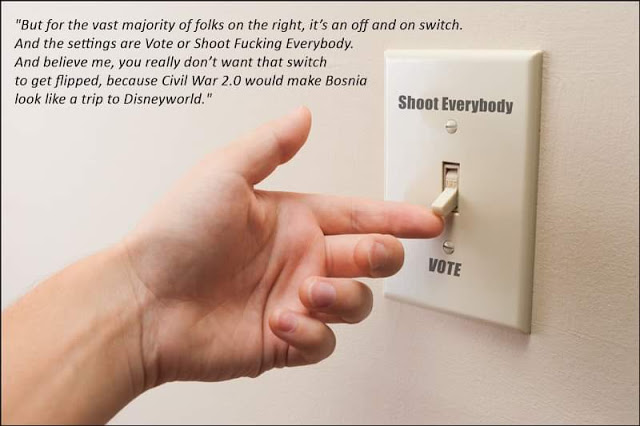
Reposting this seems apropos:
The Care and Feeding of Your Right Wing Death Squad, Chapter 32 Copyright © 2025, Tom Kratman, Harry Kitchener
“When must we kill them?”
That question was asked recently by a leftist student, one Nicholas Decker, from George Mason University. It’s a very interesting question, and one that most, and perhaps all, hard leftists in the United States are contemplating. Indeed, we see now, from an NCRI / Rutgers survey, that something over half of leftists believe that assassinating Trump would be justified, and nearly half think the same thing about Musk.
Note, here, that this was of all people identifying as left of center. I would suggest that this means that almost nobody who is slightly left of center would agree with that and nearly everybody who is far left of center agrees with that. And if we needed any more proof, just contemplate the number of would be groupies moistening their panties over murderer Luigi Mangione, as pointed out by former New York Times reporter Taylor Lorenz.
Why do they think so or why are they wondering about it? It’s actually more understandable than most on the right and perhaps even many on the left would understand. They’re wondering about it because, with the destruction of the Deep State, with so many billionaires turning against the left and – horrrors! – no longer letting the left wing narrative control online and legacy media political discourse, with no prospect of the kind of money being shunted from the taxpayer, through the Federal Government, to left wing NGOs to help swing elections, they do not really think there is any serious prospect of the left ever winning a national election again or, at least, not in their lifetimes. And they may be right about that.
With James Carville telling the Democrats to give the boot to the gender and woke ideologues, the identity politics losers, the little boy penis choppers and little girl breast destroyers and vagina removers; they see themselves being marginalized, losing their influence, and losing their dream, forever. And this seems fairly likely. With no possibility, once Trump gets finished deporting all the illegals, of turning just enough of those illegals into client voters to swing elections just enough for control, they think that leftism will be hopeless in the United States. And they’re probably right about that. With the Communist factories of higher education being broken to the will of the right, with Gramsci’s / Rudi Dutschke’s “Long March Through the Institutions” being walked back, and quickly, they’re thinking about it and wondering about it because leftism is dead in the United States, a corpse just awaiting burial.
So, though the point of this entire exercise in the Right Wing Death Squad has been to convince the left to chill out, FFS, it seems that certain key point bear repeating.
1. Urban Guerilla movements invariably succeed in creating the kind of oppressive government that they believe will infuriate the people and lead to a general uprising. Those governments then proceed to exterminate the Urban Guerillas and all their supporters, and do so to general popular applause.
2. The armed forces, barring some political generals and morally cowardly colonels, hate you and everything about you. Posse Comitatus is only a law, not something in the constitution that would require going through the difficult process of amendment. Change the law – and do but note who has control of the House, the Senate, and the Supreme Court (so that constitutional grounds could not be manufactured to create an objection to getting rid of the law) – and the military would be very happy to round you all up. And you’re completely, incompetently, incapable of resisting this.
3. Moreover, though you have a few people with some military experience and training, the key word there is “few”. Yes, yes, I know that, since Vietnam, the left has been obsessed with the inner city black cannon fodder meme, but it wasn’t true then and it isn’t true now. Conversely, the white working class and conservative populations at large – to the limited extent these categories may differ – are replete with people with a lot of military training and experience and they hate you, too. They also have most of the guns. Your side has fairly few, in comparison, and little skill in using what you do have, alone or in groups.
4. You also fundamentally misunderstand the difference between your approach to violence – as a rheostat to be turned up or down, to suit – with the right’s – which is an on-off switch marked “peace and good feelings” on the one hand, and “kill every one of them” on the other.
You know all those terrible things you and your pals like to say about right wing, especially but not always white, Americans? Well, we know you don’t really believe those things because if you did you would be afraid ever to leave your mom’s basement. But you really ought to try to grasp this; sometimes those things are true.
Although our purpose with this project has been to try to get you to save yourselves, still, one cannot help but look forward to the prospect of young Mr. Decker finding this out.
So, if you were to succeed in killing the president, you will get Vance. Vance will have a mandate, in that case, to obliterate you. If he fails to carry out that mandate then genuine Right Wing Death Squads will take up the slack. No trial, no due process at all; they will proceed to obliterate you and every safe harbor and supporter you have, and often in creatively disgusting ways.
Amusingly enough, your only safety, in such a case, would be in being sent to some variant on El Salvador’s CECOT. I could see the population of El Salvador roughly doubling in the course of a few years as millions of American leftists find out just how grim a Latin American prison can be.
But, seriously, why would they or anybody waste the money when you could as easily just become an unfortunate statistic? Were I betting on it, I’d bet that few of you see a flight – or even half a flight – to El Salvador, but that many of you would have a long last moment staring down into a ditch you had just been forced to dig while a man with a pistol walks up behind you.
So the answer to young Mr. Decker’s question, “When must we kill them?” is “When you want to die.”
Comments Off on “When must we kill them?”
History of Britain VIII: Welsh, Picts, and Irish in the Early Middle Ages
Thersites the Historian
Published 7 Mar 2025In this video, we look at the other major ethnic groups in the British Isles and trace their development, insofar as our limited sources allow.
Comments Off on History of Britain VIII: Welsh, Picts, and Irish in the Early Middle Ages
September 13, 2025
Jennings 5-Shot Repeating Flintlock Pistol
Forgotten Weapons
Published 9 May 2025Isaiah Jennings patented an improvement to the Belton repeating flintlock system in 1821 — but we don’t know exactly what his idea was because the Patent Office lost his patent (and many others) in a large 1836 fire. Jennings’ system was used by several gunsmiths, though. In 1828/9 the State of New York contracted to convert 521 of their muskets to Jennings’-pattern repeaters. We also have a few examples like this custom five-shot pistol made by John Caswell of upstate New York.
Jennings’ system uses superposed charges loaded in the barrel along with a movable lock. Each charge has its own touch hole, and the cover plates for them act as stops for movement of the lock, to ensure proper alignment. The trigger will fire the lock in any position, and it is also fitted with an automatic magazine frizzen — so cocking the hammer automatically charges priming powder into the pan and closes the frizzen. These were very advanced arms for the early 1800s, and expensive to produce.
Belton Repeating Flintlock:
• Belton Repeating Flintlock: A Semiaut…
(more…)
Comments Off on Jennings 5-Shot Repeating Flintlock Pistol
September 12, 2025
A primer on patterns in past political assassinations
On the social media site formerly known as Twitter, ESR shares his observations on common patterns in political assassinations which may be relevant to the investigation of the assassination of Charlie Kirk:

The Salt Lake City FBI office released these photos of a “person of interest” in the Charlie Kirk assassination.
I don’t know anything other than public information about the assassination of Charlie Kirk.
However, a primer follows about patterns in past political assassinations. I will sketch what scenarios an intelligence analyst would come up with looking at this one.
The first and most important rule in this kind of investigation is: when you hear hoofbeats, think horses not zebras.
In political assassinations, as an ordinary murders, the correct suspect is usually the most obvious suspect. Airport-thriller-style convoluted plots and false-flag ops pulled off by unlikely people or organizations are rare in the real world.
Accordingly, when you’re trying to solve a political assassination, the right question to ask is “Who said they wanted him dead?”
Then, you infiltrate those organizations, or arrest a bunch of members, and do contact tracing. Usually you do in fact find your killer that way. It’s not very different from ordinary police work except for the stakes.
There are broadly speaking three different kinds of assassin: the nutter, the zealot, and the pro. They are not difficult to distinguish once you got your hands on them.
Nutters don’t have a coherent political ideology, though they may spout semi-random slogans that political actors can seize on to pretend that they do. They generally have quite an obvious history of mental illness
Before capture, given the kind of public evidence we have now in Charlie Kirk’s assassination, it’s difficult to tell the zealots from the pros by their MO. It used to be easier, but as I noted in a previous post sniper doctrine and technique have been leaking into popular culture for decades.
It’s easier to spot the nutters; they tend to have poor forward-planning capacity. A very obvious way this manifests is a weak or non-existent plan for exfiltrating after the hit. Thus, the nutter is very likely to get caught quite soon after the assassination, often at the site.
This also produces a false-prominence effect – people think political assassins are more likely to be nutters than is actually the case.
Pros – professional assassins working for intelligence agencies or militaries – are also rare. They do occasionally strike – as when, for example the Bulgarian secret service whacked Pope John Paul – but high-profile public assassinations carry a risk of diplomatic and political blowback the most nations are unwilling to assume.
Also, trained assassins are a scarce resource and exfiltrating in the hue and cry following a very public assassination is chancy. Usually you’re going to send them against more obscure targets like exiled dissidents that you think might still be dangerous, hoping not to trigger a full law-enforcement and counterintelligence response.
There’s been talk in some of the wackier corners of the Right that the Mossad did this one. No analyst would take this seriously; the blowback risk to the Israelis is far too high to justify any gain. Same goes for the Russians, though they have a higher risk tolerance than the Israelis and had a much higher tolerance in Soviet times.
In the case of Charlie Kirk it’s pretty high odds we’re looking at a zealot. That’s usually the way to bet, and in this case, the quality of his exfiltration plan and the fact that he has successfully disappeared raises the odds.
Given all these factors, LEOs are going to be looking for zealots associated with domestic organizations that said they wanted Charlie Kirk dead.
Yes, this seems boring and obvious. The main point I’m trying to drive home here is that the boring and obvious theory about a political assassination is usually the correct one.
Accordingly, the first place investigators of the assassination of Charlie Kirk are going to be looking is gun clubs associated with Antifa and the hard left, like the John Brown Gun Club and Redneck Revolt.
It’s not certain that Kirk’s assassin is a member of one of those groups, but if you had to place a bet that would be where to put it.
Update: while I was composing my analysis there was a leak from inside the ATF. They found a .30-06 with engravings expressing “anti-fascist” and transgender ideology.
As I said: When you hear hoofbeats, think horses not zebras. The obvious suspect is usually the correct one.
And later, on the particulars of this particular assassin’s work:
PSA for those speculating about the sniper who killed Charlie Kirk:
No, the shot he made was not a difficult one, and does not constitute evidence that he was a professionally-trained sniper.
His choice of hide and the quality of his exfiltration plan was impressive. That could indicate pro-level training. Or, it could just mean he played the right videogames.
Information about sniper practice has been leaking into popular culture for decades. It used to be that good practice could enable you to make deductions about the background of the sniper, but that time is past.
Nothing has yet been released about what ammunition or weapon he used. It is highly likely that the bullet has been recovered and identified.
About the most we’re likely to be able to extract from the caliber is whether the sniper used an American traditional caliber like .30-06, NATO-standard 7.62, or Russian 7.62. The latter two cases may not be distinguishable if the bullet is deformed.
Knowing this won’t really tell us anything, as rifles in all plausible calibers are generally available in the United States. Furthermore, if this were a pro-level hit, misdirecting investigators by choosing an adversary or third party weapon is part of normal covert operations doctrine.
All in all, it is not possible to deduce anything of significance about the sniper from the publicly available information. Mistrust anyone who claims otherwise.
Comments Off on A primer on patterns in past political assassinations
Ancient Roman Table Manners & Etiquette
Tasting History with Max Miller
Published 8 Apr 2025Spiral-shaped fritters drizzled with honey and sprinkled with white poppyseeds
City/Region: Rome
Time Period: 2nd Century B.C.E.These fritters are kind of like a mix between globi and jalebi. The batter is simple like the globi, made of just spelt flour and ricotta, but they’re piped into hot fat in spiral shapes like jalebi. The technique can be a little tricky to get right so that the spirals hold together, but you should get about 12 to 15 tries out of the amount of batter this recipe makes.
The encytum are delicious and kind of remind me of a healthy pancake, but with honey instead of maple syrup. They don’t stay crispy for very long, so plan on serving them right away if you’d like to retain maximum crispness.
Make encytum the same way as globi, except that you use a vessel with a hole in the bottom which you can stream through into hot fat, and shape like the spira, coiling and turning it with two sticks. Spread and color with honey while still warm. Serve with honey or mulsum.
— De Agri Cultura by Cato the Elder, 2nd century B.C.E.
Comments Off on Ancient Roman Table Manners & Etiquette
September 10, 2025
The Korean War Week 64: Inexperienced UN Recruits Face Disaster – September 9, 1951
The Korean War by Indy Neidell
Published 9 Sep 2025The Battle of Bloody Ridge comes to its end, having very much earned its name. One issue the UN is really having though, is with replacement troops. They don’t have the training or experience that the war requires. And yet, a new offensive to test them further is just around the corner.
Chapters
00:00 Intro
00:53 Recap
01:22 Problems With New Troops
04:36 Company C Attacks
06:09 Operation Talons
07:32 Operation Minden
08:19 Flying Aces
08:57 San Francisco Conference
14:13 Summary
14:28 Conclusion
(more…)
Comments Off on The Korean War Week 64: Inexperienced UN Recruits Face Disaster – September 9, 1951
Space Nazis! Evil Empires and Historical Memory
Feral Historian
Published 30 Jun 2022A brief look at the echo of Nazi Germany and its impact on American sci-fi, with a focus on Star Wars because it’s endured for nearly half a century.
Comments Off on Space Nazis! Evil Empires and Historical Memory
QotD: “The [western Roman Empire] did not drift hopelessly towards its inevitable fate. It went down kicking, gouging and screaming”
The fall of the Roman Empire in the West (please, right now, just mentally add the phrase “in the west” next to every “the fall of Rome” and similar phrase here and elsewhere) is complicated. I don’t mean it is complicated in its causes or effects (though it is that too), I mean it is complicated in its raw events: the who, what, where and when of it. Most students are taught a fairly simple version of this because most of what they need to actually learn is the cause and the effects and so the actual “fall” part is a sort of black box where Huns, Vandals, Goths, plague, climate and economic decline go in and political fragmentation, more economic decline and the European Middle Ages come out. The fall itself ends up feeling like an event rather than a process because it is compressed down to a single point, the black box where all of the causes become all of the effects. That is, frankly, a defensible way to teach the topic at a survey level (where it might get at most a lecture or two either at the end of a Roman History survey or the beginning of a Medieval History survey) and it is honestly more or less how I teach it.
But if you want to actually try to say something intelligent about the whole thing, you need to grapple with what actually happened, rather than the classroom black-box model designed for teaching efficiency rather than detail. We are … not going to do that today … though I will have some bibliography here for those who want to. The key thing here is that the “Fall of Rome” (in the West) is not an event, but a century long process from 376 to 476. Roman power (in the West) contracts for a lot of that, but it expands in periods as well, particularly under the leadership of Aetius (433-454) and Majorian (457-461); there are points where it would have really looked like the Romans might actually be able to recover. Even in 476 it was not obvious to anyone that Roman rule had actually ended; Odoacer, who had just deposed what was to be the last Roman emperor in the west promptly offered the crown to Zeno, the Roman emperor in the East (there is argument about his sincerity but James O’Donnell argues – very well, though I disagree on some key points – that this represented a real opportunity for Rome to rise from defeat in a new form yet again).
Glancing even further back historically, this wasn’t even the first time the Roman Empire had been on the brink of collapse. Beginning in 238, the Roman Empire had suffered a long series of crippling civil wars and succession crises collectively known as the Crisis of the Third Century (238-284). At one point, the empire was de facto split into three, with one emperor in Britain and Gaul, another in Italy, and the client kingdom of Palmyra essentially running the Eastern half of the empire under their queen Zenobia. Empires do not usually survive those kinds of catastrophes, but the Roman Empire survived the Crisis, recovered all of its territory (save Dacia) and even enjoyed a period of relative peace afterwards, before trouble started up again.
The reason that empires do not generally survive those kinds of catastrophes is that generally when empires weaken, they find that they contain all sorts of people who have been waiting, sometimes patiently, sometimes less so, for any opportunity to break away. The rather sudden collapse of the (Neo-)Assyrian Empire (911-609 BC) is a good case study. After having conquered much of the Near East, the Assyrians fell into a series of succession wars beginning in 627; their Mesopotamian subjects smelled blood and revolted in 625. That was almost under control by 620 when the Medes and Persians, external vassals of the Assyrians, smelled blood too and invaded, allying with the rebelling Babylonians in 616. Assyria was effectively gone by 612 with the loss and destruction of Ninevah; they had gone from the largest empire in the world at that time or at any point prior to non-existent in 15 years. While the Assyrian collapse is remarkable for its speed and finality, the overall process is much the same in most cases; once imperial power begins to wane, revolt suddenly looks more possible and so the downward slope of collapse can be very steep indeed (one might equally use the case study of decolonization after WWII as an example: each newly independent country increased the pressure on all of the rest).
Yet there is no great rush to the doors for Rome. Instead, as Guy Halsall puts it in Barbarian Migrations and the Roman West (2007), “The West did not drift hopelessly towards its inevitable fate. It went down kicking, gouging and screaming”. Among the kicked and gouged of course were Attila and his Huns. Fought to a draw at the Battle of the Catalaunian Plains, his empire disintegrated after his death two years later under pressure from both Germanic tribes and the Eastern Roman Empire (and the standard tendency for Steppe empires to fragment); of his three sons, Ellac was killed by revolting Germanic peoples who had been subject to the Huns, Dengizich by the (Eastern) Romans (we’re told his head was put on display in Constantinople) and the last, Ernak just disappears in our narrative after the death of Dengizich. The Romans, it turns out, did eventually get down to business to defeat the Huns. But the Romans doing all of that kicking, gouging and screaming were not the handful of old families from the early days of the Repulic; most of those hard-fighting Romans were people who in 14 AD would have been provincials. And indeed, the Roman Empire would survive, in the East, where Rome wasn’t, making for a Roman Empire that by 476 consisted effectively entirely of “provincial” Romans.
Instead what we see are essentially three sets of actions by provincial elites who in any other empire would have been leading the charge for the exits. There were the kickers, gougers and screamers, as Halsall notes. There were also, as Ralph Mathisen, Roman Aristocrats in Barbarian Gaul (1993) has noted, elites who – seeing the writing on the wall – made no effort to hasten the collapse of the empire but instead retreated into their estates, their books and their letters; these fellows often end up married into and advising the new “barbarian” kings who set up in the old Roman provinces (which in turn contributes quite a bit to the preservation and continued influence of Roman law and culture in the various fragmented successor states of the early Middle Ages). Finally, there were elites so confident that the empire would survive – because it always had! – that they mostly focused on improving their position within the empire, even at the cost of weakening it, not because they wanted out, but because “out” was inconceivable to them; both Halsall and also James O’Donnell, The Ruin of the Roman Empire (2009) document many of these. If I may continue my analogy, when the exit door was yawning wide open, almost no one walked through; some tried to put out the burning building they were in, others were content to be at the center of the ruins. But no one actually left.
During the Crisis of the Third Century, that set of responses had been crucial for the empire’s survival and for brief moments in the 400s, it looked like they might even have saved it again. For all of the things that brought the Roman Empire down, it is striking that “internal revolts” of long-ruled peoples weren’t one of them. And that speaks to the power of Rome’s effective (if, again, largely unintentional) management of diversity. The Roman willingness to incorporate conquered peoples into the core citizen body and into “Roman-ness” meant that even by 238 to the extent that the residents of the Empire could even imagine its collapse, they saw that potentiality as a disaster, rather than as a liberation. That gave the empire tremendous resiliency in the face of disaster, such that it took a century of unremitting bad luck to bring it down and even then, it only managed to take down half of it.
(As an aside, those provincial Romans were correct in the judgement that the collapse of the empire would mean disaster. The running argument about the fall of the Roman Empire is generally between the “decline and fall” perspective, which presents the collapse of the Roman Empire as a Bad Thing and the “change and continuity” perspective, which both stresses continuity after the collapse but also tends to try minimize the negative impacts of it, even to the point of suggesting that the average Roman peasant might have been better off in the absence of heavy Roman taxes. That latter view is particularly common among many medievalists, who are understandably quite tired of the unfairly poor reputation their period gets. This is an argument that for some time lived in the airy space of narrative and perspective where both sides could put an argument out. Unfortunately for some of the change-and-continuity arguments about living standards, archaeology has a tendency to give us data that is somewhat less malleable. That archaeological data shows, with a high degree of consistency, that while there is certainly some continuity between the Late Antique and the early Middle Ages the fall of Rome (in the West) killed lots of people (precipitous declines in population in societies without reliable birth control; probably this is mostly food scarcity, not direct warfare) and that living standards also declined to a degree that the results are archaeologically visible. As Brian Ward-Perkins notes in The Fall of Rome and the End of Civilization (2005), the collapse causes cows to shrink, speaking to sudden scarcity of winter fodder (which in turn likely speaks to a general reduction in available nutrition). Some areas were worse hit than others; Robin Flemming, Britain After Rome (2010) notes, for instance, that in post-Roman Britain, pot-making technology was lost (because ceramic production had been focused in cities which had been largely depopulated out of existence). The fall of Rome might have been good for some people, but the evidence is, I think, at this point inescapable that it was quite bad for most people. Especially, one assumes, all of the people who got depopulated.)
Bret Devereaux, “Collections: The Queen’s Latin or Who Were the Romans, Part V: Saving and Losing and Empire”, A Collection of Unmitigated Pedantry, 2021-07-30.
Comments Off on QotD: “The [western Roman Empire] did not drift hopelessly towards its inevitable fate. It went down kicking, gouging and screaming”
September 9, 2025
MG38: Colt’s Interwar Water-Cooled Machine Gun
Forgotten Weapons
Published 7 May 2025After World War One, Colt was the sole owner of license to produce Browning machine guns. With production tooling well established from the war, the company set about looking for international sales. The water cooled .30 caliber (the M1917 in US service, essentially) was designated the Model 1919 Automatic Machine Gun. In 1931, it was renamed the MG38, although basically the same gun as in 1919. It had a few distinctions from the US military pattern, including:
- Manual safety on the backplate
- Self-contained recoil spring
- Large water fill and drain fittings, identical to the ones used on Colt’s .50 caliber guns
- Slightly different top cover latch
Colt offered the guns with lots of options and features, including a variety of calibers (basically any modern rifle cartridge of the time), flash hiders, lightened anti-aircraft bolts, and spade grips (guns sold with spade grips were designated MG38B). From 1919 until commercial production ceased in January 1942, Colt had sold 2,720 water-cooled Brownings in total. Most went to South America in 7.65mm, with Argentina being the single biggest buyer.
Full video on the Browning M1917:
• Browning M1917: America’s World War O…
(more…)
Comments Off on MG38: Colt’s Interwar Water-Cooled Machine Gun
QotD: The horrible 1970s
Colby Cosh, “Cinema: recently seen”, ColbyCosh.com, 2005-08-19.
September 8, 2025
Ancient Historian Reviews Monty Python’s Life of Brian | Deep Dives
History Hit
Published 1 May 2025In this new video, classicist Honor Cargill-Martin delves into the iconic Monty Python’s Life of Brian. Is it historically accurate or is it a very naughty film?
00:00 Intro
00:53 Judea A.D. 33
01:55 Colosseum?
06:56 People’s Front of Judea
10:28 “What have the Romans done for us?”
16:05 Roman Grafitti
19:44 Hypocaust
23:30 Biggus Dickus
28:42 “Crucifixion?”
30:37 “… release a wrong doer from our prison”
32:09 “I’m Brian!”
(more…)
Comments Off on Ancient Historian Reviews Monty Python’s Life of Brian | Deep Dives
QotD: Sir Arthur Conan Doyle and the Cottingley Fairies
One of the most famous hoaxes of that era was the so-called Cottingley Fairies. Two girls in Yorkshire, cousins Elise Wright and Frances Griffith, took a series of five photos in 1917 showing themselves near a stream in the presence of tiny fairy-like creatures. Elsie’s father Arthur Wright, an amateur photographer, never doubted that the photos were fabricated. But the girl’s mother Polly was more credulous. The pictures became public when Polly Wright attended a lecture on “fairy life” at a Theosophical Society meeting in Bradford. They were quickly circulated among the group’s adherents, who found the photographed fairies consistent with their theosophical beliefs. The extraordinary images soon came to the attention of the famous author Sir Arthur Conan Doyle, an ardent spiritualist who was writing an article on fairies for the Strand Magazine. Conan Doyle, the creator of Sherlock Holmes, was convinced the fairies were real. His article was published under the headline Fairies Photographed, describing the Cottingley Fairies as an “epoch-making event”.
“The recognition of their existence will jolt the material twentieth century mind out of its heavy ruts in the mud, and will make it admit that there is a glamour and mystery to life,” wrote Conan Doyle. “Having discovered this, the world will not find it so difficult to accept that spiritual message supported by physical facts which has already been put before it.” In 1922, Conan Doyle followed up with a book, The Coming of the Fairies, in which he announced that proof of fairy existence was a blow to cold Victorian science, which “would have left the world hard and clean and bare, like a landscape in the moon”. He added: “There is nothing scientifically impossible, so far as I can see, in some people seeing things that are invisible to others.”
Conan Doyle was wrong of course. Like many other spiritualists at the time, he’d been taken in. The photos were fake. The two girls Elsie and Frances both lived into their 80s. Toward the end of their lives in the 1980s, they admitted that they’d fabricated the fairy photos using paper cutouts.
Matthew Fraser, “Marie Antoinette: Figure of Myth, Magnet for Lies”, Quillette, 2020-06-24.
Comments Off on QotD: Sir Arthur Conan Doyle and the Cottingley Fairies


