… I think the interesting question is not about Cleopatra’s parentage or even her cultural presentation (though the latter will come up again as it connects to the next topic); rather the question I find interesting is this: “What sort of ruler was Cleopatra? Did she rule well?” And I think we can ask that in two ways: was Cleopatra a good ruler for Egypt, that is, did she try to rule for the good of Egyptians and if so, did she succeed (and to what extent)? And on the other hand, was Cleopatra a good steward of the Ptolemaic dynasty?
These are related but disconnected questions. While we’ll get to the evidence for Cleopatra’s relationship with the people of Egypt, the broader legacy of the Ptolemies itself is very clear: the Ptolemaic dynasty and the Greek-speaking settlers it brought were an ethnically distinct ruling strata installed above native Egyptian society, an occupying force. None of Cleopatra’s royal ancestors, none of them had ever even bothered to learn the language of the people they ruled, whose taxes sustained their endless wars (initially foreign, later civil). Top administrative posts remained restricted to ethnic Greeks (though the positions just below them, often very important ones, might be held by Egyptians), citizenship in Alexandria, the capital, remained largely (but not entirely) restricted to Greeks and so on. It’s clear these designations were not entirely impermeable and I don’t want to suggest that they were, but it is also clear that the Greek/Macedonian and Egyptian elite classes don’t begin really fusing together until the Roman period (when they were both equally under the Roman boot, rather than one being under the boot of the other).
Consequently, the interest of the Ptolemaic dynasty could be quite a different thing from the interests of Egypt.
And I won’t bury the lede here: Cleopatra, it seems to me, chose the interests of her dynasty (and her own personal power) over those of Egypt whenever there was a choice and then failed to secure either of those things. Remember, we don’t have a lot in the way of sketches of Cleopatra’s character (and what we have is often hostile); apart from a predilection to learn languages and to value education, it’s hard to know what Cleopatra liked. But we can see her strategic decisions, and I think those speak to a ruler who evidently was unwilling or unable to reform Egypt’s ailing internal governance (admittedly ruined by generations of relatively poor rule), but who shoveled the resources she had into risky gambles for greater power outside of Egypt, all of which failed. That doesn’t necessarily make Cleopatra a terrible ruler, or even the worst Ptolemaic ruler, but I think it does, on balance, make her a fairly poor ruler, or at best a mediocre one.
But before we jump into all of that, I think both a brief explanation of the structure of this kingdom and brief timeline of Cleopatra’s life would be good just so we’re clear on what happens when.
For the structure of the kingdom, we need to break up, to a degree, the peoples in Egypt. Ptolemaic Egypt was not even remotely an ethnically uniform place. Most of the rural population remained ethnically Egyptian but there were substantial areas of “Macedonian” settlement. Ptolemaic subjects were categorized by ethne, but these ethnic classifications themselves are tricky. At the bottom were the Egyptians and at the top were the “Macedonians” (understood to include not just ethnic Macedonians but a wide-range of Greeks). The lines between these groups were not entirely impermeable; we see for instance a fictive ethnic grouping of “Persians” who appear to be Hellenized Egyptians serving in the military. At some point, this group is seems to be simply rolled into the larger group of “Macedonians”. nevertheless it seems like, even into the late period the “Macedonians” were mostly ethnic Greeks who migrated into Egypt and we don’t see the Egyptian and Macedonian elites begin to fuse until the Roman period (when they both shared an equal place under the Roman hobnailed boot). Nevertheless, this was a status hierarchy; “Macedonian” soldiers got paid more, their military settlers got estates several times larger than what their native Egyptian equivalents (the machimoi) got, the tippy-top government posts were restricted to Macedonians (though the posts just below them were often held by Egyptian elites) and so on. And while there was some movement in the hierarchy, for the most part these two groups did not mix; one ruled, the other was ruled.
To which we must then add Alexandria, the capital, built by Alexander, which had a special status in the kingdom unlike any other place. Alexandria was structured as a polis, which of course means it had politai; our evidence is quite clear that all of the original politai were Greek and that new admission to the politai did happen but was very infrequent. Consequently the citizen populace of Alexandria was overwhelmingly Greek and retained a distinctive Greek character. But Alexandria was more than just the politai: it was a huge, cosmopolitan city with large numbers of non-Greek residents. The largest such group will have been Egyptians, but we know it also had a large Jewish community and substantial numbers of people from basically everywhere. So while there were, according to Polybius, three major groups of people (Greek citizens, Egyptian non-citizens and large numbers of mercenaries in service to the king, Polyb. 34.14), there were also lots of other people there too. I do want to stress this: Alexandria was easily one of the most cosmopolitan cities in the ancient world; but for the most part only the Greeks (and not even all of them) were citizens there.
That’s in many ways a shamefully reductive summary of a very complex kingdom, but for this already overlong essay, it will have to do. On to the timeline.
Cleopatra was born in 69 BC, the middle of three daughters of Ptolemy XII Auletes, then ruler of Egypt (he also had two sons, both younger than Cleopatra). In 58 BC (Cleopatra is 11) her father, by all accounts an incompetent ruler, was briefly overthrown and his eldest daughter (Berenice IV) made queen; Cleopatra went into exile with her father. In 55 BC, with Roman support, Ptolemy XII returned to power and executed Berenice. Ptolemy XII then died in 51, leaving two sons (Ptolemy XIII and XIV, 11 and 9 years old respectively) and his two daughters; his will made Cleopatra queen as joint ruler-wife with Ptolemy XIII (a normal enough arrangement for the Ptolemies).
Before the year was out, Cleopatra and Ptolemy XIII (or perhaps more correctly, his court advisors) were at odds, both trying to assert themselves as sole monarch, though by 49 Ptolemy XIII’s faction (again, it seems to mostly have been his advisors running it) had largely sidelined Cleopatra in what had become a civil war. Cleopatra travels to Syria to gather an army and invades Egypt with it in 48, but this effort fails. She is able, however, to ally with Julius Caesar (lately arrived looking for Pompey, who supporters of Ptolemy XIII had killed, to Caesar’s great irritation). Caesar’s army – Cleopatra’s military force is clearly a non-factor by this point – defeats Ptolemy XIII in 47. Caesar appoints Cleopatra as joint ruler with her youngest brother, Ptolemy XIV (he’s 12) and Cleopatra bears Caesar’s son, Ptolemy XV Caesar in 47, who we generally call “Caesarion”.
Cleopatra then journeys to Rome late in 46 and seems to have stayed in Rome until after Caesar’s assassination (March, 44) and the reading of Caesar’s will (April, 44). Ptolemy XIV (the brother) also dies in this year and Cleopatra then co-rules with her son, Caesarion. Cleopatra returns to Egypt, attempts to dispatch troops to aid the Caesarian cause against Brutus and Cassius, but fails and loses all of the troops in 43. She is saved from being almost certainly steamrolled by Brutus and Cassius by their defeat in 42 at Philippi. Cleopatra meets with Marcus Antonius in 41 and they form an alliance, as well as (at some point) a romantic relationship. Cleopatra has three children by Antonius: Cleopatra Selene and Alexander Helios (twins, born in 40) and Ptolemy Philadelphus (born in 36).
With Cleopatra’s resources, Antonius launches an invasion of Parthia in 38 BC which goes extremely poorly, with him retreating back to Roman territory by 36 having lost quite a fair portion of his army (Cleopatra is back in Egypt ruling). In 34, Antonius embarks on a massive reorganization of the Roman East, handing over massive portions of Rome’s eastern territory – in name at least – to Cleopatra’s children, a move which infuriated the Roman public and cleared the way politically for Octavian to move against him. Through 33 and 32, both sides prepare for war which breaks out in 31. Cleopatra opts to go with Antonius’ combined land-sea military force and on the 2nd of September 31 BC, solidly outmaneuvered at Actium, she and Antonius are soundly defeated. They flee back to Egypt but don’t raise a new army and both die by suicide when Octavian invades in the following year. Octavian reorganizes Egypt into a Roman province governed by an equestrian prefect. Octavian and subsequent Roman emperors never really adopted the title of pharaoh, though the Egyptian priesthood continued to recognize the Roman emperors as pharaohs into the early fourth century – doubtless in part because the religion required a pharaoh, though Roman emperors could never be bothered to actually do the religious aspects of the role and few ever even traveled to Egypt.
So ended the 21-year reign of Cleopatra, the last heir of Alexander.1
Bret Devereaux, “Collections: On the Reign of Cleopatra”, A Collection of Unmitigated Pedantry, 2023-05-26.
- Except not really, as Cleopatra’s three children by Antonius survived their mother (though the two boys vanish from our sources fairly quickly, though we’re told they were spared by Octavian) and Cleopatra Selene actually ended up a queen herself, of the kingdom of Mauretania. There’s a recent book on what we know of her life, J. Draycott, Cleopatra’s Daughter: From Roman Prisoner to African Queen which I have not yet had a chance to read.
October 10, 2025
QotD: Cleopatra’s reign in Egypt
October 9, 2025
Enoch Powell: The Father of Brexit?
The Rest Is History
Published 6 Oct 2025Who was Enoch Powell, the deeply controversial British conservative politician? Why is he the father of Brexit, and possibly even Reform? And, how did he come to make his inflammatory “Rivers of Blood speech”, in 1968?
00:00 Intro
00:23 Hive
01:46 Introducing Enoch Powell
07:41 A very peculiar childhood
09:19 The least clubbable man in Cambridge
13:30 War years
14:48 An imperial dream thwarted
17:02 An eccentric MP
23:26 The anti-American
24:53 Immigration in post-war Britain
31:09 Smethwick 1964: campaign, slogan, shock result
33:34 Uber
34:14 Mid-60s Britain
35:59 Powell pivots to immigration
41:44 English identity in Powell’s mind (“united people in an island home”)
44:12 Politics & ambition: differentiating from Heath
45:03 The role of US race riots in Powell’s evolving opinions
46:24 Kenyan Asians crisis; Labour’s response
49:47 Race Relations Bill setup: Powell prepares the speech
50:59 The “Rivers of Blood” speech
56:07 Immediate fallout: sacking, friends’ reactions
57:42 Public opinion divides
1:00:04 His legacy
1:04:02 Was Powell racist?
1:08:12 Long-term legacy: why politicians avoided the topicJoin Dominic and Tom as they discuss Enoch Powell — one of the most incendiary and contentious figures in all of British political history — and his enduring shadow today.
(more…)
Russia’s Great Retreat 1915
The Great War
Published 9 May 2025In May 1915, the Central Powers launched one of the greatest offensive operations of the First World War. The armies of Germany and Austria-Hungary planned to smash their way through Russia lines and tip the strategic balance in their favor. The result was one of the biggest and bloodiest campaigns of the war, known today as the Great Russian Retreat.
(more…)
QotD: Ontario and the Loyalists
In 1784, after the American Revolution, Loyalist settlers arrived with intention, bringing with them the legal traditions, religious institutions, and steadfast allegiance to the Crown that had shaped their former world. They sought to uphold a civilisational order rooted in monarchy, Church, and Law, and to establish a society founded on duty, hierarchy, and restraint. From these early Loyalist settlements, beginning at Kingston, a distinct political and cultural tradition emerged. It was neither British nor American. It became the foundation of a new people.
Today, the descendants of these settlers form the core of an ethnocultural identity known as Anglo-Canadian. Numbering over ten million across the country, and more than six million in Ontario, Anglo-Canadians are known for their enduring institutions: constitutional monarchy, common law, Protestant-rooted civic morality, and a national ethos shaped by loyalty and order. This cultural framework shaped Ontario’s development across every sphere of life.
Loyalists built the province’s schools, banks, and legal systems. They established its early industries, including agriculture, forestry, mining, and railroads, and later came to dominate the professional sectors of law, education, public administration, and finance. Their shining city, Toronto the Good, became the centre of Canadian banking and corporate life, while small towns across the province were anchored by courthouses, parish churches, and grain elevators.
Language and schooling played a central role in shaping the Anglo-Canadian character. Ontario’s education system, from common schools to universities, was built to transmit British values, civic order, and the English language. Protestant denominational schools and later public grammar schools taught the children of settlers to read scripture, study British history, and speak in the elite formal register of English Canada. Institutions such as Upper Canada College, Queen’s University, and the University of Toronto became pillars of elite formation, producing the clergy, lawyers, teachers, and administrators who carried the culture forward.
Culturally, Anglo-Canadians preserved a rhythm of domestic and seasonal life rooted in British tradition but adapted to the northern landscape. Autumn fairs, apple bobbing, and harvest suppers marked the calendar in rural communities. Roast beef, butter tarts, mincemeat pies, and tea with milk became the everyday fare of farmhouses and urban kitchens alike. Sunday observance, cenotaph ceremonies, school uniforms, and service clubs reflected a moral seriousness and civic sense inherited from the Loyalist project. It is this tradition that formed the structural spine of its political and cultural development.
Fortissax, “Loyal she Began, Loyal she Remains”, Fortissax is Typing, 2025-07-07.
October 8, 2025
History of Britain IX: New Arrivals in the British Dark Age: Angles, Saxons, and Jutes
Thersites the Historian
Published 31 Mar 2025In this episode, we look at the invasion and overrun of most of southern Britain by newcomers from the European mainland, who set the stage for the transformation of that region into the Kingdom of England. We also explore the thorny issue of what a dark age is and why the label fits in the case of Britain.
The Korean War Week 68: Aussies Take the Lead In Operation Commando – October 7, 1951
The Korean War by Indy Neidell
Published 7 Oct 2025Omar Bradley, Chairman of the Joint Chiefs, arrives in Korea to see the war for himself. At the same time, UN forces launch new offensives — Operation Touchdown at Heartbreak Ridge and Operation Commando to the west. Both promise heavy fighting, but can they finally break the stalemate?
#KoreanWar #HeartbreakRidge #OperationCommando #OmarBradley
Chapters
00:00 Intro
00:54 Recap
01:16 Bradley and Bohlen
02:17 Operation Touchdown
05:07 Heartbreak Ridge
08:44 Operation Commando
11:20 The Cavalry Attacks
14:49 The Commonwealth Division
16:03 Summary
16:18 Conclusion
(more…)
QotD: Porn is always in the vanguard of new technologies
I remember seeing something years ago that commented on how soon after the development of photography we got pictures of naked women.
5 Florins says after Gutenberg invented the printing press and mass printed the Bible, guys were buying presses and cranking out copies of Thee Hornee Shepard and Thee Shye But Readye Milkmaide. 😍
(“T’would say it be a bodice ripper, but we’ve not invented bodices yet” – Johannes of Cologne, Ye Cologne Courier Newspapere)
mmack, commenting on “Why the Internet Stinks Now”, Founding Questions, 2025-07-03.
Update, 9 October: Welcome, Instapundit readers! Please do have a look around at some of my other posts you may find of interest. I send out a daily summary of posts here through my Substack – https://substack.com/@nicholasrusson that you can subscribe to if you’d like to be informed of new posts in the future.
October 7, 2025
How a Myth Started the Nuclear Arms Race – W2W 47
TimeGhost History
Published 5 Oct 2025The Bomber Gap: a mid-1950s panic that convinced Washington the USSR was outproducing the U.S. in long-range strategic bombers — and triggered a massive nuclear buildup. This episode traces Eisenhower’s New Look, Curtis LeMay and SAC’s push for jets, the Dulles brothers’ influence, the M-4 “Bison” bluff, and the Symington hearings that turned bad intel into national policy. Learn how politics, optics, and deliberate Soviet deception combined to accelerate the arms race and reshape deterrence for decades.
[NR: At Dominion Review, Palmiro Campagna discusses the missile gap and how it impacted the decision to cancel the Avro Arrow.]
(more…)
An unexpected Gen Z “influencer” – Shakespeare
Ted Gioia describes the plight of a young man who had to move home after college and falls into a state of depression thanks to his hopeless situation and his dysfunctional home and social life. His name is Hamlet:
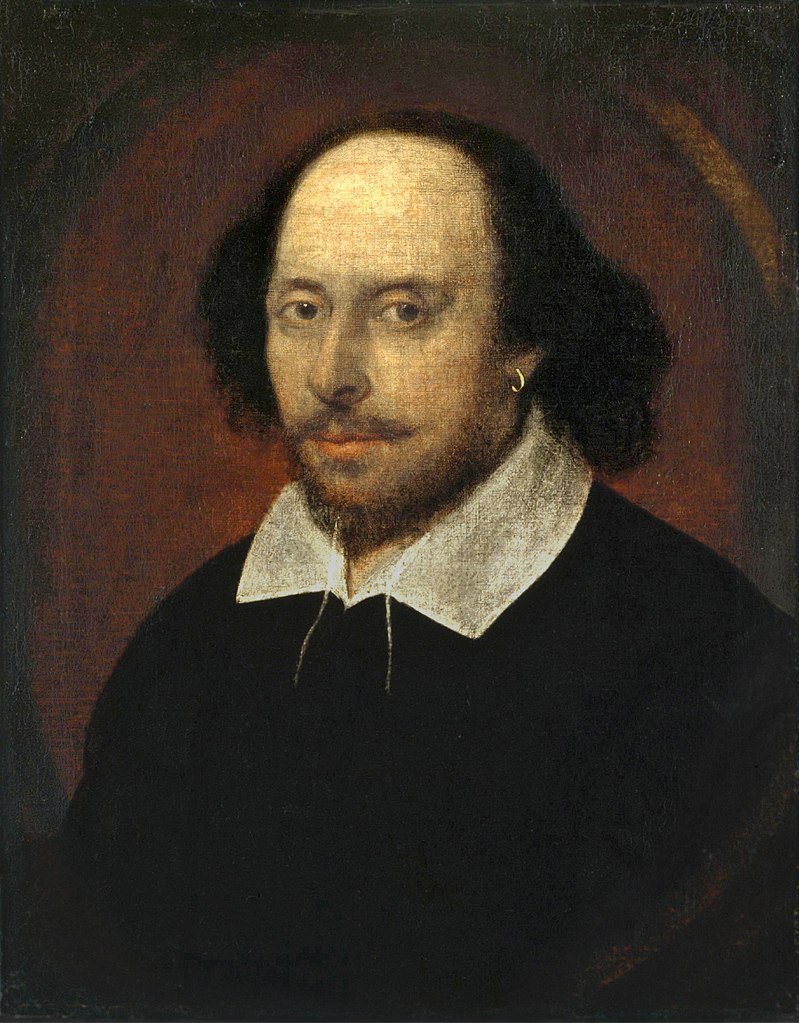
This was long thought to be the only portrait of William Shakespeare that had any claim to have been painted from life, until another possible life portrait, the Cobbe portrait, was revealed in 2009. The portrait is known as the “Chandos portrait” after a previous owner, James Brydges, 1st Duke of Chandos. It was the first portrait to be acquired by the National Portrait Gallery in 1856. The artist may be by a painter called John Taylor who was an important member of the Painter-Stainers’ Company.
National Portrait Gallery image via Wikimedia Commons.
It’s almost uncanny how relevant it feels right now.
So if I were directing Hamlet in the current moment, I’d give the title character an iPhone and game console. I’d have the characters onstage share photos on Instagram — and put up a big screen so the audience could see them posted in real time.
Hamlet could add pithy captions to his social media images. What a piece of work is a man! or maybe The lady doth protest too much!
Yes, Hamlet is many things, but one of them is, perhaps, a failed influencer.
Along the way, we may have answered the classic question about this play. For generations, critics have wondered why Hamlet wastes so much time, and can’t be bothered to take action.
Maybe he’s just too busy gaming and scrolling.
Okay, it sounds ridiculous. But is it really? Shakespeare possessed tremendous insight into the human condition — perhaps more than any author in history. So maybe he really did grasp the dominant personality types of our own time.
The Prince of Denmark still walks in our midst. And maybe — just maybe — careful attention to this play might help us, in some small degree, to heal the Hamlets all around us. Their number is legion.
Of course, the larger reality is that Shakespeare has proven himself relevant to every time and place. We can see that easily be examining how other generations viewed this same play.
Hamlet‘s original audience, four hundred years ago, clearly enjoyed the spectacle of violence and adultery. Nine key characters die during the course of the play — most of them murdered. Audiences loved these kinds of dramas back then, and Shakespeare always knew how to please the crowd.
But more sophisticated viewers, circa 1600, would have seen Hamlet as a political commentary — a reflection of all the tensions and rivalries of Elizabethan England. Nobody knew better than Shakespeare that monarchy is a dangerous game, and he always looked for opportunities to refer to current events in roundabout ways.
But two hundred years later, the Romanticists were in ascendancy, and they saw Hamlet as a very different kind of play. They ditched the politics, and embraced the Prince of Denmark for his pathos and personality. They tapped into the intense emotional currents of Shakespeare’s heroes — and the plays seemed perfectly suited for this kind of interpretation.
It’s no exaggeration to say that Hamlet continued to change for each new generation. He always feels timely and relevant.
A hundred years ago, critics began grappling with psychology and the unconscious — and Hamlet was a perfect character for these kinds of interests. In his 1900 book The Interpretation of Dreams, Freud focused on Hamlet as a case study in repression.
And who could disagree?
But fifty years later, Hamlet changed again. It now was the perfect play for those who had survived World War II. Jan Kott insists, in his book Shakespeare, Our Contemporary, that these old plays were more relevant than ever during the Cold War — just as timely as Beckett or Sartre or Brecht or Ionesco.
C93 Borchardt: the First Successful Self-Loading Pistol
Forgotten Weapons
Published 29 Nov 2015Hugo Borchardt was a brilliant and well-traveled firearms designer. He was born in Germany but emigrated to the United States at a fairly young age, where he became engaged in the gun trade. He spent time working with Winchester, Remington (where he patented improvements on James Paris Lee’s box magazine idea), and Sharps (where he designed the M1878 rifle and worked as Superintendent). With this experience under his belt, he returned to Germany and worked with the Loewe/DWM corporation.
Borchardt’s seminal invention in Germany was his C93 automatic pistol, which was the first of its kinds using a reasonably powerful cartridge and a locked-breech action. Unlike the other designs extant at the time, the C93 went into commercial production, and 3000 were ultimately made. The gun was safe and reliable, and it set the standard for locating a detachable box magazine in the grip, which remains the standard today. However, its very bulky mainspring assembly led to it being a rather awkward handgun to use (although it was a quite nice carbine when used with its detachable shoulder stock).
Borchardt’s talents came hand-in-hand with a fair amount of hubris, and he refused to consider the possibility that his pistol could be improved. Several military trials requested a smaller and handier version of the gun, and when Borchardt refused to make those changes, DWM gave the job to a man named Georg Luger. Luger was very good at taking existing designs and improving them, and he transformed the basic action of the C93 into the Luger automatic pistol, which of course became one of the most iconic handguns ever made.
QotD: “That wasn’t real communism …”
All Karl Marx did was bring that down to the material level — it’s not the world spirit having a debate with itself, it’s the world, the material object. Both the debate and its conclusion are made manifest in History, capital-H, which is why Marx was one of a long line of gurus who claimed to make History into a hard science. That “wrong side of History” stuff the Left is always going on about? That’s why they use that phrase so much, and why it has such emotional resonance for them. If you’re a Dialectical Materialist, being against Socialism is like being against gravity. What could possibly be the point? You’re just being perverse, comrade, and on some level you must know that …
Alas, History isn’t a hard science. There are patterns, of course, any fool can see that, but those patterns are the intersection of human nature and emergent behavior. The proof is in the writings of Karl Marx himself — every prediction the man ever made was not just wrong, but ludicrously so, and after getting burned a few times he admitted in his letters to writing in such a way that he could never be “proven” wrong. See also: The complete history of the Soviet Union, 1917-1991, and as a side note, you can tell the intellectual caliber of Socialism’s defenders by the fact that they trot out the excuse “That wasn’t real Communism; real Communism has never been tried.” Ah, so Lenin — he of Marxism-Leninism — wasn’t a true Communist. They’ll shoot you for saying that in, say, China, but do please go on …
Severian, “Power”, Founding Questions, 2022-02-02.
Update, 8 October: Welcome, Instapundit readers! Please do have a look around at some of my other posts you may find of interest. I send out a daily summary of posts here through my Substack – https://substack.com/@nicholasrusson that you can subscribe to if you’d like to be informed of new posts in the future.
October 6, 2025
Fire and Fury – Bomber Command 1943 – The Ruhr, Hamburg, Berlin and Disaster
HardThrasher
Published 4 Oct 2025The Bomber War continues — In this second part of our deep dive into RAF Bomber Command, we explore the WW2 strategic bombing campaign that raged from the Spring of 1943 to the Spring of 1944.
This episode covers the Battle of the Ruhr, the Hamburg Firestorm, the raid on the V1 and V2 rocket research site at Peenemünde, and the disastrous attacks on Berlin and Nuremberg. We’ll look at how these missions affected the course of World War II, the Nazi war economy, and the future of the Royal Air Force itself.
00:00:00 – Introduction
00:00:23 – Quotation
00:00:57 – The Battle of the Ruhr and Context of the War
00:04:59 – Planning for Operation Gomorrah
00:06:29 – Window
00:07:42 – Gomorrah
00:10:00 – Firestorm
00:14:53 – An Old “Friend” Returns
00:16:00 – Germany Goes On The Defensive
00:18:59 – Assessing the Damage
00:19:54 – Killing the V1 & V2s at Peenemünde
00:22:51 – The Battle of Berlin
00:27:53 – Reality Check for Bomber Command
00:29:50 – Disaster over Nuremberg
00:31:23 – Summing Up
00:32:05 – Survivor’s ClubReferences –
xvi The Wages of Destruction, Tooze, Penguin, 2006 (from the 2007 reprint) p. 590 and on
xvii The Wages of Destruction, Tooze, Penguin, 2006 (from the 2007 reprint) p. 597
xviii Stalin’s War, McMeekin, Penguin, 2022 p.470 and on
ixx Ibid p.327
xx The Bombing War, Overy, Penguin, 2012, p.332
xxi The Bombing War, Overy, Penguin, 2012, p323
xxii Ibid p.334
xxiii The Bomber Command War Diaries, Middlebrook and Everitt, Penguin, 1990 (orig 1985) p.413
xxiv Ibid p.440
xxv Speer: Hitler’s Architect, Kitchen, Penguin, 2020 p.185
xxvi The Rise and Fall of the German Air Force, Arm & Armour Press, 1983, p.236
xxvii The Bomber War, Overy, Penguin, 2020, p.336
xxviii The Rise and Fall of the German Airforce, Arms and Armour Press, 1983, p.235
ixxx Flak, Westerman, University of Kansas Press, 2001 p.202 and on
xxx The Pathfinders, Iredale, Penguin, 2021, p.213
xxxi Bomber War, Hastings, Pan Military, 1977, p. 371 (2020 reprint)
xxxii Bomber Command’s War Against Germany, Frankland, Pen & Sword, 2020 (see also original AIR 41/57, 1951) p.89
xxxiii AIR 16/487 – Despatches on War Operations Feb 1942 – May 1945
xxxiv Bomber Command’s War Against Germany, Frankland, Pen & Sword, 2020 (see also original AIR 41/57, 1951) p.197
xxxv Bomber Command, Hastings, Pan, 2021 (orig. 1979) Pan, p.373
xxxvi Bomber Command, Hastings, Pan, 2021 (orig. 1979) Pan, p.376Get Your Merch Here – https://hardthrasher-shop.fourthwall….
Email me – lordhardthrasher@gmail.com
“Hate speech” bans work perfectly to eliminate mean words and mean thoughts … and the rivers will run uphill
I have to assume that the headline captures the mentality of the people who call for more “hate speech” legislation, because the real world evidence clearly fails to support the notion. Many well-meaning people want the government to have the power to suppress speech they don’t like, never thinking that a different government could use the same laws to quash opinions they support. In the National Post, Chris Selley argues that the last way to achieve reconciliation with First Nations would be to ban “residential school denial”:

Two years ago, I ruefully predicted that Canada’s new law purporting to outlaw Holocaust denial would likely lead to a law purporting to outlaw “denying” the impact of the residential school system. That hasn’t happened yet, but we are well on our way.
The Liberals recently announced plans to table legislation that would purportedly outlaw displaying the Nazi or Hamas flags or symbols of other hate movements, and that has only intensified calls for that law outlawing “residential school denialism”, or indeed denying Canada’s “genocide” against Indigenous peoples.
“What is the difference between Holocaust Denialism and Residential School Denialism? I suggest there is no difference at all,” author Michelle Good wrote in the Toronto Star Tuesday on the occasion of the National Day for Truth and Reconciliation. “The inclusion of Holocaust Denialism in the criminal code is obviously to prevent the denial of the Jewish genocide of World War II. Therefore, after clearly illustrating that the residential school system was genocidal in nature and intent, it is difficult to find any reason whatever that Residential School Denialism should not be criminalized as well.”
I say these two new and proposed new laws would “purportedly outlaw” atrocity-denialism and hate symbols because they aren’t outright bans on the speech in question. Rather, to fall foul of them, you have to use your argument, flag or symbol to “wilfully promote hatred” against the group in question. It was and is already illegal to wilfully promote hatred against a religious or ethnic group — albeit with some huge caveats, more on which in a moment.
At some point in the future, should the Liberals remain in power — and perhaps even if they don’t — the government is likely to knuckle under to the calls for censorship of certain residential-school opinions. It’s just not worth the political blowback to object, or so one can imagine a backroom strategist reasoning. They would probably introduce the new law just in time for the National Day for Truth and Reconciliation. If police are willing to enforce these laws, there’s little reason to believe Crown prosecutors would be interested in pursuing the cases. That, in turn, would only frustrate the people who see value in this censorship, and would likely lead to ever-stronger laws … that themselves likely wouldn’t be enforced.
This is not good lawmaking, and it’s a chilling argument when the simple act of pointing out how many bodies have actually been discovered on former residential school sites is widely considered a form of “denialism”.
October 5, 2025
North Africa Episode 2: Rommel Arrives in Africa
World War Two
Published 4 Oct 2025
North Africa, February 1941. Operation Compass has shattered the Italian 10th Army, capturing over 100,000 men and pushing deep into Libya. But just as Britain celebrates its first major land victory of World War II, a new threat arrives: Erwin Rommel. Sent by Hitler to salvage the collapsing Italian front, the “Desert Fox” lands in Tripoli with orders to hold Libya — and immediately begins pushing east.
At the same time, British commanders face tough choices: should they secure North Africa, or divert their best troops to Greece as Churchill demands? With overstretched Commonwealth divisions left behind in the desert and fresh German forces arriving, a new campaign begins — one that will decide the future of the Mediterranean war.
(more…)
October 4, 2025
The “nation of shopkeepers” is now the nation of problematic “Centrist Dads”
Dr. Robert Lyman on the common misunderstanding of the nature of war and even their own imperial history among British voters:
I’ve been involved with the practice and study of war for the past 44-years. I have five degrees in history and the study and practice of war, and I have written 19 books on the subject and have contributed to the writing of 10 more, with 3 more of my own in train. The net result of this, observing international events and Britain’s response to them over recent times, is to conclude that Britain – and Britons – have a problem about war. The problem is that at a very fundamental or essential level we simply don’t understand it. I see eyebrows rising everywhere at this assertion, protests arising in the usual places to suggest that if we don’t understand war, how on earth did we create an empire? Worrying swathes of academia and our impressionable young – I know, I’ve taught them – believe that Britain is and has been a nation of rapacious warlords that conquered a major part of the world by the use of violence and disrespect for others. We don’t have time to refute that silly nonsense here, apart from observing that the primary nature of the British Empire wasn’t one that was secured or maintained by violence.
But, to the subject at hand. A product of long decades readying, studying, teaching and writing about war has led me to the conclusion that as a nation, both politically and culturally, we are too squeamish about the practice of war to be any good at either preventing it, or preparing for it. Put simply, our problem is that we are just too nice. Centrist Dads spend their entire lives seeking compromise, and worrying when a middle way cannot be found. It is only when, deep into a war we hoped wouldn’t wash up against our shores, that we come to the shocking realisation that people are trying to destroy us and as a result we find ourselves forced into the process of trying to master the business of organizing violence on a massive scale, and unleashing it as effectively as we can against our enemies. We always seem to be playing catch up, because we haven’t prepared adequately in the first place for the inevitability of war in a fractious world.
[…] Kit Kowol’s superb (and recent) Blue Jerusalem describes in embarrassing detail the ignorance evinced by politicians and military thinkers in the 1930s who hoped to avoid the sharp end of war by buying only bombers, or ships, or of relying on persuading the enemy population to coerce their leaders into ending a war they had themselves started. Perhaps if we dropped leaflets on Herr Hitler he would see the error of his ways, and end all this silliness? Very few people in Britain on the eve of the Second World War could bring themselves to comprehend the extent of the fascist animus either for democracy in general, or the Jews in particular, both seen by the Nazis as preventing the creation of a Grosse Deutschland and allowing Germany to regain her status as primus inter pares in continental Europe. It was only as Belsen was liberated nearly six-years later that the penny seemed to drop in the befuddled British mind that these people were bad, really bad, after all. It is one of the accepted reasons for the Allied failure to destroy the railways feeding Auschwitz: decision-makers in London or New York never truly comprehended the scale of the slaughter then underway across Occupied Europe.
This is where are again. Evidence for the worryingly widespread intellectual softness that dominated political thinking through the 1930s, which I would describe as a Centrist Dad problem, is everywhere. At an event last year with General Lord Dannatt where he gave what I considered to be a pretty straight forward talk on the security threats facing the UK, and what we should do about them, I overheard a comfortable middle class couple at the end complaining that he was being “too pessimistic”. They couldn’t see any cause for alarm. I was almost too shocked to reply. These are the sort of people who cannot quite understand why Hamas and Israel don’t just kiss and make up. It must therefore be Israel’s fault that there is no two-state solution in the Middle East. I read this sort of commentary every day in the broad sheets. It is particularly well expressed by the weekly output of two well-known podcast blatherers, archetypical Centrist Dads, one a retired politician – you know the two I mean – who consistently demonstrate that they have a fragile grasp on the animus that is generated in the hearts of those who despise us, no real understanding of the security steps we need to take to prevent it, nor of the kind of war required to eliminate such threats.
The starting point of these blatherers is what the journalist Jake Wallis Simon and the security commentator Andrew Fox describe as the “Wykehamist proposition”, which is that we should treat all people, hostile or otherwise, on the basis of our own benign ideological predilections. Accordingly, if we want to prevent someone attempting to kill us, regardless of the enemy’s motives, all we need to do is to sit round a table together, assume we all want the same positive outcomes from our conversation, and proceed amicably to resolve our differences. The sad reality is that this is not how the world works, nor is it how humans behave. If they have been to taught from childhood to despise you and everything about you, to the extent that they want to kill you – as Hamas and its ilk see Jews – no amount of so-called Wykehamism is going to persuade them to do otherwise. I suggest that the opposite approach is required. We need to treat threats to ourselves and our friends seriously, both in political and in military terms, and prepare accordingly. As General Lord Dannatt and I suggest in our book, stern, decisive military active to prevent Herr Hitler from remilitarising the Rhineland may well have prevented the entire Second World War from breaking out at all. To understand how to deal with war and threats of war, we need a political class that understands the scale of the threat we face and is prepared to undertake decisive action to nip hostility in the bud when it might occur. If we can resolve our differences amicably then of course we must always do so. But where an enemy does not want to play this game we must be determined to use force – and if necessary extreme violence – to protect our interests, and our people. This might involve dropping leaflets over the Ruhr but it might also entail dropping incendiaries on Berlin. In other words, to defend ourselves as a country, we must have the capability and the willingness to exercise the full-throated management of violence. We must also accept that it is the legitimate function of other democracies – like Israel – to do the same.