
Forgotten Weapons
Published 8 Sept 2015The Warner carbine was another of the weapons used in small numbers by the Union cavalry during the Civil War. It is a pivoting breechblock action built on a brass frame. These carbines were made in two batches, known as the Greene and Springfield. The first guns were chambered for a proprietary .50 Warner cartridge, which was replaced with .56 Spencer in the later versions (for compatibility with other cavalry arms).
This particular Warner shows some interesting modification to its breechblock, which has been converted to use either rimfire or centerfire ammunition. This was not an uncommon modification for .56 Spencer weapons, as the centerfire type of Spencer ammunition could be reloaded (unlike the rimfire cartridges). With this modification, the firing pin can be switched from rimfire to centerfire position fairly easily.
October 4, 2025
Warner Carbine
QotD: Roman … democracy?
Rome’s popular assemblies – for unlike most poleis, Rome has not one but four major assemblies, three of which matter – are the subject of something of a paradox in Roman political history which has in turn served as the hub around which a fairly active debate on the nature of Roman politics has rotated now for decades. The paradox is this: on the one hand, legally the Roman assemblies are sovereign. Their decisions, once rendered, are final and cannot be overridden by any other part of the res publica. That would seem to make Rome quite democratic, but to the contrary: apart from a few very notable exceptional moments, the assemblies are largely the dog that did not bark. They have vast power, but in part because of the traditional conventions of Roman politics (the mos maiorum, the “customs of the ancestors”) and in part because of how they are structured, the power of the assemblies often sleeps.
And today we’re going to look at why it is that the assemblies never roar quite so often as you’d expect and in the process begin developing the arguments of perhaps the central scholarly debate currently about the Roman Republic: how democratic was it really?
Bret Devereaux, “Collections: How to Roman Republic 101, Part II: Romans, Assemble!”, A Collection of Unmitigated Pedantry, 2023-07-28.
October 3, 2025
Women and credit card access … another “just so” story
Janice Fiamengo debunks a common “just so” story about women only gaining the right to hold a credit card in the 1970s:
A few years ago, I started hearing that women, before feminism, couldn’t have their own credit cards. Or they couldn’t get one without a man’s signature. Or married women couldn’t have one in their own name. Divorced women, apparently, couldn’t get credit at all. Men conspired to keep women powerless and dependent.
THANK THE GODDESS FOR FEMINISM!
Just last June, on the podcast Diary of a CEO (in an episode viewed by nearly two million people), three feminists debating feminism agreed that, in the words of one of the panelists, “None of us could get a credit card a few decades ago … We couldn’t have anything …” (see 1:50:37).
Before correcting herself, in fact, the panelist had started to say, “None of us could get a credit card a couple of decades ago …”
The statement struck me with the full force of the ludicrous. I started school in 1970. My teachers were nearly all women, at least half of them unmarried. They certainly seemed to live full, normal lives in obeisance to no man. They were paid a salary; they had bank accounts; they owned cars; they bought things and went on vacations.
My mother had worked in an insurance office for years both before and after she married my father in 1956. She had purchased appliances and paid her own rent, helped my father buy his first commercial fishing boat, and handled all the household expenses when my dad was away fishing for months every summer.
My friends’ mothers were similarly active and self-determining. Were all these women actually hobbled by the patriarchy, cut off from the economy?
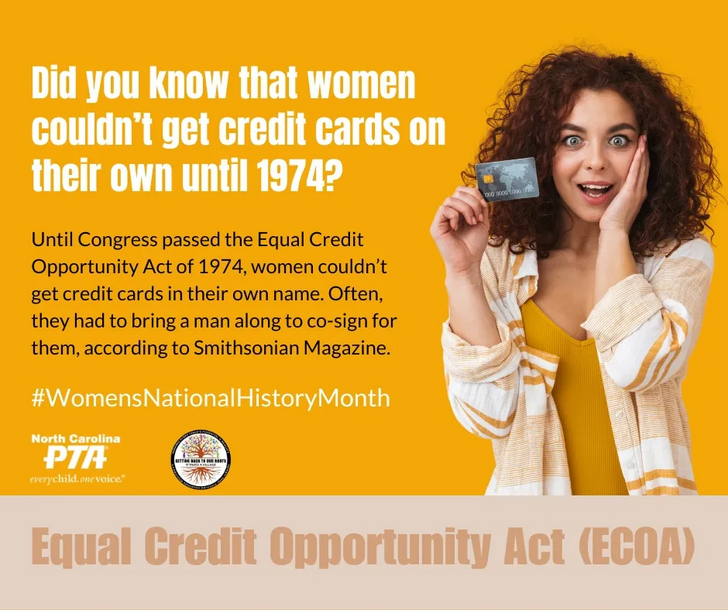
Received knowledge would have us believe so. Last year, The Globe and Mail published a paid advertisement for Women’s History Month titled “50 Years Ago: Women Got the Right to Have Credit Cards”. Written by a financial services company seeking to drum up business, the article repeated the popular story that women in North America could not get their own credit cards until 1974.
Credit cards were one of the growth areas for banks and other financial service companies in the 1960s and 70s … from something only relatively wealthy travellers and business executives used, they expanded to become widely used by ordinary consumers for all kinds of purchases. Consumers benefitted from access to useful financial tools, while banks enjoyed the profits from the widespread use of credit cards. So where did the idea that they were male-only come from?
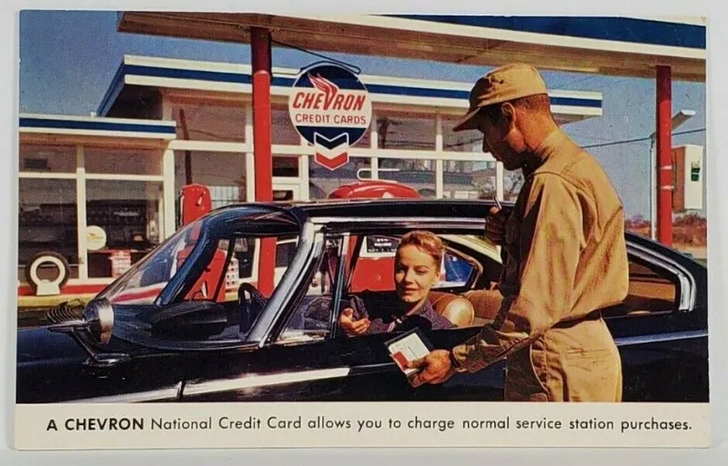
The reality is that from the 1950s on, credit cards were a new invention being aggressively marketed to both men and women. Advertising from the era shows how keen credit card companies were to target female customers, how eager to tap into women’s spending power.
Originally introduced as a convenience for travelers on business, credit cards began to expand their purview in the late 1950s. Bank Americard (later Visa) became the first consumer credit card in 1958. A network of banks formed the Interbank Card Association, originally named Master Charge (later Mastercard), in 1966.
Yet we are somehow to believe that half the population was deliberately excluded from this new consumer venture for no other reason than that they were female?
“It wasn’t until 1974 that women were allowed to open a credit card under their own name,” the Globe article states emphatically. “Before 1974, if women wanted to open a credit card, they would be asked a bunch of intrusive questions, like if they were married or whether they planned to have children. If a woman was married, she could (hopefully) get a credit card with her husband. But single, divorced, or widowed women weren’t allowed to get a credit card of their own — they had to have a man cosign for the credit application.”
The explanation is dramatic and incoherent, undoing its own logic from the beginning. It backtracks to allege that women were in fact “allowed” to have a credit card so long as they answered “a bunch of intrusive questions” or found a co-signer. Even this lesser claim is false, but it is rather different from the prior assertion about women “not having the right” to a card.
At a time when many married women either did not work outside the home or worked only part-time and on a temporary basis, there would have been nothing unreasonable about a woman’s husband co-signing her credit card application. Many married women were happy to purchase what they wanted on the assurance that their husbands would pay the bill when it came in, and credit card issuers saw joint accounts as a way of ensuring payment.
Update, 4 October: Welcome, Instapundit readers! Please have a look around at some of my other posts you may find of interest. I send out a daily summary of posts here through my Substack – https://substack.com/@nicholasrusson that you can subscribe to if you’d like to be informed of new posts in the future.
Mulligan “Hobo” Stew from the Great Depression
Tasting History with Max Miller
Published 29 Apr 2025Soup with canned peas, canned corned beef, onion, and ketchup
City/Region: United States of America
Time Period: 1940Today the word “hobo” is usually used in a derogatory manner, but back in the time between the end of the Civil War and the end of the Great Depression, it referred to a specific group of migrant workers and their culture.
Part of that culture was mulligan stew, which was basically a stew of any meat and vegetables that were thrown together. The ingredients would be made up of things that keep well, mostly food that was canned or bottled.
The flavor of this soup is surprisingly good, but it’s maybe a little too sweet, even for me. The prodigious amount of ketchup is the dominant flavor, and maybe 1940 ketchup was less sweet than modern versions.
Mulligan Stew (Serves 6)
1 medium size can corned beef — minced
1 onion — minced fine
1 No. 2 can peas with liquid
1 medium size bottle tomato catsup
1 cup water
Salt and pepper to tastePut all ingredients in saucepan and simmer gently over low flame for about one hour. The flavor improves with the length of cooking time.
— The Brookshire Times, August 2, 1940
QotD: The role of the True Believer
Anon @Greynxgga69
Abolish The Family.
Abolish Religion.
Abolish Wage Labour.
Abolish Money.
Abolish Work.
Abolish Commodity Production.
Abolish the State.
Abolish Class.
Abolish Private Property.
Abolish the Nation.
Abolish Patriarchy.
Abolish Gender.
Abolish Town and Country.The True Believers imagine they will live in Utopia after the Revolution.
They will instead be sent to the gulag, or lined up against the wall and shot.
Why?
Because the function of the True Believer is to make the Revolution. And the purpose of the Revolution is to replace The Regime.
Once the Revolution is made, and The Regime has been replaced, no further Revolutions are wanted. Therefore the True Believer serves no purpose.
He is a liability, because he has been promised Utopia, and Utopia is hard, even perhaps impossible, to deliver. If he does not receive the promised Utopia, he is apt to make Revolution again.
The Regime does not want this. It does not wish to be replaced in the same fashion that it replaced The Regime. So the True Believer must be disposed of. He must be replaced with the Opportunist.
The Opportunist can be relied upon, because he does not want Utopia. He wants to have more than his comrades. So long as he receives more than his comrades, he will serve The Regime.
As above, so below.
As before, so after.
Meet the New Boss. Same as the Old Boss.
Devon Eriksen, The social media site formerly known as Twitter , 2025-07-01.
October 2, 2025
The ritual humiliation of ordinary Canadians through “land acknowledgements”
On the social media site formerly known as Twitter, Tom Marazzo explains his objections to the ever-expanding use of “land acknowledgements”:

Let me break this down clearly so you can better understand why these mandated Land Acknowledgements are offensive to me.
They imply inherited guilt
A Land Acknowledgement usually frames the land I live and work on as “stolen”. Even if it does not say the words directly, the message is that I am benefiting from a theft. I served my country for 25 years, I have paid my taxes, raised my family responsibly, and built a life honestly. It cuts against my sense of fairness and justice to be told I must carry guilt for actions taken by people hundreds of years ago. I will not accept accountability for the past when I had no part in it.They ignore my contribution
I have invested decades of service in the military, in my education, in my community, and in my family. These acknowledgements do not recognize those sacrifices, nor those of my ancestors who also built and defended this country. Instead, they imply my very presence is illegitimate. That denies the legitimacy of my life’s work and my family’s role in helping build this nation.They make reconciliation into a ritual of shame
A healthy society should face the past with honesty. But what I see is not dialogue or shared responsibility. It is a scripted performance that demands I accept a label like “colonizer”, whether or not it reflects who I am. Rather than bringing people together, it divides by assigning one group permanent guilt and another permanent victimhood. That is not reconciliation. It is coerced shame.They erase complexity
History in Canada is complicated. Many settlers and Indigenous peoples lived, worked, and fought together. There were injustices, but also cooperation, intermarriage, and shared struggles. Long before Europeans arrived, Indigenous groups also fought among themselves, sometimes brutally, with violence and cruelty toward rival tribes. No group in history is free from wrongdoing. Yet the Land Acknowledgement format reduces this reality to a one-sided story of “oppressors vs. oppressed”, which is neither fair nor accurate.They are being mandated
Perhaps the strongest reason I find them offensive is that these acknowledgements are not voluntary. They are imposed in workplaces, schools, and public events as if they were civic duties or loyalty oaths. Refusing to participate often brings social or professional penalties. That strips away personal agency and turns what could have been a gesture of respect into a forced confession.So my reaction is not irrational. These acknowledgements conflict with my principles of fairness, personal responsibility, and earned legitimacy. They demand I accept guilt I do not bear, while ignoring the contributions my family and I have made. They also erase the truth that no people, Indigenous or otherwise, lived without conflict or wrongdoing in the past.
The first time I encountered a “land acknowledgement” in person was at my son’s university graduation ceremony. I assumed, as the university had a major First Nations study program, that this was something only done there … but now it’s hard to find any public gathering in Canada that doesn’t have the opening cultural cringe and ritual humiliation ceremony to start the event.
How “Roman” is Times New Roman?
toldinstone
Published 24 May 2025Today’s video explores the long history of “Roman” fonts.
Chapters
0:00 Introduction
0:42 The Latin Alphabet
1:53 Rustic capitals
2:21 Uncial
2:50 Carolingian miniscule
3:32 Gothic
4:24 The Book
5:26 The first fonts
6:05 Littera Antiqua
6:46 Aldus Manutius and his successors
7:40 Times New Roman
8:07 How Roman?
QotD: The gap between the author and the reader
The Psellus book was a memoir, and so its author was presenting himself fairly directly to his audience, if in a self-edited fashion. Fiction adds a layer of veiling between creator and reader, ranging from a thin gauze to a thick stage curtain. People are naturally curious about anything hidden by a curtain, and always want to peek. (When thinking about this as a shy writer, I always channel that famous line from the Wizard at the climax of the movie The Wizard of Oz — “Pay no attention to that man behind the curtain!”) But if readers can’t get an actual look, they will make up the writer in their heads, constructed from their own knowledge and expectations much as they mentally construct the fictional characters they’re reading about.
I got an accidental peek at this process many years ago at a science fiction convention, where I fell into a conversation in the booksellers’ room with a (male) reader who was very surprised to discover I was a woman — by whatever assumptions, he had not processed my name on the cover as female. (This, I later discovered, is not uncommon in my foreign-language translations, where the genders of English names are less recognizable.) Quickly, before his mental image was overwritten by our encounter, I got him to describe the author whom he had imagined had written the books he’d enjoyed (Vorkosigan Saga science fiction stories, at the time.) It included some odd details — male, mid-thirties, dark-haired, East Coast upper class — rather like my fictional character Ivan Vorpatril, really. Nothing at all like the beleaguered (if also mid-thirties) Midwestern housewife and mother I actually was. Yay curtain.
Lois McMaster Bujold, introduction to the Taiwanese edition of The Curse of Chalion by Fantasy Foundation/Cite Publishing, 2020-03-25.
October 1, 2025
The Korean War Week 67: Ridgway Questions Truman’s Resolve – September 30, 1951
The Korean War by Indy Neidell
Published 30 Sep 2025There’s worry and chaos in Washington when UN Commander Matt Ridgway indicates that there is one order that if given from above, he will not obey. That order concerns the possible resumption of peace talks with the Communists at Kaesong. Meanwhile in the field, the bloody Battle of Heartbreak Ridge continues, though US 2nd Division has a new commander who has new plans for how to bring about victory.
Chapters
00:00 Hook
00:53 Recap
01:07 Heartbreak Ridge
04:04 Replacement Troops
06:30 Operation Commando
09:25 Ridgway Refuses
12:52 Summary
13:11 Conclusion
(more…)
The Battle of Actium – We can at least agree ships were involved!
Drachinifel
Published 12 Oct 2022Today we take a look at the battle that decided if Rome was to be a Republic or an Empire, and also examine why its incredibly hard to work out just exactly what happened between the start and the end!
Sources:
https://www.amazon.co.uk/Battle-Actiu…
https://www.amazon.co.uk/Actium-31-BC…
https://www.amazon.co.uk/War-That-Mad…
https://www.amazon.co.uk/Roman-Histor…
http://eprints.nottingham.ac.uk/10452/
(more…)
QotD: The Indian Mutiny of 1857
This is a near-perfect synecdoche for the Raj’s problems. British Army officers weren’t stupid — lots of them commented on the issue. But they were isolated. For one thing, lots of them weren’t regular army — they were attached to the East India Company army, a separate formation, and within the Company’s army were different formations with different service requirements. And the army — whichever army — was deeply isolated from the civilian administration. For one thing, India’s huge, and there were never more than about 200,000 British in the whole place. The army was mostly on the frontier; the Government hung around primarily in a few big cities: Bombay, Calcutta, the summer capital at Simla (way up in the Himalayas).
So stop me if this sounds familiar: The civilian administration didn’t really know anything about the group upon which their peace, their security, their very lives depended. Actively despised them, in fact — oh, those wogs and their silly customs. But also look at it from the bottom up: What could the civilian administration really have done, with the best will and deepest knowledge in the world? […]
What could the leadership really have done at that point? Send a select group of brahmins and imams to tour the grease factory? The rumor would be that the British set up a Potemkin factory just for them; the real factory was using cow and pig fat. Reissue the old rifle? Recall that they already changed their drill — a pretty big deal in any army; a huge deal in a mid-19th century one — and that just added to the paranoia. Anyone who has ever been on the Internet knows how these things work once they get started: Evidence of an evil conspiracy is evidence of an evil conspiracy, but no evidence of an evil conspiracy is even more evidence of an evil conspiracy!
The root cause of the Mutiny, in other words, wasn’t political or economic (despite what Karl Marx said). It wasn’t even “cultural” in a lot of senses, and you can tell by the actions of the mutineers — or, rather, the non-actions. They simply had no idea what to do. They had no leadership (though some of them tried to install one of the remaining Mughal rulers in Delhi as an expedient; there’s a great book about it). The “Mutiny” was really just generalized beefing and score-settling on a continent-wide scale. They all had grief with the British, of course, and that was a convenient rallying cry. Once the British were gone — and see above, there were never very many of them — the guys down south quickly realized they had nothing in common with the guys up north. Ditto the guys on the east coast, the west coast, the hill country, the jungles …
Again, stop me if this sounds familiar: Stuffing a bunch of alien groups together inside artificial boundaries under a capricious, purposefully out-of-touch “government” that obviously hates every single one of those alien groups more than each one of the groups hates all the others, is kind of a bad idea. With the exception, of course, of that capricious government’s goon squad, the one group they obviously favor because that group can be counted on to knock heads on all the other groups whenever the government lets them off the chain (I’m talking about the Sikhs, obviously).
It doesn’t matter, in other words, what the rifle cartridges were greased with, or if they were greased at all. In this historical timeline, the precipitating cause of the Sepoy Rebellion was “the Enfield Rifle”. In the next timeline over, it’s something else — something equally minor — but the rebellion still happens, at pretty much the same time and in pretty much the same way.
In other words: It’s not that the British were alien to their subjects. Most groups in most places have been ruled by aliens, and trust me, the brahmin caste is far, far more alien to the castes below it than the British were to all of them combined. Nor was it that the British were high-handed administrators, as incompetent as they were arrogant. They were actually pretty good administrators, all things considered — “government competence” is always one of life’s lower bars, but the Raj cleared it easily. The guys running the “princely states” that made up the majority of the “British” Raj were every bit as alien to “their” people as the British, and in general spectacularly incompetent too.
Severian, “The Ruling Caste”, Founding Questions, 2022-03-09.
September 30, 2025
How Tyrants Rise — and How to Stop Them – W2W 46
TimeGhost History
Published 28 Sept 2025Tyrants don’t just appear overnight — they rise through propaganda, fear, and control. In this episode of War 2 War, we explore how authoritarian leaders consolidated power in the 20th century, from the ruins of World War Two to the opening battles of the Cold War. How do tyrants gain control, how can you recognize the warning signs, and what can societies do to resist them? Drawing on lessons from Hitler, Stalin, and beyond, we break down the patterns of dictatorship and what history can teach us about confronting them.
(more…)
Stamm-Saurer Model 1913 Long-Recoil Prototype Rifle
Forgotten Weapons
Published 21 May 2025Hans Stamm developed a series of firearms in Switzerland in the early 1900s, and today we are looking at a second-pattern Model 1913 semiauto rifle. This was developed while Stamm was working for the Saurer company, where he headed its small arms division. Stamm’s Model 1907 straight pull rifle failed to win military adoption, and so in 1910 he began working on a quite complex long recoil system. The first prototype was finished in 1912, and by 1913 another seven examples were made.
These are sent to the Swiss and Belgian militaries for consideration, but neither are interested — and the outbreak of World War One ends possibilities for other adoption.
Previous Stamm designs:
1902 Gas-Operated Semiauto: • Stamm-Zeller 1902: A Swiss Straight-P…
1907 Straight-Pull: • Stamm-Saurer Model 1907: A New Swiss …Many thanks to the Swiss Shooting Museum in Bern for giving me access to these two very rare rifles to film for you! The museum is free to the public, and definitely worth visiting if you are in Bern — although it is closed for renovation until autumn 2025:
https://www.schuetzenmuseum.ch/en/
(more…)
September 29, 2025
Bomber Command 1943 – Reap What You Sow – The Bomber War Episode 6.
HardThrasher
Published 26 Sep 2025Part 1 of a 2 Part Series covering Bomber Command in 1943 — this is the background and build up, the aircraft, the founding of pathfidner force and the mechanics behind the mass use of incendiaries
References from the video below
i Battle of the Beams, Tom Whipple, Penguin, 2003, p.209
ii The Battle of the Beams, Whipple, Penguin, 2003, p.213
iii The Bombing War, Overy, Penguin, 2012, p.345
iv The Pathfinders, Will Iredale, Penguin, 2021, p.116 and on
v The Bombing War, Overy, Penguin, 2012, p.238
vi See Caliban Rising’s excellent video on statistical deaths for Bomber Command
vii B12/36, The British Aircraft Specifications File, Meekcoms & Morgan, Air-Britain, 1994, p.228
viii The Bombing War, Overy, Penguin, 2012, p.290-91
ix The Pathfinders, Will Iredale, Penguin, 2021 p.74
x Proceedings of the Royal Air Force Historical Society, Issue No 6, Sept 1989, p.22
xi The Pathfinders, Iredale, Penguin, 2021, p.75
xii The Pathfinders, Iredale, Penguin, 2021, 2021 p.79
xiii https://en.wikipedia.org/wiki/Wilfrid… – yes, yes I know, a Wiki reference.
xiv Interview 1977 for the RAF Centre for Air Power Studies (CASPS) – • RAF CASPS Historic Interview | Group Capta…
xv Pathfinder, Goodall, 1988 pp. 102, 158, 205email – hardthrasher@gmail.com
Merch – https://hardthrasher-shop.fourthwall.com
Patreon – patreon.com/LordHardThrasher
The Galactic Empire and a (Revised) Generic Model of “Fascism”
Feral Historian
Published 29 Sept 2023While we can classify significantly different regimes as “communist” based on their key similarities, we don’t have the same taxonomy for “fascism” as a political category. The term is either used so broadly it becomes meaningless, or defined so narrowly that it’s only relevant to Mussolini’s Italian Fascism.
But we can identify three key factors that, when all are present together, result in a system we can define as “fascist” in a sense that’s both historically based and general enough to be useful for analysis. In addition to laying out a simple model defining fascism, this video also dives into some history of Fascism and National Socialism, mixed with the kind of sci-fi analysis you’ve come to expect here.
00:00 Intro
00:35 Palp, Dolf, and Communists
04:05 Old Republic vs Weimar Republic
04:55 Party and State
08:57 Three-Point “Fascist Minimum”
09:24 “Third Way” Economics
15:12 Totalitarianism
19:19 Unifying Myth
22:53 Umberto Eco
24:46 Franco
26:25 Closing Miscellany🔹 Patreon | patreon.com/FeralHistorian
🔹 Ko-Fi | ko-fi.com/feralhistorian


