
Doctrine. Something I keep promising to write about and then don’t. Doctrine is, “the body of formal knowledge that tells a fighting force how it is expected to fight” (Parshall and Tully, 83). it is not a plan for a specific war, but the general planning framework a military brings to every war; think of it like a very complex list of “best practices”. This is necessary because war is too complex to make this stuff up on the fly. That said, just because a military has a written out doctrine doesn’t mean they can execute on that doctrine; the doctrine may call for things that military (or its political leaders) are simply not capable or willing to do. That said, a military that finds itself operating well outside its own doctrine is likely in trouble. Russian maneuver warfare doctrine generally goes by the moniker Deep Battle or Deep Operations (Глубокая операция) and to say that the Russian Armed Forces [in the 2022 invasion of Ukraine] have not managed to pull off their doctrine in practice is a significant understatement.
Bret Devereaux, “Miscellanea: A Very Short Glossary of Military Terminology”, A Collection of Unmitigated Pedantry, 2022-03-25.
September 21, 2026
QotD: Military doctrine
September 20, 2026
“Honest” graft
Politicians and corruption go together like wine and cheese but not like crime and punishment for some reason. It’s almost as though the path to wealth and influence goes through political connections rather than economic efficiency and innovation. Chris Bray points out the difference between the “honest” graft of days gone by and the kind of all-consuming corruption we see far too often these days:

Tammany had honest graft: They said they would build a bridge or a park, and then they built it. The cost would be sort of not nakedly obscene, and no money would be missing if there was an audit. But by the most remarkable coincidence, the land where the park or the highway or the approaches to the bridge would go turned out to be owned by very close friends of the Tammany machine, who then got paid a nice little premium for the acquisition of land that was needed for a public purpose, and maybe the people who sold the concrete and the lumber and supplied the labor also turned out to be awfully close friends of the politicians who approved the project, but at the end, there’s the bridge. There’s the new highway, and it cost something within shouting distance of what you would expect the thing to cost. It added up, but they did some fairly polite stealing. There was respect in it. It wasn’t honest, but it wasn’t wide-open looting.
An extremely common form of graft in American politics is the “Three Bs” that Robert Caro famously described in Texas politics: beef, bourbon, and blondes. Cocktails, steak dinners, and maybe if you were a legislator who played ball a nice young lady came and visited your hotel room during the legislative session. But that graft was about topics like who got the state highway contract. Some money traded hands, there was dishonesty in the allocation of public resources, and the highway got re-paved.
The Quality Learing Center model, or the high-speed rail model, or the 800 hospices in Los Angeles with patients that never died, all represent a model of grift that comes from a culture of complete shamelessness. In California, nearly 700 non-profit corporations exist to provide shelter to the homeless, and over 500 non-profit corporations exist to prevent homelessness and provide social services to the homeless or to people who may become homeless. There’s quite a bit of overlap between those categories, so there aren’t 1200+ non-profits, but there are hundreds, and they have billions of dollars in income.
Some are entirely legitimate and do real work. There are people in California who will be fed and sheltered tonight by a non-profit corporation that will keep them from sleeping on the street. It’s not at all my argument that no one in any non-profit anywhere ever does anything real. But the overall picture is theft, and the premise that the flood of money is ending homelessness (or is meant to) is a lie, and a dark one. Gavin Newsom presented his ten-year plan to end chronic homelessness in 2008.
Update, 22 September: Welcome, Instapundit readers! Have a look around at some of my other posts you may find of interest. I send out a daily summary of posts here through my Substack – https://substack.com/@nicholasrusson that you can subscribe to if you’d like to be informed of new posts in the future.
What Caused the War of 1812?
Real Time History
Published 17 Apr 2026The War of 1812 broke out after a series of escalations between Great Britain and the still young United States. The impressment of American sailors into the Royal Navy desperate to crew their ships in the ongoing war against Napoleon, the question if the US could trade with Britain and France at the same time and thus profit of the war, all came to a head after failed negotiations.
(more…)
September 19, 2026
CAMRA and the fight to save British beer in the 70s
On his Substack, Henry Jeffreys recommends a couple of YouTube videos that beer fans might find interesting:

Every so often I vow that I am going to stop wallowing in nostalgia and engage with some contemporary culture: watch some new films, read a new book, and maybe even listen to some new music. But then I discover a treasure trove of old Jonathan Meades documentaries on Youtube and I’m lost. There’s so much good stuff on there that I am very tempted to cancel my Netflix subscription and take out Youtube premium, which means I won’t have to watch the incredibly irritating adverts. That’s another thing that’s not as good as it used to be.
Here’s a few booze-linked things that I’ve been watching recently.
[…]
I’ve long been a real ale enthusiast, in fact I wrote something for the Daily Telegraph on the subject earlier this month. My father was an early member of CAMRA, the Campaign for Real Ale. Meades refers to the organisation, not altogether negatively, I think, as “anti-metropolitanism, anti-modernism”. There’s something distinctly Hobbity about tilting at progress and, to some extent, winning. Live, unpasteurised beer was becoming a rarity by the 1970s, and now it’s easy to find in almost every town and village that still has a pub. It was described as “the most effective consumer pressure group in Europe”.
This documentary from 1977 looks at the battle to save Britain’s traditional beer. It’s particularly worth watching for the young bearded earnest CAMRA members at their conference. There were also a surprising number of women. It makes you realise that while real ale has a stuffy image today, at the time it was fashionable. It was a youth movement, not a bunch of reactionary old men, but young people seeing a problem and doing something about it. It is inspiring. If it wasn’t for these earnest, bearded young men and women (mainly without beards), then much of what we take for granted about British beer would no longer exist. The movement also inspired American craft beer, which in turn inspired British craft beer. It is hard to overstate how important CAMRA was for beer around the world.
Whicker’s World — Englishmen in New York
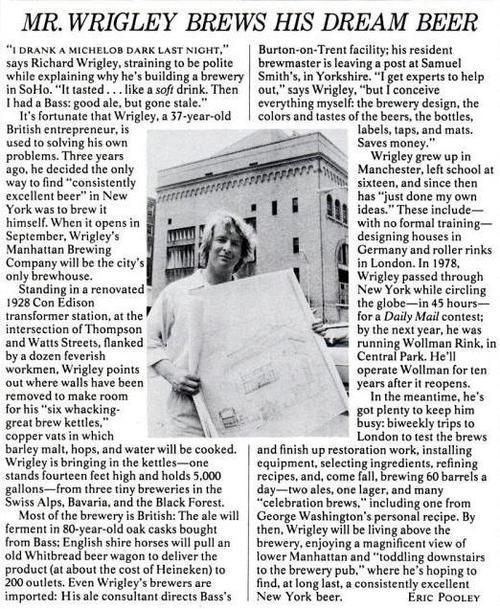
If you want to see what the state of American beer was like in the early 1980s, watch Alan Whicker’s documentary about Englishmen living in New York. The star is entrepreneur Mancunian Richard Wrigley, who is behind the Manhattan Brewery Co. He says at one point: “I like good beer and there wasn’t any in the States”, and compares the local brew to Perrier. He has taken over a gigantic derelict industrial building and is trying to turn it into a brewpub with brewing equipment from Germany. He’s even shipped over two dray horses at vast expense. Wrigley is completely unflappable, confident that they will open in two weeks even though the work is nowhere near finished. Whicker is such a great interviewer, warm and avuncular, but he keeps pressing Wrigley about the expense and where the money is coming from.
Amazingly the brewery, which cost over a million dollars, did actually open, but it struggled to make money and eventually closed in 1995. Richard Wrigley, who died in 2022, is a fascinating character. He’d make a great subject for a feature film. There’s something of a chancer about him, slightly slippery but very charming. At one point Wrigley says that he has been described as a “conman”, but the Americans mean it as a compliment. It’s well worth reading up on the story of the Manhattan Brewery Co. While it failed, the head brewer Garrett Oliver would go on to make beer at the Brooklyn Brewery in 1994 — a company that would transform beer in New York. By the time I visited the city for the first time in 2003, good beer was everywhere.
How Britain’s oldest Proof House still tests modern military weapons
BFBS Forces News
Published 12 May 2026For nearly 400 years a succession of Proof Masters have been making sure firearms in the UK are safe, stopping dangerous guns from being used.
Every firearm, whether it’s for military use or not, has to go through something called a proofing process.
This is a series of tests to make sure the weapon is not only made properly, but it can withstand the pressure generated by modern-day ammunition.
QotD: Islam and the rise of Western hegemony
This, which claimed in its preamble that acknowledgement of “the equal and inalienable rights of all members of the human family is the foundation of freedom, justice and peace in the world”, was in reality not at all as “universal” as it affected to be. Standing recognisably in a line of descent from the proclamations of the French Revolution, it served as well as a repudiation of some of the more foundational assumptions of Islamic theodicy.
The concept of human rights was an alien one to Islam. Muslims, traditionally, had not believed in natural law. There were only laws authored by God. The insistence of United Nations agencies on “the antiquity and broad acceptance of the rights of man” derived, not from the great inheritance of the Sunnah, but from the philosophes of the 18th century. Tellingly, the Universal Declaration of Human Rights had been signed — where else? — in Paris.
Western hegemony over the Islamic world, then, did not end with the collapse of direct rule over it by the European powers. Western values, Western assumptions, Western concepts of law, all of them packaged and marketed as “universal”, continued to exercise an overweening dominance in global affairs. If this was true for Muslims in lands that had sought to reconstitute themselves as nation states, then how much more so was it for Muslims who, in the decades that followed the Second World War, travelled to Europe, and settled there in growing numbers.
Tom Holland, “The age-old tension between Islam and France”, UnHerd, 2020-11-02.
September 18, 2026
Worrying about post-combat lawfare will crush initiative and morale
As mentioned in Dr. Robert Lyman’s account yesterday, the British government wants to turn back the hands of time to change the rules of engagement under which British Army troops and police conducted themselves during “The Troubles” in Northern Ireland. It may be an exciting prospect for law firms, activists, and other anti-military groups, but it would set a terrible precedent for British use of military force from this moment onwards. At The Critic, Alexander Gray explains why this is a dangerous and stupid idea that should be dropped forever:
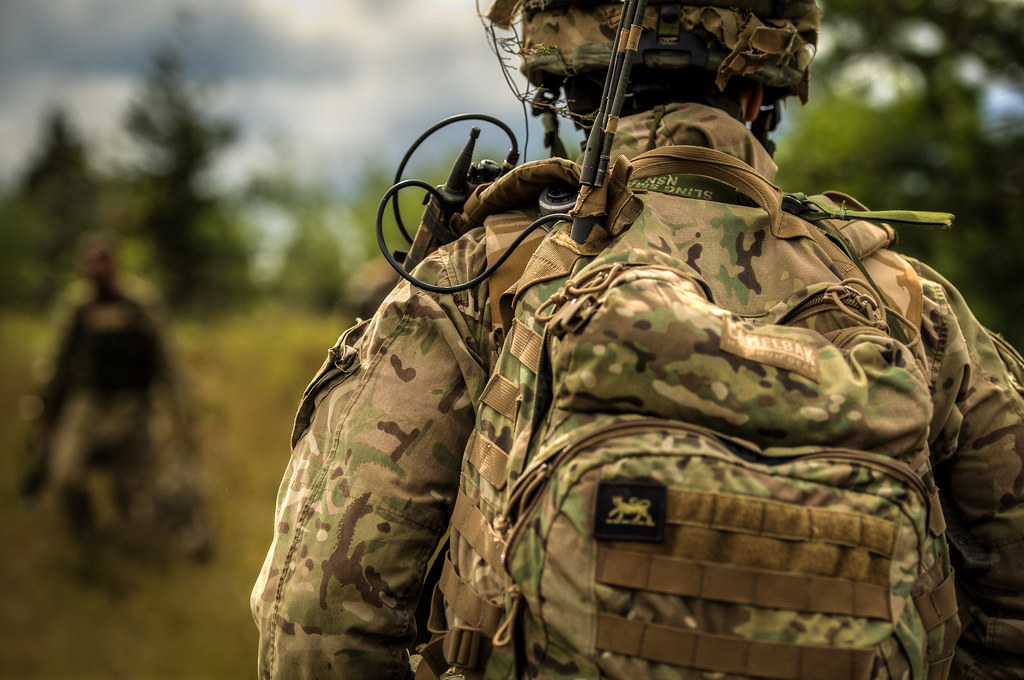
“British Army working during the Field Training Exercise” by U.S. Army Europe is marked with Public Domain Mark 1.0  .
.
The debate about the hounding of veterans through the courts has long been presented in terms of fairness. This is indeed one side of the story. No decent country should tolerate servicemen being dragged through repeated investigations decades after the events in question, often without new evidence and after previous inquiries have already reached their conclusions.
But focusing only on veterans misses an even more urgent point: this has become a national security threat.
Over the past two decades, the legal framework governing military operations has changed. Courts have increasingly applied standards developed for peacetime to scrutinise wartime situations of uncertainty and danger which often demand split-second judgement. Human rights law, designed principally to regulate relations between the state and individuals, has increasingly been applied to military operations, including to situations already governed by the Law of Armed Conflict.
This is having consequences on the battlefield. Personnel who believe that a lawful decision taken in combat may be reconstructed years later in a civilian courtroom are now incentivised to be more cautious, more process-driven and less willing to exercise initiative. That hesitation can slow decisions in situations where delay may place lives and the success of an operation at risk. The prospect of repeated investigations and prolonged legal uncertainty is also damaging morale and contributing to experienced personnel leaving the service, depriving the Armed Forces of skills and judgement that are difficult to replace.
This is why the Prosperity Institute has published the Military Operations Bill, presented to Parliament this week by Sir David Davis MP. It reasserts the principle that combat operations should be judged primarily by the Law of Armed Conflict. Courts have an important role in punishing wrongdoing, but they should not become alternative command structures reviewing military judgement from the safety of hindsight.
Update, 19 September: Welcome, Instapundit readers! Have a look around at some of my other posts you may find of interest. I send out a daily summary of posts here through my Substack – https://substack.com/@nicholasrusson that you can subscribe to if you’d like to be informed of new posts in the future.
“The destruction of the European Civil War traumatized us”
On Substack Notes, John Carter points out the vast chasm between the capabilities of western nations and their timid aspirations for the future:
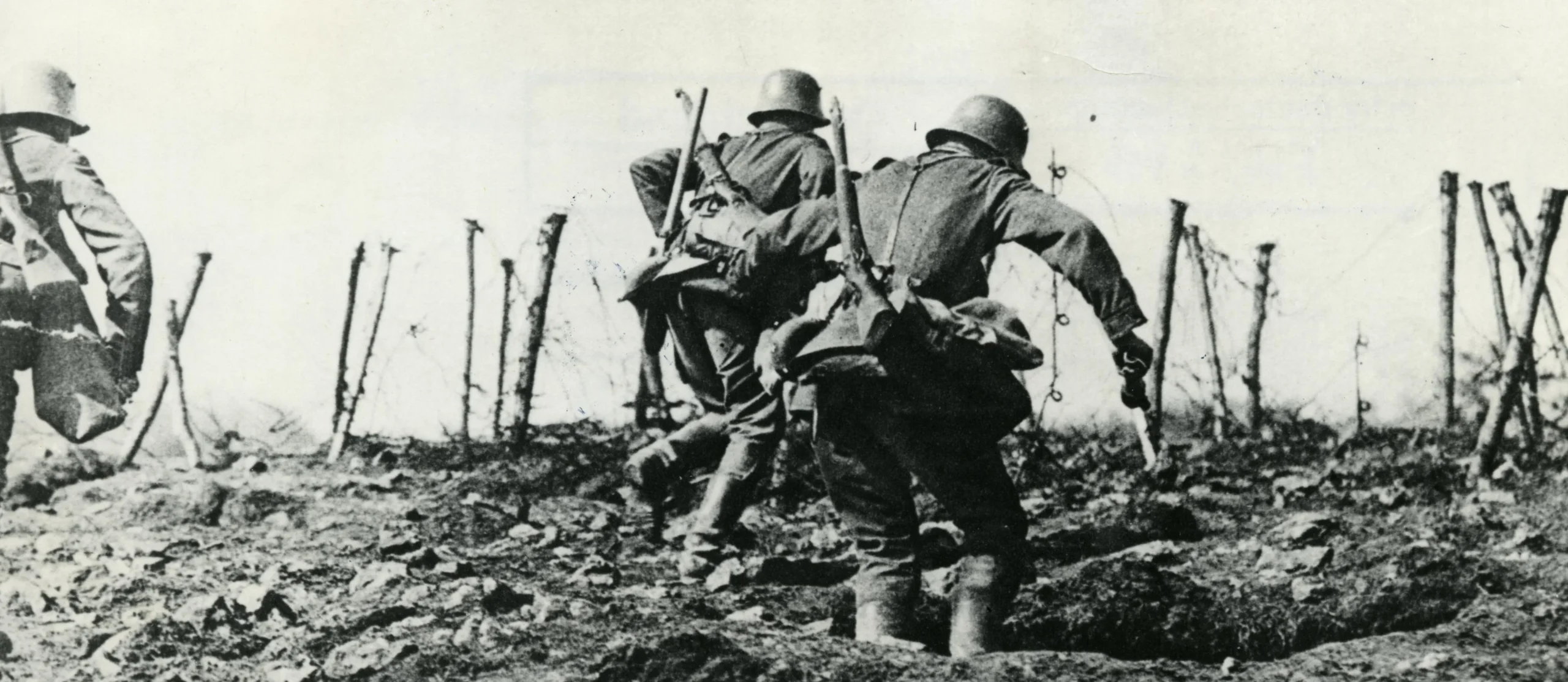
LeMO Erster Weltkrieg – Kriegsverlauf – Frühjahrsoffensive 1918
Photo from dhm.deWestern civilization is terrified of itself. The destructive power of our militaries is unparalleled in history. We can devastate continents in minutes. We can annihilate entire populations. We can reduce cities to rubble.
But we don’t.
The same is true of our industrial capability. We can erase mountains, redirect rivers, carve tunnels deep into bedrock, reshape entire landscapes as we please.
But we don’t.
The destruction of the European Civil War traumatized us. Meanwhile, the unintended consequences of unrestricted development — air pollution, water pollution, soil erosion, habitat destruction, even the sheer rampant ugliness of so much of postwar industry — has left us leery of just doing things.
In the postwar era we began binding ourselves ever more tightly with laws. International law to restrict the use of military force; environmental laws, labour laws, indigenous rights laws, and so on to govern the use of our industrial capacity. We did this for good reason. No one wants nuclear war, or even a repeat of World War Two. No one wants another Three Mile Island, another Chernobyl. With great power comes great responsibility, and no civilization has ever been more powerful.
But the result has been to paralyze us.
Our militaries watch helplessly as supplicants invade us with begging bowls held up as their battle standards, prohibited from shooting the unarmed boats by governments bound by international treaties to respect the human rights of anyone who claims to be seeking asylum. Meanwhile we find that it is almost impossible to build anything. High-speed rail, bridges, highways, housing — all of it is slowed to an imperceptible crawl by a regulatory overburden designed to do precisely that. Gulliver held down by Lilliputian strings of his own design, his flesh swarming with hungry ants.
The emerging political coalition of the right is largely comprised of those factions who have grown impatient with this artificial paralysis of the will. Why shouldn’t we use our military to assert ourselves abroad, and defend our borders at home? Why shouldn’t we turn loose the incredible power of modern, heavily automated, high-tech industry to build wonders on a scale never before known? Why shouldn’t we conquer space? Why shouldn’t we use biomedical science to make ourselves beautiful, brilliant, healthy and fit? Why shouldn’t we allow ourselves to be powerful? Why shouldn’t we allow ourselves to be strong? We shouldn’t we reach for greatness?
The opposition consists of all those factions who are horrified by this, terrified of the strength of Western civilization, intent on slowing it, stopping its engine, dismantling the machine, and salting the biocultural soil from which it grew. Third worldists, climatists, AI safetyists, pacifists, open-borders activists, misinformation censors, DEI ideologues, international human rights NGOs, all of these cooperate to throw sand in the gears, to sabotage the West, to subordinate it and ultimately to destroy it.
Guatemalan Contract St Chamond 70mm Mountain Gun
Forgotten Weapons
Published 2 May 2026Despite the French Army adopting a 65mm mountain gun in 1906, several French companies — including St Chamond and Schneider — developed their own mountain gun designs in the years before World War One. These were popular guns for foreign export, being relatively small, light, and inexpensive. St Chamond’s 70mm gun was built on the same breech design as their previous 75mm field gun, at the request of the Mexican military and famous small arms designer Manuel Mondragon. Quantities were sold to Mexico, Guatemala, and Belgium (for use in the Belgian Congo). This example is a Guatemalan one, now in the United States as a live, registered, transferrable Destructive Device.
(more…)
September 17, 2026
British government seeks to retroactively change the Rules of Engagement during “The Troubles”
I’m old enough to have had lengthy conversations with British soldiers and officers who were serving or had recently served in Northern Ireland at the tail end of “The Troubles”. It was a dangerous situation the troops found themselves in and the Rules of Engagement they worked under at least recognized that it wasn’t a normal day at the office back home. On his Substack, Dr. Robert Lyman explains why the current government’s plan to retroactively change the rules that governed the actions of the British military forces is one of the worst possible things they could do:

Lieutenant Robert Lyman in the Ballymurphy, 1983, in a photograph snapped by Lieutenant Colonel Bryan Elliott, CO of 1LI at the time. He was driving past in his Landrover and spotted a photo opportunity.
Photo via The War Room
For those who know me well, the idea that I might now be encouraging young men and women not to join the Armed Forces might sound that I had lost my marbles. I can assure you that is not the case. I am deadly serious. This government’s determination, building on the surrender of the previous Conservative government to the varying dictats of the ECHR, will drive an impossible moral and legal wedge between the people who the country ask to do its dirty work, and the government that sends them in harms way. It is an intolerable set of affairs that all sensible people in his country should oppose. What sort of perversity might think that this behaviour is acceptable from any government? I despair, yet it seems that this is precisely what our current morally impoverished government seems to desire.
[…]
The central concern is that the proposed changes will expose servicemen and women, many of whom have already undergone judicial scrutiny for actions undertaken during the Troubles, to further litigation and investigation. In practice, this is likely to encourage a new wave of cases brought by individuals seeking to revisit or reinterpret events from a campaign in which terrorist organisations such as the IRA and INLA were ultimately defeated.
The immediate implications are troubling enough. The longer-term precedent, however, is far more serious. If this legislation proceeds, it will send a clear message to today’s servicemen and women, that even after they have acted lawfully, completed investigations, and fulfilled their duty to the State, they may still face renewed legal jeopardy in later decades. It undermines the fundamental bond of trust between those who serve and the government that sends them into harm’s way.
Every member of the British Armed Forces operates within a strict and clearly defined legal framework. These rules, embodied in the Laws of Armed Conflict and implemented through Rules of Engagement (RoE), govern the use of force in military operations. During my own service, I spent countless hours learning these rules, teaching them to my soldiers, and ensuring they were followed in Northern Ireland, Bosnia, and elsewhere.
This debate is not about whether soldiers should be above the law. Of course they are not, nor should they be. Rather, it is about whether the rules that governed military operations at the time can be retrospectively reinterpreted after a conflict has ended. The concern is that former adversaries will be able to pursue legal action against veterans for actions that were considered lawful under the Rules of Engagement in force at the time.
Today, Policy Exchange published an excellent report examining this issue in relation to former members of the SAS who served in Northern Ireland. The report sets out the problem clearly and persuasively, concluding that the proposed changes should be abandoned. I agree.
Predictably, some MPs have defended the legislation. Diane Abbott, for example, has argued on X that opposition to the changes amounts to “a call for armed forces personnel to be placed above the law.” That characterisation is deeply misleading. The debate has never been about exempting soldiers from the law. It is about subjecting veterans to repeated investigations and additional layers of judicial scrutiny many years after the events in question, often in ways that were never demanded of those they fought against on behalf of the nation.
At its core, this issue is one of fairness. It raises questions about double standards, retrospective judgment, and the constant shifting of the goalposts. Veterans who served under one set of rules are now being told that those rules may no longer be sufficient protection against further legal action.
Is This Table Really 200 Years Old? (Furniture Forensics)
Rex Krueger
Published 16 Sep 2026[AI summary: Rex Krueger investigates a vintage drop-leaf gate leg table to determine whether it was handmade or factory-built. By examining specific construction techniques, joinery, and material choices, Rex deciphers the history of this piece and explains how such multi-purpose furniture served past households.]
All my plans!: https://www.rexkrueger.com/
More Furniture Forensics: • Furniture Forensics
Compass Rose Toolworks: https://www.compassrosetools.com/
Join the Mailing List: http://eepurl.com/g3rkmv
Get my woodturning book: http://www.rexkrueger.com/book
Get My Book, Everyday Woodworking: https://amzn.to/3oyjC0E
Follow me on Instagram: @rexkrueger
You don’t hate the relic media nearly as much as they deserve
The relic media in Canada has — thanks to generous government subsidies — become a maple-flavoured version of the North Korean news media, but even in the United States where there’s still a somewhat competitive market, most media outlets are delighted to act as unpaid propagandists … and have been that way for generations:
Walter Duranty won a Pulitzer Prize for lying about Stalin’s Ukraine famine while millions starved. His employer, the New York Times, never returned that prize. The institutional rot ran deeper than one reporter.
In 1936, Times Moscow correspondent Harold Denny watched the first of Stalin’s Great Purge trials and reported the proceedings as credible. The defendants, Grigory Zinoviev and Lev Kamenev among them, confessed to plotting murder and sabotage. Denny saw no obvious coercion and wrote accordingly. The NKVD had spent weeks breaking these men through sleep deprivation, threats against their families, and relentless psychological torture until they would say anything in open court.
Every confession was fabricated. Every defendant was executed anyway. Stalin murdered roughly 750,000 people during the Great Purge between 1936 and 1938, and the Times gave the operation a veneer of legitimacy at its most critical moment.
Central planners require a monopoly on information to survive. When the newspaper of record in the most powerful capitalist country on earth launders your show trials as fair proceedings, you buy yourself years of Western political goodwill. Stalin purchased that goodwill with useful idiots who confused proximity to power with insight.
You pay for this dynamic today every time an institution that failed catastrophically keeps its credentials, its prizes, and its authority to declare what counts as credible journalism.
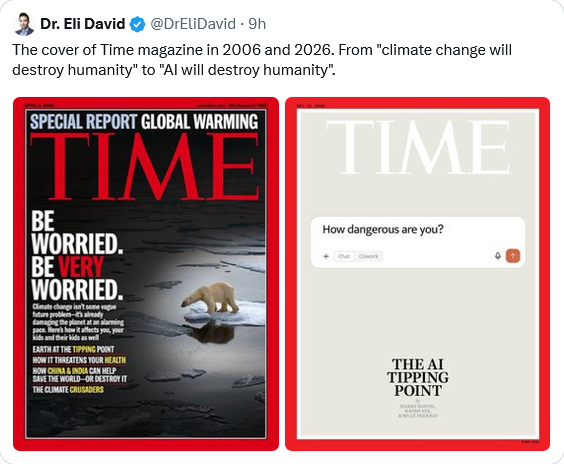
Duranty would have been proud of Time magazine had he been alive today.
The Brutal Life of a Medieval Butcher
Tasting History with Max Miller
Published 24 Mar 2026Tender stewed spiced meat and onions with bright yellow saffron sauce
City/Region: England
Time Period: c. 1430It’s a well-circulated myth that medieval cooks spiced meat heavily in order to hide the fact that the meat had gone bad. And it is, indeed, a myth. Amongst the many reasons why this doesn’t hold up is the fact that in medieval Europe, spices were expensive, and if you could afford to use a lot of them on your meat, you could afford not-spoiled meat. Dishes like this one, which uses five different spices and saffron, which has always been expensive, would be only for the wealthy.
This dish has the classic medieval flavors of warm spices and vinegar, and I really enjoyed it. The meat and onions are tender, the sauce is a beautiful bright yellow, and it’s quite unlike anything we typically eat today.
Brawn en peuerade
Take might broth of Beef or Capon, and then take clean fresh meat, and seeth it, but not too much; And if it be fresh meat, roast it, but not too much, and then cut it in pieces, and cast it into the broth; And then take whole onions, and peel them, and then take vinegar thereto, and cinnamon, … then take cloves, mace, and powdered pepper, and cast thereto, and a little saunders, and set it on the fire, and let boil till the onions and the meat be cooked enough, and not too much; then take liquor made with bread and vinegar and wine … and cast thereto saffron to make the color bright, and salt, and serve it forth.
— Harleian Ms. 279, c. 1430
QotD: Boris Johnson
How can this possibly have happened to the land of Magna Carta and English Common Law, the heroic seafaring nation which coloured the atlas pink and stamped its character on half the world’s nations from Australia and the U.S. to India and South Africa, that invented most of the world’s best sports, produced most of its greatest literature, beat Philip II of Spain, Napoleon, the Kaiser, and Hitler and discovered almost everything worth discovering?
Just when did Britain become so incredibly, embarrassingly shit?
Well, it’s easy to blame Boris, as I have done on occasion, for being a priapic lard-butted lightweight chancer who should never have been given the keys to Number 10. As we’ve learned to our cost, he’s all mouth and no trousers, great for an impromptu bon mot or jolly photo op but perfectly useless in times of crisis, being too easily led, having no opinions of his own, the backbone of sponge and the moral character of a Plecostomus catfish.
James Delingpole, “Britain is now the sick man of Europe”, Breitbart, 2020-08-14.


