
World War Two
Published 20 Jan 2024The huge new Soviet offensives charge ahead this week, taking Warsaw and Krakow; in the west the Battle of the Bulge is officially called over … though there is still fighting there. On Luzon, the Americans push out of their beachhead, though there is heavy fighting to secure their flank.
(more…)
January 21, 2024
The Red Army Overruns Poland! – WW2 – Week 282 – January 20, 1945
Comments Off on The Red Army Overruns Poland! – WW2 – Week 282 – January 20, 1945
A Book and a Rifle: The Vercors Resistance in WWII
Forgotten Weapons
Published 20 May 2018One of the single largest actions of the French Resistance during World War Two was Operation Montagnards — the plan to drop about 4,000 Allied paratroops onto the Vercors Massif when the resistance was activated in support of the Allied landings in Normandy and Provence. If you are scratching your head trying to figure out why you don’t remember that operation, it is because it never actually happened. The two Allied landings were originally intended to take place simultaneously, but logistical limitations forced the southern landings to be delayed about two months. In an deliberate decision to prevent the Germans from immediately understanding the nature of the Allied attack, the whole of the French Resistance was activated to support the Normandy landings in June 1944. The internal attacks in the south would force the Germans to keep significant forces in that area in expectation of a second landing, which would increase the chances of the Normandy landings succeeding. Unfortunately, the other result of this decision was that Resistance cells would come into the open in anticipation of imminent military support, which would not be coming. The southern elements of the Resistance were basically sacrificed in this gambit.
The Vercors Massif is a large geographical feature near Lyon and Grenoble which comprises basically a triangular sheer-walled plateau rising well above the surrounding plains. It offers a fantastically defensible redoubt, and that is what it was planned to be. Paratroops dropped onto the top of the massif would reinforce a substantial force of Maquis fighters, and create a serious strong point behind the German lines to aid in the fight inland from the landing beaches. The plan was organized in Algiers by Resistance representatives from the Vercors and Free French officers earlier in the war. Some have argued that the lack of support was simply due to the compromises of the single-landing plan, while others fault de Gaulle for deliberately abandoning the men and women on Vercors as part of a strategy to consolidate post-war political support — but that debate is beyond the scope of today’s discussion.
The fighters and civilians on the massif ultimately held out for about 6 weeks — only just too little to still be there when the Allied armored columns reached Grenoble. The German commander in the area spent several weeks making small probing attacks before the final assault with about 10,000 veteran Wehrmacht soldiers, glider-borne infantry, and tanks. Once that attack came, the fate of the Vercors was sealed. With proper military backing they could have defended their redoubt, but instead they had only a smattering of small arms and no heavy weaponry at all. It was a fight that was gloriously courageous but hopelessly doomed to failure.
I am privileged to have in my own collection a Berthier carbine tied to the Vercors Resistance, as evidenced by the brass embellishments on its stock. While I cannot conclusively prove it came from the Resistance, it was sold to me without any premium attached to them, and I have no reason to believe it is fake. And, of course, since I have no plans to sell it, I am not really concerned about conclusively proving its veracity to others. For me, it is a poignant icon of a tremendously heroic group. I hope I would live up to the bar they set should I ever be in a comparable situation!
(more…)
Comments Off on A Book and a Rifle: The Vercors Resistance in WWII
January 20, 2024
The British Empire would have failed a proper cost-benefit analysis
At the Institute of Economic Affairs, Kristian Niemietz is working on a paper on the economics of empire that, as he shows in this article, indicates that the empire was never a winning economic proposition for Britain as a whole, no matter how well certain well-connected individuals and companies benefitted:
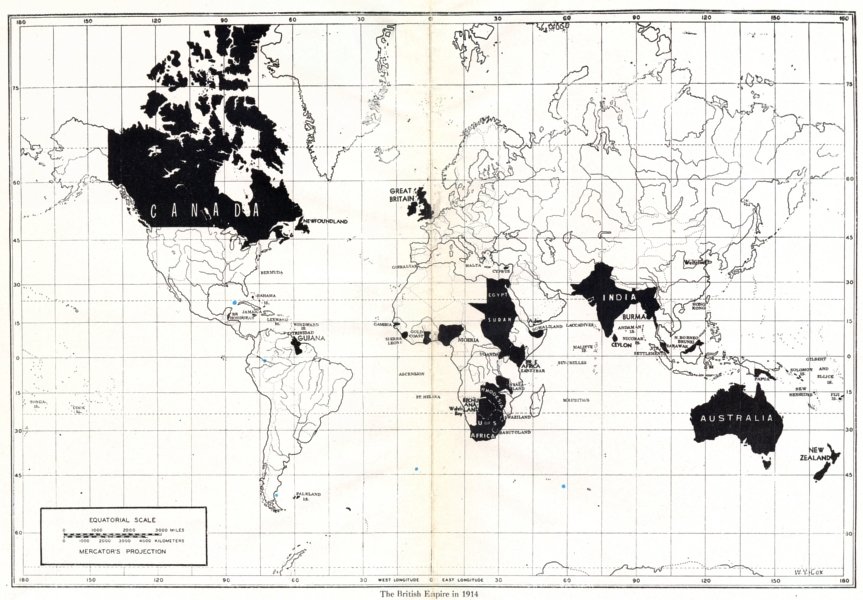
The British Empire in 1914 (via antiquaprintgallery.com)
But is it actually true that imperialism makes countries richer? Does imperialism make economic sense?
This question was already hotly debated at the heyday of imperialism. Adam Smith believed that the British Empire would not pass a cost-benefit test:
The pretended purpose of it was to encourage the manufactures, and to increase the commerce of Great Britain. But its real effect has been to raise the rate of mercantile profit, and to enable our merchants to turn into a branch of trade, of which the returns are more slow and distant than those of the greater part of other trades, a greater proportion of their capital than they otherwise would have done […]
Great Britain derives nothing but loss from the dominion which she assumes over her colonies.
He believed that Britain would be better off if it dissolved its Empire:
Great Britain would not only be immediately freed from the whole annual expense of the peace establishment of the colonies, but might settle with them such a treaty of commerce as would effectually secure to her a free trade, more advantageous to the great body of the people, though less so to the merchants, than the monopoly which she at present enjoys.
The liberal free-trade campaigner Richard Cobden agreed:
[O]ur naval force, on the West India station […], amounted to 29 vessels, carrying 474 guns, to protect a commerce just exceeding two millions per annum. This is not all. A considerable military force is kept up in those islands […]
Add to which, our civil expenditure, and the charges at the Colonial Office […]; and we find […] that our whole expenditure, in governing and protecting the trade of those islands, exceeds, considerably, the total amount of their imports of our produce and manufactures.
If imperialism was a loss-making activity – why did Britain and other European colonial empires engage in it for so long?
Smith and Cobden explained it in terms of clientele politics (or Public Choice Economics, as we would say today). Somebody obviously benefited, even if the nation as a whole did not. And the beneficiaries were politically better organised than those who footed the bill.
This proto-Public Choice case against imperialism was not limited to political liberals. Otto von Bismarck, the Minister President of Prussia and future Chancellor of the German Empire, hated liberals in the Smith-Cobden tradition, but he rejected colonialism in terms that almost make him sound like one of them:
The supposed benefits of colonies for the trade and industry of the mother country are, for the most part, illusory. The costs involved in founding, supporting and especially maintaining colonies […] very often exceed the benefits that the mother country derives from them, quite apart from the fact that it is difficult to justify imposing a considerable tax burden on the whole nation for the benefit of individual branches of trade and industry [translation mine].
In his writing about the economics of imperialism, even Michael Parenti, a Marxist-Leninist political scientist (who is, for obvious reasons, popular among Twitter hipsters), sounds almost like a Public Choice economist:
[E]mpires are not losing propositions for everyone. […] [T]he people who reap the benefits are not the same ones who foot the bill. […]
The transnationals monopolize the private returns of empire while carrying little, if any, of the public cost. The expenditures needed […] are paid […] by the taxpayers.
So it was with the British empire in India, the costs of which […] far exceeded what came back into the British treasury. […]
[T]here is nothing irrational about spending three dollars of public money to protect one dollar of private investment – at least not from the perspective of the investors.”
This leads us to a curious situation. Today’s woke progressives disagree with their comrade Parenti on the economics of empire, but they do agree with Britain’s old imperialists, who argued that the Empire was vital for Britain’s prosperity.
Why Tyrian Purple Dye Is So Expensive | So Expensive | Insider Business
Insider Business
Published 21 Jan 2023Making authentic Tyrian purple dye starts with extracting a murex snail gland. After a series of painstaking steps, Tunisian dye maker Mohamed Ghassen Nouira turns as much as 45 kilograms of snails into a single gram of pure Tyrian purple extract. When he’s done, he can sell it for $2,700. Some retailers sell a gram of the pigment for over $3,000. In comparison, 5 grams of synthetic Tyrian purple costs under $4.
So, why is real Tyrian purple so hard to make? And is that why it’s so expensive?
(more…)
Comments Off on Why Tyrian Purple Dye Is So Expensive | So Expensive | Insider Business
QotD: 19th Century techno-optimism
In The Politics of Cultural Despair (a book I recommend, with reservations), Fritz Stern called the writers of the 19th century “conservative revolution” in Germany “intellectual Luddites”. Just as the original Luddites wanted to stop “progress” by breaking machines, so the intellectual Luddites wanted to un-enlighten the Enlightenment, wiping out “Manchesterism” to return to a largely imaginary communitarian, agrarian past. The “machine” the intellectual Luddites sought to break, Stern argues, was reason … or, at least, rationalism, which by the later 19th century was basically the same thing in most people’s minds.
They had a point, those intellectual Luddites. If you haven’t read up on the later 19th century in a while, it’s almost impossible to convey their boundless optimism, their total faith that “science” could, would, and should solve every conceivable problem. The best I can do is this: Back when they were still allowed to be funny, The Onion published a book called Our Dumb Century, which purported to be a collection of their front pages from every year of the 20th century. The headline for 1903 was something like: “Wright Brothers’ Flyer Goes Airborne for 30 Seconds! Conquest of Heaven Planned for 1910.”
That’s the late 19th century, y’all.
Severian, “Digital Infants”, Rotten Chestnuts, 2021-04-16.
Comments Off on QotD: 19th Century techno-optimism
January 19, 2024
Canada “as a white supremacist genocidal settler state” also somehow has an immigration problem
In The Line, Jen Gerson documents what she characterizes as a collapse of the pro-immigration consensus that has been a major part of Canadian political affairs for generations:

A billboard in Toronto in 2019, showing Maxime Bernier and an official-looking PPC message.
Photo from The Province.
Canada created a durable and lasting consensus on immigration by leaning on a shared national mythology: that from a colonial past, we forged a principled multicultural nation in which people from around the world are able to honour their heritage and traditions while building a prosperous and successful life for themselves and their descendants. This narrative requires that all of us — regardless of our divergent ideologies or religious views — cohere around a shared set of post-enlightenment principles: the equality of man, the rule of law, tolerance, and the rest. We take this highly abstract concept of nationhood so for granted that we’ve forgotten how historically rare it is.
This is not to say Canada ever imagined itself to have an unblemished history, but rather that this is a nation that saw itself as a fundamentally good and noble project, and therefore some place worth immigrating to, and a culture worth integrating with.
The last nine years of Liberal government have undermined that vision. Under the Trudeau Liberals, instead what we have been regularly subjected to Canada as a white supremacist genocidal settler state. And, hey, to what extent that historical reckoning is good or necessary is not for me to say: but if “Canada is bad, actually” is the starting position, by what delusion do any of us presume to perpetuate it?
A post-modern nation state that has no sense of itself, and no belief in its own inherent value, is not an experiment worth continuing, now is it? How do we expect to welcome and integrate 500,000 new Canadians annually into a corrupt national project? If “Canadian” isn’t something worth being, why should anyone sublimate their ethnic or religious grievances into this vicious national identity?
I think this is the tension that lies at the heart of this growing unease around immigration, and it’s going to be the most difficult one for the Conservatives to navigate. There will be those within the party that follow this thread directly into white grievance and conspiracies like great replacement theory, the xenophobic fear that “elites” are trying to demographically and culturally replace white people through mass migration.
I think that theory is insane, to be clear, but I’m also noticing it wend its way into politics in weird and destructive ways.
A small example: before the holidays, certain conservative social media circles were put into a state of high uproar over the construction of a 55-foot statue of the Hindu deity Hanuman on a private temple complex in Brampton.
Initially, I was baffled and confused and even a bit amused by the upset. After all, this wasn’t a publicly funded monument. It was on private property, and isn’t respect for private property a sacrosanct value for conservatives? This wasn’t rational.
The controversy was only explicable when we examine the emotional subtext of the complaints: that there was something deeply menacing about Hanuman to these people. They saw him overlooking the suburbs of Brampton with a colonial intent. (Irony abounds!) One of the most telling tweets came from one angry individual who said something to the effect: “They tore down our John A. Macdonald statues, but, sure, Hanuman is great.”
To this gentleman: the fine devout Hindus of Brampton did not tear down your John A. Macdonald statues — and I highly doubt they would any pick bones with historic or civic monuments.
We, Canadians, tore down our own statues (or allowed them to be torn down) as part of an internal process of historical reckoning. Again, immigrants are not doing anything to Canada. They are Canada, and as such, they share in this country’s problems, which are largely self created.
Vienna’s Iconic Chocolate Cake
Tasting History with Max Miller
Published 17 Oct 2023
(more…)
Comments Off on Vienna’s Iconic Chocolate Cake
January 18, 2024
Understanding the Spanish Civil War
Niccolo Soldo offers an introduction to the context in which the Spanish Civil War took place, with emphasis on one side’s uneasy coalition of interests:
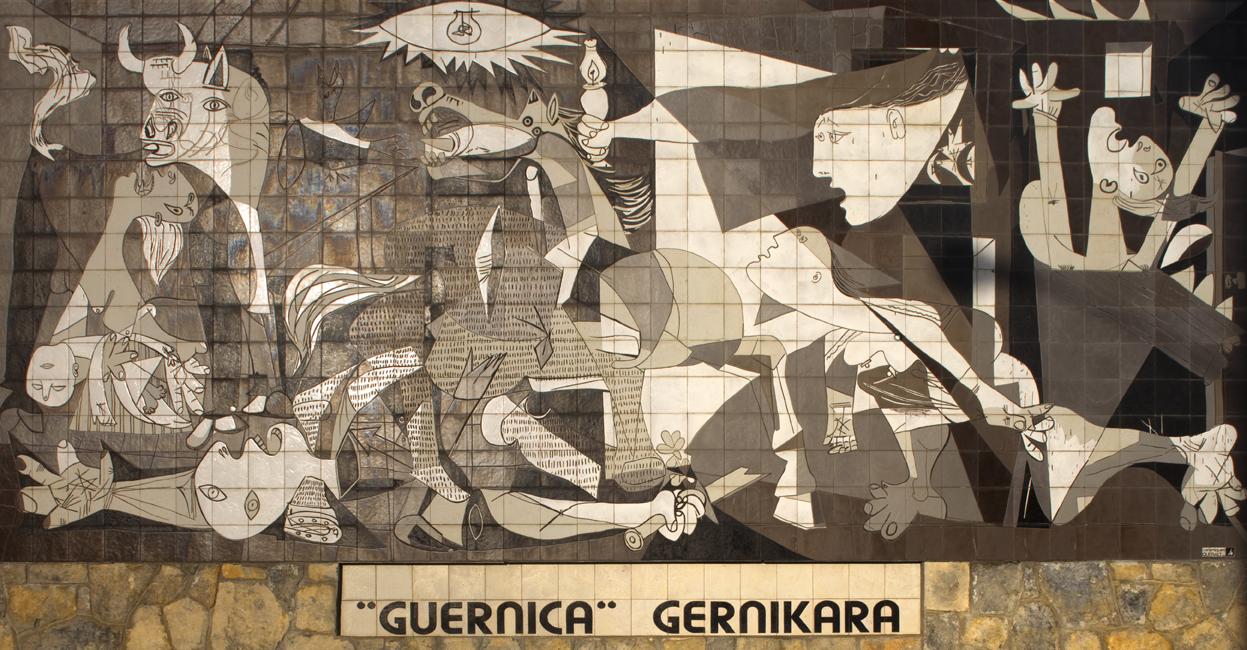
Picasso’s “Guernica” in mural form in the town of Guernica.
Photo by Papamanila via Wikimedia Commons.
At a crossroads in his life, [Ernest Hemingway] decided to go to Spain to cover the conflict for a newspaper chain. Out of his experiences in that war came For Whom the Bell Tolls (1940), one of his most celebrated novels. In this excerpt, he uses the female character “Pilar” to relate the story of how Republican forces massacred a group of people in a small town who were opposed to the government and supported the Spanish Generals seeking to overthrow it. Derided as “fascists”, each of the men were forced to pass a line of pro-government peasants who would beat them with flails before throwing them off of a cliff. Civil wars are indeed the most vicious, even in fictional depictions like this one.
The Spanish Civil War is odd for two reasons, the first one being that more than any other war that I can think of, historians have placed a much stronger focus on the politics of the conflict to the detriment of its military aspects. The second reason is much more important overall, and particularly germane to the subject of this essay: it is the only war that I can think of where the histories have been overwhelmingly written by the losers.1
If you ask a random, somewhat educated person in the West about the Spanish Civil War, they will generally say that “Franco was a fascist who allied himself to Hitler and Mussolini and won the civil war in the most brutal fashion possible. He was a dictator who hated democracy and killed thousands upon thousands of innocent people.” Beyond that, they might make mention of Hemingway and his novel, or even Pablo Picasso’s painting entitled “Guernica”2, that depicts the victims of the German Luftwaffe bombardment of that small Basque town in the north of Spain. Others still will relay the fact that the term “Fifth Column” came out of the Spanish Civil War.3 Added up all together, the most simplified take becomes “Franco bad, Republicans good”.
Of course this take is wrong, as this conflict was too complex to arrive at such a ridiculous reductionist conclusion no matter which side you sympathize(d) with. To give you a quick illustration of just how complex this conflict was, here is a list of the major domestic factions that took part in it:
Spanish Republican Side:
- People’s Army (the armed forces of the Spanish Republic)
- Popular Front (left-wing electoral alliance of communists, socialists, liberals, anarchists)
- UGT (very large trade union affiliated with the Spanish Socialists)
- CNT-FAI (massive trade union of anarchist militants)
- POUM (anti-Stalinist communists, including some Trotskyites)4
- Generalitat de Catalunya (Catalonian Autonomists)
- Euzko Gudarostea (Army of the Basque Nationalists)
Spanish Nationalist Side:
- Spanish Renovation (monarchists supporting the Bourbon claimant to the throne, Alfonso XIII, who abdicated in 1931)
- CEDA (the main conservative party, Catholic conservatives)
- Requetés (traditionalist Catholic monarchist militants who supported the Carlist Dynasty, mainly from the region of Navarre)
- Falange Española de las JONS (Spanish Fascists)
- The Army of Africa, including the Spanish Legion (Spanish Army in Spain’s then-colony of Morocco, with many Moroccans serving in it)
Add to this mix the International Brigades5 that fought on the side of the government, and the German and Italian forces who backed the rebels. To list off all the political groupings that participated in the war is a mouthful, but necessary to hammer home the point of the complexity of this conflict. So here goes: nationalists, monarchists (from two competing royal houses), fascists, conservatives, liberals, social democrats, socialists, communists (from two competing camps), anarchists, and regional autonomists. In short, this war had something for everyone, which is why it caught the attention of so many foreigners (especially famous ones) at the time. But before we dive into the run up to the civil war, we need to understand some of the history of Spain that lead up to this “world war in miniature”.
1. “History will be kind to me, for I intend to write it” – falsely attributed to Winston Churchill, but it makes for a good quote to illustrate the point. From the International Churchill Society: “‘Alas poor Baldwin. History will be unkind to him. For I will write that history.’ And another version often repeated is ‘History will be kind to me. For I intend to write it.’
What Churchill actually said, in the House of Commons in January 1948, was in response to a speech by Herbert Morrison, the Labour Lord Privy Seal, which attacked the Conservatives’ foreign policy before the war:
“For my part, I consider that it will be found much better by all parties to leave the past to history, especially as I propose to write that history myself.”
2. In January of 1937, Picasso was commissioned by the Spanish Republican government to create a work of art to display at the upcoming World’s Fair in Paris in order to draw international attention to their cause. At the time, Picasso was living in the French capital. It wasn’t until he read reports of the bombing of Guernica on April 26 of that same year that he felt inspired enough to create something that he felt was worthwhile for audiences to see.
3. In September 1936, General Francisco Franco supposedly claimed that there were “four nationalist columns approaching Madrid, and a fifth column inside of it ready to attack”.
4. Leon Trotsky did not support POUM and went on to disassociate himself from them and their actions. George Orwell joined POUM when he went to Spain to volunteer to fight against the Spanish nationalists.
5. Formed by volunteers from outside of Spain and almost entirely Stalinist in leadership and political orientation.
Comments Off on Understanding the Spanish Civil War
Kalashnikov vs Sturmgewehr!
Forgotten Weapons
Published 17 Sept 2016The German Sturmgewehr and the Soviet Kalashnikov are widely and rightly considered the two most influential and iconic of the modern military rifles. While the German rifle certainly influenced the Soviet design, the two were designed with different intentions and goals. The Sturmgewehr was an attempt to blend the roles of rifle and light machine gun, while the Kalashnikov was intended to blend the roles of rifle and submachine gun — and yet they both reached largely the same practical reality.
Which do you think was the better system?
Comments Off on Kalashnikov vs Sturmgewehr!
January 17, 2024
Look at Life – Kings of Speed
PauliosVids
Published 9 Dec 2018British racing drivers have always been at the forefront of this exciting sport. This film examines what has helped to put them in this winning position.
From the comments:
alastairbeaton5245
3 years agoThis was the 1959 British Grand Prix at Aintree. Jack Brabham, who won the race, went on to win the first of his three World Championships, clinching the title in the last race of the year at Sebring when, having run out of fuel, he pushed his car over the line to finish fourth.
Comments Off on Look at Life – Kings of Speed
QotD: Did Hari Seldon live in vain?
Such complex causation defies general laws (even before we get into the fact that humans also observe history, which creates even more complexity) with such tremendous import from such unlikely events in an experiment which can only be run once without a control.
The other problem is evidence. Attempting to actually diagnose and model societies like this demands a lot of the data and not merely that you need a lot of it. You need consistent data which projects very far back in history which is accurate and fairly complete, so that it can be effectively compared. Trying, for instance, to compare ancient population estimates, which often have error bars of 100% or more, with modern, far more precise population estimates is bound to cause some real problems in teasing out clear correlations in data. The assumptions you make in tuning those ancient population figures can and will swallow any conclusions you might draw from the comparison with modern figures beyond the fairly obvious (there are more people now). But even the strongest administrative states now have tremendous difficulty getting good data on their own lower classes! Much of the “data” we think we have are themselves statistical estimates. The situation even in the very recent past is much worse and only degrades from there as one goes further back!
By way of example, I was stunned that Turchin figures he can identify “elite overproduction” and quantify wealth concentration into the deep past, including into the ancient world (Romans, late Bronze Age, etc). I study the Romans; their empire is only 2,000 years ago and moreover probably the single best-attested ancient society apart from perhaps Egypt or China (and even then I think Rome comes out quite solidly ahead). And even in that context, our estimates for the population of Roman Italy range from c. 5m to three to four times that much. Estimates for the size of the Roman budget under Augustus or Tiberius (again, by far the best attested period we have) range wildly (though within an order of magnitude, perhaps around 800 million sestertii). Even establishing a baseline for this society with the kind of precision that might let you measure important but modest increases in the size of the elite is functionally impossible with such limited data.
When it comes to elites, we have at best only one historical datapoint for the size of the top Roman census class (the ordo equester) and it’s in 225 BC, but as reported by Polybius in the 140s and also he may have done the math wrong and it also isn’t clear if he’s actually captured the size of the census class! We know in the imperial period what the minimum wealth requirement to be in the Senate was, but we don’t know what the average wealth of a senator was (we tend to hopefully assume that Pliny the Younger is broadly typically, but he might not have been!), nor do we know the size of the senatorial class itself (formed as a distinct class only in the empire), nor do we know how many households there were of senatorial wealth but which didn’t serve in the Senate because their members opted not to run for public office. One can, of course, make educated guesses for these things (it is often useful and important to do so), but they are estimates founded on guesses supported by suppositions; a castle of sand balanced atop other castles of sand. We can say with some confidence that the Late Roman Republic and the Early Roman Empire saw tremendous concentrations of wealth; can we quantity that with much accuracy? No, not really; we can make very rough estimates, but these are at the mercy of their simplifying assumptions.
And this is, to be clear, the very best attested ancient society and only about 2,000 years old at that. The data situation for other ancient societies can only be worse – unless, unless one begins by assuming elite overproduction is a general feature of complex, wealthy societies and then reads that conclusion backwards into what little data exists. But that isn’t historical research; it is merely elevating confirmation bias to a research methodology.
As noted, I have other nitpicks – particularly the tendency to present very old ideas as new discoveries, like secular cycles (Polybius, late 2nd century BC) or war as the foundation of complex societies (Heraclitus, d. c. 475 BC) without always seeming to appreciate just how old and how frequently recurring the idea is (such that it might, for instance, be the sort of intuitive idea many people might independently come up with, even if it was untrue or that it might be the kind of idea that historians had considered long ago and largely rejected for well established reasons) – but this will, I hope, suffice for a basic explanation of why I find the idea of this approach unsatisfying. This is, to be clear, not a rejection of the role of data or statistics in history, both of which can be tremendously important. Nor is it a rejection of the possible contributions of non-historians (who have important contributions to make), though I would ask that someone wading into the field familiarize themselves with it (perhaps by doing some traditional historical research), before declaring they had revolutionized the field. Rather it is an argument both that these things cannot replace more traditional historical methods and also that their employment, like the employment of any historical method, must come with a very strong dose of epistemic humility.
Psychohistory only works in science fiction where the author, as the god of his universe, can make it work. Today’s psychohistorians have no such power.
Bret Devereaux, “Fireside Friday: October 15, 2021”, A Collection of Unmitigated Pedantry, 2021-10-15.
1. For those confused by the causation, the Mongols are considered the most likely vector for the transmission of gunpowder from China, where it was invented, to Europe. Needless to say, having a single polity spanning the entire Eurasian Steppe at the precise historical moment for this to occur sure seems like a low probability event! In any event, European mastery of gunpowder led directly into European naval dominance in the world’s oceans (its impact on land warfare dominance is much more complex) which in turn led to European dominance at sea. At the same time, the English emphasis on gunnery over boarding actions early in this period (gunpowder again) provided a key advantage which contributed to subsequent British naval dominance among European powers (and also the British navy’s “cult of gunnery” in evidence to the World Wars at least), which in turn allowed for the wide diffusion of English as a business and trade language. In turn, American and British prominence in the post-WWII global order made English the natural language for NATO and thus the ICAO convention that English be used universally for all aircraft communication.
Comments Off on QotD: Did Hari Seldon live in vain?
January 16, 2024
Mark Twain’s Huck Finn
In Quillette, Tim DeRoche re-reads Huck Finn after finally engaging with Harriet Beecher Stowe’s Uncle Tom’s Cabin, and finds the two books are not in opposition but should be read as complementing each other:
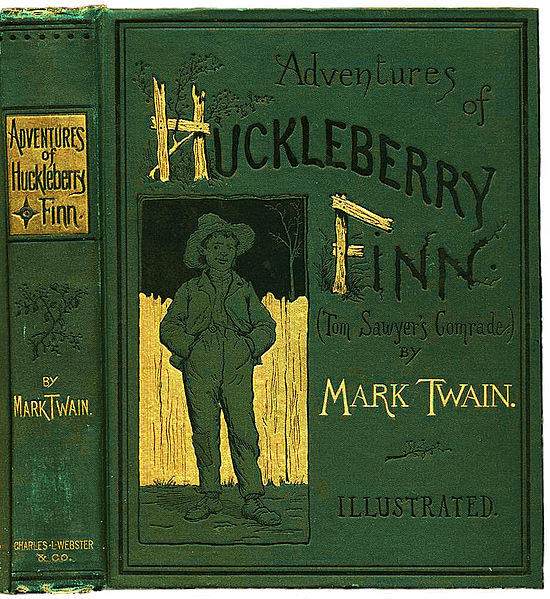
Mark Twain’s Adventures of Huckleberry Finn, 1884.
Image from Wikimedia Commons.
Twain scholar Laura Trombley (now the President of Southwestern University in Texas) once told me that Huck Finn isn’t about slavery. “It’s about an abused boy looking for a safe haven,” she said. It was daring for Twain to give a voice to the untutored, unwashed son of the town drunk.
You don’t know about me without you have read a book by the name of “The Adventures of Tom Sawyer”; but that ain’t no matter. That book was made by Mr. Mark Twain, and he told the truth, mainly. There was things which he stretched, but mainly he told the truth. That is nothing. I never seen anybody but lied one time or another …
Huck’s voice, often described as “realistic”, is actually a highly stylized literary device and a brilliant riff on how real boys talk. In these first few sentences, Twain inserts himself into the story and sets his protagonist up to be an unreliable narrator, as Huck admits that there will be “stretchers” of his own along the way.
Huck Finn is our national epic, much like The Odyssey is for Greece or the Nibelungenlied is for Germany. Like those older epics, Huck Finn can be read as version of a Jungian myth, in which the hero descends into the Underworld, undergoes trials and tribulations, and returns to us reborn. This story of two travelers on an epic journey is an archetype of our culture, which is why it is retold with such frequency. It’s possible to read every American road novel or movie as a reworking of Huck Finn.
Twain may not have written in verse, but Huck’s narration is beautiful and lyrical and so distinctively American that it has influenced generations of American writers, both popular and literary. That indelible voice, at once innocent and highly perceptive, is the fixed moral point from which Twain can then satirize so many different segments of his beloved country — preachers, con men, politicians, actors, and ordinary gullible Americans.
The book has been criticized as one of the first “white savior” narratives, but this gets it exactly backwards. Huck doesn’t save anyone in the novel. (One of Jane Smiley’s criticisms, in fact, is that Huck doesn’t “act” to save his friend.) It is actually Jim, the slave, who saves Huck — both literally and figuratively. It is Jim who provides Huck with a safe haven, and it is Jim who calls Huck to account when Huck treats him as less than human: “En all you wuz thinkin ’bout wuz how you could make a fool uv ole Jim wid a lie. Dat truck dah is trash, en trash is what people is dat puts dirt on de head er de fren’s en makes ’em ashamed.”
Huck eventually humbles himself before Jim and tells us, “I didn’t do him no more mean tricks, and I wouldn’t done that one if I’d a knowed it would make him feel that way.” Huck may be the protagonist of this story, but the slave Jim is its moral hero. It is Jim who reveals himself to be a fugitive slave so that Tom Sawyer can get medical attention for his gunshot wound. And after he is freed from slavery, Jim heads home to assume his responsibilities as a husband and father.
In contrast to Jim, Huck yearns for adventure and escape. Forced to live with the Widow Douglas and Miss Watson at the start of the book, he resents their attempts to “sivilize” him. He feels “all cramped up” by the clothes they make him wear, and he dismisses their Biblical teaching because he “don’t take no stock in dead people”. Instead of returning home with Jim, Huck tells us that he intends to “light out for the territory”. He represents one aspect of the American spirit — ironic, secular, individualistic.
Comments Off on Mark Twain’s Huck Finn
January 15, 2024
Grave Error
In the latest SHuSH newsletter, Ken Whyte calls our attention to an important book on a major Canadian topic … that has been ignored by the Canadian media establishment (as one would expect if it contravenes the official narrative):
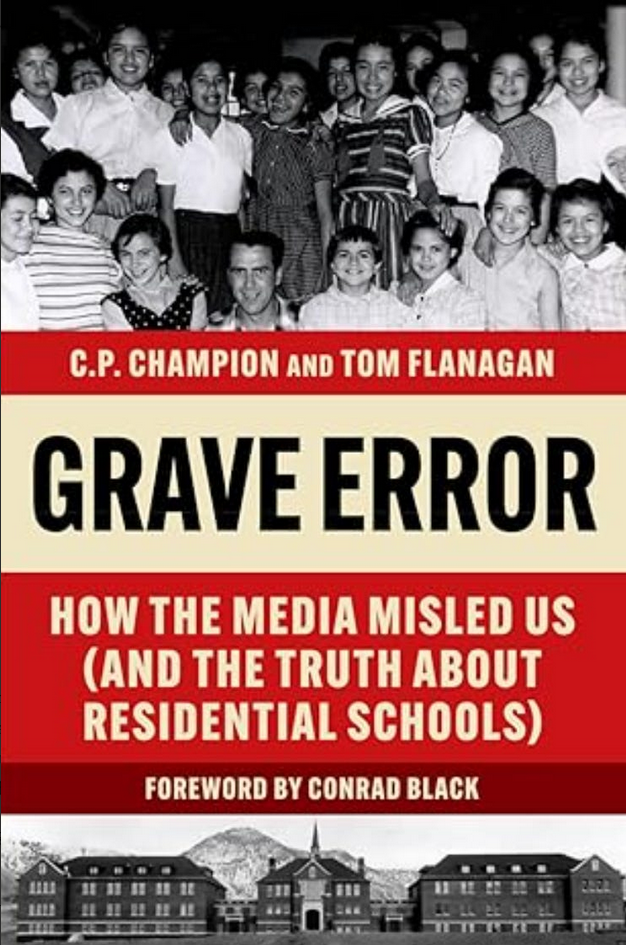
Have you read Grave Error? Have you seen it on the shelves in your local bookstore? At the library, perhaps? Did you notice coverage of it in the Globe or hear someone talking about it on CBC?
I’d bet ninety-eight out of a hundred SHuSH readers would answer “no” to all those questions.
The full title of the book is Grave Error: How the Media Misled Us (and the Truth About Residential Schools). Its authors are former University of Calgary political scientist and Harper aide Tom Flanagan and Chris Champion, editor of the Dorchester Review. The book takes strong exception to commentary by media, politicians, and Indigenous leaders on the subject of unmarked graves at a former Kamloops Indian Residential School. I first noticed it over the holidays, several weeks after publication, when it was the overall #1 bestseller on Amazon.
It’s not easy to become the top-selling book on Amazon. You’re competing against Colleen Hoover and Prince Harry and the entire world of books, published and self-published. Grave Error was the only Canadian book, fiction or nonfiction, in Amazon’s top fifty when I came across it. It’s rare to see more than two or three Canadian books in Amazon’s top fifty at any given time.
You won’t have noticed Grave Error in your local bookstore because Amazon is the only outlet that’s selling the book. You won’t have seen coverage of it because no mainstream Canadian media outlet has paid attention to it. Nor does any public library stock it. It has not appeared on any conventional bestseller list, although it has to be a Canadian bestseller — Amazon sells well over half of all books in Canada. Most Amazon sales don’t register on our bestseller lists because Amazon doesn’t cooperate with the organizations that produce the lists.
Grave Error is published by True North, a conservative news website and public policy organization. It is run by Candace Malcolm, who founded True North with her husband, Kaz Nejatian, a former Jason Kenney staffer, now COO of Spotify. It’s published a half dozen hits in recent years, several written by Malcolm herself.
Comments Off on Grave Error
SS77: South Africa Builds a GPMG on the Shoulders of Giants
Forgotten Weapons
Published 13 Oct 2023In the 1970s, South Africa began looking for a domestic-production GMPG to replace its inventory of FN MAG machine guns. The MAG was an excellent weapon, but the ones in South Africa were getting old and worn out, and with the country under international embargo over Apartheid, new guns and parts were not available from FN.
The SS-77 (named for its two designers, Richard Joseph Smith and Lazlo Soregi) began development in 1977, with initially prototypes built by Lyttleton Engineering Works in 1978. The design took elements from several other excellent machine guns — the side-locking action form the SG43 Goryunov, the barrel release and feed mechanism from the MAG, and the gas system from the PK. After an extensive series of testing and tweaking, the gun was formally adopted by the South African Defence Forces in 1986, and went into serial production. Despite the development cycle, the guns still proved to have significant problems in the field. The gas piston was liable to break, along with problems of broken extractors, loose pins, and other issues. The guns were actually recalled from military service and rebuilt in the early 1990s. Following that redesign program, the gun has proven very reliable and successful in service.
A Mini-SS design was also adopted, essentially the same gun scaled down to 5.56mm. Initial plans were to produce a conversion kit to allow the regular SS-77 to use either caliber, but these were never actually produced.
(more…)
Comments Off on SS77: South Africa Builds a GPMG on the Shoulders of Giants
January 14, 2024
Soviet and American Massive Attacks – Week 281 – January 13, 1945
World War Two
Published 13 Jan 2024In the East, the Soviets launch a massive series of new offensives. In the West, Monty holds an ill-judged press conference about the Battle of the Bulge. Operation Nordwind, the German offensive in Alsace, continues. In Hungary, there’s house to house fighting as the Red Army besieges Budapest. In Asia, the Allies wrestle with the Kamikazes, begin their landings on Luzon, and advance in Burma.
00:54 Intro
01:12 Recap
01:22 Montgomery’s Press Conference
05:53 Operation Nordwind
07:07 The battle for Hungary
09:38 The huge Soviet offensive begins!
12:22 American landings on Luzon
15:29 Anti-Kamikaze tactics
18:11 Slim’s advance in Burma
21:11 Conclusion
(more…)
Comments Off on Soviet and American Massive Attacks – Week 281 – January 13, 1945


