
You Suck At Cooking
Published Mar 17, 2019The history of Ireland is a long and storied one, and one I know next to nothing about. The history of St. Patrick is a short one, relative to the length of the history of the world. The current St. Patrick’s day celebrating has little or nothing to do with the actual St. Patrick, and that’s the way we like it.
The first step to making green beer is to add a few drops of food coloring, then add beer. When selecting a glass to drink it out of, make sure it’s transparent, that way you are able to see the green part of the beer not only from the top or from within the stomach, but also from the side while drinking beer.
While pouring the beer, making sure not to pour it from a great height. This will decrease the amount of bubbles that end up in the beer when you are drinking it, and therefore the enjoyment. If you were aware of the lengths that the manufacturers went to in order to get bubbles inside of that beer in the first place, you wouldn’t even drink it at all.
While drinking the beer, make sure you don’t allow the beer to come into contact with anything that could get stained, such as your clothes, dog, or mouth. If you swallow quickly enough you can keep your mouth from turning green permanently.
If you dislike drinking beverages that are colored green but want to get into the festive spirit, simply tape green construction paper around your drinking vessel, and dye your beer purple instead.
March 17, 2024
Green Beer (You Suck at Cooking) Episode 87
QotD: Imperial Japan and Nazi Germany never had a “long game” … but Stalin did
Though both the Germans and the Japanese had every intention of starting major wars, as everyone knows they seemingly put zero thought into what they’d do once they won. I know, I know, [Himmler] had his sweaty wet dreams about Wehrbauern on the vast Russian steppes, but all but the most rudimentary post-victory planning seems to have been beyond the Third Reich’s capacity — the Reich Resettlement Office, for instance, was tiny even when the war looked like it would be over by Christmas. The Japanese were, if anything, even dumber — they honestly seemed to believe they could run China, all of it, and even India Manchukuo-style.
The Russians, meanwhile, never stopped playing the long game. While Goebbels made a few token gestures at rapprochement with “the West” (yeah, they called it that), and to sell Nazism to ditto, his heart wasn’t in it, any more than the Japanese’s heart was in their “Greater East Asia Co-Prosperity Sphere” hooey. Stalin, by contrast, was always pimping Communism to the West — even in the deepest, darkest days of the war, when it looked like the Wehrmacht was about to march into Moscow, the propaganda directed at the West continued full blast.
Like the German and Japanese aircraft industries, the German propaganda industry was ideologically locked into its core mission: To sell Nazism to Germans. And they were aces at it, no doubt … but then the mission changed. The smart thing for the Germans (and Japanese) to have done with their conquered territories was, in the context of the war, to ease up on the Nazi shit for the duration. The Nazis could’ve had zillions of Ukrainians fighting for them in 1941 just as the Japanese probably could’ve waltzed into India in 1941 had they not been so … well, so Japanese, in the rest of the Pacific rim. Stalin would’ve done it in a heartbeat, had the situation been reversed, and to hell with “authentic” Marxism-Leninism. Win the war first; square the ideology later.
As this is running way long, one example should suffice. Goebbels approached the task of selling Nazism to Germans in the most German way possible: He created the Reich Culture Chamber, which controlled all newspapers, radio broadcasts, film distribution, etc. And it worked, as far as it went — Goebbels deserves his “evil genius” rep — but as we’ve seen, that locked the leadership into an ideological straightjacket. Telling the Wehrmacht to ignore the Commissar Order and buddy up with the Ukrainians would’ve been the smart thing to do, militarily, but it was culturally impossible. Goebbels did his job too well … and then the mission changed.
The Soviets had a similar problem inside the USSR, but — here’s Stalin’s evil genius — they had free reign in propagandizing the West. Goebbels hardly bothered, but the Soviets poured massive resources into it. Forget, as far as you can, everything you think you know about “Nazism” […]. Even if you look at it as objectively as possible, it still seems ridiculous, and there’s a simple explanation for that — it’s not for you. Unless you were a pure blooded Aryan, actually living in Germany (or within Germany’s potential military reach), [they] couldn’t care less about you. Which made being a “Nazi” in, say, America uniquely pointless — you just look like a bigot at best, a traitorous bigot at worst.
Being a “Communist”, though? That was universal. Indeed, that made you a Smart person, a very very smart person, and morally superior to boot. Why? Because you care so much that you’ve mastered this large body of deliberately esoteric doctrine, comrade … all straight out of the NKVD playbook. And if actual life as it was lived in the Soviet Union didn’t quite measure up to the promises, well, that’s because they didn’t have the right people — people like YOU — running things. It’s fucking brilliant — a totally ideologically closed, indeed brutal, system at home, presented as the most open-minded, enlightened, tolerant one possible abroad.
Which is why Joey G. needed a huge Reich Culture Chamber that never came close to justifying its budget, and Stalin needed, effectively, nothing. Being so very, very Smart, wannabe “elites” in the West were happy to spread Commie propaganda for free. The NKVD, let alone the Gestapo, ain’t got shit on the Junior Volunteer Thought Police of Twitter and Facebook …
… which forces us to confront the question: Which model of propaganda are our rulers using? Has the one morphed into the other? Is it real, or is it just “German efficiency”?
Severian, “The Myth of German Efficiency”, Rotten Chestnuts, 2021-05-26.
March 16, 2024
Orwell – The New Life (DJ Taylor in discussion with Les Hurst)
The Orwell Society
Published Jun 9, 2023DJ Taylor discusses his new biography of Orwell with Les Hurst
Part 2:
The Orwell Society
Published Jun 26, 2023DJ Taylor answers questions and discusses issues raised by Orwell Society members.
QotD: “Surface democracies” and “surface monarchies” — how the deep state pretends to be something else
Surface democracies are wildly, raucously competitive. Two or more parties wage an all-out cinematic slugfest over hot-button issues with big, beautiful ratings. There may be a kaleidoscopic cast of quixotic minor parties with unusual obsessions filling the role of comic relief, usually only lasting for a season or two of the hit show Democracy. The spectacle is gripping, everybody is awed by how high the stakes are and agonizes over how to cast their precious vote. Meanwhile, in a bland gray building far away from the action, all of the real decisions are being made by some entirely separate organ of government that rolls onwards largely unaffected by the show.
Losers and haters are perpetually accusing the United States of being a surface democracy. Enemies of the state ranging from Ralph Nader to Vladimir Putin are constantly banging on about it, but this is a Patriotic Substack and we would obviously never countenance such insinuations about our noble republic. So there’s absolutely no chance it’s even the slightest bit true of the US, but … what about Japan?
Well, awkwardly enough, it turns out that the central drama of preindustrial Japanese history was the growing power of unofficial rulers (the shoguns) who ran the country in reality while the official rulers (the emperors) gradually devolved into puppets and figureheads. A “surface monarchy”, if you will. Of course that all ended with the Meiji Restoration of 1868 (c’mon, it says “restoration” right there in the name) which returned the emperor to being fully in charge … which is why when the Japanese declared war on America in 1941, neither the Emperor Hirohito nor the parliament was even consulted. Hang on a minute!
In fact, yes, prewar Japan may have been reigned over by a monarch, but it was ruled by the deep state — especially the career military general staff and the economic planning bureaucracies. I know it’s hard to believe that drab agencies regulating coal and steel production were able to go toe-to-toe with General Tojo, but just imagine that they were all being staffed by fanatical clans of demobilized samurai or something crazy like that. When MacArthur rolled in with the occupation forces, he had a goal of creating total discontinuity with Japan’s past and utterly bulldozing the government. But a guy needs to pick his battles, and so he obviously focused on getting rid of all those nasty generals and admirals he’d just spent years fighting. The harmless paper-pushers, on the other hand, how much trouble could they be? Maybe they could even help organize the place.
The chapter about the post-war occupation is one of the deadpan funniest in Johnson’s book. The American occupiers are genuinely trying to create a liberal democracy out of the ashes, but have no idea that the friendly, helpful bureaucrats they’ve enlisted in this quest were the secret rulers of the regime they’d just conquered. The stats bear this out — of all the officials who controlled Japan’s wartime industry, only a few dozen were ever purged by the Americans. The most striking example of continuity has to be Nobusuke Kishi,1 but there were countless others like him. These were the men charged with translating the occupiers’ desires into policy, reconstructing Japanese society, and finally drafting a new constitution. Then eventually the Americans sailed off, and the bureaucrats smiled and waved, and went back to ruling as they’d done for hundreds of years, behind the scenes.
John Psmith, “REVIEW: MITI and the Japanese Miracle by Chalmers Johnson”, Mr. and Mrs. Psmith’s Bookshelf, 2023-04-03.
1 Briefly: Kishi was a descendant of samurai (of course) who became an economic planning bureaucrat (of course) and then the dictator of the Japanese puppet state in Manchuria in the 1930s. During his reign he tried out a lot of the industrial policy ideas that would later fuel the Japanese postwar boom … and also brutalized the population to such an extent that even other Imperial Japanese colonial administrators thought he was excessive. Later he signed the declaration of war against the United States (he was an economic planning bureaucrat, after all), and was briefly imprisoned as a war criminal after the Japanese surrender. Within a few years, however, he was back out, and running the country as prime minister. His brother was also prime minister. Oh … and his grandson was a guy you might have heard of, a guy named “Shinzo Abe”.
March 15, 2024
Woke Shakespeare?
Andrew Doyle wonders if even the Bard can survive the incessant assaults of the ultra woke, the new Puritans:
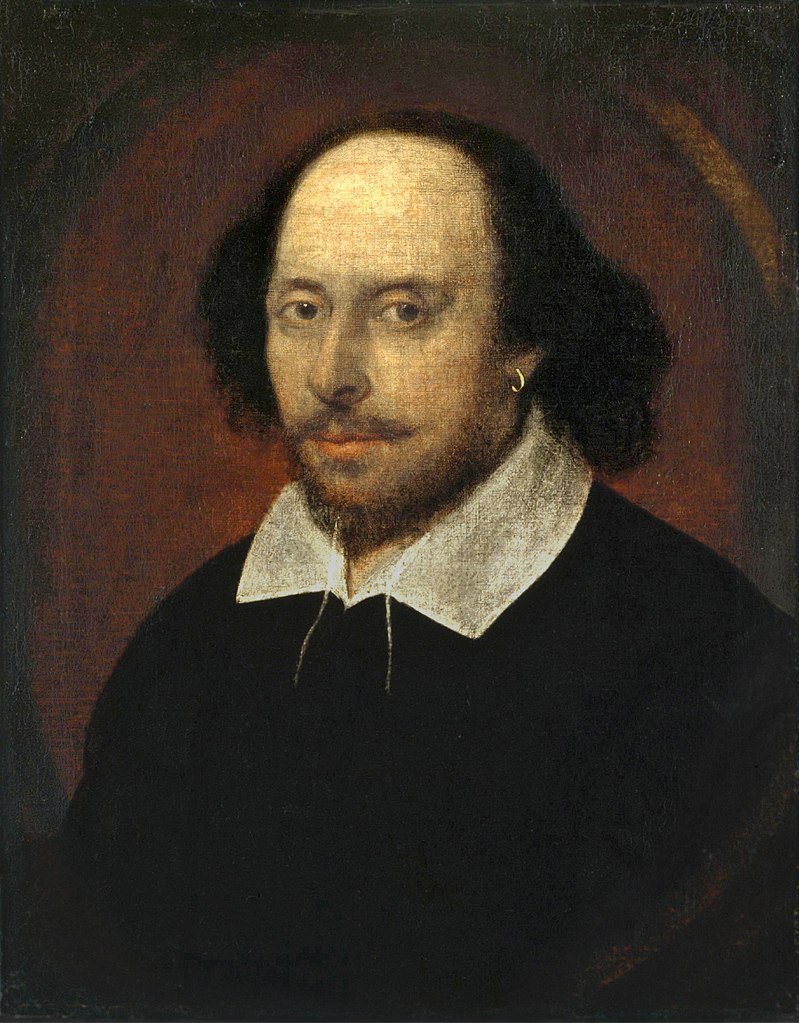
This was long thought to be the only portrait of William Shakespeare that had any claim to have been painted from life, until another possible life portrait, the Cobbe portrait, was revealed in 2009. The portrait is known as the “Chandos portrait” after a previous owner, James Brydges, 1st Duke of Chandos. It was the first portrait to be acquired by the National Portrait Gallery in 1856. The artist may be by a painter called John Taylor who was an important member of the Painter-Stainers’ Company.
National Portrait Gallery image via Wikimedia Commons.
The puritans had it in for Shakespeare. With the exception of the plague, they were perhaps the most persistent threat to his livelihood. As far as these zealots were concerned, the theatre was a realm of “adulterers, adulteresses, whoremasters, whores, bawds, panders, ruffians, roarers, drunkards, prodigals, cheaters, idle, infamous, base, profane, and godless persons”.
These were the words of the polemicist William Prynne from his Histrio-Mastix (1633). He was eventually to get his way in 1642 when the puritan-led parliament shut the theatres down. When the ban was lifted on the accession of Charles II, older plays had to be dusted off to satisfy the public’s appetite for drama. It was Shakespeare’s work that proved to be the most popular, establishing a trend that has never waned.
Now the bard faces another breed of puritan, more censorial than the last. We are living in conformist times, and inexplicably those in the creative arts have turned out to the be most conformist of all. Nowhere is this more evident than the theatre industry, where wrongthink is outlawed and artistic freedom is sacrificed on the altar of identity politics. Virtually all productions of Shakespeare’s plays I have seen in recent years have been mangled to promote the regressive fashions of our time. Today’s audiences are seeing a vague shadow of these masterworks through a narrow and uninspiring prism.
Even so, many of us are reluctant to give up on the theatre altogether. We tolerate the gender-neutral toilets that nobody asked for, the rainbow lanyards worn by ushers, and the little sermons in the programmes by directors who think their job is to educate the masses. One friend remarked that so long as the preaching only amounts to 20% of the show’s content, he is willing to accept it. I suppose it’s like going for dinner in an especially pious household, and having to put up with a long-winded prayer before a delicious meal.
Theatregoers might have a better experience if they opt for productions of plays written many years before this new state religion took hold. Shakespeare, as a playwright who has never been bettered, is surely the safest choice. In his work we find ourselves unmolested by ideology. We know nothing of Shakespeare’s opinions on matters of politics or religion, and attempting to glean any suggestions from his works is futile. I think A. L. Rowse put it best when he pointed out that Shakespeare “saw through everybody equally”. Neither prince nor pauper escapes his sceptical gaze.
Starr DA & SA Revolvers
Forgotten Weapons
Published Feb 4, 2015Starr revolvers are one of the less recognized designs used in the US Civil War, although tens of thousands of them were made and issued. Indeed, in many ways they were superior to the much more common Colt and Remington revolvers of the period. One of the interesting facts about the Starr is that the double action design came first, and was only replaced with the more typical single action design several years into the war (due to problems with price and complexity). Today we’re taking a look at a pair of Starrs, one single action and one double action. Ultimately the company shut down after the end of the war, and Colt would go on to dominate the revolver market in the United States.
(more…)
March 14, 2024
Book Reviews – Juno Beach and the Canadians
WW2TV
Published Dec 5, 2023A short live show where I talk about my favourite Juno Beach and Canadian focussed Normandy books
WW2TV Bookshop – where you can purchase copies of books featured in my YouTube shows. Any book listed here comes with the personal recommendation of Paul Woodadge, the host of WW2TV. For full disclosure, if you do buy a book through a link from this page WW2TV will earn a commission.
UK – https://uk.bookshop.org/shop/WW2TV
USA – https://bookshop.org/shop/WW2TV
QotD: Recruiting an army in the Roman Republic
In addition to the imperium-haver leading the army, there were also a set of staff officers called military tribunes, important to the process. These fellows don’t have command of a specific part of the legion, but are “officers without portfolio”, handling whatever the imperium-haver wants handled; at times they may have command of part of a legion or all of one legion. Finally, there’s one more major magistrate in the army: the quaestor. A much more junior magistrate than the imperium-haver (but senior to the tribunes), he handles pay and probably in this period also supply. That said, the quaestor is not usually the general’s “number two” even though it seems like he might be; quaestors are quite junior magistrates and the imperium-haver has probably brought friends or advisors with a lot more experience than his quaestor (who may or may not be someone the imperium-haver knows or likes). […]
The first thing to note about this process, before we even start is that the dilectus was a regular process which happened every year at a regular time. The Romans did have a system to rapidly raise new troops in an emergency (it was called a tumultus), where the main officials, the consuls, could just grab any citizen into their army in a major emergency. But emergencies like that were very rare; for the most part the Roman army was filled out by the regular process of the dilectus, which happened annually in tune with Rome’s political calendar. That regularity is going to be important to understand how this process is able to move so many people around: because it is regular, people could adapt their schedules and make provisions for a process that happened every year. I should note the dilectus could also be held out of season, though often the times we hear about this it is because it went poorly (e.g. in 275 BC, no one shows up).
The process really begins with the consular elections for the year, which bounced around a little in the calendar but generally happened around September,2 though the consuls do not take office until the start of the next calendar year. As we’ve discussed, the year originally seems to have started in March (and so consuls were inaugurated then), but in 153 was shifted to January (and so consuls were inaugurated then).
What’s really clear is that there is some standard business that happens as the year turns over every year in the Middle Republic and we can see this in the way that Livy structures his history, with year-breaks signaled by these events: the inauguration of new consuls, the assignment of senior Roman magistrates and pro-magistrates to provinces, and the determinations of how forces will be allotted between those provinces. And that sequence makes a lot of sense: once the Senate knows who has been elected, it can assign provinces to them for the coming year (the law requiring Senate province assignments to be blind to who was elected, the lex Sempronia de provinciis consularibus, was only passed in 123) and then allocate troops to them. That allocation (which also, by the by, includes redirecting food supplies from one theater to another, as Rome is often militarily actively in multiple places) includes both existing formations, but is also going to include the raising of new legions or the conscription of new troops to fill out existing legions, a practice Livy notes.
The consuls, now inaugurated have another key task before they can embark on the dilectus, which is the selection of military tribunes, a set of staff officers who assist the consuls and other magistrates leading armies. There are six military tribunes per legion (so 24 in a normal year where each consul enrolls two legions); by this point four are elected and two are appointed by the consul. The military tribunes themselves seem to have often been a mix, some of them being relatively inexperienced aristocrats doing their military service in the most prestigious way possible and getting command experience, while Polybius also notes that some military tribunes were required to have already had a decade in the ranks when selected (Polyb. 6.19.1). These fellows have to be selected first because they clearly matter for the process as it goes forward.
The end of this process, which as we’ll see takes place over several days at least, though exactly how many is unclear, will have have had to have taken place in or before March, the Roman month of Martius, which opened the normal campaigning season with a bunch of festivals on the Kalends (the first day of the month) to Mars. As Rome’s wars grew more distant and its domestic affairs more complex, it’s not surprising that the Romans opted to shift where the year began on the calendar to give the new consuls a bit more of winter to work with before they would be departing Rome with their armies. It should be noted that while Roman warfare was seasonal, it was only weakly so: Roman armies stayed deployed all year round in the Middle Republic, but serious operations generally waited until spring when forage and fodder would be more available.
That in turn also means that the dilectus is taking place in winter, which also matters for understanding the process: this is a low-ebb in the labor demands in the agricultural calendar. I find it striking that Rome’s elections happen in late summer or early fall, when it would actually be rather inconvenient for poor Romans to spend a day voting (it’s the planting season), but the dilectus is placed over winter where it would be far easier to get everyone to show up. I doubt this contrast was accidental; the Roman election system is quite intentionally designed to preference the votes of wealthier Romans in quite a few ways.
So before the dilectus begins, we have our regular sequence: the consuls are inaugurated at the beginning of the year, the Senate meets and assigns provinces and sets military priorities, including how many soldiers are to be enrolled. The Senate’s advice is not technically legally binding, but in this period is almost always obeyed. Military tribunes are selected (some by election, some by appointment) and at last the consuls can announce the day of the dilectus, conveniently now falling in the first couple of months of the year when the demand for agricultural labor is low and thus everyone, in theory, can afford to show up for the selection process.
Bret Devereaux, “Collections: How To Raise a Roman Army: The Dilectus“, A Collection of Unmitigated Pedantry, 2023-06-16.
1. And the dictator’s master of the horse.
2. On this, see J.T. Ramsey, “The Date of the Consular Elections in 63 and the Inception of Catiline’s Conspiracy”, HSCP 110 (2019): 213-270.
March 13, 2024
The History of the Chocolate Chip Cookie – Depression vs WW2
Tasting History with Max Miller
Published Dec 5, 2023WWII ration-friendly chocolate chip cookies made with shortening, honey, and maple syrup
City/Region: United States of America
Time Period: 1940sDuring WWII, everyone in the US wanted to send chocolate chip cookies to the boys at the front. With wartime rationing in effect, we get a recipe that doesn’t use butter or sugar, but shortening, honey, and maple syrup instead.
The dough is much softer than the original version, and the cookies spread out a lot more as they bake. They bake up softer than the crunchy originals, with a light pillowy texture. They aren’t as sweet, but still have a really lovely flavor. It kind of reminds me of Raisin Bran, but with chocolate. All in all, I was pleasantly surprised.
Check out the episode to see a side-by-side comparison with the original recipe.
(more…)
QotD: Filthy coal
So, standing in my coal-fired kitchen for the first time, I was feeling confident. Surely, I thought, the Victorian regime would be somewhere halfway between the Tudor and the modern. Dirt was just dirt, after all, and sweeping was just sweeping, even if the style of brushes had changed a little in the course of five hundred years. Washing-up with soap was not so very different from washing-up with liquid detergent, and adding soap and hot water to the old laundry method of bashing the living daylights out of clothes must, I imagined, make it a little easier, dissolving dirt and stains all the more quickly. How wrong could I have been.
Well, it turned out that the methods and technologies necessary for cleaning a coal-burning home were fundamentally different from those for a wood-burning one. Foremost, the volume of work — and the intensity of that work — were much, much greater.
The fundamental problem is that coal soot is greasy. Unlike wood soot, which is easily swept away, it sticks: industrial cities of the Victorian era were famously covered in the residue of coal fires, and with anything but the most efficient of chimney designs (not perfected until the early twentieth century), the same thing also happens to your interior. Imagine the sort of sticky film that settles on everything if you fry on the stove without a sufficient vent hood, then make it black and use it to heat not just your food but your entire house; I’m shuddering just thinking about it. A 1661 pamphlet lamented coal smoke’s “superinducing a sooty Crust or Furr upon all that it lights, spoyling the moveables, tarnishing the Plate, Gildings and Furniture, and corroding the very Iron-bars and hardest Stones with those piercing and acrimonious Spirits which accompany its Sulphure.” To clean up from coal smoke, you need soap.
“Coal needs soap?” you may say, suspiciously. “Did they … not use soap before?” But no, they (mostly) didn’t, a fact that (like the famous “Queen Elizabeth bathed once a month whether she needed it or not” line) has led to the medieval and early modern eras’ entirely undeserved reputation for dirtiness. They didn’t use soap, but that doesn’t mean they didn’t clean; instead, they mostly swept ash, dust, and dirt from their houses with a variety of brushes and brooms (often made of broom) and scoured their dishes with sand. Sand-scouring is very simple: you simply dampen a cloth, dip it in a little sand, and use it to scrub your dish before rinsing the dirty sand away. The process does an excellent job of removing any burnt-on residue, and has the added advantage of removed a micro-layer of your material to reveal a new sterile surface. It’s probably better than soap at cleaning the grain of wood, which is what most serving and eating dishes were made of at the time, and it’s also very effective at removing the poisonous verdigris that can build up on pots made from copper alloys like brass or bronze when they’re exposed to acids like vinegar. Perhaps more importantly, in an era where every joule of energy is labor-intensive to obtain, it works very well with cold water.
The sand can also absorb grease, though a bit of grease can actually be good for wood or iron (I wash my wooden cutting boards and my cast-iron skillet with soap and water,1 but I also regularly oil them). Still, too much grease is unsanitary and, frankly, gross, which premodern people recognized as much as we do, and particularly greasy dishes, like dirty clothes, might also be cleaned with wood ash. Depending on the kind of wood you’ve been burning, your ashes will contain up to 10% potassium hydroxide (KOH), better known as lye, which reacts with your grease to create a soap. (The word potassium actually derives from “pot ash,” the ash from under your pot.) Literally all you have to do to clean this way is dump a handful of ashes and some water into your greasy pot and swoosh it around a bit with a cloth; the conversion to soap is very inefficient (though if you warm it a little over the fire it works better), but if your household runs on wood you’ll never be short of ashes. As wood-burning vanished, though, it made more sense to buy soap produced industrially through essentially the same process (though with slightly more refined ingredients for greater efficiency) and to use it for everything.
Washing greasy dishes with soap rather than ash was a matter of what supplies were available; cleaning your house with soap rather than a brush was an unavoidable fact of coal smoke. Goodman explains that “wood ash also flies up and out into the room, but it is not sticky and tends to fall out of the air and settle quickly. It is easy to dust and sweep away. A brush or broom can deal with the dirt of a wood fire in a fairly quick and simple operation. If you try the same method with coal smuts, you will do little more than smear the stuff about.” This simple fact changed interior decoration for good: gone were the untreated wood trims and elaborate wall-hangings — “[a] tapestry that might have been expected to last generations with a simple routine of brushing could be utterly ruined in just a decade around coal fires” — and anything else that couldn’t withstand regular scrubbing with soap and water. In their place were oil-based paints and wallpaper, both of which persist in our model of “traditional” home decor, as indeed do the blue and white Chinese-inspired glazed ceramics that became popular in the 17th century and are still going strong (at least in my house). They’re beautiful, but they would never have taken off in the era of scouring with sand; it would destroy the finish.
But more important than what and how you were cleaning was the sheer volume of the cleaning. “I believe,” Goodman writes towards the end of the book, “there is vastly more domestic work involved in running a coal home in comparison to running a wood one.” The example of laundry is particularly dramatic, and her account is extensive enough that I’ll just tell you to read the book, but it goes well beyond that:
It is not merely that the smuts and dust of coal are dirty in themselves. Coal smuts weld themselves to all other forms of dirt. Flies and other insects get entrapped in it, as does fluff from clothing and hair from people and animals. to thoroughly clear a room of cobwebs, fluff, dust, hair and mud in a simply furnished wood-burning home is the work of half an hour; to do so in a coal-burning home — and achieve a similar standard of cleanliness — takes twice as long, even when armed with soap, flannels and mops.
And here, really, is why Ruth Goodman is the only person who could have written this book: she may be the only person who has done any substantial amount of domestic labor under both systems who could write. Like, at all. Not that there weren’t intelligent and educated women (and it was women doing all this) in early modern London, but female literacy was typically confined to classes where the women weren’t doing their own housework, and by the time writing about keeping house was commonplace, the labor-intensive regime of coal and soap was so thoroughly established that no one had a basis for comparison.
Jane Psmith, “REVIEW: The Domestic Revolution by Ruth Goodman”, Mr. and Mrs. Psmith’s Bookshelf, 2023-05-22.
1. Yeah, I know they tell you not to do this because it will destroy the seasoning. They’re wrong. Don’t use oven cleaner; anything you’d use to wash your hands in a pinch isn’t going to hurt long-chain polymers chemically bonded to cast iron.
March 12, 2024
The recently admitted “death spiral” for the Canadian Armed Forces is nothing new
“Shady Maples” outlines just a few of the historical procurement fuckups Canada’s armed forces have had to work through, showing that the recent admission that the armed forces are in a “death spiral” by MND Bill Blair is almost “situation normal” for the troops:
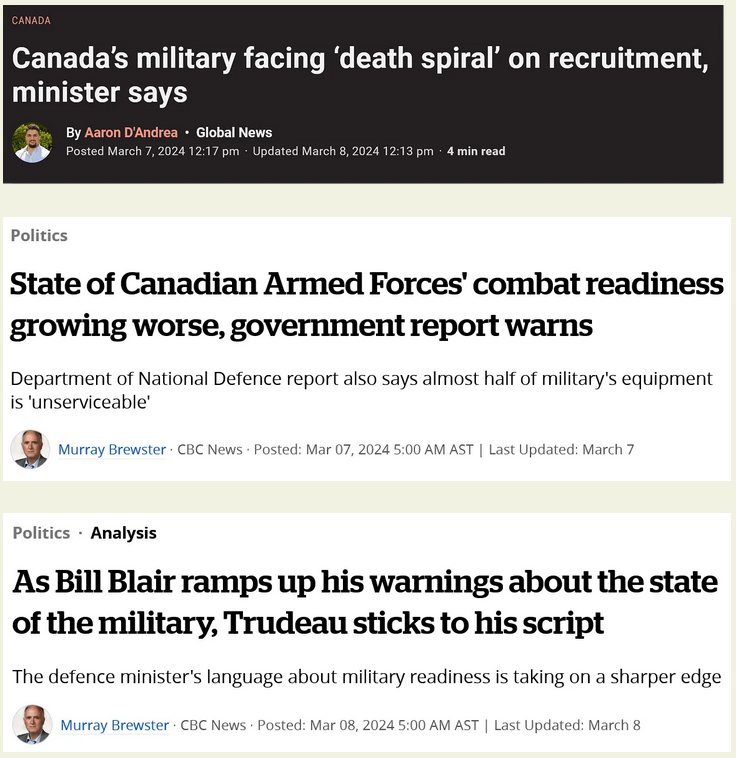
The Canadian Armed Forces are fucked. By this term of art, I mean that the CAF:
- are in dire circumstances; and
- are being used for such aggressive political gratification that it’s practically perverse.
You don’t have to take my word for it. The Minister of National Defence made the following remarks last week:
because, the bottom line is the Canadian Armed Forces must grow. We’re short a lot of people. Almost 16,000 in our regular forces and reserves.
If that wasn’t bad enough, he added:
more than half of our trucks, more than half of our ships and more than half of our planes are not available for service because they are in need of parts and repair. We’re going to have to do better.
Translation: we are fucked.
The MND’s remarks come eleven months after the CDAI published an open letter on the state of national security and defence:
Years of restraint, cost cutting, downsizing and deferred investments, have meant that Canada’s defence capabilities have atrophied. Our military capabilities are outdated and woefully inadequate to protect our landmass and maritime approaches. We have also fallen short in meaningful contributions to burden sharing for the collective defence and security of our allies and partners.
Translation: we have been fucked for awhile.
More recently, the Vice Admiral Tophsee made waves on the RCN’s official YouTube channel by stating the obvious:
Colleagues and Shipmates, the RCN is facing some very serious challenges right now that could mean we fail to meet our Force Posture and Readiness commitments in 2024 and beyond. La situation est grave mais nos problèmes ne sont pas uniques et je sais que l’aviation et l’armée sont confrontées a des défis similaires. [The situation is serious, but our problems are not unique, and I know that the Air Force and the Army are facing similar problems.]
Translation: we will be fucked for the foreseeable future.
He then shows that this sort of thing has been part-and-parcel of Canada’s delusionary approach to national defence since the year before Confederation. Canada’s WW1 army was sent off with fantastically bad equipment — from rifles to web gear, from automobiles to artillery ammunition — all scandals of the day that no lessons were learned from.
Soldiers and officers at the tactical level will readily tell you that these headlines are only surprising because senior leaders are finally saying the quiet part out loud: the CAF is undermanned, under-equipped, under-trained, and unprepared. We know this because we live it every day: situation normal, all fucked up. But you don’t need a source or a leak to learn about our deplorable state of readiness. Here is a link to DND’s 2023 audit and evaluation reports. They paint a bleak picture: we have insufficient equipment and what we have keeps breaking. We have insufficient personnel to match with commitments, and we are struggling to recruit, train, and retain more. Go have a look at the reports, they lay it all out.
Vektor CP-1: Recalled to the Mother Ship
Forgotten Weapons
Published Dec 8, 2023The Vektor CP-1 was developed by Lyttleton Engineering Works (who owned the Vektor brand) in 1995 for a South African Police contract. They lost that contract to the Republic Arms RAP-401, but decided to put the CP-1 onto the civilian market instead. It was a pretty decent seller for them, and after a couple years they started importing it into the US. Things went bad when it turned out the the gun wasn’t quite drop-safe, and in late 2000 they were recalled for a repair. Some were repaired and returned to owners, but a great many were simply repurchased by Vektor instead. In light of the recall and potential future problems with the US legal outlook, Vektor USA was dissolved circa 2001.
Mechanically, the CP1 is a gas-delayed blowback pistol in 9mm Parabellum. It came with 12- and 13-round magazines (10 rounds in the US, because of the Assault Weapons Ban). It was hammer fired, and used a polymer frame (the first such made in South Africa). Its futuristic design lines are very deliberate, and its biggest shortcoming is a fairly heavy trigger, for being single action only. It has a somewhat unorthodox trigger safety, and also a Garand-style manual safety in the front of the trigger guard.
In today’s video, we will take a look at both an original configuration example and also one rebuilt after the recall, with a new firing pin block mechanism.
(more…)
QotD: Isaiah Berlin on Niccolò Machiavelli
What did he actually believe?
In 1953, the British philosopher Isaiah Berlin delivered a lecture titled “The Originality of Machiavelli”.
Berlin began by posing a simple question: Why has Machiavelli unsettled so many people over the years?
Machiavelli believed that the Italy of his day was both materially and morally weak. He saw vice, corruption, weakness, and, as Berlin says, “lives unworthy of human beings”. It’s worth noting here that around the time that Machiavelli died in 1527, the Age of Exploration was just kicking off, and adventurers from Italy and elsewhere in Europe were in the process of transforming the world. Even the shrewdest individuals aren’t always the best judges of their own time.
So what did Machiavelli want? He wanted a strong and glorious society. Something akin to Athens at its height, or Sparta, or the kingdoms of David and Solomon. But really, Machiavelli’s ideal was the Roman Republic.
To build a good state, a well-governed state, men require “inner moral strength, magnanimity, vigour, vitality, generosity, loyalty, above all public spirit, civic sense, dedication to security, power, glory”.
According to Machiavelli, these are the Roman virtues.
In contrast, the ideals of Christianity are “charity, mercy, sacrifice, love of God, forgiveness of enemies, contempt for the goods of this world, faith in the hereafter”.
Machiavelli wrote that one must choose between Roman and Christian virtues. If you choose Christianity, you are selecting a moral framework that is not favorable to building and preserving a strong state.
Machiavelli does not say that humility, compassion, and kindness are bad or unimportant. He actually agrees that they are, in fact, good and righteous virtues. He simply says that if you adhere to them, then you will be overrun by more unscrupulous men.
In some instances, Machiavelli would say, rulers may have to commit war crimes in order to ensure the survival of their state. As one Machiavelli translator has put it: “Men cannot afford justice in any sense that transcends their own preservation”.
From Berlin’s lecture:
If you object to the political methods recommended because they seem to you morally detestable … Machiavelli has no answer, no argument … But you must not make yourself responsible for the lives of others or expect good fortune; you must expect to be ignored or destroyed.
In a famous passage, Machiavelli writes that Christianity has made men “weak”, easy prey to “wicked men”, since they “think more about enduring their injuries than about avenging them”. He compares Christianity (or Humanism) unfavorably with Paganism, which made men more “ferocious”.
“One can save one’s soul,” writes Berlin, “or one can found or maintain or service a great and glorious state; but not always both at once.”
Again, Machiavelli’s tone is descriptive. He is not making claims about how things should be, but rather how things are. Although it is clear what his preference is.
He writes that Christian virtues are “praiseworthy”. And that it is right to praise them. But he says they are dead ends when it comes to statecraft.
Machiavelli wrote:
Any man who under all conditions insists on making it his business to be good, will surely be destroyed among so many who are not good. Hence a prince … must acquire the power to be not good, and understand when to use it and when not to use it, in accord with necessity.
To create a strong state, one cannot hold delusions about human nature:
Everything that occurs in the world, in every epoch, has something that corresponds to it in the ancient times. The reason is that these things were done by men, who have and have always had the same passions.
Rob Henderson, “The Machiavellian Maze”, Rob Henderson’s Newsletter, 2023-12-09.
March 10, 2024
Viking longships and textiles
Virginia Postrel reposts an article she originally wrote for the New York Times in 2021, discussing the importance of textiles in history:
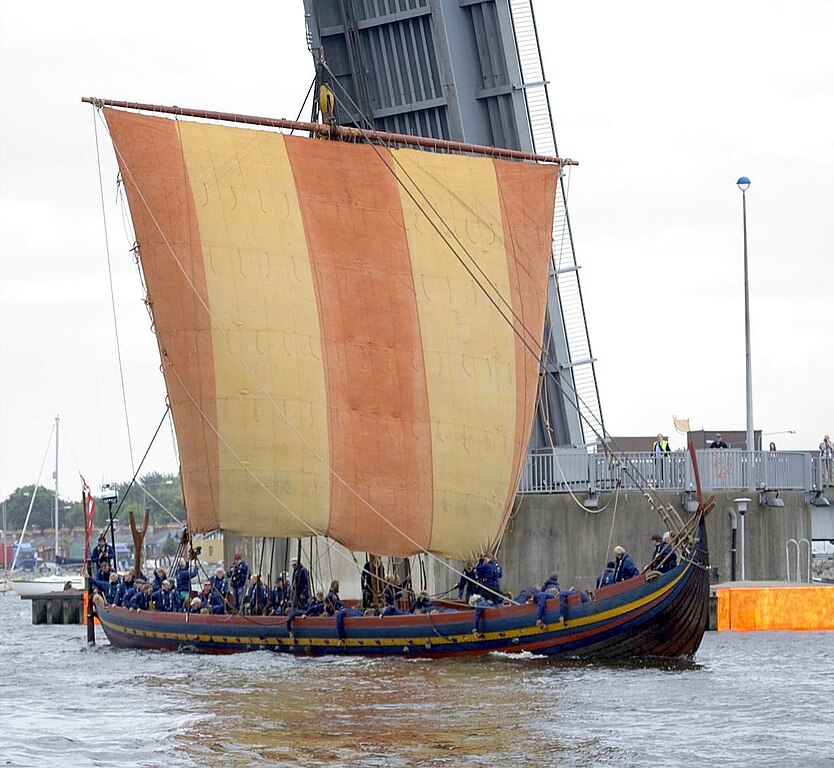
The Sea Stallion from Glendalough is the world’s largest reconstruction of a Viking Age longship. The original ship was built at Dublin ca. 1042. It was used as a warship in Irish waters until 1060, when it ended its days as a naval barricade to protect the harbour of Roskilde, Denmark. This image shows Sea Stallion arriving in Dublin on 14 August, 2007.
Photo by William Murphy via Wikimedia Commons.
Popular feminist retellings like the History Channel’s fictional saga Vikings emphasize the role of women as warriors and chieftains. But they barely hint at how crucial women’s work was to the ships that carried these warriors to distant shores.
One of the central characters in Vikings is an ingenious shipbuilder. But his ships apparently get their sails off the rack. The fabric is just there, like the textiles we take for granted in our 21st-century lives. The women who prepared the wool, spun it into thread, wove the fabric and sewed the sails have vanished.
In reality, from start to finish, it took longer to make a Viking sail than to build a Viking ship. So precious was a sail that one of the Icelandic sagas records how a hero wept when his was stolen. Simply spinning wool into enough thread to weave a single sail required more than a year’s work, the equivalent of about 385 eight-hour days. King Canute, who ruled a North Sea empire in the 11th century, had a fleet comprising about a million square meters of sailcloth. For the spinning alone, those sails represented the equivalent of 10,000 work years.
Ignoring textiles writes women’s work out of history. And as the British archaeologist and historian Mary Harlow has warned, it blinds scholars to some of the most important economic, political and organizational challenges facing premodern societies. Textiles are vital to both private and public life. They’re clothes and home furnishings, tents and bandages, sacks and sails. Textiles were among the earliest goods traded over long distances. The Roman Army consumed tons of cloth. To keep their soldiers clothed, Chinese emperors required textiles as taxes.
“Building a fleet required longterm planning as woven sails required large amounts of raw material and time to produce,” Dr. Harlow wrote in a 2016 article. “The raw materials needed to be bred, pastured, shorn or grown, harvested and processed before they reached the spinners. Textile production for both domestic and wider needs demanded time and planning.” Spinning and weaving the wool for a single toga, she calculates, would have taken a Roman matron 1,000 to 1,200 hours.
Picturing historical women as producers requires a change of attitude. Even today, after decades of feminist influence, we too often assume that making important things is a male domain. Women stereotypically decorate and consume. They engage with people. They don’t manufacture essential goods.
Yet from the Renaissance until the 19th century, European art represented the idea of “industry” not with smokestacks but with spinning women. Everyone understood that their never-ending labor was essential. It took at least 20 spinners to keep a single loom supplied. “The spinners never stand still for want of work; they always have it if they please; but weavers are sometimes idle for want of yarn,” the agronomist and travel writer Arthur Young, who toured northern England in 1768, wrote.
Shortly thereafter, the spinning machines of the Industrial Revolution liberated women from their spindles and distaffs, beginning the centuries-long process that raised even the world’s poorest people to living standards our ancestors could not have imagined. But that “great enrichment” had an unfortunate side effect. Textile abundance erased our memories of women’s historic contributions to one of humanity’s most important endeavors. It turned industry into entertainment. “In the West,” Dr. Harlow wrote, “the production of textiles has moved from being a fundamental, indeed essential, part of the industrial economy to a predominantly female craft activity.”
German Blunder Hands Allies a Rhine Crossing – WW2 – Week 289 – March 9, 1945
World War Two
Published 9 Mar 2024The Allies manage to take an intact bridge over the mighty Rhine at Remagen, a major piece of luck; the Germans launch a new offensive in Hungary, and the Allies end one in Italy. Over in Burma, Meiktila falls, sabotaging the entire Japanese supply system for the country, and on Iwo Jima the fight continues, bloodier than ever for both sides.
00:59 Recap
01:35 The Fall of Meiktila
03:46 The fight on Iwo Jima
05:27 Advances on the Western Front
07:44 The Rhine River
10:05 Remagen Bridge
16:20 Operation Encore
17:10 Rokossovsky and Zhukov attack
18:09 Operation Spring Awakening
21:57 Notes to end the week
23:42 Conclusion
(more…)


