Quotulatiousness

November 30, 2022

The widespread anti-lockdown protests in China … and how Apple is helping suppress them

N.S. Lyons admires what can only be described as potentially revolutionary protests across many of China’s big cities and resisting further lockdowns by the government:

Something extraordinary happened in China over the weekend. Not long ago I wrote at length, if in a rather different context, about the vital importance of courage in the defense of the true and the human against the cold, mechanistic evil that is nihilistic technocracy, the machine whose Conditioners forever lust after total control – not only over men, but ultimately over reality itself. Well, now we have just seen a stunning example of such courage in the streets of China, where people rose up to reassert their human dignity in the face of the most dehumanizing machine of control in the world today: the Chinese Communist Party’s “zero-Covid” terror-state.

For three years now, the Chinese government has maintained its policy of draconian city-wide lockdowns, endless daily mass testing and biomedical surveillance, digital Covid-passes that arbitrarily govern every aspect of daily life, vast camps to house those dragged into quarantine for weeks (or longer) at a time, and, more recently, such innovations as “closed-loop” factories, where workers are forced to work, sleep, and “live” completely isolated from the outside world so that they can continue to produce your iPhones.

But now over the past several days protests have erupted in at least a dozen cities and 79 universities across the country, with spontaneous demonstrations – often begun by only a handful of people, or even a single individual – quickly drawing crowds of hundreds, even thousands, of people willing to fearlessly demand an end to the zero-Covid nightmare.

In Wuhan, where it all began, swarming crowds smashed down containment barriers and “liberated” locked-down neighborhoods:

[…]

All across the country, many thousands of these protesters spontaneously echoed many of the same lines:

    We don’t want PCR tests. We want to eat.

    We don’t want Cultural Revolution. We want reform.

    We don’t want lockdowns. We want freedom.

    We don’t want a Great Leader. We want the vote.

    We don’t want lies. We want dignity.

    We aren’t slaves. We are citizens.

These are conspicuously the same lines as those of a banner hung from a Beijing bridge by a lone (since disappeared) protester, Peng Lifa, on the 13th of October, just ahead of the CCP’s 20th Party Congress and Xi Jinping’s re-coronation as Chinese leader for life.

Now, as recordings of the anti-lockdown protests are swiftly censored online, Chinese netizens have often simply been replying with “We saw it” – a phrase referring not just to the protests, but to Peng Lifa’s message.

His final and most striking line, on a second banner, happens to have been:

    “Refuse to go to class. Go on strike. Remove the traitor Xi Jinping.”

And indeed in many protests over the last few days the people’s frustration with zero-Covid tyranny translated into something more: an outpouring of raw anger against the CCP and Xi.

Of course, China’s ruling Communist regime isn’t without its loyal supporters and useful idiots like Apple:

Maybe something will come of the COVID lockdown protests in China. Maybe not, if you’re old enough to remember the guy who stood in front of the tank in Tiananmen Square, and who was never identified nor ever seen again. More likely, the Chinese Communist Party will crack down again, and the people of China will become compliant again.

And the West will turn a blind eye. Again.

Here’s what was in the latest iPhone update, according to Zachary M. Seward of Quartz:

    Hidden in the update was a change that only applies to iPhones sold in mainland China: AirDrop can only be set to receive messages from everyone for 10 minutes, before switching off. There’s no longer a way to keep the “everyone” setting on permanently on Chinese iPhones. The change, first noticed by Chinese readers of 9to5Mac, doesn’t apply anywhere else.

In other words, Chinese iPhone users can’t do or say anything without the CCP knowing about it. Dissent can be quashed before it even starts. The Chinese people can be kept under the CCP’s thumb. And Apple is helping.

November 29, 2022

Prime Minister Justin Trudeau, expert projectionist

Filed under: Cancon, Government, Law, Liberty, Media, Politics — Tags: , , , — Nicholas @ 03:00

Donna Laframboise on part of Prime Minister Justin Trudeau’s performance last Friday at the Public Order Emergency Commission’s hearings in Ottawa:

There’s a concept in psychology known as projection – accusing others of your own shortcomings. Last week Canada’s Prime Minister, Justin Trudeau, told an Emergencies Act hearing that Freedom Convoy protesters didn’t just want to talk. They wanted, he said, to be obeyed.

That was a strange word for him to use. About people he’d never spoken to. Yet it sums up his own posture rather nicely: Don’t bother trying to change my mind. I’m in charge, you must obey. Conversation over. Case closed.

According to Mr. Trudeau, the Freedom Convoy didn’t deserve a face-to-face meeting with his government because it wanted to change public policy. How terrible that free people, in a free country might want some influence over the increasingly draconian COVID rules they were required to follow. How unreasonable for them to come to Ottawa in an attempt to communicate the depths of their desperation.

A Prime Minister who received less than 33% of the votes cast during the federal election a mere four months earlier chose to thumb his nose at these protesters. Get lost, peasants. You will not be changing public policy.

[…]

We need to recognize what has happened here. The same federal officials who meet with corporate lobbyists by the thousands refused to have a single meeting with the truckers.

This, ladies and gentleman, is the state of Canada’s democracy.

November 28, 2022

It’s not a “conspiracy theory” if you’re just repeating the words they say themselves

Filed under: Economics, Environment, Government, Media, Politics — Tags: , , — Nicholas @ 05:00

Dr. Rainer Zitelmann on the clear declarations of climate activists that abolishing capitalism is part of their overall goal:

For the last three years, Greta Thunberg has said that her life’s purpose was to save the world from climate change. Now she told an audience in London that climate activists must overthrow “the whole capitalist system”, which she says is responsible for “imperialism, oppression, genocide … racist, oppressive extractionism”. The “activists” of the doomsday cult “Last Generation” say quite openly that their goal is the abolition of capitalism.

Examine the standard work of anti-capitalist climate change activists, and you will quickly see what I mean. Naomi Klein, the popular critic of capitalism and globalization, admits she initially had no particular interest in the issues surrounding and related to climate change. Then, in 2014, she wrote a hefty 500-page tome called This Changes Everything: Capitalism vs. The Climate.

Why did she suddenly become so interested in climate change? Well, prior to writing this 2014 book, Klein’s main interest was the fight against free trade and globalization.

She admits in her writing: “I was propelled into a deeper engagement with [the topic of climate change] partly because I realized it could be a catalyst for forms of social and economic justice in which I already believed.” And she hopes for “a new kind of climate movement to take up the fight against so-called free trade”. She strictly rejects highly efficient solutions, such as climate-friendly nuclear energy, because she is not at all interested in solutions within the framework of capitalism.

Klein writes that she recognizes that climate change presents a chance to “collectively use the crisis to leap somewhere that seems, frankly, better than where we are right now” and “that climate change could become a catalyzing force for positive change … it could be the best argument progressives have ever had … to reclaim our democracies from corrosive corporate influence; to block harmful new free trade deals … to open borders to migrants.” The climate crisis could “form the basis of a powerful mass movement”, and this movement should set itself the following objectives:

  • to “radically expand the commons” (i.e., state-owned property and resources)
  • to introduce a “carefully planned economy”
  • to “change pretty much everything about our economy”
  • to introduce “new taxes, new public works programs”
  • “reversals of privatizations”
  • “extinction for the richest and most powerful industry the world has ever known — the oil and gas industry”
  • government guidelines on “how often we drive, how often we fly, whether our food has to be flown to get to us, whether the goods we buy are built to last … how large our homes are”
  • “a fundamental reordering of the component parts of Gross Domestic Product”
  • “less private investment in producing for excessive consumption”
  • “increased government spending”
  • “a great deal more redistribution”

Klein embraces a suggestion that the well-off 20 percent in a population take the largest cuts in order to create a fairer society. She argues that “our economic system and our planetary system are now at war”, and the only suitable response is “revolutionary change to the political and economic hegemony”.

November 27, 2022

QotD: Gambling is not a “public health” issue

Filed under: Britain, Bureaucracy, Government, Health, Quotations — Tags: , , — Nicholas @ 01:00

By any conventional definition, gambling is not a public-health issue. It is not an infectious disease. It is not an environmental hazard. And its association with poor health is tenuous and indirect. Losing a lot of money might be bad for your health in some way. But if that is the argument, you might as well redefine compulsive shopping or stock trading as public-health issues, too.

Nevertheless, the public-health lobby is keen to take over this area of policy and PHE ended its days with the following conclusion: “The evidence suggests that harmful gambling should be considered a public-health issue because it is associated with harms to individuals, their families, close associates and wider society.”

By this definition, anything that can cause harm to individuals and / or other people is a public-health issue. This would make every health problem and most social problems public-health issues. It spreads the net across such a vast expanse of human behaviour that it renders the term “public health” totally meaningless. Still, this is very much in keeping with the mission creep of a sector that claims everything from poverty and war to housing and climate change can be public-health issues.

It can be argued that almost everything has an effect on health, but what is the point of making everything a public-health issue? What expertise do people with a masters in public health have that makes them better at solving complex social and economic problems than anyone else? And as we saw during the pandemic, when the public-health lobby spreads itself too thinly, it becomes incapable of doing its day job. The World Health Organisation and Public Health England, for instance, were both far more interested in pushing for nanny-state interventions than in preparing for pandemics.

But if we see the modern public-health movement for what it really is – a paternalistic, bourgeois crusade for moral reform – it becomes obvious why gambling is in the crosshairs. A classic target of puritans, gambling will fit in well alongside the other supposed public-health “epidemics” of our age: gluttony, sloth, smoking and the demon drink. It wouldn’t surprise me if usury and lust were its next targets.

Christopher Snowdon, “No, gambling is not a “public health” issue”, Spiked, 2022-08-25.

November 25, 2022

“… no Canadian should trust any government enough to settle for a ‘trust me’ on matters this serious”

Filed under: Cancon, Government, Law, Liberty, Media, Politics — Tags: , , — Nicholas @ 05:00

Matt Gurney at TVO Today on the likely outcome of the Public Order Emergency Commission’s deliberations after testimony ends on Friday with whatever Prime Minister Justin Trudeau is planning to say:

A screenshot from a YouTube video showing the protest in front of Parliament in Ottawa on 30 January, 2022.
Photo via Wikimedia Commons.

We can’t simply outsource decision-making to federal agencies, particularly intelligence services! The federal cabinet has the right to disagree with CSIS’s conclusions, especially as it may consider a broader range of information. That’s why we elect leaders. That’s democracy.

But a democracy is supposed to empower the people. We are citizens, not subjects. And there is something very worrisome in Vigneault’s comments. He noted that he had information that informed his decisions — information that cannot be publicly disclosed. This apparently includes legal opinions that the federal government has not disclosed (citing attorney-client privilege) and also, reportedly, classified information.

Attorney-client privilege is important. So is secrecy on matters of national security. Both of these things are essential for a society to function. But, in this case, they are corrosive to democracy and public faith in the federal government.

The Trudeau government’s case for invoking the Emergencies Act isn’t a slam dunk. It’s not bulletproof. I’ve been swayed by some of its arguments and some of the testimony and documents that have been produced. But it hasn’t sealed the deal. And if its final argument hinges on legal advice and classified information, that’s … awful. That’s just a terrible situation. That would amount, in effect, to Trudeau saying, “We can’t tell you why we did this incredibly rare and controversial thing, but trust us.”

No.

That’s it. Just no.

I don’t trust this government. That’s partially, I grant, a criticism of this particular government, which I am not a fan of. It is often high-handed, arrogant, and incompetent, and I do not trust it won’t try to duck criticism by hiding dirty laundry behind privilege and secrecy. Its conduct over the past seven years in office simply has not earned it any benefit of the doubt.

But there’s a deeper truth here: no Canadian should trust any government enough to settle for a “trust me” on matters this serious. That’s not how a democracy is supposed to work. Bluntly, if that’s how your democracy is working, it isn’t working or a democracy.

November 24, 2022

Viewing the Public Order Emergency Commission spectacle from abroad

Filed under: Cancon, Government, Law, Liberty, Media, Politics — Tags: , , , , , — Nicholas @ 03:00

Chris Bray on how the Public Order Emergency Commission inquiry in Ottawa has utterly failed to show up on the radar of the US legacy media:

I conducted a dignified survey of a number of politically savvy people this evening, by which I mean I staggered around a bar and slurred questions at friends, and I was surprised to discover that no one has noticed the POEC. At all. Similarly, the US news media appears to have taken a nearly complete pass on covering the thing. The New York Times offered a single story, more than a month ago, describing the fact that it would be happening, and then lapsed into silence. I left some blank space at the bottom of this image so you can see all the nothing down there:

But the spectacle has been extraordinary, and it opens the curtains on the world of high-status malevolence, elite mediocrity, and news media cravenness. For background, remember that the Canadian government led by Prime Minister Derek Zoolander responded to the peaceful truckers’ “Freedom Convoy” in Ottawa and anti-Covid-measure blockades at several border crossing areas this February — the infamous bouncy castle protests — by invoking Canada’s Emergencies Act, for the first time since that law was created in 1988. That declaration of a national emergency allowed the government to exercise extraordinary power, most infamously in the form of an order to Canadian banks to completely freeze the bank accounts of protest participants. Zoolander lost his state of emergency as the Canadian Senate signaled its growing alarm at the decision, after a shameful vote in the House of Commons to affirm the declaration. The state of emergency was declared on February 14, and revoked on February 23.

Now comes the second act. The invocation of the Emergencies Act triggers a legal duty to review that decision after the fact. Here’s the directive calling the Public Order Emergency Commission into being.

So the commission is meeting, with testimony from government officials, and — this is the important part — with cross-examination from lawyers representing the targets of the declaration of emergency. In effect, the truckers are in the room; their representatives can ask questions of the government officials who did things like ordering banks to take their money because they disagreed with the government.

If you read the mainstream Canadian press, which pisses me off every time I try to do it, this means that the moronic lawyers for a bunch of idiotic terrorists are being pointlessly mean to senior government officials. Conspiracy theories! Debunked claims! I mean, truck drivers versus respectable figures, amirite? All the usual deployment of marking language is in effect, telling readers what to think about what’s happening while carefully limiting their description of what’s actually happening.

[…]

And finally, most remarkably, if you followed the Emergencies Act debate in the House of Commons back in February, you’ll recall that Prime Minister Zoolander and his ministers responded to every criticism and question regarding their handling of the convoy by saying that Canadians won’t stand with people who carry Confederate flags, and with “those who fly swastikas”.

That’s how they framed the entire event, full stop: the truckers, the swastika people. The anti-vaccine-mandate Nazis!

The news media picked up that framing and ran with it, non-stop, pounding the message that the truckers were flying Nazi symbols and Confederate flags:

Now: Miller said, before the commission, that he knows the identity of the people who carried those Nazi and Confederate flags in Ottawa — and that they’re employees of a public relations firm that was working on behalf of officials in the Canadian government.

November 19, 2022

“But actually, vat ve haf to confront is ze deep, systemic, and structural restructuring of our world”

Because, as Chris Bray points out, there’s no point in restructuring the non-structural structures or something…

The G20 leaders flew to Bali this week to cosplay social repulsiveness and to hear from Klaus Schwab, who has no government position or formal place in the G20, making the G20 gathering a kind of executive committee meeting for something that rhymes with “Morld Meconomic Morum”.

The terrifyingly vacuous Bond villain said that ve must fundamentally restructure ze vorld, flattering the geniuses like Justin Trudeau and Joe Biden who will now use their personal wisdom and strength to do the restructuring.

(That’s an excerpt — the whole thing is here, if you want to punish your mind.)

There’s so much to love in this babbling, starting with the fact that the wealthiest and most powerful nations in the world can’t manage to deliver decent audio. But listen to what the man says:

1.) Looking out into an audience of the world’s major national leaders, he says that we face a global “multi-crisis”, made up of “economic, political, social, and ecological, and institutional crisis”.

Accepting the premise for the sake of argument, who caused all that crisis? Hello, leaders of the ruined world, I honor your wisdom and clarity, and turn to you to fix your broken countries that you’ve been leading.

2.) “But actually, vat ve haf to confront is ze deep, systemic, and structural restructuring of our world. Und zis vill take some time! Und ze vorld vill look differently, after ve haf gone through zis transition process.”

This is all of Klaus Schwab in three sentences: We must do structural restructuring, see, not non-structural restructuring. And after we have completely, deeply, systematically restructured literally everything in the entire world, the world will look — wait for this, because this is insight from the most renowned of all the experts, a deep mind who you may struggle to follow — different. Yes, changing things a lot makes them not be the same. Und zis is vy Klaus Schwab receives ze big bucks! You and I could not think at this level! Stand at attention!

3.) “Politically, the driving forces for this political transformation, of course, is the transition into a multipolar world, which has a tendency to make our world much more fragmented.”

Political fragmentation, then — the transition into multipolarity — causes fragmentation. The fragmentation into multipolarity makes the world fragmented, thereby, you see, fragmenting it. Careful, Klaus, you’ll accidentally write a whole Thomas Friedman column with your mouth.

The man is like a novelty gift with a pop-up clown inside it: You press the button, and it makes nonsensical streams of word-sounds. Fortunately, however, Klaus was speaking to an audience of Joe Biden, so I’m sure it sounded deep in the room.

November 18, 2022

“There are no solutions. There are only trade-offs.”

Filed under: Cancon, Government, Health — Tags: , , , , — Nicholas @ 03:00

Parenting babies and toddlers, as Jen Gerson can tell you in disturbingly graphic detail, requires a totally revamped view of what an acceptable level of hygiene and cleanliness might be compared to those blissful days pre-parenthood … and that was before Canada’s public healthcare system began sinking under the weight of the pandemic:

“Covid 19 Masks” by baldeaglebluff is licensed under CC BY-SA 2.0

Ask any parent of a small child right now and you’ll get much the same tale of woe. We’re in the trenches, man. The illnesses have been utterly relentless since school began. We’ve seen nothing like it before; it’s as if three years of sicknesses are being crammed into three months.

So while we’re stressed out, grumpy, and annoyed, we’re not surprised that the shelves are bare of basic children’ medications, and the hospitals are overwhelmed. This was all entirely predictable — and was, in fact, predicted.

That’s why Moore’s advice, to mask up in the Stage 4 biohazard that is my own home, was responded to with an instant eye roll. It was the type of well-intentioned advice that I completely discounted as out of touch and impractical — which is how we used to regard quite a lot of public health advice in the Before Times. “This is a very fine sentiment, but has no relationship to the world in which people actually live.”

Sorry, my little girl just coughed into my mouth.

Moore’s announcement felt like a trial balloon for the return of mask mandates in Ontario in the hope of offsetting the effects on pediatric ICUs, which are currently being overrun by sick children. (The government has thus far not imposed a mandate or even hinted that it may, but you know Ford and his sudden reversals.) Federal public-health officer Theresa Tam has already suggested we mask indoors — but has also stopped short of mandates.

I admit, seeing this from afar, I was struck by two entirely contradictory emotions, neither of them positive.

The first, as better articulated by one of my good friends and fellow mom-in-arms was: “Jesus, we shut down the entire world for two years to save the lives of the elderly, and now that the kids are getting sick, it’s like pulling teeth to get anyone to accept even the most moderate, least intrusive measure — masking.”

The other emotion, equally intense and angry, is the exact opposite of this sentiment: My daughter needs to build an immune system. She needs to be exposed to germs, bacteria, bugs and illnesses. That can’t be avoided. It can only be further delayed.

If the current wave of extraordinary pediatric illnesses is the entirely predictable result of three years of social isolation, lockdowns, school cancellations and, yes, masking, then how will more of any of this help matters in the long run? All we’ll be doing is spreading out the pain over a longer period of time. Non-Pharmaceutical Interventions are sometimes necessary, but truer words were never spoken than these: “There are no solutions. There are only trade-offs.”

Both of these sentiments are rooted in the same, bone-deep mommy anger. This pandemic, and our response to it, has revealed a profound intergenerational inequity that demands redress. Once again, our kids are paying the bills, literally, figuratively, and physically.

November 13, 2022

Corruption in US politics? Where’s the fainting couch?

Elizabeth Nickson looks at several recent books covering political corruption in US politics:

Whitney Webb’s One Nation under Blackmail published late last month, explains in exhaustive detail how the American government was taken over by well-dressed thieves. Webb writes from the left, but she is dispassionate. In 1,000 pages, she explains the history of the turning of democracy, starting post WW2 with the heinous Dulles brothers, moving through Reagan with country club thugs calling themselves The Enterprise, to Jeffrey Epstein’s seduction of Bill and Hillary Clinton. Promising riches beyond their imaginings, the seduction led the couple, by increments, to sell out the country to China and Wall Street.

Webb explains how Epstein set up the Clinton and Gates Foundations promising a new iteration in “charity”, one that made profits, and pushed forward the founders as Saviours. Clinton in her years as Sec State, flew around the world eating brownies and demanding tithes for herself, in return for every beneficence she gave courtesy of the American taxpayer. The ’08 crisis was brought to us by the same crooks, and the same methods, chipping away at regulation. The head Fannie and Freddie Mae bureaucrat, James A Johnson walked away with $100 million leaving the world in crisis. Tens of millions lost everything.

Add this to [Profiles in Corruption] Peter Schweizer’s extraordinary detailing of how Pelosi etc. made their hundreds of millions using taxpayer money, pinpointed deregulation and insider trading.

Schweizer describes how the mega-criminal dealing of the Bidens with China and the Ukraine has walked us into a potential nuclear conflict with both Russia and China. The Lords of Easy Money shows how Wall Street and all the pension funds, all the index funds, have been rolling over corporate debt and taking profits, then borrowing more, selling, borrowing more, selling, and repeat. Which means that every American enterprise that is traded and somehow functional, is laden with corporate debt it cannot possibly pay the interest on, as interest rates rise. Jay Powell made his $50 million that way.

Webb shows how Epstein coached Gates through invading and then purchasing public health both at home and through the UN. Add in the Covid mess, and another bunch of corporate and government thieves walked away with $3 Trillion, in the US alone.

Do you really think they’d allow the endless prosecutions they deserve? Do you really think they want to give back the money they stole?

November 8, 2022

The inevitable next act of the media subsidy game – “Before long we will be back for more”

Filed under: Business, Cancon, Government, Media, Technology — Tags: , , , , , , — Nicholas @ 05:00

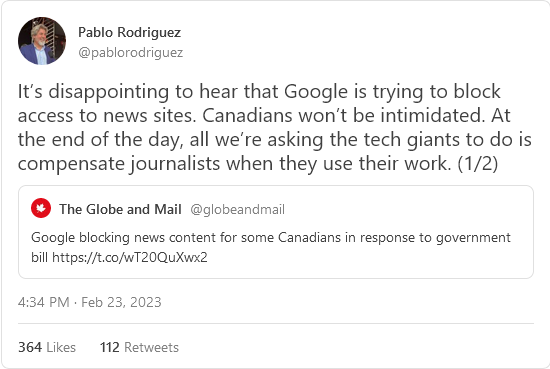
In The Line, Peter Menzies outlines the state of play in the continued efforts of the federal government to pass C-18, a bill that will massively benefit certain media outlets … or convince the “tech giants” to pull out of the Canadian market altogether rather than pay the blackmail:

News Media Canada’s persistent campaigning finally produced its Holy Grail — Bill C-18. All might have been well for Torstar, Postmedia and Le Devoir except that once the flesh was thrown on the bones of the Act, broadcasters that aren’t facing economic peril heard the dinner bell and came running.

The result, according to the Parliamentary Budget Officer, is that Bill C-18 is expected to produce $329 million in annual revenue for Canadian media (for context, that’s less than the Calgary Herald, Edmonton Journal, Edmonton Sun and Calgary Sun were bringing in between them 20 years ago). Of that, $249 million will go to broadcasters, few of whom are on a fiscal ledge and a good many of whom have contributed to the demise of local newspapers. Remarkably, the CBC, already receiving $1 billion in taxpayer funding, will get the most of that cash, followed by CTV (Bell), Rogers, Videotron and others. The newspapers and start ups will have $80 million (a little more than what the Edmonton Journal and Edmonton Sun used to make in combined annual profit) to fight over.

And very few of those previously mentioned startups — run by mostly young and often female innovators — trying to find a sustainable business model for good journalism can expect anything more than a token pay off. No. They will have to go to the little kids table and see what they can find on the children’s menu of subsidies.

It is distressingly obvious that while so many were tricked into believing this was the most progressive Canadian government ever, it is in fact, a slave to the status quo; as staunch a defender of the corporate establishment as the Toronto Club could wish for. With the 21st century and all its opportunities staring it in the face, Justin Trudeau’s government has not only turned its back on innovation, it has put its thumb on the scale in favour of failed business models that long ago ran out of ideas.

Yet there may be a final twist in this tale.

Bill C-18’s particulars are, as Meta/Facebook’s Kevin Chan put it to a Parliamentary committee last week “globally unprecedented”. For all its sins — and for all we know there are a few more skeletons rattling around in its closet — Meta is unlikely to pay up. Sure, it can cover the Canadian shakedown; what it can’t afford though is to pay every other country in the world that makes the same demand. So Meta says it may simply stop serving up news links which, when you think about it, is a better idea in the long run than permanently entrenching its dominant market position

So while the publishers of those blank pages appear to have bullied even the Conservatives into supporting this travesty, they are still left to ponder:

“Imagine if Facebook wasn’t there.”

Freeland to NATO? Almost certainly not

Filed under: Cancon, Government, Military, USA — Tags: , , , , — Nicholas @ 03:00

CDR Salamander explains why, despite her having good qualities that match some of what the job requires, we shouldn’t be betting any money on Deputy PM Chrystia Freeland taking over the role of Secretary General of NATO:


Screencap from a CPAC video of Chrystia Freeland’s speech at the Brookings Institution in October, 2022.

So, via NYT, as a war wages in Eastern Europe and NATO is looking for a new Secretary General, what is the focus?

    The behind-the-scenes jockeying for who should succeed Jens Stoltenberg has begun in earnest, with a focus on women.

Here’s the CV:

    While the officials cautioned that these are early days, and very often the names that surface first do not survive the bargaining among NATO’s 30 members, they said one prime candidate has surfaced in Washington: Chrystia Freeland, 54, the Canadian-Ukrainian deputy prime minister and finance minister of Canada.

    Ms. Freeland, 54, a former journalist (who is married to a reporter for The New York Times), has also been Canada’s foreign minister. Her advantages are considerable: she speaks English, French, Italian, Ukrainian and Russian; she has run complicated ministries; she is good at news conferences and other public appearances; and she would be the first woman and first Canadian ever to run NATO.

The fact that word is on the street that the primary filter here is if someone is XX vs XY would be laughable if not so destructive. There is absolutely nothing wrong with a woman being Secretary General, but that should have nothing to do with the decision. The fact is leading with that as the first criteria, any woman selected as Secretary General this round, would — rightly — always have a shadow over them for this simple fact that they did not get the position on merit — but simply an attempt to signal virtue to … well … fellow members of the woke left in the West, I guess. NATO’s potential enemies will only be encouraged by such an act.

This does nothing for NATO or women — and it degrades both by the process.

That being said, as her name is being floated, let’s look at Freeland. Many US citizens may recognize her from her very undiplomatic interactions with the Trump Administration. It wasn’t just Trump, but something worse that seeps out. Even during the Biden Administration, her not-so-subtle sniffs of standard issue leftist Canadian anti-Americanism crops up on a regular basis. It only gets worse when she deals with Americans to the right of Bernie Sanders.

In NATO, you need someone who is a subtle politician — again with experience working in a vigorous multi-party coalition with highly different views, priorities, and goals. That is why Europeans make such good Secretary Generals. While Canada also has a parliamentary system, it and its parties are VERY different than the European model. Freeland only gets partial credit here.

There is also the issue of temperament. Read the links above. Freeland likes to pick fights, often in public. Worse, she seems to enjoy — again as most standard-issue Canadian leftists do — in making snide comments about the government and people of the alliance’s largest monetary and troop contributing nation — the United States of America.

The Secretary General of NATO has to be someone by temperament and habit seen as a non-partisan person toward the USA so that they can work with American administrations from all political parties. Freeland has significant issues with the American Republican Party in general and American conservatives in particular. That alone should be enough for serious alliance nations from Poland to Great Britain to be against her as a possible candidate. In summary; Freeland does not possess the skills or temperament for the position.

Now is not the time for such frivolity.

The last reason — and the most important reason for me — that Freeland should not be the Secretary General will be recognizable to regular readers here. It has nothing to do with her as a person, but her nation, Canada.

I love Canada and Canadians — but this is not personal, this is business. Serious alliance business. Simply by the numbers, Canada has not earned the position.

Review my post from September if needed, but Canada spends ~1.3% of her GDP on defense. This is WELL below NATO’s 2% minimum. Only Slovenia, Belgium, Spain and Luxembourg spend less.

We are well past being polite to alliance members who refuse to pull their fair share of the burden. Canada simply has not put herself in the position to reward any of her political elite with the position of Secretary General, man or woman.

November 6, 2022

How bad do the midterm elections look for the Democrats? Even Andrew Sullivan is voting Republican this time

From the free-to-cheapskates excerpt of Andrew Sullivan’s Weekly Dish:

“Polling Place Vote Here” by Scott Beale is licensed under CC BY-NC-ND 2.0 .

The day I received my absentee ballot from the DC government, there was a story in the Washington Post about the DC Council’s imminent vote:

    The bill would eliminate most mandatory minimum sentences, allow for jury trials in almost all misdemeanor cases and reduce the maximum penalties for offenses such as burglaries, carjackings and robberies.

Over the past few years, violent crime in DC has been rising fast. Last year the murder rate was the highest since 2003, and this year the death toll is slightly higher so far. Carjackings are up 36 percent and robberies are up 57 percent. Almost all this hideous violence is inflicted on African-Americans, including many children. It permeates outward, creating a deeper public sense of insecurity and out-of-control crime. Tent cities are now all over the city. People suffering from mental illness patrol the streets. You feel the decline in law and order, the slow fraying of the city, every day.

And yet the Council has decided that now is the time to make it harder to prosecute and easier to defend violent criminals, partly in the name of “equity”. Yes, it’s part of a longstanding “modernization” of the criminal code, but they had to include these provisions and now? And this isn’t new. Just before the crime explosion took off, the DC mayor had “Black Lives Matter” painted on the street in letters so large you could read them from a plane, and allowed “Defund the Police” to remain next to it. That summer, woke mobs were allowed to harass anyone in their vicinity, yelling slogans that vilified all police — and the MSM took the side of the bullies. After the summer of 2020, the DC police force dropped to its lowest level in two decades.

So guess what? I’m going to vote for the Republican and the most conservative Independent I can find next Tuesday. And I can’t be the only Biden and Clinton and Obama voter who’s feeling something like this, after the past two years.

There was no choice in 2020, given Trump. I understand that. If he runs again, we’ll have no choice one more time. And, more than most, I am aware of the profound threat to democratic legitimacy that the election-denying GOP core now represents. But that’s precisely why we need to send the Dems a message this week, before it really is too late.

By “we”, I mean anyone not committed to the hard-left agenda Biden has relentlessly pursued since taking office. In my view, he and his media mouthpieces have tragically enabled the far right over the past two years far more than they’ve hurt them. I hoped in 2020 that after a clear but modest win, with simultaneous gains for the GOP in the House and a fluke tie in the Senate, Biden would grasp a chance to capture the sane middle, isolating the far right. After the horror of January 6, the opportunity beckoned ever more directly.

And yet Biden instantly threw it away. In return for centrists’ and moderates’ support, Biden effectively told us to get lost. He championed the entire far-left agenda: the biggest expansion in government since LBJ; a massive stimulus that, in a period of supply constraints, fueled durable inflation; a second welfare stimulus was also planned — which would have made inflation even worse; record rates of mass migration, and no end in sight; a policy of almost no legal restrictions on abortion (with public funding as well!); the replacement of biological sex with postmodern “genders”; the imposition of critical race theory in high schools and critical queer theory in kindergarten; an attack on welfare reform; “equity” hiring across the federal government; plans to regulate media “disinformation”; fast-track sex-changes for minors; next-to-no due process in college sex-harassment proceedings; and on and on it went. Even the policy most popular with the center — the infrastructure bill — was instantly conditioned on an attempt to massively expand the welfare state. What on earth in this agenda was there for anyone in the center?

The ArriveCAN farce as the poster child for Canada’s vastly diminished state capacity

Filed under: Bureaucracy, Cancon, Government, Liberty — Tags: , , , , , — Nicholas @ 03:00

In The Line, Andrew Potter considers the expensive, ineffective ArriveCAN app the government tried to impose on international travellers as a symptom of Canada’s decreasing state capacity:

There is perhaps no clearer poster child for the current crisis of state capacity than the ArriveCAN app, which was a bad policy initiative, poorly implemented, at great cost, and whose ultimate effect was not to keep Canadians safe and healthy, but rather to annoy users and generate a great deal of hostility towards the government.

The question of state capacity (or more frequently, its absence) became an issue of popular concern during the COVID-19 pandemic when governments, both in Canada and elsewhere, struggled to accomplish basic tasks of pandemic management. Whether it was sourcing enough PPE for the health-care system, scaling up testing or contact tracing, securing the borders, properly staffing long-term-care facilities, taking care of temporary foreign workers, and so on … the authorities struggled to get their act together. This is a well-documented story.

But this all came at a time when we had already started a national conversation about whether Canada had become a place where it was impossible for government to get anything done. Pipelines were the big issue, but we seemed to have turned into a country where crumbling infrastructure and slow and ineffective public services had become simply accepted as a fact of life. “State capacity” just put a name to something that had been in the air for a long while.

And so the pandemic served to both exacerbate and accelerate the concern over state capacity, for two main reasons. First, it raised the stakes. Before the pandemic, the failure of state capacity manifested itself as a slow-motion and genteel sort of generalized decline. With the arrival of COVID-19, it quickly became a matter of life and death. But second, the gusher of money the government printed during the pandemic helped put a point on the problem: the problem didn’t originate in a lack of funds. Indeed, what transpired during the pandemic was a bit of a spin on the old Woody Allen joke about the restaurant with terrible food and such small portions: There was so much government, and so much of it was bad.

So what is state capacity anyway? And why is it so important?

As I’ve said many times, the more the government tries to do, the less well it does everything. More government is worse government … and I’m not even being a pedantic libertarian here, I’m talking objectively about the outcomes of pretty much every new government action.

November 5, 2022

Psyops in theory and practice

Filed under: Government, Media, Politics, USA — Tags: , , , — Nicholas @ 05:00

Theophilus Chilton on the development of psyops and some examples of their use in US civilian contexts in recent years:

I trust that most readers are familiar with the concept of a “psyop”, a psychological operation designed to sway its targets in certain desired directions. Many of the mechanics of psyops were pioneered by the CIA and other intelligence agencies during the Cold War but have now been turned against civilian populations in the USA and elsewhere in an effort by the Regime to maintain control and minimise opposition to its various agendas. However, I’d like to make the point that psyops qualitatively differ from standard, run-of-the-mill propaganda such as governments have used for millennia.

The difference is primarily that of the time preferences involved. Whether it’s designed to whip up a population against an enemy or to try to obfuscate the truth about some particular event that has occurred, propaganda tends to operate on a shorter timescale and with more limited and simple policy goals in mind. It’s not surprising that modern propaganda techniques share a lot in common with commercial advertising designed to induce an “impulse buy” response in potential customers. Propaganda generally operates the same way — create a monodirectional response to a particular stimulus.

Psyops, on the other hand, are quite a bit more complex and generally involve the building of a narrative memeplex over the course of months, years, or even decades. Psyops are, of course, also fake but theirs is a fakeness that builds upon constant, repetitious narrative-building that lays out a foundational lens through which any individual incident or act can be systematically interpreted, adding them to the overall saga being told.

With conventional propaganda, the aim is to communicate Regime diktat to the average citizen. However, it does not necessarily expect the recipients to believe the propaganda, but merely comply with the goals. The Powers That Be in such cases don’t care why Havel’s greengrocer puts the sign up in his window, but merely that he does so. The primary purpose of psyops, on the other hand, is to ensure compliance by convincing the target to self-comply, rather than it having to be done by outside force or persuasion. It’s always touch and go when you’re making someone outwardly comply but inwardly they’re dissident. When the mark can be convinced to willingly self-police, this makes the government’s job easier since they don’t have to worry about this closet dissidence. The true believer is the best believer.

In essence, propaganda aims for immediate reactive persuasion while psyops seek long-term groundlaying that gives more all-inclusive means of maintaining overarching narrative control.

Now, a lot of people out there like to think they’re immune to psyops because “hurr durr I don’t beleeb da media!!” But they’re not. Indeed, a lot of these boomercon types are just as susceptible to psyops as anyone else when the right buttons are pushed. This is because they’ve been primed for it by the systematic, society-wide preparation of the psychological battle space without their ever realising it. In many cases, the foundations for a psyop are so culturally systematic that people don’t even realise what is happening.

For example, there are a ton of people out there who would pride themselves on being independent thinkers who nevertheless believed everything that was peddled during the covid and vaccine psyops. The reason for this is because they want to think of themselves as smart, knowledgeable about science, etc. Smart People believe the Right Things, after all. That, in turn, is the result of decades of psyops that have ensconced “science” as the arbiter of morality and truth in post-Christian America. So even when the science is fake or wrong, it is still accorded a moral authority that it does not deserve.

November 4, 2022

Amnesty “literally means a pardon, i.e. the absence of punishment … for a crime committed in the past

Filed under: Government, Health, Media, Politics, USA — Tags: , , , — Nicholas @ 05:00

Sarah Reynolds considers the implications of what Emily Oster wrote in her Atlantic article suggesting a Covid-19 amnesty:

Now “amnesty” is a very specific word. It doesn’t mean forgiveness, it literally means a pardon, i.e. the absence of punishment … for a crime committed in the past.

It is a stark and loaded word indeed when used to refer to anything Covid-related because it establishes two parties: victims and perpetrators. Group 1: Those who committed crimes and could be in the legal sense pardoned of the criminal behavior they engaged in; and Group 2: those who will consequently not get justice.

The implication of such a dichotomy (if one were to appear) is horrifying.

The author alludes to the appeal and inevitability of forgiveness; I posit in contrast that forgiveness is a spiritual concept, one that may be inextricably linked to a religious belief for some, so she’s jumping the gun here because Forgiveness would be the stage after Justice, and only for those whose religion, faith, or spiritual practice also inspires or compels it.

Use of the word amnesty is terribly concerning to me because it insinuates that grave injustice has been committed. And if some horrible truth is coming out soon, her piece in the Atlantic serves as a way to beta test our/society’s future reaction to it — acting as the proverbial canary in the coal mine.

In other words, if we’re this outraged now knowing only what we know so far, how outraged will we be then, after this (speculated by me) coming newsflash triggers national indignation from coast to coast?

The most revealing part of the Professor’s piece in the Atlantic is this statement:

    The standard saying is that those who forget history are doomed to repeat it. But dwelling on the mistakes of history can lead to a repetitive doom loop as well. Let’s acknowledge that we made complicated choices in the face of deep uncertainty, and then try to work together to build back and move forward.

No, vacuums are complicated. All those attachments.

Tyranny is quite straight-forward, in contrast.

Years ago, I read a book that taught the reader that people are often confessing and how to detect it. If you look at and listen to their word choices, you can sometimes find what it is they did in the past, what they fear will happen in the future, and clues about whether or not they are capable of remorse. Many of you who have watched my youtube or read my blog before I got on substack know how I like to do a communication analysis, and delineate a) what’s literally being said, b) what the person really meant, and c) the third and most important/revealing part, what’s being left unsaid. And I rarely hear people say, “it’s complicated”, unless they are feeling profound regret, fear of the consequences of those “complicated choices”, and plenty of denial of the emotional origin of that particular word choice. They don’t even know why they were compelled unconsciously to use that word … but we do. The stark truth would likely be anything but complicated and possibly horrifying. (For example, what if Oster got on twitter tomorrow and tweeted out, “I don’t think I feel regret or remorse like other people. Intellectually, I get it: the Pandemic response caused human beings unbearable pain and society irrevocable damage but it doesn’t really bother me per se and sometimes I even feel gratified by it, especially when I witness overt force (mandates) replace emotional manipulation (shame).” Now I’m sure Oster is a wonderful person with a fully intact moral compass who’s 100% able to empathetically relate to others!! But … IF … on the off chance it were a true statement so she did declare it on twitter, it might seem complicated to her, but to us it would be the simplest most logical explanation for her actions. We’d go, oh! She’s a sociopath! Oh my God, now it all makes perfect sense! Hahahahaha I get it now hahahahaha because we live in hell!!)

H/T to Chris Bray for the link.

« Newer PostsOlder Posts »

Powered by WordPress