
High-income earners pay a higher rate of tax than people on low incomes. So why is it unfair, as Kim Beazley argues, that high-income earners receive a larger tax cut?
An analogy: your house and your neighbour’s house are both burgled. You lose a television. He loses a DVD player, microwave, his collection of Chomsky memorabilia (it’s an inner-city house), and a unique framed Leunig depicting Mr Curly’s pedophilia arrest. Would it be unfair if police were to return all of this fellow’s belongings, and you were only to get back your 24-inch Sony?
Tim Blair, “Simplistic right-wing greed justification attempted”, Road to Surfdom, 2005-05-12.
[H/T to Samizdata, both for the link and for their title on the post, which I’ve purloined.]
May 19, 2024
QotD: Taxation and theft
Comments Off on QotD: Taxation and theft
May 17, 2024
Canada Post is in deep, deep trouble
I was vaguely aware that Canada Post has been in financial difficulties for a while, but I had no idea things were quite this dire:

You’d better believe that the Canada Post Corporation is in very deep trouble. Here’s how they phrased it in their 2023 annual report:
Canada Post’s financial situation is unsustainable.
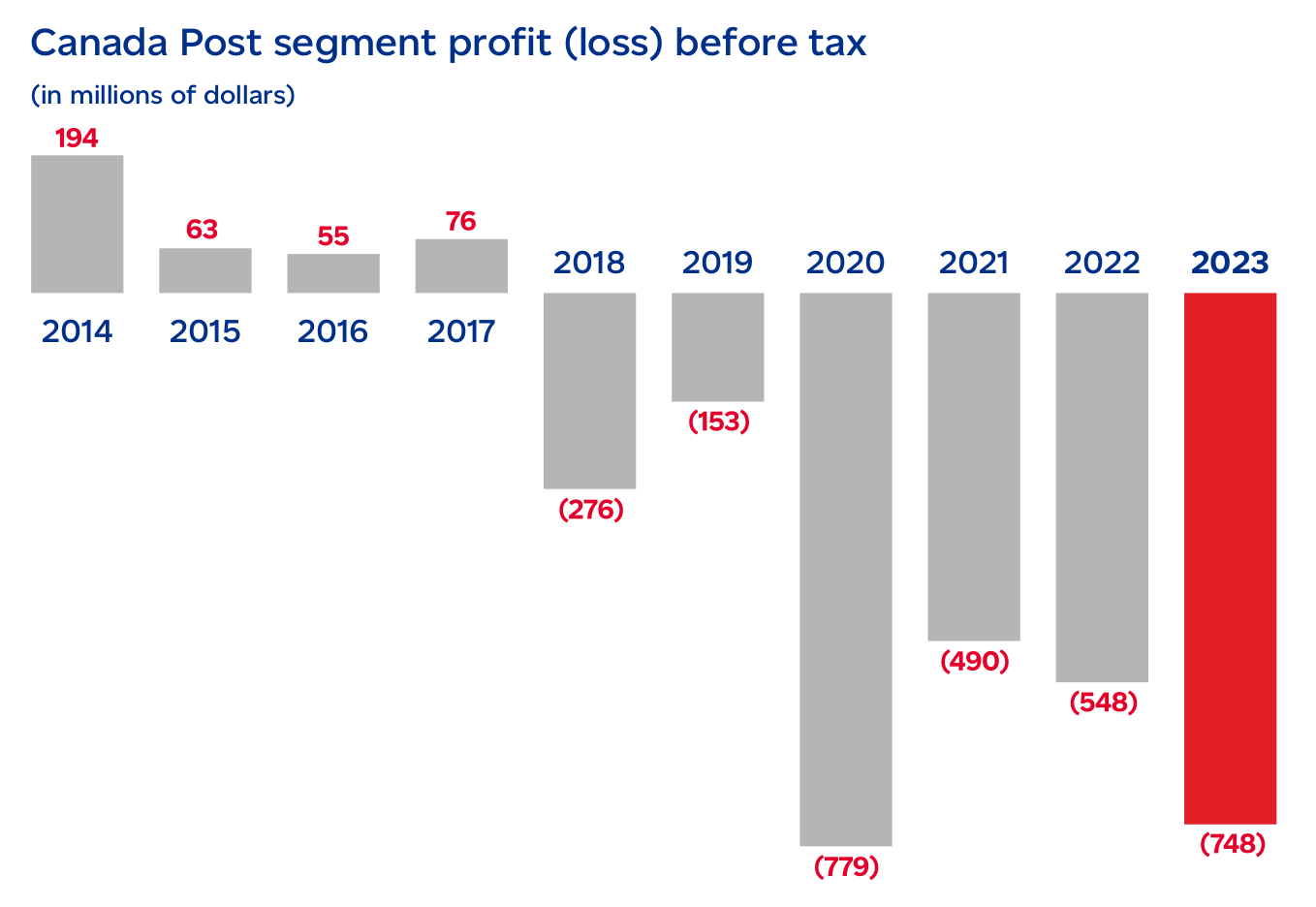
“Unsustainable”. Well that doesn’t sound good. Think they’re just putting on a show to carve out a better negotiating position? Well, besides for the fact that they’re not currently negotiating with anyone, the numbers do bear out the concern:
For 2023, the Corporation recorded a loss before tax of $748 million, compared to a loss before tax of $548 million in 2022. From 2018 to 2023, Canada Post lost $3 billion before taxes. Without changes and new operating parameters to address our challenges, we forecast larger and increasingly unsustainable losses in future years.
In other words, it’s madly-off-in-all-directions panic time.
Hey! You know I can hear your condescending sniff: “I’m sure this is just a temporary disruption. They’ll figure out how to fix the leak and get themselves back on the road like always. They’re too big to fail.”
Yeah … not this time. The competition from digital communications (i.e., the internet), FedEx, and UPS isn’t going anywhere. Letter delivery nosedived from nearly 5.5 billion pieces in 2006 to just 2.2 billion in 2022. And vague references to “major strategic changes to transform our information technology model” don’t sound much like magic bullets for reversing the decline.
But Canada Post’s labour and pension costs sure are marching bravely forward. In fact, if it wasn’t for Parliamentary relief in the form of Canada Post Corporation Pension Plan Funding Regulations, the Corporation would have had to pay $354 million into the pension plan in 2023 alone. But that $354 million — plus whatever additional amounts show up in 2024 and besides the $998 million in existing general debt — are still liabilities that’ll eventually need paying.
Comments Off on Canada Post is in deep, deep trouble
May 16, 2024
The replication crisis and the steady decline in social trust
Theodore Dalrymple on the depressing unreliability — and sometimes outright fraudulence — of far too high a proportion of what gets published in scientific journals:
Until quite recently — I cannot put an exact date on it — I assumed that everything published in scientific journals was, if not true, at least not deliberately untrue. Scientists might make mistakes, but they did not cheat, plagiarise, falsify, or make up their results. For many years as I opened a medical journal, the possibility simply that it contained fraud did not occur to me. Cases such as those of the Piltdown Man, a hoax in which bone fragments found in the Piltdown gravel pit were claimed to be those of the missing link between ape and man, were famous because they were dramatic but above all because they were rare, or assumed to be such.
Such naivety is no longer possible: instances of dishonesty have become much more frequent, or at least much more publicised. Whether the real incidence of scientific fraud has increased is difficult to say. There is probably no way to estimate the incidence of such fraud in the past by which a proper comparison can be made.
There are, of course, good reasons why scientific fraud should have increased. The number of practising scientists has exploded; they are in fierce competition with one another; their careers depend to a large extent on their productivity as measured by publication. The difference between what is ethical and unethical has blurred. They cite themselves, they recycle their work, they pay for publication, they attach their names to pieces of work they have played no part in performing and whose reports they have not even read, and so forth. As new algorithms are developed to measure their performance, they find new ways to play the game or to deceive. And all this is not even counting commercial pressures.
Furthermore, the general level of trust in society has declined. Are our politicians worse than they used to be, as it seems to everyone above a certain age, or is it that we simply know more about them because the channels of communication are so much wider? At any rate, trust in authority of most kinds has declined. Where once we were inclined to say, “It must be true because I read it in a newspaper”, we are now inclined to say, “It must be untrue because I read it in a newspaper”.
Quite often now I look at a blog called Retraction Watch which, since 2010, has been devoted to tracing and encouraging retraction of flawed scientific papers, often flawed for discreditable reasons. Such reasons are various and include research performed on subjects who have not given proper consent. This is not the same as saying that the results of such research are false, however, and raises the question of whether it is ethical to cite results that have been obtained unethically. Whether it is or not, we have all benefited enormously from past research that would now be considered unethical.
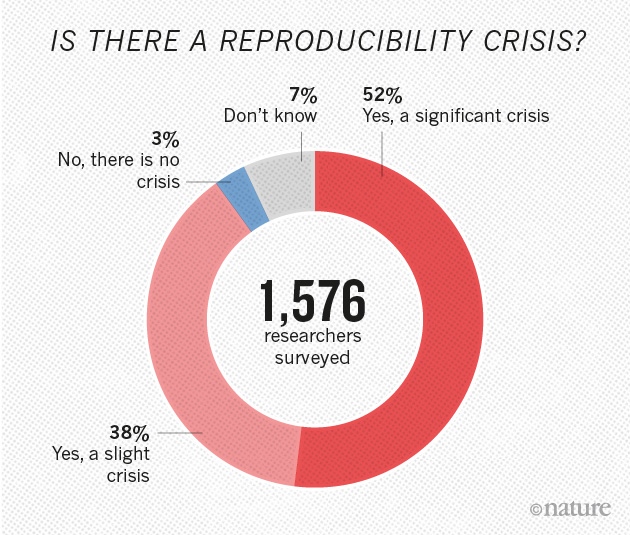
One common problem with research is its reproducibility, or lack of it. This is particularly severe in the case of psychology, but it is common in medicine too.
Comments Off on The replication crisis and the steady decline in social trust
The Canadian Senate is an anti-democratic fossil … that might totally frustrate a future Conservative government
Tristin Hopper considers the constitutional weirdness of Canada’s upper house, an appointed body that has the power to block a popularly elected House of Commons:
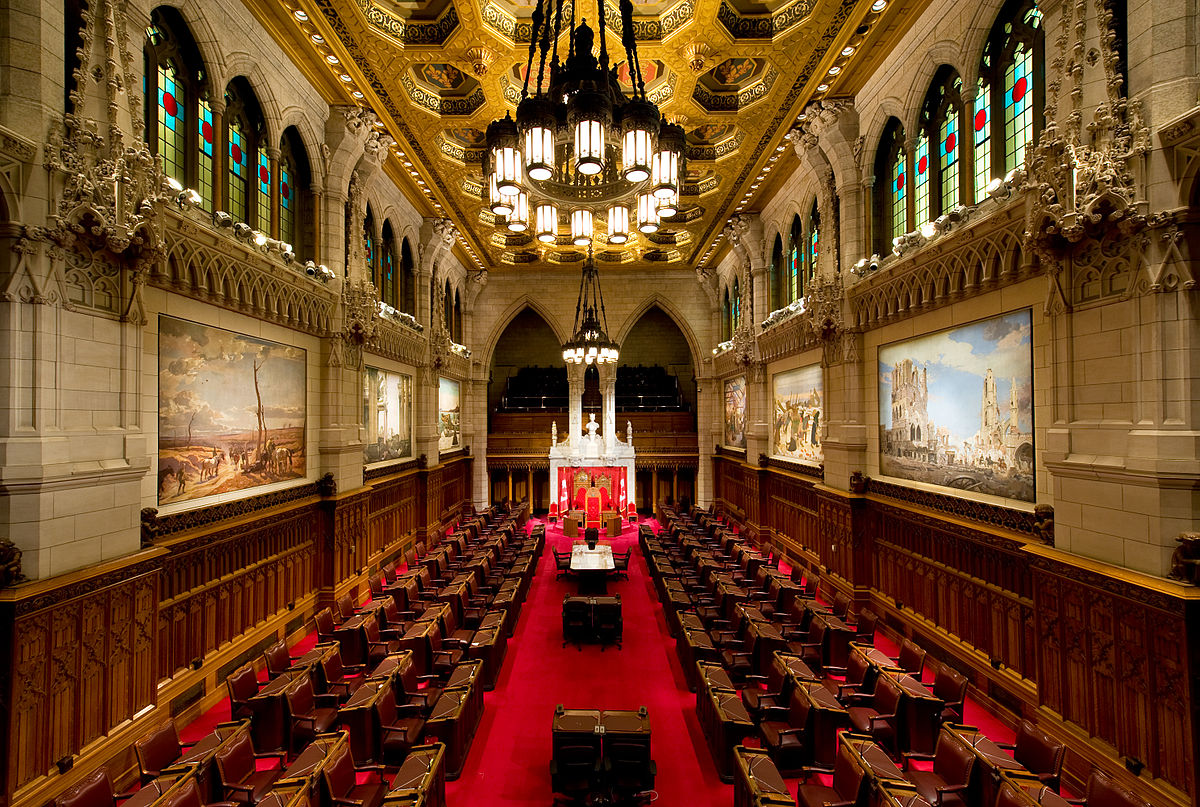
“In the east wing of the Centre Block is the Senate chamber, in which are the thrones for the [King and Queen], or for the federal viceroy and his or her consort, and from which either the sovereign or the governor general gives the Speech from the Throne and grants Royal Assent to bills passed by parliament. The senators themselves sit in the chamber, arranged so that those belonging to the governing party are to the right of the Speaker of the Senate and the opposition to the speaker’s left. The overall colour in the Senate chamber is red, seen in the upholstery, carpeting, and draperies, and reflecting the colour scheme of the House of Lords in the United Kingdom; red was a more royal colour, associated with the Crown and hereditary peers. Capping the room is a gilt ceiling with deep octagonal coffers, each filled with heraldic symbols, including maple leafs, fleur-de-lis, lions rampant, clàrsach, Welsh Dragons, and lions passant. On the east and west walls of the chamber are eight murals depicting scenes from the First World War; painted in between 1916 and 1920”
Photo and description by Saffron Blaze via Wikimedia Commons.
By the anticipated date of the 2025 federal election, only 10 to 15 members of the 105-seat Senate will be either Conservative or Conservative appointees. The rest will be Liberal appointees. As of this writing, 70 senators have been personally appointed by Trudeau, and he’ll likely have the opportunity to appoint another 12 before his term ends.
What this means is that no matter how strong the mandate of any future Conservative government, the Tory caucus will face a Liberal supermajority in the Senate with the power to gut or block any legislation sent their way.
“If a majority of the Senate chose to block or severely delay a Conservative government’s legislative agenda, it would plunge the country into a constitutional crisis the likes of which we have not seen in more than a century,” reads an analysis published Tuesday in The Hub.
Constitutional scholars Howard Anglin and Ray Pennings envisioned a potential nightmare scenario in which the Senate casts themselves as “resisting” a Conservative government. Given that senators are all permanently appointed until their mandatory retirement at age 75, it would take at least 10 years until a Conservative government could rack up enough Senate appointments to overcome the Liberal-appointed majority.
“Canadian politics would grind to the kind of impasse that is only broken by the kind of extraordinary force whose political and social repercussions are unpredictable,” they wrote.
The piece even makes a passing reference to 1849, when mobs burned down Canada’s pre-Confederation parliament.
The prospect of an all-powerful Senate able to block the mandate of an elected government is a legislative situation almost entirely unique to Canada.
New Zealand abolished its Senate and is now governed by a unicameral legislature. Australia and the United States both employ term-limited elected senates. The U.K. House of Lords – on which the Canadian Senate is closely modelled – is severely constrained in how far it can check the actions of the House of Commons.
But in Canada, the Senate essentially retains the power of a second House of Commons; it can do whatever it wants to legislation that has passed the House of Commons, including spike it entirely.
Comments Off on The Canadian Senate is an anti-democratic fossil … that might totally frustrate a future Conservative government
May 15, 2024
Canada’s Minister of National Defence says new submarines are “inevitable”
Bill Blair regrets earlier comments that some read as weakening the government’s already feeble commitment to re-equipping the Royal Canadian Navy’s submarine branch:
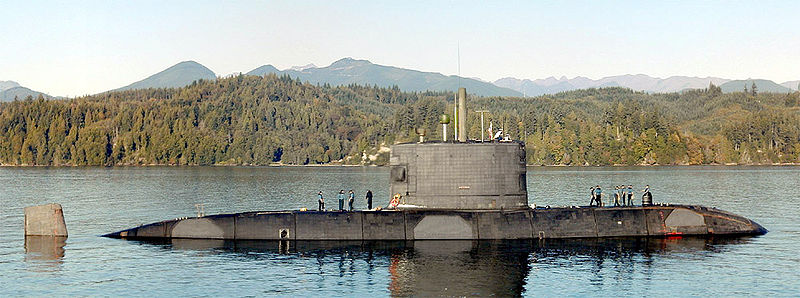
HMCS Victoria, one of the four submarines currently in service with the Royal Canadian Navy. She was originally commisioned into the Royal navy as HMS Unseen in 1991 and re-commissioned as HMCS Victoria in 2000.
Image via Wikimedia Commons.
Bill Blair, the federal defence minister, made a rare admission of Liberal fallibility in Washington on Monday when he said he regrets using the word “explore” when talking about renewing Canada’s submarine fleet.
Ottawa’s recent defence policy update said the government will “explore options for renewing and expanding the submarine fleet”, a form of words that was criticized for lacking urgency.
“It’s certainly not my intention to be wishy-washy. What I’ve tried to articulate very, very clearly and strongly in the document is, we know we have to replace our submarine fleet, and we’re going to do that,” Blair said.
Replacing the four Victoria-class subs is necessary, he said. “It is, I might suggest, inevitable.”
That is absolutely the case, if Canada is committed to maintaining its submarine capability. The Victoria-class subs date back to the late 1980s and are due to be taken out of service at the end of the 2030s.
Submarines are seen as a crucial defence against incursion by hostile powers, as the polar ice melts and opens up northern waterways. The Northwest Passage is forecast to be the most efficient shipping route between Asia and Europe by 2050.
But Blair admits “there is a lot of work to do”, not least convincing his cabinet colleagues of the “business case for the capability”.
“One of the greatest challenges of being a defence minister is to secure funding and the second one is actually spending it”, he said on Monday.
He gave a sense of the struggles around the cabinet table last month in a speech in Ottawa, where he admitted: “I had to sort of keep on pushing my issue forward about the importance and the need to invest in defence”. He made it sound as if he was a lone voice in the wilderness.
[…]
Retired captain Norman Jolin recently wrote an analysis for the Naval Association of Canada that noted if Canada wants to maintain submarine capability, it needs to place a contract with a proven builder by 2027 at the latest. He said the lack of domestic submarine-building capacity means there is neither the time nor resources to even think about a made-in-Canada solution.
The typical procurement process takes 18 years to get from cabinet approval to delivery, which would mean if an order was placed tomorrow, we wouldn’t get new subs until 2042.
Based on that timeline, “it is clear that the decision to replace the submarines is considerably overdue,” Jolin wrote.
There’s little chance that this will move closer to completion during the remaining life of the current government, with an election due before the end of 2025, and Blair is already on the record emphasizing how little the Liberals would relish spending any money on military equipment even in good economic times. Oddly, the fact that there are no domestic shipyards currently capable of building submarines may be a positive — building the RCN’s ships in Canadian yards always means that each ship costs much more than if the hull is built in a foreign shipyard. Canada doesn’t have the facilities and trained workforce to build naval vessels, so every time a new class of ships is needed, the cost of building/refurbishing the shipyards and hiring and training-from-scratch a new workforce balloons the total cost of the program.
Comments Off on Canada’s Minister of National Defence says new submarines are “inevitable”
May 13, 2024
Unravelling the actual origins of Covid (aka Wuhan Coronavirus)
In Spiked!, Matt Ridley outlines some of the more recent admissions-against-interest of the people who used to accuse you of tinfoil-hattism and peddling conspiracy theories when the topic of the origins of Covid came up:

Wuhan Institute of Virology.
Wikimedia Commons.
Two of the key figures in the story of Covid’s origins gave away vital new information last week before the US Congress.
One of these figures is Ralph Baric, the University of North Carolina professor who invented ingenious techniques for genetically altering coronaviruses. He effectively taught scientists at the Wuhan Institute of Virology in China how to do “gain of function” experiments with bat-derived sarbecoviruses to make them more infectious or lethal in humanised mice. The other figure is Peter Daszak, the highly paid president of the non-profit, EcoHealth Alliance. Over many years, EcoHealth Alliance has channelled large sums of US taxpayer money to the Wuhan Institute of Virology for “gain of function” experimentation, and for finding new sarbecoviruses in bats.
Up until now, Baric and Daszak have taken slightly different approaches to (hardly) helping the world understand what went on in Wuhan before the Covid-19 outbreak in November 2019. Baric has remained largely silent, refusing to do interviews or sign up to articles in the scientific press. He remained silent last week, too, but the Congressional Select Subcommittee on the Coronavirus Pandemic released the transcript of a lengthy closed-door session it held with him in January.
Daszak, by contrast, has adopted a high profile, organising round-robin letters defending his friends and colleagues in Wuhan, giving interviews, writing articles and getting himself appointed to not one but two commissions investigating Covid’s origins, despite a glaring conflict of interest. He appeared before the subcommittee on 1 May.
Both men reluctantly admitted under oath to points that markedly strengthen the already strong hypothesis that the pandemic began with an accident in a laboratory in Wuhan. But before considering what they said, it might be worth briefly looking at the relationship between the two.
In comments on a draft of a grant proposal written in 2018, which were made public last year, Daszak boasted of how cheap it is to do experiments in Wuhan because they use a lower biosafety level (BSL-2), without negative-pressure work cabinets. Baric responded that US scientists would “freak out” at that. So a newly released email Baric sent to Daszak on 27 May 2021 smacks one’s gob somewhat. Responding to Daszak’s insistence that the Wuhan Institute actually used safer versions of these low safety standards for its experiments, Baric wrote:
Your [sic] being told a bunch of BS. Bsl2 [with] negative pressure, give me a break. There [sic] last paper mentioned bsl2 [with] appropriate PPE. This last part was the first and only time this was ever mentioned, never in earlier papers, and in the latest paper never defined either. I have no doubt that they followed state-determined rules and did the work under bsl2. Yes China has the right to set their own policy. You believe this was appropriate containment if you want but don’t expect me to believe it. Moreover, don’t insult my intelligence by trying to feed me this load of BS.
Baric clearly does not have a high regard for the Wuhan Institute of Virology’s safety standards, or indeed for his virus-hunting grantrepreneur colleague, Daszak. Nor do some other scientists who have nonetheless defended Daszak in public. Thanks to freedom-of-information revelations, we now know that “Dastwat” and “EgoHealth” are just two of the epithets used about him by his friends. With friends like that …
Both men still insist, however, that the pandemic began naturally – but, to borrow from Mandy Rice-Davies, they would say that wouldn’t they? Before the subcommittee, where even the Democrats gave him a pasting, Daszak was forced to concede some key points on which he had previously stonewalled or said the opposite.
Firstly, he had to concede that a lab leak was possible. Yet back in 2020, Daszak told Democracy Now that “the idea that this virus escaped from a lab is just pure baloney. It’s simply not true … So it’s just not possible.”
Comments Off on Unravelling the actual origins of Covid (aka Wuhan Coronavirus)
“Our NATO allies are despairing. Our American friends are frustrated … all the officers are extraordinarily polite in public. But in private, the conversations are quite brutal.”
Former Liberal MP and retired Lt.-General Andrew Leslie has few illusions about the current Liberal government’s approach to military issues:

Lt.-Gen. (ret’d) Andrew Leslie is keen to talk about the embarrassing state of Canadian military preparedness.
“The current prime minister of Canada is not serious about defence. Full stop. A large number of his cabinet members are not serious about defence. Full stop,” the former Liberal MP tells me.
“Our NATO allies are despairing. Our American friends are frustrated. But because NATO and Norad (North American Aerospace Defense Command) are both essentially voluntary organizations, in which other people cannot give Canada orders,” the retired general explains, “all the officers are extraordinarily polite in public. But in private, the conversations are quite brutal.”
I have asked Andrew to explain our federal government’s foot-dragging on military spending — despite significant changes in risk — and what we should expect from our allies. This 35-year veteran of the Canadian Armed Forces (CAF), former chief of staff of the Canadian Army and one-time MP for Orleans is well-placed to decipher what’s really going on and in our frank conversation, he doesn’t pull any punches. I connect with Andrew at his home in Ottawa; behind him, the walls of his spacious office are sheathed in medals and awards, testimony to decades of decorated service in places like Afghanistan and Yugoslavia.
We get to the heart of the matter. Canada’s allies are pressuring Prime Minister Justin Trudeau’s government to get serious about military spending. And with a relentless war in Ukraine, a thawing and more vulnerable Arctic, unrest in the Middle East, and a general shakeup of the world order, Canadians are waking up to the risks of not being ready to defend ourselves.
Recently, U.S. Air Force Gen. Gregory Guillot (who took over leadership of Norad in February) has put his Canadian counterparts on notice that he aims to have U.S. troops training, not just in Alaska, but in the Canadian Arctic. A good idea, or the thin edge of a wedge?
It’s totally sensible, Andrew replies, because Canada has “no permanently stationed combat capability in the Arctic.” After a pause to let that sink in, he repeats that fact and elaborates. “Just in terms of numbers, there’s about 22,000 professional men and women in the U.S. Armed Forces based in the Arctic, mainly in Alaska. There’s about 30,000 to 35,000 Russian armed forces based in the Arctic. Canada has about 300 people.”
Comments Off on “Our NATO allies are despairing. Our American friends are frustrated … all the officers are extraordinarily polite in public. But in private, the conversations are quite brutal.”
May 5, 2024
Trudeau’s shameful role in promoting “the blood libel against Canada”
Conrad Black believes that Justin Trudeau owes Canadians an apology for his role in pushing the most extreme version of the Residential Schools propaganda:
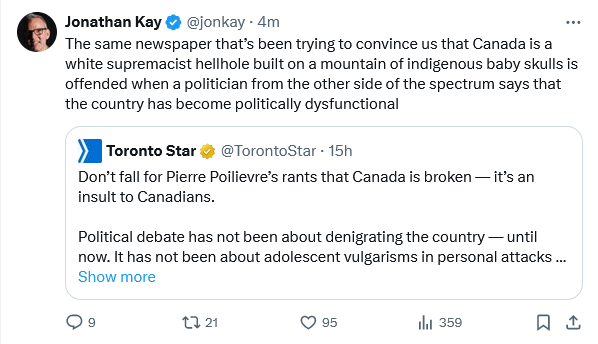
A very well-informed friend of many years, a contemporary of mine, wrote me the other day that “The blood libel against Canada of this monstrous fiction of thousands of secretly buried Indigenous victims of residential schools may be the single worst injustice this country has suffered in our lifetimes. It is now a conspiracy of silence involving both federal and provincial governments, the RCMP (shameless and useless as ever), and the media, and ‘let’s be frank’, (quoting a Soviet diplomat many years ago whom we both always found rather entertaining in the utter nonsense he used to recite at international meetings), a large section of the public, which knows this to be a falsehood but chooses to side with the silent forces”.
Almost all readers will be aware of the tidal wave of self-mutilating hysteria that inundated this country when, on the basis of apparent anomalies detected by underground radar close to a former Indian Residential School site at Kamloops, British Columbia, a couple of years ago. Immediately, the theory took hold that thousands of native children in those schools had died because of negligence or outright homicide, were buried secretly in unmarked graves, their deaths never recorded and no account given to their families. There is no evidence to support this, yet the prime minister led the nation in an almost medieval circular mass pilgrimage of self-flagellation. In order to impress upon ourselves and the entire world the profundity of our self-humiliation, all official Canadian flags everywhere were lowered to half-mast and maintained in that condition for an unheard-of period of six months.
Parliament voted to spend $27 million to conduct the excavations necessary to verify or otherwise the existence and extent of these graves. This work could have been accomplished by a small group for a few thousand dollars, but the suggestion of actually establishing what happened set up the customary cacophony of complaints about the sacred untouchability of burial grounds, even though it was not clear that there was burial ground at the Kamloops site, and if it was it was rank speculation about who might be buried there if it was. It is not conceivable to me that the country could dress itself out in sackcloth and ashes and flay the flesh off its own back before the bemused or astonished eyes of the entire world and then produce no evidence whatever of the unspeakable outrages that allegedly occurred and gave rise to this conduct, and then simply lapse into Sphinx-like incommunicability: a pristine silence of perfect ambiguity followed a near-terminal St. Vitus dance of window-rattling ululations of national guilt, shame, and self-hate.
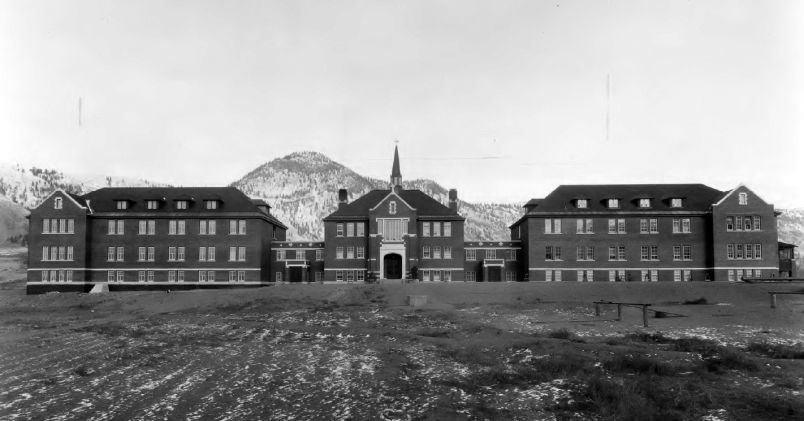
Kamloops Indian Residential School, 1930.
Photo from Archives Deschâtelets-NDC, Richelieu via Wikimedia Commons.Various parts of this macabre fable have been precisely and publicly put to rest: children in residential schools were not buried secretly and records were not destroyed; residential school students were accounted for and if they died while at the schools the reason was typically provided and it was almost invariably as a result of illnesses that were not as well treated in those times, and particularly tuberculosis. Beyond that, there has been silence: the febrile allegations of hideous wrongdoing vituperatively hurled at Canadian history and society – at the ancestors of English and French Canadians, at the main Christian churches, at the principal founder of our country whose distinguished name (John A. Macdonald) has been taken down from public buildings, statues of him overturned or removed, and effigies of him burned at festivities of confected righteous anger from coast to coast; all just mysteriously stopped. It is a sonic version of the celebrated poem by Shelley about the fallen monument of a once great King: “Round the decay of that colossal wreck, boundless and bare, the loan and level sands stretch far away.”
Comments Off on Trudeau’s shameful role in promoting “the blood libel against Canada”
May 3, 2024
So, what Richard Hanania is really saying is “US civil rights law is bad”
Scott Alexander reviews Richard Hanania’s recent book The Origins of Woke: Civil Rights Law, Corporate America, and the Triumph of Identity Politics:
The Origins Of Woke, by Richard Hanania, has an ambitious thesis. And it argues for an ambitious thesis. But the thesis it has isn’t the one it argues for.
The claimed thesis is “the cultural package of wokeness is downstream of civil rights law”. It goes pretty hard on this. For example, there’s the title, The Origins Of Woke. Or the Amazon blurb: “The roots of the culture lie not in the culture itself, but laws and regulations enacted decades ago”. Or the banner ad:
he other thesis, the one it actually argues for, is “US civil rights law is bad”. On its own, this is a fine thesis. A book called Civil Rights Law Is Bad would – okay, I admit that despite being a professional Internet writer I have no idea how the culture works anymore, or whether being outrageous is good or bad for sales these days. We’ll never know, because Richard chose to wrap his argument in a few pages on how maybe this is the origin of woke or something. Still, the book is on why civil rights law is bad.
Modern civil rights law is bad (he begins) for reasons baked into its history. The original Civil Rights Act of 1964 was supposed to be an ad hoc response to the outrageous level of anti-black racism going on in the South, which protests and TV news had finally brought to the attention of the white majority. There was broad support for a bill which was basically “don’t be the KKK”.
Sex discrimination got tacked on half as a joke, half as a poison pill by its enemies to make the bill unpalatable (fact check: true – but there’s a deeper story, see this Slate article for more details). Ideas about “affirmative action” and “disparate impact” weren’t tacked on at all; the bill’s proponents denied that it could be used to justify anything of the sort, and even agreed to include language in the bill saying it was against that. Still, after the bill was passed, a series of executive orders, judicial decisions, and bureaucratic power grabs put all those things in place.
The key point here is that “quotas”, or any kind of “positive discrimination” where minorities got favored over more-qualified whites, were anathema to lawmakers and the American people. But civil rights activists, the courts, and the bureaucracy really wanted those things. So civil rights law became a giant kludge that effectively created quotas and positive discrimination while maintaining plausible deniability. This ended up as the worst of both worlds. Hanania specifically complains about1:
Affirmative Action
Hanania’s take on affirmative action involves the government sending companies a message like this:
- We notice your workforce has fewer minorities than the applicant pool.
- If this remains true, we’ll sue you for millions of dollars and destroy your company. So by the next time we check, your workforce had better have exactly many minorities as the applicant pool.
- But you’re not allowed to explicitly favor minority applicants over whites. You certainly can’t do anything flagrant, like set a quota of minority employees equal to their level in the applicant pool.
- Have fun!
(here “the applicant pool” is an abstraction, often but not always the same as the general population, which is poorly defined and which bureaucracies can interpret however they want. It’s definitely not the same thing as the actual set of qualified applicants to the business!)
This satisfied the not-really-paying attention white electorate, because politicians could tell them that “quotas are illegal, we’re sure not doing anything like that”. And it satisfied civil rights activists, because inevitably businesses/departments came up with secret ways to favor minorities until representation reached the level where they wouldn’t get sued.
A recent case illustrates the results of this double-bind. The FAA hires air traffic controllers. They used to judge applicants based on a test which measured their skills at air traffic control. This resulted in comparatively few black air traffic controllers. Various civil rights groups put pressure on them, and they replaced the test with a “biographical questionnaire”. The questionnaire asked weird unrelated questions about your life, and you got points if you gave the answer that the FAA thought black people might give (for example, if you said your worst subject was science). This still didn’t get them enough black employees, so they secretly told black communities exactly what answers to put on the questionnaire to go through.
It’s easy to blame the FAA here, but (Hanania says) civil rights law almost forces you to do something like this. People tried simpler things, like keeping a test but giving minority applicants extra points. The courts and civil rights bureaucracy struck these down as illegal. The almost-explicit policy was that you had to get more minority employees, but you had to hide it carefully enough that the American people (who were still against racial preferences) wouldn’t catch on.
1. I’ve included three of Hanania’s four civil rights law subtopics. The book covers a fourth, Title IX (mostly focusing on women’s sports in college). Although the book provides lots of examples about how the laws here are unfair and outrageous, I can’t bring myself to care about college sports enough to give it the same subtopic status, as, say, the hiring process for all the corporations in America.

Comments Off on So, what Richard Hanania is really saying is “US civil rights law is bad”
May 1, 2024
The Supreme Court of Canada has created “Charter-free zones” in Canada
A recent Supreme Court of Canada decision to allow the Charter of Rights and Freedoms to be overridden in cases where First Nations’ laws conflict with the rights guaranteed to all Canadians by the Charter:
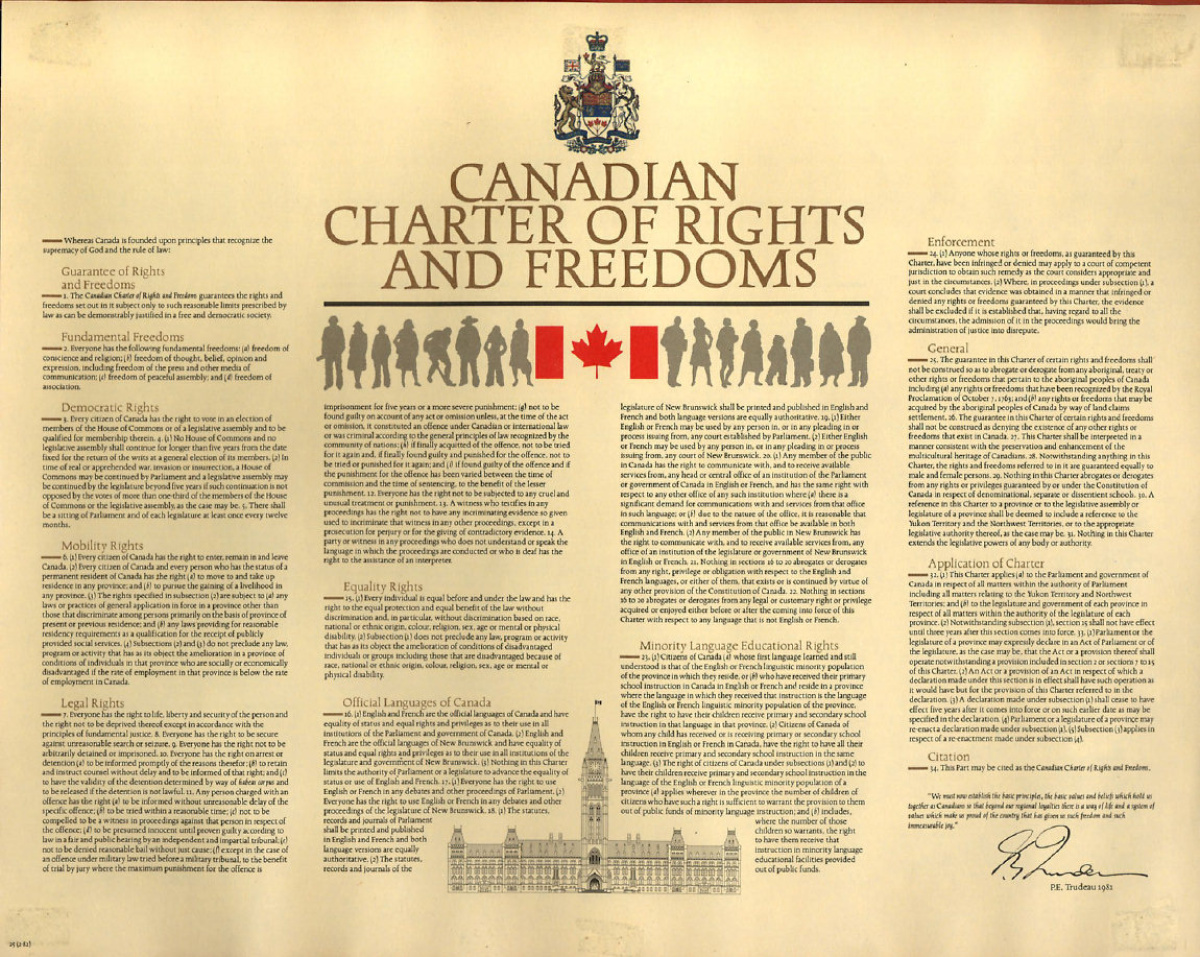
Governments of the over 600 First Nations bands and self-governing Indigenous communities across Canada have been given the green light by the Supreme Court to, in their laws, legally abrogate and override the civil liberties of their band members and citizens.
In its Dickson v. Vuntut Gwitchin First Nation decision the Court ruled that so long as an Indigenous government law “protects Indigenous difference — understood by the collective as interests connected to Aboriginal cultural difference, Aboriginal prior occupancy, Aboriginal prior sovereignty or Aboriginal participation in the treaty process” — then, despite the fact that the law infringes the Charter rights of its citizens, those Charter rights cannot have any application or be given any effect to.
Four of the seven Judges who ruled on the case ruled that the Canadian Charter of Rights and Freedoms prima facie applies to Indigenous government laws, but notwithstanding that, if the law is to “protect Indigenous difference”, and the exercise of a Charter right would have the effect of diminishing that “Indigenous difference”, then section 25 of the Constitution Act “shields” the law from Charter application.
A fifth Judge ruled that section 25 meant that the Charter didn’t apply at all to Indigenous government laws, not even prima facie.
Two of the seven judges dissented, one of whom very significantly was Madame Justice O’Bonsawin, the Indigenous person appointed to the Supreme Court supposedly to import an “Indigenous perspective” into its judgments. These two dissenting Justices wrote correctly that the majority opinion creates “Charter-free zones” in Canada. They further wrote:
Minorities with Indigenous communities (will) not be protected from the actions of their own governments. All Canadians, including Indigenous people, need constitutional tools to hold their governments accountable for breaches of their entrenched rights and freedoms. It is against the purposes of the Charter and s. 25, as well as being profoundly inequitable, to deny members of self-governing Indigenous nations similar, rights, remedies and recourse.
There are more than 1.8 million Indigenous Canadians, two-thirds of whom live “off-reserve” in Canada’s towns and cities. The Supreme Court of Canada has deprived all these Canadians of the protections afforded by the Charter of Rights and Freedoms on their home reserves and territories.
The Court employed cloud castle reasoning to bring about this illiberal and un-Canadian result, heavy on empty verbal assertions and abstractions with little relation to practical life.
Cloud castles are pleasant and charming to conjure up, even more so because they have no foundations.
The factual foundations of the Court’s decision, such as they, like those of cloud castles, are mainly imaginary. To the extent that may exist in reality, they are wrong.
In an earlier article the writer wrote on this case Cindy Dickson discussed the discriminatory, black sheep treatment she faced when trying to run for office in Vuntut Gwitchin.
The article pointed out other negative, First Nations realities ignored by the majority of the Supreme Court of Canada in its judgement: the “banana republic” nature of small Indigenous governments, and alpha-type band chiefs and councils — “colonizers of their own people” — overseeing a conflicted, family-based system of self-dealing and crony capitalism.
Indigenous Justice O’Bonsawin, as part of her “Indigenous perspective”, expressly acknowledged these entrenched negatives and listed other illiberal aspects of the “Indigenous difference” that the Charter exists to prevent or remedy: the unequal role given men in debating constitutional reforms, band membership rules that excluded some women and their children, election codes that prevent individuals from running for office on the basis of their gender, marital status or sexual orientation, and warrantless searches of homes.
QotD: Entitlement politics
Janice Rogers Brown, Speech at McGeorge School of Law, 1997-11-21.
Comments Off on QotD: Entitlement politics
April 28, 2024
How Britain got out of the Great Depression (and no, it wasn’t WW2)
Tim Worstall, in refuting something being pushed by Willie Hutton, explains how the British government escaped from the Great Depression and set off a nice little boom in the mid- to late-1930s:
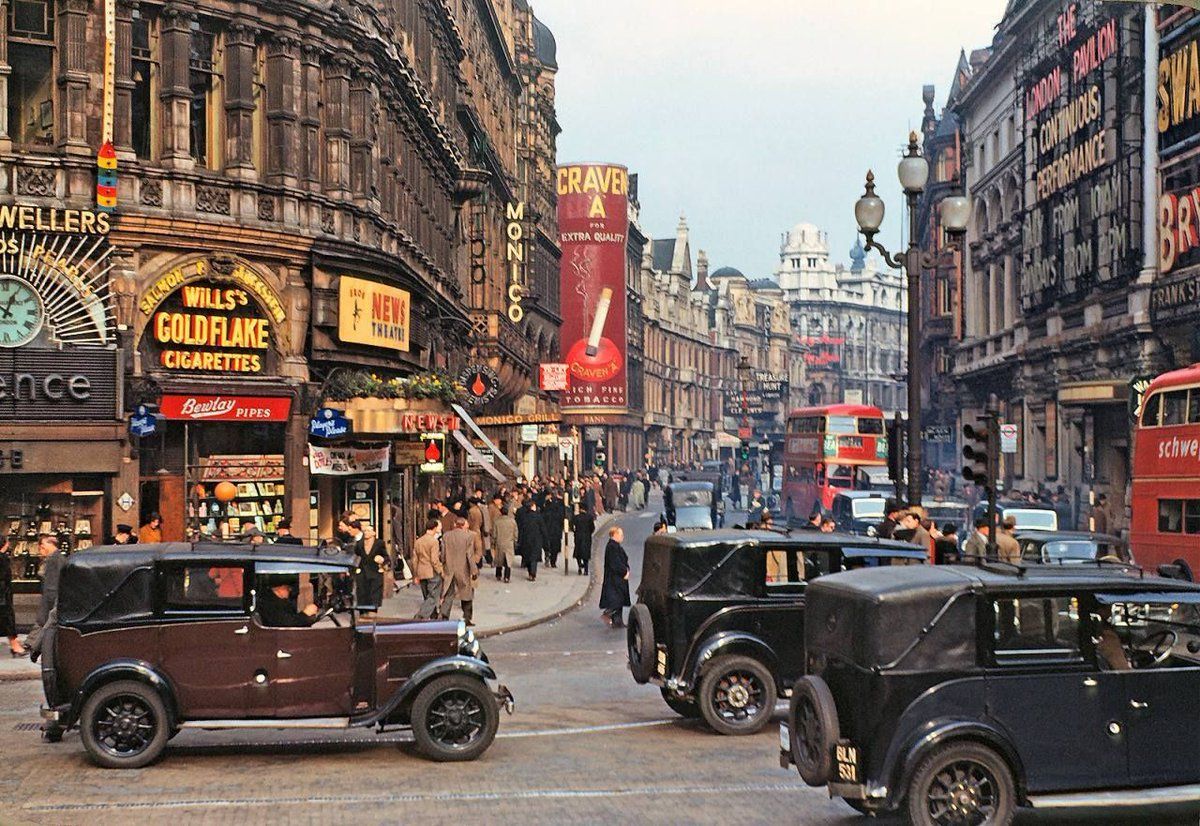
Piccadilly Circus in London, mid-1930s.
Colourized photo via Reddit.
Well, yes. Except that’s not actually what did drag Britain out of the Depression. What did was expansionary fiscal austerity. You know, that thing the Tories talked of in 2010 and which everyone laughed at? Somewhat annoyingly I was one of the very few (it’s annoying because I was clearly right in what I was saying) who pointed this out back then.
When we boil this right down it’s an argument about the effectiveness of monetary policy. Absolutely no one thinks that it has no effect. But there’s many who think that it has no effect at the zero lower bound: when interest rates are zero. That’s really the argument that leads to fiscal policy, that idea that government might tax less, or spend more, blow out that deficit and get the economy moving again. We’ve done all we could with monetary policy and we’ve still got to do something so here’s fiscal policy.
To put it as simply as possible. We’ve two major macroeconomic tools, monetary policy and fiscal. The first is interest rates, exchange rates and money printing and so on. The second is the difference between taxes collected and money spent by government — the government deficit or surplus (note, please, for purists, this is being very simple).
OK, either lever or tool can be used to loosen conditions — gee stuff up — or tighten them. Which we use when is somewhere between a matter of taste and necessarily correct given the circumstances. But clearly the total amount of geeing up out of a recession — or tightening to prevent inflation — or depression is the combination of the two sets of policies, applications of levers and tools.
It’s thus theoretically possible to tighten with one, loosen with the other and gain, overall, either tightening or loosening. Depends upon how much of each you do.
Britain in the 30s tightened fiscal policy. The opposite of what the Keynesians said, the opposite of what the US did and so on. Cut — no, really cut, not just slowed the increase in — government spending and thereby cut the government deficit (might, actually, have gone into surplus, not sure). This is, according to the Keynesian line, something that should make the recession/depression worse.
But at the same time they came off the gold standard — Churchill had taken us back in in 1925 at far too high a rate — and lowered interest rates. That’s a loosening of monetary policy.
As it happens, on balance, the monetary was loosened more than the fiscal was tightened and so we have expansionary fiscal austerity. Which set off a very nice little boom in fact. The mid- to late- 30s in Britain were economic good times. Driven, nicely driven, by a housebuilding boom — the last time the private sector built 300 k houses a year in fact (this is before the Town and Country Planning Act stopped all that). Mixed in was that the motor car was becoming a fairly standard bourgeois item and so housing spread out along the roads.
Comments Off on How Britain got out of the Great Depression (and no, it wasn’t WW2)
QotD: “I love Big Brother!”
I don’t relish the Winston Smith role. I’ll just pass on the rats in Room 101 and skip right to the mindless, thoughtless bliss of Big Brotherly love without having to have it beaten into me.
Actually, it seems that Orwell was mistaken. Oppression does not have to mean dismal living conditions, horrible food, telescreen propaganda and rusty rationed razor blades. Big government can control people far more effectively by giving them a small slice of comfort and domesticity. Allow them a modest home. Encourage them to accumulate trinkets and toys and the occasional status symbol. Allow commercial marketing to develop the propaganda that shapes opinion and mood and sets people on the desired path.
Commercial marketing is far more effective than state propaganda — “Drivers Wanted” has recruited more people than any poster featuring a stern and serious Uncle Sam. Keep them somewhat comfortable, keep them acquisitive rather than inquisitive, keep them entertained rather than informed — and no-one will be seriously tempted to pursue an alternative.
Jonathan Piasecki, private e-mail, 1999-07-07 (originally published, with permission, on the old blog, 2005-06-24).
Comments Off on QotD: “I love Big Brother!”
April 27, 2024
“… when it comes to energy policy Germany is an undisputed champion of crazy”
eugyppius explains how Angela Merkel’s government reacted to the Japanese Fukushima disaster in a sane, measured, and sensible way … naw, I’m pulling your leg. They looked at all the options and then selected the dumbest possible reaction available to them:

German anti-nuclear protest in Cologne, 26 March 2011.
Photo by Bündnis 90/Die Grünen Nordrhein-Westfalen via Wikimedia Commons.
All of our countries are crazy in various ways, but when it comes to energy policy Germany is an undisputed champion of crazy.
In 2011, a tsunami caused the Fukushima nuclear disaster. If you check a map, you’ll notice that Fukushima is in a country called Japan, which it turns out is a different country from Germany. The Fukushima disaster had zero to do with the Federal Republic, but then-Chancellor Angela Merkel felt the need to solve the problem of Fukushima by phasing out nuclear power in Germany, even though tsunamis and earthquakes are not a problem in Germany, because Germany is a country in Central Europe and not an island nation in Asia.
That is crazy enough, but it gets much crazier. Months before announcing the nuclear phase-out, Merkel’s government had passed energy transition legislation to secure Germany’s path towards a zero-emissions future. We resolved to ditch our most significant source of emissions-free power, in other words, just months after resolving an energy transition to emissions-free power. At this point you would be justified in wondering if Germany suffers from some kind of shamanistic cultural phobia of electricity in general, that is how crazy this is. These insane choices had the near-term consequence of increasing our dependence on Russian natural gas. Otherwise, they ensured that power generation in Germany would be vastly more expensive than necessary and also vastly more carbon intensive than necessary.
Now, crazy demands explanations, and observers have proposed various theories for the German climate nuclear crazy. Two of them deserve mention here:
1) The 1968 generation in Germany suffered from unusual radicalism, sharpened by moral anxiety over National Socialism, and resolved to outcompete all others in the project of self-abnegating virtue. Our culture developed a deranged anti-nuclear movement that in a fit of typical German thoroughness also came to embrace opposition to nuclear power. The Chernobyl disaster radicalised the pink-haired anti-nuclearists still further, and these cretins grew up to become news anchors, school teachers and book authors, effectively indoctrinating the next generation according to their parareligious delusions.
2) German politicians after the Cold War – especially Gerhard Schröder and Angela Merkel – harboured a subtle and not entirely unreasonable desire to strengthen ties with resource-rich Russia. They decided that the anti-nuclearists and the Green Party could be instrumentalised towards this end. The energy transition and the nuclear phase-out increased our dependence on Russian gas, and this was a feature more than it was a bug.
These are mutually supporting theories, but I don’t think either of them can fully account for the bizarre phenomenon before us. Germany energy crazy is a very deep problem and it will keep historians busy for many generations.
In 2022, Russia invaded Ukraine, and Germany under Merkel’s successor, Chancellor Olaf Scholz, decided along with the rest of the liberal West that Russia was bad, bad, bad and that evil Putin had to be punished with self-immolating sanctions, sanctions, sanctions. This new spasm of high-minded moralising further attenuated our energy situation, ushering in an entirely self-made energy crisis. The Greens, now in government, were determined to proceed with the last stages of the nuclear phase-out, even with our natural gas supplies in doubt. Only when they saw themselves staring into the abyss of political doom did they grudgingly agree to give our last nuclear plants a three-and-a-half month lease on life. We Germans and our energy policy had out-crazied everyone else, we had made ourselves the laughing stock of the entire world, that is how crazy we were.
Comments Off on “… when it comes to energy policy Germany is an undisputed champion of crazy”
April 26, 2024
Economic inefficiencies in the water market? Don’t worry, here’s the government to make it much worse
Tim Worstall discusses the economics of water markets in the US … that Senator Elizabeth Warren and Representative Ro Khanna seem determined to make far less efficient if their plans come to fruition:

Senator Elizabeth Warren speaking at the Iowa Democrats Hall of Fame Celebration in Cedar Rapids, Iowa, on 9 June, 2019.
Photo by Lorie Shaull via Wikimedia Commons.
Aficionados for truly stupid political interventions into matters economic will already be aware of the idiocies perpetrated by Senator Elizabeth Warren and Representative Ro Khanna. The two seem to end up as if someone rolled together the ideas of Professor Richard J Murphy and The Guardian opinion page then removed all the insight, subtlety and sensibility. True, not an arduous task removing those three but …
The basic water problem out in the Western US is that the wrong people currently own the water rights. We would therefore like to see more trade in those rights. Warren and Khanna are insisting upon further limitations upon the trade in those rights. This is rampant idiocy.
To set the scene, as folk moved out there they realised that water was not one of those things in great surplus in the area. So, those who got there first made sure that the property rights to the water were assigned to them. Nothing odd about this and rights to a scarce resource do need to be allocated. Otherwise we just end up with the commons problem and the resource is exhausted.
OK. And, y’know, quite a lot of things have changed in the century, century and a half since that Wild West was properly populated. But the descendants of those original farmers still own near all the water rights. Hmm, bit of a problem.
That’s OK, we’ve Coase to advise us here:
Ronald Coase (1960), “The Problem of Social Cost”
In the absence of transaction costs, if property rights are well-defined and tradable, voluntary negotiations will lead to efficiency.
It doesn’t matter how rights are allocated initially …
… because if they’re allocated inefficiently at first, they can always be sold/traded …
so the allocation will end up efficient anyway
Now, the distribution — who gets the cash from all of that — is dependent upon that first distribution. But that’s a minor problem compared to the efficient use of water.
So, we want lots of buying and selling. The idiots using $300 of irrigation water to grow $100 worth of alfalfa (pretty much my first English-world piece was on exactly this subject, near 30 years back) can instead sell that same acre-foot to a city, where the two households will happily each pay $500 a year for the half an acre-foot they require.
The asset — the water — has moved from a lower valued (actually, value destructive) use to a higher, the world is richer in aggregate. It doesn’t matter that the farmers get the money because Grandpappy shot all the Injuns. Even without the who gets the money we’re all richer — we’re getting $1k not $100 from the same acre-foot of water.
Coolio!
Enter Warren and Khanna:
With private investors poised to profit from water scarcity in the west, US senator Elizabeth Warren and representative Ro Khanna are pursuing a bill to prohibit the trading of water as a commodity.
Idiots. Damn fools. Politicians, but I repeat myself triply.
Now, do note they’re not trying to insist that water cannot be bought and sold — not because they don’t want to, they do, but because as Federal politicians they’ve no power whatever over within state markets. However, as Federal politicians they can claim power over commodity markets — the speculators will come from around the country, over state lines and interstate commerce is Federal.
So, as with onion futures, they want to ban water futures.
Comments Off on Economic inefficiencies in the water market? Don’t worry, here’s the government to make it much worse


