… Shaw is not at all the heretic his fascinated victims see him, but an orthodox Scotch Presbyterian of the most cock-sure and bilious sort. In the theory that he is Irish I take little stock. His very name is as Scotch as haggis, and the part of Ireland from which he comes is peopled almost entirely by Scots. The true Irishman is a romantic; he senses religion as a mystery, a thing of wonder, an experience of ineffable beauty; his interest centers, not in the commandments, but in the sacraments. The Scot, on the contrary, is almost devoid of that sort of religious feeling; he hasn’t imagination enough for it; all he can see in the Word of God is a sort of police regulation; his concern is not with beauty but with morals. Here Shaw runs true to type. Read his critical writings from end to end, and you will not find the slightest hint that objects of art were passing before him as he wrote. He founded, in England, the superstition that Ibsen was no more than a tin-pot evangelist — a sort of brother to General Booth, Mrs. Pankhurst, Mother Eddy and Billy Sunday. He turned Shakespeare into a prophet of evil, croaking dismally in a rain-barrel. He even injected a moral content (by dint of abominable straining) into the music dramas of Richard Wagner, surely the most colossal slaughters of all moral ideas on the altar of beauty ever seen by man. Always this ethical obsession, the hall-mark of the Scotch Puritan, is visible in him. He is forever discovering an atrocity in what has hitherto passed as no more than a human weakness; he is forever inventing new sins, and demanding their punishment; he always sees his opponent, not only as wrong, but also as a scoundrel. I have called him a good Presbyterian.
H.L. Mencken, “Shaw as Platitudinarian”, The Smart Set, 1916-08.
November 9, 2024
QotD: George Bernard Shaw
November 8, 2024
Highlights of Herculaneum (Part II)
Scenic Routes to the Past
Published Jul 12, 2024This second part of my survey of Herculaneum explores some of the site’s incredibly well-preserved houses.
(more…)
QotD: David Lloyd George and the British Liberal Party
Lloyd George was from nowhere. He grew up in Llanystumdwy, Caernarfonshire, where he lived in a compact cottage with his mother, uncle, and siblings, and was trained as a solicitor in Porthmadog. He rose to dominate British politics, and to direct the affairs of the most expansive empire the world had known, seeing off thousands of more privileged rivals, on the basis of truly exceptional native gifts, and without even speaking English as his first language.
How he got into the position to direct World War I is one of the most remarkable personal trajectories in British history. Contemporaries everywhere saw it as an astonishing story, even in the most advanced democracies. As the New York Times asked when Lloyd George visited America in 1923, “Was there ever a more romantic rise from the humblest beginning than this?”
The second reason why Lloyd George is fascinating is his extraordinary command of words. Collins is good on this. The book is full of speeches that turn tides and smash competitors. Lloyd George could exercise an equally mesmeric command over both the Commons and mass audiences, typically rather different skills. Harold Macmillan called him “the best parliamentary debater of his, or perhaps any, day”.
Biblical references and Welsh valleys suffused his speeches. As another American journalist put it, when Lloyd George was speaking, “none approaches him in witchery of word or wealth of imagery”, with his “almost flawless phraseology” communicated through a voice “like a silver bell that vibrates with emotion”. Leading an imperial democracy through a global war demanded rhetorical powers of the rarest kind. Asquith lacked them. That, amongst other reasons, is why Lloyd George was able to shunt him aside.
The last reason we should all be interested in Lloyd George — as readers will have anticipated — is that he was the last British politician to inter a governing party. His actions during the war split the Liberals into Pro-Asquith and pro-Lloyd George factions, and the government he led from 1916 until 1922 was propped up by the Conservatives. Though the Liberal split was partly healed in 1923, it was all over for the party as a governing force. By the time Lloyd George at last became leader of the Liberal Party (in the Commons) in 1924, he had only a rump of 40 MPs left to command.
By the 1920s, Lloyd George’s shifting ideologies could not easily accommodate the old party traditions or the new forces reshaping allegiances and identities in the aftermath of the war. In 1918 he described his political creed to George Riddell, the press magnate, as “Nationalist-Socialist”. The consequence was an unprecedented redrawing of the map of British party politics, producing the Labour/Conservative hegemony we have lived with ever since.
The rot had arguably begun to set in for the Liberals in the elections of 1910, when they lost their majority. Fourteen years later, in 1924, Lloyd George stepped up to the Commons leadership of an exhausted, defeated party, and neither he nor his successors could arrest the slide into irrelevance. […] The Liberals could not come back because they were left with no clothes of their own. What had once been distinctive lines on economics, religion, welfare, the constitution, foreign policy and even “progress” were either appropriated by their competitors or ceased to be politically relevant. The party’s history as the dominant political force of the last near-century was no proof against radical structural change.
Alex Middleton, “Snapshot of the PM who killed his party”, The Critic, 2024-08-01.
November 7, 2024
Kemi Badenoch portrayed by the left as “the most prominent member of white supremacy’s black collaborator class”
The left likes to think themselves the faction of racial equality, yet they often reveal themselves to be anything but when someone steps out of line (from their point of view) and chooses a different political worldview:
For centuries, Britain was ruled by an aristocracy. In recent decades, however, this concept has become rather passé, and we have been doing away with it — most recently with the vote to abolish hereditary peers in the House of Lords.
Yet, as the old guard fades, a new elite has taken its place. Inherited traits — particularly skin colour and sex — now grant special dispensations. Utterances that would be unthinkable for most are allowed, and positions incommensurate to talent are dispensed.
This is because the new aristocracy is flush, often through little toil of its own, with moral authority — a valuable currency wielded by what we might call the Patricians of Victimhood.
Their power rests on the idea that Britain is a fundamentally racist country, brimming with other nasty “isms” that can be contained only by them. To deny this is heresy — but to disprove it is a crime for which no punishment is too great.
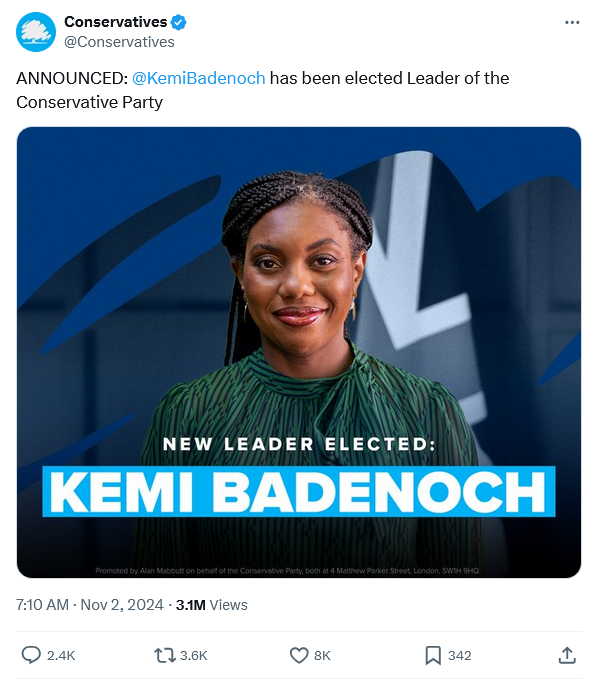
This was evident when Kemi Badenoch, a black woman, was elected Saturday to lead the Conservative Party. This historic first for Britain might have been expected to please those preoccupied with combating racism, perhaps even chalked up as a win.
Instead, Badenoch was lambasted by politicians who have built careers campaigning about racism. Dawn Butler, a Labour MP, shared a post accusing Badenoch of representing “white supremacy in blackface” — an insult so improbable that it conjures only an image of a face-painted Justin Trudeau.
The post, now removed from Butler’s X account, read: “Today the most prominent member of white supremacy’s black collaborator class (in Britain) is likely to be made leader of the Conservative Party. Here are some handy tips for surviving the immediate surge of Badenochism (i.e. white supremacy in blackface).”
Another Labour MP, Zara Sultana, said Badenoch was “one of the most nasty & divisive figures in British politics”, for, among other things, “downplaying racism”.
Badenoch is opposed to identity politics. She believes in meritocracy and that Britain — as she told her children recently — “is the best country in the world to be black”. Badenoch’s optimism is well founded: a 2023 World Values Survey found that Britain is indeed one of the least racist countries in the world.
Forgotten War Ep4 – Rise of the Chindits
HardThrasher
Published 4 Nov 2024Please consider donations of any size to the Burma Star Memorial Fund who aim to ensure remembrance of those who fought with, in and against 14th Army 1941–1945 — https://burmastarmemorial.org/
(more…)
Highlights of Herculaneum (Part I)
Scenic Routes to the Past
Published Jul 9, 2024An introduction to Herculaneum, buried and preserved by the eruption of Vesuvius in 79 AD. This video surveys the site and some of its public monuments. Part II explores Herculaneum’s incredibly well-preserved houses.
Check out my other channels, @toldinstone and @toldinstonefootnotes
November 6, 2024
The Korean War 020 – American Disaster at Unsan! – November 5, 1950
The Korean War by Indy Neidell
Published 5 Nov 2024American forces drive onwards, almost oblivious to the emerging Communist Chinese threat. At Unsan, an American regiment finds itself at the mercy of two Chinese divisions, who bear down on it from three sides. Getting out before being overrun will be no easy feat.
Chapters
01:18 Destruction of the 7th
03:41 Unsan Prelude
05:41 The Disaster at Unsan
10:47 Aftermath
13:31 Elsewhere
16:15 Summary
16:30 Conclusion
(more…)
QotD: “Colourism”
which reinforce the inherently colonial practice of “colourism” – the discrimination against individuals with a dark skin tone.
It’s not colonial, it’s classist. Dark skin means sun exposure. That is, someone who works for a living outside in the fields. Pale skin means someone rich enough to stay inside. Thus the bits in Jane Austem where the girls worry about their bonnets for they might get freckles.
This also changed, entirely, when work for poor people moved inside and only the rich could afford to get away for a tan. Suddenly, to have a tan – darker skin – became a mark of wealth, not poverty.
A change rather reflected in make up in fact, pre WWII (about, roughly) the aim was to powder or cream the face to be pale, pale, white. Post[-WWII] much foundation make up is to add colour, not take it away.
This also explains the popularity of sunbeds and fake tans, something which a century ago would have been quite literally unthinkable.
Colourism exists, most certainly, but that flip shows that it’s about class, not colonialism.
For the part about it that the colonialism reason cannot explain is why that flip.
That it’s about class also explains why colourism happens in places that never were colonies – Thailand say.
Tim Worstall, “Educashun”, Tim Worstall, 2020-01-12.
November 5, 2024
History of Ostia Antica: The Best Preserved Ancient Roman City in the World
Augustinian Thomist
Published Jul 4, 2024A 4k documentary and historical tour of the most well preserved ancient Roman city in the world filmed on site.
– Contents –
00:00 Introduction of Roman Ostia
01:10 Necropolis outside city gate
01:50 City gate
02:26 Early history of Ostia
04:41 Baths of Neptune
06:55 Theater of Ostia
12:10 House of the Infant Hercules
12:50 Square of Corporation Temple and Mosaics
21:21 Altar of Romulus and Remus
23:15 Four temple sanctuary
23:57 Temple of Pertinax
27:28 Grand Warehouse of Ostia
28:26 House of the Millstones
28:56 Ostia’s synagogues: Europe’s oldest synagogues
30:30 Ancient apartment buildings: House of the Paintings and House of the infant Bacchus
31:50 House of Jupiter and Ganymede
32:43 Ancient wine bar
34:50 House of Diana
36:25 Square of the Lares
37:45 Main Forum of Ostia, Temple of Jupiter
41:36 Baths of the Coachmen
(more…)
November 4, 2024
Cicero 101: Life, Death & Legacy
MoAn Inc.
Published 31 Oct 2024A Bit About MoAn Inc. — Trust me, the ancient world isn’t as boring as you may think. In this series, I’ll talk you through all things Cicero. I hope you guys enjoy this wonderful book as much as all us nerds do.
(more…)
November 3, 2024
Unholy Alliance topples Saxony – Rise of Hitler 05, May 1930
World War Two
Published 2 Nov 2024May 1930 brings political upheaval to the Weimar Republic, with the French deciding to leave the Rhineland, violent clashes between Communists and Nazis, and a surprising alliance that dissolves Saxony’s government. See how these events unfold and shape Germany’s current political landscape.
(more…)
Kemi Badenoch replaces Rishi Sunak as UK Conservative leader
In the National Post, Michael Murphy discusses the new British Tory leader and why she could be a viable challenger to Two-tier Keir’s Labour government:
… in July, the Tories were ousted by Labour after 14 years in power, limping on with only 121 seats in the 650 seat House of Commons. But the honeymoon period for Sir Keir Starmer’s Labour government ended almost immediately, as its popularity plummeted faster than that of any administration in recent memory. This has made the Tories interesting once again at precisely the moment when they’ve chosen a new leader: Kemi Badenoch.
The Nigerian-raised mother of three, elected today to lead the Conservative party, threatens to be kryptonite for a Labour party wedded to identity politics. A black, female immigrant at the dispatch box is apt to leave Labour frontbenchers — particularly Sir Keir, a one-time BLM kneeler — somewhat stumped. To make matters worse, Badenoch is a persuasive speaker, commanding a charisma and eloquence that Sir Keir — a dull, po-faced lawyer — does not possess.
These qualities have given Badenoch cross-party appeal within the Tories, rallying endorsements from both the left and right. By endorsing her, however, the party has effectively signed a blank cheque, as Badenoch, unlike her opponents, has made few specific pledges. She has chosen instead to reflect on the election loss and the party’s ideological roots; she is prepared to play the long game, hoping this will allow the Tories to “earn back trust”.
On some issues, though, Badenoch is clear. “The government is doing far too much and it is not doing any of it well — and it is growing and growing,” she declared recently. “The state is too big; we need to make sure there is more personal responsibility.” These ideas are common fare among Conservatives, especially in bloated welfare states like Britain — but her zeal for them evokes, for many, memories of Margaret Thatcher. As the political commentator Simon Heffer wrote, “Mrs Badenoch is the politician who most reminds me of Mrs Thatcher since I last saw Mrs Thatcher”. He noted both women’s hard-mindedness, “deep principles”, and grasp of the “art of the possible”.
Badenoch’s Conservatism can be traced, as the writer Tom Mctague has argued elsewhere, to her beginnings in Africa. Having fled Nigeria during a 1996 military coup, she has a keen, outsider’s appreciation for Britain’s core ideals — not least the rule of law and policing by consent. She is therefore a champion of Britain, of both “the good” and “bad” of its former empire, at a time when it is fashionable to denigrate it, precisely because of her first hand experience that these norms are rare and fragile.
Like Thatcher, Badenoch studied a hard science (computing), marking them out in a Parliament filled with lawyers and humanities graduates. And the swift rise of both women, from modest beginnings through the ranks of the Conservative party, suggests that the “art of the possible” is indeed etched into their stars.
The Armchair General has a few suggestions for Badenoch’s agenda to turn the British economy around:

The new leader of the Conservative Party (image: www.kemibadenoch.org.uk)
My one reservation [about Badenoch] was that, being a software engineer, instead of espousing liberty or slashing laws and regulations, Kemi might reach for more tinkering technocratic solutions — and your humble General is surely not alone in his opinion that we have had quite enough, thank you, of technocratic governments.
However, the more that I consider the severe problems that afflict this country, the more I believe that a process-driven leader, who can focus on the details, might make the biggest difference in the short to medium term.
The immigration issue
As we know, uncontrolled immigration has seized the public imagination greatly — and, indeed, Jenrick centred his campaign around leaving the European Convention on Human Rights (ECHR). We should almost certainly do this anyway — simply because, like the Americans, we should refuse to sign any treaties that raises foreign courts above our own Parliament.
But leaving that aside, the stated problems with mass immigration can largely be divided into two halves:
- cultural differences — these are not insignificant, and it is claimed that they lead to an increase in crime (especially sexual crimes) and an undermining of our high-trust society;
- economic issues — the evidence shows that a massive net influx of low-skilled immigrants depresses wages at the lower end, puts a strain on public services (which cannot expand swiftly enough to accommodate the increase in demand), raises the demand for houses (of which there is a shortage) and thus pushes up prices, and, ultimately, only increases nominal GDP whilst per capita GDP has barely shifted in a decade and a half.
For the purposes of this post, I shall address only the latter issue; given where we are right now, the former is a much thornier problem — at least politically — and probably cannot be solved without radical (and some might say “authoritarian”) action.
The second problem is easier to solve because it is caused, essentially, by the single biggest drag on our economy — our planning system.
[…]
Planning: the Conservatives’ political agenda
The core of the new Conservative manifesto must be a growth agenda; it needs to set out the following core principles:
- if we carry on the current trajectory, the British government will be effectively bankrupt in the next 50 years — so something needs to change;
- therefore, in order to pay for all the goodies that we have promised ourselves (now and in the future), we need to massively accelerate economic growth;
- unless we can build the roads, railways, power stations, research labs, data centres, and homes that we need, then our economy will not grow at the required rate — and spending will need to be cut to the bone;
- given the above, the only way to grow is to reform planning laws;
- removing the barriers to building will lead to greater investment, lower energy prices (leading to even greater investment), greater social mobility, regeneration of all the regions (so-called “levelling up”), and vast increases in per capita GDP;
- where the state invests in infrastructure, then it will cost considerably less than it does currently — meaning that not only will those projects undertaken provide more value for money, but also that many more projects will be viable;
- this prosperity and increased mobility will remove even the perceived need for immigrants to perform low-wage jobs (including in our public services), and remove the economic pressures of those that we have already taken in;1
- if we do it right, then we will also be able to cut taxes without drastically cutting the size of the state.2
The argument needs to be as stark and inevitable as that.
What this means is that the Conservatives need not stand on a platform of slashing state spending — thus addressing the huge numbers of people in this country who, incredibly, still believe in the benevolent state.
Except for one caveat, there really is no downside to adopting Foundations [discussed here], in full, as the core of the next Conservative manifesto (although it should not be the full extent of said manifesto — there are many other areas that need to be addressed, which I shall write about later).
1. As I say, the cultural issues are for another time.
2. Obviously, as a classical liberal, I believe that the size of the state should be drastically cut — but this is not a popular argument in a country that has been raised and educated on socialist doctrine for decades.
Ancient Sparta Historian Breaks Down 300 Movie | Deep Dives
History Hit
Published Jul 8, 2024Ancient Greek historian Roel Konijnendijk takes a deep dive into the historical accuracy of one of the most iconic and ridiculous depictions of the Spartans – 300 (2006).
00:00 Introduction
00:33 Spartan Society and Customs
02:34 Xerxes’ Messenger
06:56 The Ephors, the Oracle and the Carneia
10:30 The 300
15:39 The Persian Fleet
16:14 Thermopylae, the “Hot Gates”
17:17 Spartan Battle Technique
19:12 The Persian Army
24:42 Xerxes
28:28 Ephialtes
32:01 Dilios – Why Did the Spartans Stay?
34:18 The Final Stand
38:44 Aftermath of Thermopylae and Delios
40:53 Movie Quotes: Fact or Fiction?
(more…)
November 2, 2024
The Short SA.4 Sperrin; Britain’s Back-Up, Back-up Nuclear Bomber
Ed Nash’s Military Matters
Published Jul 9, 2024No, I have no idea how you pronounce “Gyron”.
November 1, 2024
“[H]er plan will mean the obliteration of your savings, the end of banks and even the destruction of ‘money as we know it'”
It’s astonishing how many highly placed bureaucrats, NGO functionaries, and the very, very wealthy are super gung-ho for reducing the rest of us to the status (and living conditions) of medieval serfs:



This week, VW announced plans to cut tens of thousands of jobs and to close three factories. That is a very big deal, because they have never closed a single German factory before. I try to avoid economic topics, but this story is so much bigger than economics. As Daniel Gräber wrote in Cicero last month, “the VW crisis has become a symbol for the decline of our entire country“.
The Green leftoid establishment are eagerly blaming management for these failures, which is on the one hand not entirely wrong, but on the other hand not nearly an absolution. The German state of Lower Saxony holds a 20% stake in Volkswagen, and so they also manage the company. Recently, in a fit of virtue, they placed a Green politician – Julia Willie Hamburg – on its supervisory board. Hamburg does not even own a car and has used her position to argue that Volkswagen should regard itself not as an automobile manufacturer but as a “mobility services provider” and shift its focus away from “individual transport”.
The absurdly named Julia Willie Hamburg is merely symptomatic of a broader phenomenon. Germany has succumbed to political forces that have nothing but indifference and disdain for the industries that have made us prosperous. Our sitting Economics Minister, Robert Habeck, gave an interview to taz in 2011 in which he said that “fewer cars will not lead to less economic growth, but to new industries”, and attacked “the old growth theory, based on gross domestic product“. And behind Green politicians like Habeck are even more radical forces, like Ulrike Herrmann, the editor of taz, for many years a member of the Green Party and also an open advocate of wide-scale deindustrialisation. Because I am going to quote Herrmann saying some very crazy things, you need to know that she is in no way a fringe figure. She appears regularly on all the respectable evening talkshows and every politically informed person in the Federal Republic knows who she is.
Herrmann has outlined her political views in various books like The End of Capitalism: Why Growth and Climate Protection Are Not Compatible – and How We Will Live in the Future. From these monographs, we learn that Herrmann sees climatism as a means of imposing a centrally planned economy in which we will own nothing and be happy. Happily, Herrmann also talks a lot, and in her various speeches and interviews she states her vision for decarbonising Germany in very radical terms. I am grateful to this twitter user for highlighting typical remarks that Herrmann delivered in April of this year before a sympathetic audience of climate lunatics.
There, Herrmann elaborated on her vision for a future economy in which all major goods would have to be rationed:
Talking about rationing: It’s clear that if we shrink economically, we won’t have to be as poor as the British were in 1939; rather, we’d have to be as rich as the West Germans were in 1978. That is a huge difference, because we can take advantage of all the growth of the post-war period and the entire economic miracle.
The central elements of the economy would have to be rationed. First of all, living space, because cement emits endless amounts of CO2. Actually, new construction would have to be banned outright and living space rationed to 50 square metres per capita. That should actually be enough for everyone. Then meat would have to be rationed, because meat production emits enormous amounts of CO2. You don’t have to become a vegetarian, but you’ll have to eat a lot less meat.
Then train travel has to be rationed. So this idea, which many people also have – “so okay then I don’t have a car but then I always travel on the Intercity Express trains” – that won’t work either, because of course air resistance increases with speed. Yes, it’s all totally insane. Trains won’t be allowed to travel faster than 100 kilometres per hour, but you can still travel around locally quite a lot. This is all in my book, okay? But I didn’t expand on it there because I didn’t want to scare all the readers.
At this point Herrmann begins to cackle manically, ecstatic at the thought that millions of Germans will be stuck riding rationed kilometres on slow local public transit.