
World War Two
Published 14 Nov 2024Millions of Germans continue to be expelled from their homes in Central and Eastern Europe. They run a gauntlet of violence, robbery, and even murder before arriving in the shattered remains of Berlin. By the end of 1945, the Allied Powers have at least agreed that further expulsions must be “orderly and humane”. But isn’t that a contradiction in terms?
(more…)
November 15, 2024
The Final Solution to the German Question
Comments Off on The Final Solution to the German Question
QotD: Battles are over-rated
Take another look at the conventional narrative. Almost every key event involves a battle, a period of time in a relatively localized area where combatants slugged it out to see who would occupy some bit of land or sea. To [How the War Was Won author Phillips Payson] O’Brien, this focus is silly, a relic of long-ago wars in ages with far less industrial capacity.
Start with theory. States fight to impose their will on another state in pursuit of some political goal. To do that requires that they achieve sufficient local military superiority that the other state can’t stop them from achieving their political goal.
Nazi Germany wanted to be the new administrators of the agricultural area of the western Soviet Union. To do that, they had to evict the Soviet military, whether through direct destruction or forcing the Soviet government to withdraw their armed forces. Individual battles for control of a localized area only matter if they are a means to that end.
Does the occupation or non-occupation of that point on the map affect the ability of a combatant to keep fighting?
In some limited cases, yes. Battlefield victory enabled Germany to overrun France before France could really focus its productive effort on the war. After their surrender, the French could not produce weapons, and they functionally could not organize their manpower to fight the Germans. But if the German army conquered, say, a random city in the Soviet Union, like Stalingrad, Soviet production and manpower was barely affected. The war goes on.
In theory, the German army could destroy so much of the Soviet military in one battle (or even a few discrete battles) that the Soviets run out of men or weapons. If there was ever a time this could have happened, it would have been the German invasion of the Soviet Union in 1941, when the Germans basically won a series of crushing victories.
The problem for the Germans was that by World War II, people in the combatant countries were good at building stuff in vast quantities, and the major combatants of World War II generally had access to sufficient natural resources. Even massive armies could not destroy produced weapons systems (e.g., tanks, airplanes) on the battlefield fast enough to remove the other side’s ability to continue fighting. What could (and did) happen was the destruction of the other side’s ability to produce and distribute weapons.
Sure enough, if you look at the actual data from even the largest battles, neither side really destroys a hugely significant amount of stuff. Take the Battle of Kursk — the largest tank and air battle of World War II. Wikipedia will dazzle you with the numbers of soldiers involved (millions), tanks deployed (in the ballpark of 10,000), and aircraft in the sky (in the ballpark of 5,000).
In this entire vast battle that supposedly dictated the outcome of the Eastern Front, the Germans lost approximately 350 armored fighting vehicles (AFVs) during the most intense 10 days of fighting. In the two months around when the battle took place, the Germans lost 1,331 AFVs on the entire Eastern Front. In the year of the battle, 1943, the Germans built more than 12,000 AFVs. Also worth noting: they disproportionately lost older, obsolete tanks at Kursk, and built new, capable tanks. The Germans lost a very manageable amount of equipment at Kursk — less than a month’s worth of AFV production.
If modern war means you cannot realistically destroy enough weapons in one battle to matter — if the largest battle of all time didn’t really matter — what did?
Anonymous, “Your Book Review: How the War Was Won“, Astral Codex Ten, 2024-08-09.
Comments Off on QotD: Battles are over-rated
November 14, 2024
Germans are perfectly free to post anything to the internet as long as it doesn’t criticize politicians
Once again, eugyppius helpfully illustrates the broad range of freedoms German citizens enjoy in their online activities and the totally reasonable and not-at-all-insane restrictions to those rights:



It’s been a while since I last wrote about the highly advanced democratic freedoms that we enjoy in Germany. Here in the Federal Republic, the police will never fine you or harass you or raid your house for criticising the government – except, of course, when they do all of these things, because you happened not even to tweet, but merely to retweet, the wrong image.
Stefan Niehoff is a 64 year-old retiree who lives in the small town of Burgpreppach in Lower Franconia. He runs an X account with 1,200 followers, where he occasionally expresses his dissatisfaction with the present state of German politics and with the Greens in particular.
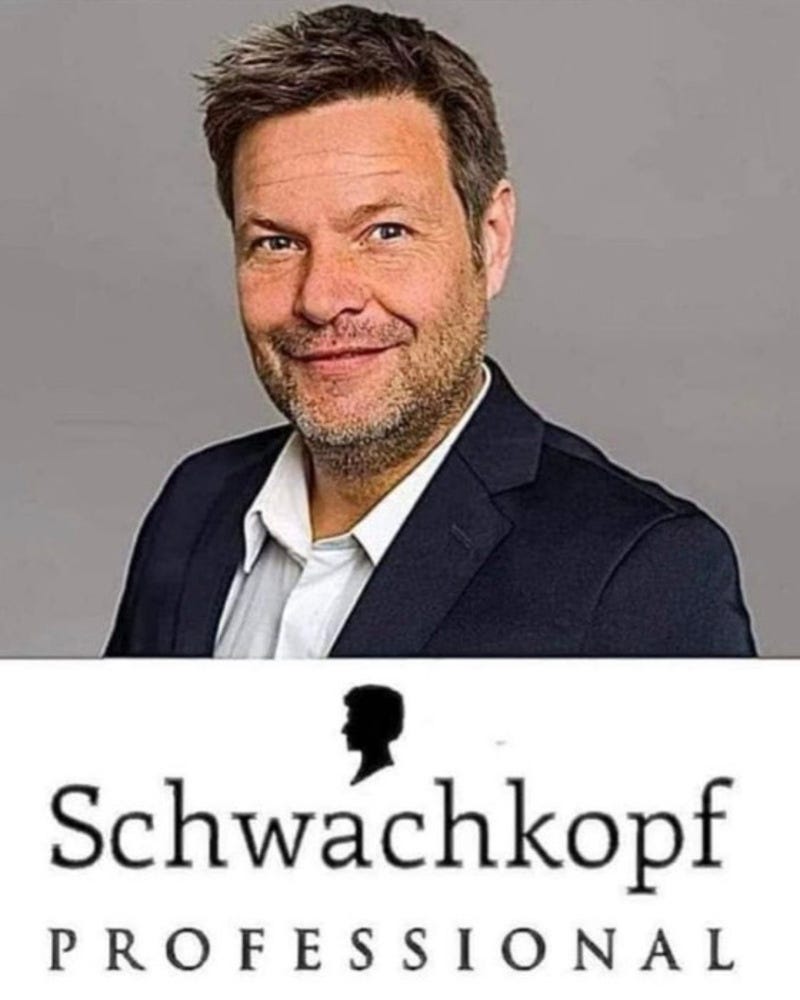
In June 2024, he retweeted this image …
… which appropriates the logo of a popular cosmetic brand to suggest that Robert Habeck, our Green Minister of Economic Affairs, might be a “professional moron”.
Habeck and his associates are notorious for pursuing internet users who share highly illegal content of this nature. They brought Niehoff’s retweet to the attention of authorities, and the Bamberg public prosecutor’s office decided that Niehoff was indeed guilty of a criminal speech offence. The Bamberg District Court then issued an order permitting the police to search Niehoff’s residence and confiscate his electronic devices.
In this order, reproduced by NiUS, the judges explained their rationale as follows:
On the basis of the investigations to date – in particular the screenshots of the posts and the investigations into the user of the X-account “IchbinFeinet” – there exists the following suspicion of a criminal offence:
The accused is the user of the account “IchbinFeinet” on the internet platform X with approx. 901 followers.
At a time that cannot now be determined more precisely, in the days or weeks before 20 June 2024, the accused published an image file using his account that showed a portrait of the Federal Minister of Economic Affairs with the words “professional moron” … in order to defame Robert Habeck in general and to make his work as a member of the federal government more difficult.
The public prosecutor’s office affirms the public interest in criminal prosecution.
This is punishable as defamation directed against persons of political life in accordance with §§ 185, 188 para. 1, 194 StGB. …
The measures ordered are proportionate to the severity of the offence and the strength of the suspicion and are necessary for the investigation …
Armed with this document, Schweinfurt police showed up at Niehoff’s house at 6:14am yesterday morning and took his tablet. Police later told the press that the raid was one in a series of enforcement actions – part of something called “an action day against cybercrime”. By harassing a lot of cybercriminals all at once, police and prosecutors hope to send a message to the people of Germany that they cannot just retweet anything, and that they may only retweet the right things.
Comments Off on Germans are perfectly free to post anything to the internet as long as it doesn’t criticize politicians
Trump’s position and likely options on Ukraine
In his weekly commentary, Niccolo Soldo considers what the incoming Trump administration might do about the war in Ukraine:
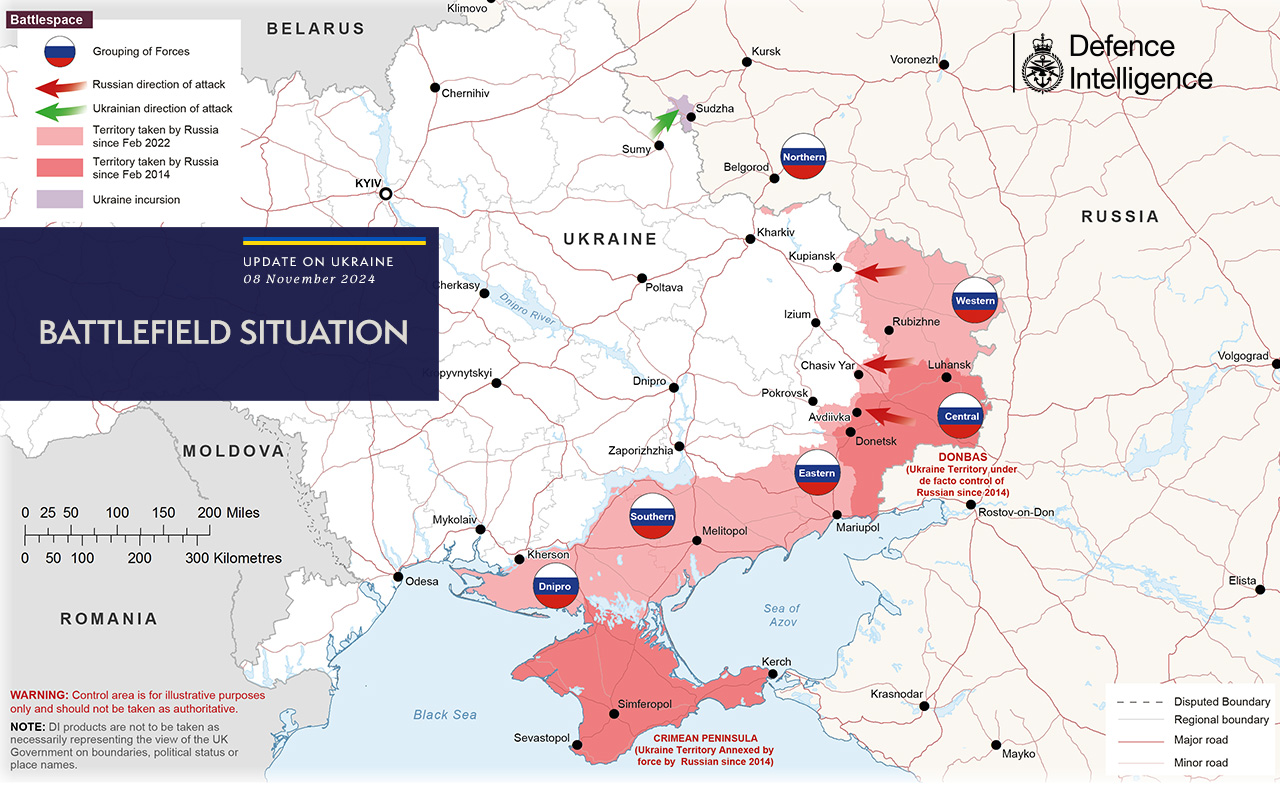
The situation in Ukraine as of 8 November, 2024.
Map from the UK Ministry of Defence via X.
… Ukraine is losing the war, and is losing it at a faster pace than before. Time is not on Kiev’s side, and there is no magic wand that anyone can wave to turn the tide in its favour. The question is: how much is Kiev willing to give up in order to save as much as it can?
The foreign policy blob is on tenterhooks, waiting to see what Trump will do regarding this conflict:
Like in Trump’s first term, different factions are set to compete to influence the Republican’s foreign policy. More traditionally minded allies such as Mike Pompeo, the former secretary of state now in contention to lead the Pentagon, are likely to push for a settlement that doesn’t appear to give a major win to Moscow. Other advisers, particularly Richard Grenell, a top candidate to lead the State Department or serve as national-security adviser, could give priority to Trump’s desire to end the war as soon as possible, even if it means forcing Kyiv into significant concessions.
Pompeo is out, but that doesn’t mean that those like him are entirely out either, as he has DoD officials sharing his views. No doubt that there are certain elements in the State Department, CIA, and in Congress as well who take the same position.
The proposals all break from Biden’s approach of letting Kyiv dictate when peace talks should begin. Instead, they uniformly recommend freezing the war in place — cementing Russia’s seizure of roughly 20% of Ukraine — and forcing Ukraine to temporarily suspend its quest to join the North Atlantic Treaty Organization.
One idea proposed inside Trump’s transition office, detailed by three people close to the president-elect and not previously reported, would involve Kyiv promising not to join NATO for at least 20 years. In exchange, the U.S. would continue to pump Ukraine full of weapons to deter a future Russian attack.
Under that plan, the front line would essentially lock in place and both sides would agree to an 800-mile demilitarized zone. Who would police that territory remains unclear, but one adviser said the peacekeeping force wouldn’t involve American troops, nor come from a U.S.-funded international body, such as the United Nations.
“We can do training and other support but the barrel of the gun is going to be European,” a member of Trump’s team said. “We are not sending American men and women to uphold peace in Ukraine. And we are not paying for it. Get the Poles, Germans, British and French to do it.”
“Pumping” Ukraine full of weapons would be attractive to Trump, as it means steady cash flow. He is a businessman after all.
The last bit is the most important, as it conforms to US policy trends in which the dumpster fire that they started is left to the Europeans to extinguish while the Americans go deal with the Chinese.
That proposal in some respects echoes comments made by Vice President-elect JD Vance during a September interview, when he suggested a final agreement between Ukraine and Russia could involve a demilitarized zone “heavily fortified so the Russians don’t invade again.” Russia, Vance continued, would get to keep the land it has taken and be assured of Ukraine’s neutrality.
“It doesn’t join NATO, it doesn’t join some of these sort of allied institutions,” he said on “The Shawn Ryan Show,” a podcast.
“No NATO, no stealth NATO”, is music to Moscow’s ears. The problem here is that the Russians do not trust the Americans to keep up their end of any deal. Russian Foreign Minister Lavrov has famously described the Americans as “agreement non-capable”.
Also, why would the Russians even agree to negotiate at this point?
For one, Ukraine and Russia still have vastly differing war aims and little desire to alter them. With Russian troops advancing slowly but steadily in Ukraine, the Kremlin has shown little inclination to negotiate, and has shown its willingness to escalate the conflict with hybrid attacks outside its borders, such as sabotage operations in Europe.
“The objectives of the special military operation remain unchanged and will be achieved,” Dmitry Medvedev, a top Russian official, posted Wednesday to X after learning of Trump’s victory over Vice President Kamala Harris, the Democratic presidential nominee.
Zelensky is over a barrel:
Zelensky, whose country is heavily dependent on the U.S. for military and financial assistance, could — more easily than Putin — be forced by Trump to negotiate, but the Ukrainian leader would have to contend with a public that views ceding territory as capitulation to Moscow.
Trump has said that Ukraine’s survival is important to the U.S., but has repeatedly criticized Zelensky, calling him the “greatest salesman”, a stance that has worried some officials in Kyiv that a Trump-led U.S. might push for a settlement that favors Russia.
Zelensky on Wednesday congratulated the president-elect on his victory, appealing to their September meeting in New York and praising his “‘peace through strength’ approach in global affairs”.
Forcing Zelensky to concede land would open up the possibility of a coup d’etat in Kiev, and even civil war. Even if a deal were hammered out, Zelensky would be forced to try to sell it at home. There are may factions in Ukraine that have no desire to budge even one inch, and would happily take his head off of the rest of his body to make sure that no one signs away any Ukrainian land.
Comments Off on Trump’s position and likely options on Ukraine
Early Christianity – from ~1,000 to 40 million believers in the Roman Empire
The latest book review at Astral Codex Ten is Rodney Stark’s The Rise of Christianity:
The rise of Christianity is a great puzzle. In 40 AD, there were maybe a thousand Christians. Their Messiah had just been executed, and they were on the wrong side of an intercontinental empire that had crushed all previous foes. By 400, there were forty million, and they were set to dominate the next millennium of Western history.
Imagine taking a time machine to the year 2300 AD, and everyone is Scientologist. The United States is >99% Scientologist. So is Latin America and most of Europe. The Middle East follows some heretical pseudo-Scientology that thinks L Ron Hubbard was a great prophet, but maybe not the greatest prophet.
This can only begin to capture how surprised the early Imperial Romans would be to learn of the triumph of Christianity. At least Scientology has a lot of money and a cut-throat recruitment arm! At least they fight back when you persecute them! At least they seem to be in the game!
Rodney Stark was a sociologist of religion. He started off studying cults, and got his big break when the first missionaries of the Unification Church (“Moonies”) in the US let him tag along and observe their activities. After a long and successful career in academia, he turned his attention to the greatest cult of all and wrote The Rise Of Christianity. He spends much of it apologizing for not being a classical historian, but it’s fine — he’s obviously done his homework, and he hopes to bring a new, modern-religion-informed perspective to the ancient question.
So: how did early Christianity win?
Comments Off on Early Christianity – from ~1,000 to 40 million believers in the Roman Empire
QotD: The tragedy of the commons in North London
One fact about those bathing ponds on the Heath:
Honesty boxes for bathers to pay to swim were introduced in 2005. There were plans for a compulsory charge in 2012, but they came to nothing.
We have open access to a resource, Marxian access. We also have one other fact:
It was once a well-kept secret. Now the bathing ponds on Hampstead Heath are among the most crowded parts of London on a hot summer’s day.
We have – by one measure at least – excessive use of that resource, use that needs to be limited in some manner.
This is a problem that has been noted before, it’s called the Tragedy of the Commons. As Garrett Hardin points out there are only two ways of restricting such access, capitalist – charge for it – or socialist – regulate.
The third option, Elinor Ostrom’s, does not work with this number of people. That communal agreement tops out at about 3,000 peeps, not 10 million.
Which of the two solutions works depends upon the specific circumstance and isn’t the point to be made here. Rather, the lesson to learn is that Marxian access just doesn’t work when demand is at or above capacity. A useful thing to think about when contemplating other areas of the economy.
Tim Worstall, “Hampstead Heath Ponds And The Tragedy Of The Commons”, Continental Telegraph, 2020-01-19.
Comments Off on QotD: The tragedy of the commons in North London
November 13, 2024
Ah, the lovely Welsh countryside, where everything is … racist?
Andrew Doyle digs into the claim that the Welsh government recently made that “racism relating to climate change, environment, and rural affairs” is oppressing visible minorities in the principality and preventing them from accessing the countryside:
The Welsh government believes that the countryside presents a problem for ethnic minorities. Its latest report on “racism relating to climate change, environment, and rural affairs” concludes that certain racial groups “face barriers created by exclusions and racism preventing them from fully participating in ‘environmental’ activities”. In response, the Welsh Conservative leader Andrew R. T. Davies has told a reporter from Guido Fawkes: “This kind of outdated virtue signalling nonsense is completely out of touch with the needs of the people of Wales. Labour is stuck on yesterday’s thinking, the kind that is being roundly rejected globally. Time to turf them out.”
The horticultural pun is forgivable given the sheer magnitude of the absurdity. While we might dismiss this as the usual brain-addled antics of the Welsh government, it’s just the latest example of a trend that has been ongoing for years. In September 2020, an article appeared in the Metro claiming that the countryside was “shaped by colonialism” and therefore is “unwelcoming to people of colour”.
Apparently, the illustration of three white people scowling at a black woman while standing in a meadow is proof of the article’s central thesis. I may as well sketch a shiny goblet and claim it as evidence that I’ve found the Holy Grail.
[…]
All of these examples are ostensibly frivolous and easy to dismiss as yet more “woke gone mad” news items, but there are other sinister aspects to consider. For instance, I was able to discover the reason why Kew Gardens went along with this ideological bilge by reading its Equality, Diversity and Inclusion Delivery Plan. One of Kew’s EDI “strategy pillars” includes the seeking of accreditation by outside activist groups including Stonewall. Like many public bodies, ideas are implements in the workplace in return for points on schemes like Stonewall’s Workplace Equality Index.
And this has serious ramifications. You might remember when the Times uncovered documents revealing that Stonewall has attempted to control what NHS trusts, government departments and local councils say on their social media accounts, demanding public support for its views on gender identity ideology, and then rewarding them with points towards its Top 100 Employers index. This means that if a government department uses the term “birthing parent” instead of “mother” they are able to advance in the scheme. It’s quite the racket.
Worse still, 10% of the Scottish government’s score on the index was relating to consultation with Stonewall on revising legislation. In other words, for a while there it was looking very much as though the SNP were using taxpayers’ money to fund a lobbying group that would in turn reward the government for changing the law according to their ideology.
The Welsh government is one of the worst offenders when it comes to pushing gender identity ideology onto children and working at the behest of identitarian activists. A Freedom of Information request in 2023 revealed that “Stonewall Cymru was directly funded by Welsh Government in the sum of £100,000 for the financial year requested”. (The full details can be accessed here.) I am not alleging that the latest drive to “problematise” the countryside is being directed by activist groups for financial gain, but it does suggest a certain susceptibility when it comes to this kind of ideological mania.
So when the Welsh government and other institutions insist that the countryside is racist, or that chrysanthemums are homophobic, or that badgers hate Sikhs, or whatever the current delusion might be, we shouldn’t just laugh it off. These are just the latest and silliest symptoms of a much deeper cultural malaise. This is an illiberal and regressive ideological movement masquerading as liberal and progressive, and it has ways of asserting its power.
Let’s face it, if they can convince you that the countryside is a domain of heteronormative white supremacy, they can convince you of anything.

Comments Off on Ah, the lovely Welsh countryside, where everything is … racist?
Anglo-German Dreadnought Arms Race – Anything you can build I can build better!
Drachinifel
Published Nov 17, 2021Today we take a whistlestop tour behind the driving forces and outcome of the Anglo-German Naval Arms Race that led up to WW1.
Comments Off on Anglo-German Dreadnought Arms Race – Anything you can build I can build better!
November 12, 2024
Type 92 Japanese HMG
Forgotten Weapons
Published Mar 9, 2015The Type 92 was the final iteration of a machine gun that began as the Model 1897 Hotchkiss HMG made in France. The Japanese army purchased many of these guns, and then produced their own slightly refined version. These in turn were replaced by the updated Type 3 (1914) heavy machine gun, and finally the Type 92 (1932). A lightened upgrade to the Type 92 was prototyped (the Type 1, 1941), but never went into production. Mechanically, the Type 92 is very much like a scaled-up Type 11 light machine gun, using 30-round strips to feed. Despite being generally derided today, these machine guns were very reliable, accurate, and effective. This particular one happens to have a 7mm Mauser barrel in it, from a South American contract.
http://www.forgottenweapons.com
Theme music by Dylan Benson – http://dbproductioncompany.webs.com
Comments Off on Type 92 Japanese HMG
QotD: Roger Scruton, terroiriste
>Good wine is a “somewhere”, not an “anywhere”. It is stamped with a place and a year. Rooted, literally. The fancy French word for this is terroir, referring to the way in which environment — soil, geology, even the history of a place — is all responsible for a wine’s character. Terroir is a sense of place in a glass. Roger Scruton often referred to himself as a “terroiriste“. And this could describe his political philosophy as much as his philosophy of wine. From 2001 to 2009, Scruton wrote a wine column in the New Statesman, enabling him to smuggle into that otherwise exclusively Left-wing journal, all sorts of reactionary political ideas: about God, about fox-hunting, about beauty, about his love of the countryside.
Wine, for Scruton, was never just about the taste, never a merely aesthetic sensation. Indeed, he was extremely sniffy about all those “blind tastings” — the ones where we delight when an expert fails to spot the difference between plonk and Premiere Cru. They miss the point, says Scruton. Blind tasting, he explained, is like blind kissing — not a good way to distinguish, for example, between someone who is sexy and someone who is not. Indeed, if the experiment on Love Island is anything to go by, it’s not even a good way to distinguish who your own girlfriend is.
That’s because sexual chemistry, like wine, is a great deal more than some momentary sensation on the lips. It’s a great deal more than a message sent by taste receptors to the brain. It is all about the terroir. And this is not just a comment about wine but about aesthetic experience in general. When we encounter a work of art, we bring a whole hinterland of knowledge that makes sense of that specific experience and gives it its character as art. Music is more than a vibration of the air and its reception by the ear and the brain. So too with wine and taste.
Giles Fraser, “Raise your glass to Roger Scruton, the terroiriste“, UnHerd, 2020-01-15.
Comments Off on QotD: Roger Scruton, terroiriste
November 11, 2024
In memoriam
A simple recognition of some of our family members who served in the First and Second World Wars:
The Great War
 Private William Penman, Scots Guards, died 16 May, 1915 at Le Touret, age 25
(Elizabeth’s great uncle)- Private Archibald Turner Mulholland, Argyll & Sutherland Highlanders, mortally wounded 25 September, 1915 at Loos, age 27
(Elizabeth’s great uncle) - Private David Buller, Highland Light Infantry, died 21 October, 1915 at Loos, age 35
(Elizabeth’s great grandfather) - Private Harold Edgar Brand, East Yorkshire Regiment. died 4 June, 1917 at Tournai.
(My first cousin, three times removed) - Private Walter Porteous, Durham Light Infantry, died 4 October, 1917 at Passchendaele, age 18
(my great uncle, who had married the day before he left for the front and never returned) - Corporal John Mulholland, Argyll & Sutherland Highlanders, wounded 2 September, 1914 (shortly before the First Battle of the Aisne), wounded again 29 June, 1918, lived through the war.
(Elizabeth’s great uncle) - John Eleazar (“Ellar”) Thornton, (ranks and dates of service unknown, served in the Royal Garrison Artillery, the East Surrey Regiment, and the Essex Regiment (dates of service unknown, but he likely joined the RGA in 1899). Put on the “Z” list after the war — recall list. He died in an asylum in 1943.
(my grandfather’s eldest brother) - Henry (Harry) Thornton, (uncertain) Lancashire Fusiliers. (We are not sure it is him as there were no identifying family or birth date listed. Rejected for further service.)
(my grandfather’s second older brother)
The Second World War
- Flying Officer Richard Porteous, Royal Air Force, survived the defeat in Malaya, was evacuated to India and lived through the war.
(my great uncle) - Able Seaman John Penman, Royal Navy, served in the Defensively Equipped Merchant fleet on the Atlantic convoys, the Murmansk Run (we know he spent a winter in Russia at some point during the war) and other convoy routes, was involved in firefighting and rescue efforts during the Bombay Docks explosion in 1944, lived through the war.
(Elizabeth’s father. We received his Arctic Star medal in July, 2024.) - Private Archie Black (commissioned after the war and retired as a Major), Gordon Highlanders, captured during the fall of Singapore (aged 15) and survived a Japanese POW camp (he had begun to write an autobiography shortly before he died)
(Elizabeth’s uncle) - Elizabeth Buller, “Lumberjill” in the Women’s Timber Corps, an offshoot of the Women’s Land Army in Scotland through the war.
(Elizabeth’s mother) - Trooper Leslie Taplan Russon, 3rd Royal Tank Regiment, died at Tobruk, 19 December, 1942 (aged 23).
Leslie was my father’s first cousin, once removed (and therefore my first cousin, twice removed). - Reginald Thornton, rank and branch of service unknown, hospitalized during the war with shellshock and was never discharged back into civilian life. He died in York in 1986.
(my grandfather’s youngest brother)
My maternal grandfather, Matthew Kendrew Thornton, was in a reserved occupation during the war as a plater working at Smith’s Docks in Middlesbrough. The original design for the famous Flower-class corvettes came from Smith’s Docks and 16 of the 196 built in the UK during the war (more were built in Canada). My great-grandmother was an enthusiastic ARP warden through the war (she reportedly enjoyed enforcing blackout compliance in the neighbourhood using the rattle and whistle that came with the job).
For the curious, the Commonwealth War Graves Commission the Royal British Legion, and the Library and Archives Canada WW1 and WW2 records site provide search engines you can use to look up your family name. The RBL’s Every One Remembered site shows you everyone who died in the Great War in British or Empire service (Canadians, Australians, New Zealanders, South Africans and other Imperial countries). The CWGC site also includes those who died in the Second World War. Library and Archives Canada allows searches of the Canadian Expeditionary Force and the Royal Newfoundland Regiment for all who served during WW1, and including those who volunteered for the CEF but were not accepted.
In Flanders fields the poppies blow
Between the crosses row on row,
That mark our place; and in the sky
The larks, still bravely singing, fly
Scarce heard amid the guns below.We are the Dead. Short days ago
We lived, felt dawn, saw sunset glow,
Loved and were loved, and now we lie
In Flanders fields.Take up our quarrel with the foe:
To you from failing hands we throw
The torch; be yours to hold it high.
If ye break faith with us who die
We shall not sleep, though poppies grow
In Flanders fields.Lieutenant Colonel John McCrae, MD Canadian Army Medical Corps (1872-1918)
Here is Mark Knopfler’s wonderful song “Remembrance Day” from his Get Lucky album, set to a slideshow of British and Canadian images from World War I through to more recent conflicts put together by Bob Oldfield:
Comments Off on In memoriam
November 10, 2024
WW2 in Numbers
World War Two
Published 9 Nov 2024World War II wasn’t just the deadliest conflict in history — it was a war of unprecedented scale. From staggering casualty numbers to military production and economic costs, this episode breaks down the biggest statistics that defined the global conflict.
(more…)
Comments Off on WW2 in Numbers
The Sixties, Cicero, Catiline, Cato and Caesar – The Conquered and the Proud Episode 9
Adrian Goldsworthy. Historian and Novelist
Published Jul 3, 2024Continuing our series on the the history of Rome from 200 BC to AD 200, this time we look at the turbulent decade following the consulship of Pompey and Crassus in 70 BC. These years saw Pompey being given major commands against the pirates and Mithridates. Men like Cicero, Caesar and Cato were on the ascendant. Cicero’s letters can make the decade seem calm, but further consideration reveals the threat and reality of political violence, seen most of all in Catiline’s conspiracy which led to a brief civil war.
In this talk we explore the themes we have already considered and consider how imperial expansion continued to change the Roman Republic.
This talk will be released in July — and as this is the month named after Julius Caesar, it seemed only appropriate to have a Caesar theme to most of the talks.
Next time we will look at the Fifties BC and the start of the Civil War in 49 BC.
Comments Off on The Sixties, Cicero, Catiline, Cato and Caesar – The Conquered and the Proud Episode 9
QotD: The low social status of shepherds in the ancient and medieval world
One the one hand, there is a robust literature, beginning in the Greek and Roman literary corpus, which idealizes rustic life, particularly shepherding. Starting with Theocritus’ short pastoral poems (called eidullion, “little poems” from where we get the word idyll as in calling a scene “idyllic”) and running through Vergil’s Eclogues and Georgics, which present the pure rural simplicity of the countryside and pastoralism as a welcome contrast to the often “sordid” and unhealthy environment of the city (remember the way these “gentlemen farmers” tend to think about merchants and markets in cities, after all). This idolization only becomes more intense in Europe with the advent of Christianity and the grand metaphorical significance that shepherding in particular – as distinct from other rural activities – takes on. It would thus be easy to assume just from reading this sort of high literature that shepherds were well thought of, especially in a Christian social context.
But by and large just as the elite love of the idea of rural simplicity did not generally lead to a love of actual farming peasants, so too their love of the idea of pastoral simplicity did not generally lead to an actually high opinion of the folks who did that work, nor did it lead shepherds to any kind of high social status. While the exact social position of shepherds and their relation to the broader society could vary (as we’ll see), they tended to be relatively low-status and poor individuals. The “shepherds out tending their flocks by night” of Luke 2:8 are not important men. Indeed, the “night crew” of shepherds are some of the lowest status and poorest free individuals who could possibly see that religious sign, a point in the text that is missed by many modern readers.
We see a variety of shepherding strategies which impact what kind of shepherds might be out with flocks. Small peasant households might keep a few sheep (along with say, chickens or pigs) to provide for the household’s wool needs. In some cases, a village might pool those sheep together to make a flock which one person would tend (a job which often seems to have gone to either fairly young individuals or else the elderly – that is, someone who might not be as useful in the hard labor on the farm itself, since shepherding doesn’t necessarily require a lot of strength).
Larger operations by dedicated shepherds often involved wage-laborers or enslaved laborers tending flocks of sheep and pastured owned by other, higher status and wealthier individuals. Thus for instance, Diodorus’s description of the Sicilian slave revolts (in 135 and 104 BC; the original Diodorus, book 36, is lost but two summaries survive, those of Photios and Constantine Porphyrogennetos), we’re told that the the flocks belonging to the large estates of Roman magnates in the lowland down by the coast were tended by enslaved shepherds in significant numbers (and treated very poorly; when a Greek source like Diodorus who is entirely comfortable with slavery is nevertheless noting the poor treatment, it must be poor indeed). Likewise, there is a fair bit of evidence from ancient Mesopotamia indicating that the flocks of sheep themselves were often under state or temple control (e.g. W. Sallaberger, “The Value of Wool in Early Bronze Age Mesopotamia” or S. Zawadzki, “‘If you have sheep, you have all you need’: Sheep Husbandry and Wool in the Economy of the Neo-Babylonian Ebaddar Temple at Sippar” both in Wool Economy in the Ancient Near East and the Aegean eds. C. Breniquet and C. Michel, (2014)) and that it was the temple or the king that might sell or dispose of the wool; the shepherds were only laborers (free or unfree is often unclear).
Full time shepherds could – they didn’t always, but could – come under suspicion as effective outsiders to the fully sedentary rural communities they served as well. Diodorus in the aforementioned example is quick to note that banditry in Sicily was rife because the enslaved shepherds were often armed – armed to protect their flocks because banditry was rife; we are left to conclude that Diodorus at least thinks the banditry in question is being perpetrated by the shepherds, evidently sometimes rustling sheep from other enslaved shepherds. A similar disdain for the semi-nomadic herding culture of peoples like the Amorites is sometimes evident in Mesopotamian texts. And of course that the very nature of transhumance meant that shepherds often spent long periods away from home sleeping with their flocks in temporary shelters and generally “roughing it” exposed to weather.
Consequently, while owning large numbers of sheep and pastures for them could be a contributor to high status (and thus merit elite remark, as with Pliny’s long discussion of sheep in book 8 of his Natural History), actually tending sheep was mostly a low-status job and not generally well remunerated (keeping on poor Pliny here, it is notable that in several long sections on sheep he never once mentions shepherds). Shepherds were thus generally towards the bottom of the social pyramid in most pre-modern societies, below the serf or freeholding farmer who might at least be entitled to the continued use of their land.
Bret Devereaux, “Collections: Clothing, How Did They Make It? Part I: High Fiber”, A Collection of Unmitigated Pedantry, 2021-03-05.
Comments Off on QotD: The low social status of shepherds in the ancient and medieval world
November 9, 2024
Did US Indecision Encourage Stalin in Korea?
The Korean War by Indy Neidell
Published 8 Nov 2024In March 1950, Stalin finally approves Kim Il-sung’s plans for an invasion of South Korea. But why now? Today Indy looks at the wider Cold War context that fed into Stalin and Mao Zedong’s decision making. He also examines whether the lack of a clear and public commitment from the US to defend the Asian theatre helped to invite the invasion.
(more…)
Comments Off on Did US Indecision Encourage Stalin in Korea?


