
The Victorian workhouse did not feed its inmates badly by accident. It fed them badly on purpose, and the purpose was written into the law.
The principle behind the New Poor Law of 1834 was “less eligibility”. Life inside the workhouse had to be made worse than the life of the poorest labourer surviving outside, or people might actually choose it. Misery was the policy, and the food was central to it.
The diet was built around gruel, bread, and watery broth. Thin oatmeal porridge. Pease soup. A little cheese. Meat, where it appeared at all, appeared in quantities a working man would have laughed at, carefully weighed out on a handful of days a year. Strip a population of meat and feed it on cheap starch, and you get people who are weak, compliant, and grateful for very little. The men with the ledgers understood that completely. They wrote the smallness down, in ounces, and signed it.
Now read that menu back slowly.
Porridge to start the day. Wholegrain bread as the base of every plate. Beans and pulses for protein. Broth-based soups. Dairy in moderation. Red meat cut right back, if you have it at all.
That is the workhouse diet, almost line for line. The gruel that was once the punishment for being poor is now the breakfast of the health-conscious. The near-absence of meat, once an economy forced on people who had no say in it, is now sold to you as the enlightened, heart-healthy choice you are making of your own free will.
They worked out the cheapest way to keep a body upright and dependent, and wrote it down in ounces.
A century and a half later the same menu comes back with a wellness label on it, and this time people pay extra for the privilege.
Sama Hoole, The social media site formerly known as Twitter, 2026-06-04.
September 10, 2026
QotD: The Victorian Workhouse diet and the modern “wellness” diet
September 9, 2026
QotD: Subordinate officers in pre-modern armies
One of the key divides that shows up repeatedly is the division between commoners elevated to positions of minor authority and aristocrats in positions of command. Indeed, we have this in our modern armies: this is the distinction between non-commissioned officers (NCOs) which are generally soldiers promoted from the lower ranks and commissioned officers who enter the military typically at the rank of lieutenant (or its equivalent). That system is a hold-over from the origins of modern military structure in Europe’s early-modern gunpowder armies: the commissioned officers (whose commission, to be clear, came from the king) were drawn from the aristocracy and often the nobility, while their non-comissioned subordinates were drawn from the common soldiery who were in turn recruited from the peasantry. Because no peasant could become a knight or noble (under normal circumstances) so too no sergeant could (under normal circumstances) become a lieutenant; the social orders were thus kept separate, civilian mirroring military.
But exactly where that divide occurs and its significance varies wildly. In the modern military structure, a second lieutenant, the lowest commissioned officer, typically commands a platoon of c. 40 soldiers while a sergeant typically leads a squad or section (around 10 soldiers). By contrast in the Roman army, the centurion – a senior NCO like the sergeant promoted from the common soldiers – led a century of 60-80 soldiers; more senior centurions (the primi ordines) commanded an entire cohort (480 soldiers). So the line between NCO and commissioned officer can be drawn in very different places in different societies.
Likewise an important distinction is often made around the emergence of a professional officer class (following on the emphasis made on this point by Samuel P. Huntington in The Soldier and the State (1957)) and the officers who came before which Huntington describes as “amateurs”. This is, I’d argue, a mistaken understanding of the role of military aristocrats in their societies; they were no more amateurs at war than a person born into serfdom is am amateur farmer. Neither the serf nor his military aristocrat overlord is a professional, but neither of them is an amateur either; the categories are not exclusive. Nevertheless there is a difference between truly “amateur” officers (which certainly existed), military aristocrats for whom war is a born-calling, and professional officers.
For this discussion, however, much of this complexity is beside the point. That isn’t to say it is unimportant generally (it is very important generally) but that for this topic here, we can define “officer” very broadly and so avoid having to untangle the particular social context of each military in question. Consequently we’re going to just define officer here as anyone who has command over other combatants, effectively lumping NCOs and commissioned officers (and their ancient equivalents) together. That isn’t because those distinctions are unimportant (they are important!) but because they aren’t quite relevant here, since we are really focused on how command structures enable armies to respond with ability and execute complex plans. It is command, not social status per se that we’re focused on.
Bret Devereaux, “Collections: Total Generalship: Commanding Pre-Modern Armies, Part IIIb: Officers”, A Collection of Unmitigated Pedantry, 2022-06-24.
September 8, 2026
Sulla Seized Rome… Then Marius Returned for Revenge | Rome’s First Civil War
The Rest Is History
Published 7 Sep 2026What shocking, unprecedented act did Sulla commit with his legions after having his ambitions frustrated once more by his bitter rival, the tribune Marius? How did Marius escape capture and death? And, would Marius retaliate …?
Join Tom and Dominic as they unfold the mounting rivalry between two Roman generals — Marius and Sulla — as they battle for ultimate control of the empire, and Sulla takes a fateful step that will change the fate of the Republic forever …
0:00 Sulla: The First Roman General to March on Rome
4:31 Marius Seizes Sulla’s Command
11:47 Sulla Marches on Rome
19:50 Mithridates: Rome’s Great Enemy in the East
23:25 The Massacre of the Romans in Asia
26:46 Athens Revolts Against Rome
30:34 Rome’s Generals Become Warlords
34:38 Pressure
35:46 Marius: Fugitive and Outlaw
41:02 Rome Descends Into Political Violence
45:13 Marius Raises a Private Army
48:15 Marius Returns to Rome
49:06 Marius’s Seventh Consulship and Death
51:44 Sulla Goes to War in Greece
53:40 The Siege of Athens
56:59 Sulla Storms Athens
59:51 Sulla Faces Mithridates’ Army
1:00:48 Sulla Makes Peace with Mithridates
1:03:33 Sulla’s Revenge on Athens
1:04:58 Rome’s First Civil War Looms
The legacy of Top Gear
I’m not really a “car guy” … I’ve generally driven pretty unexciting vehicles and don’t have a burning desire to own a “supercar” or even a “sports car”. Yet I always enjoyed being able to catch an episode of BBC’s Top Gear, which was usually years and years after that particular episode had been originally aired. There’s lots of YouTube channels that serve up Top Gear clips and even some multi-episode supercuts. It may well have been the only “car show” whose primary audience were not “car guys”:

The original Top Gear that launched in 1977 was a useful programme. The 2002 reboot, cooked up by Clarkson and producer Andy Wilman, was something else: a studio with a live crowd, a mute racing driver in a white suit called The Stig, celebrities sent around a track in a “reasonably priced car”, and three presenters who treated cars as punchlines, characters and passports.
When James May replaced Jason Dawe in series two, the chemistry locked. Clarkson was the loud, power-obsessed ringmaster. Hammond was the sharp witted, enthusiastic hamster who would try anything. May was Captain Slow, the pedant with the soul of an engineer. Their arguments weren’t bits. They felt like three mates who actually liked each other and enjoyed winding each other up. The show became a sitcom that happened to have supercars in it.
Cars stopped being appliances. They became the excuse for “how hard can it be?” challenges, £1,500 sports cars that immediately exploded, races against trains and boats and planes, and specials that sent three middle-aged men across Botswana, Vietnam, Bolivia, Patagonia and the Arctic. The cinematography — helicopter shots, dusk light, engines echoing off mountains — made a car show look like cinema. People who had never cared about torque curves suddenly cared about whether Hammond would survive the next cheap-car challenge.
The numbers were absurd — In the UK it regularly pulled six million-plus viewers and peaked near seven or eight million. At its height it was the BBC’s most valuable commercial property, worth tens of millions a year in overseas sales, DVDs, tours and merch. The UK version was sold into 170-plus countries. BBC figures put the cumulative worldwide audience around 350 million people — not every week, but over the life of the show, an astonishing reach for a programme that started as a poky little motoring magazine.
Sunday night became a ritual. Families who couldn’t name a camshaft still sat down together. Kids who would never own a Veyron learned what one sounded like. People in countries with no British TV tradition quoted “POWERRRR,” “Oh, cock,” and “Some say …” as if they were local slang.
They invented the template everyone still copies — Look at YouTube car culture. Cinematic reviews. Personality-first presenting. Budget road trips with mates. “We bought three terrible cars and drove them across a continent.” That whole language exists because Clarkson, Hammond and May made it look like the most fun job on earth, years before every 22-year-old had a gimbal and a channel. Writers have argued, not unreasonably, that for a generation they mattered more to car enthusiasm than many of the great manufacturers. Ask a random person to name someone famous associated with cars. They will not say Enzo Ferrari. They will say Jeremy Clarkson.
They also made loving cars socially normal. You didn’t have to be a garage hermit. You could be a bloke who liked engines and jokes and scenery. The specials doubled as travel films. A lot of people booked flights to Vietnam or Botswana because three idiots on BBC Two made the world look reachable.
The impact wasn’t just ratings. It was companionship. For more than a decade, millions of people had three familiar voices in the living room every week. Bad day? Cheap-car challenge. Need wonder? Polar special. Need to laugh at human incompetence? Almost any episode. The friendship on screen — real enough that it survived crashes, controversies, a BBC firing and a move to Amazon — made the show feel like hanging out with people you knew.
They were messy. They caused diplomatic incidents. They said things that would not survive a modern compliance meeting. That is part of why they felt like television from a different era: three men who were allowed to be large, rude, authentic, sentimental and ridiculous in the same hour. When they finally signed off from The Grand Tour, it really did feel like the end of something that television no longer quite knows how to make.
And on that bombshell …
Why The Soviet Union Lost In Afghanistan
Real Time History
Published 3 Apr 2026In February 1989, the last Soviet combat troops leave Afghanistan after almost a decade of war. Despite military superiority, the superpower was not able to establish a stable Moscow-friendly regime in the country. Yet, the mujahedeen are also deeply divided and influenced by outside forces such as Pakistan, Saudi Arabia, and Osama Bin Laden.
(more…)
QotD: Why the revolution envisioned by Marx didn’t happen
The prescriptions of The Communist Manifesto were in any case singularly unappealing to the industrial workers they were aimed at. Marx and Engels called for the abolition of private property; the abolition of inheritance; the centralization of credit and communications; the state ownership of all factories and instruments of production; the creation of “industrial armies for agriculture”; the abolition of the distinction between town and country; the abolition of the family; “community of women” (wife-swapping); and the abolition of all nationalities. By contrast, mid-nineteenth-century liberals wanted constitutional government, the freedoms of speech, press, and assembly, wider political representation through electoral reform, free trade, and, where it was lacking, national self-determination (“home rule”). In the half-century after the upheaval of 1848 they got a great many of these things — enough, at any rate, to make the desperate remedies of Marx and Engels seem de trop. In 1850 only France, Greece, and Switzerland had franchises in which more than a fifth of the population got to vote. By 1900 ten European countries did and Britain and Sweden were not far below that threshold. Broader representation led to legislation that benefited lower-income groups. Free trade in Britain meant cheap bread, and cheap bread plus rising nominal wages thanks to union pressure meant a significant gain in real terms for workers. Building laborers’ day wages in London doubled in real terms between 1848 and 1913. Broader representation also led to more progressive taxation. Britain led the way in 1842 when Sir Robert Peel introduced a peacetime income tax; by 1913 the standard rate was 14 pence in the pound. Prior to 1842 nearly all British tax revenue had come from the indirect taxation of consumption via customs and excise duties, regressive taxes that take a proportionately smaller amount of your income the richer you are. By 1913 a third of revenue was coming from direct taxes on the relatively rich. In 1842 the central government had spent virtually nothing on education and the arts and sciences. In 1913 those items accounted for 10 percent of expenditures. By that time, Britain had followed Germany in introducing a state pension for the elderly.
Marx and Engels were wrong on two scores, then. First, their iron law of wages did not exist. Wealth did indeed become highly concentrated under capitalism, and it stayed that way into the second quarter of the twentieth century, but income differentials began to narrow as real wages rose and taxation became less regressive. Capitalists understood what Marx missed: that workers were also consumers. It therefore made no sense to try to grind their wages down to subsistence levels. On the contrary, as the case of the United States was making increasingly clear, there was no bigger potential market for capitalist enterprises than their own employees. Far from condemning the masses to immiseration, the mechanization of textile production created growing employment opportunities for Western workers — albeit at the expense of Indian spinners and weavers — and the decline in the prices of cotton and other goods meant that Western workers could buy more with their weekly wages. The impact is best captured by the exploding differential between Western and non-Western wages and living standards in this period. Even within the West the gap between the industrialized vanguard and the rural laggards widened dramatically. In early seventeenth-century London, an unskilled worker’s real wages were not so different from what his counterpart earned in Milan. From the 1750s until the 1850s, however, Londoners pulled far ahead. At the peak of the great divergence within Europe, London real wages were six times those in Milan. With the industrialization of northern Italy in the second half of the nineteenth century, the gap began to close, so that by the eve of the First World War it was closer to a ratio of 3:1. German and Dutch workers also benefited from industrialization, though even in 1913 they still lagged behind their English counterparts.
Niall Ferguson, “Capitalism, Socialism and Nationalism: Lessons from History”, 2020-02.
September 7, 2026
“Don’t forget to like and subscribe!”
Along with the earlier post on the recent steep decline in basic literacy, here’s Christopher Gage discussing the same phenomenon of younger Brits’ increased dependency on videos while also demonstrating reduced verbal skills. A mere co-incidence, we can be sure:

La Cigarette by Henri Lebasque (1921)
A friend of a friend of a friend — a primary school teacher — reckons her pupils spend so much time glued to screens that they speak in YouTube English.
Rather than greet one and other with “Hello” they say, “Hi, guys! Welcome to my channel!” When saying goodbye, it’s “Don’t forget to like and subscribe!” Apparently, these little dopamine fiends cannot endure one moment without suckling on the eternal teat of Mother iPad. With their scrolling fingers they tear the pages in strange, ad-free artefacts once known as “books”. Reader, I don’t know if this little fable is entirely true or some semblance of the truth. But it rings truer than false.
Am I being facetious? Not really. The British government, in a rare bout of usefulness, conducted a study into screen-time amongst primary school children. That recent study by the education department found that the more a child spends scrolling on a screen, the less good their vocabulary be.
Please excuse that example of mongrelised English. Then again, perhaps we should call it Future English given that, in just a few years, the YouTube kids will speak in that very bastardised tongue.
According to a bleak wave of childhood study, spending hours tethered to screens quite literally dissolves learning. Researchers found that the “heavy users” — a term usually reserved for heroin addicts — recalled significantly fewer words from a list than their less addicted peers. These screen-addled sprogs spend more than five hours chasing that dopamine dragon. In Plain English, them don’t talk good and shit. At least when compared to their mates who spend less than one hour on a screen. Them kids know more words and shit.
They asked kids to recall words from a list of 34. The ones double-stitched to iPads upwards of five hours daily recognised barely half the words whilst their peers recalled two thirds. Eighty-six minutes. That figure represents the tipping point between literacy and a life talking in the mangled English of a failed rapper.
The study arrived at a rather chilling conclusion: If a child spends over an hour and a half each day thumbing through brain-bleaching bilge on YouTube, their grasp of language withers faster than a doormat outside a crack den.
Of course, these are hyper-sensitive times. The researchers keenly doled out the old “correlation doesn’t imply causation” disclaimer mandatory in a neurotic culture which treats truth like hazardous waste. And who am I to judge? The ability to express one’s thoughts isn’t utterly essential. The development of language — I’m sure a Foucault-addled academic might agree — is elitist and racist and sexist and ableist and all that.
And so, I am intensely relaxed about this brave new world in which the brains of the next generation dissolve in a swamp of TikTok reels and YouTube videos. There is nothing to worry about. This is progress. And progress must always progress. Words are just words and you can still talk good and shit without knowing them words in them things that don’t even have videos on them pages.
The Backbone of the Nazi Panzer War – Panzer III
World War Two
Published 5 Sep 2026The Panzer III was intended to become the backbone of Nazi Germany’s panzer divisions. Emerging from clandestine Weimar-era experimentation and formally developed from 1934, it combined mobility, a five-man crew, a three-man turret, and comprehensive radio communication in one highly effective prewar design.
In this episode, Spartacus follows the Panzerkampfwagen III from secret German-Soviet tank trials at Kama through its production and deployment in Poland, France, North Africa, and Operation Barbarossa. We examine its evolution from the 3.7 cm gun to increasingly powerful 5 cm weapons, the advantages provided by crew specialization and radio-coordinated warfare, and why the Soviet T-34 and KV-1 exposed its diminishing margins in armor and firepower.
By 1943, the Panzer III had been displaced as Germany’s principal gun tank by the more adaptable Panzer IV. Its chassis, however, found an extraordinarily productive second life beneath the Sturmgeschütz III. The Panzer III was not a failed tank. It was an effective prewar design overtaken by an armored arms race it lacked the capacity to survive. Its fate also reflected Nazi Germany’s wider strategic failure: it had built weapons for short campaigns, then unleashed a coalition war whose demands exceeded Germany’s resources.
Watch our episode on the Sd.Kfz. 251: • The Halftrack That Made Blitzkrieg Possibl…
Watch Ten Days in Sedan: • Ten Days in Sedan
The Ancient Greeks 05 – The Greeks Fight Back 3 – Plataea
seangabb
Published 31 Mar 2026Greece: A Brief History, c.700 BC – 500 AD
How was the Persian invasion finally defeated on land?
In this lecture, we examine the final phase of the Persian invasion, culminating in the decisive Greek victory at the Battle of Plataea in 479 BC. After the withdrawal of Xerxes, a large Persian army remains in Greece under the command of Mardonius. Through diplomacy and force, he attempts to break Greek resistance — but fails.
We explore:
– Persian diplomatic strategy and the offer to Athens
– The reoccupation and second destruction of Athens
– The mobilisation of the Spartan army under Pausanias
– The Battle of Plataea and the destruction of the Persian land forces
– The simultaneous Greek victory at MycaleThis lecture shows that Salamis was not the end of the war, but the beginning of a final, decisive Greek victory on land and sea.
QotD: “Knackered”, “shattered”, and other useful Britishisms
The surprised expressions caught me off guard at first. “Blimey!” and “Crikey!” initially felt theatrical coming out of my mouth, as if I were performing in a period drama. But they’ve grown on me. There’s something deeply satisfying about a good “blimey” when you’ve just discovered the cost of your heating bill (although, if I’m honest, my partner would be far more expletive about it).
Then there are the words that capture concepts and objects I didn’t even know I needed:
Faff — The act of fussing around with something, whether it’s organizing (like a “bag faff” when you’re rearranging everything in your bag) or just messing about when you should be just getting on with it. [NR: “Faffing about” is a regular bit of my vocabulary — I picked it up from my wife’s uncle on our first trip back after we got married.]
Cheeky — That delightful word for something (or someone) playfully impudent. A cheeky pint. A cheeky biscuit. A cheeky comment from a cheeky child. Americans don’t have an equivalent that carries the same affectionate mischief. [NR: I use the word occasionally, but only in the “cheeky comment” sense. I suspect the other usages developed after we came to Canada.]
Chinwag — A chat or conversation, usually informal and friendly. “Having a chinwag over tea.”
Wheelie bin — A bin with wheels, which is exactly how I explained it to my sister-in-law when she asked what one was. Somehow it sounds less depressing than “trash can” when you’re dragging it to the kerb in the rain, though I can’t explain why. [NR: My cousin in Edinburgh used this term and we laughed ourselves silly … but it’s a useful phrase as wheelie bins are much more common here now.]
Bits and bobs — Covers all those miscellaneous things better than any American phrase. “I need to pick up some bits and bobs” is so much more charming than “I need to run errands”. [NR: I use this phrase all the time, also referring to accessories, jigs or associated “bits”.]
Picky bits — Those yummy nibbles you put out before a meal or during drinks. Americans would say “appetizers” or “snacks”, but “picky bits” is somehow more fun and less formal.
Lashings — A generous amount of something, usually used with food. “Lashings of butter” sounds so much more indulgent than just “a lot of butter”.
A lie in — Sleeping in, staying in bed late. “I had a lovely lie in this morning” sounds so much more luxurious than “I slept in”.
When I’m pleased about something, I’m chuffed to bits. It’s the British equivalent of my American “tickled pink”, though somehow “chuffed” sounds a bit less old-fashioned. When something’s gone wrong, I’m gutted — which is just more emotionally accurate than “disappointed” when your team loses or your train’s been cancelled. When someone’s being ridiculous, they’re a pillock (an insult that somehow sounds almost friendly).
Daft has replaced “stupid” in most contexts because it’s softer, more affectionate, somehow. Posh carries weight that “fancy” just doesn’t. And I’ve learned that “taking the mick” means teasing someone, though I’m still not entirely confident I’m using it right.
Pants can mean trousers, underwear, or that something’s rubbish (as in “that film was pants”) — that was a confusing first month trying to figure out which meaning applied when.
Speaking of films — it’s always a film, never a movie, and you see them at the cinema, not a movie theater. I still slip up on this one regularly. Pro tip: when browsing Netflix or BBC iPlayer in the UK, search for “films”, not “movies”, or you’ll come up empty-handed.
Dodgy covers everything from suspicious strangers to questionable leftovers. When something’s sorted, it’s all taken care of. My spouse uses “lovely” for everything from a cup of tea to a sunset to the bins being collected on time.
When it’s cold outside, it’s not just chilly — it’s parky. When I mentioned it was “a bit parky” on a call with my family, they immediately asked, “So that means you wear a parka when it’s parky?” Fair question, honestly.
When it’s very windy, it’s blowing a hoolie — which sounds far more dramatic than “blustery”, and right now with Storm Amy hitting the UK, it’s particularly relevant (I hope my readers in Scotland are all ok).
When a place is packed, it’s chocker. The pub’s chocker. The motorway’s chocker. It works for everything, where Americans would say “packed” for a pub or “bumper to bumper” for traffic. These words just have more personality than their American equivalents.
The car vocabulary is starting to creep in, and I have to think about it more now. The boot sometimes wants to replace “trunk”. The bonnet makes sense when I hear it instead of “hood”.
And then there’s reckon, which occasionally slips out instead of “think”. I’m trying to hang onto my Americanisms for as long as I can, but it’s getting harder to resist.
Marianne Jennings, “Squeaky Bum Time and Other British Phrases I Never Knew I Needed”, An American’s Guide to British Life, 2025-10-05.
September 5, 2026
The most stupid tax (yet)
Tim Worstall sings the “praises” for some of the worst taxation ideas in history:
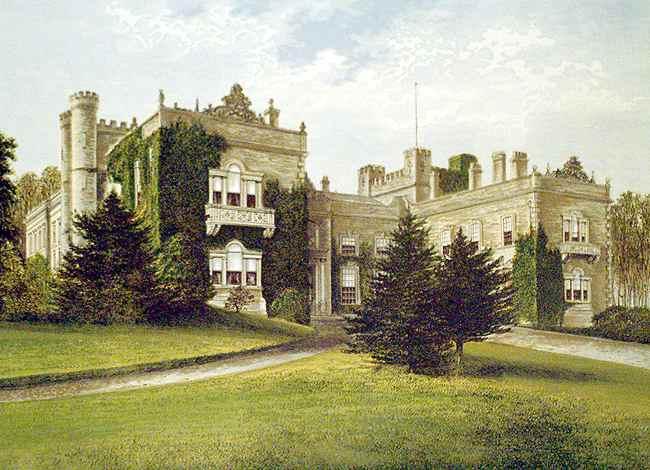
Aske Hall from Morris’s Seats of Noblemen and Gentlemen (1880).
Wikimedia Commons
Imagine having a tax even more stupid than the one generally agreed to be the most stupid ever?
Mansion tax inspectors will target homes with views of the countryside and driveways, The Telegraph can reveal.
The Government valuation agents will be sent out with a checklist of features supposed to signal an increase in a property’s estimated value.
They include whether the house is set in scenic surroundings, if it has a conservatory, and even the number of parking spaces and bathrooms.
It comes after The Telegraph revealed that HMRC agents will be able to demand entry to people’s properties to assess their value for the levy.
Sigh. So, the most stupid tax ever is generally agreed to be the Windows Tax. This led to people bricking up their windows in order to avoid the tax and therefore live in the dark just to middle-finger the revenue. Well, OK, giving the revenue the middle-finger is an honourable thing to do but still, forcing people to live in the dark and dank via your choice of taxation methods is generally agreed to be very stupid indeed.
The thing is this is not, in fact, the most stupid tax ever. This was actually a replacement — a less bad replacement — of the tax which went before. Which was the Hearth Tax. Window tax was under Willie III and it replaced the hearth tax of Charlie II — if you are unblessed by being English yes, C II was before W III.
The aim and intent was the same with both — tax those rich bastards with large houses. A mansion tax that is. But taxing hearths means getting into the house to count the number of hearths. Which then runs up against that Englishman’s home and castle and all that — basic civil liberties stuff. And, of course, the expense of a team of people going around to count fireplaces. And the protection thugs they’ll need when knocking on the door of Squire Haggard. So, not sensible, that. Plus, of course, people will reduce their tax bill by blocking up fireplaces and generally living worse, poorer and colder lives by doing so — but being able to middle-finger the taxman.
The windows tax was an advance on this. We still get the poncey rich bastards in their big houses but we can do so by a clerk walking down the street and counting. No civil liberties violations there and it’s hugely, vastly, cheaper.
Except, of course, we’ve now only got the second most stupid tax in all history.
And back to the present day. There’s that desire to tax the poncey rich in their big houses. So, they’re going back to the hearth tax. Instruments of the State get to invade the righteous castle and thereby — very expensively — tot up the tax. When what we actually want is a simple, from the street, method of valuing the big poncey houses.
QotD: The first (of many) near-death experiences of William Marshal, the greatest knight
He would have been far from the first child to die on Stephen’s account, because at this point England was fourteen years into a civil war so brutal that the Peterborough Chronicle recorded that men “said openly that Christ slept” (þa sæden openlice ðæt Crist slep. ⁊ his halechen),1 but this time was different. This time, the king had to order the boy’s death himself.
The medieval English royal succession was never as neat as Crusader Kings mechanics would have you believe, but even so Stephen I (and only) was an unlikely king. His mother Adela was the youngest child of William the Conqueror. She had four older brothers, three of whom survived their father, and Stephen himself was the third of her sons. But the Conqueror’s eldest son, Robert Curthose, mortgaged his duchy of Normandy to fund his participation in the First Crusade and would go on to spend the decades after his return in comfortable captivity. His second son, Richard, was killed as a teenager in a hunting accident in the New Forest in 1070, and his third son, William Rufus, succeeded him as king, never married, and was also killed in a hunting accident in the New Forest (this time in 1100). If this seems suspiciously convenient, it was: the youngest brother, Henry, was also on the fatal hunting trip. He immediately rode hard for Winchester, where he was crowned three days later.
Henry I promptly married Matilda, whose father was the king of Scotland and whose mother Margaret (later canonized by Innocent IV) was the sister of Edgar Ætheling: Henry and Matilda’s son William, born in 1103, united the blood of the Norman conquerors and the old Anglo-Saxon House of Wessex. Their daughter, another Matilda, was sent off to Germany at the age of eight to marry the twenty four-year-old Holy Roman Emperor Henry V. And that was it: Henry I also fathered at least twenty-two attested bastards, but William and Matilda were his only legitimate children. Which meant that when a drunken helmsman wrecked the ship carrying William and at least three hundred other flowers of the Anglo-Norman nobility across the Channel, Henry was in deep trouble. Luckily for him, his daughter soon returned from Germany a childless widow and once he had remarried her to Geoffrey of Anjou he was able to browbeat his barons into accepting her as his heir. Unluckily for him, they didn’t mean it: Empress Matilda was deeply unpopular even beyond the fact that she was a woman, and as soon as Henry died they were happy to crown his nephew Stephen instead.
The ensuing civil war, known to history as “the Anarchy,” was exciting and dramatic and featured such moments as a king captured on the battlefield, a queen climbing out the window of a besieged castle and escaping through a snowstorm, and a teenage boy invading England with a mercenary army he couldn’t afford to pay. For our purposes, though, all you really need to know is that in 1152 Stephen laid siege to a castle in Berkshire that John Marshal, a supporter of Matilda, had built without royal authorization. (These are apparently called “adulterine castles“, which I think is delightful.) Marshal asked for a truce to consult with his constable and organize the garrison’s surrender and offered his youngest son William as a hostage for his good behavior. Stephen accepted, took the boy into his camp, and withdrew to let Marshal enter with his men.
And then John Marshal stayed in the newly-reinforced castle instead.
Using your children as diplomatic hostages was standard practice in this era. Abandoning them to be executed as punishment for your bad faith was definitely not. But when Stephen’s men told John Marshal that his son’s life would be forfeit for his treachery, Marshal is said to have replied that he didn’t care, because he still had “the anvils and the hammers to forge even finer ones”. Stephen was not, in the end, able to bring himself to kill young William: the story has it that he lost his nerve when the boy asked on his way to the gallows whether he could play with a guard’s spear “afterwards”, and then again when William happily climbed into the catapult they planned to use to send him over the walls to his father (he thought it was a swing). He did, however, remain a hostage in Stephen’s camp until the end of the war a year later.2
Our only source for this story of William’s childhood, and for most of the truly excellent stories medievalist Thomas Asbridge recounts in The Greatest Knight, is a 19,215 line rhyming poem in medieval French. Probably composed a few years after William Marshal’s death at the behest of his friends or children, and pretty well corroborated by other sources where other sources exist, the poem is our only surviving example of a medieval biography of a “normal” person. (Relatively speaking; that little boy grew up to be an incredibly accomplished man but neither a king nor a saint, which is who usually got written about.) Moreover, it seems to have been compiled from stories told by people who actually knew him — which probably means that he was the one who told them about the child who thought the catapult was a swing. The poem exists in only one manuscript,3 discovered by Paul Meyer in the late 19th century and published with partial translations into modern French as L’histoire de Guillaume le Maréchal. (You can find Meyer’s version here or here.) More recently, Nigel Bryant published a full English translation, the text of which isn’t available online, though I’ll point out that even Claude Sonnet does a pretty decent job with screencaps of the original.4
Jane Psmith, “REVIEW: The Greatest Knight by Thomas Asbridge”, Mr. and Mrs. Psmith’s Bookshelf, 2026-04-27.
- As a measure of the degradation of the times, the chroniclers’ English no longer employed grammatical gender.
The ⁊ is a Tironian note for “and”, incidentally, and halechen is obviously cognate with “hallowed”. Like and subscribe for more Old English in the least expected places.
- Stephen’s son and heir Eustace having died by this point, it was agreed that he would keep the English throne but be succeeded by Matilda’s son, the future Henry II, who had already conquered Stephen’s duchy of Normandy.
- Yes, like Beowulf. It’s depressing to realize how many incredible medieval texts survive in only one manuscript. Thank a Benedictine today!
- Claim not verified by anyone who actually reads medieval French, but I didn’t see any obvious errors.
September 4, 2026
Marius Saved Rome … Then They Turned To His Greatest Rival | Rome’s First Civil War
The Rest Is History
Published 3 Sep 2026What was the ancient city of Rome actually like in the first century BC? Who was Lucius Cornelius Sulla, another great, but aristocratic, Roman general who would clash with Gaius Marius in a totemic struggle termed the Social War? And, who were the terrifying Germanic tribes amassing on the borders of the empire, potentially spelling its doom …?
Join Tom and Dominic as they discuss Rome’s apocalyptic threat from the North, Marius’ wars in defence of the empire, and the rise of his greatest adversary: Sulla.
0:00 Rome’s Most Unlikely Saviour
4:25 The Barbarian Threat to Rome
9:15 Rome’s Catastrophic Defeat
14:04 Marius Rebuilds the Roman Army
16:48 Marius Takes on the Teutones
19:36 The Cimbri Are Annihilated
23:41 Marius Becomes Too Powerful
27:00 The Rise of Sulla
31:02 Sulla’s Ruthless Ambition
35:05 Amazon
36:15 The Extraordinary Wealth of Roman Italy
42:49 Italy’s Second-Class Citizens
46:18 The Social War Erupts
50:44 Rome Fights Back
52:35 Sulla Becomes Rome’s New Hero
56:05 A New War in the East
58:18 Mithridates Takes on Rome
1:02:00 Marius Makes His Comeback
1:04:39 Violence Erupts in Rome
1:07:01 Marius Takes Sulla’s Command
As Tom and Dominic mention during this episode, there’s a members-only bonus episode discussing the (much contested) “Marian reforms” of the Roman army with … Bret Devereaux who is a strong proponent of the notion that the Marian reforms were not a thing.
Making Shepherd’s Pie from an 1894 Recipe – Beef or Lamb?
Tasting History with Max Miller
Published 10 Mar 2026Minced beef filling covered in browned mashed potatoes
City/Region: North Ayrshire, Scotland
Time Period: 1894Cottage pie is made with beef, and shepherd’s pie is made with lamb. Or so they would have you believe. This division between mashed potato-topped meat pies is actually only about 50 years old. Before that, recipes for shepherd’s or cottage pie could call for beef or lamb, or didn’t specify a kind of meat at all.
The clove and the mushroom ketchup are both present but not overpowering, and the potatoes are creamy and delicious. Shepherd’s pie is my absolute favorite way to make meat and potatoes, and this 1894 version holds up.
Shepherd’s Pie
Minced beef or lamb; if beef, put in a pinch of pulverised cloves; if lamb, pinch of summer savoury to season it, very little pepper and some salt, and put in a baking-dish; mash potatoes and mix them with cream and butter and a little salt, and spread them over the meat; beat up an egg with cream or milk, a very little, spread it over the potatoes and bake it a short time, sufficient to warm it through and brown the potatoes.
— Irvine Herald and Kilwinning Chronicle, October 5, 1894
September 3, 2026
The Last Tiger
The Tank Museum
Published 24 Apr 2026The war has raged for more than 5 years.
In the Essel Forest, on the north German plain, a troop of British Comet cruiser tanks halts for a brew.
A shot rings out
It’s a Tiger!
Within seconds one of the Comets is hit.
The war is far from over …
This is the story of a fascinating and dangerous moment in time – one of the last duels between the brilliant Comet and the legendary Tiger.
00:00 | Introduction
00:42 | The Last Tiger
04:55 | The Rise and Fall of the Kampfgruppen
06:40 | The British Armour
07:52 | Tiger v Comet
13:08 | April 13th 1945This video features archive footage courtesy of British Pathé.
In this film, join Chris Copson as he tells the story of one of the last tank duels of the Second World War. On one side, the Tiger. With its 88mm gun and almost impenetrable armour, it had inspired fear in many Allied tank crews. But on the other side, the Brits were prepared with the latest in tank technology – the Comet. Both were imposing sights on the late WWII battlefield, but who would come out on top in the depths of the Essel Forest?
Want to learn more about the Tiger and Comet tanks? Here are some of the sources we used to make this film:
Battleground, Zaloga (Ed), Osprey, 2011.
Crouching Tiger, Hidden Comet, Fletcher, 2017
Encyclopaedia of British and American Tanks of WW II, Chamberlain and Ellis, Cassell 2014.
Encyclopaedia of German Tanks of WWII, Chamberlain and Doyle, Cassell 2011.


