
Quotulatiousness

August 19, 2012

Minnesota Vikings to play at Wembley?

Filed under: Britain, Football — Tags: , , , — Nicholas @ 09:58

Don’t panic, Vikings fans … the team isn’t moving. What is being considered is to allow the Vikings to play a couple of “home” games at Wembley Stadium in England while they await the end of construction on their new stadium:

The NFL and Vikings are both reportedly very keen to make this happen. It makes sense for the Vikings because, with the new stadium construction, they’ll have to play away from their real home for up to two years anyway. A couple home games at Wembley, which seats 86,000 for American football, means two fewer home games at temporary residence TCF Bank Stadium, which after upgrades will still be able to accommodate less than 60,000.

Of course the state-side fans might gripe about losing a couple of home games, but if there’s money to be made elsewhere, the Vikings won’t hesitate to follow it (sorry fans). It seems what we have here is a match made in heaven. The NFL wants to make more inroads in the European market, and the Vikings want to make back some of the revenue they’ll be losing by temporarily moving into a much smaller venue. So it seems inevitable that, for awhile at least, the Vikings will become England’s team.

A side-benefit to this would be that it ensures at least two games will be telecast outside the Vikings’ home region: a matter of great interest to this Toronto-area Viking fan.

August 18, 2012

Warships are not like books or DVDs

Filed under: Britain, Bureaucracy, Economics, Military — Tags: , — Nicholas @ 00:23

“Sir Humphrey” explains why adding another two Type 45 destroyers to the Royal Navy’s current construction plans won’t fly, even though it would be popular with many key constituencies: “it would win votes, it would keep supporters of the Navy happy, and the RN would be delighted”.

From the outset, let’s be extremely clear. This article is not saying that the UK could not build two more Type 45s – if the will is there, and the budget exists to do so, then anything is possible. As will be seen though, the challenge is trying to do so in a manner which makes rational sense.

[. . .]

In terms of support and manning, providing two additional Type 45s would raise a significant cost and manpower burden on the fleet. The RN has scaled itself to provide spares for six hulls. An additional two hulls means increasing spares by 33% above the existing fleet, which in turn would mean extra funding for parts, supplies, maintenance and munitions. Even basic issues like Sea Viper war shots, helicopter fleets, ammunition for 4.5” guns and the like would need to be increased. The funding for this is not in place at present. It’s not that the RN can’t find this funding, but that it will cost more to fund it than previously expected — this money has to be found from commensurate savings elsewhere.

[. . .]

The final point is perhaps the best reason why it would be near impossible to achieve this. There is simply no room in the construction yards to build two additional Type 45s. As was seen in the award of the MARS tanker project to Korea, the current UK shipbuilding industry is operating at peak capacity – the CVF programme is in pure tonnage terms providing the equivalent of 20 Type 45 destroyers worth of construction. The yards are full with CVF work now, and in a few years’ time will be ramping up to construct Type 26. To inject two additional Type 45s now would throw that programme into disarray as the yards struggle to work out how they can actually build the vessels. It’s not just a case of laying some steel down and a new ship popping up. T45s are built across multiple yards in parts, so it would need all the component yards to work together to fit it into their programme. They’d also need to work out how to take on the extra staff, who would then need to be made redundant later on as the workflow dropped off again. One of the key successes of the terms of business agreement is that the shipyards can plan for an agreed level of work. Adding ships in to this actually throws the plan into confusion as the yards have to resource to a higher level than before, incurring additional costs, and probably delaying both CVF and T26.

It is not impossible to build extra ships. That much is clear — if the willpower is there, then it can be done. But the days of shipyards existing in a short term environment, dependent on the next RN order, whatever it may be, are all but gone. The issue is the preservation of key skills, such as ship design and also high end manufacture of critical components, and doing so in a manner which makes the industry sustainable for the long term, and not the ‘boom and bust’ approach of the last century.

Regular readers of the blog may remember that the Type 45 destroyer design in particular came in for a hammering from other sources.

The road to publishing Orwell’s works

Filed under: Books, Britain, History, Media — Tags: — Nicholas @ 00:07

The notion of putting out a complete set of the works of George Orwell formed in the early 1980s. It was, as Peter Davison relates, a very long, troubled process:

For many years I taught scholarly editing and edited the work of Shakespeare and his colleagues (in particular 1 and 2 Henry IV, in Penguin editions still in print after some 45 years) — oh, and, for a New York publisher in 1971 a critical edition of music-hall songs. Out of the blue in July 1982 I was telephoned and asked if I would edit a de luxe edition of Orwell’s nine books. That meant closely comparing over fifty texts and manuscripts in twelve months. The intention was to publish this edition in 1984 — a new but intriguing kind of anniversary celebration. The concept of a de luxe edition of Down and Out in Paris and London and The Road to Wigan Pier has never ceased to amuse me but owing to the disastrous delays in getting even the first three books into print (they saw the light of day only in 1986 and had immediately to be pulped because the printer had used the uncorrected version of my text) that embarrassing description was quickly dropped. Two examples, both, fortunately, just caught in time, might well illustrate the kind of errors introduced by the printer. The title of Orwell’s last novel appeared as:

Nineteen 48pt
Eighty-Four

’48pt’ was, of course, the type-size for the title-page. And that famous formula, 2 + 2 = 5 appeared as 2r 29 5-

[. . .]

Obviously an edition of this extent takes time to produce, especially if the editor has also simultaneously to earn a living outside academe without benefit of grants and fellowships, but even then it might be asked why the 21 volumes took seventeen years to get into print. First, the edition was abandoned by its publishers — Secker & Warburg in London and by Harcourt, Brace Jovanovich in New York — no fewer than six times. For example, after being abandoned in summer 1986 it was again abandoned three years later — without it having been resuscitated in between. Perhaps foolishly, but in the end fortunately, we ignored ‘abandonments’ and simply kept at it, seeking, editing and annotating material.

August 17, 2012

Even Guardianistas are puzzled by Assange’s Ecuador gambit

Filed under: Europe, Law, Liberty, Media — Tags: , , , , — Nicholas @ 09:10

There are few newspapers who have been as supportive of Julian Assange in his legal plight than the Guardian. When even Guardian columns find it difficult to figure out why he turned to Ecuador, we’ve moved into a different universe:

Julian Assange’s circus has pulled off another breathtaking stunt: he has won political asylum in Ecuador. Assange’s flight from Sweden, a decent democracy with a largely excellent justice system, takes ever more absurd forms. After the decision of Ecuador’s foreign minister, Ricardo Patiño, the Swedish Twitterverse filled with mocking jokes.

Assange has few fans left here. On the contrary, his unholy alliance with Ecuador’s political leadership casts a shadow over what was, despite everything, his real achievement: to reveal shattering news through the revolutionary medium of WikiLeaks.

Patiño praised Assange as a fighter for free expression, and explained that they had to protect his human rights. But Ecuador is a country with a dreadful record when it comes to freedom of expression and of the press. Inconvenient journalists are put on trial. Private media companies may not operate freely.

President Rafael Correa is patently unable to tolerate any truths that he does not own. Reporters Without Borders has strongly and often criticised the way that media freedoms are limited in Ecuador. Assange is a plaything for the president’s megalomania.

The plight of Russian submariners

Filed under: History, Military, Russia — Tags: , , , , — Nicholas @ 08:36

An update from Strategy Page on how far the Russian nuclear submarine threat has diminished from its peak during the cold war:

Three years ago two Akulas were detected (by the U.S. Navy) off the east coast of the United States, in international waters. Russia admitted two of its Akula class boats were out there. This was the first time Russian subs had been off the North American coast in over a decade. This spotlights something the Russian admirals would rather not dwell on. The Russian Navy has not only shrunk since the end of the Cold War in 1991, but it has also become much less active. In the previous three years, only ten of their nuclear subs had gone to sea, on a combat patrol, each year. Most of the boats going to sea were SSNs, the minority were SSBNs (ballistic missile boats). There were often short range training missions, which often lasted a few days, or just a few hours.

The true measure of a fleet’s combat ability is the number of “combat patrols” or “deployments” in makes in a year and how long they are. In the U.S. Navy, most of these last from 2-6 months. Currently U.S. nuclear subs have carry out ten times as many patrols as their Russian counterparts. Russia is trying to catch up, but has a long way to go.

Russia has only 14 SSNs (nuclear attack subs) in service and eight of them are 7,000 ton, Akulas. These began building in the late 1980s and are roughly comparable to the American Los Angeles class. All of the earlier Russian SSNs are trash, and most have been decommissioned. There are also eight SSGN (nuclear subs carrying cruise missiles) and 20 diesel electric boats. There is a new class of SSGNs under construction, but progress has been slow.

[. . .]

The peak year for Russian nuclear sub patrols was 1984, when there were 230. That number rapidly declined until, in 2002, there were none. Since the late 1990s, the Russian navy has been hustling to try and reverse this decline. But the navy budget, despite recent increases, is not large enough to build new ships to replace the current Cold War era fleet that is falling apart. The rapid decline of Russia’s nuclear submarine fleet needed international help to safely decommission over a hundred obsolete, worn out, defective or broken down nuclear subs. This effort has been going on for over a decade, and was driven by the Russian threat to just sink their older nuclear subs in the Arctic Ocean. That might work with conventional ships, but there was an international uproar over what would happen with all those nuclear reactors sitting on the ocean floor forever. Russia generously offered to accept donations to fund a dismantling program that included safe disposal of the nuclear reactors.

Weigel’s prog rock series: the excess goes critical

Filed under: Britain, History, Media — Tags: , , — Nicholas @ 00:04

Part four of Dave Weigel’s look at the rise and fall of progressive rock:

The order, Rick Wakeman remembers, was for chicken vindaloo, rice pilau, six papadums, bhindi bhaji, Bombay aloo, and a stuffed paratha. This was November 1973 and Yes had sold out the Manchester Free Trade Hall for a performance of Tales From Topographic Oceans. The album consisted of four songs that rolled gently together, over four sides of vinyl, for 83 minutes. “There were a couple of pieces where I hadn’t got much to do,” Wakeman would recall, “and it was all a bit dull.

During every show, a keyboard tech reclined underneath Wakeman’s Hammond organ, ready to fix broken hammers or ribbons and to “continually hand me my alcoholic beverages.” That night in Manchester, the tech asked the bored Wakeman what he wanted to eat after the show. Wakeman, the lone carnivore in Yes, ordered the curry. “Half the audience were in narcotic rapture on some far-off planet,” Wakeman wrote in his 2007 memoir, “and the other half were asleep, bored shitless.”

Wakeman kept on at the keyboards, adding gossamer organ melodies and ambient passages to the songs. And then, around 30 minutes later, his tech started handing up “little foil trays” of curry, and Wakeman began placing them on top of his keyboards. “I still didn’t have a lot to do,” he wrote, “so I thought I might as well tuck in.” The food was obscured by the instrument stacks, further obscured by Wakeman’s cape, but the aroma danced over to Yes’s lead singer, Jon Anderson. He took a good look at the culinary insult. Shrug. Papadum in hand, he returned to his microphone to sing his next part.

Tales From Topographic Oceans just might be the recorded ur-text of prog rock excess. No band had ever tried to fill each side of two LPs with long, multisection suites. Yes did it, and voila — a No. 1 album. They went on tour with a sci-fi lullaby backdrop, designed by their three-time album cover artist Roger Dean. He had seen the sort of enormous venues they’d booked, realized how hard it now was for faraway audiences to see the band, and so voila — phantasmagoric eye candy. Their set began with 82 minutes of new music before they played an old familiar tune. They played in their biggest-ever concert halls, and they sold them out.

But as the tour went on, Yes dropped the third section of the album from the show, then the second. Soon, Wakeman vented to reporters about the band’s screw-up. “Tales From Topographic Oceans is like a woman’s padded bra,” he told one interviewer. “The cover looks good but when you peel off the padding there’s not a lot there.” Yes had gotten too damn silly. The music had collapsed in on itself.

August 16, 2012

Weigel’s prog rock series: the excess creeps in

Filed under: Britain, History, Media — Tags: , , — Nicholas @ 08:32

The third entry in Dave Weigel’s excellent and informative history of progressive rock:

With more gigs came more pomp. Ian Dove, one of the New York Times’ rock writers, approached ELP’s December 1973 Garden shows the way a reporter might write about a fully loaded nuclear submarine. The gear — tell us about this gear. ELP had arrived in Manhattan, Dove wrote, with “over 200 separate items of equipment, valued by customs at just over $100,000.”

Among them:

  • “Thirteen keyboard units” for Keith Emerson, including a “brand new prototype Moog synthesizer.”
  • A $5,000 Persian rug, “for bass player Greg Lake to stand on while playing.”
  • A drum kit as complex as a painting by H.R. Giger — he’d designed the nightmare cover to ELP’s most recent album, Brain Salad Surgery — crafted in stainless steel, topped off by an “old church bell from the Stepney district of London,” surrounded by Chinese gongs. If a stage was equipped right, the kit could rotate 360 degrees while Carl Palmer pounded out the solos in “Tarkus.” Cost: $25,000.

Band members got a little tired of talking about all this. Lake showed up for a Rolling Stone interview in cheap jeans and pronounced touring “incredibly tiring.” The excess was the sacrifice the band made for you, the fan. “It is very hard to get something across to 10,000 people with just a piano, a bass, and a set of drums,” Emerson told the Times. “It works fine in smaller places and the recording studio. I always compose on the piano. But in the large arenas where we have to play, everything gets lost.”

Where we have to play — a magnificent early example of the humblebrag.

George Orwell, “the moral compass of the 20th century”

Filed under: Books, Britain, History, Media, WW2 — Tags: , , , — Nicholas @ 08:15

A review of Diaries by George Orwell in the Wilson Quarterly:

The early entries cover Orwell’s days as a tramp, a period that provided material for Down and Out in Paris and London (1933), and his subsequent investigation of poverty in the industrial north of England, from which he drew for The Road to Wigan Pier (1937). This volume’s lacuna is Orwell’s experience fighting the fascists during the Spanish Civil War. Plainclothes policemen in Barcelona seized the one or two diaries that recorded those events, and delivered the work to the Soviets. Though the writings likely remain in the archives of the former KGB, Orwell transformed them into literature as well, with the extraordinary memoir Homage to Catalonia (1938).

Of greatest interest are entries from the periods of Orwell’s life that he did not turn directly into books. His World War II diaries are the highlight. Although all of the entries feature Orwell’s direct prose style, there are occasional hints of the novelist at work: “Characteristic war-time sound, in winter: the musical tinkle of raindrops on your tin hat.” And there are ominous passages that reveal his unusually clear view of the awful century unfolding, such as this one from June 1940 that prefigured his 1945 novel Animal Farm:

Where I feel that people like us understand the situation better than so-called experts is not in any power to foretell specific events, but in the power to grasp what kind of world we are living in. At any rate I have known since about 1931 . . . that the future must be catastrophic. I could not say exactly what wars and revolutions would happen, but they never surprised me when they came. Since 1934 I have known war between England and Germany was coming, and since 1936 I have known it with complete certainty. . . . Similarly such horrors as the Russian purges never surprised me, because I had always felt that — not exactly that, but something like that — was implicit in Bolshevik rule. I could feel it in their literature.

August 15, 2012

Dave Weigel on the rise of prog rock

Filed under: Britain, History, Media — Tags: , , — Nicholas @ 10:44

The second installment in Dave Weigel’s informative history of progressive rock:

That keyboardists were suddenly rock gods represented the sea change that progressive music brought to the rock ‘n’ roll scene of the 1970s. The pop song was out. The prog epic was in. We laugh now at the foolhardiness of these 20-minute rock operas, but at the time they felt revolutionary — like the future of music, arrived all at once in the form of a wall of keyboards and a Moog organ. Small A&R teams went on treasure digs for progressive music. Labels like Charisma, Immediate, Harvest, and Sire signed bands that never intended to record three-minute singles. And the labels could sign them because the tours and the LPs sold. Rick Wakeman could write a thematic micro-opera about the Knights of the Round Table, and sell 10 million copies. In 14 months, Jethro Tull recorded not one but two albums that consisted of single, 40-minute songs. And they both went platinum.

Who was listening to this music? Hippies. Teenagers. Fans who were sure there was something more out there. People who wanted to drop acid and have their pupils bombarded by lasers. Arty types who wanted to find meaning in music, and who — rather than searching for it in short pop songs based on American blues — found it in the quirky Britishness of prog, equal parts twee and subversive.

The musicians, and the audiences, had grown up with rock. They took it seriously. But they didn’t feel constrained. They were more interested in personalizing or stretching the forms passed down to them. Everybody loved the Beatles, but they loved them best when they got weird. “The Beatles,” said guitarist and producer Robert Fripp, “achieve probably better than anyone the ability to make you tap your foot first time round, dig the words sixth time round, and get into the guitar slowly panning the twentieth time.”

This was supposed to be rebellious music. The Louis XVI of the time was the standard pop song structure — creative kryptonite. In a 1974 feature on Yes for Let It Rock magazine, David Laing explained that the “basic impetus was a justified discontent with the limitations of the pre-Pepper pop approach — the glorification of image, the three-minute single, the pressure towards repetition of the already successful formula.” Rejecting the three-minute single in favor of the suite meant rejecting the “establishment” in every way. “It was felt after Sgt. Pepper anybody could do anything in music,” said Yes/King Crimson drummer Bill Bruford in a 1994 interview. “It seemed the wilder the idea musically the better.”

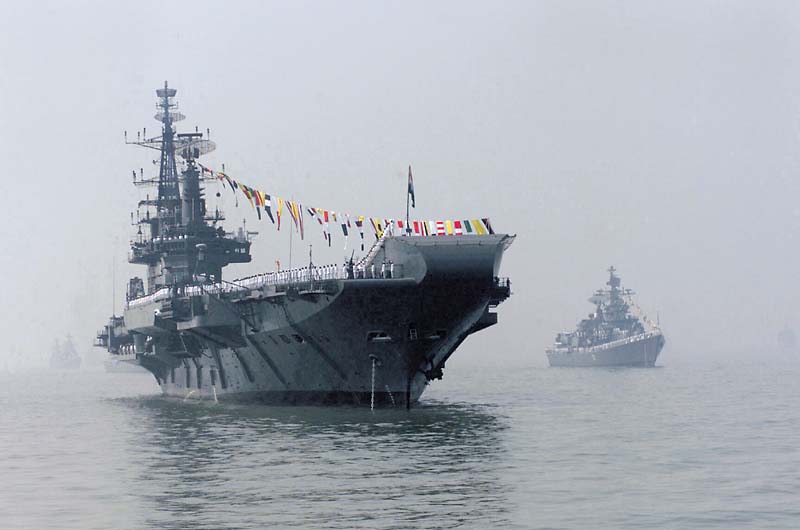
India’s next aircraft carrier delayed (again)

Filed under: India, Military, Russia — Tags: , — Nicholas @ 09:02

The Indian navy will have to carry on with an ancient aircraft carrier for a few more years because the INS Vikrant is being further delayed:

India announced that its first locally designed and built aircraft carrier, INS Vikrant will be at least three years late. This was not unexpected. The latest delay was caused, in large part, because the Indian firm hired to build a complex portion of the engine, the gearbox, proved incapable of the task and a foreign company had to be brought in.

There have been many other problems. While construction began three years ago, it was soon delayed because Russia was late in supplying the high-grade steel needed for the hull. Last December 30, the Vikrant was floated out its dry dock. Vikrant was not supposed to leave dry dock yet but the dock was needed for another project. Construction will go on, with pipes, conduits, and other fittings installed. Later this year, Vikrant will return to another dry dock to have its engines and other major equipment installed, although some of that equipment will be late because of problems with suppliers.

While waiting for the Vikrant to be ready, India will have to extend the service life of the already aged INS Viraat, which began life as HMS Hermes in the Royal Navy before being transferred to Indian service in 1987. She is the oldest aircraft carrier in active service in any navy.

Image from Wikipedia.

August 14, 2012

O’Neill: London outdid Beijing in politicizing the Olympics

Filed under: Britain, China, Sports — Tags: , , , — Nicholas @ 08:22

Brendan O’Neill says that the London Olympics were far more politicized than the Beijing games in 2008:

From the flurry of fanboy commentary that followed Danny Boyle’s am-dram opening ceremony to the insistence that the Games represented the coming to fruition of the post-Diana dream of a new, less stuffy Britain, the urge to politicise the Games has been intense. That the political classes have sought so shamelessly to usher in ‘another kind of Britain’ on the back of the Games speaks volumes about their desperate need for a new national narrative, and their disillusionment with the democratic route to social overhaul.

Normally we frown upon elites that heap their political obsessions on to mass sporting events. We think of Hitler turning the Berlin Games into an advert for Aryan superiority (a vision shot down by Jesse Owens) or of the Beijing opening ceremony’s thousands of fantastically coordinated drummers and boastful history lesson, described by one British hack last week as ‘crypto-fascist’. And yet, Britain’s ostensibly liberal observers thought nothing of turning 2012 into an advert for their own allegedly superior way of life and thinking.

The tone was set by Labour MP and historian Tristram Hunt, who described Boyle’s opening ceremony as the ‘march past’ — that is, victory parade — of his side in the Culture Wars. The ceremony was proof, said Hunt, that ‘the left took victory in the Culture Wars’, and moreover that a New Britain was being born: if the Queen’s Jubilee celebrated a ‘staid and nostalgic national identity’, this ceremony ‘offered an attractively contradictory, complicated, and above all creative conception of these Isles of Wonder’.

There has since been a concerted effort to turn the ‘bonkers’ opening ceremony into a new national narrative. Somewhat defensively, the Guardian’s Jonathan Freedland insists that it is ‘not just Guardian types’ who are exalting in the new political vision provided by both the ceremony and the multicultural message of the Games that followed — the whole nation is, apparently, recognising that ‘we have glimpsed another kind of Britain’, and that we should ‘love the country we have become — informal, mixed, quirky — rather than the one we used to be… reactionary’.

August 13, 2012

After five years, the Great Recession still shows little sign of ending

Filed under: China, Economics, Europe, USA — Tags: , , — Nicholas @ 09:02

For your daily dose of doom, here’s Ambrose Evans-Pritchard at the Telegraph:

The world remains in barely contained slump. Industrial output is still below earlier peaks in Germany (-2), US (-3), Canada (-8) France (-9), Sweden (-10), Britain (-11), Belgium (-12), Japan (-15), Hungary (-15) Italy (-17), Spain (-22), Greece (-27), according to St Louis Fed data. By that gauge this is proving more intractable than the Great Depression.

[. . .]

The original trigger for the Great Recession has since faded into insignificance. America’s house price bubble — modest by European or Chinese standards — has by now entirely deflated. Warren Buffett is betting on a rebound. Fannie and Freddie are making money again.

Five years on it is clear that subprime was merely the first bubble to pop, a symptom not a cause. Europe had its own parallel follies. Britons were extracting almost 5pc of GDP each year in home equity by the end. Spain built 800,00 homes in 2007 for a market of 250,000. Iceland ran amok, so did Latvia and Hungary. The credit debacle was global. If there was an epicentre, it was Europe’s €35 trillion banking nexus.

[. . .]

A study by Stephen Cecchetti at the Bank for International Settlements concludes that debt turns “bad” at roughly 85pc of GDP for public debt, 85pc for household debt, and 90pc corporate debt. If all three break the limit together, the system loses its shock absorbers.

“Debt is a two-edged sword. Used wisely and in moderation, it clearly improves welfare. Used imprudently and in excess, the result can be disaster,” he said.

English law in the age of Twitter

Filed under: Britain, Law, Technology — Tags: , , — Nicholas @ 08:45

At The Register, OUT-LAW.COM outlines the things to avoid saying on Twitter:

Debates in Parliament, home visits from the police and distressed celebrities have all left tweeters a little unsure as to what is and what is not acceptable by law on Twitter.

The list of those offending and those offended keeps growing with recent high profile reports referring to Louise Mensch, Tom Daley, Guy Adams, Steve Dorkland, Helen Skelton and Kevin Pietersen. This guide discusses 10 legal risks which apply, or potentially apply, to Twitter, in the context of recent media attention given to the lawfulness of tweets.

This is not just of intellectual interest to those of us living outside England: American, Canadian, Australian, Dutch, Indian, or Zimbabwean Twitter users can be sued in English courts (your country may or may not have laws shielding you from this kind of legal action, but most currently do not: the law lags well behind the technology).

August 12, 2012

The (long awaited) growth in Indian manufacturing

Filed under: Business, Germany, History, India, Technology — Tags: , , , , , — Nicholas @ 08:59

The Economist on the relatively slow development of India’s manufacturing sector:

If India is to become “the next China” — a manufacturing powerhouse — it is taking its time about it. “We have to industrialise India, and as rapidly as possible,” said the country’s first prime minister, Jawaharlal Nehru, in 1951. Politicians have tried everything since, including Soviet-style planning. But India seems to prefer growing crops and selling services to making things you can drop on your foot.

Manufacturing is still just 15% of output (see chart), far below Asian norms. India needs a big manufacturing base. No major country has grown rich without one and nothing else is likely to absorb the labour of the 250m youngsters set to reach working age in the next 15 years. But it can seem a remote prospect. In July power cuts plunged an area in which over 600m people live into darkness, reminding investors that India’s infrastructure is not wholly reliable. And workers boiled over at a car factory run by Maruti Suzuki. Almost 100 people were injured and the plant was torched. The charred body of a human-resources chief was found in the ashes.

Yet not all is farce and tragedy. Take Pune in west India, a booming industrial hub that has won the steely hearts of Germany’s car firms. Inside a $700m Volkswagen plant on the city’s outskirts, laser-wielding robots test car frames’ dimensions and a giant conveyor belt slips by, with sprung-wood surfaces to protect workers’ knees. It is “probably the cheapest factory we have worldwide”, says John Chacko, VW’s boss in India. In time it could become an export hub. Nearby, in the distance it takes a Polo to get to 60mph, is a plant owned by Mercedes-Benz.

The initial demand for a domestic manufacturing base was more political than economic: it would serve to reinforce the newly won independence of India by showing that India could make its own goods rather than importing from the UK or other major manufacturing nations. It was also economic, in that it would provide relatively high-paying jobs for India’s rapidly urbanizing population.

Ironically, now that the manufacturing sector seems to be on the upswing, the one thing it isn’t going to do for India is provide lots and lots of jobs: as with the rest of the world, manufacturing “things” is being done with fewer workers every year (even when the total output increases, fewer workers are needed to produce that output).

August 9, 2012

QotD: “No one is patriotic about taxes”

Filed under: Britain, Bureaucracy, Government, Quotations, WW2 — Tags: , , , — Nicholas @ 08:54

The money situation is becoming completely unbearable. . . . Wrote a long letter to the Income Tax people pointing out that the war had practically put an end to my livelihood while at the same time the government refused to give me any kind of a job. The fact which is really relevant to a writer’s position, the impossibility of writing books with this nightmare going on, would have no weight officially. . . . Towards the government I feel no scruples and would dodge paying the tax if I could. Yet I would give my life for England readily enough, if I thought it necessary. No one is patriotic about taxes.

George Orwell, diary entry for 9 August, 1940.

« Newer PostsOlder Posts »

Powered by WordPress

