Quotulatiousness

August 8, 2012

How British libel laws work (and why Jimmy Wales is wrong about them)

Filed under: Britain, Law, Media — Tags: , , , , — Nicholas @ 09:54

Tim Worstall explains that Jimmy Wales misunderstands what British libel laws really mean for publishers (and bloggers) in other countries:

The libel law of England and Wales is rather different from many other countries, yes. It’s a lot harder to defend against a charge there, damages are higher than in most other jurisdictions and so on. However, that isn’t the important point. What drags you into that jurisdiction is not where your servers are. Nor where the people who prepared the material, where it was uploaded nor where the company is located. What matters is where was the person reading it located?

Please note, this applies to us all. In all jurisdictions the result is the same. It applies to corporate websites, to blogs, to Wikipedia, to everyone. It is a generally accepted legal rule that publication of digital information takes place where it is read, not where it is “published”. The general logic is that at one point there is a copy on the server somewhere. Then, someone downloads it into a browser window in order to read it. At this time there are two copies, on in the browser, one on the server. This creation of a second copy is therefore publication. And that publication takes place in the jurisdiction of the reader, not anywhere else.

[. . .]

Thus Wikipedia not having servers in the UK, not being a UK corporation or charity, does not protect it from English libel laws. None of us are so protected from them, we are liable under them if as and when someone in England and Wales reads our pages.

[. . .]

But as I say, it is still true that jurisdiction on the internet depends upon where the reader is, not the producer or the servers. It’s not a happy thought that we’re now subject to 200 off legal jurisdictions every time we post something but it is true.

August 6, 2012

Admiral Fisher: an excitable sort of man

Filed under: Britain, Germany, History, Humour, WW1 — Tags: , , , — Nicholas @ 10:41

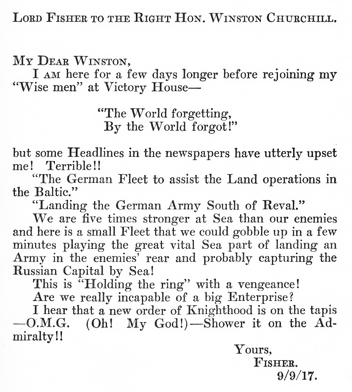
Admiral “Jackie” Fisher was a major historical figure in the Royal Navy, advocate of the modern dreadnought battleship and a tad high-strung (“…and on one occasion, the king asked him to stop shaking his fist in his face”). His relationship with Winston Churchill at the Admiralty must have been something to observe, as two of the most influential men in London worked together (for a while). After leaving the Admiralty for the last time, he still kept in touch with Churchill. Here is an example of his communication style:

This is believed to be the first documented use of the now familiar “OMG”.

H/T to Shaun Usher.

QotD: The modern British pub

Filed under: Britain, Humour, Quotations — Tags: , , — Nicholas @ 00:28

With some shining exceptions, of which my own local is one, the pub is fast becoming uninhabitable. Fifteen or twenty years ago, the brewing companies began to wake up to the fact that their pubs badly needed a face-lift, and started spending millions of pounds to bring them up to date. Some of the results of their refurbishings have been admirable: more and more comfortable seating, improved hygiene, chilled beers, snack lunches that in general have reached such a standard that, when in quest of a midday meal in unfamiliar territory, you will usually find quicker service and much better value for money in the pub than in the near-by trattoria.

But that is about as far as it goes. The interior of today’s pub has got to look like a television commercial, with all the glossy horror that implies. Repulsive “themes” are introduced: the British-battles pub, ocean-liner pub, Gay Nineties pub. The draught beer is no longer true draught, but keg, that hybrid substance that comes out of what is in effect a giant metal bottle, engineered so as to be the same everywhere, no matter how lazy or incompetent the licensee, and, in the cases of at least two well-known, lavishly advertised brews, pretty nasty everywhere. But all this could be put up with cheerfully enough if it were not for the bloody music — or that kind of uproar having certain connections with a primitive style of music and known as pop. It is not really the pop as such that I object to, even though pop is very much the sort of thing that I, in common with most of the thirty- or thirty-five-plus age-group, would have expected to go to the pub to get away from. For partly different reasons, I should also object to having Beethoven’s Choral Symphony blaring away while I tried to enjoy a quiet pint with friends. If you dislike what is being played, you use up energy and patience in the attempt to ignore it; if you like it, you will want to listen to it and not to talk or be talked to, not to do what you came to the pub largely to do.

Kingsley Amis, Everyday Drinking: The Distilled Kingsley Amis, 2008.

August 5, 2012

Raoul Wallenberg remembered

Filed under: Europe, Germany, History, Russia, WW2 — Tags: , , , , — Nicholas @ 11:05

Yesterday was what would have been Raoul Wallenberg’s 100th birthday. It was observed in Sweden:

Sweden on Saturday commemorated the life of a diplomat credited with saving thousands of Hungarian Jews from the Nazis in World War II, but whose fate remains one of the country’s greatest war-time mysteries.

Crowds gathered in the town of Sigtuna, 50 kilometers (30 miles) north of Stockholm to celebrate the centennial of the birth of Raoul Wallenberg, whose defiance of the Nazis has been commemorated worldwide in statues, streets names, and on postage stamps.

Wallenberg served as Sweden’s envoy in Budapest from July 1944 — where he saved the lives of at least 20,000 Jews by giving them Swedish travel documents, the so-called “shutzpass,” or moving them to safe houses. He is also credited with dissuading German officers from massacring the 70,000 inhabitants of the city’s ghetto.

But, in January 1945, the young Swede was arrested by the Soviet Red Army on leaving Budapest to go to the eastern part of the country, and suddenly disappeared.

The Soviets initially denied they had detained him, but later said he had died of a heart attack in prison on July 17, 1947.

Angers still pushing for compensation for Plantagenet murder in 1499

Filed under: Britain, Europe, France, History, Law — Tags: , , — Nicholas @ 10:22

I mentioned this amusing little issue last month. The city of Angers is still trying to get the British crown jewels as compensation for Henry VII’s judicial murder of the last legitimate male Plantagenet claimant to the English throne. Lowering The Bar has more:

What’s the connection between these French people and the English throne? It looks like the first connection that mattered was between Matilda, the daughter of King Henry I, and Geoffrey of Anjou (the county in which Angers was located). Their oldest son became Henry II of England in 1154. After 331 years of exciting adventures, the ruling line ended with Richard III, who was killed in battle by the forces of Henry Tudor (Henry VII). (Since history is written by the victors, Richard III now appears in plays as a murderous hunchback and the Tudors got their own miniseries on Showtime.)

But Angers doesn’t appear to care about any of those guys (especially the hunchback), only about Edward, Earl of Warwick. He had a claim to the throne (he was Richard III’s nephew, or something), but was only 10 in 1485, and judging from this portrait was so poor that he could not even afford to be drawn from the neck down. But Henry threw him in the Tower of London anyway and kept him there until he was old enough to kill, basically, which happened in 1499. He was the last legitimate male Plantagenet.

Angers is sponsoring a petition drive about this 513-year-old outrage and will send the official results to Queen Elizabeth II (House of Windsor) in September. This will coincidentally coincide with Angers’s annual cultural festival. A spokesperson for the city admitted that the petition “had little chance of success” (the original crown jewels were done away with by Oliver Cromwell anyway), but said that the crime against the Plantagenets was worth remembering. According to the report, he also “encouraged British people to visit Angers, which has medieval buildings including a magnificent castle which recalls the glory days of the Plantagenets.”

August 4, 2012

British quirks, in brief

Filed under: Britain, History, Humour, WW2 — Tags: , — Nicholas @ 09:19

To provide assistance to all the benighted foreigners visiting Britain for the Olympics, BBC News Magazine solicited helpful bits of advice and information from their audience. Here are a few of the responses, explaining some of the odd and illogical quirks of Britons:

Avoiding terms of address

British speakers of English try to avoid addressing each other by any sort of title. While speakers of French politely address strangers as “monsieur” or “madame”, the British are tongue-tied at the point of interaction, hoping that simple proximity will indicate to whom they are talking. These days, it’s considered condescending to use “sir” or “madam”, unless the speaker is in a clearly-defined “service” role. To fill this gap, the locals have developed various colloquial circumlocutions. In London, for example, “guv[nor]”, “mate” and “squire” are employed by males (according to complex rules) to address unknown males, with “darling” or “love” (rather questionably) filling the gap for males speaking to females. Further north, “petal” is a possible variant on “love”, while in western Scotland “pal” is used to address unknown males. In south Hampshire, the guv/pal equivalent is the linguistically intriguing “moosh”. What the British never, ever do is follow the American tradition and address those driving taxis as “driver”, those serving at table as “waiter” or those working the hotel switchboard as “operator”. To our ears, this is the height of condescension, verging on rudeness, and will ensure that the cab stops on the wrong side of the road, drinks orders are unfilled and the call is misrouted. Y’all remember that now.

Nick Stevenson, London

[. . .]

Saying sorry

Visitors should be wary of the word sorry — it has endless nuances. For instance, if I inadvertently step on your toe we should both immediately say sorry. I’m sorry for having stepped on your toe — you say sorry to imply it was your fault really, or at least no one is quite sure, so both should say sorry. It also means no hard feelings. But when I say “sorry to bother you, but…” I’m not really apologising, just prefacing a request for some trivial favour, or bit of information. Such as: “Sorry to bother you, but do you have the time?” However, if you hear “sorry?” as a question you’re most likely being asked to repeat something not quite heard or understood. But don’t get carried away with your new knowledge. If someone pronounces sorry a “so-ree” with a strong emphasis on both syllables then that is bad news. They are not sorry at all, just being sarcastic. Maybe someone has mildly offended them — perhaps by accusing them of the unforgivable sin of queue-jumping. Their “so-ree” then means “shut it mate”. But occasionally, very occasionally, sorry really does mean sorry. If someone says: “I’m so sorry to hear your mother has died” they probably are sorry. Not always, but probably.

Mike Pollak, Birmingham

[. . .]

The War

The War — always meaning World War II — is as alive in the collective British consciousness as if it only ended five years ago. A melange of manic cheerfulness, stiff upper lips, atrocious food, doodlebugs, and muddling through. Equally evocative are the sounds of the time — big band dance numbers, and the warbling note of the air raid siren — and ladies’ fashions — severe, economically cut, but with a certain dour style, and neat, off-the-shoulder hairdos, topped (in my mother’s case) with a jaunty WAAF forage cap. It is an awful example of how propaganda can take hold and become history. History is laid down by the survivors – the images we all remember so well were composed with a good deal of thought by the powers that be — the Ministry of Information and the BBC — with a definite end in mind; to endure, to tough it out, to hang on until things got better. Something very similar was attempted during the Cold War, but met with far less success — the Cold War was nasty but theoretical, whereas WWII was nasty but actually happened. As a Baby Boomer, I just remember the post-war atmosphere — grey, tatty, somewhat regimented. We ate baked cod, mashed potatoes and boiled carrots off plates that did not match.

Luce Gilmore, Cambridge

August 3, 2012

Did the Olympic badminton tournament format lead directly to four teams being ejected?

Filed under: Britain, Sports — Tags: , , — Nicholas @ 14:57

Scott Page and Simon Wilkie contend that the real responsibility for four badminton pairs being tossed out of the London Olympics should fall on the tournament organizers, not the players or their coaches:

Why though did teams try to lose? And specifically, why four teams? The answer lies in the organization of the Olympic tournament and provides an illustration of the importance of a field of economics known as mechanism design.

Here’s how the Olympics set up the tournament. In the “round robin” phase, the 16 teams were divided into four pools, each team playing all three other teams in its pool. The top two finishers in each pool would then advance to a playoff.

After pool play, the tournament becomes single elimination (also known as “win or go home,” with the lone exception that the semi-final losers would compete for the bronze medal). This single elimination portion would pit the winner of one pool against the runner-up in another pool. The winners and runners up were matched up in such a way that no two teams from the same pool would play in the first round.

The best teams advance, and by coming in first in your division, you play a runner up from another pool — an expected weaker team in the knockout round of eight. Not only does this make sense, it’s a tried and tested institution that has stood the test of time, from little league to the FIFA World Cup.

They offer some alternatives to the existing tournament format that might work better. On the players themselves, I see the point that Page and Wilkie are making, but I still agree with the BWF decision to sanction the players. For that matter, I’d support my local badminton club in this kind of decision in a local tournament. To have gotten away with what these teams attempted to do, they’d at least have to pretend to be seriously playing. I’ve seen better acting by seven-year-olds.

Sir John Keegan, RIP

Filed under: Books, Britain, History, Media, Military — Tags: , — Nicholas @ 00:04

One of the most influential military historians of the 20th century is dead. Sir John Keegan, perhaps best known for his groundbreaking book The Face of Battle is remembered by Con Coughlin of the Telegraph:

While, on a personal note, I was deeply saddened to learn of the the death of my dear friend and colleague Sir John Keegan, I hope his passing will provide all of us with the opportunity to reflect on his truly monumental contribution to the study of military history, as well as his more waspish contributions as the Daily Telegraph‘s Defence Editor.

As Professor of Military History at Sandhurst, a position he held with distinction for many years before joining the Daily Telegraph in 1986, John, and he liked to be known in the Telegraph office, single-handedly transformed the way in which we approach military history. Before John made his seminal contributions with books such as The Face of Battle and The Mask of Command, military history was mainly confined to the study of strategy, tactics and technological advances in equipment. The human face — and cost — of warfare was largely overlooked, until Sir John opened up a whole new dimension to the discipline by addressing the human element of conflict.

Update: The New York Times obituary.

Mr. Keegan never served in the military. At 13, he contracted orthopedic tuberculosis and spent the next nine years being treated for it, five of them in a hospital, where he used the time to learn Latin and Greek from a chaplain. As he acknowledged in the introduction to “The Face of Battle,” he had “not been in a battle, nor near one, nor heard one from afar, nor seen the aftermath.”

But he said he learned in 1984 “how physically disgusting battlefields are” and “what it feels like to be frightened” when The Telegraph sent him to Beirut, Lebanon, to write about the civil war there.

Mr. Keegan’s body of work ranged across centuries and continents and, as a whole, traced the evolution of warfare and its destructive technology while acknowledging its constants: the terrors of combat and the psychological toll that soldiers have endured.

Update, the second: “Sir Humphrey” at the Thin Pinstriped Line regrets the news:

Humphrey was deeply saddened to read of the death of the esteemed author and military historian, Sir John Keegan. He was one of the greatest authors of military history of the late 20th century, and many of his books can be found on Humphreys bookcases.

Humphrey first discovered Keenan’s work in his teens, and found the excellent analysis and writing style to be engrossing. It was always a pleasure to read his books, and the world is a poorer place for his passing. Similarly, his work on the Daily Telegraph provided first rate analytical capability to that paper, enabling him to join many disparate facts and events and turn them into a critical ‘so what’ assessment on the implications of a situation. In many ways Keegan was an intelligence analyst in all but name, and proponents of the value of Open Source Intelligence (OSINT) could do worse than look at his media articles to show how well written work, derived using the same information as everyone else had access to, could easily be used to inform policy makers without being classified as ‘Top Secret Burn Before Reading’.

One of the most important roles that Keegan played though was in his work at Sandhurst. Working alongside other superb historians, such as the late Richard Holmes, he was able to educate an entire generation of British Army Officers in the subtleties of the academic study of the profession of war. The 1970s and 1980s saw almost a ‘golden generation’ of academics emerge from Sandhurst, teaching and writing, and making the move from being a lecturer through to being internationally renowned historians. This was not a new move, for there has long been a strong academic trend at all three service academies over many years, and where whole generations of officers would have been brought into contact with their theories and ideas. The academic studies teams would teach on strategy, tactics, and history and try to bring the wider theoretical and conceptual understanding of military conflict, and merge it with what the cadets were learning in their basic training. This marked the start of a lifelong process of military education, where throughout their careers, military officers returned to Staff College for further updates on strategy, history and wider considerations.

August 2, 2012

England: land of history … and archaic laws that still can bite

Filed under: Britain, History, Law, Religion — Tags: , — Nicholas @ 10:50

Do you live in England? Do you live near an old church? Brace yourself for possible bills to repair that lovely old pile of crumbling stone:

Because of the way land was carved after the dissolution of the monasteries under Henry VIII, the owners of many houses sited near historic churches have a legal obligation to contribute to repairs.

People living in more than 5,000 parishes in England are subject to the historic “chancel repair liabilities”, which affect properties built on former monastic land.

Most take out a form of insurance against the liability but many so-called “lay rectors” are entirely unaware of the obligation as it is rarely enforced.

But now, after an attempt by the last Government to tidy up the law in the wake of a high profile court case, parishes have been ordered to trawl through land records dating back hundreds of years to clarify exactly who is liable.

A 10-year legal deadline imposed by the last Government is due to expire next year and local parish bodies have been warned they could be legally responsible if they fail to comply.

August 1, 2012

Badminton in the headlines, but not in a good way

Filed under: Britain, China, Sports — Tags: , , , , — Nicholas @ 09:53

It’s not a sport that generally attracts a lot of attention during the Olympics, but several Badminton players are accused of deliberately losing games to secure better match-ups in the elimination round:

China’s Olympic sports delegation has begun an investigation into allegations two badminton players “deliberately lost” their match, state media say.

Doubles players Yu Yang and Wang Xiaoli are among eight players charged by the Badminton World Federation (BWF) with “not using one’s best efforts to win”.

Four players from South Korea and two from Indonesia have also been charged.

Some of the players said they were saving energy. Reports say they wanted to lose to secure an easier draw.

It may not be a technical violation of the rules to “take it easy” in a non-critical game, but it does sound as if these particular players didn’t even bother to make it look like they were competing.

The match between the top-seeded Chinese duo and South Koreans Jung Kyung-eun and Kim Ha-na came under scrutiny after the longest rally in their game lasted four shots.

Match referee Thorsten Berg came on court at one point to warn the players, who also appeared to make deliberate errors.

Both pairs were already through to the quarter-finals.

The Chinese duo lost, meaning — Xinhua noted — that if both Chinese pairs continue to do well, they will not meet until the final.

Update: The IOC Badminton World Federation (BWF) brings out the ban hammer:

EIGHT female badminton players have been sent home from the Olympics, disqualified by the sport’s world federation after throwing matches in a case condemned by London Games boss Sebastian Coe as “depressing” and “unacceptable”.

A disciplinary hearing held this morning, which Australia’s badminton coach made a submission to, found that four players from South Korea, two from Indonesia and the competition’s top seeds from China deliberately tried to lose their qualifying matches in an attempt to manipulate their draws.

The four sets of doubles teams were charged after matches on Tuesday littered with basic errors. Accused by badminton’s international governing body of “conducting oneself in a manner that is clearly abusive or detrimental to the sport”, they were ultimately found guilty of trying to lose with the motive of improving their positions for the knockout stages.

The spectators who attended the matches on Tuesday night will not be offered refunds by the London organizers, according to the BBC:

Update, the second: I couldn’t find any actual footage of the match in question until CTV posted it (not embeddable, unfortunately). It’s amazingly bad. The audience absolutely deserve a full refund.

July 31, 2012

QotD: The crony capitalist Olympics

Filed under: Britain, Government, Politics, Quotations, Sports — Tags: , , , — Nicholas @ 09:17

The Olympics are a giant exercise in sports socialism — or crony capitalism, if you prefer — where the profits are privatized and the costs socialized. The games never pay for themselves because they are designed not to. That’s because the International Olympic Committee (an opaque “nongovernmental” bureaucracy made up of fat cats from various countries) pockets most of the revenue from sponsorships and media rights (allegedly to promote global sports), requiring the host country to pay the bulk of the costs. Among the very few times the games haven’t left a city swimming in red ink was after the 1984 Los Angeles Olympics, when voters, having learned from Montreal’s experience, barred the use of public funds, forcing the IOC to use existing facilities and pick up most of the tab for new ones.

Even that’s far from fair. If anything, the Olympics should be compensating the host city for the hassle and inconvenience, not the other way around. The only reason they don’t is because the Cold War once stirred retrograde nationalistic passions, blinding the world to the ass-backwardness of the existing arrangement. Londoners are signaling that this can’t go on.

Shikha Dalmia, “Why London Is Yawning Over the Olympics: Have Western countries finally outgrown the sports socialism of the Olympic Games?”, Reason, 2012-07-31

Milton Friedman on the Euro in November, 2000

Filed under: Cancon, Economics, Europe — Tags: , — Nicholas @ 08:49

In the National Post, Michael Walker has an article on the great economist, Milton Friedman and his influence on Canada. He also includes this interesting comment on the Euro from a Bank of Canada conference in 2000:

When, at that same Bank of Canada Conference in 2000, Milton Friedman was asked about the future of the Euro, he said:

“I think the Euro is in its honeymoon phase. I hope it succeeds, but I have very low expectations for it. I think that differences are going to accumulate among the various countries and that non-synchronous shocks are going to affect them. Right now, Ireland is a very different state; it needs a very different monetary policy from that of Spain or Italy… On purely theoretical grounds, it’s hard to believe that it’s going to be a stable system for a long time… “You know, the various countries in the Euro are not a natural currency trading group. They are not a currency area. There is very little mobility of people among the countries. They have extensive controls and regulations and rules, and so they need some kind of an adjustment mechanism to adjust to asynchronous shocks — and the floating exchange rate gave them one. They have no mechanism now.

“If we look back at recent history, they’ve tried in the past to have rigid exchange rates, and each time it has broken down. Nineteen ninety-two, 1993, you had the crises. Before that, Europe had the snake [the first attempt at European monetary cooperation in the 1970s], and then it broke down into something else. So the verdict isn’t in on the Euro. It’s only a year old. Give it time to develop its troubles.”

It is highly unfortunate for the European countries that they did not pay more attention to these piercing insights — and that Milton Friedman is no longer here to hold them to account.

Update: Reason.tv did a tribute to Friedman last year:

New British tolerance: it’s still conform or be cast out

Filed under: Britain, Liberty — Tags: , , — Nicholas @ 08:01

Brendan O’Neill on the dangers of dissenting from the cult of tolerance:

Did you enjoy the Olympics opening ceremony? If you didn’t, it’s probably wise to keep it to yourself. After all, you don’t want to end up like Tory MP Aidan Burley, who has been denounced as “reprehensible”, “offensive” and even “incompatible with modern Britain” — wow — for having the temerity to tweet that he thought the ceremony was “leftie multicultural crap”. There is a profound irony at work here. The ceremony celebrated the openness and diversity of modern Britain and has been hailed as a wonderful spectacle of “inclusion”. Yet it seems our celebration of diversity does not extend to allowing any criticism of the ceremony itself; our inclusiveness does not mean we will include dissenting views on Danny Boyle’s vision of the New Britain. When it comes to the opening ceremony, you must conform and celebrate, or risk being cast out (of polite society).

The opening ceremony is speedily morphing into another “Diana moment”, into another instance when everyone is expected to kowtow before a new, unstuffy vision of Britain, and heaven help those who don’t. Following the death of Princess Diana, we were told that we had entered a post-traditional, emotionally-aware New Britain, and yet the expression of certain emotions — such as criticism of the cult of public mourning outside the various royal palaces — was frowned upon and censured.

July 29, 2012

British army dispatches troops to … fill empty seats at the Olympics?

Filed under: Britain, Military, Sports — Tags: , , , — Nicholas @ 12:47

I don’t want to turn the blog into an exercise in mocking the major international sporting event being held in a major English city, but this report from the Guardian can’t be missed:

Soldiers have been drafted in to fill empty seats at the London 2012 Olympics after prime blocks of seating at the Aquatics Centre and gymnastics arena went unused on the first day of competition.

Troops were despatched to the North Greenwich Arena this morning by the London Organising Committee of the Olympic and Paralympic Games (Locog), to take up seats left empty by accredited officials from Olympic and sporting federations, as well as some sponsors and members of the media. More troops, many of whom had their leave cancelled to provide emergency cover after the organisers failed to find enough security guards, will be issued with last-minute invites to take seats in venues when blocks of seats are found to be empty, the games organisers said this morning.

The culture secretary, Jeremy Hunt, said on Saturday the empty seats were “very disappointing” and suggested they could be offered to members of the public. He said the matter was being looked at “very urgently”.

I guess giving the seats to members of the public would be too much of a security risk?

NBC’s Olympic coverage under fire

Filed under: Britain, Media, Sports — Tags: , , — Nicholas @ 12:41

Billy Gallagher at TechCrunch explains why he’s recommending viewers not watch NBC:

Spoiler alert: Phelps and Lochte raced today. The results are all over Twitter. But the race won’t air on TV in America until tonight.

This is 2012, not 1996. NBC has put all of the events live online, provided you have a cable subscription, but won’t have them available recorded online and won’t air many events, including the most high-profile ones, until a primetime tape delay.

This isn’t a new strategy, just a dumb, outdated one.

Sums it up pretty well. We’ve already covered the failings of NBC (and the IOC) fairly extensively, but its a topic that bears repeating. Check out #nbcfail for a live (gasp, what’s that?) stream of people’s frustrations with the peacock network.

« Newer PostsOlder Posts »

Powered by WordPress


