
Quotulatiousness

July 29, 2012

NBC’s Olympic coverage under fire

Filed under: Britain, Media, Sports — Tags: , , — Nicholas @ 12:41

Billy Gallagher at TechCrunch explains why he’s recommending viewers not watch NBC:

Spoiler alert: Phelps and Lochte raced today. The results are all over Twitter. But the race won’t air on TV in America until tonight.

This is 2012, not 1996. NBC has put all of the events live online, provided you have a cable subscription, but won’t have them available recorded online and won’t air many events, including the most high-profile ones, until a primetime tape delay.

This isn’t a new strategy, just a dumb, outdated one.

Sums it up pretty well. We’ve already covered the failings of NBC (and the IOC) fairly extensively, but its a topic that bears repeating. Check out #nbcfail for a live (gasp, what’s that?) stream of people’s frustrations with the peacock network.

A brief critical analysis of Olympic merchandise

Filed under: Britain, Humour, Sports — Tags: , , — Nicholas @ 09:39

Stephen Bayley – Founder of the Design Museum – gives the Olympics merchandise a critical mauling.

In ‘Rule Britannia: The Vice Guide to The Olympics’ VICE takes an in-depth look at the British public’s reaction to The Games coming to London this summer and the negative impact it’s having on certain people’s lives.

The six week festival promises to bring a a celebration of unity and sporting achievement, not to mention a huge cash injection to our beleaguered capital. VICE questions the real effects of The Games on a city as complex and tempestuous as London and discovers that they go much deeper, and murkier than the Olympics’ media spin-machine would have us believe.

H/T to Nick Packwood for the link.

July 27, 2012

Bruce Arthur calls for moderation in regard to the London Olympics

Filed under: Britain, Media, Sports — Tags: , , , — Nicholas @ 11:13

In the National Post, Bruce Arthur tries to encourage all of us, in spite of our memories of what British journalists were saying about the Vancouver Olympics, to avoid being nasty about the London games:

But perhaps we in Canada should restrain ourselves, as a nation. Perhaps we should take the higher road. That is, unless the higher road is crammed with traffic in this built-for-horses-and-carriage town. Or the tube is down again.

The Brits did not treat Canada kindly two years ago, it’s true. The Guardian said Vancouver could be the Worst Games Ever three days in, and they based the assessment on refunded snowboard tickets rather than on the preventable death of an athlete. The Guardian also called our glowing totem poles a collection of ice penises, and even the BBC announcer cocked an eyebrow, as it were. The Times of London called us cursed, while the Daily Mail mocked the escalation of the budget. They were, to be honest, kind of jerks about it.

But that doesn’t mean that Canadians should stoop to a similarly savage brand of mockery, beginning with the Opening Ceremony. It doesn’t mean we should make fun of the leaked details of the event, starting with children in hospital beds, which doesn’t seem terribly festive. It doesn’t mean we should make fun of the fact that Muse will apparently play, and even if they do not, that the official song of the Olympics by Muse is a grating, strutting, whining, overcompensatory sneer of a song.

Twitter joke trial comes to the correct result, eventually

Filed under: Britain, Law, Liberty, Technology — Tags: , , , — Nicholas @ 10:53

Kelly Fiveash at The Register on the Twitter “bomb threat” case:

A bloke found guilty of tweeting a “menacing” joke about blowing up a UK airport has had his conviction quashed by the High Court today. A collective sigh of relief was heard moments later from comedians addicted to the micro-blogging website.

Paul Chambers, 28, was waiting to fly from Doncaster’s Robin Hood airport to Belfast to see his girlfriend, whom he met on the social networking site, when snow closed the airfield and delayed his flight.

He vented his frustration in a series of tweets to his squeeze Sarah Tonner, now his fiancee, including a suggestion that he had considered “resorting to terrorism” to ensure he could visit her.

[. . .]

Mr Justice Owen and Mr Justice Griffith Williams said in the High Court today that the facts needed to be considered in context, pointing out that the tweets had clearly appeared to be a reference to the airport closing due to adverse weather conditions.

“There was no evidence before the Crown Court to suggest that any of the followers of the appellant’s ‘tweet’, or indeed anyone else who may have seen the ‘tweet’ posted on the appellant’s time line, found it to be of a menacing character or, at a time when the threat of terrorism is real, even minimally alarming,” the High Court heard.

If Boris wasn’t mayor of London

Filed under: Britain, Media, Sports — Tags: , , , , , , , — Nicholas @ 08:53

Lawsmith imagines what Boris Johnson would write about the London Olympics “major international sporting event” in a “certain major city in the UK” if he were not mayor:

I can imagine his perfect article in this alternative history in my dreams. Written in the Spectator and littered with self-deprecation, references to dead or fictitious Greeks, Liverpool and wiff-waff, Boris would have danced across the pages as he gleefully excoriated the Labour administration for the absurd idea of inviting a bunch of prima donna athletes and bureaucrats, most of them foreign, to compete in an outdoor stadium during the coldest, wettest summer in British history.

He might have pointed out that all this would take place in Newham, a place not altogether unlike Portsmouth and, in any case, one most Londoners consider more alien than Paris, with among the highest incidence of robbery and assault in the entire city. He might have joyfully foretold the pain and suffering of millions of income taxpayers on account of the shut-down of major roads and TfL advising know-nothing tourists to hop the tube at rush hour to make the 10 AM events, and seriously questioned the wisdom of erecting a steel wall around Hyde Park for an entire summer before fouling it up beyond recognition.

In our alternative history he would have savaged, rather than prodded, the implementation of widespread censorship undertaken by a hit squad of intellectual property ninjas; he would have lamented the fact that our police were arresting “marginal” (i.e., possibly innocent) suspects – living, breathing, thinking people – on terrorism charges which they might not be able to prove. If he had really driven it home, he would have pointed out that, under normal circumstances, those arrests would never have been made. He would also have asked why nobody seems to care.

By this point, his oeuvre would have been the most hilarious political essay ever written. He would flay alive in full public view the pathetic, uncritical, fawning news-media industry which crafts its Olympic stories with all the creative flavour of an oak plank, their proxy world to escape from our own inadequacies where professional athletes become “heroes” (seriously, find a different word), washed-up “heroes” become “legends,” and civil liberties violations and government largesse are completely ignored.

July 26, 2012

Wreck of WWII U-boat may be 100km up the Churchill River

Filed under: Cancon, Germany, History, Military, WW2 — Tags: , , — Nicholas @ 09:57

CBC News on the possible discovery of remains of a German WW2 submarine in Labrador:

The German government says it is possible, but added that it would be “sensational and unusual,” that a submarine could have ended up so far inland.

“We do know that German U-boats did operate in that region,” said Georg Juergens, the deputy head of mission for the German Embassy in Ottawa.

He notes that a Second World War-era, battery-operated weather station was found decades after being left in Labrador by a U-boat. It is now on display at the Canadian War Museum in Ottawa.

“We must brace ourselves for surprises,” Juergens told CBC News, while stressing that the submarine has yet to be positively identified.

More than a dozen U-boats may still be unaccounted for, he said.

If the mystery find is proven to be a submarine wreck, the German government does not favour bringing it to the surface.

“That would be against our tradition and our naval customs,” Juergens said. “This site then would be declared a war grave at sea.”

He said Canadian policy dovetails with German policy on such matters.

According to Juergens, the Newfoundland and Labrador government is now involved in efforts to authenticate the possible wreck.

The “international sporting event” in “the capital of the United Kingdom”

Filed under: Britain, Law, Liberty, Media, Sports — Tags: , , , — Nicholas @ 09:00

Dahlia Lithwick explains why we all need to be careful how we refer to a certain large organized sports extravaganza happening in a major city in England:

At the London Olympics, we’re seeing unprecedented restrictions on speech having anything to do with, erm, the Olympics. There are creepy new restrictions on journalists, with even nonsportswriters being told they should sign up with authorities.

Then there’s the London Olympic Games and Paralympics Games Act 2006. The law was originally aimed at preventing “over-commercialization” of the games, but it seems to have unloosed something of a Pandora’s box of speech suppression. Provisions triggering worries for protesters include sections regulating use of the Olympic symbol “in respect of advertising of any kind including in particular — (a) advertising of a non-commercial nature, and (b) announcements or notices of any kind.” The law further seems to authorize a “constable or enforcement officer” to “enter land or premises” where they believe such material is being produced. It also permits that such materials may be destroyed, and for the use of “reasonable force” to do so.

[. . .]

But it’s not just the Olympic rings that are being protected; it’s also Olympic words. As Nick Cohen recently observed, the “government has told the courts they may wish to take particular account of anyone using two or more words from what it calls ‘List A.’ ” Those words: Games, Two Thousand and Twelve, 2012, and twenty twelve. And woe betide anyone who takes a word from List A and marries it with one or more words from “List B”: Gold, Silver, Bronze, London, medals, sponsors, summer.

Spectators have been warned they may not “broadcast or publish video and/or sound recordings, including on social networking websites and the Internet,” making uploading your video to your Facebook page a suspect activity. Be careful with your links to the official Olympic website as well.

July 24, 2012

Boris Johnson, Mayor of London, welcomes you to the Olympic Games

Filed under: Britain, History, Humour, Sports — Tags: , , , — Nicholas @ 08:12

H/T to Nick Packwood for the link.

July 23, 2012

Disproportional British and Canadian combat casualties in Afghanistan

Filed under: Asia, Britain, Cancon, Military, USA — Tags: , , , , , , , — Nicholas @ 10:35

Although the total losses hide it, British and Canadian soldiers took higher casualty rates than Americans during combat in Afghanistan:

In the last year, British troops in Afghanistan have been getting killed at twice the rate (1,300 per 100,000 troops per year) as Americans during the height of the fighting in Iraq. Canadian troops, until they withdrew from combat, had an even higher rate of loss. But the U.S. has a lot more troops in Afghanistan. Thus total combat deaths since late 2001 are; U.S.-2,050, Britain-422 and Canada-158.

The British military describes “major combat” as an operation where losses (killed) were greater than 600 per 100,000. Thus only recently did British losses go north of 600. There are several reasons for these different death rates. For one thing, a higher proportion of British and Canadian troops in Afghanistan are in combat. The Americans handle a lot more of the support functions and thus a smaller proportion of the U.S. force is combat troops. Finally, the U.S. had more helicopters for moving troops and a much larger number of MRAP (bomb resistant vehicles) for troops moving on the ground.

[. . .]

Despite the higher casualty rates for the British and Canadians, the overall death rate for foreign troops in Afghanistan is still lower than it was in Iraq. In the last four years, foreign troops in Afghanistan lost about 300-400 dead per 100,000 troops per year. In Iraq, from 2004-7, the deaths among foreign troops ran at 500-600 per 100,000 per year. Since al Qaeda admitted defeat in Iraq four years ago, the U.S. death rate in Iraq has dropped to less than 200 dead per 100,000 troops per year within two years, and to nothing by the end of 2011 (as the last Americans troops left). Meanwhile, the rate in Afghanistan peaked at 400 dead per 100,000 troops in 2010 and has been declining ever since.

July 19, 2012

Multiculturalism and suttee in the Raj

Filed under: Britain, History, India, Law, Religion — Tags: , , , — Nicholas @ 10:30

ESR on a famous incident in British India in the 1840s:

The first lesson is for the various sorts who call themselves “multiculturalists” and “moral relativists”. Napier showed us that these ostensibly liberating doctrines actually translate into “might makes right” — that, in the absence of a common normative ethical framework, disputes about “custom” will be won by the tribe with the most ability and will to use force.

The second lesson is for people who, having noticed than relativism and multiculturism are a road to ruination and blood, then argue that we must fall back on religion as the only possible source of truly universal ethical norms (If God is dead, is anything permissible?). Notice that the would-be widow-burners are priests? The “custom” they are arguing for is exactly their bid in the game of if-you-accept-my-religious-premises.

Napier, in promising those priests a hanging, says nothing of any religious counter-conviction of his own. And it would make no difference to the lesson if he had — except, perhaps, to underline the point that religion is just another form of tribal particularism and thus fundamentally unable to lift us away from the bloody muck of might-makes-right.

July 17, 2012

How the Nanny State undermines family life for parents and children

Filed under: Britain, Government — Tags: , , , — Nicholas @ 08:13

Jennie Bristow at sp!ked:

… Bailey’s diagnosis of the dangers inherent in eroding parental authority was absolutely spot on. By attempting to ‘nationalise’ childrearing, whether by providing classes to instruct parents in officially approved childrearing methods or by using schools to inculcate children in a heightened awareness of the failings of their mothers and fathers, in recent decades, government parenting policy has stripped parents of their directly authoritative role.

Instead of being the boss of their own homes, parents are situated as mediators in the relationship between the child and the state, and told that their primary responsibility is not to do right by their child but to show that they are doing the right thing according to the current parenting orthodoxy. The effect of this, as Bailey suggested last year, is to disorient both parents and children, as both question the basis for parental authority.

Was this what caused the riots last summer? Not on its own. The behaviour of those young people engaged in the mayhem was profoundly shocking – but so, too, was the response of the adult population, from the middle classes cowering in their living rooms and boasting about that in the press, to the failure of the police to intervene decisively. What underpinned the chaos was the open collapse of adult authority, and this should have provided a wake-up call to our society about the need to grow up and take responsibility for the younger generations.

But the problem of parental authority forms an important part of the generalised crisis of adulthood, and it is worth reflecting on the relationship between the two.

July 16, 2012

If this forecast is accurate, we’ll all be nostalgic for global warming

Filed under: Britain, Environment — Tags: , , , , — Nicholas @ 08:05

In his Telegraph column on the current weather in Britain (and what it may or may not do to the Olympic schedule), Boris Johnson shares a long range weather forecast that is chilling — literally:

I have just been on the blower to my old chum, Piers Corbyn, the world’s foremost meteorological soothsayer, and he sounds like Jeremiah with an ingrown toenail. This is the same Corbyn, with a first-class degree in physics, who decisively beat the Met Office in 2010 and accurately forecast the cold and snowy winter — and I am afraid he has been bearish about this summer from sometime in February or March.

According to Piers and his team at Weather Action, we all underestimate the role of the sun. This is set to be just about the wettest July on record, he says, and that is mainly because of things taking place in the nuclear fireball millions of miles away from earth. “Sometime too bright the eye of heaven shines,” says the Poet, and often is his gold complexion dimmed. This is one of the dim moments. The old boy is suffering from some kind of solar acne, called “coronal holes”, and on July 12 he apparently emitted a colossal flare — a cosmic spurt of X-rays and other charged particles; and, by a process that we (or at least I) do not fully understand — perhaps because rain droplets form more easily when there are charged particles around — this distemper in the celestial orb is helping to cause the current inundations.

For the sake of completeness, and so that no one can later accuse me of concealing the bad news (what did he know about the weather, and when did he know it?), I should say that Piers has a general thesis that the current phase of grim weather — cold, snowy winters and wet summers — is just the prelude to something yet more bracing. We are heading, he says, for a mini Ice Age. These wet Julys and frosty Januaries are part of the opening drum roll of a cold period that will set in over the next decades.

Some say it will be upon us by 2045, some say by 2030. Looking at the pattern of the last few years, Piers Corbyn now thinks it could be sooner than that. He does not say that sabretooth tigers will roam the streets of Newcastle. He does not say that the Thames will freeze at London Bridge and that we will have fairs on the ice — unlikely, given how fast the river flows these days. But he does believe that it will get nippier, and that we will see the kind of cold period last experienced in the late 17th century and early 18th century.

We’ll grant this petition, but only one condition…

Filed under: Britain, Europe, France, History, Humour — Tags: , — Nicholas @ 07:48

A French petition calls for the return of the British Crown Jewels to Angers, in compensation for the execution of the last Plantagenet pretender to the throne in 1499:

Angers, in the Loire valley, was the capital of Anjou province and the geographical base of the Plantagenets, who ruled England from 1154 until 1485, providing some of the most celebrated monarchs in British history, including Richard the Lionheart and Henry V.

But when Edward Plantagenet, the Earl of Warwick, was executed for treason in the Tower of London in 1499, the house’s legitimate male line came to an end. “As redress for the execution of Edward, Angers today demands that the Crown Jewels of England be transferred to Angers,” reads a petition posted on the city’s official website.

Recalling 25-year-old Edward’s “unfair and horrible death” at the hands of henchmen working for Henry VII, England’s first Tudor king, the city believes it is owed an apology and 513 years’ worth of compensation.

Tim Worstall explains the one condition under which Her Majesty should accept the French claim:

Happily stick the Crown Jewels in Angers.

Immediately after the union of the Angevin Empire with the United Kingdom.

We’ll have the Duchy of Normandy back too if you don’t mind. And Brittany (they are Bretons after all).

Francois Hollande can keep the Ile de France, the bit we didn’t have back then.

This time around let’s do European integration properly eh?

July 14, 2012

Flood policy and personal responsibility

Filed under: Britain, Environment, Government — Tags: , , , , , — Nicholas @ 00:03

James Delingpole on the British government’s latest announcements on flood policy:

Yesterday it was reported that the Coalition had decided we should all be liable for the cost of flood damage, regardless of where we live. This puzzled me, as the Coalition’s decisions so often do. The only way it would make any kind of sense would be if you believed a) flooding is a new and unnatural phenomenon resulting directly from late 20th century Man Made Climate Change or b) that everyone is now so stupid they cannot be trusted to act in their own best interests and that it is therefore government’s job to hold their hands and wipe their bottoms for them from cradle to grave.

To discount a) you only have to go somewhere like the River Severn, just below Worcester Cathedral, and look at the flood marks on the wall. Many of the most dramatic inundations happened in years long before “man made global warming” was even a sinister glint in Al Gore’s eye. This isn’t to say that the cost of flood damage hasn’t risen to unprecedented levels these last few decades. But that has more to do with our insane practice of allowing property developments to be built on flood plains, together with our unfortunate habit of paving and tarmacking everything (such as the front gardens we would once have kept as front gardens) which means that in times of high rainfall floodwater is likely to accumulate in drains more rapidly. Plus, of course, we’re all richer — so there’s more expensive property for flooding to damage.

But it’s the b) aspect I find more worrying because of the way it rides roughshod over the most basic principles of free market economics. Can we really assume that when anybody buys a house by a river — or near a floodplain — they don’t do so in the full knowledge that flood-risk is one of the prices they pay for their pleasing waterside ambience? The very idea is a nonsense. Buyers, being rational, will factor this into their calculations: “OK, so it will be great for fishing and swimming and boating. But getting insurance will be a bugger and we’d better not keep anything too precious on the ground floor.” These complexities will be reflected by the market. While the value of the property may be enhanced by its attractive location, it will simultaneously be decreased by its flood-damage potential.

July 11, 2012

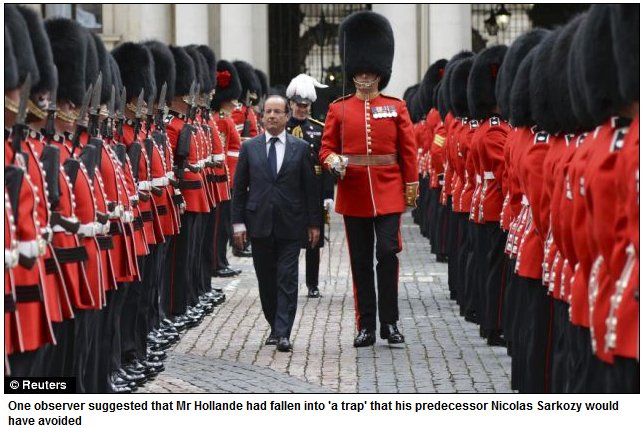
President Hollande “dwarfed” by Coldstream Guards

Filed under: Britain, Europe, France, Media, Military, Politics — Tags: , , — Nicholas @ 10:08

So much for a honeymoon period in office for French President Francois Hollande:

Francois Hollande was ridiculed today after allowing himself to look like a ‘dwarf’ alongside a British regiment which won battle honours at Waterloo and then occupied Paris.

During an official visit to London on Tuesday, the French President inspected a guard of honour from the 1st Battalion of the Coldstream Guards at the Foreign Office.

He then appeared in hugely embarrassing photographs alongside Major James Coleby, who looked around two feet taller than the Gallic head of state.

Comments alongside the image on a website of pictures taken by AFP, France’s national news agency, suggested Hollande had fallen into a ‘trap’ made to make him look ridiculous.

‘Poor France,’ wrote Jean-Marc Rameau, from Paris, while Dmitri Kovaley mocked Mr Hollande, who is 5ft 7ins, with the words ‘Dwarfs rule the world’.

H/T to Nicholas Packwood for the link.

« Newer PostsOlder Posts »

Powered by WordPress

