
Quotulatiousness

July 11, 2012

Antony Beevor’s latest book

Filed under: Asia, Books, Europe, History, Military, Pacific, WW2 — Tags: , — Nicholas @ 00:02

In History Today, Roger Moorhouse talks to Antony Beevor on his latest booK:

I asked what novelties of approach or new material he employed for the book? Did he, for instance, set out to try to draw the two traditionally distinct narratives of the war in the Pacific and the war in Europe into a single integral whole? Though he does make a nod in that direction, Beevor believes that such an approach is not really feasible, adding that the war in the Pacific was ‘almost like a war on another planet’, such was its separation from events in Europe. ‘I was fascinated,’ he went on, ‘by the reaction of the US Marines on Okinawa when they heard about the surrender of Germany. It was “Who cares?” For them it was impossible to imagine, just as it was impossible for the people fighting in the snows of Russia to imagine war in the Pacific Islands.’

If the approach is largely conventional, the book does not lack new information. Russian sources are still yielding fascinating material, he notes, despite political retrenchment, while German scholarship is throwing up new approaches and new resources, such as the archive of Feldpostbriefe (soldiers ‘field post’ letters) in Stuttgart. Beevor’s most interesting revelation, however, is the horrific contention that the Japanese army practised organised cannibalism. As he explains: ‘Allied prisoners, especially Indian army prisoners, were kept as sort of human cattle and slaughtered one by one for their meat.’ News of such crimes was largely suppressed after the war, as it was considered ‘too awful even to be mentioned in the war crimes trials’, but has since been brought to light by Japanese historians.

[. . .]

Of course the heart of Beevor’s appeal is precisely that straightforward narrative approach, coupled with his lively, engaging style and his use of memorable, almost cinematic, set-pieces. I put it to him that, in tackling a book of this scope, perhaps he had been obliged to rein in some of those literary flourishes. ‘You are right,’ he conceded. ‘There is so much more to tell and there is much less room for the vignette, but it is still terribly important, serving to root the reader in the reality of the moment.’ He is swift to acknowledge a debt to John Keegan in this regard, under whom he studied at Sandhurst and whose The Face of Battle (1976) was hugely influential. ‘It is absolutely vital to give the reader a frequent reminder of what it was actually like, the view from below, otherwise it’s just history from above, which never really works.’

July 9, 2012

The constipated British housing market

Filed under: Britain, Bureaucracy, Business, Economics, Government — Tags: , , — Nicholas @ 09:33

Tim Harford’s weekend column on the state of Britain’s housing market and a possible solution to the disconnect between supply and demand:

The chief obstacle to house building in the UK is the planning system, which, 65 years ago, did away with the idea that if you owned land, you could build on it, and replaced it with a system where planning permission was required. Permission to build houses is severely rationed, and such rationing can be seen clearly in the gap between the value of agricultural land without planning permission (a few thousand pounds a hectare) and the value of such land once permission has been granted (a few million).

The difficulty is that local authorities have the ability to grant planning permission but have little incentive to do so, because it tends to be unpopular with existing voters. The huge windfall from winning planning permission falls to whoever has managed to speculate on land and navigate the tangle of planning rules. These serve as nice barriers to entry for existing developers, while driving up the price of building land and so driving down the size of new homes.

Tim Leunig, chief economist at CentreForum, a think-tank, has proposed a two-part system of land auctions to get around this problem. Local authorities would buy land at auction, grant planning permission on it and then sell the land on to developers — with some strings attached, if they so choose. The profits would be enormous, and enjoyed by existing residents in the form of lower taxes or better public services. This isn’t the only way to liberalise planning, but it retains local control and democratic accountability — while dramatically increasing the incentive to develop.

Restoring a free market right to build on property you own would also be a fast solution to the diminished housing supply, but when have governments at any level willingly given up power?

July 8, 2012

Economic land mines laid by Blair and Brown’s governments exploding now

Filed under: Britain, Economics, Government — Tags: , , , , , — Nicholas @ 10:34

At The Commentator, John Phelan wonders if it’s now time for “an economic Nuremburg” for the 1997-2010 British governments of Tony Blair and Gordon Brown:

Like an iceberg, the extent of the damage wrought by the last Labour government is still becoming apparent.

One of the wheezes Labour used to camouflage its vast spending spree was the Private Finance Initiative. These had been brought in by John Major’s Conservatives (to criticism from the then Labour opposition) and involved a private sector entity building something and then selling it or leasing back to the government over a number of years, usually decades.

Upon winning the election in 1997 however, Labour performed a volte face and embraced PFIs. They appealed to Gordon Brown because the liabilities taken on under PFIs would not show up on the government’s balance sheet. In other words, they wouldn’t be included in the national debt figure.

Labour signed up to an estimated £229 billion of PFI projects. That’s almost two and a half times the entire projected budget deficit for 2012 – 2013, or 16 percent of GDP.

[. . .]

Indeed, like the cat who leaves little ‘presents’ around the house for you to discover when you return from holiday, the Labour government of 1997 to 2010 is the gift that keeps on crapping on your carpet. We will be discovering fiscal turds left by Labour for literally decades to come.

If you were being charitable you would ascribe the fiscal incontinence of the Blair/Brown governments to some sort of Keynesian economic theory, though that fails to explain why they applied fiscal ‘stimulus’ for seven years to an already growing economy.

If you were being slightly less charitable you might ascribe it to incompetence of a quite staggering degree. The last Labour government, after all, were probably the biggest set of mediocre idiots ever to govern this country.

And, if you were being even less charitable, you might ascribe it to something more sinister – Brown poisoning the wells when he heard opposition tanks at the end of his strasse.

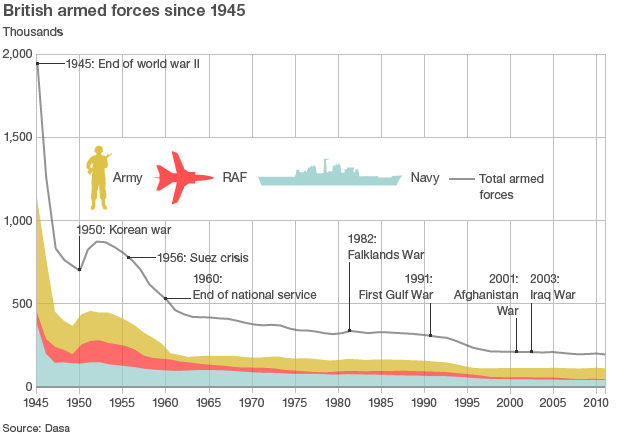
Britain’s “two-tier” army after the recently announced cuts

Filed under: Britain, Military — Tags: , — Nicholas @ 00:49

At the Thin Pinstriped Line, Sir Humphrey looks at some of the potential problems the reconfigured British army may face:

In summary, the Army will comprise two very distinct elements, the so-called ‘Reaction Force’ and the ‘Adaptable Force’. The Reaction Force will comprise what appears to be a slimmed down Armoured Division, built around three brigades, and augmented by 16 Air Assault Brigade (and effectively 3 Commando Brigade) plus supporting units to provide the short notice rapid response capability. The Adaptable Force is built around those units which are held at longer readiness to move, and which will provide the routine garrison, training and roulement duties. Within this structure some units will be held at different levels of readiness depending on how the security situation looks. Essential to this plan is the use of some 30,000 trained Army Reserve personnel to augment both forces, through a bolstered set of employment rules.

[. . .]

That said, there are real challenges that will need to be overcome in order to make this a success. From the outset real leadership is going to be needed to avoid the accusation and emergence of a ‘two-tier army’. It seems clear from looking at the wiring diagrams that large swathes of the Infantry and supporting units is going to be working under what was previously seen as the Regional Forces. Assuming that the Arms Plot has not been reintroduced, and that battalions will remain locked into their roles, it is going to take a lot of effort to convince people to join a unit which is posted to the ‘Adaptable Forces’. Who is going to want to join the part of the Army that is unlikely to deploy anywhere exciting, or where deployment is likely to be peace keeping, and not high intensity warfare? It will be a real blow to the morale of many soldiers if they perceive that their soldiering careers are in future going to be spent on Salisbury plain practising feeding Orphans or watching fake militias simulate slaughtering innocent civilians whilst they have to stand and watch in accordance with their UN ROE. Meanwhile their peers in the Reaction Forces will be charging around playing with the best equipment, newest kit, and better deployment prospects.

The Army manning cell at Glasgow is going to have to come up with a very good way of ensuring that those who join for a career regularly cross between the two forces. There already exists a sense of ‘them and us’ between the Regional Forces and the rest of the Army. One feels that this will only get worse over time, particularly if deployments go to units such as the Paras or Guards, which enjoy better publicity in the eye of politicians.

The danger is that the best posts get earmarked for the high flyers, and that over time the Officer Corps will emerge with the best and brightest occupying all the promotion jobs, while everyone else is left to stay in the Adaptable Forces. This could lead to a real challenge as good officers walk early, not leaving sufficient leadership across the Army as a whole.

July 5, 2012

British army reduces and consolidates 17 units

Filed under: Britain, Military — Tags: , , , — Nicholas @ 09:47

As reported earlier, the British army will be losing several battalions of infantry in the consolidation effort to reduce the army’s total manpower by 20,000:

The four infantry battalions to disappear are the 2nd Battalion the Royal Regiment of Fusiliers, the 2nd Battalion the Yorkshire Regiment (Green Howards), the 3rd Battalion the Mercian Regiment and the 2nd Battalion the Royal Welsh.

A fifth infantry battalion, the 5th Battalion the Royal Regiment of Scotland (Argyll and Sutherland Highlanders), will become a single company to carry out public duties in Scotland.

The Armoured Corps will be reduced by two units with the mergers of the Queen’s Royal Lancers and the 9th/12th Royal Lancers and the 1st and 2nd Tank Regiments.

The Royal Artillery, the Royal Engineers, the Army Air Corps, the Royal Logistic Corps, the Royal Electrical and Mechanical Engineers and the Royal Military Police will also be affected.

[. . .]

Details of the other changes are:

  • The Royal Artillery will be reduced from 13 to 12 units with the withdrawal of the 39th Regiment Royal Artillery
  • The Royal Engineers will be reduced from 14 to 11 units with the withdrawal of 24 and 28 Engineer Regiments and 67 Works Group
  • The Army Air Corps will reduce from five to four units as 1 Regiment AAC merges with 9 Regiment AAC
  • The Royal Logistic Corps will be reduced from 15 to 12 units with 1 and 2 Logistic Support Regiments withdrawn from the Order of Battle and 23 Pioneer Regiment disbanded
  • The Royal Electrical and Mechanical Engineers will be reduced to seven units with the withdrawal of 101 Force Support Battalion
  • 5 Regiment Royal Military Police will be removed

Update: As you’d expect, the changes are not being welcomed by current or former soldiers.

The reforms have caused anger and frustration within senior ranks. Earlier this week, a leaked letter to General Wall from one senior officer in the Royal Fusiliers showed the anger brewing over the scale of the proposed cuts.

Brigadier David Paterson, the honorary Colonel of the Regiment of Fusiliers, said the decision to axe one of its battalions would not “best serve” the armed forces and “cannot be presented as the best or most sensible military option”.

He added: “I, as Colonel, have the duty to tell my men why it is their battalion, which at the time of the announcement will be the best manned battalion in the army, with recruits waiting in the wings, was chosen by CGS. I will then also have to explain to my Fusiliers in a fully manned battalion why they are likely to be posted to battalions that cannot recruit. This will not be an easy sell.”

July 4, 2012

ACTA rejected decisively by European Parliament

Filed under: Europe, Law, Media — Tags: , , , , — Nicholas @ 09:37

Apparently even the insulated, protected European Parliament can be moved if enough people are actively against something — in this case it was the Anti-Counterfeiting Trade Agreement (ACTA). Michael Geist explains:

When ACTA was formally signed by most participants in October 2011 in Tokyo, few would have anticipated that less than a year later, the treaty would face massive public protests and abandonment by leading countries. But with tens of thousands taking to the streets in Europe earlier this year, ACTA became the poster child for secretive, one-sided IP agreements that do not reflect the views and hopes of the broader public. This morning, the European Parliament voted overwhelmingly against the agreement, effectively killing ACTA within the EU. The vote was 478 against, 39 in favour, with 165 abstentions. This is a remarkable development that was virtually unthinkable even a year ago. Much credit goes to the thousands of Europeans who spoke out against ACTA and to the Members of the European Parliament who withstood enormous political pressure to vote against the deal.

The European developments have had a ripple effect, with the recent Australian parliamentary committee recommendation to delay ACTA ratification and the mounting opposition around the world. ACTA is not yet dead — it may still eke out the necessary six ratifications in a year or two for it to take effect — but it is badly damaged and will seemingly never achieve the goals of its supporters as a model for other countries to adopt and to emerge as a new global standard for IP enforcement. That said, ACTA supporters will not take today’s decision as the final verdict. In the coming weeks and months, we can expect new efforts to revive the agreement within Europe and to find alternative means to implement its provisions. That suggests the fight will continue, but for today, it is worth celebrating how the seemingly impossible — stopping a one-sided, secretly negotiated global IP agreement — became possible.

This has been referred to as the biggest parliamentary defeat ever for a European Commission initiative. In theory, the ACTA treaty cannot be enacted into EU law without being approved by the European Parliament (although, as we’ve seen before, the EU is adept at getting around minor inconveniences like referenda and recalcitrant national governments).

British banks are “a cossetted, subsidised industry with captive consumers”

Filed under: Britain, Economics, Government — Tags: , , , — Nicholas @ 08:46

If any industry has more than its fair share of “too big to fail” wards of the state, it’s the banking sector. Allister Heath in the Telegraph:

There is a horrendous problem, certainly, and urgent reform is required. But the ailment has been fundamentally misdiagnosed: banking has become a ward of the state, a cossetted, subsidised industry with captive consumers, and it is that which has crippled it. We have been there before, in other sectors, and the medicine is always the same. This may come as a shock, but we need more capitalism in banking, not less.

Banks need to be allowed to go bust, like every other private company. It was a disgrace that taxpayers were called upon to bail out some of the City’s grandest names. This must never happen again. The reason capitalism works so well, whenever it is tried properly, is that the principle at its heart — profit and loss — is the toughest of disciplines and the best of motivators. It is more ruthless than anything regulators, however clever, could ever dream up. It allows two conflicting emotions, greed and fear, to balance one another out. Shareholders, creditors and bosses want to make money — but they know that a step too far might entail ruin.

That, at least, is how it works for much of UK Plc — but no longer in banking, where profits have been privatised and losses nationalised. It is an obscene perversion of capitalism. Forget the nonsense about “light touch” regulation: the problem is that the fear of failure ceased to exist. Market discipline was replaced by extreme laxity.

There was no longer much need for prudence, proper capital buffers or strict internal controls: the taxpayer was ready to pick up the bill if anything went wrong, while incompetent regulators signed everything off. The Labour government which introduced this mad system wasn’t deliberately seeking to subsidise risk: it merely made a terrible mistake, though with the politically useful side effect of reducing the cost of credit and increasing its availability. The real blunder was that the Financial Services Authority had no plan to cope with a bank going bust. It simply assumed failure would never happen. After all, how could it? Gordon Brown had abolished booms and busts.

July 3, 2012

Details of British army cuts leaked

Filed under: Britain, Military — Tags: , — Nicholas @ 09:19

The Guardian has some details on the upcoming cuts to the British army, which will include the elimination of several battalions of infantry and the merging of some armoured regiments:

The acrimony and chaos surrounding plans to cut 20,000 troops from the army have been laid bare after details of the battalions to be scrapped were leaked before a ministerial statement on Thursday.

The proposals, whose publication has been delayed by Downing Street because of their sensitivity, show historic units to be axed include the third battalion of the Yorkshire regiment and the Argyll and Sutherland Highlanders, the fifth battalion of the Royal Regiment of Scotland. One battalion will be lost from the Royal Welsh, the Mercians and the Royal Fusiliers.

[. . .]

Official letters to army commanders were sent out on Tuesday, ready for the announcement in parliament by the defence secretary, Philip Hammond. The hope had been that soldiers would hear about the cuts from senior officers, but this has been dashed by the leak in Tuesday’s Sun.

[. . .]

The army is losing a fifth of its overall strength because of budget cuts and restructuring set out in the much criticised 2010 Strategic Defence and Security Review.

A subsequent MoD re-evaluation — last year’s so-called “three-month exercise” — more than doubled the number of troops to be lost to 20,000.

[. . .]

The battalions to be saved include the Royal Scots Dragoon Guards, the Queen’s Dragoon Guards and the Royal Dragoon Guards. The Parachute Regiment’s three battalions will be spared.

Under the proposals, the Queen’s Royal Lancers will be merged with the 9th/12th Lancers, and the 1st Royal Tank Regiment with the 2nd Royal Tank Regiment.

“The longer the euro area’s debt crisis drags on, the more it resembles an instrument of economic torture”

Filed under: Economics, Europe — Tags: , , , , , — Nicholas @ 08:47

The Economist on the long-drawn-out European financial mess:

THE longer the euro area’s debt crisis drags on, the more it resembles an instrument of economic torture. Like the medieval rack, every turn of the crisis tears Europe further apart. This week Cyprus announced it would seek a bail-out. Spain formally asked for money to recapitalise its banks. The Greek limb is close to being ripped off. How long can the Italian one hold?

Monetary union was meant to be a blessing. The euro’s founders dreamed that it would end chronic and divisive currency crises, promote growth and multiply Europe’s economic power. After the creation of the single market, the euro was the next step toward political union.

[. . .]

Now, after first blaming speculators, then profligate states, then, more broadly Europe’s lack of competitiveness, the cardinals of monetary union have belatedly come to understand that the main problem is the euro itself. A new report by a group of prominent economists — sponsored by Jacques Delors, the former president of the European Commission, and Helmut Schmidt, the former German chancellor — describes in telling detail how the euro is destroying itself.

Start with the European Central Bank’s “one size fits all” interest rate, which the report’s leading author, Henrik Enderlein of the Hertie School of Governance in Berlin, relabels a “one size fits none” rate. Differences in inflation are magnified: in countries with higher-than-average inflation (eg, Italy), the real interest is too low, fuelling more inflation; the opposite is true in countries where inflation is low (eg, Germany). Another problem is that the single market is far from complete, so that competition does not even out price differences across the EU. The market in services, which represents the biggest share of economic output, is still fragmented. Moreover, European workers are less likely to move in search of jobs than, say, American ones. A further curse is that countries of the euro zone do not independently control their own money. Because each lacks its own central bank to act as a lender of last resort, troubled countries can more easily be pushed into default as markets panic. Lastly, cross-border financial integration has spread far enough to channel contagion from one country to another, but not so far as to break the cycle of weak banks and weak sovereigns bringing each other down.

July 1, 2012

The Royal Navy’s successful privatization effort

Filed under: Britain, Business, Economics, Military — Tags: , , — Nicholas @ 00:04

Even the most dogmatic libertarian would be hard-pressed to defend the notion of privatizing the fighting navy, but the rest of the navy (training, support, maintenance, etc.) can in some instances be privatized not only without impacting military efficiency, but actually boosting it:

The Royal Maritime Auxiliary Service (RMAS) was privatised and taken over by Serco back in the 1990s and run for profit. To this day, Serco Denholm are responsible for the provision of all manner of auxiliary services, ranging from tugs and tender transfers, through to torpedo recovery craft, exercise minelayers and range target vessels.

All in all, there are easily over 100 vessels which can be found primarily in naval bases, but also in other establishments such as the Kyle of Lochalsh, around the UK. This fleet of vessels is an important reason to be positive for two reasons. Firstly, many navies rely on their own personnel to man and operate these vessels. When they need replacing, these costs are funded from naval budgets, and not from a wider contract fund. Similarly, the manpower needed to operate them comes from the Navy, and not from the private sector, meaning more sailors are needed to do this sort of job, and not go to sea on a ‘proper’ military vessel. By contracting out the service, the RN is able to focus its resources and manpower on proper military vessels, and not have to worry about finding funds to replace elderly tugs, at a time when it wants to bring frigates into service. It is not remotely glamorous, but it is an essential part of operating a Navy, and one that is often forgotten.

Also forgotten is just how new this fleet is — there has been a huge amount of investment in the port services fleet in recent years, with literally dozens of craft (Humphrey read something saying over 80 new vessels were being ordered) being built and entering service. The RN has managed to acquire the services of one of the most modern and effective port support vessels fleets in the world. This would not have happened if the RN were still looking after the RMAS — instead, by privatising it, the funding instead has brought new ships and better capabilities into service, at a reduced cost to the taxpayer. This matters because without it, the RN would be reliant on ever older ships, or finding scarce equipment programme funds to pay for them. (For those interested in the ships in service now, try this link — http://www.rfanostalgia.org/gallery3/index.php/RMAS)

June 28, 2012

Duleep Allirajah: “Penalties. Again. Jesus, it’s like bloody Groundhog Day.”

Filed under: Britain, Europe, Soccer — Tags: , , , — Nicholas @ 09:16

More cogitation on England’s inglorious record of penalty kick performance:

Why do England always lose on penalties? It’s like one of those big ontological questions which children ask — like ‘Why is the sky blue?’ — which invariably stump parents. These are self-evident truths, but we struggle to explain them. The players practice spot-kicks regularly. The goalkeepers meticulously study the penalty traits of their opponents. And yet we always, always bottle it. Why? Roy Hodgson was at a loss to explain what went wrong. ‘I don’t know how to answer why we cannot win penalties shootouts. It can go either way. It is a difficult one. Anyone can win’, he said. ‘I think penalties is always down to luck. It is a lottery. It is just the way it goes in football.’

It’s an old cliché that penalties are a lottery. It also happens to be nonsense, as I’ve argued before. Sure, luck plays a part. But, ultimately, penalty shootouts are tests of psychological strength. They are won and lost in the mind. It’s all about keeping focused, banishing the doubts and holding one’s nerve under extreme pressure. Easier said than done, of course, but successive penalty shootout defeats are imprinted on our sporting psyche. The inevitability of failure has become a myth that all of us — footballers included — have come to believe. Did you see the terror in Ashley Young’s face as he was about to take his ill-fated kick? The ghosts of all those missed penalties had returned to haunt him.

Invariably, a motley crew of psychologists, positive-thinking gurus and snake-oil sellers will be forming a queue outside FA headquarters, offering cures for the English penalty curse. I think there’s a simpler solution. Let’s campaign for spot kicks to be scrapped. We should use whatever arguments we think might work. I’d play the inclusion card. Penalty kicks clearly discriminate against the mentally frail. The English, who suffer from a collective, penalty-induced trauma, will always get a raw deal. How can that be fair? If FIFA wants a truly level playing field, the answer is to get rid of the pseudo-lottery of spot kicks. What we need is a proper lottery. We don’t want skill or nerve to play any part. Tossing a coin, rolling dice, drawing straws, a game of scissor-paper-stone — anything is better than a shootout. Come on Mr Blatter, give us chokers a chance.

June 27, 2012

John Kay on the evils of rent-seeking

Filed under: Economics, Germany, Government, Politics — Tags: , , , , — Nicholas @ 08:08

Broadly speaking, wealth can be accumulated in two distinctly different ways. It can be earned through hard work, innovation, and competition, or it can be extracted from the public by use of coercive methods, corruption, and misappropriation:

Whatever the true extent of the Mubarak family fortune, it stands in stark contrast to the lot of most Egyptians. Gross domestic product per capita in Egypt is a mere $2,500. In western Europe and North America GDP per capita is about $40,000, yet the capacities of Egypt’s intellectual and entrepreneurial elite are the rival of any state in the world.

The real damage imposed by men such as Mr Mubarak is not the money they might have stolen. The tragedy is that the system that enables them to steal it destroys opportunities for others to generate wealth — not only for themselves but for the whole population.

The price of requiring a potential Mark Zuckerberg or Mr Gates to pay a $100 bribe to each of 10 officials before he can establish his new business is not the $1,000 creamed off by corrupt bureaucrats. It is the far greater one of lost businesses that never came into being because the licensing process that makes such corruption possible was not navigated. In the meantime, people who might be successful entrepreneurs choose instead to seek political power. If business is endlessly frustrating and politics endlessly rewarding, the career choice for able and enterprising people is obvious.

Institutions are the key influence on economic prosperity — West Germany did not outperform East Germany because of its excellent monetary policies. And, as Daron Acemoglou and James Robinson point out in their book, Why Nations Fail, a critical feature of successful economic institutions is that they limit the scope for what these authors call “extractive activity” — others have described it as predation or rent-seeking — which appropriates the wealth created by other people.

June 26, 2012

Poland’s uneasy WW2 history

Filed under: Books, Europe, Germany, History, Media, WW2 — Tags: , , — Nicholas @ 09:39

Poles are being told unwelcome things about the country’s experiences under Nazi rule. The most recent upheavals have been triggered by the publication of a new book by Jan T. Gross:

Its title, Golden Harvest, stems from a cover photograph that purportedly shows Polish peasants who have been digging through remains of victims killed at Treblinka, where 800,000 Jews were gassed and cremated, to find gold or valuable stones neglected by the Nazis.

From there, Mr. Gross narrates events beyond the barbed wire of Nazi death camps. He describes Poles hunting Jews down, extorting money from them, massacring them, and profiting by taking over their jobs and property. Some 3.3 million Jews lived in Poland before the war began, and about 90 percent had perished by its end.

“There was a sense of satisfaction that was quite widespread that they are being eliminated from Polish economic and social life,” Mr. Gross says in a phone interview from Kraków, where he is teaching a summer course for Princeton students. “When given the opportunity, a large number of Poles participated in victimization of Jews.”

[. . .]

The white-haired, New York-based writer, 64, enjoys a level of notoriety in his native country that lacks any analogue among American historians. When word gets out that he is publishing a new book, anxiety spreads about what dirty laundry he will expose this time. His writing gets discussed on prime-time TV.

Mr. Gross “polarizes public opinion probably more than anyone else outside of the political world,” says Jan Grabowski, a Holocaust historian who splits his time between the University of Ottawa and Poland.

His books have struck such a nerve because they cut against the national narrative that Poland is exclusively a victim of history, not a victimizer.

Railway engineering, 1947 style

Filed under: Britain, History, Railways, Technology — Tags: , , — Nicholas @ 00:03

London, Midland & Scottish Railway documentary that shows the relaying of St. Pancras Junction with prefabricated trackwork, along with the associated changes to the signalling system.

What struck me while watching this was the ages of most of the track crew: I’d have expected them to be a bunch of teens-to-early 20’s guys, but there are a lot of old gaffers still doing the heavy lifting here. Oh, and of course the work clothes: caps, hats, jackets, and braces. Not a hard hat or much in the way of obvious safety gear in sight. They may or may not have been better men in those days, but they earned their aches and pains honestly.

H/T to Roger Henry for the link, who pointed out “This will get your pulses racing. Also makes you realize that working on the railroad was for real men. Mechanisation has come a looong way since then.”.

June 25, 2012

The rot began at the top: Britain’s rotten state

Filed under: Britain, Government, Media, Politics — Tags: , , , , — Nicholas @ 09:06

David Conway reviews The Rotten State of Britain by Eamonn Butler:

In fourteen pithy, well-documented chapters, Butler guides the reader through the maze of political, economic and social changes to which New Labour subjected Britain during their period in office. After noting that ‘the rot starts from the top’, Butler summarize the main political changes the country was made to undergo so:

‘From Magna Carta in 1215, our rights and liberties have been built up over the centuries. Trial by jury, habeas corpus, the presumption of innocence — all these and more grew up to restrain our leaders and prevent them from harassing us. Yet within a decade almost all these protections have been diluted or discarded. Our leaders are no longer restrained by the rule of law at all [22]…The Prime Minister and colleagues in Downing Street decide what is good for us and then it’s nodded through Parliament. It’s hardly democracy: it’s a centralist autocracy.’ [31]

One by one, Butler explains how each of the country’s traditional constitutional restraints on uncurbed executive power was deliberately weakened, if not altogether discarded, by New Labor in pursuit of their master political project which was, having come to equate the national good with that of their own party, to perpetuate their hegemony indefinitely. Their first step was to effect a massive centralization of power in the hands of the Prime Minister and a small clique of unelected advisors that led to a systematic downgrading of Parliament, the Cabinet and civil service.

To observers of the Canadian system, this critique sounds hauntingly familiar: change “Downing Street” to “Sussex Drive” and it’s equally valid here. Some of the centralization was already well underway before 2001, but it was accelerated by terrorist attacks and governments’ response to them:

9/11 also served New Labor, Butler argues, as a pretext for making a power-grab in the name of security that turned Britain into ‘a surveillance state’ where ‘freedom exists only in name’. [106] He chillingly observes:

‘Of course, the terrorism threat is real… But in response, we seem to have given our government powers to track us anywhere, stop and search us in the street, arrest us for any imagined offense, imprison us for peaceful protest, hold us without charge for 28 days, extradite us to the United State without evidence, ban us for being members of non-violent organizations that they don’t happen to like, export us to other EU countries to stand trial for things that aren’t a crime here, take and file our DNA samples before we’ve been convicted, charged or even cautioned for any offense — and much more as well. In the name of defending our liberties against terrorism, we seem to have lost them.’ [92-93]

« Newer PostsOlder Posts »

Powered by WordPress

