
Quotulatiousness

June 25, 2012

The rot began at the top: Britain’s rotten state

Filed under: Britain, Government, Media, Politics — Tags: , , , , — Nicholas @ 09:06

David Conway reviews The Rotten State of Britain by Eamonn Butler:

In fourteen pithy, well-documented chapters, Butler guides the reader through the maze of political, economic and social changes to which New Labour subjected Britain during their period in office. After noting that ‘the rot starts from the top’, Butler summarize the main political changes the country was made to undergo so:

‘From Magna Carta in 1215, our rights and liberties have been built up over the centuries. Trial by jury, habeas corpus, the presumption of innocence — all these and more grew up to restrain our leaders and prevent them from harassing us. Yet within a decade almost all these protections have been diluted or discarded. Our leaders are no longer restrained by the rule of law at all [22]…The Prime Minister and colleagues in Downing Street decide what is good for us and then it’s nodded through Parliament. It’s hardly democracy: it’s a centralist autocracy.’ [31]

One by one, Butler explains how each of the country’s traditional constitutional restraints on uncurbed executive power was deliberately weakened, if not altogether discarded, by New Labor in pursuit of their master political project which was, having come to equate the national good with that of their own party, to perpetuate their hegemony indefinitely. Their first step was to effect a massive centralization of power in the hands of the Prime Minister and a small clique of unelected advisors that led to a systematic downgrading of Parliament, the Cabinet and civil service.

To observers of the Canadian system, this critique sounds hauntingly familiar: change “Downing Street” to “Sussex Drive” and it’s equally valid here. Some of the centralization was already well underway before 2001, but it was accelerated by terrorist attacks and governments’ response to them:

9/11 also served New Labor, Butler argues, as a pretext for making a power-grab in the name of security that turned Britain into ‘a surveillance state’ where ‘freedom exists only in name’. [106] He chillingly observes:

‘Of course, the terrorism threat is real… But in response, we seem to have given our government powers to track us anywhere, stop and search us in the street, arrest us for any imagined offense, imprison us for peaceful protest, hold us without charge for 28 days, extradite us to the United State without evidence, ban us for being members of non-violent organizations that they don’t happen to like, export us to other EU countries to stand trial for things that aren’t a crime here, take and file our DNA samples before we’ve been convicted, charged or even cautioned for any offense — and much more as well. In the name of defending our liberties against terrorism, we seem to have lost them.’ [92-93]
Euro 2012: “I can take the despair. It’s the hope I can’t stand.”

Filed under: Britain, Europe, Italy, Soccer — Tags: — Nicholas @ 07:58

I watched yesterday’s game with a deep sense of foreboding … that it just might come down to penalties. Again. Richard Littlejohn obviously felt the same way:

We might have guessed it was always going to come down to penalties. We’ve been here before.

There was a grim inevitability about England’s elimination from Euro 2012 on penalties. And Italy deserved their victory. But that’s not to pretend it still doesn’t hurt.

Every two years, I kid myself I don’t care. Why invest emotional energy in a bunch of footballers? It’s only a game.

When England kicked off against France 10 days ago, I feigned indifference. So what if England lose? Life goes on. World Cups, European Championships, it’s bound to end in tears.

But England didn’t lose. They drew with France, beat Sweden and Ukraine, finished top of their group and qualified for the quarter finals. Suddenly, it mattered. Three more wins and four and a half decades of bitter disappointment and under-achievement would be consigned to history. Football’s coming home.

Against my better judgment and years of experience I discovered I did care after all. As England progressed and last night’s game against Italy approached, the pulse began to quicken, the optimism returned. This time we really could be in with a chance.

To be honest, it was better when England stuck to the script and crashed out of tournaments prematurely, consumed by hubris and an inflated sense of their own abilities. We’re used to being let down. We can handle it. As John Cleese said in the movie Clockwise: ‘I can take the despair. It’s the hope I can’t stand.’

H/T to Nick Packwood for the link.

June 24, 2012

Conrad Black: Don’t blame Canada

Filed under: Cancon, Economics, Europe, Government — Tags: , , , , , , — Nicholas @ 08:45

In his weekly column at the National Post, Conrad Black refutes Jose Manuel Barroso (who appeared to refer to Prime Minister Harper as a “nobody” recently) that the European crisis was made in North America:

Stephen Harper is absolutely correct to refuse to contribute to World Bank assistance to Europe. The reward for the consistently intelligent fiscal management of Canada by both governing parties for more than 20 years should not be to assist rich countries that ignored our example and the warnings of their own wiser statesmen until the wheels came off the Euro-fable in all four directions.

The president of the European Commission, Jose Manuel Barroso, made the point at the G20 meeting in Mexico last week — in, as he thought, a reply to Harper’s comments on Europe’s self-generated economic and fiscal problems — that the current economic crisis originated in North America. That is not entirely true. It originated in the ill-starred fiscal and social policies of most European countries, and the tinder was set alight by bad financial, social, fiscal and regulatory policy in the United States.

Margaret Thatcher, Angela Merkel, and even Gerhard Schroeder, as well as a number of Austrian, Dutch, and Scandinavian leaders all warned that Europe could not continue to guarantee employment to all job-holders as a steadily shrinking percentage of Europeans worked and the public sector share of GDP rose, infused with the steroids of over-bountiful social democracy. Most countries of Europe today are like the little pigs who didn’t build their homes from weather-proof materials.

Furthermore, it is no rejoinder to Mr. Harper to complain about the Americans. It would be no less logical to blame the floundering of Dalton McGuinty’s Ontario on booming Texas, since both jurisdictions are in North America. In the same line of reasoning, I would like Newfoundland’s involvement in the drug wars in Mexico fully examined.

June 23, 2012

The Turing inquest verdict of suicide may not have been consistent with the evidence

Filed under: Britain, History, Law — Tags: , , — Nicholas @ 08:46

Brilliant mathematician Alan Turing died in an apparent suicide after undergoing chemical castration, but the inquest seems to have rushed to a conclusion:

At a conference in Oxford on Saturday, Turing expert Prof Jack Copeland will question the evidence that was presented at the 1954 inquest.

He believes the evidence would not today be accepted as sufficient to establish a suicide verdict.

Indeed, he argues, Turing’s death may equally probably have been an accident.

[. . .]

The motive for suicide is easy to imagine. In 1952, after he had reported a petty burglary, Turing found himself being investigated for “acts of gross indecency” after he revealed he had had a male lover in his house.

Faced with the prospect of imprisonment, and perhaps with it the loss of the mathematics post he held at Manchester University, which gave him access to one of the world’s only computers, Turing accepted the alternative of “chemical castration” — hormone treatment that was supposed to suppress his sexual urges.

It is often repeated that the chemicals caused him to grow breasts, though Turing is only known to have mentioned this once.

[. . .]

In his authoritative biography, Andrew Hodges suggests that the experiment was a ruse to disguise suicide, a scenario Turing had apparently mentioned to a friend in the past.

But Jack Copeland argues the evidence should be taken at face value — that an accidental death is certainly consistent with all the currently known circumstances.

The problem, he complains, is that the investigation was conducted so poorly that even murder cannot be ruled out. An “open verdict”, recognising this degree of ignorance, would be his preferred position.

None of this excuses the treatment of Turing during his final years, says Prof Copeland.

June 22, 2012

Greek government getting serious about debt issues: selling off government land

Filed under: Economics, Europe, Government, Greece, Railways — Tags: , , — Nicholas @ 10:18

It’s surprising it’s taken this long for the Greek government to consider selling off excess government-owned land as a way to address some of their debt issues:

There’s little that shouts “seriously rich” as much as a little island in the sun to call your own. For Sir Richard Branson it is Neckar in the Caribbean, the billionaire Barclay brothers prefer Brecqhou in the Channel Islands, while Aristotle Onassis married Jackie Kennedy on Skorpios, his Greek hideway.

Now Greece is making it easier for the rich and famous to fulfill their dreams by preparing to sell, or offering long-term leases on, some of its 6,000 sunkissed islands in a desperate attempt to repay its mountainous debts.

The Guardian has learned that an area in Mykonos, one of Greece’s top tourist destinations, is one of the sites for sale. The area is one-third owned by the government, which is looking for a buyer willing to inject capital and develop a luxury tourism complex, according to a source close to the negotiations.

However, if you’re in the market for a lovely little Greek island, you should also consider that land costs are going to be only a small part of your investment:

Only 227 Greek islands are populated and the decision to press ahead with potential sales has also been driven by the inability of the state to develop basic infrastructure, or police most of its islands. The hope is that the sale or long-term lease of some islands will attract investment that will generate jobs and taxable income.

Also on the block for sale are other government monopolies:

In its battle to raise funds, the country is also planning to sell its rail and water companies. Chinese investors are understood to be interested in the Greek train system, as they already control some of the ports. In a deal announced earlier this month, the Greek government also agreed to export olive oil to China.

Update: Ah, I didn’t notice that the article had originally been published in 2010, hence my expressed surprise that it had taken so long for these measures to be considered.

Charities: the Trojan Horse for expansion of government

Filed under: Britain, Bureaucracy, Government — Tags: , , — Nicholas @ 08:51

Some charities are still what they were twenty years ago: organizations that provide help to those in need. Others, however, have morphed into specialized entities that exist primarily to lobby the government for more funds … to allow them to lobby more efficiently:

The relationship between charities and the British state has been significantly transformed in the past 15 years. There is a gulf between the public’s perception of what is charitable – a traditional view still dominated by visions of self-sacrificing volunteers and jumble sales – and the third sector’s view of itself as a more caring, semi-professional wing of the state. The public can be forgiven for being confused about a ‘voluntary sector’ that, according to a 2009 report for the National Council for Voluntary Organisations (NCVO), employs more than 600,000 people. The public might equally be puzzled by the plethora of ‘non-governmental’ organisations which require an Office of the Third Sector to preside over them.

Between 1997 and 2005, the combined income of Britain’s charities nearly doubled, from £19.8 billion to £37.9 billion, with the biggest growth coming in grants and contracts from government departments. According to the Centre for Policy Studies, state funding rose by 38 per cent in the first years of the twenty-first century while private donations rose by just seven per cent.

This surge in government spending coincided with a politicisation of the third sector which was actively encouraged by the state apparatus from the prime minister down. Traditionally, lobbying activity could not be a charity’s ‘dominant’ activity, but could only be ‘incidental or ancillary’ to its charitable purpose. In 2002, however, a report from the Prime Minister’s Strategy Unit called for charities to increase their lobbying activity and for the Charity Commission guidelines to be made ‘less cautionary’: ‘Charities perform a valuable role in campaigning for social change. The guidelines on campaigning should be revised to encourage charities to play this role to the fullest extent.’

The Charity Commission duly revised its guidelines on campaigning two years later, allowing all non-party political campaigning in furtherance of a charity’s goals so long as this activity was not ‘the dominant method by which the organisation will pursue its apparently charitable objects’. A subsequent Cabinet Office report in 2007 called for the rules to be relaxed further still. Accepting that charities had ‘considerable latitude… for political campaigning under existing rules’, the authors expressed concern about the range of legal and regulatory restraints which ‘unjustifiably restricts political campaigning by third-sector organisations’. Stressing the right of charities ‘to undertake campaigns, regardless of any funding relationship with government’, the Cabinet Office argued that organisations whose purpose was wholly political should not be barred from charitable status: ‘Provided that the ultimate purpose remains demonstrably a charitable one, the government can see no objection, legal or other, to a charity pursuing that purpose wholly or mainly through political activities.’

There are still charities that do what most of us think of as “charity”, but far too many of them are just lobbying devices to accomplish political rather than charitable ends. There’s no reason to prevent organizations from political lobbying, but they should not benefit from the special tax status of genuine charities.

June 21, 2012

Canada’s recession, in one Tweet

Filed under: Cancon, Economics, Europe, USA — Tags: , , — Nicholas @ 12:16

Light to moderate drinking during pregnancy has no measurable health risks

Filed under: Europe, Health — Tags: , , , — Nicholas @ 09:26

As Radley Balko pointed out on Twitter, “Prediction: The activist public health crowd will go absolutely nuts over this study.” Jacob Sullum on a recent European health study:

Despite the familiar surgeon general’s warning advising women to abstain completely from alcoholic beverages during pregnancy “because of the risk of birth defects,” there has never been any solid evidence that light to moderate consumption harms the fetus (as Stanton Peele pointed out in Reason more than two decades ago). New research from Denmark, funded by the U.S. Centers for Disease Control and Prevention, indicates once again that heavy drinking is the real hazard. In a study of more than 1,600 women (“nearly a third of all Danish women who were pregnant between 1997 and 2003,” Maia Szalavitz notes in Time), children of women who consumed nine or more drinks per week during pregnancy had shorter attention spans and were five times as likely to have low IQs at age 5 than children of abstainers. But no such effects were apparent in the children of women whose alcohol consumption during pregnancy was light (one to four drinks per week) or moderate (five to eight drinks per week). “Our findings show that low to moderate drinking is not associated with adverse effects on the children aged 5,” the researchers said.

Szalavitz cautions that a “drink” as defined in this study contained 12 grams of pure ethanol, compared to the American standard of 14 grams, one-sixth more. Given the relatively wide consumption ranges, that difference probably does not matter much. Szalavitz also notes that, unlike earlier studies, this one asked women about their drinking while they were still pregnant, so the responses are less likely to be skewed by inaccurate recall. Still, self-reported drinking, especially by pregnant women, probably underestimates actual consumption, meaning that the amounts associated with no neurological impairment are apt to be bigger than those indicated by the study.

One of the issues with studies of this sort is the very need for self-reporting: most people, after a lifetime of public health warnings, will under-report their drinking (whether consciously or not). In this case, that’s a useful thing to provide some level of comfort in the findings: if most women in the study under-reported their actual intake of alcohol while pregnant, yet the children show no negative effects developmentally, we can concentrate on those few who really do over-indulge and whose children do suffer as a result.

Addressing society’s hypocrisy on drugs

There’s apparently a call in Britain for the police to be given discretionary powers in certain cases where they could push civil rather than criminal penalties for drug offences. A better solution would be to fix the massive disconnect between the law and reality:

‘Ease drug penalties on the young,” a government adviser has urged. And of course, Professor Les Iversen, chairman of the Advisory Council on the Misuse of Drugs, is absolutely right. After all, if every young man who had dabbled with drugs had felt the fullest penalty of the law, then David Cameron would not be prime minister nor Barack Obama US president.

But in my view, Les Iversen doesn’t go nearly far enough. He talks of police being granted the discretion as to whether to press for civil rather than criminal penalties in certain drugs cases. This, however, is a fudge that doesn’t address the real issue. If our drugs laws are antiquated, expensive, inconsistent, socially damaging, draconian and counterproductive — and they are — then the solution is not to give the police more leeway to turn a blind eye. The solution is to change the laws.

[. . .]

What’s the thing I’m scared of most about my children and drugs? Not the drugs themselves, that’s for sure. The way we class drugs bears almost no relation to their relative degrees of harmfulness, as Professor David Nutt, the former government drugs adviser and Cambridge-educated neuropsychopharmacologist, made himself extremely unpopular by explaining. Alcohol and tobacco, Nutt infamously pointed out, are more dangerous than LSD; Ecstasy is safer than horse riding.

No, what worries me far more about my kids and drugs is the grubby illegality of that culture: the fact that whoever supplies them will, by definition, come from the criminal underworld; the fact that, there being no consumer protection or quality control, their drugs could be cut with any quantity of rubbish; the fact that they risk being imprisoned and having their futures blighted for the essentially victimless crime of seeking an altered state.

There are some authoritarian types, I know, who reading this will say: “And serve them bloody right!” It was a similar warped mentality that, at the height of Prohibition, led the US government to poison the nation’s supply of industrial alcohol (used to make moonshine) with a contaminant called Formula No 5. As Christopher Snowdon notes in his book The Art of Suppression, this resulted in as many as 10,000 needless deaths.

June 19, 2012

British “researchers” call for starvation diets to meet carbon targets

Filed under: Britain, Environment, Health — Tags: , , — Nicholas @ 11:04

There’s only so much “mad” you can tolerate in the ranks of your “scientists”, and these guys are more than a bit over-the-top:

A famous mad professor who has previously called for Britons to starve their children into dwarfism so as to ease strains on the planetary ecosystem has reiterated his arguments, this time insisting that the amount of surplus flab carried by the human race will soon be equivalent to having another half-a-billion people on Earth.

Regular readers will be familiar with Professor Ian Roberts of the London School of Hygiene and Tropical Medicine already: he and his colleague Dr Phil Edwards wrote a paper in 2009 in which they suggested that it would be a good idea for Britons and Americans to model their diet and physique on that of the “lean” Vietnamese, as this would assist in such things as meeting British government carbon pledges. Lightweight Vietnamese people, according to the two scientists, not only need less food but use less energy to move themselves around.

Unfortunately, as we pointed out at the time, this would not merely have been a matter of Britons shedding some flab. In order to match the Vietnamese on weight, Brits would also have to lose four inches or so of height. Extrapolating from Roberts’ and Edwards’ figures, in fact, the people of the UK would need to shrink to a Hobbit-like stature barely over three feet to meet the more ambitious governmental carbon goals.

Oh, and in case you still think BMI has any scientific validity, here’s your disillusionment of the day:

Unfortunately the entire edifice of their argument is based on the long-discredited Body Mass Index (BMI), a frankly bizarre method of assessing how fat people are which was developed by an obscure Belgian social scientist without any medical qualifications in the early 19th century. The BMI assumes that healthy human mass goes up in proportion to the square of height, a patently absurd suggestion given that human bodies are three-dimensional rather than flat 2D shapes. All other things being equal a human’s weight should go up related to the cube of height — and indeed they aren’t equal. Any engineer will point out that cross-sectional area in support structures (feet, leg bones etc) needs to go up in direct proportion to weight carried, adding still more heft than a cube law would as height goes up. This is why elephants are not simply scaled-up dogs, and dogs are not simply scaled-up insects — they have proportionally thicker legs and other supporting structures and come out much heavier.

As one would expect, then, it has been confirmed by several recent studies among the taller populations of the modern-day developed nations that a BMI assessment of “overweight” should really be assessed as normal or healthy, while the previous “normal” range ought in fact to be dubbed “underweight”, as it has negative health consequences similar to being “obese”.

By suggesting that the human race — including the taller peoples — needs to shift into the outmoded BMI “normal” range, Roberts and his fellow public-health experts are advocating a course which would cause more health problems: scarcely what they are paid to do.

EU’s Barroso spurns advice from Canadian “nobody”

Filed under: Cancon, Economics, Europe — Tags: , , , , , , , — Nicholas @ 08:22

The EU is not taking Prime Minister Stephen Harper’s advice gracefully. In fact, they’re not taking it at all:

Maybe it was the 35 C heat here on Mexico’s Baja Peninsula. Maybe it was the pressure of the crisis he faces back home.

Whatever it was, when I asked European Commission president Jose Manuel Barroso here Monday why Canada should risk its financial good name to bail out European banks, Barroso blew a diplomatic gasket.

“We are extremely open and we are engaging our partners but we are certainly not coming here to receive lessons from nobody,” he harrumphed.

That “nobody” is apparently our PM. How dare a mere Canadian politician offer criticism of the European Union, the greatest political achievement of mankind?

In Barroso’s eyes, the fiscal crisis in Europe is not even Europe’s fault. It is the victim in all of this. For that reason, the rest of the world ought bail it out, even though, as Prime Minister Stephen Harper has noted, the so-called euro area of 27 countries is the single largest and wealthiest economic unit in the entire world.

Harper has told Barroso just that, saying that if Canada — or anyone else — is going to kick in to a US$430 billion pool administered by the International Monetary Fund, then Europe is going to have to release the chokehold it has had on the IMF.

And of course, no negotiation with the EU is complete without some hard-to-misunderstand threats from the Eurocrats:

But Barroso wasn’t finished. In the middle of his tirade, he trotted out a thinly veiled threat that a Canada-EU free-trade deal was at risk unless Harper comes to his senses and sends Canadian cash to the continent.

“We are trying to conclude an important agreement on trade with Canada. Why? Because all the other parts of the world look at Europe as a source of possible growth for them. And, in fact, they also have an interest. The sooner the situation is stabilized in Europe, the better for them,” he said.

June 18, 2012

There, but for the grace of God …

Filed under: Britain, Europe, France, History, Humour — Tags: — Nicholas @ 15:55

Rerun of the Greek election

Filed under: Economics, Europe, Greece, Politics — Tags: , , , — Nicholas @ 09:16

The Economist summarizes the results of yesterday’s election in Greece:

WHEN deciding whether to grant citizenship to an outsider, the Ancient Greeks would put the matter to a vote, tossing coloured pebbles into a clay jar. On June 17th almost 29.7% of voting Greeks picked the colours of New Democracy, a centre-right party that broadly supports the country’s EU bail-out agreement. It was seen as a vote to remain citizens in good standing of the single currency. New Democracy narrowly beat Syriza, the “coalition of the radical left”, which was threatening to rip up the bail-out agreement. That would have resulted in ejection from the euro area or at least ostracism (another Ancient Greek practice) from its fellow members.

On the face of it, this do-over election has generated the kind of result euro-officials were hoping to see in the first election on May 6th. The leader of New Democracy, Antonis Samaras, will now seek to form a coalition with other parties that broadly support the bail-out. The Greek people can look forward to the sweat of fiscal austerity, not the tears of financial chaos. They can expect chronic misery rather than acute disaster.

[. . .]

What about the economy? As our piece last week reported, it has spent the last six weeks in suspended animation. Unfortunately, economies do not keep well in the freezer. The hesitation has wreaked great and irreparable harm. The banks have lost more deposits. The government’s arrears have grown. Erik Nielsen, chief economist of UniCredit, reports that pharmacists have suspended credit to the government, hampering the supply of medicines. The pebbles cast in May have spread damaging ripples through world markets, which have not reversed themselves. They “introduced yet another round of uncertainty” that the second bail-out programme “was not built to deal with.”

Who’s afraid of austerity?

Filed under: Economics, Europe, Government, USA — Tags: , , , , — Nicholas @ 08:17

At the BBC News website, Niall Ferguson on why young westerners should welcome austerity:

The heart of the matter is the way public debt allows the current generation of voters to live at the expense of those as yet too young to vote or as yet unborn.

In this regard, the statistics commonly cited as government debt are themselves deeply misleading, for they encompass only the sums owed by governments in the form of bonds.

The rapidly rising quantity of these bonds certainly implies a growing charge on those in employment, now and in the future, since — even if the current low rates of interest enjoyed by the biggest sovereign borrowers persist — the amount of money needed to service the debt must inexorably rise.

But the official debts in the form of bonds do not include the often far larger unfunded liabilities of welfare schemes like — to give the biggest American schemes — Medicare, Medicaid and Social Security.

The most recent estimate for the difference between the net present value of federal government liabilities and the net present value of future federal revenues is $200 trillion, nearly thirteen times the debt as stated by the U.S. Treasury.

Notice that these figures, too, are incomplete, since they omit the unfunded liabilities of state and local governments, which are estimated to be around $38 trillion.

These mind-boggling numbers represent nothing less than a vast claim by the generation currently retired or about to retire on their children and grandchildren, who are obligated by current law to find the money in the future, by submitting either to substantial increases in taxation or to drastic cuts in other forms of public expenditure.

[. . .]

It is surprisingly easy to win the support of young voters for policies that would ultimately make matters even worse for them, like maintaining defined benefit pensions for public employees.

If young Americans knew what was good for them, they would all be in the Tea Party.

A second problem is that today’s Western democracies now play such a large part in redistributing income that politicians who argue for cutting expenditures nearly always run into the well-organised opposition of one or both of two groups: recipients of public sector pay and recipients of government benefits.

June 17, 2012

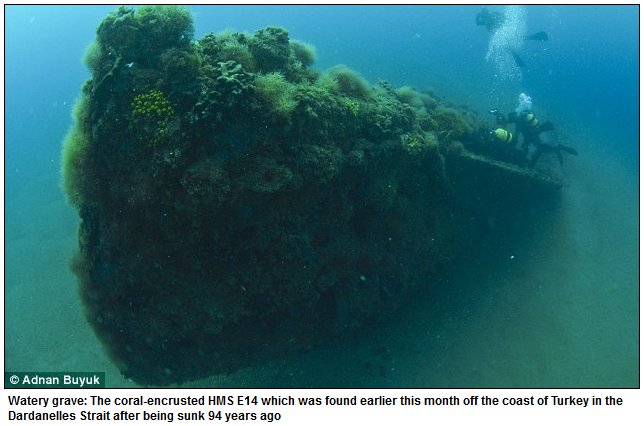
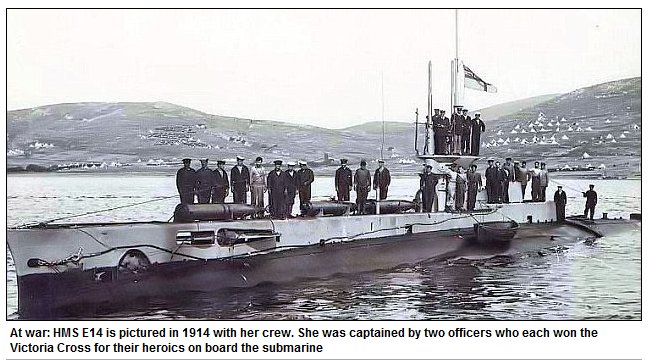
Royal Navy submarine wreck discovered in the Dardanelles

Filed under: Britain, History, Middle East, Military, WW1 — Tags: , , , — Nicholas @ 09:26

What appears to be the wreck of the E14 has been located just 800 feet offshore in the Straits of the Dardanelles:

Its precise location in the eastern Mediterranean remained a mystery until this month when a Turkish marine engineer and a diver detected it on the seabed off the town of Kumkale – just 800ft from the beach.

The wreck was discovered by marine expert Selçuk Kolay and film-making diver Savas Karakas, who had spent three years trying to find it.

After studying documents at the national Archives in Kew, west London, and surveying Turkish defences, they scanned an unusual object from a boat on the surface.

But they could not establish what it was because it was near the mouth of the straits — a sensitive military area where diving was forbidden.

It took two years to get permission from the military before their team were able to dive to the wreck and confirm it was the E14 earlier this month.

« Newer PostsOlder Posts »

Powered by WordPress


