
Quotulatiousness

January 23, 2013

UK considering alternatives to Trident

Filed under: Britain, Military — Tags: , , , , — Nicholas @ 09:15

The Royal Navy operates four Vanguard-class ballistic missile submarines equipped with the Trident nuclear missile. The coalition government is internally divided over the decision to order replacement submarines to come online when the current subs reach their designed end-of-life. The Tories (at least for public consumption) are in favour of a replacement on a one-for-one basis, while the Liberal Democrats would prefer to eliminate nuclear missiles from the British arsenal.

In the Telegraph, Peter Dominiczak explains why the one-for-one replacement is the least likely outcome:

Mr Alexander, the Chief secretary to the Treasury, dismissed Tory demands for a new continuous at-sea nuclear deterrent and warned that the Treasury does not have “a magic pot of money” to pay for a new generation of submarines.

In an interview with the Guardian he insisted that there are “potential alternatives” to Trident.

The Liberal Democrats have repeatedly clashed with Conservatives who are calling for an upgrade to the fleet of Trident submarines.

The Lib Dems insisted on an official review into Trident, which is due to report in June, as part of the Coalition agreement in 2010.

[. . .]

“Is it right in the 21st century that we still need to have submarines at sea, 24 hours a day, seven days a week, 12 months of the year? All those things are ripe for being reviewed and considered, and alternatives presented.”

Philip Hammond, the Defence Secretary, last year said that upgrading Trident would probably be cheaper than any alternative nuclear deterrent proposed by the Lib Dems.

He said the Trident missiles and warheads have “many, many years of life in them” and will only need new submarines to carry them by 2028.

Any attempt to create a whole new nuclear deterrent system is unlikely to be economic, he said.

Ballistic missile submarines are very expensive to design and build (and to operate), and shifting to a smaller number of hulls would save very little money. As I put it back in 2010, “Army, RN, RAF, and Trident replacement: pick any three“. Trident is nearly as expensive as an entire arm of the military all on its own, and it’s no surprise that the Liberal Democrats would love to eliminate it if they could get away with it.

January 22, 2013

British army facing next wave of cuts

Filed under: Britain, Government, Military — Tags: , — Nicholas @ 10:14

The British army has to reduce down to a slim 82,000 troops by 2015, and the cuts coming down later this year are part of the 2010 Strategic Defence and Security Review (SDSR):

Up to 50 brigadiers and other senior officers are expected to be axed as part of a sweeping round of army redundancies that will result in up to 5,300 troops leaving the forces over the next year.

In what is thought to be the biggest tranche of redundancies faced by the army since the early 1990s, infantry battalions are likely to be worst hit as the military reorganises itself for the post-Afghanistan era.

Special forces units will be spared any losses, but officials made clear that this round of job cuts would take “a large slice out of the army in one go”.

Separately, the Ministry of Defence (MoD) also admitted more medical staff from the army, Royal Navy and RAF staff were likely to face redundancy later this year.

Some of the details from the SDSR were discussed in 2010. I also posted that I suspected SDSR actually stood for “Slashing Damage to Strategic Resources

The obscure, unremembered — but bloodiest — battle in England

Filed under: Britain, History — Tags: , , , , , — Nicholas @ 09:42

Unless you paid very close attention to British history, you may not even have heard of the bloodiest battle in England:

Consider, for example, Towton — the bloodiest battle on English soil, in which most of our nobility and their retainers took part and in which 28,000 people are said to have died. Since the population of the time was not much more than three million, that’s the equivalent of a battle today costing the lives of half a million.

If you were on the wrong side, that was it: curtains. Even if you survived the fighting you faced the greater horror of being ‘attainted’. This meant being hanged, drawn and quartered, while your goods were confiscated and your heirs disinherited in perpetuity. Such was the fate of 60 Lancastrian knights and gentlemen (including 25 MPs — so it wasn’t all bad…) after Towton.

As with the Norman Conquest and the first world war, the war’s victims numbered disproportionately among the English upper classes. ‘Out of 70 adult peers during this period, over 50 are known to have fought in battles they had to win if they wanted to stay alive,’ notes Desmond Seward, in his superb The Wars Of The Roses. Entire noble families were exterminated. In one campaign alone — 1460 to 1461 — 12 noblemen were killed and six beheaded, over a third of the English peerage.

And there was no way of opting out. If you were one of the 50 or 60 great families, you were too prominent politically and socially, and your private army was too valuable, to permit your remaining neutral. This, in turn, meant that your myriad kinsmen, retainers, and hangers-on had to follow you into battle, whether they liked it or not. As a government spokesman told the House of Commons in 1475, ‘None [of us] hath escaped.’

Update: Colby Cosh sent along a link to this Economist article from 2010:

Towton is a nondescript village in northern England, between the cities of York and Leeds. Many Britons have never heard of it: school history tends to skip the 400-or-so years between 1066 and the start of the Tudor era. Visitors have to look hard to spot the small roadside cross that marks the site of perhaps the bloodiest battle ever fought in England. Yet the clash was a turning point in the Wars of the Roses. And, almost 550 years later, the site is changing our understanding of medieval battle.

In Shakespeare’s cycle of eight plays, the story of the Wars of the Roses is told as an epic drama. In reality it was a messy series of civil wars — an on-again, off-again conflict pitting supporters of the ruling Lancastrian monarchy against backers of the house of York. According to Helen Castor, a historian at Sidney Sussex College, Cambridge, the wars arose from the slow breakdown of English government under Henry VI, a man who was prone to bouts of mental illness and “curiously incapable” even when well. As decision-making under Henry drifted, factions formed and enmities deepened. These spiralling conflicts eventually drove Richard Plantagenet, Duke of York, to assert his own claim to the throne. York was named Henry’s heir, but he was killed in December 1460. His 18-year-old son, Edward, proclaimed himself king just before the battle of Towton.

That set the stage for a vicious fight. Edward had his father and brother to avenge. After killing him, Lancastrian forces had impaled York’s head on a lance and adorned it with a paper crown. Following years of skirmishes others had scores to settle, too. In previous encounters, efforts had been made to spare rank-and-file soldiers. At Towton, orders went out that no quarter be given. This was to be winner-takes-all, a brutal fight to the death.

The result was a crushing victory for the Yorkists and for the young king. Edward IV went on to rule, with a brief interruption, until his death 22 years later — a death that triggered the final stage of the conflict and the rise of a new dynasty under Henry Tudor. The recorded death toll at Towton may well have been inflated to burnish the legend of Edward’s ascent to the crown. Yet there can be little doubt it was an unusually large confrontation.

The archaeological details of the battlefield excavations are quite interesting. Gruesome, but interesting.

January 21, 2013

Orwell Day

Filed under: Books, Britain, History, Media — Tags: , — Nicholas @ 09:04

To mark Orwell Day, History Today posted a short account of the publication of Orwell’s last book, 1984:

George Orwell’s forty-sixth birthday was less than a month off when his last novel was published in London by Secker & Warburg, and five days afterwards by Harcourt Brace in New York. The socialist author of the twentieth century’s most devastating critique of left-wing totalitarianism had less than a year left to live. The idea for the book had come to him in 1943 and themes in an early outline included, ‘The system of organized lying on which society is founded, the ways in which this is done (falsification of records, etc), the nightmare feeling caused by the disappearance of objective truth, leader-worship, etc…’. No one who knew London in the years immediately after 1945 will need to be told where the appalling shabbiness of the book’s setting came from. The shortages, the bombsites, the regular failure of things to work properly, the prevailing dreariness — were drawn from real life.

Update: History Today also posted a link to an earlier article comparing Orwell to Edmund Burke:

Both Orwell and Burke consistently mistrusted their fellow intellectuals. Orwell wrote, in his great wartime essay The Lion and the Unicorn, that ‘the Bloomsbury highbrow with his mechanical snigger is as out-of-date as the cavalry colonel’. His was not just an abstract dislike — he had seen how the blind worship of Stalin’s Russia by many on the left had given credence to the purges, paving the way for Communist repression of the non-Stalinist Left in Barcelona, to which he is a blistering eyewitness in Homage to Catalonia (1938).

[. . .]

Orwell hymns it differently. In Nineteen Eighty-Four history and memory are the subversives of a totalitarian order that has made grim flesh of the old Soviet joke ‘only the future is certain … the past is constantly changing’. But as Simon Schama has recently reminded us, ‘For Orwell, to have a future, at least a free future, presupposes keeping faith with the Past’. It is to the Past’s potential to undo Big Brother that Winston Smith proposes his rebel’s toast.

In The Lion and the Unicorn Orwell writes that it is patriotism that is ‘the bridge between the future and the past’. Bernard Crick’s description of him as a ‘revolutionary patriot’ whose ‘socialism embraces both memory and nature’ is spot-on. And in Orwell’s sense that the ‘privateness of English life … this strange mixture of reality and illusion, democracy and privilege, humbug and decency’, would eventually win through to victory over Fascism and a better world he is not all that far from Burke’s ‘idea of a liberal descent which inspires us with a sense of habitual native dignity’ — an untidy Britain but one where ‘the species is wise, and when time is given to it, as a species it almost always acts right’. Orwell saw his future Socialist Britain as an inconsistent Utopia: ‘it will not be doctrinaire, nor even logical … it will leave anachronisms and loose ends everywhere … but it will never lose touch with the tradition of compromise and the belief in a law that is above the State’. Burke might not have approved the Utopia but he would have appreciated its untidiness. In his view, ‘the circumstances are what render every civil and political scheme beneficial or noxious to mankind’.

January 20, 2013

Identifying Britain’s “greatest” land battle

Filed under: Britain, Cancon, Europe, History, Military — Tags: , , , — Nicholas @ 11:41

Setting aside the fact that there’s no rational way to compare battles from different wars in different eras, the National Army Museum is holding a poll to determine the top five British battles, then a debate among historians followed by a concluding vote to determine the “best” of them.

As well as famous battles, the list includes some less well-known clashes, such as Megiddo in 1918, in modern-day Israel, where a British-led force decisively broke through the Ottoman front lines.

The earliest battle on the list is the English Civil War clash at Naseby, in 1645, in which the Royalists were defeated by the Parliamentarians’ disciplined New Model Army.

It is one of two that took place on British soil between two armies from this country. The other is Culloden (1745), which marked the end of the Jacobite rebellion.

Not all the battles ended in victory. The list includes the failed Gallipoli campaign (1915-1916), in which Britain and its allies tried to invade the Ottoman Empire.

Others are less conclusive: such as the Crimean clash of Balaklava (1854) – noted for the disastrous Charge of the Light Brigade — and the Somme (1916).

The most recent engagement is Musa Qala, in Afghanistan, where, in 2006, a small garrison of British, Danish and Afghan troops withstood a lengthy Taliban siege.

Only land battles are being considered, ruling out naval victories such as Trafalgar (1805) and air campaigns such as the Battle of Britain (1940).

Speaking non-scientifically, clearly the most important land battle in British history was the clash between Wolfe and Montcalm on the Plains of Abraham:

… also known as the Battle of Quebec, (Bataille des Plaines d’Abraham or Première bataille de Québec in French) was a pivotal battle in the Seven Years’ War (referred to as the French and Indian War in the United States). The battle, which began on 13 September 1759, was fought between the British Army and Navy, and the French Army, on a plateau just outside the walls of Quebec City, on land that was originally owned by a farmer named Abraham Martin, hence the name of the battle.

The battle involved fewer than 10,000 troops between both sides, but proved to be a deciding moment in the conflict between France and Britain over the fate of New France, influencing the later creation of Canada.[2]

The battle (and its aftermath) tend to be ignored in Quebec, but it shouldn’t be:

Montcalm died before dawn on the 14th. Hit again, probably by a Canadien militiaman, Wolfe died as the French ranks dissolved. Fighting on the Plains continued until dusk, sustained by Canadien militia and their native allies. When Quebec sovereignists killed plans to re-enact the battle they helped keep that heroic story secret. Perhaps they had no idea that it happened. When French regulars fled, the militia fought on.

Five times they stopped Fraser’s terrifying Highlanders from slaughtering the terrified regulars. Thanks to their despised militia and aboriginal allies, Montcalm’s French regulars could safely stop at Beauport, catch their breath, and begin a long, dreary march back to Montreal to prepare for another year of war. Did the separatists not want anyone to know?

A petition for Richard III to be reburied at York Minster

Filed under: Britain, History — Tags: , , — Nicholas @ 10:20

Elizabeth linked to this petition which might be of interest to Ricardians:

Joe Ann Ricca, Founder and Chief Executive of The Richard III Foundation, Inc., said: “Richard obviously had no choice after he was killed as to where his remains were taken, but today we have the opportunity to right the many wrongs that have been done to this unjustly maligned king, by correcting the distorted picture that has been painted of Richard over the centuries, and by bringing his remains home to Yorkshire, and to York Minster as he wanted.”

Richard, who was the last Plantagenet king, and the last English monarch to die in battle, had strong connections with the City of York and the County of Yorkshire. He spent much of his youth at Middleham Castle and for 12 years he ruled the North of England on behalf of his elder brother, King Edward IV, earning a widespread reputation for fair-mindedness and justice. After becoming king, he visited York several times and was showered with gifts each time. His son, Edward, was crowned Prince of Wales whilst in York.

Although entitled to be buried at Westminster Abbey alongside other kings and queens of England, Richard III announced his intention to be buried at York, and in 1483 set in motion plans for a new chantry chapel at York Minster. Indeed, so strongly was Richard linked to York that the City authorities greeted the news of his death at the Battle of Bosworth with these words: “King Richard, late mercifully reigning over us, was, through great treason, piteously slain and murdered, to the great heaviness of this city.”

January 18, 2013

For your “protection”, some new smartphones are configured to hide “mature” content

Filed under: Britain, Business, Media, Technology — Tags: , , , , , — Nicholas @ 09:52

Willard Foxton discusses some eye-raising configurations on new smartphones in the UK:

When you get a new phone, there’s a very good chance it comes with automatic filters enabled. For example, it’s very common for you have to explicitly request the ability to call premium-rate phone lines. This is long established, but now, a sinister new trend has started, whereby phone providers are automatically blocking access to certain websites for “mature content”, rather than “adult content”.

Mobile provider 3UK is blocking access to political satire as “mature content”; Orange is preventing access to feminist articles as “mature content” through its automatically applied Orange Safeguard service; several providers are blocking perfectly legitimate sites like Pink News because they deal with gay issues, or Channel 4’s excellent Embarrassing Bodies website, because of the graphic discussion of body parts and sexuality.

This was bad enough when these services were blocking porn (I for one wholeheartedly support the right of teenagers to watch smut on their iPhones), but now it seems overzealous providers are blocking access to anything a Catholic Bishop might consider for adults only. This carries not only the problem of “overblocking” caused by lazy filter design — notably, it’s hard to get your website read if it refers to Middlesex or Scunthorpe — but also as these filters are automatically applied, most people don’t even realise they are losing access to certain parts of the web.

Obsessing over drugs will damage sports much more than Lance Armstrong could

Filed under: France, Media, Sports — Tags: , , , — Nicholas @ 09:41

At sp!ked, Tim Black reviews Seven Deadly Sins: My Pursuit of Lance Armstrong, by David Walsh:

And so, in the aftermath of his Oprah-atic confession, bound to neither sate the critics nor elate the devout, the infernal humiliation of one-time cyclist Lance Armstrong continues.

The kicking and pelting began in earnest in August last year, when the US Anti-Doping Agency (USADA) stripped Armstrong of his seven Tour de France titles following his failure to challenge their numerous doping charges. The USADA then followed that up in October with a voluminous, damning report, complete with gruesome testimonies from Armstrong’s one-time confidantes and teammates. By this point, even the International Cycling Union (UCI), which had long sided with Armstrong, had given up the defence to join in the lynching. ‘Lance Armstrong has no place in cycling’, exclaimed UCI president Pat McQuaid. ‘Lance Armstrong deserves to be forgotten in cycling.’

As sporting officialdom condemned, large swathes of the media spat. Gossipy stories of Armstrong’s bullying, his lying, his alleged sociopathology were published without nuance; op-eds assassinating Armstrong’s character, inflating his wrongs to Biblical proportions, were rushed off without perspective. On a man once lionised by millions, whose fame had for years been wrapped yellow around the wrists of those who admired him, open season had been declared. All the hunt lacked was a sighting of the quarry himself. And then this week, that finally happened — in the interview with Oprah Winfrey. Caught and unavoidably contrite, Armstrong acted out the role of the doping sportsman. Yes, he was saying, I am everything that the Dopefinder Generals say I am: I am that witch.

January 17, 2013

Joe Strummer to be posthumously square in Granada

Filed under: Europe, History, Media — Tags: , — Nicholas @ 09:34

After legendary punk band The Clash fell apart, Joe Strummer retired to Granada and the city is going to rename a square in memory of his time there:

Granada City Council’s Daniel Galan told the BBC: “The initiative came from a neighbourhood association, backed by some political parties and was approved. It was a popular movement. It is very well known the connection between Joe and the city and people still remember him.”

Strummer’s relationship Spain began back in the 1970s, when he first visited Granada with his then girlfriend Paloma Romero, who later became the drummer of The Slits, under the nom de rock Palmolive.

His interest in Andalucia, the celebrated poet Federico García Lorca and the Spanish Civil War is reflected in the classic Spanish bombs, from 1979’s London Calling. During his later self-imposed exile, Strummer hooked up with Granada punk band 091, producing their 1986 album Más de 100 lobos (More than 100 wolves).

Galan said: “Joe Strummer loved Granada. He loved the whole of Spain but he had a very good connection with Granada because he was friends with 091.”

January 14, 2013

Insufficient bribes and transport aircraft

Filed under: Government, Italy, Military — Tags: , , — Nicholas @ 09:35

Strategy Page on the sad-but-predictable situation in Afghanistan:

Afghanistan recently announced that it would cancel the contract to buy and use 20 C-27A transports. The official reason was the inability of the Italian maintenance firm to keep the aircraft operational. The unofficial reason is the unwillingness of the Italians to pay as much in bribes as the Afghan commanders were demanding. Over half a billion dollars was being spent on buying and operating these aircraft and all the money was coming from the United States. Afghan government and air force officials were determined to grab as much of that cash as possible. That meant there was not enough money for the spare parts and tools needed to keep the C-27As flying. The Afghans can be self-destructive in so many ways, and letting these transports get away because not enough could be stolen from the contracts was another example of this.

More self-destructive behavior is expected. The Western donor nations are getting fed up with the increasingly aggressive Afghan corruption. Last year, as the Afghans asked for more military aid, the donor nations instead cut contributions. The Afghans were told that the aid would be reduced from $11 billion a year to $4.1 billion a year between 2012 and 2017. That would only change if, by some miracle, the Afghans managed to get their thieving ways under control. Currently, the Afghans will go to great lengths to get around donor auditors and anti-corruption measures. The C-27A was a case of everyone just giving up. Expect to see more cases like this.

In the re-enacting world, don’t be a “Walt” or a “Farb”

Filed under: Britain, History, Military — Tags: , — Nicholas @ 09:15

Dick Delingpole tells us more about the less-welcome members of the re-enacting hobby:

Re-enactors have a term of abuse, “Farb”, thought to have originated in the States, which is used to describe someone whose authenticity standards leave much to be desired. There is also a term of abuse directed at re-enactors from outside the hobby, notably from the Armed Forces: “Walt”. It means “fantasist” or “wannabe”, and derives from James Thurber’s fictional literary fantasist, Walter Mitty. It is not used affectionately, and implies ineptitude with delusions of grandeur. Just google “walt” and “re-enactor” and you’ll get the idea.

Despite my deep and abiding affection for our Armed Forces, I think there’s a bit of misunderstanding here.

In 12 years, the only re-enactors I’ve met who think that they’re soldiers are the ones who actually are. And there are many of them: regulars and TA, retired, current and soon-to-be-joining. While ex-soldiers are attracted to the cameraderie associated with re-enactment, many are pursuing an interest in the history of their own regiments which doesn’t confine them to an armchair.

[. . .]

Early period re-enactors (anything pre WWII, but the earlier the better) attract relatively light amounts of abuse from the Armed Forces. One fellow Napoleonic re-enactor who is a serving Major in the Rifles, describes the kind of Walt most likely to get a soldier’s back up. They are overweight middle-aged blokes who can’t march or hold a gun correctly, but who have the kit, uniform and insignia of the current SAS or other specialist elite unit. Here I feel the insult is possibly justified. Why, asks the squaddy, don’t these people just join the army? And why must they represent elite forces whose serving members have sweated blood to be part of?

H/T to Elizabeth for the link.

January 13, 2013

Britain considering reinforcements for Falkland Islands

Filed under: Americas, Britain, Military — Tags: , , , — Nicholas @ 12:54

If nothing else, the heated rhetoric from Argentina is encouraging the British government to think about sending more military resources to the Falklands:

Britain is prepared to send additional military backup to the South Atlantic as a ‘show of force’ to Argentina over the Falkland Islands.

It is understood an extra warship, another RAF Tycoon [sic] combat aircraft and further troops could be dispatched to the region ahead of the March referendum over whether the islands remain part of the UK.

According to the Sunday Telegraph, the options being proposed by planners at the Permanent Joint Headquarters in Northwood, London, include conducting naval exercises in the region.

Alternatives include sending elements of the Army’s 16 Air Assault Brigade — the airborne task force which includes members of the Parachute Regiment — which has just completed a series of demanding exercises in Spain preparing for ‘general war’.

Islanders will vote on March 11 on whether they wish to remain an overseas territory of the UK.

It is expected there will be a 100 per cent ‘yes’ vote, which intelligence officials have warned the Prime Minister could lead to an aggressive ‘stunt’ by Argentina, such as planting the country’s flag on the island.

January 11, 2013

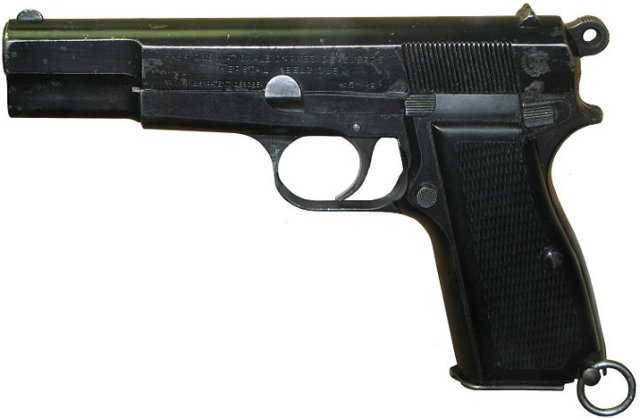
British forces to replace venerable Browning 9mm with new Glocks

Filed under: Britain, Military, Weapons — Tags: , , , , — Nicholas @ 10:22

Lewis Page on the recently announced retirement of the Browning 9mm from British military service:

The new pistol is the Glock 17 Gen4, which fires the same NATO standard 9x19mm cartridge as its illustrious predecessor. However the Glock holds 17 rounds as opposed to the Browning’s 13 — and even more crucially the new weapon can be carried with a round in the chamber ready to shoot at a moment’s notice due to its modern safety mechanisms, a practice which was normally forbidden with the Browning.

[. . .]

The now superseded weapon was designed way back in the 1920s by the legendary weapons engineer John Browning and first manufactured by Fabrique Nationale of Belgium in 1935. It was known commercially as the “Browning Hi-Power”. It was first issued to British forces during World War II, and gradually replaced all other pistols then in service to become the UK’s standard military sidearm. In its day it was a great weapon, and pistol design has evolved only incrementally since then, but today’s handguns are measurably superior and it was surely time for a change — the more so as the existing Brownings must have been pretty worn out by now.

The wars in Iraq and Afghanistan have enabled the British forces to slowly and belatedly sort out their dire personal-weapons situation of the 1990s. The crappy Royal Ordnance/BAE Systems SA80 (L85A1) rifle was rebuilt in German factories so that it is now a good weapon, and proper belt-fed light machine guns and 40mm grenade launchers were procured. Other popular pieces of kit such as the L115A1 sniper rifle (from the famous Portsmouth firm Accuracy International, perhaps better known under its commercial name Arctic Warfare Super Magnum), the new combat shotgun and the new 7.62mm Sharpshooter rifle have also appeared in response to battlefield needs. Now with the new Glocks, at last, pretty much all the personal weapons carried by British troops today can be said to be first-class.

The Browning 9mm was first handgun I ever fired, and is still one of my favourites:

January 5, 2013

BBC forgets about original (BBC) series, asks for pilot of new Yes, Prime Minister

Filed under: Britain, Bureaucracy, Humour, Media — Tags: , , — Nicholas @ 00:01

As a result, the remake will not be shown on the BBC:

The new series of Yes, Prime Minister was made for a rival channel because the BBC asked its creators to make a pilot episode, it has emerged.

Co-writer Jonathan Lynn said the BBC had been given first refusal on the revival out of “courtesy”, because it aired the award-winning original.

But he called the request for a test episode “extraordinary”, as “there were 38 pilots available on DVD”.

The first new episodes for 25 years will be aired on digital channel Gold.

Lynn told comedy website Chortle that the BBC “said it was policy” to order a pilot episode before commissioning a full series.

“So we said our policy was to not write a pilot.”

The original Yes, Minister and Yes, Prime Minister tell you more about the actual workings of parliamentary democracy than a full semester undergraduate course. I hope the new series can recapture the magic (if you can call showing the awful workings of government bureaucrats and politicians “magic”).

The new series was filmed last summer and is based on a recent stage production, which launched in 2010.

Digital network Gold said the Rt Hon Jim Hacker would return as the leader of a coalition government, with plots focussing on the economic crisis, a leadership crisis with his coalition partners and a Scottish independence referendum.

David Haig will take the lead role, with Henry Goodman as Sir Humphrey. Both have appeared in the stage version of the show.

They will be joined by Dame Maggie Smith’s son, Chris Larkin, as Bernard Woolley, and Robbie Coltrane as a guest star.

January 3, 2013

Comitology and the EU

Filed under: Bureaucracy, Europe, Government, Humour — Tags: , — Nicholas @ 10:58

Alexandra Swann notes that the great C. Northcote Parkinson predicted the EU’s decision-making mechanics with great accuracy:

If we listen to Daniel Guéguen, Professor of European Political and Administrative studies at the College of Europe, the Europhile madrassa, the equation spells the downfall of the European Union.

Guéguen has worked as a Brussels lobbyist for 35 years; he is a full time federast and one of the remaining true believers in the EU. Given his commitment to the EU project, when he deems its system of governance, comitology, “an infernal system” perhaps it’s time to listen.

The concept of Comitology was invented by the incomparable Professor C Northcote-Parkinson in his seminal work Parkinson’s law of 1958. It was meant as a satire but, like many of the best jokes, they either get elected or, in this case, embedded in the bureaucracy. Here is the Professor explaining the comitology and his equation:

    x=(mo(a-d))/(y+p b1/2)

    Where m = the average number of members actually present; o = the number of members influenced by outside pressure groups; a = the average age of the members; d = the distance in centimetres between the two members who are seated farthest from each other; y = the number of years since the cabinet or committee was first formed; p = the patience of the chairman, as measured on the Peabody scale; b = the average blood pressure of the three oldest members, taken shortly before the time of meeting. Then x = the number of members effectively present at the moment when the efficient working of the cabinet or other committee has become manifestly impossible. This is the coefficient of inefficiency and it is found to lie between 19.9 and 22.4. (The decimals represent partial attendance; those absent for a part of the meeting.)

This beautifully encapsulates the terrifying silliness of what is going on in the tubular steel and stripped Swedish pine chairs of Brussels, and for anyone with an interest in transparency or good governance, it is a serious concern. After all, under various estimates upwards of 75 per cent of our laws, the laws that govern the minutiae of our lives are made in the sterile Committee rooms of the Breydel, Berlyamont, Justis Lupsius and other buildings in the EU quarter of Brussels. That this cosmic joke now governs our lives is just a factor of the brobdingnagian reality of our membership of the EU.

« Newer PostsOlder Posts »

Powered by WordPress

