Quotulatiousness

February 12, 2013

Rules for the masses, but not for the bureaucratic elite

Filed under: Bureaucracy, Business, Europe, Law — Tags: , , , , , — Nicholas @ 10:33

The European Union’s rules on gender equality appear to apply to everything in the EU except the EU’s own bureaucracy:

Part of the aggrandised myth EU institutions like to propagate about themselves is that they are pioneers in promoting tolerance, gender equality, and diversity in the workplace. Read the promotional literature and you will find effusive descriptions of liberal workplace revolutions and the achievements of Soviet-style five-year plans. Yet, like the Soviet Union, there is an embarrassing mismatch between the trumpeted idealism and the reality.

Since its creation in 1967, DG Employment (Directorate-General for Employment, Social Affairs and Inclusion at the European Commission) has nominally been responsible for fair employment conditions in the European Union. Rising levels of workplace equality in member states (for which DG Employment take an undue amount of credit) are woefully incongruous with the situation of EU civil servants. Women occupy 19 per cent of senior management positions; compare this with the often decried 35.9 per cent of women in the top levels of the UK civil service.

Yet it is figures like the UK civil service’s that prompt EU proposals on affirmative action. One set of proposals has recently been discussed in the European parliament, for example, which if passed will introduce gratuitous and complicated legislation across the continent. That bureaucracy breeds bureaucracy is unsurprising, but it is hard to take seriously calls for equality from an institution endemically opposed to the concept.

The only European agency where women in management positions outnumber men is in the Institute for Gender Equality (the administration is 95 per cent female). Incontrovertibly, out of all the agencies, this is the one with the strongest prerogative for tackling equality in its workforce. But the message is clear: shout about equality to the world and create a dummy institute to anyone holding a mirror up to the EU bureaucracy itself. So far, the commission is on its fifth ‘action programme’ to tackle inequality within its institutions, taking the same form as every one that has come before it; vague guidelines forgotten until lobby group pressure becomes too annoying.

February 9, 2013

The domestic food desert

Filed under: Britain, Food, Health — Tags: , , , , — Nicholas @ 10:00

Theodore Dalrymple on one of the more likely culprits for obesity among poor British families:

With the decline of the family — wrought by the policies of successive governments — patterns of eating have changed. Meals in many households, especially those of the relatively poor, are no longer family or social occasions. It has been found that a fifth of children do not eat more than one meal a week with another member of their household; and in such households, which I used sometimes to visit as a doctor, the microwave oven was the entire batterie de cuisine, or at any rate the only cooking implement that was ever actually employed.

Moreover, there was no table at which a meal could have been eaten in common if anyone had thought of doing so. The result was that children became foragers or hunter-gatherers in their own homes, going to the fridge whenever they felt like it and grazing on prepared foods — high, of course, in the evil fructose. Not coincidentally, these households were also the least likely to have what would once have been considered the normal family structure.

Such households also tended to be in areas called “food deserts”, in which fresh produce is either not easily available or unavailable. But those who ascribe the dietary habits of the households I have just described to food desertification put the cart before the horse: for if heroin can reach these areas (and it can), surely the humble lettuce can do so?

It is also sometimes alleged that people buy prepared foods because they are cheap. This is nonsense. In fact, if you go to areas inhabited by poor Indian or Pakistani families you will find stores that sell an astonishing range of vegetables at equally astonishing prices. I used to shop in one such store, at a time when I did not have to concern myself too much over the price of food; I could hardly carry all that I could buy for a few pounds. I remember in particular a 10-kilo bag of onions costing £1.49.

The Indian and Pakistani women bought with discrimination and, taking a maternal interest in me, would sometimes indicate what to look for among what were for me the more exotic vegetables. But I never saw any poor whites shopping there: they went straight to the pie and pizza shops, without so much as a glance at the okra and aubergine.

In other words, food desertification and the supposed cheapness of industrially prepared foods is a consequence, not a cause of, the food habits I have described. Food desertification is a symptom of the culinary ignorance, incompetence and indifference of a substantial minority of our population: ignorance, incompetence and indifference unopposed by any attempt of our educational system to counteract it, for example by teaching girls the elements of cookery. Fat is indeed a feminist issue, but not in the sense that Susie Orbach originally meant it.

QotD: When God sticks his nose into public health and taxation issues

Filed under: Britain, Food, Health, Humour, Quotations, Religion — Tags: , , , — Nicholas @ 00:01

It is not an original thought to say that public health crusaders often resemble religious zealots, but seldom is the comparison more literal than in the case of Mike Rayner, director of the British Heart Foundation Health Promotion Research Group.

[. . .]

So far, so mundane. Another illiberal battler against the free market with a heightened sense of his own importance and his nose in the trough. The only point of interest is that Mr Raynor is a Church of England priest who is guided by voices.

    In all of this I see a sacred dimension. You may not believe that I have heard God aright but I think God is calling me to work towards the introduction of soft-drink taxes in this country and I am looking forward to the day when General Synod debates the ethical issues surrounding this type of tax rather than some of the other issues that august body seems obsessed by.

Golly. Where to begin? On a theological note, I do wonder whether Jesus would really be in favour of a deeply regressive stealth tax that would take from the poor to give to the rich. Perhaps the reason the General Synod does not debate tax policy is because they recall the old “render under to Caesar…” message and realise that it’s none of their business.

If we weren’t already sceptical about the documents coming from Mr Rayner’s team of would-be policy-makers, the fact that its director believes that God has told him to bring about a fat tax in this land should be enough to make us suspect that a tiny bit of research bias might have crept into his work. Considering that the Almighty has approved of the policy, what are the chances of his loyal servant producing evidence that would question its efficacy?

Christopher Snowdon, “Fat tax campaigner: ‘God told me to do it'”, Velvet Glove, Iron Fist, 2012-05-21

February 8, 2013

Telegraph runs “Shock, horror!” story about UK government’s wine budget

Filed under: Britain, Government, Media, Wine — Tags: , , — Nicholas @ 09:12

I’m a minarchist: I’m in favour of much smaller, less intrusive government. Even saying that, I can’t find it in my heart to get upset about this “shocking” revelation:

Ministers fail to balance books at £3million wine cellar
Ministers and guests have got through 5,000 bottles of alcohol worth more than £55,000 in the last year, report into the Government’s wine cellar has revealed.

[. . .]

The latest annual report into the Government’s wine cellar has revealed that ministers, officials and their guests got through nearly 5,000 bottles of alcohol worth more than £55,000 in the last year.

In total, the cellar holds 38,000 bottles costing £857,000 when bought, but are now valued on the open market at £2,953,000.

Some of the taxpayer-funded bottles are sold in shops for more than £1,000 each.

Guests at Government events drank 23 bottles of the 1982 Chateau Margaux Bordeaux, which sells for up to £1,100 a bottle.

Five thousand bottles? That’s all? David Cameron’s cabinet consists of 22 senior ministers. I assume there are junior ministers or parliamentary assistants for most of those ministers, so let’s call it 50 men and women who are entertaining on government business and would be drawing from the official wine cellar. Even if each of them only entertains one other person at each event, that’s roughly two bottles of wine per minister per week.

The Queen drinks more than that by herself!

And the eye-popping number of £857,000? That works out to less than £23 per bottle. And we’re told that some of the bottles could sell on the open market for £1,100 a bottle. But based on the figures, there can’t be very many of those ultra-expensive bottles, can there?

I fail to see a scandal here…

February 7, 2013

Japan scrambles fighters after two Russian aircraft intrude

Filed under: Asia, Japan, Military, Pacific, Russia, WW2 — Tags: , , — Nicholas @ 09:39

Japan’s military forces are getting quite a workout these days, with the standoff with China over the Senkaku Islands and now the Russians are getting aggressive about probing Japanese airspace:

Two Russian fighter jets have violated Japanese airspace, prompting Tokyo to scramble its own aircraft, reports say.

Japan lodged a protest after the planes were detected off the northern island of Hokkaido for just over a minute.

The incident happened after Japanese PM Shinzo Abe said he was seeking a solution to a territorial dispute with Russia over a Pacific island chain.

Russia’s military denied the incursion, saying the jets were making routine flights near the disputed islands.

Mr Abe was speaking on the anniversary of an 1855 treaty which Japan says supports its claims to the islands.

The four islands — which Russia calls the Southern Kurils and Japan calls the Northern Territories — are the subject of a 60-year-old dispute.

Because of the dispute, the two nations have not yet signed a peace treaty to end World War II.

February 6, 2013

English accents, circa 1483

Filed under: Britain, History — Tags: , , , — Nicholas @ 00:02

I’m afraid the coverage of the discovery and identification of the remains of Richard III have done bad things to the newspapers. We’re starting to see articles like this posted:

King Richard III was ‘a brummie’
King Richard III would have spoken with a Birmingham accent, according to a language expert.

Dr Philip Shaw, from the University of Leicester’s School of English, used two letters penned by the last king of the Plantagenet line more than 500 years ago to try to piece together what the monarch would have sounded like.

He studied the king’s use of grammar and spelling in postscripts on the letters.

The university has now released a recording of Dr Shaw mimicking King Richard reading extracts from those letters.

Despite being the patriarch of the House of York, the king’s accent “could probably associate more or less with the West Midlands” than from Yorkshire or the North of England, said Dr Shaw.

Wow. This must have been a long, painstaking effort to pin down the linguistic “tics” that help indicate a person’s natural speaking habits. What were the key elements that indicated Good King Richard was a “Brummie”?

“… there is also at least one spelling he employs that may suggest a West Midlands accent.”

That’s it? One spelling variation that “suggests” he would pronounce that one word in a similar manner to the modern Birmingham style? Gah!

February 5, 2013

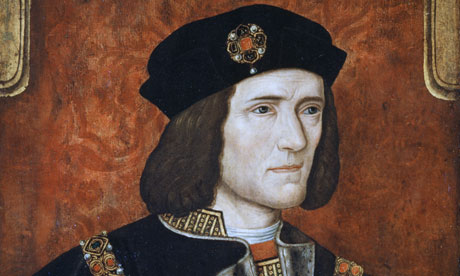
What did King Richard III look like?

Filed under: Britain, History, Science — Tags: , , — Nicholas @ 09:33

A facial reconstruction based on the skull of Richard III:

A facial reconstruction based on the skull of Richard III has revealed how the English king may have looked.

The king’s skeleton was found under a car park in Leicester during an archaeological dig.

The reconstructed face has a slightly arched nose and prominent chin, similar to features shown in portraits of Richard III painted after his death.

Historian and author John Ashdown-Hill said seeing it was “almost like being face to face with a real person”.

The development comes after archaeologists from the University of Leicester confirmed the skeleton found last year was the 15th Century king’s, with DNA from the bones having matched that of descendants of the monarch’s family.

I was unable to find an image of the reconstruction that is okay to use, but you can see various pictures on Google Image Search.

February 4, 2013

University of Leicester confirms that the remains are those of King Richard III

Filed under: Britain, History, Science — Tags: , , , — Nicholas @ 09:16

BBC News rounds up the details:

A skeleton found beneath a Leicester car park has been confirmed as that of English king Richard III.

Experts from the University of Leicester said DNA from the bones matched that of descendants of the monarch’s family.

Lead archaeologist Richard Buckley, from the University of Leicester, told a press conference to applause: “Beyond reasonable doubt it’s Richard.”

Richard, killed in battle in 1485, will be reinterred in Leicester Cathedral.

Mr Buckley said the bones had been subjected to “rigorous academic study” and had been carbon dated to a period from 1455-1540.

Dr Jo Appleby, an osteo-archaeologist from the university’s School of Archaeology and Ancient History, revealed the bones were of a man in his late 20s or early 30s. Richard was 32 when he died.

Battle wounds

His skeleton had suffered 10 injuries, including eight to the skull, at around the time of death. Two of the skull wounds were potentially fatal.

One was a “slice” removing a flap of bone, the other caused by bladed weapon which went through and hit the opposite side of the skull, a depth of more than 10cms (4ins).

Dr Appleby said: “Both of these injuries would have caused an almost instant loss of consciousness and death would have followed quickly afterwards.

“In the case of the larger wound, if the blade had penetrated 7cm into the brain, which we cannot determine from the bones, death would have been instantaneous.”

Other wounds included slashes or stabs to the face and the side of the head.

Update: New Scientist still has concerns that the trail of evidence is not strong enough to constitute proof of identity:

Mitochondrial DNA is passed down the maternal line and has 16,000 base pairs in total. Typically, you might expect to get 50 to 150 fragments from a 500-year-old skeleton, says Ian Barnes at Royal Holloway, University of London, who was not involved in the research. “You’d want to get sequences from lots of those fragments,” he says. “There’s a possibility of mitochondrial mutations arising in the line from Richard III.”

“It’s intriguing to be sure,” says Mark Thomas at University College London. It is right that they used mitochondrial DNA based on the maternal line, he says, since genealogical evidence for the paternal lineage cannot be trusted.

But mitochondrial DNA is not especially good for pinpointing identity. “I could have the same mitochondrial DNA as Richard III and not be related to him,” says Thomas.

The researchers used the two living descendents to “triangulate” the DNA results. The evidence will rest on whether Ibsen and his cousin have sufficiently rare mtDNA to make it unlikely that they both match the dead king by chance.

February 3, 2013

US poised to increase involvement in Mali

Filed under: Africa, France, Military, Religion, USA — Tags: , , , , — Nicholas @ 11:27

Sheldon Richman explains why it could be a problem if the American presence in northwestern Africa is further expanded:

Ominously but unsurprisingly, the U.S. military’s Africa Command wants to increase its footprint in northwest Africa. What began as low-profile assistance to France’s campaign to wrest control of northern Mali (a former colony) from unwelcome jihadists could end up becoming something more.

The Washington Post reports that Africom “is preparing to establish a drone base in northwest Africa [probably Niger] so that it can increase surveillance missions on the local affiliate of Al Qaeda and other Islamist extremist groups that American and other Western officials say pose a growing menace to the region.” But before that word “surveillance” can bring a sigh of relief, the Post adds, “For now, officials say they envision flying only unarmed surveillance drones from the base, though they have not ruled out conducting missile strikes at some point if the threat worsens.”

Meanwhile Bloomberg, citing American military officials, says Niger and the U.S. government have “reached an agreement allowing American military personnel to be stationed in the West African country and enabling them to take on Islamist militants in neighboring Mali, according to U.S. officials.… No decision has been made to station the drones.”

The irony is that surveillance drones could become the reason the “threat worsens,” and could provide the pretext to use drones armed with Hellfire missiles — the same kind used over 400 times in Pakistan, Yemen, and Somalia, killing hundreds of noncombatants. Moving from surveillance to lethal strikes would be a boost for jihadist recruiters.

February 2, 2013

Romania responds to British anti-immigration talk

Filed under: Britain, Europe, Humour, Media — Tags: , , , , — Nicholas @ 12:01

Romania’s Gandul has a bit of fun at Britain’s expense:

Gandul - Why don't you come over

Public fears in the UK over mass immigration by Eastern Europeans has prompted a peculiar response from Romania: One newspaper published a series of ads playing on British cultural stereotypes, and saying why people should move to Romania instead.

­“Our draft beer is less expensive than your bottled water,” one of the ads proudly states, hinting at the high costs of living in the UK. Another ad made fun of British cuisine: “We serve more food groups than pies, sausage, fish and chips.”

Other ads touched upon politics, weather and even women: “Half of our women look like Kate. The other half, like her sister.”

The ‘Why don`t you come over?’ ad campaign was designed by the online Romanian newspaper Gandul and GMP Advertising firm in response to numerous reports in the British media about a possible government initiative to launch a negative ad campaign discouraging Romanians and Bulgarians from coming to work in Britain.

Update, 13 September: The campaign just won a Gold Award at AdStars.

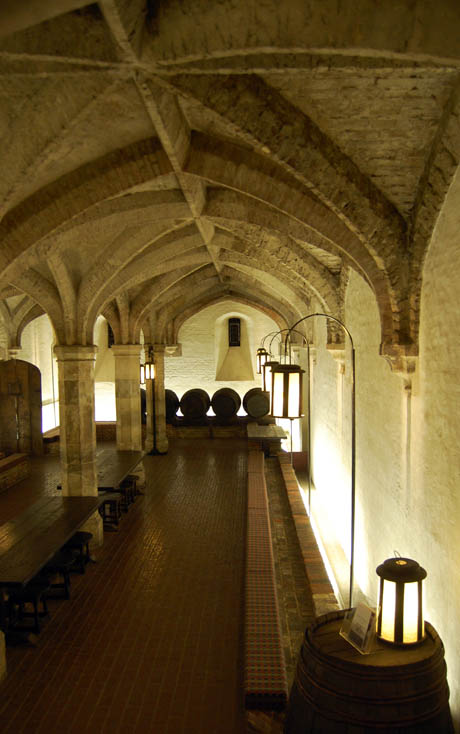
Hidden under Britain’s defence HQ: Henry VIII’s wine cellar

Filed under: Architecture, Britain, History, Military, Wine — Tags: , — Nicholas @ 11:44

It’s not open to the general public — and given what’s built on top of it, that’s probably no surprise:

Like the Pentagon, its better-known counterpart in the United States, Britain’s Ministry of Defence building is a fairly mundane, if gigantic, office block camouflaging a much more exciting subterranean realm of secret tunnels, bunkers, and — at least in the MoD’s case — a perfectly preserved Tudor wine cellar.

IMAGE: Henry VIII’s wine cellar, photograph by Nicola Twilley. The cellar is apparently occasionally used to host Ministry of Defence dinners and receptions, but is otherwise off-limits to the public other than by special request.

IMAGE: Henry VIII’s wine cellar, photograph by Nicola Twilley. The cellar is apparently occasionally used to host Ministry of Defence dinners and receptions, but is otherwise off-limits to the public other than by special request.

This stone-ribbed, brick-vaulted undercroft was built in the early 1500s by Cardinal Wolsey, as part of a suite of lavish improvements to York Place, the Westminster residence of the archbishops of York since the thirteenth century. The additions, which also included a gallery, presence chamber, and armoury, were intended to make York Place into a palace splendid enough to host the King. They succeeded well beyond Wolsey’s intentions: when Wolsey fell from favour, due to his inability to secure the papal annulment Henry VIII needed in order to marry Anne Boleyn, the King decided to move in.

[. . .]

York Place became the Palace of Whitehall, the principal residence of the English monarchy in London for nearly two hundred years, and Wolsey’s expansive cellar (he apparently received the first delivery of Champagne ever exported to England) became King Henry VIII’s Wine Cellar, the name by which it is still known today.

In Tudor times, the wine was stored in barrels, which presented a certain problem for service: “The barrels are historical reconstructions to represent how wine was stored in Tudor times. Henry VIII’s court consumed something like 300 barrels of wine each year, mostly exported from France and delivered to the palace by river. Interestingly, the wine was drunk very young by today’s standards — an August harvest might be on the table by November — and it was carefully blended with water, honey, and spices to mask its increasing sourness, as half-drunk casks allowed air into contact with the wine, which gradually oxidised into vinegar.”

“The welfare state we have is excellent in most ways. We only have this little problem. We can’t afford it.”

Filed under: Economics, Education, Europe, Government — Tags: , , , , , , — Nicholas @ 00:02

Based on this report in The Economist, we really should strive to be more like Sweden, and not for the reasons most Canadians would expect:

Sweden has reduced public spending as a proportion of GDP from 67% in 1993 to 49% today. It could soon have a smaller state than Britain. It has also cut the top marginal tax rate by 27 percentage points since 1983, to 57%, and scrapped a mare’s nest of taxes on property, gifts, wealth and inheritance. This year it is cutting the corporate-tax rate from 26.3% to 22%.

Sweden has also donned the golden straitjacket of fiscal orthodoxy with its pledge to produce a fiscal surplus over the economic cycle. Its public debt fell from 70% of GDP in 1993 to 37% in 2010, and its budget moved from an 11% deficit to a surplus of 0.3% over the same period. This allowed a country with a small, open economy to recover quickly from the financial storm of 2007-08. Sweden has also put its pension system on a sound foundation, replacing a defined-benefit system with a defined-contribution one and making automatic adjustments for longer life expectancy.

Most daringly, it has introduced a universal system of school vouchers and invited private schools to compete with public ones. Private companies also vie with each other to provide state-funded health services and care for the elderly. Anders Aslund, a Swedish economist who lives in America, hopes that Sweden is pioneering “a new conservative model”; Brian Palmer, an American anthropologist who lives in Sweden, worries that it is turning into “the United States of Swedeamerica”.

[. . .]

This is not to say that the Nordics are shredding their old model. They continue to pride themselves on the generosity of their welfare states. About 30% of their labour force works in the public sector, twice the average in the Organisation for Economic Development and Co-operation, a rich-country think-tank. They continue to believe in combining open economies with public investment in human capital. But the new Nordic model begins with the individual rather than the state. It begins with fiscal responsibility rather than pump-priming: all four Nordic countries have AAA ratings and debt loads significantly below the euro-zone average. It begins with choice and competition rather than paternalism and planning. The economic-freedom index of the Fraser Institute, a Canadian think-tank, shows Sweden and Finland catching up with the United States (see chart). The leftward lurch has been reversed: rather than extending the state into the market, the Nordics are extending the market into the state.

Why are the Nordic countries doing this? The obvious answer is that they have reached the limits of big government. “The welfare state we have is excellent in most ways,” says Gunnar Viby Mogensen, a Danish historian. “We only have this little problem. We can’t afford it.” The economic storms that shook all the Nordic countries in the early 1990s provided a foretaste of what would happen if they failed to get their affairs in order.

January 29, 2013

Taking the fight against CCTV surveillance to the streets of Berlin

Filed under: Europe, Germany, Government, Liberty — Tags: , , , , — Nicholas @ 10:00

TechEye looks at the “gamification” of resistance against CCTV surveillance in Berlin:

A group of German activists has come up with an intriguing campaign to counter state surveillance — turning the destruction of CCTV cameras into a game.

Dubbed ‘Camover’, the aim of the game is simple: destroy as many CCTV cameras as possible.

Once your target is destroyed, you can upload a video of the act to YouTube for internet points and kudos. The rules say players should come up with a name starting with ‘command’, ‘brigade’, or ‘cell’, followed by the name of a historical figure, then destroying as many CCTV cameras as possible.

“Video your trail of destruction and post it on the game’s website,” the activists suggest, but warn that the homepage is continuously being shut down. It’s recommended that players conceal their identities, but this is “not essential”.

Economic analysis of Imperial Rome

Filed under: Economics, Europe, History — Tags: , , , , , — Nicholas @ 09:43

A post by Jasmine Pui at History Today discusses a new online tool for economic analysis of the Roman Empire:

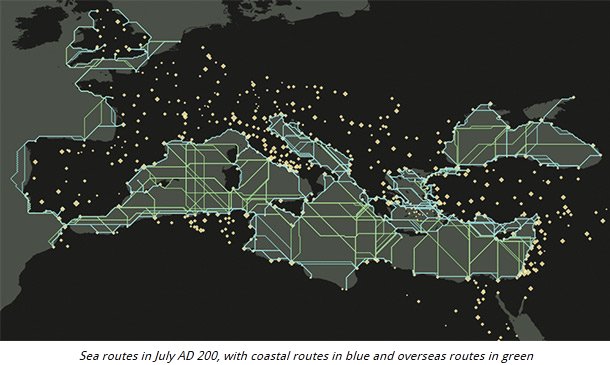
Sea routes in July AD 200

A recently launched online interactive research source, ORBIS, the Stanford Geospatial Network Model of the Roman World, has made it possible to analyse data about the Roman Empire in new ways that reveal the fragility of Roman communication and freight systems. Conventional maps are often unable to capture the environmental constraints that govern the flows of people, goods and information. Museum and ancient sites usually include titbits of information about the wide-ranging origins of artefacts, hinting at the relative cost of goods and labour in the Roman era, but factors such as sailing times and inland routes for freight cannot be precisely revealed through archaeological finds, Roman coins, taxation records or riot reports.

The first resource of its kind, ORBIS offers comprehensive graphic tools to portray the transport and communication infrastructure that underpinned the Roman Empire’s existence. By typing in a starting point, destination, an imagined weight of goods to transport and the time of year, the site shows whether such a movement would have been feasible and at what cost. Studying movement during the course of the empire’s existence suggests it was far more difficult to hold an empire together than to expand one. There are few scenarios where marching and conquering is not easier and less costly than moving goods and slaves between regions. Cost, rather than distance, was the principal determinant of connectivity in the Roman world.

ORBIS is based on a simplified version of the giant network of cities, roads, rivers and sea lanes that framed movement across the Roman Empire. The Stanford team has relied on data such as historical tide and weather information, size and grade of road surfaces and an average walking distance of 30 kilometres per day. Hundreds of cities, ports and routes, vehicle speeds for ships, ox carts and horses, as well as the variable cost of transport have been logged. The data mainly focuses on the period around AD 200, when Septimius Severus expanded control of Africa and Roman power was at one of its peaks.

January 27, 2013

In Britain, ignorance of the law is a valid excuse (under certain circumstances)

Filed under: Britain, Law, Religion — Tags: , , , , , — Nicholas @ 11:25

Words fail me:

The failure of an Islamic faith school in the UK to provide a pupil with any knowledge about sexual relations, other than to teach him that women were “no more worthy than a lollipop dropped on the ground”, led to the trial of an 18-year-old who was charged with raping a 13-year-old girl.

But, according to this report, instead of being jailed, the “naïve” Birmingham teenager, Adil Rashid, was handed a suspended sentence in Nottingham Crown Court by Judge Michael Stokes, who said:

    Although chronologically 18, it is quite clear from the reports that you are very naive and immature when it comes to sexual matters.

The judge added that because Rashid was “passive” and “lacking assertiveness”, sending him to jail might cause him “more damage than good”.

Rashid admitted having sex with the girl, saying he had been “tempted by her” after they met online.

After they had had sex, Rashid returned home and went straight to a mosque to pray. He was arrested the following week after the girl confessed what had happened to a school friend, who informed one of her teachers.

He told police he knew the girl was 13 but said he was initially reluctant to have sex before relenting after being seduced.

Earlier the court heard how Rashid had “little experience of women”due to his education at an Islamic school in the UK, which cannot be named for legal reasons.

After his arrest, he told a psychologist that he did not know having sex with a 13-year-old was against the law. The court heard he found it was illegal only when he was informed by a family member.

« Newer PostsOlder Posts »

Powered by WordPress