
Quotulatiousness

March 3, 2013

Arms merchant’s golden customer: an Arab nation with oil money

Filed under: Britain, Business, Middle East, Military — Tags: , , , , , , — Nicholas @ 12:56

Strategy Page explains why some of the most lucrative customers for high-tech weaponry are Arab nations:

Britain has been quite successful selling their new Typhoon fighter to Middle East nations. Two years ago Saudi Arabia bought 72 Typhoons from Britain. That was followed by an order for 12 from Oman and now the UAE (United Arab Emirates) is negotiating the purchase of 60 of these expensive aircraft. This is big money, as the aircraft have a basic price of $65 million each and there are many ways to greatly increase that. For warplanes sold to Arab Gulf states there is an additional bonanza. The biggest additional cost is providing support services and personnel to keep the aircraft operational. The Typhoon manufacturer, BAE Systems, is energetically recruiting qualified maintenance personnel to keep these aircraft flying. This a much larger profit center for Arab customers than for anyone else. Few local Arabs will be recruited for this work and most of these technicians will come from the West. That is very expensive. Why can’t locals be found for these high paying jobs? The reason is simple; there are few Arabs qualified or even interested in such exacting work. This is a common problem in the Middle East.

For example, the unemployment rate in Saudi Arabia is 12 percent and many of those men are unemployed by choice. Not even counted [are] most women, who are barred from most jobs because they are women. Arab men tend to have a very high opinion of themselves, and most jobs available, even to poorly educated young men, do not satisfy. Thus most Saudis prefer a government job, where the work is easy, the pay is good, the title is flattering, and life is boring. Thus 90 percent of employed Saudis work for the government. In the non-government sector of the economy, 90 percent of the jobs are performed by foreigners. These foreigners comprise 27 percent of the Saudi population, mostly to staff all the non-government jobs and actually make the economy work. This means most young Saudi men have few challenges. One might say that many of them are desperate for some test of their worth, but a job in the competitive civilian economy does not do it, nor does the military.

The Saudi employment situation is not unique. The UAE (United Arab Emirates) has foreigners occupying 99 percent of the non-government jobs. The unemployment rate is 23 percent, but only a tenth of those are actually looking for a job. A survey indicated that most of the unemployed are idle by choice. Kuwait is more entrepreneurial, with only 80 percent of the non-government jobs taken by foreigners. The other Gulf Arab states (which have less oil) have a similar situation.

February 26, 2013

Kipling rediscovered

Filed under: Britain, History, Media — Tags: , — Nicholas @ 17:27

In the Guardian, Alison Flood talks about the newly discovered Rudyard Kipling poems:

Kipling scholars are celebrating the publication of lost poems by the author whose exhortations in “If” to “keep your head when all about you / Are losing theirs and blaming it on you” are regularly voted the nation’s favourite poem. Discovered by the American scholar Thomas Pinney in an array of hiding places including family papers, the archive of a former head of the Cunard Line and during renovations at a Manhattan house, more than 50 previously unpublished poems by Rudyard Kipling will be released for the first time next month.

The collection includes several poems dating from the first world war, which Kipling initially supported, helping his son John to gain a commission in the Irish Guards.

A short poem, “The Gambler”, finishes with the couplet: “Three times wounded; three times gassed / Three times wrecked – I lost at last”, while another fragment runs: “This was a Godlike soul before it was crazed / No matter. The grave makes whole.”

After his son’s death at the Battle of Loos in 1915, Kipling regretted his earlier enthusiasm for the conflict, writing in his “Epitaphs of the War”: “If any question why we died / Tell them, because our fathers lied”.

Why did Machiavelli write The Prince?

Filed under: Books, History, Italy, Media — Tags: , , , — Nicholas @ 10:45

In History Today, Alexander Lee discusses the situation in Florence leading up to the time when Niccolò Machiavelli wrote his (in)famous work:

In 1512, however, everything fell apart. After a series of military defeats, Soderini was forced from office. With the help of Pope Julius II, Giuliano di Lorenzo de’ Medici was installed as the de facto ruler of Florence. The Republic collapsed.

Immediately, Giuliano purged the government and instituted a city-wide witch-hunt. As a prominent republican, Machiavelli was summarily dismissed from his positions in late 1512, and in 1513, a warrant was issued for his arrest. Accused of plotting against the Medici, he was tortured using a cruel technique known as the ‘strappado’ — which left his shoulders dislocated, and his whole body in excruciating pain — before being released and exiled to his country estate.

It was at this point that Machiavelli penned The Prince. Broken, depressed, and penniless, he saw it as his best chance of getting into the Medici’s good books, and of recouping his losses. Dedicating the book first to Giuliano di Lorenzo de’ Medici — the very man who had destroyed his life — and, after Giuliano’s death, to his nephew, Lorenzo, Machiavelli set out to provide not just a guide to princely government, but a positive justification of all of the terrible things to which he had fallen victim. Much like a fallen Politburo members at a Soviet show trial, Machiavelli defended his persecution in the hope of securing favour. Only later did he feel safe enough to express his republican sympathies more openly.

February 21, 2013

From the sublime to the ridiculous, warship edition

Filed under: Humour, Media, Military, Russia — Tags: , , — Nicholas @ 09:56

One of the most influential propaganda films of all time meets one of the least. BATTLESHIP POTEMKIN: a mashup trailer created by Josh Nelson.

H/T to Mary Ann Johanson, via John Scalzi.

February 19, 2013

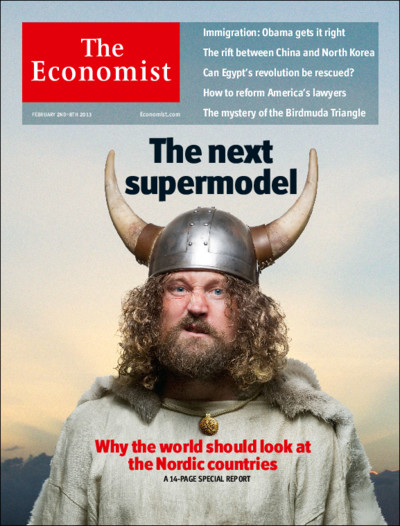
Horns on Viking helmets? Let’s all agree to blame Wagner…

Filed under: Europe, History, Media — Tags: , , — Nicholas @ 11:37

In The Economist, a sort-of-apology for perpetuating the myth that Vikings wore helmets with horns:

Economist cover with Viking horns

The practice of burying the dead with their goods has left archaeologists with lots of evidence about the Vikings, who were arguably the first maritime superpower. Unfortunately, few Viking helmets survive intact. The small sample size cannot prove the point definitively, but they are all horn-free.

Why, then, do cartoon Vikings, Scandinavian football fans and Economist covers persist in giving their helmets horns? As in the rest of Europe, Scandinavia saw an upsurge of interest during the 19th century in home-grown cultural traditions and images. Folk dances, songs, sagas — all were revived and celebrated. The 18th century had seen most of Europe trying to imitate sophisticated Parisian fashions. Now trolls were cool. Where there were gaps in the historical record, artists often used their imagination to reinvent traditions. Painters began to show Vikings with horned helmets, evidently inspired by Wagner’s costume designer, Professor Carl Emil Doepler, who created horned helmets for use in the first Bayreuth production of “Der Ring des Nibelungen” in 1876, as a reader points out in a letter we publish this week. (For the full story, see Roberta Frank, “The Invention of the Viking Horned Helmet“, published in International Scandinavian and Medieval Studies in Memory of Gerd Wolfgang Weber, 2000.)

February 18, 2013

Did you know … that Wikipedia has an obsession over Gibraltar?

Filed under: Britain, Europe, Media — Tags: , — Nicholas @ 11:00

I’d noticed one or two of these “Did you know…” entries on the Wikipedia site, but I didn’t realize just how much of a fixation the online encyclopedia has for “The Rock”:

Last October Wikipedia‘s supreme leader Jimmy Wales called for a “strong moratorium” on the online project’s strange obsession with promoting Gibraltar — even suggesting a five-year ban on Gibraltar-loving Did You Know… posts on Wikipedia‘s front page.

“I think it is clear that there should be a strong moratorium on any Gibraltar-related DYKs on the front page of Wikipedia. I would recommend a total ban on them for five years, but that might be too extreme. I support that we get wider community attention on the issue,” he wrote in October last year.

The moratorium was opposed by Wiki editors but they did agree on certain guidelines. Every Gibraltar DYK has to be reviewed by two reviewers to check for conflict-of-interest issues or promotionalism, and no more than one Gibraltarpedia hook is allowed in one a day. Also, Bamkin (user name Victuallers) is not allowed to create or nominate Gibraltar-related articles to DYK.

Jimmy Wales speaks, and Wikipedia leaps into action. In December, they restricted themselves to a mere nine Gibraltar DYK entries. January saw 12 Gibraltarpedia links. As of today, there have been six Gibraltar-related posts in February.

Opening the food testing can of worms: “We don’t test for hedgehog either”

Filed under: Britain, Europe, Food, Health, India, Science — Tags: , , , — Nicholas @ 10:20

Tim Worstall on some of the issues with demands that all British beef for human consumption be tested for horsemeat:

Now let’s turn to that meat problem. We’re going to test something to make sure that it is indeed what it says. Most of the time, usually, we’d go looking for beef DNA and on finding it say, yup, that’s beef.

But now we’re talking about trace amounts of other species. Some of this horse contamination is someone deliberately substituting, yes. But a lot of it, those trace amounts, is someone not cleaning the pipes between species being processed. Or the knives even. Which leads us to something of a problem.

How many species do we test for? Some minced beef… or pink slime perhaps. Do we test for beef and horse? For beef, horse, mutton, pork, chicken, duck, goose? What about rat and mouse? For I’ll guarantee you that however much people try there will often be the odd molecule of either one of those in there. Sparrow? That’s more of a problem with grain processing but still.

For example, one lovely story about vegetarianism. Those (umm, OK, some) who have moved from the sub-continent to the UK. They carry on eating the (possibly Hindu caste based) vegetarian diet they are used to. And they start falling prey to all sorts of dietary deficiencies. Anaemia, there have even been reports of kwashikor (a protein deficiency). The grains and the pulses of the sub-continent have rather more insect and other residue in them than our more modern processing and storage systems provide.

People don’t test for hedgehog DNA in meat supplies, no. But how many species should they test for?

February 17, 2013

A shocking, lurid tale of depravity that transfixed Victorian London

Filed under: Britain, History, Law, Liberty — Tags: , , , , — Nicholas @ 12:15

In History Today, Richard Canning reviews a new book on the trial of Frederick Park and Ernest Boulton, aka Mrs Fanny Graham and Miss Stella Boulton in 1871:

McKenna provides what is certainly the definitive account of the Boulton/Park story, drawn not only from contemporary journalism but also from the full legal transcript, a miraculous survivor housed in Kew’s National Archives. It is a miserable tale, if leavened both by McKenna’s dramatic verve and, during the show trial held in Westminster Hall, by Fanny and Stella’s black humour. The establishment account – that the pair’s persistent cross-dressing importuning was a scandal to public morals that must be stopped – soon breaks down. McKenna shows clearly how the men were effectively set up and, to some degree, even entrapped.

Police confidence in pressing the serious charge of ‘conspiracy to solicit, induce, procure and endeavour to persuade persons unknown to commit buggery’ (as opposed to the minor offence of outraging public decency) was nonetheless misplaced. Buggery had until lately incurred the death penalty and still carried a lifelong penal sentence. No such charge had been brought for 240 years. The problem which attended the endless, farcical medical examinations of Boulton and Park reflected sodomy’s millennial history as the nameless or invisible crime. Few Victorian doctors could claim to have seen evidence of the extreme anal dilation which purportedly occurred after the ‘insertion of a foreign body’. Of the half dozen who inspected the pair – both inveterate sodomites, as McKenna concedes – only one remained certain that the corporeal evidence supported conviction. They were acquitted and the notion that ‘the impurities of Continental cities’ had reached London was rooted in legal terms for a quarter-century – if paradoxically seeming somehow to be affirmed.

McKenna lays bare a fascinating tapestry of interrelated personal histories, only partially capable of reconstruction. Frederick’s elder brother Harry, already twice disgraced, was hiding in Scotland under an assumed name. Their father, a judge, was urgently shipped off to South Africa during the trial of his younger son. Impressively, Frederick’s mother – amusingly a literal ‘Mary Ann’ – took to the stand to defend his moral character. So successful was she that the identification of Frederick/’Fanny’ as a theatrical mother’s boy exonerated him entirely from the imputation of vice.

It turns out it actually was the Burmese equivalent of Al Capone’s vault

Filed under: Asia, Britain, History, Military, WW2 — Tags: , , — Nicholas @ 11:51

Back in early January, the archaeological dig for buried WW2 Spitfires was announced:

Then, the doubts began to grow:

And now, even the sponsoring organization says there are no buried Spitfires after all:

A global video gaming company that funded a high-profile hunt for dozens of World War II-era British fighters in Myanmar has some bad news for aviation enthusiasts: It says none of the legendary planes are buried in the Southeast Asian country.

Excavation teams carrying out surveys on the ground, however, said Saturday that they would not give up the search.

The hunt for the lost planes was launched amid hope that as many as 140 rare Spitfires were hidden in crates in pristine condition in three locations in Myanmar.

But the Belarusian video gaming company Wargaming.net, which had backed the venture, said in a statement late Friday that the planes were never even delivered to the country by Allied forces as the war drew to a close nearly 70 years ago.

“The Wargaming team now believes, based on clear documentary evidence, as well as the evidence from the fieldwork, that no Spitfires were delivered in crates and buried” in Myanmar between 1945 and 1946, the statement said.

I’d been rather doubtful of the story from the start — even though it would have been awesomely cool to find a stash of Spitfires.

Whinnygate is just a useful distraction from the real scandal in the NHS

Filed under: Britain, Bureaucracy, Health, Politics — Tags: , , , , , — Nicholas @ 11:09

The British media is doing a great job of distracting the public with the horsemeat story, and the politicians and National Health Service bureaucrats are delighted that nobody is paying attention to the real scandal:

At any given moment, there exists at least one delicate subject that all mainstream political parties would much rather not discuss. For many years the abuse of MPs’ expenses fell into this category. After this was exposed by a Telegraph investigation, everyone joined a tacit agreement to keep quiet about the criminality inside the Murdoch newspaper empire.

Now the subject which nobody wants to talk about is the National Health Service. It is just over a week since the publication of the Francis report into Stafford hospital, where some 1,200 patients died in appalling circumstances. Had any other institution been involved in a scandal on this scale, the consequences would have been momentous: sackings, arrests and prosecutions. Had it involved a private hospital, that hospital would have been closed down already, and those in charge publicly shamed and facing jail.

Astonishing to relate, nothing has happened. Politicians have made perfunctory expressions of concern, while agreeing that there must be “no scapegoats”, and that Sir David Nicholson (the senior figure responsible) must remain in his job.

Then, almost at once, the political class turned its attention to a far more lively subject: horse meat. Few “scandals” in living memory have carried less significance. And yet few stories have dominated the press quite as comprehensively since rival teams of crack reporters from The Sun and The Star pursued Blackie the Donkey across Southern Spain in 1987, in the wake of some dubious allegations of mistreatment by his Spanish owners.

Misdirection is a vital tool in the arsenal of the magician — and it can be even more valuable in the political arena. If they can fool you into watching the hand that isn’t hiding the coin, they can get away with a great trick (magicians) … or a great evil (politicians).

Money talks, fading historical memories edition

Filed under: Britain, Middle East, Military, WW1 — Tags: , , — Nicholas @ 10:42

The British army’s officer training college at Sandhurst (think “West Point” in the American context) has invited a lot of criticism for this decision:

Britain’s top military academy, Sandhurst, has come under fire for renaming a sports hall commemorating a First World War battle after the King of Bahrain.

The Mons Hall — named after the 1914 battle where thousands died — will have its name changed to honour the Bahraini monarch who has given millions in funding to the Army’s officer training college.

The building will now be called King Hamad Hall and will reopen next month after being refurbished thanks to a £3 million donation from the king, who is the patron of the Sandhurst Foundation but is known for brutally repressing demonstrators at home.

Sandhurst has also accepted a £15 million donation from the United Arab Emirates to build a new accommodation block, raising questions about the college’s links with authoritarian Gulf states accused of human rights abuses.

Critics say the Army is betraying the soldiers who gave their lives and that Bahrain and the UAE are trying to avert criticism of their regimes by buying silence with donations.

The 1914 Battle of Mons was the first major battle of the war. Against overwhelming odds, the British Army inflicted 5,000 casualties on the Germans. At least 1,600 British troops were killed.

February 16, 2013

Contrasting the State of the Union Address to the Speech from the Throne

Filed under: Australia, Britain, Cancon, Government, USA — Tags: , , , — Nicholas @ 11:40

Mark Steyn looks at how the republican method compares to the constitutional monarchy’s method:

“I’m also issuing a new goal for America,” declared President Obama at his State of the Union on Tuesday. We’ll come to the particular “goal” he “issued” momentarily, but before we do, consider that formulation: Did you know the president of the United States is now in the business of “issuing goals” for his subjects to live up to?

Strange how the monarchical urge persists even in a republic two-and-a-third centuries old. Many commentators have pointed out that the modern State of the Union is in fairly obvious mimicry of the Speech from the Throne that precedes a new legislative session in British Commonwealth countries and continental monarchies, but this is to miss the key difference. When the Queen or her viceroy reads a Throne Speech in Westminster, Ottawa, or Canberra, it’s usually the work of a government with a Parliamentary majority: In other words, the stuff she’s announcing is actually going to happen. That’s why, lest any enthusiasm for this or that legislative proposal be detected, the apolitical monarch overcompensates by reading everything in as flat and unexpressive a monotone as possible. Underneath the ancient rituals — the Gentleman Usher of the Black Rod getting the door of the House of Commons slammed in his face three times — it’s actually a very workmanlike affair.

The State of the Union is the opposite. The president gives a performance, extremely animatedly, head swiveling from left-side prompter to right-side prompter, continually urging action now: “Let’s start right away. We can get this done … We can fix this … Now is the time to do it. Now is the time to get it done.” And at the end of the speech, nothing gets done, and nothing gets fixed, and, after a few days’ shadowboxing between admirers and detractors willing to pretend it’s some sort of serious legislative agenda, every single word of it is forgotten until the next one.

The socialist origins of Mussolini’s Fascist Italy

Filed under: Europe, History, Italy, Politics, WW2 — Tags: , , , , — Nicholas @ 11:13

Everyone “knows” that Fascism is an ideology of the extreme right, and Communism is an ideology of the extreme left. Benito Mussolini’s fascist state was bankrolled by big business and the Catholic Church to suppress the democratic demands of the workers in the wake of the First World War. Except that isn’t actually true:

… Mussolini was every bit as much as man of the Left as contemporaries such as Eugene V. Debs. He was what would later come to be known as a “red diaper baby” (meaning the child of revolutionary socialist parents). As a young man, Mussolini himself was a Marxist, fervently anticlerical, went to Switzerland to evade compulsory military service, and was arrested and imprisoned for inciting militant strikes. Eventually, he became a leader in Italy’s Socialist Party and he was imprisoned once again in 1911 for his antiwar activities related to Italy’s invasion of Libya. Mussolini was so prominent a socialist at this point in his career that he won the praise of Lenin who considered him to be the rightful head of a future Italian socialist state.

[. . .]

When the Italian Fascist movement was founded in 1919, most of its leaders and theoreticians were, like Mussolini himself, former Marxists and other radical leftists such as proponents of the revolutionary syndicalist doctrines of Georges Sorel. The official programs issued by the Fascists, translations of which are included in Norling’s book, reflected a standard mixture of republican and socialist ideas that would have been common to any European leftist group of the era. If indeed the evidence is overwhelming that Fascism has its roots on the far Left, then from where does Fascism’s reputation as a rightist ideology originate?

[. . .]

During its twenty-three years in power, Mussolini’s regime certainly made considerable concessions to traditionally conservative interests such as the monarchy, big business, and the Catholic Church. These pragmatic accommodations borne of political necessity are among the evidences typically offered by leftists as indications of Fascism’s rightist nature. Yet there is abundant evidence that Mussolini essentially remained a socialist throughout the entirety of his political life. By 1935, thirteen years after Mussolini seized power in the March on Rome, seventy-five percent of Italian industry had either been nationalized outright or brought under intensive state control. Indeed, it was towards the end of both his life and the life of his regime that Mussolini’s economic policies were at their most leftist.

After briefly losing power for a couple of months during the summer of 1943, Mussolini returned as Italy’s head of state with German assistance and set up what came to be called the Italian Social Republic. The regime subsequently nationalized all companies employing more than a hundred workers, redistributed housing that was formerly privately owned to its worker occupants, engaged in land redistribution, and witnessed a number of prominent Marxists joining the Mussolini government, including Nicola Bombacci, the founder of the Italian Communist Party and a personal friend of Lenin. These events are described in considerable detail in Norling’s work.

It would appear that the historic bitter rivalry between Marxists and Fascists is less a conflict between the Left and the Right, and more of a conflict between erstwhile siblings on the Left. This should come as no particular surprise given the penchant of radical leftist groupings for sectarian blood feuds. Indeed, it might be plausibly argued that leftist ”anti-fascism” is rooted in jealously of a more successful relative as much as anything else.

February 15, 2013

A useful bit of perspective over Whinnygate

Filed under: Europe, Food, Health — Tags: , — Nicholas @ 11:35

It’s reasonable to be concerned that your hamburger may once have raced in the Grand National, but worries about chemical contamination from the horse meat are almost certainly overblown. In fact, your health might be more at risk from the burger itself:

There is reasonable public outrage at possible criminal conspiracies to adulterate meat products with horsemeat, and additional concerns raised about the presence of the anti-inflammatory known as bute.

While not in any way questioning this concern about adulteration with a chemical compound, it is helpful to get a sense of magnitude. When bute was given as a human medicine, it was reported to be associated with a serious adverse reaction in 1 in 30,000 (over a whole course of treatment), but at a dose giving concentrations at least 4,000 times that arising from eating a diet of horse meat – see the excellent information from the Science Media Centre

So making all sorts of heroic assumptions about there being a linear-no-threshold response, we might very roughly assign a pro-rata risk of a serious event as 1 in 100,000,000 per burger.

February 14, 2013

“A triumph for our culture of self-pity, narcissism and whining entitlement”

Filed under: Britain, Government, Law — Tags: , , — Nicholas @ 00:01

In sp!ked, Neil Davenport explains why the legal victory against workfare in England isn’t actually a good thing even for people in that situation:

… the case is still seen as a major coup. Joanna Long, a member of campaigning group Boycott Workfare, captured the mood of Reilly’s supporters: ‘Today’s ruling is a victory for the people against a government which thought it could compel unemployed and sick people to work without pay, backed by a vicious regime of sanctions which made the poorest far poorer.’ Really? Only in this victim-centred age could doing a few shifts at Poundland be seriously compared to forced slavery.

What the ruling in favour of Reilly is not, however, is a victory for ‘the people’. Rather, it is a triumph for our culture of self-pity, narcissism and whining entitlement. The new ruling will further cushion and cosset young people, relieving them of any impositions or pressures. And it will bolster the infantile notion that young people must be protected from the demands of becoming economically independent or hard working. In the long run, this will do the development of young people far more damage than a few weeks working for benefits.

[. . .]

In this sense, today’s ruling will bolster the idea held by some young people that the world really does owe them a living. The Reilly ruling seems to acknowledge officially that young people should not be expected to meet society’s requirement to work in case it damages their vulnerable self-esteem. It suggests that self-pity and a sense of entitlement is now far more laudable than simply overcoming life’s challenges or learning how to grow up.

Nevertheless, it shouldn’t be too surprising that the court came to such a decision. For the past two decades, the state has been keen to show that adult autonomy is not something people should exercise too much. So while the ruling looks like a victory for people power-style leftism against a (mainly) Tory government, in truth it is a demand for the state to look after us. It is an acknowledgement that we should forgo individual sovereignty for a close relationship with the all-watching, all-checking and autonomy sapping state. Whereas genuine radicalism was always a demand for autonomy from state regulators, today’s radicals aspire to be more tightly bound to state institutions. Any excuse to bolster state legitimacy and authority over us, even at the expense of a Tory government, will always appeal to elite-minded, undemocratic judges. Reilly and her supporters demand to be treated like children. Is it any wonder that a paternalistic state will oblige?

« Newer PostsOlder Posts »

Powered by WordPress

