
Quotulatiousness

March 5, 2014

Vladimir Putin and the “vertical of power”

Filed under: Europe, Politics, Russia — Tags: , , — Nicholas @ 09:31

The BBC‘s Steve Rosenberg says that to understand what Russia is doing, you have to get into the mind of the man who controls it all:

One thing that makes Vladimir Putin mad is the feeling that he is being deceived. We saw that with Libya in 2011. Moscow was persuaded not to block a UN Security Council resolution on a no-fly zone to protect civilians. But Nato’s military action led to regime change and the death of Col Muammar Gaddafi — far beyond what Russia had expected. It helps explain why Russia has been quick to veto resolutions on Syria.

On Ukraine, too, President Putin feels the West has tricked him. Last month he sent his envoy to Kiev to take part in negotiations on a compromise agreement between President Viktor Yanukovych and the opposition. That deal, brokered by foreign ministers from Germany, France and Poland, envisaged early elections, constitutional reform and a national unity government.

The Kremlin’s representative did not sign the deal, but Russia appeared to accept it as the best solution in a bad situation. It remained words only. Less than 24 hours later, Mr Yanukovych was on the run, the parliament removed him from power and appointed a new acting president from the opposition. The pace of events took Moscow completely by surprise.

The world according to Vladimir Putin is one in which Western powers are plotting night and day to destabilise Russia (and him, personally).

He remembers the Rose Revolution in Georgia in 2003, the Orange Revolution in Kiev the following year; Russia suspected the West of planning both.

More recently the Kremlin accused the West of funding and fuelling anti-government street protests in Moscow.

For months, Russia has been accusing the US and EU of meddling in Ukraine for geopolitical gains. On Tuesday President Putin said Viktor Yanukovych’s refusal to sign an association agreement with the EU last autumn “was simply used as an excuse to back opposition forces in their battle for power… it’s not the first time our Western partners have done this in Ukraine”.
March 4, 2014

Britain’s prostitution law reforms are driven by moral panic

Filed under: Britain, Law — Tags: , , , , — Nicholas @ 11:35

An editorial from last weekend’s Independent:

What the All Party Parliamentary Group on Prostitution broadly proposes is Nordic-style reform, which is what the European Parliament also backed last week. This would shift the burden of prosecution from mostly women sellers to mostly male buyers and pimps. MPs are right to say that one of the root problems with Britain’s laws on the sex trade is that they send conflicting messages about who is in the wrong. If trafficked women, especially, are to be helped, they must be assured that the law is on their side. It is why the MPs want the mass of current legislation consolidated into a single Act, which makes it clear that only those who purchase sex will feel the rigours of the law.

Change along these lines will bitterly disappoint libertarians who want to see the sex trade fully legalised on Dutch or German lines. There is also an argument that it is illogical – another mixed message – to penalise the purchase of sex but not the sale. But, a counter-argument, which the authorities in Sweden, Norway and Iceland deploy with some justification, is that “redistributing guilt” over the sale of sex undoubtedly benefits women who have felt trapped into prostitution and makes life much harder for pimps and traffickers.

The underlying idea is that because many people (especially politicians) dislike the idea that women sell their bodies, it should be made illegal. The troubling reality that a lot of prostitutes are voluntarily in the business requires the would-be banners to come up with a justification that somehow invalidates the individual decisions of those women. The ongoing moral panic over human trafficking is the current choice of vehicle for that. Tim Worstall:

The only possible claim that can be made in favour of the banning of prostitution, or even of the declaration that it is something wrong that we would like to minimise, is that it represents some form of slavery in which people are forced to do things they do not agree to doing voluntarily.

And that is indeed the claim that is being made, see that reference to “trafficking” in the Independent. However, the one thing that we do in fact know about the “slavery” in prostitution is that it doesn’t, in this country at least, actually exist. For we had a plan whereby every single police force in the country went out looking for people who were indeed sex slaves. People who were being forced, against their will, into prostitution (ie, repeatedly raped, a vile crime). And when they had a look through all of the brothels, working flats, saunas and street walkers they could find not one single police force was able to come up with sufficient evidence to charge anyone at all with the crime of holding someone in such sex slavery. Operation Pentameter it was called and it’s the biggest refutation of the hysterical case about trafficking that could possibly have been devised.

The vision some have of people being forced onto the game is simply untrue. What we do in fact have is consenting adults deciding to offer such services as they wish to offer for the cash being proferred to them. And this isn’t something that requires customers to be made into criminals: nor is it something that requires suppliers to be made into criminals either. It’s just not something that requires anyone at all to be made into a criminal. It’s consenting adults deciding what to do with their own bodies.

Update: The Canadian government is conducting a survey on what to do in the wake of the Supreme Court decision that struck down key parts of Canada’s prostitution laws last year. You can participate in the survey here. The public consultation period lasts until March 17.

On December 20, 2013, in the case of Bedford v. Attorney General of Canada 1, the Supreme Court of Canada found three Criminal Code prostitution offences to be unconstitutional and of no force or effect. This decision gives Parliament one year to respond before the judgment takes effect. Input received through this consultation will inform the Government’s response to the Bedford decision.

You will find some specific questions on this issue at the end of this document. To put them in context, here is a brief overview of the current criminal laws addressing prostitution, the Bedford decision, and existing international approaches to prostitution.

1. http://scc-csc.lexum.com/decisia-scc-csc/scc-csc/scc-csc/en/item/13389/index.do?r=AAAAAQAHYmVkZm9yZAAAAAAB

H/T to Maggie McNeil for the link.

Not a science fiction story – “National Bolshevism” versus “Atlantis”

Filed under: Europe, Politics, Russia — Tags: , , — Nicholas @ 09:59

According to Robert Zubrin, a key advisor to Vladimir Putin and other Russian leaders has some really weird notions:

Putin is sometimes described as a revanchist, seeking to recreate the Soviet Union. That is a useful shorthand, but it is not really accurate. Putin and many of his gang may have once been Communists, but they are not that today. Rather, they have embraced a new totalitarian political ideology known as “Eurasianism.”

The roots of Eurasianism go back to czarist émigrés interacting with fascist thinkers in between-the-wars France and Germany. But in recent years, its primary exponent has been the very prominent and prolific political theorist Aleksandr Dugin.

[…]

Nazism, it will be recalled, was an abbreviation for National Socialism. National Bolshevism, therefore, put itself forth as an ideology that relates to National Socialism in much the same way as Bolshevism relates to Socialism. This open self-identification with Nazism is also shown clearly in the NBP flag, which looks exactly like a Nazi flag, with a red background surrounding a white circle, except that the black swastika at the center is replaced by a black hammer and sickle.

[…]

The core idea of Dugin’s Eurasianism is that “liberalism” (by which is meant the entire Western consensus) represents an assault on the traditional hierarchical organization of the world. Repeating the ideas of Nazi theorists Karl Haushofer, Rudolf Hess, Carl Schmitt, and Arthur Moeller van der Bruck, Dugin says that this liberal threat is not new, but is the ideology of the maritime cosmopolitan power “Atlantis,” which has conspired to subvert more conservative land-based societies since ancient times. Accordingly, he has written books in which he has reconstructed the entire history of the world as a continuous battle between these two factions, from Rome v. Carthage to Russia v. the Anglo Saxon “Atlantic Order,” today. If Russia is to win this fight against the subversive oceanic bearers of such “racist” (because foreign-imposed) ideas as human rights, however, it must unite around itself all the continental powers, including Germany, Central and Eastern Europe, the former Soviet republics, Turkey, Iran, and Korea, into a grand Eurasian Union strong enough to defeat the West.

In order to be so united, this Eurasian Union will need a defining ideology, and for this purpose Dugin has developed a new “Fourth Political Theory” combining all the strongest points of Communism, Nazism, Ecologism, and Traditionalism, thereby allowing it to appeal to the adherents of all of these diverse anti-liberal creeds. He would adopt Communism’s opposition to free enterprise. However, he would drop the Marxist commitment to technological progress, a liberal-derived ideal, in favor of Ecologism’s demagogic appeal to stop the advance of industry and modernity. From Traditionalism, he derives a justification for stopping free thought. All the rest is straight out of Nazism, ranging from legal theories justifying unlimited state power and the elimination of individual rights, to the need for populations “rooted” in the soil, to weird gnostic ideas about the secret origin of the Aryan race in the North Pole.

March 2, 2014

Why the EU hesitates to do anything about Ukraine

Filed under: Europe, Politics, Russia — Tags: , , , , — Nicholas @ 09:50

Theodore Dalrymple:

Extreme wealth, whether honestly or dishonestly acquired, seems these days to bring forth little new except in the form and genre of vulgarity. Mr. Ambani’s skyscraper tower home in Bombay is a case in point: His aesthetic is that of the first-class executive lounge of an airport. Mr. Ambramovich’s ideal is that of a floating Dubai the size of an aircraft carrier. Only once have I been invited to a Russian oligarch’s home, and it struck me as a hybrid of luxurious modernist brothel and up-to-date operating theater. I saw some pictures recently of some huge Chinese state enterprise’s headquarters, and it appalled me how this nation, with one of the most exquisite, and certainly the oldest, aesthetic traditions on Earth, has gone over entirely to Las Vegas rococo (without the hint of irony or playfulness).

But it was the luxury and not the taste of Yanukovych’s homes that outraged the Ukrainians, for if by any chance they had come into money they would have done exactly the same, aesthetically speaking. Yanukovych may have been a dictator of sorts, but when it came to taste he was a man of the people. A horrified Ukrainian citizen, touring one of his homes after his downfall, was heard to exclaim, “All this beauty at our expense!”

As to politics, the Ukrainian crisis has once again revealed the European Union’s complete impotence. Physiognomy is an inexact science, but it is not so inexact that you cannot read the bemused feebleness on the faces of people such as Van Rompuy, Hollande, and Cameron, the latter so moistly smooth and characterless that it looks as though it would disappear leaving a trail of slime if caught in the rain. Mrs. Merkel has a somewhat stronger face, but then she has the advantage of having spent time in the Free German Youth (the East German communist youth movement), which must at least have put a modicum of iron in her soul.

Be that as it may, Russia holds all the trump cards in this situation. It can turn off Western Europe’s central heating at a stroke, and for Europeans such heating is the whole meaning and purpose of life—together with six-week annual holidays in Bali or Benidorm. Therefore Europe will risk nothing for the sake of Ukraine, except perhaps a few billion in loans of no one’s money, a trifle in current economic circumstances. If Bismarck were to return today, he would say that the whole of Ukraine was not worth the cold of one unheated radiator.

February 28, 2014

“Reenactment’s for pussies”

Filed under: Europe, History, Russia, Sports, Weapons — Tags: , , — Nicholas @ 13:39

The SCA or Western Martial Arts not macho enough for you? You might be interested in medieval combat with steel weapons:

Steel kisses steel. Actual sparks fly. An axe snaps in half as it dents a helmet. A municipal garbage bin, carelessly left at the fringes of the fight, implodes in a sorry mess of dented plastic as four armored men collapse onto it.

I’m witnessing, from the far side of a flimsy rope, something much more violent than your average historical battle reenactment. These men are engaging in full-contact medieval combat in an open training session for the U.K. iteration of a growing global society. More GBH than LARP, it substitutes foam weaponry for real steel and scripted acting for unpredictable scuffling, and despite the mayhem, operates under tightly controlled rules and regulations.

[…]

The team’s press officer, Nick Birkin, agrees. “Reenactors are used to dink, dink,” he says, mimicking the prissy swordplay anyone who’s sat through a retelling of Agincourt will no doubt cringe to recall. Another weekend warrior sums up the distinction more succinctly: “Reenactment’s for pussies.”

I first heard about the Russian origins of this new organization from a co-worker who was still upset he’d had to leave his chainmail and weapons behind when he came to Canada from St. Petersburg. It sounded like great fun … but was significantly more injury-prone than the SCA combat of my youth.

The Russian connection also brings with it some aspects that make Western practitioners uncomfortable:

The West’s notions of fair play and how an international tournament should be run are, it would seem, at odds with that of the East’s. Dissent has been stirring among the camps and honor was called into question on several sides, and complaints started to be raised about the Russian organizers. The first to percolate were stories about rule-changing and underhand tournament organization.

“They said that under no circumstances can you have a metal handle on your shield, and that you can’t wear titanium armor,” U.S. team captain Andre Sinou tells me later over the phone from his native New Jersey. Sinou is also the owner of an armory manufacturer called Icefalcon. “So I told my guys that. Then when we went out there, all the Eastern teams had metal handles. We complained, and they said, ‘Oh, we sent out a memo’, which none of the Western countries got.”

Many of the Eastern fighters were wearing Kevlar armor under their suits and came with lethal equipment — such as two-handled halberd axes — that was banned for anyone else. “The weapons that some of the Eastern teams were using were just dangerous,” Sinou says. “They were pointy, they didn’t follow the rules for sharpness. After 2013, we had puncture wounds — we had a meaty guy who got punctured all the way down to the bone on the shoulder. It hit his spine. He could have been paralyzed.”

Nick Birkin from Team U.K. echoes many of these complaints and adds his own stories of match fixing, detailing devious techniques that would put a Sochi figure-skating judge to shame and which apparently allowed Russian teams to progress further and enjoy longer rest breaks between contests. But the growing concerns of an increasing number of countries was met by a response almost laughably Kafkaesque.

H/T to Steve Muhlberger for the link.

February 27, 2014

Ukraine and the EU – why the easy answer won’t work

Filed under: Economics, Europe, Russia — Tags: , , — Nicholas @ 09:09

At the Adam Smith Institute website, Eamonn Butler explains why there won’t be an easy economic fix for the EU/Ukraine trading relationship:

The trouble with EU membership is that it is such a big deal. A country that wants to be part of the club, and enjoy its free trade benefits also has to accept a mountain of regulation and to sign up for the common currency. It is all or nothing.

That puts countries like Ukraine in a fix, just as it put the UK in a bit of a fix in the early 1970s. The UK did not want to raise tariff barriers and lose its trading relationships with its historic trading partners such as Canada, Australia and New Zealand, from which it imported a great many agricultural products — butter, lamb, fruit, bacon and much else. But thanks to the Common Agricultural Policy, it did not have much choice. Today, the UK is inside the EU’s tariff wall, which makes trade with the rest of the world more expensive, and naturally focuses UK trade on Europe.

[…]

As a logical matter, that does not have to be. If the EU allowed Ukraine the same sort of status enjoyed by (neutral) Switzerland, the country would be free to trade with the EU as part of its customs-union club – but would remain free to preserve trading links to other countries as well. It would also be free to retain its currency and its legal and regulatory structure. A free trade pact with the EU that would help grow the Ukrainian economy, without threatening Russia or the Russian-speaking Ukrainians that the country would be wholly swallowed up into a Western political alliance.

A genuine free-trade deal, rather than full membership. That would probably be ideal for Ukraine (and for other nearby countries not already in the EU), but it won’t be on offer, because too many existing members of the EU would also prefer to have that kind of trading relationship without all the legislative/regulatory overhead that full membership requires. In many ways, the EU cannot afford to offer Ukraine such a deal, for fear of undermining the basis of the current integrated model.

Update: Daniel Hannan on the possibility of partition in Ukraine.

These two views — Ukrainians as a historic people, Ukrainians as a strain of Russians — frame the present quarrel. Most Russian nationalists allow, albeit reluctantly, that Ukrainian national consciousness exists. Alexander Solzhenitsyn grumpily accepted that western Ukrainians, after the horrors of the Soviet era, had been permanently alienated from Mother Russia; but he insisted that the frontiers were arbitrarily drawn under Lenin. If Ukrainians claimed independence on grounds of having a separate national identity, he argued, they must extend their own logic to the Russian-speakers east of the Dnieper.

[…]

Plainly a pro-Russian regime can’t govern the whole country: the recent uprising has put that fact beyond doubt. If the Slavophiles can’t rule the West, might the Westernisers win the East? The way of life they propose ought to be more attractive. But we should not underestimate the importance, in such a region, of blood and speech. Nor should we underestimate how much more Ukraine matters to Moscow than it does to Brussels. Vladimir Putin has mobilised troops on the border. Does anyone imagine any EU government, with the possible exception of Poland’s, contemplating a military response?

If neither the Slavophiles nor the Westernisers can carry the entire territory, some kind of separation starts to look inevitable. Such a separation might come about as paramilitary groups establish local supremacy. Or it might happen as a result of Russian intervention, as in Armenia, Moldova and, later, South Ossetia. It is easy enough to imagine Russian security forces crossing the border at the request of local proxies and establishing a de facto Russophone state. The Trans-Dniester Republic still exists, unrecognised but very much in force, on Ukraine’s western border; why not a Trans-Dnieper Republic to its east?

The Parachute Regiment

Filed under: Britain, History, Military, WW2 — Tags: , — Nicholas @ 08:13

February 26, 2014

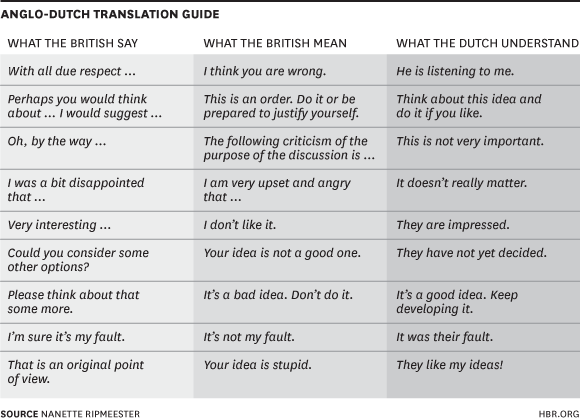
Sometimes a direct translation fails to convey the exact meaning

Filed under: Britain, Business, Europe — Tags: , — Nicholas @ 17:42

Especially if the speaker is British and the listener is Dutch:

Anglo-Dutch Translation Guide

February 25, 2014

A contrarian speaks out on Ukraine

Filed under: Europe, Media — Tags: , , , — Nicholas @ 11:43

Brendan O’Neill isn’t comfortable with the widespread media descriptions of Ukraine’s change of government and calls it regime change instead:

Even in this era of rampant political spin and platitudes, where George Orwell’s claim that political language is used and abused to ‘make lies sound truthful and murder respectable’ has never been truer, the commentary on Ukraine stands out for its dishonesty. Western observers tell us there has been a revolution in that benighted nation. They claim revolutionaries have overthrown a dictator. They say the people of Ukraine have risen up and deposed their despot, and are now ‘experiencing the intense emotions expressed so eloquently by Thomas Paine in 1776 [in his writings on the American War of Independence]’. It is hard to remember the last time political language was so thoroughly used to obfuscate reality, to impose inappropriate historical narratives on to a messy modern-day event. For what we have in Ukraine is not revolution, but regime change, set in motion far more by the machinations of Western politicians than by the stone-throwing of Ukrainians.

Orwell was right – too much political writing is less about clarifying real-world events than it is a collection of pre-existing phrases ‘tacked together like the sections of a prefabricated henhouse’. So it has been in relation to Ukraine, where the words selected by Western observers tell us more about them and their prejudices than they do about events in Kiev. So the word ‘meddling’ is used to describe Vladimir Putin’s interventions in Ukraine, but never to describe Angela Merkel’s or John Kerry’s cultivation of the oppositional forces – that is ‘mediation’. Ousted Ukrainian leader Viktor Yanukovich is now widely referred to as a ‘dictator’, confirming how exhausted and meaningless that word has become through overuse: unlike serious dictators like Gaddafi or Assad, Yanukovich won a free and fair election, in March 2010. As for the word ‘revolution’ – that has been knackered by misuse for decades, but its deployment in Ukraine takes its bastardisation to a new low: there has of course been no replacement of one social order by another in Ukraine, or even the instalment of a people’s government; instead various long-established parties in parliament, some of which are deeply unpopular among certain constituencies in Ukraine, are forming an interim government. Revolutionary? Hardly.

The Western debate and coverage of Ukraine has cast a massive political fog over events there. It may not have quite made ‘murder seem respectable’, but it has certainly made externally generated regime change seem revolutionary, and the Western-assisted anti-democratic removal of an elected leader seem like an act of people’s democracy. It has exposed a severe dearth of independent critical thinking among the Western commentariat. Even those on the right who are normally passionately anti-EU are now lining up like lemmings behind Brussels’ dishonest moral narrative about being a mere observer to a glorious revolution in the East. And even those on the left who condemned regime change in Iraq or Libya are buying the idea that Ukraine has undergone a revolution of Paineite proportions, with the Observer giddily declaring that Ukraine is currently experiencing ‘an intoxicating sense of liberation from an old guard’. Across the political spectrum, narratives about Ukraine that don’t add up, and which are being promoted by people normally seen as untrustworthy, are being accepted as good coin – among both a right excited by the prospect of a return of the neat Cold War-era divide between good West and bad East, and a left so desperate for evidence of revolutionary behaviour in the twenty-first century that it will lap up even staid, grey, distinctly unrevolutionary Brussels’ claims about a revolution being afoot in Ukraine.

Note: This article is posted at Spiked Plus, which is normally a pay site. They’ve made the site available to non-subscribers for a limited time to mark their second anniversary. If you’re reading this post at a later date, the link to the whole article may not work unless you’re a member.

February 24, 2014

Euromaidan’s pseudo-medieval technological battle with Berkut

Filed under: Europe, Politics, Weapons — Tags: , , — Nicholas @ 10:59

Robert Beckhusen on the throwback to the Middle Ages in the fighting between the Euromaidan protestors and the paramilitary Berkut police:

But to understand why the protests succeeded in toppling Yanukovych, it’s worth taking a glance at its strategies and military-style tactics. The protesters not only built a broad and inclusive coalition, but innovated where it mattered most: on the streets.

Really, it turned medieval.

Protesters shot fireworks with makeshift launchers. In combination with throwing stones and using slingshots, they overwhelmed disoriented Berkut special forces units, who were pelted with flying objects as fireworks exploded around them.

Protesters wore military helmets and carried makeshift — or captured — shields. Wooden boards were used to protect their lower legs from shrapnel the police taped to exploding stun grenades.

Among the array of homemade weapons, some were perhaps a little too ambitious. A crude trebuchet — a type of medieval catapult which uses a counterweight to fling objects — was overrun and dismantled.

To shield themselves from the onslaught, the police special forces units known as Berkut adopted distinct tetsudo formations. This packed shield formation was used by the Roman Empire, developed to shield infantry units from arrows. The first line holds its shields forward, with each preceding line holding their shields towards the sky.

The problem with this tactic? It makes you much slower.

Paul Krugman on Scottish money

Filed under: Britain, Economics — Tags: , , — Nicholas @ 09:40

I rarely find much of interest in Paul Krugman’s blog, but he’s pretty good in this brief analysis of Scotland’s monetary future in a post-independence scenario:

Whether it’s overall a good idea or not, however, independence would have to rest on a sound monetary foundation. And the independence movement has me worried, because what it has said on that that crucial subject seems deeply muddle-headed.

What the independence movement says is that there’s no problem — Scotland will simply stay on the pound. That is, however, much more problematic than they seem to realize.

[…]

In fact, Scotland-on-the-pound would be in even worse shape than the euro countries, because the Bank of England would be under no obligation to act as lender of last resort to Scottish banks — that is, it would arguably take even less responsibility for local financial stability than the pre-Draghi ECB. And it would fall very far short of the post-Draghi ECB, which has in effect taken on the role of lender of last resort to eurozone governments, too.

Add to this the lack of fiscal integration. The question isn’t whether Scotland would on average pay more or less in taxes if independent; probably a bit less, depending on how you handle the oil revenues. Instead, the question is what would happen if something goes wrong, if there’s a slump in Scotland’s economy. As part of the United Kingdom, Scotland would receive large de facto aid, just like a U.S. state (or Wales); if it were on its own, it would be on its own, like Portugal.

As Stephen Gordon points out, this is “another analysis where you can substitute Qc/RoC for Scotland/UK”.

February 23, 2014

Winter storms uncover a “Welsh Atlantis”

Filed under: Britain, Environment, History — Tags: , , , — Nicholas @ 11:54

A story in the Express about waves from recent storms having uncovered a previously unknown ancient forest on the shores of Cardigan Bay:

Gales stripped the sand from a beach at Borth in Ceredigion, West Wales, revealing the remains of a 6,000-year-old forest.

A picture of the same spot taken before the storms shows a strip of pristine sand.

The ancient oaks and pines date back to the Bronze Age.

They were discovered by Deanna Groom and Ross Cook from the Royal Commission on the Ancient and Historical Monuments of Wales.

Miss Groom, a maritime archeologist said: “The site around Borth is one where if there’s a bad storm and it gets battered, you know there’s a good chance something will be uncovered as the peat gets washed away.

“It’s regularly monitored and that’s why we went to have a look there again now to see if anything new had emerged.”

The ancient remains are said by some to be the origins of the legend of Cantre’r Gwaelod, a mythical kingdom now submerged under the waters of Cardigan Bay.

It has been described as a “Welsh Atlantis” and has featured in folklore, literature and song.

H/T to Elizabeth for the link.

Update: Elizabeth also sent a link that shows that ancient oak stumps aren’t the only things being uncovered by the waves:

The latest hazard caused by this winter’s devastating storms and floods has been revealed by police — unexploded bombs.

The storms that have ravaged and reshaped parts of the British coastline have led to the discovery of wartime shells long-buried on beaches.

There are also fears that flooding along the Thames will erode riverbanks, leading to the discovery of bombs dropped on the area by the Luftwaffe during the Second World War.

Police say that high tides and huge waves have either exposed devices or brought them closer to the surface.

Further storms and flooding are expected today as a new front moves in from the Atlantic. The Met Office has issued three severe rain warnings and gusts of wind are expected to reach 70mph.

The Environment Agency also still has 48 severe flood warnings issued across the UK following what the Met Office has described as the wettest winter on record.

Now walkers are being urged not to touch unidentified metal objects but to alert police to their finds instead.

In South West England and West Wales, which bore the brunt of the storms, six devices have been handled by bomb disposal units in six weeks.

The Navy’s Southern Diving Group said it had received a 20 per cent increase in reports of unexploded bombs since January.

A 100lb Mk XIX Second World War British anti-submarine mine was found by surfers at Watwick Bay, Haverfordwest, while a rare First World War German mine surfaced on a beach near the popular Cornish resort of Newquay.

February 22, 2014

Ukrainian President flees coup

Filed under: Europe, Politics, Russia — Tags: , , , — Nicholas @ 11:09

The situation in Ukraine just got more fluid, as President Yanukovych is said to have fled from Kiev and the speaker of the Ukrainian parliament announced a vote to remove him from the presidency. James Marson, Alan Cullison and Alexander Kolyandr report for the Wall Street Journal:

Government authority appeared to melt away Saturday, leaving protesters in control of the capital’s center. President Viktor Yanukovych left the capital for a city in the country’s Russian-speaking east and vowed to remain in power.

In a television interview Saturday afternoon in Kharkiv, Mr. Yanukovych denounced the events in Kiev as a “coup d’etat” that he blamed on “bandits.”

“I have no plans to leave the country and I have no plans to resign. I am the legally elected president and all the international intermediaries I’ve talked to (over the last few days) have given me guarantees of security. We’ll see how those are fulfulled,” Mr. Yanukovych told a small TV station in Kharkiv.

Opposition leader Vitali Klitschko earlier had called on parliament to vote to oust Mr. Yanukovych and announce presidential elections in May, as police withdrew from the center of the capital Saturday.

Ukraine opposition leader and former Prime Minister Yulia Tymoshenko was expected to be released from prison within hours, according to a spokeswoman for the opposition.

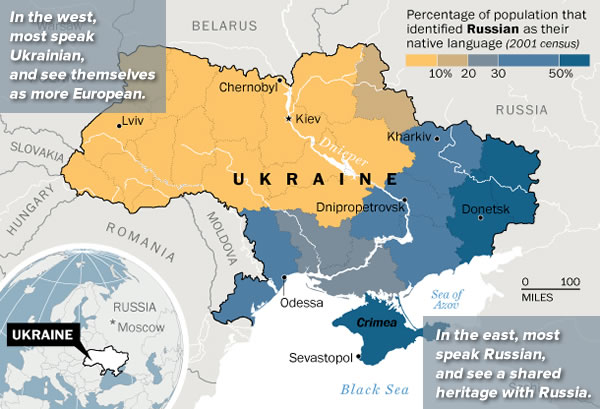
Ukraine is divided politically and linguistically on almost the same line:

Ukraine language map

The BBC reports that new elections have been called for May 25:

Ukrainian MPs have voted to oust President Yanukovych and hold early presidential elections on 25 May.

Mr Yanukovych’s spokeswoman said he did not accept the decision.

Earlier on Saturday, protesters walked unchallenged into the president’s office and residential compounds.

Also on Saturday afternoon, prominent opposition leader Yulia Tymoshenko was freed from a hospital in the eastern city of Kharkiv where she was being held under prison guard.

A BBC correspondent saw Tymoshenko driven away in a car after leaving the hospital.

MPs had voted to pave the way for her release on Friday. She was sentenced to seven years in prison in 2011 for abuse of power.

Her supporters have always maintained this was simply Mr Yanukovych taking out his most prominent opponent, and her release has always been a key demand of the protest movement.

February 21, 2014

Delingpole’s “love” letter to Scotland

Filed under: Britain, Economics, Food — Tags: , , — Nicholas @ 12:12

He spends just about as much time trying to persuade Scots to stay as he does in winding them up:

Anyway, here are my ten reasons why I think Scotland and England are much better together than apart.

[…]

3. Deep Fried Mars Bars.

As every Englishman knows, these are the staple diet of inner city Scotland*, usually served with a side order of deep fried pizza, washed down with Irn Bru, and followed with a heroin chaser, which makes them vomit it all up again, as seen in Irvine Welsh’s hard-hitting documentary Trainspotting. (*Although we of course are aware that outside the cities, you subsist on haggis and whisky)

Some Scots like to claim that this a grotesque caricature which is typical of the contempt in which they are held by the snide, ignorant, condescending English. But then, the feeling’s mutual, isn’t it? In any international sporting event, the Scots will always support whichever foreign team is playing England.

And isn’t that exactly what’s so wonderful about our relationship? All the best marriages are based on partial loathing: look at Anthony & Cleo; Taylor and Burton; Petruchio and Katherina. It’s the spark that keeps it all alive.

4. The Pound.

As Bank of England Governor Mark Carney has made perfectly clear, an independent Scotland is not going to keep the pound. Why not? Well look at what Greece did when — with a little book-balancing sleight of hand from its friends at Goldman Sachs — it snuck into membership of the Euro.

So if you want a future where you travel abroad, my Scottish friends, or indeed where you want to be able to be able to import anything at all, it’s very much in your interests to maintain the Union. Otherwise you’ll have to find a currency more in keeping with your new global status: the Albanian Lek, perhaps, or the West African CFA franc, as used by your economic soul-mate Burkina Faso.

5. The economy.

Let’s be blunt: apart from the whisky industry, and what’s left of the tourist industry that hasn’t been wiped out by Alex Salmond’s wind-farm building programme, Scotland doesn’t really have one. It is a welfare-dependent basket case, with near Soviet levels of government spending and a workforce who’d mostly be out of jobs if they weren’t sucking on the teat of state employment.

For various historical and emotional reasons, the English taxpayers who bankroll most of this welfarism — e.g. through the iniquitous Barnett Formula, whereby around £1000 more per annum is spent by the government on Scottish citizens than English ones — have decided generally to be cool about this.

But when we hear about Scotland’s plans to go it alone economically, we’re about as convinced as the parents of stroppy teenage kids are when they threaten to leave home right this minute. The difference is that when in ten minutes’ time we get the phone call “D-a-a-d. Will you come and pick me up? I’ve run out of pizza money” we’re not going to come running.

February 20, 2014

Anti-tobacco campaigners – “a great bunch of puritanical Cnuts”

Filed under: Britain, Business, Health, Technology — Tags: , , , , — Nicholas @ 08:37

In sp!ked, Rob Lyons looks at the way e-cigarettes are being marketed in the UK and how it’s driving anti-tobacco campaigners absolutely insane:

For the tobacco-control lobby, an advert like Dorff’s is an absolute nightmare. It makes no health claims. It is clearly targeted at adults. It plays to the fact that even smokers dislike aspects of old-fashioned cigarettes, and are happy to compromise in order to get most of the pleasure of smoking without the hassle or the irritation to others. And then – God forbid – it even plays to the annoyance of smokers at the health fanatics. The last thing smoke dodgers want is for anyone to be able to take their freedom back. Even the existence of the sanitised offer from Vype’s say-nothing advert is anathema.

This was made abundantly clear in a report published by Cancer Research UK last year, The marketing of electronic cigarettes in the UK [PDF]. The authors are forced to admit that e-cigs ‘are accepted as being much safer than their conventional equivalents, so if smokers can be encouraged to switch there is the potential for significant public health gain’.

However, this message is quickly lost in a cloud of public-health cant. The threats, say the authors, include concerns that ‘hard-won tobacco-control policies (smokefree public places, the ad ban, age restricted sales, tobacco industry denormalisation, POS [point-of-sale] restrictions) are being undermined’ and that ‘there is evidence that young people, who have always been the key to the long-term viability of the tobacco industry, may be being pulled into the market’. The danger, say the authors, is that tobacco companies don’t want you to give up your addiction, just switch to a different delivery system. The problem with this argument is that the new delivery system is much, much safer. Why shouldn’t corporations try to sell us safe products?

[…]

In reality, what the anti-tobacco lobbyists (and their fans in Westminster and Whitehall) are really afraid of is the loss of their power and influence over our lives. They fear they will be helpless against the tide of e-cigs, like a great bunch of puritanical Cnuts. (Note to sub-editor: that’s definitely ‘Cnuts’, as in the Danish king who famously – probably apocryphally – tried to turn back the sea. Honest.)

E-cigs are a safe, practical alternative to smoking. For all the huffing and putting-a-stop-to-puffing, tobacco control has been an illiberal failure. E-cigs are encouraging smokers to switch, cut down or stop altogether far more successfully than all the bans, taxes, restrictions and useless nicotine-replacement therapies that have gone before. ‘Vaping’ is an unexpected but nonetheless happy success story.

« Newer PostsOlder Posts »

Powered by WordPress


