Quotulatiousness

February 19, 2014

Euromaidan versus Berkut – it’s not a game

Filed under: Europe, Government, Liberty, Politics, Russia — Tags: , , — Nicholas @ 14:34

The situation in Ukraine is not getting the public attention it deserves in the West, and Zenon Evans provides a quick summary of the extent of the protests and government repression:

Violence between Ukraine’s opposition (known as Euromaidan) and the government’s SWAT-style police force (Berkut), has boiled over today. Fires are raging across protesters’ tent-towns and police stations in what is being described as “open warfare.” Estimates indicate that over 20 people are dead and over 1,000 are injured. The BBC reports that officers are using rubber bullets and stun grenades, while The Daily Beast says machine guns are their weapon of choice. Protesters are armed with an array of weapons, from bricks and molotov cocktails to firearms of their own.

Parliamentary member Lesya Orobets writes:

    The war is here. A real fierce war. It is impossible to grasp this emotionally, although the mind is working precisely and quickly quite apart from emotions. We are being exterminated because of our desire to have dignity and decide our lives independently. This simply makes no sense. My fellow Ukrainians are being killed by the creatures that not only resemble us biologically, but also carry Ukrainian passports.

Russian news website Slon.ru explains that mayhem was sparked because police blocked opposition members and their representatives from entering Ukraine’s parliamentary building, where they planned on introducing constitutional reforms to limit the authority of President Yanukovych, who has been consolidating power.

For more background, Joey DeVilla has assembled a primer on Euromaidan at his blog:

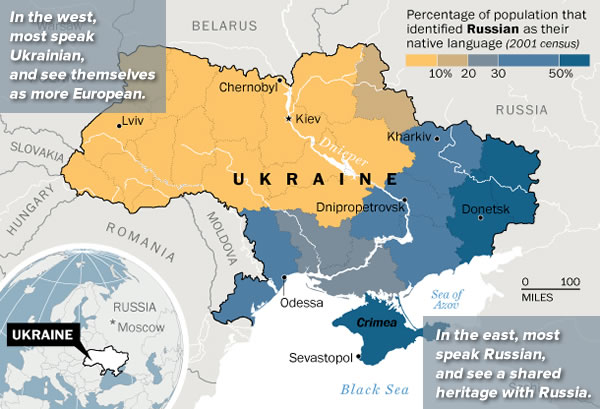
Ukraine language map

I continue to be surprised with how many people I keep running into who don’t know what’s going on in Ukraine right now. For those of you who haven’t been following the news or who’d like to know more, this article’s for you!

For the most basic introduction, check out the above video by the Washington Post, Ukraine’s crisis explained in 2 minutes. It starts with a question that you might be asking: What is Ukraine? (If you live in the Bloor West Village area of Toronto, you have no excuse for not knowing about Ukraine.)

February 16, 2014

QotD: Theodore Roosevelt’s admiration for Imperial Germany

Filed under: Europe, Germany, History, Quotations, WW1 — Tags: , , , — Nicholas @ 11:02

There was in the man a certain instinctive antipathy to the concrete aristocrat and in particular to the aristocrat’s private code — the product, no doubt, of his essentially bourgeois origin and training. But if he could not go with the Junkers all the way, he could at least go the whole length of their distrust of the third order — the undifferentiated masses of men below. Here, I daresay, he owed a lot to Nietzsche. He was always reading German books, and among them, no doubt, were Also sprach Zarathustra and Jenseits von Gut und Bose. In fact, the echoes were constantly sounding in his own harangues. Years ago, as an intellectual exercise while confined to hospital, I devised and printed a give-away of the Rooseveltian philosophy in parallel columns — in one column, extracts from The Strenuous Life; in the other, extracts from Nietzsche. The borrowings were numerous and unescapable. Theodore had swallowed Friedrich as a peasant swallows Peruna — bottle, cork, label and testimonials. Worse, the draft whetted his appetite, and soon he was swallowing the Kaiser of the Garde-Kavallerie-mess and battleship-launching speeches — another somewhat defective Junker. In his palmy days it was often impossible to distinguish his politico-theological bulls from those of Wilhelm; during the war, indeed, I suspect that some of them were boldly lifted by the British press bureau, and palmed off as felonious imprudences out of Potsdam. Wilhelm was his model in Weltpolitik, and in sociology, exegetics, administration, law, sport and connubial polity no less. Both roared for doughty armies, eternally prepared — for the theory that the way to prevent war is to make all conceivable enemies think twice, thrice, ten times. Both dreamed of gigantic navies, with battleships as long as Brooklyn Bridge. Both preached incessantly the duty of the citizen to the state, with the soft pedal upon the duty of the state to the citizen. Both praised the habitually gravid wife. Both delighted in the armed pursuit of the lower fauna. Both heavily patronized the fine arts. Both were intimates of God, and announced His desires with authority. Both believed that all men who stood opposed to them were prompted by the devil and would suffer for it in hell.

If, in fact, there was any difference between them, it was all in favor of Wilhelm. For one thing, he made very much fewer speeches; it took some colossal event, such as the launching of a dreadnaught or the birthday of a colonel-general, to get him upon his legs; the Reichstag was not constantly deluged with his advice and upbraiding. For another thing, he was a milder and more modest man — one more accustomed, let us say, to circumstance and authority, and hence less intoxicated by the greatness of his state. Finally, he had been trained to think, not only of his own immediate fortunes, but also of the remote interests of a family that, in his most expansive days, promised to hold the throne for many years, and so he cultivated a certain prudence, and even a certain ingratiating suavity. He could, on occasion, be extremely polite to an opponent. But Roosevelt was never polite to an opponent; perhaps a gentleman, by American standards, he was surely never a gentle man. In a political career of nearly forty years he was never even fair to an opponent. All of his gabble about the square deal was merely so much protective coloration, easily explicable on elementary Freudian grounds. No man, facing Roosevelt in the heat of controversy, ever actually got a square deal. He took extravagant advantages; he played to the worst idiocies of the mob; he hit below the belt almost habitually. One never thinks of him as a duelist, say of the school of Disraeli, Palmerston and, to drop a bit, Blaine. One always thinks of him as a glorified longshoreman engaged eternally in cleaning out bar-rooms — and not too proud to gouge when the inspiration came to him, or to bite in the clinches, or to oppose the relatively fragile brass knuckles of the code with chair-legs, bung-starters, cuspidors, demijohns, and ice-picks.

Abbott and Thayer, in their books, make elaborate efforts to depict their hero as one born with a deep loathing of the whole Prussian scheme of things, and particularly of the Prussian technique in combat. Abbott even goes so far as to hint that the attentions of the Kaiser, during Roosevelt’s historic tour of Europe on his return from Africa, were subtly revolting to him. Nothing could be more absurd. Prof. Dr. Sherman, in the article I have mentioned, blows up that nonsense by quoting from a speech made by the tourist in Berlin — a speech arguing for the most extreme sort of militarism in a manner that must have made even some of the Junkers blow their noses dubiously. The disproof need not be piled up; the America that Roosevelt dreamed of was always a sort of swollen Prussia, truculent without and regimented within. There was always a clank of the saber in his discourse; he could not discuss the tamest matter without swaggering in the best dragoon fashion.

H.L. Mencken, “Roosevelt: An Autopsy”, Prejudices, part 2, 1920.

February 15, 2014

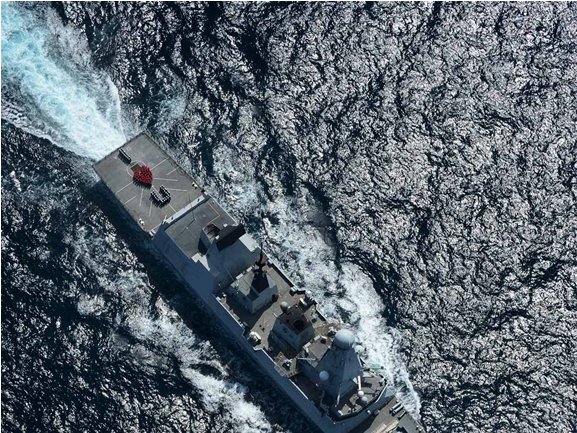
HMS Love Boat, er, I mean HMS Daring

Filed under: Britain, Media, Military — Tags: , , — Nicholas @ 11:40

Sir Humphrey notes the tut-tutting disapproval of other military sites but defends the Royal Navy’s little Valentine Day squib:

HMS Daring as the Love Boat

To mark Valentines Day this year, the Royal Navy put out a small number of press releases showing how some deployed ships like HMS Daring had tried to mark the occasion. For instance, there was a picture of the crew on the flight deck, spelling out an ‘I love you’ message (news release is HERE). This particular story got quite a lot of media attention in the UK press, with a variety of outlets carrying it and giving coverage to the story. But, it also had its detractors — the superb website Think Defence did not appreciate the story, feeling that it perhaps didn’t reflect the RN in a truly professional manner — their views can be found HERE. The view expressed was essentially that in pushing across a human interest story, the RN was not demonstrating itself to be as professional as its peers in other navies, who perhaps did not feel the need to provide equivalent stories.

This debate perhaps goes to the heart of the question about how we can push the case for Defence in the modern UK. To the authors mind, the issue is that what specialists consider of interest, and what the wider public consider of interest is two very different, and often arguably mutually incompatible subjects. Wander into any UK major newsagent and you will come across rack after rack of deeply specialist magazines, often providing immensely technical commentary on the most niche of subjects, ranging from transportation through to outdoor model railways and agricultural vehicles (a favourite story of the author is of when serving in Iraq seeing a friend open a morale package to receive a magazine about tractors, whose review of the novel A Short History of Tractors in Ukrainian complained that while a good read, it would have benefited from far more detail about the tractors). All of these magazines have one thing in common — they write technical articles for a technically minded audience which gets much of the underpinning issues. There are letters pages and articles full of debates on the most minor of points, quite literally arguing over the location of a decimal place or widget. There is an incredible passion and intensity to these debates, but the fact remains that the subject matter remains a deeply niche and specialist interest.

Arguably Defence is in a similar position to this — it is an organisation full of technical equipment, and engages in all manner of activities which people can take either an immensely superficial view, or spend many years becoming world class experts in. The problem is how to meet the interests of the experts, without losing the interest of the wider audience, who may have little to no idea of what the MOD really does all day. To an interested audience which inherently understands the importance of things like why the deployment of HMS Daring to the Far East was important, and why it achieved a tremendous amount of good for the RN, this sort of press release may well seem embarrassing — after all, who wants to see pictures of sailors missing their families when we could see press releases issued discussing whether there is sufficient space in the T45 hull to adopt a Mk141 launcher for VLS TLAM behind the PAAMS launcher but only if CEC were put onboard and the 114mm gun were downgraded to a 76mm OTO Melara — a complete exaggeration, but indicative of the sort of immensely technical debate which can be found in certain parts of the internet or specialist magazines.

February 13, 2014

Time to change the name of the Winter Olympics back to the “Nordic Games” they started as

Filed under: Russia, Sports — Tags: — Nicholas @ 14:13

Mick Hume isn’t a big fan of the Winter Olympics, and suggests that they revert back to their original name:

The six nations to have won medals at every winter games are, unsurprisingly, Austria, Canada, Finland, Norway, Sweden and the US. (Of the other snowy powers, Germany might be on the list but was banned from competing immediately after the Second World War; the Soviet Union did not enter until the 1956 winter games, where it won more medals than any other state.)

This snow-job badly skews the assessment of sporting prowess. Thus Jamaica, the undisputed king of world sprinting, remains a Cool Runnings joke at Sochi. Africa, the new powerhouse of global athletics, is barely there; an American-based student has just become the first Winter Olympics entrant from Zimbabwe, where it has not snowed since before he was born.

Before the International Olympic Committee decided to claim winter sports for itself, the major festival of sporting events on snow and ice, also held every four years, was called the Nordic Games. That might still seem a more fitting name for it today.

There’s also the quite fair comment that unlike the original Olympic events, too many of the Winter events are, for lack of a better word, effete sports for rich folks:

The Winter Olympics have little such universal appeal. Most events are arcane, technical affairs of which we know little and understand less, the commentators talking a foreign language – hog line, backside rodeo, bossing that melon – even when apparently speaking English. The competitors often seem a self-defined cliquish elite not only in the best sporting sense, but also in not-so-admirable cultural terms. Whatever they might think, however, to be the quickest of a closed shop of posh blokes swanning about the slopes in garish Euro-trash garb is hardly on a par with Usain Bolt’s Olympic title of the Fastest Man on Earth.

No doubt the accusation of dull, sectional, technical cliquishness could also be levelled at a good few fringe events in the summer games, from sailing to dressage – but then they shouldn’t be Olympic sports, either.

Many of these events look more like ‘games’ in the childish sense than world-class sport. For instance, speeding down an icy slope on a tea tray, either head-first (‘skeleton’) or feet-first (‘luge’), would be many a reckless youth’s idea of fun. Several of the new events introduced at Sochi have made matters worse, giving out Olympic gold medals for messing around doing smartarse tricks in the snow. The reaction to Jenny Jones winning the UK’s first-ever medal on snow in one such event, the ‘slopestyle’, rather captured the puerile atmosphere, with all three BBC commentators squealing like Blue Peter presenters on speed (‘This feels like I’ve got slugs in my knickers!’) before all bursting into tears when Jones got bronze. As Britain’s top TV columnist Ally Ross observed in the Sun, ‘Snowboarding is, and always will be, just young people twatting about’.

However, this suggestion would eliminate one of the all-time evergreen sporting jokes “… and 4.2 from the Russian judge”:

As for the events decided by judges’ marks, there is a good case for arguing that no such subjective carry-on should ever be considered as a serious sporting contest. Even one of the greatest sports, boxing, can be demeaned by the idiosyncrasies and idiocies of judges. Sporting tragedy becomes farce when judges award Olympic medals for dancing on ice or doing tricks in the snow, almost reducing the ‘greatest show on earth’ to the level of reality TV (‘Strictly Come Sochi?’). Britain may still go on about Torvill and Dean’s gold as ‘our’ finest Winter Olympic hour, but if ice dancing is a real Olympic sport it is hard to argue with those who want the ballroom version included in the summer games.

Personally, I haven’t watched any of the Olympic coverage this time around. Elizabeth’s god-daughter played hockey for Canada in three previous Olympic games, but she retired from competition last year … so there’s not the same level of personal interest now.

Flooding in Britain – call for the Witchfinder Floodfinder General!

Filed under: Britain, Environment, Media — Tags: , , , , — Nicholas @ 12:13

Rob Lyons asks who is to blame for the current flooding in Britain. The answer may be … nobody:

Floods in the UK are getting worse. There’s not much we can do it about it. It’s caused by climate change, which in turn is caused by human beings. It’s payback time.

There you go. In one paragraph, I’ve saved you having to read British newspapers or watch British TV news for the next few days. Of course, the recent flooding is a nightmare for those affected. It’s also a dream for lazy TV news editors who want to plonk their reporters in front of some interesting backdrop offering trite statements about a human-interest story. But the discussion about the causes of the floods and whether we can – or should – do anything about them is rather more worrying than TV’s dumbed-down ‘news values’.

[…]

A briefing published by the UK Met Office earlier this month highlights just how unusual the weather is at present. ‘Although no individual storm can be regarded as exceptional, the clustering and persistence of the storms is highly unusual. December and January were exceptionally wet. For England and Wales this was one of, if not the most, exceptional periods of winter rainfall in at least 248 years. The two-month total (December + January) of 372.2mm for the south-east and central southern England region is the wettest any two-month period in the series from 1910.’ It’s the conveyor belt of stormy weather, rather than any particular individual event, which is causing the problems. The ground is already soaked and rivers are already high; further rainfall has nowhere to go but out on to the flood plains.

However, a quick look at the Met Office briefing shows that while rainfall in southern England in January was very exceptional, it is hard to glean any particular overall pattern – other than that rainfall is very variable.

January rainfall, southern England, 1910-2014. Source: Met Office

January rainfall, southern England, 1910-2014. Source: Met Office

Indeed, just two years ago, Britain was in drought. Consecutive winters of below-average rainfall had left water companies enforcing restrictions on supply. Then the heavens opened, and it seems to have barely stopped raining since. So how on earth did the head of the Met Office, Dame Julia Slingo, conclude that while there was ‘no definitive answer’ to what caused the storms, ‘all the evidence suggests there is a link to climate change’? Indeed, Slingo is not alone in her assessment. The prime minister, David Cameron, said in January that he ‘suspected’ climate change was behind the floods. Labour leader Ed Miliband declared that climate change was sure to bring ‘more flooding, more storms’. Yet less than a year ago, scientists were assuring us that climate change would lead to more droughts in the future in the UK.

February 12, 2014

In praise of Frédéric Bastiat

Filed under: Economics, Europe, France, History — Tags: , , — Nicholas @ 08:48

Douglas Carswell wishes more people knew about nineteenth-century economist Frédéric Bastiat:

I reckon that one of the greatest Frenchman of all time is a fellow called Frédéric Bastiat (1801-1850). Not heard of him? France, I reckon, would have remained a truly global nation if more people had.

A free market, Classical liberal thinker, Bastiat grasped how wealth is created — and how parasitical elites and vested interests will seek to live off the productivity of others.

Nations rise, he could see, when various naturally parasitical interests were reined in, making production more fruitful than parasitism. Nations sunk into mediocrity, or remained there, when the parasites got their way — and other people’s wealth.

Far from being just a creature of his time, Bastiat speaks to us today. His spoof petition of the candlestick makers (they lobbied politicians to block out unfair competition from sunlight) tell us a great deal about the behaviour today of energy renewable interests and central bankers.

As a free market thinker, Bastiat was up there on a par with Adam Smith or Richard Cobden. Yet unlike Smith and Cobden, for all his brilliance, Bastiat had little impact on the French body politic. French lassies faire gave way to dirigisme. In terms of French politics, it is almost as if Bastiat might never have existed. And a once global player, presided over by a succession of enarques and corporatist cliques, sunk slowly into Hollandesque mediocrity.

My fear is that free-market thinkers on this side of the Channel could turn out to be little more than British Bastiats. Already the land of Adam Smith is run by a big, bloated state bureaucracy. The country that produced Cobden trades with the world on the basis of quota, not free competition.

Spain reconsidering law that makes them venue of choice for international cases

Filed under: China, Europe, Law — Tags: , , — Nicholas @ 08:38

Another day, another non-Spanish leader or ex-leader being charged with crimes against humanity in a Spanish court … but perhaps not for long:

Spain’s MPs voted on Tuesday to push forward with a bill that limits the power of Spanish judges to pursue criminal cases outside the country, a move that human rights organisations said would end Spain’s leading role as an enforcer of international justice.

Last month, the ruling People’s party (PP) tabled a fast-track legal change to curb the use of universal jurisdiction, a provision in international law that allows judges to try cases of human rights abuses committed in other countries. Since being adopted into Spanish law nearly two decades ago, the doctrine has allowed Spanish judges to reach beyond their borders and investigate serious human rights abuses in countries such as Argentina, Rwanda and Guatemala.

Its use put the Spanish justice system into the headlines at times — most famously for the 1998 arrest of the Chilean dictator Augusto Pinochet in London.

“This reform makes it even harder to probe into severe human rights abuses,” said Ignacio Jovtis, of Amnesty International Spain. “It’s a step backwards for human rights and justice.”

Nearly two dozen international human rights groups have spoken out against the change, calling it political interference in the justice system and urging the government to abandon the reform.

It’s one thing to provide a venue for pursuing violations of civil rights, but it’s quite another to allow your justice system to become an international laughingstock. Spain’s legal system has come dangerously close to the latter with the current law in place. It certainly has created some awkward situations like this:

MPs voted to push ahead with the move a day after a court in Spain ordered Interpol to issue arrest warrants for the former Chinese president Jiang Zemin, as well as four senior Chinese officials, over alleged human rights abuses in Tibet decades ago.

The arrest orders come just as Spain is seeking to lift its sagging economy by deepening trade relations with the Asian superpower.

China issued a sharp rebuke, leaving little question that the issue had strained ties between the two countries. “China is strongly dissatisfied and firmly opposed to the erroneous acts taken by the Spanish agencies in disregard of China’s position,” said a foreign ministry spokeswoman, Hua Chunying, at a daily briefing.

February 11, 2014

A perfect day at the zoo for the kiddies

Filed under: Europe, Media, Science — Tags: , — Nicholas @ 10:49

James Delingpole isn’t kidding:

If I’d been anywhere near Denmark that day, I too would have eagerly dragged my kids along to the zoo’s operating theatre to witness the ghoulish but fascinating Inside Nature’s Giants-style spectacle.

Why? Well, partly for my entertainment and education, but mainly for the sake of my children. I know we all love to idealise our offspring as sensitive, bunny-hugging little moppets who wouldn’t hurt a flea. But the truth is that there are few things kids enjoy more than a nice, juicy carcase with its guts hanging out. Dead birds are good; dead badgers are better; a dead giraffe is all but unbeatable.

You first tend to notice this trait on family walks. Desperately, you’ll try to keep your reluctant toddler going by showing it lots of fascinating things. Sheep or tractors may do the job, just about. But not nearly as well, say, as a dead rabbit with its belly distended with putrefaction and flies crawling over its empty eye sockets. It’s your child’s introduction to a concept we all have to grapple with in the end: what Damien Hirst once called “The Physical Impossibility of Death in the Mind of Someone Living”.

This, no doubt, is one of the reasons for the enduring popularity of Roald Dahl. Dahl’s brilliant insight is that children, au fond, are horrid little sickos who like nothing better than stories about giants who steal you from your bed in the night to murder you, and enormous crocodiles that gobble you all up. His is a natural world red in tooth and claw: Fantastic Mr Fox really does slaughter chickens — because he’s a fox — and when he gets his tail shot off you know, much as you might wish it otherwise, that it is never ever going to grow back.

[…]

Which reminds me: one of the stupidest mistakes made by Copenhagen Zoo was to have given that two-year-old giraffe such an affecting name. “Catomeat” might have worked. But to call a giraffe you’re planning to chop up and then chuck into the lions’ den “Marius” is surely asking for trouble. I wouldn’t want to execute a giraffe called “Marius”, would you?

I do, though, think that as a culture we need to be more grown-up about this sort of thing. If we’re going to have zoos and safari parks (as I believe we should; most of us will never have the money to enable our kids to see these wonders in the wild), then we have to accept the consequences. One of these is that sick, inbred, overpopulous or dangerous stock (like the six lions recently put down at Longleat) will have, on occasion, to be culled. Yes, it’s not ideal, but that unfortunately is how the world works. With animals, as with humans, the deal is this: none of us gets out of here alive.

February 10, 2014

Putin’s homophobia is making the case to allow same-sex marriage

Filed under: Europe, Liberty, Russia — Tags: , , — Nicholas @ 08:46

The Russian leader’s anti-homosexual agenda is making converts of people like Telegraph columnist Cristina Odone who had been strongly against allowing same-sex marriage:

Vladimir Putin has succeeded where Peter Tatchell failed. I loathe the Russian president and admire the gay rights campaigner, but it is Putin that has made me rethink my view of gay marriage.

I have written before about my fear that legalising gay marriage would affect the special status of marriage as a sacred institution. I have argued that once gay people could demand to be married, believers who refused to open their churches or even church halls to the ceremony would be punished. But Putin’s homophobic measures have changed my mind. If I oppose gay marriage I may be seen as condoning his anti-gay campaign. I couldn’t live with that.

Russia’s anti-gay laws and practices are odious. Last summer, the Duma passed a law to “protect children from information that can bring harm to their health and wellbeing”. The legislation can stamp out any organisation seen as pro-gay and fine it up to 1 million roubles; foreigners can be arrested for 15 days and deported from the country. (Note: circulating Nazi propaganda carries a fine of up to 2,000 roubles: Russian parliamentarians regard non-traditional relations as far more pernicious.)

The new law is easy to manipulate, allowing for example the authorities to shut down a helpline for LGBT teenagers, the Children-404 project: by providing sympathetic advice to isolated, bullied, ostracised, depressed and sometimes suicidal LGBT teenagers, the group is guilty of propaganda

February 9, 2014

Video QotD: Sherlock Holmes on Canada

Filed under: Britain, Cancon, Quotations, USA — Tags: — Nicholas @ 10:20

H/T to James Lileks for the clip.

February 8, 2014

What happened to charities that actually concentrate on charitable works, rather than lobbying?

Filed under: Britain, Government, Quotations — Tags: , , — Nicholas @ 12:34

James Delingpole on the remarkable community of interest between charitable organizations (partly funded by governments) and the government agencies they lobby:

“To compel a man to furnish contributions of money for the propagation of opinions which he disbelieves and abhors is sinful and tyrannical”. Thomas Jefferson, 1779.

One of the curses of modern life is the plethora of “charitable” lobbying groups demanding that the government take more regulatory action in areas where most of us believe the state has no business interfering.

Almost every day you read in the papers that some apparently grassroots movement, supposedly speaking for all of us, thinks more should be done to stop us drinking, smoking, eating sugar or salt, make us less sexist, force us to spend more on foreign aid or environmental issues. But if that wasn’t annoying enough, here’s the worst thing of all: we’re paying for these unrepresentative, mostly left-leaning lobby groups with our taxes.

This is the message of Chris Snowdon’s report for the Institute of Economic Affairs, The Sock Doctrine [PDF] — the third in his trilogy of broadsides against the lavishly state-funded “fake charities” industry. By 2007, he noted, a quarter of the UK’s 170,000 charities were receiving money from the state and approximately 27,000 received at least 75 per cent of their income from the state. If you share these charities’ predominantly liberal-Left-leaning aims you probably won’t mind so much. But if you don’t, you might be inclined to believe, as Fraser Nelson argued in these pages last year, that “Britain’s charities are nurturing a colourful, talented and efficient anti-Tory alliance.”

But, of course, there are opposing charitable organizations equally dependent on government funding and spending disproportional time and effort lobbying for their pet causes?

Well the problem is that they’re almost non-existent. The reason for this was identified in 1985 by US researchers James T. Bennett and Thomas J. DiLorenzo:

“Virtually without exception, the recipients of government grants and contracts advocate greater governmental control over and intervention in the private sector, greater limitations on rights of private property, more planning by government, income redistribution, and political rather than private decision making. Most of the tax dollars used for political advocacy are obtained by groups that are on the left of the political spectrum.”

February 6, 2014

TAFTA/TTIP – The US is negotiating from a position of unassailable strength

Filed under: Europe, Technology, USA — Tags: , , , , , — Nicholas @ 11:02

At Techdirt, Glyn Moody explains why the EU is insane not to demand that the negotiations with the US government over TAFTA/TTIP be made fully public:

On the one side is the US, on the other, the 28 nations that go to make up the European Union. Because they have differing views on the TAFTA/TTIP negotiations, it’s necessary to pass around many documents conveying information about the current negotiations, and seek to obtain some kind of consensus on future EU proposals and flexibilities.

In the wake of Snowden’s revelations, security will doubtless be much better than during the Copenhagen Summit, when supposedly secret messages were sent using unencrypted emails. But it only needs one weak link in the European Union’s security chain — somebody who forgets to encrypt his or her message, or who leaves it on a system that has been compromised — and the NSA will be able to access that information, and pass it on to the US negotiators, just as it did in Copenhagen.

The key point is that there is a profound information asymmetry in the TAFTA/TTIP talks. Although the spy agencies of the EU countries will doubtless be trying their best to obtain confidential information about US negotiating tactics, it will be much harder than it is for the US to do the same about EU positions. That’s because the NSA is far larger, and far more expert than the EU agencies. GCHQ is probably the nearest in terms of capabilities, but is so closely allied with the NSA in other areas that it probably won’t be trying too hard so as not to annoy its paymaster.

This more or less guarantees that the US will know everything about the EU’s negotiating plans during TAFTA/TTIP, while the EU will remain in the dark about the US intentions. That not only undercuts the European Commission’s argument that releasing documents is not possible because they must remain secret during the negotiations — they won’t be — it also gives the EU a huge incentive to insist on full transparency for the talks. That way, the EU negotiators would be able to see at least some US documents that currently are hidden from them, whereas the US would gain little that it didn’t already know through more dubious means.

February 5, 2014

Drawing the rhetorical battle lines for the war over the war

Filed under: Britain, Europe, History, WW1 — Tags: , — Nicholas @ 10:13

Tim Stanley on the ongoing war of words over the “celebrations” planned to mark the First World War in Britain:

The reality is that WWI had nothing to do with modern ideology, yet (ironically) we constantly seek to understand it through modern ideology. It started because the 19th-century diplomatic system broke down, undermining assumptions that various powers had no interest in fighting and would not do so when tested. Its bloodiness was due to technology: industrial warfare trumped the war of fast movement that everybody expected. And it ended because the Germans ran out of food. So it was non-ideological in spirit, but it did become the catalyst for various new ideologies. Britain convinced itself it was fighting for democracy. The Russians turned into Soviets and came to see WWI as the acme of capitalist aggression. A small band of German idiots decided defeat was down to a massive conspiracy of Jews so brilliant that it was impossible to actually explain how they pulled it off. And so the Second World War — a profoundly ideological war — was spawned by a conflict that lacked philosophical justification. No wonder memories are so confused.

We continue the mistake of seeing the past as if it was today. The neoconservatives, for example, are wrong to see “Prussian militarism” as embryonic Nazism — indeed the comparison is so slight as to be offensive. And if the plucky Brits were fighting imperialism, that raises the question of why we didn’t divest ourselves of our own possessions in Africa, Asia, Australisia etc. But the Left is equally wrong to see the First World War as a class conflict, as a case of lions led by donkeys. The aristocratic class happily signed up and were almost entirely exterminated as a result, thanks in part to the fact that they tended to be taller than the average soldier and so easier to aim at in the trenches.

Well, that perhaps, but rather more that the junior officers and company commanders actually led from the front, and were visibly distinct from the mass of their troops (making themselves more attractive targets). The allies were in the position of having to attack German positions for most of the war after the front lines solidified, which meant more opportunities for officers to be come casualties. The life expectancy of a junior officer on the Western front was said to be only six weeks.

This comment rather puzzles me, though:

Second, I’m still not entirely sure what we’re commemorating about the First World War and why. Obviously, we should always remember and honour our nation’s war dead — as we do every November. But why — as a nation — pick through every battle, every fact, every detail, every controversy and turn it into a parade? What relevance does it all have to us now? And why is it so often rated as more important than the American War of Independence, the English Civil War or the Scramble for Africa? Will it overshadow the anniversary of Waterloo next year, when, incidentally, the Brits were rather pleased to have Prussian militarism on their side? As European conflicts go, the Thirty Years War also screams out for a little more attention. The population in Germany fell by between 25 and 40 per cent; the Swedish armies destroyed one third of all German towns. That was Hell, too.

The First World War was different from what came before because it literally touched everyone: there were dead and wounded from every city, town, village, and hamlet. Everyone lost family members, friends, acquaintances, business partners, church members, and so on. Unlike the Crimean War, or the Zulu War, or the Boer War, this was the first mass conflict where the entire society had to be re-oriented to support the struggle. Privation was not just a word, as civilians faced food shortages, coal shortages, unrelenting propaganda through the newspapers, and misery all around. This was the end of Britain’s view of war as being something unpleasant at a distance, to be handled by a few good men in red coats.

February 4, 2014

“Chateau” generals

Filed under: Britain, Cancon, History, Military, USA, WW1, WW2 — Tags: , , , , — Nicholas @ 12:41

Nigel Davies has written a long post about the British and American standard of generalship in the two world wars, which won’t win him very many American (or Canadian) fans. That being said, he’s certainly right about the Canadian generals of WW2:

Contention: American senior generals in World War II were as bad, and for the same reason, as British senior generals in World War I.

[…] the politicians (and I will include Kitchener here, as he was by this time a politician with a military background rather than a real general), had based their recruiting campaign on a trendy ‘new model’ citizens army, rather than use the well developed existing territorial reserve system that would have done a far better job. They new enthusiastic troops were considered incapable of the traditional fire and movement approach of professional troops (the type that the Germans reintroduced in 1918 with their ‘commando units’, and the British army was able to copy soon after with properly trained and combat experienced personnel). Instead the enthusiastic amateurs were considered too badly trained to do more than advance in long straight lines… straight into the meat grinder.

Having said that the generals blame for the results should be at the very least shared with their political masters, I am still willing to express dissatisfaction with the approach of Haig and many of his senior commanders. They were Chateau Generals in approach and in attitude. They drew lines on maps without adequately considering the terrain, issued impossible instructions without looking at the state of the ground, and ran completely inadequate communications that were far from capable of keeping track of, or controlling, a modern battlefield.

[…]

It was noticeable later in the war that the more successful armies were commanded by competent and imaginative officers who insisted on detailed planning; intensive and specific tactical planning and operational training (down to practicing assaults on purpose built life size models); and very close control of operations to ensure success. They had usually learned the hard way, and had matured as experienced and pro-active leaders.

Of course some of this improvement was simply advances in technology. Tanks to breakthrough; better artillery fire plans to support and reduce casualties; air observation to enhance control and assess responses; better communications (including radio’s) to facilitate flexibility on the ground; and a generally better trained and more experienced soldier; with much more skilled officers. It all helped. But a lot came down to the attitude of the generals who believed that you got up front, found out the truth, stayed in close contact, and reacted to changed circumstances as immediately as possible.

However, as the American army was late to the battlefront, Davies contends that the leaders merely recapitulated the first stages of the bloody learning experience as their British counterparts, but didn’t produce the innovative leadership to match the Germans:

The Americans arrived on the Western Front when the war was already won. Only a few thousand were there for the last big German push, and by the time the Allies were moving to their final offensives with real American numbers involved, the German army was a broken reed. Which means that most American officers had only a few weeks of combat experience, and almost all of it against a failing army which had little resilience left to offer the type of resistance that might have caused the inexperienced American officers to have to reconsider their theories from their quicky officer training courses. Even the professional military officers received, at best, only a couple of hints that their ideas might not be inevitably effective against a stronger opponent. Certainly not enough time to learn how to analyse and adapt to circumstances in serious combat.

Which is why the majority of highly recognised American higher commanders in World War II appear to be chateau generals.

[…]

Eisenhower’s mistakes in theatre commands in Italy and France were possibly no worse in results than Wilson’s ongoing problems with Greece (he led the ‘forlorn hopes’ of both 1941 and 1944 there), but Eisenhower failed far more spectacularly with the Italian surrender, the Broad Front strategy, and the Bulge, than Wilson ever did with far inferior resources. MacArthur’s failures are more readily compared with Percival than the successes of a man like Leese, and Nimitz is often referred to as one of the great captains of history, for defeating a navy that repeatedly sabotaged its own efforts in the Pacific theatre. (Often by people who haven’t seemed to have ever heard of Max Horton’s much harder victory against the ruthlessly efficient U-boat campaign in the Atlantic theatre).

Similarly it is fair to say that the American front line commanders most people have never heard of were hardly inferior to their famous British contemporaries. Eichelberger was as good a commander, and as good a co-operator in Allied operations, as Alexander ever was. Truscott was probably at least the equal of Montgomery, given the opportunity. (I suspect possibly even better actually, but who can say?) Simpson, in his brief few months at the front, impressed many British officers who had served for years under men as good as Slim. And Ridgway showed in his few months of active operations a level of skill and competence (not necessarily the same thing) that far more experienced men like O’Connor did not surpass.

Why do we hear about the American chateau generals in preference to their front line leaders? And why do we hear about the British front line leaders in preference to their back office superiors. I would say it is because the British had been through a learning process in WWI that the Americans had not.

And the Canadian angle? As I’ve noted before, the First Canadian Army (scroll down to the item on John A. English’s book) was not as combat-effective in WW2 as the Canadian Corps had been in the First World War. One of the most obvious failings was in the advance to Antwerp:

Note that the equivalent British debacle during that campaign was when the Canadian Army took Antwerp undamaged, but then stopped for a rest before cutting off the retreating Germans. The Germans quickly fortified the riverbanks leading to the port, keeping it out of use for months. This was a clear example of the Canadian generals inexperience, and Montgomery is at fault here for being too involved in the last attempt to break the Germans before Christmas — Market Garden — and not paying close enough attention to one of his Army commanders, who was not supervising his Corps commander, who was not chasing his divisional commander adequately. (No one is imune from such glitches in a fast moving campaign. Inexperience any where down the chain can cause big problems. But it is noticeable that Crerar’s failure did not get him the public acclaim Patton has enjoyed?) Crerar was a ‘political appointment’ by the Canadians (an ‘able administrator’, but militarily ‘mediocre’ according to most) who Montgomery considered to be as inferior in experience and attitude as many of the American ‘chateau leaders’ he would have put in the same basket. By contrast Monty was delighted when the more competent front line leaders – the Canadian Simonds and the American Simpson – were assigned to him instead. As in the cases of the Australian General Morshead or the Polish General Anders, Montgomery only cared about ability, not nationality. But as was the case with the Americans, all too many generals in most armies, including the British and German armies, lacked experience or ability.

Update, 13 February: Mark Collins linked to an earlier post that helpfully describes some of the problems with Canadian generalship in Europe:

The Canadian command style in WW II was even more stuck in the mud than the American. With a few exceptions (McNaughton, Burns, Crerar) most Canadian generals had little or no General Staff experience, and those that did were practitioners of a successful, for the earlier WW I time and place, doctrine based on set piece battles founded on the systematic and intensive use of artillery.

One virtue of the German system is that it allowed officers to make mistakes: it did not allow them to sit on their butts waiting for orders; it encouraged risk taking which often worked but sometimes ended in bloody disaster (indeed it’s amazing it didn’t in France in 1940).

Indeed comparing the Canadian Army in WWII with the German is very difficult. Both had to expand from a tiny base to their war-time peak, but the Germans began in 1933 (actually even before then); we didn’t really begin until 1940. The Germans lost the Great War and the Reichswehr gave serious thought to how to do better next time.

One thing underlying the British set piece battle approach and limited freedom for commanders – the one the Canadian Army followed – seems to have been their realization in the late 1930s that the British Army was simply not as good as its 1914 ancestor. That was partly because of the losses of promising junior officers who never made general [though that affected the Germans too], partly because of indifference to defence at the governmental level, and partly because the military lapsed all too happily back into “real soldiering” in the 20’s.

February 3, 2014

New technology invades the vineyards – is it now the Côte-du-Drône?

Filed under: Europe, France, Technology, Wine — Tags: , — Nicholas @ 09:48

Jack Flanagan talks about the most recent technological intrusions into innovations being introduced into traditional European winemaking:

It is a new age in winemaking. The old days of doing everything by hand is ending. And while large-scale harvesters and flood-lights might not be news, the vintners of tomorrow have a few tricks up their sleeves.

[…]

And yet as advanced technology, the sort-of thing that requires a Masters of Science to understand, becomes available at lower prices (well, hovering among the thousands), vineyards in France and areas outside are adopting them.

Perhaps least surprising, if you’ve noticed a trend lately, is the addition of drones. Right now, they have a simple task: flying over vineyards, checking for damage or anything suspicious.

In the future, however, they may be required to do more labour-intensive tasks such as vine maintenance, e.g. pruning and checking how ripe the grapes are. This, specifically, is the task of a little droid resembling a rover: it skates along the vineyard floor, analysing and remembering the details of the vines. If they’re getting too long, the robot prunes them back.

« Newer PostsOlder Posts »

Powered by WordPress