Quotulatiousness

February 3, 2014

The welfare trap

Filed under: Britain, Bureaucracy, Government — Tags: , , , — Nicholas @ 09:27

An older post by A Very British Dude discusses the real problem with most of the public welfare/income support/unemployment benefits in Britain, but the same argument applies to most Western countries:

So your taxes, about a third of which go to paying working-age benefits, about a third in pensions, and the rest, everything else are part of a decent society in which everyone’s helping everyone else. Or they would be if the system wasn’t comprehensively broken, failing at all the significant tasks the welfare state is supposed to achieve. The welfare state is supposed to prevent poverty. It is, in fact, its major cause.

The problem is one of incentives, and not just those faced by the poor themselves. It’s obvious to anyone who isn’t paid handsomely to farm the poor, that for many people, it’s simply irrational to work. Once they’ve paid for taxes, clothes, transport and lunch, they’re considerably worse off than they would have been had they stayed in their pyjamas and watched Jeremy Kyle. Why would you take a miserable, boring, unpleasant minimum wage job instead of existing on benefits? The job insecurity at the bottom of the pyramid and the bureaucratic complexity of informing the authorities of a ‘change in circumstance’ is a further barrier. So when when the low-waged is “let go” after a couple of weeks, he’s got to re-apply for Housing benefits, Job-seekers’ allowance, Council Tax Benefit, income support and so on, from scratch. He may be genuinely destitute as a result of payments stopped, then restarted again too late, thanks to an abortive effort to “do the right thing”. Is it really any wonder so many feel trapped?

So, who benefits from this system? Certainly not those getting the benefits many of whom are comprehensively trapped in a life they wouldn’t have chosen. Not the Children of those getting benefits, who learn no other life thanks to the distorted incentives faced by their parents, but in whose name the benefits are paid. Certainly not the people paying the bill, John Q. Taxpayer, who thanks to the system face a sullen and resentful underclass, some of whom spend their non-working lives looking for ways to relieve you of your easily saleable property in order to buy sufficient narcotics to break the tedium for a few hours.

The main benefit of the benefits system accrues to those employed on secure graduate salaries to administer the system. These people are the farmers of the poor. This is not just the civil servants and local government employees who administer the system, but also the charity employees who don’t see the homeless and destitute (they outsource this to unpaid volunteers). It’s the police who are part of the state-crushing of the spirit of the young who find themselves trapped in this hell. The that the poor exist at all causes fear in the hearts of the affluent, and justifies the need for a police force. The Bureaucracy is an excellent provider of jobs. Which is why none of the solutions suggested by the Left of the political spectrum would ever reduce bureaucacy or police numbers, or the benefits bill. For that would involve firing sub-paying members of Unite or the PCS, and Unite is by far the biggest funder of the Labour party.

H/T to Amy Alkon for the link.

Update: A useful reminder from Rob Fisher at Samizdata — inflation hits the poor much harder than anyone else.

The Institute for Fiscal Studies is pointing out that while poorer people are paying more for food and fuel, richer people are enjoying low interest rates. So government spending and borrowing and the artificially low interest rates that go along with that are harmful to poor people, as are taxes on fuel, and income tax on minimum wage earners, and countless other instances of state meddling.

Corruption in the EU

Filed under: Bureaucracy, Business, Europe, Law — Tags: , , — Nicholas @ 08:46

BBC News discusses a recent EU report on bribery and corruption in Europe:

The extent of corruption in Europe is “breathtaking” and it costs the EU economy at least 120bn euros (£99bn) annually, the European Commission says.

EU Home Affairs Commissioner Cecilia Malmstroem has presented a full report on the problem.

She said the true cost of corruption was “probably much higher” than 120bn.

Three-quarters of Europeans surveyed for the Commission study said that corruption was widespread, and more than half said the level had increased.

Interestingly, the perception of corruption is significantly higher than the (self-reported) incidence:

In the UK only five people out of 1,115 — less than 1% — said they had been expected to pay a bribe. It was “the best result in all Europe”, the report said.

But 64% of British respondents said they believed corruption to be widespread in the UK, while the EU average was 74% on that question.

In some countries there was a relatively high number reporting personal experience of bribery,

In Croatia, the Czech Republic, Lithuania, Bulgaria, Romania and Greece, between 6% and 29% of respondents said they had been asked for a bribe, or had been expected to pay one, in the past 12 months.

There were also high levels of bribery in Poland (15%), Slovakia (14%) and Hungary (13%), where the most prevalent instances were in healthcare.

Ms Malmstroem said corruption was eroding trust in democracy and draining resources from the legal economy.

February 1, 2014

QotD: Captains, Majors, and Colonels

Filed under: Britain, Media, Military, Quotations — Tags: , , , , , — Nicholas @ 09:06

The BBC television show Blackadder is arguably one of the funniest and finest comedies of the late 20th century. Achingly sharp, with jokes that are still funny to this day, it was a four series show which finished with Blackadder Goes Forth set in the First World War. Watching the show today, one is struck by how funny it is, and also worryingly how its anti-establishment jokes aimed at undermining the social structure of the time has become the accepted historical record of the First World War.

The UK has a very strange ‘love hate’ relationship with its military officers — junior ones are portrayed as incompetent (Lieutenant George), Captains are seen as possibly okay (Captain Blackadder), Majors are usually seen retired and with a snifter in their hand (the Major from Fawlty Towers), while Colonels or heaven forbid Generals (General Melchett) are usually seen as inept, incompetent, who do not have a clue about their profession or what it involves. They are seen as people without a clue until the point when they retire, at which point they suddenly become military geniuses, whose angry letters to Broadsheet newspapers warrant being printed on the grounds that they are military commanders who know what they are talking about.

Sir Humphrey, “This is the Captain(s) of Your Ship Speaking… Why there are 260 Captains in the Royal Navy today”, Thin Pinstriped Line, 2013-10-19

January 31, 2014

Security theatre special edition – destroying hard drives that held Snowden’s documents

Filed under: Britain, Government — Tags: , , , , — Nicholas @ 09:30

It may have been pointless — and it was! — but the British government not only felt it had to do something, but that it had to be seen to be doing something:

New video footage has been released for the first time of the moment Guardian editors destroyed computers used to store top-secret documents leaked by the NSA whistleblower Edward Snowden.

Under the watchful gaze of two technicians from the British government spy agency GCHQ, the journalists took angle-grinders and drills to the internal components, rendering them useless and the information on them obliterated.

The bizarre episode in the basement of the Guardian‘s London HQ was the climax of Downing Street’s fraught interactions with the Guardian in the wake of Snowden’s leak — the biggest in the history of western intelligence. The details are revealed in a new book — The Snowden Files: The Inside Story of the World’s Most Wanted Man — by the Guardian correspondent Luke Harding. The book, published next week, describes how the Guardian took the decision to destroy its own Macbooks after the government explicitly threatened the paper with an injunction.

In two tense meetings last June and July the cabinet secretary, Jeremy Heywood, explicitly warned the Guardian‘s editor, Alan Rusbridger, to return the Snowden documents.

Heywood, sent personally by David Cameron, told the editor to stop publishing articles based on leaked material from American’s National Security Agency and GCHQ. At one point Heywood said: “We can do this nicely or we can go to law”. He added: “A lot of people in government think you should be closed down.”

January 30, 2014

Scandinavia’s less-than-utopian reality

Filed under: Europe — Tags: , , , , — Nicholas @ 09:42

Canadians are often found wanting in comparison to Norwegians, Swedes, Finns, or Danes in any international ranking. Except for smugness, where Canada (of course) is the undisputed world leader. But according to Michael Booth, things are not quite as wonderful in Scandinavia as we’re led to believe:

Whether it is Denmark’s happiness, its restaurants, or TV dramas; Sweden’s gender equality, crime novels and retail giants; Finland’s schools; Norway’s oil wealth and weird songs about foxes; or Iceland’s bounce-back from the financial abyss, we have an insatiable appetite for positive Nordic news stories. After decades dreaming of life among olive trees and vineyards, these days for some reason, we Brits are now projecting our need for the existence of an earthly paradise northwards.

I have contributed to the relentless Tetris shower of print columns on the wonders of Scandinavia myself over the years but now I say: enough! Nu er det nok! Enough with foraging for dinner. Enough with the impractical minimalist interiors. Enough with the envious reports on the abolition of gender-specific pronouns. Enough of the unblinking idolatry of all things knitted, bearded, rye bread-based and licorice-laced. It is time to redress the imbalance, shed a little light Beyond the Wall.

First, let’s look at Denmark, where Booth has lived for several years:

Why do the Danes score so highly on international happiness surveys? Well, they do have high levels of trust and social cohesion, and do very nicely from industrial pork products, but according to the OECD they also work fewer hours per year than most of the rest of the world. As a result, productivity is worryingly sluggish. How can they afford all those expensively foraged meals and hand-knitted woollens? Simple, the Danes also have the highest level of private debt in the world (four times as much as the Italians, to put it into context; enough to warrant a warning from the IMF), while more than half of them admit to using the black market to obtain goods and services.

Perhaps the Danes’ dirtiest secret is that, according to a 2012 report from the Worldwide Fund for Nature, they have the fourth largest per capita ecological footprint in the world. Even ahead of the US. Those offshore windmills may look impressive as you land at Kastrup, but Denmark burns an awful lot of coal. Worth bearing that in mind the next time a Dane wags her finger at your patio heater.

Okay, but how about Norway? Aren’t they doing well?

The dignity and resolve of the Norwegian people in the wake of the attacks by Anders Behring Breivik in July 2011 was deeply impressive, but in September the rightwing, anti-Islamist Progress party — of which Breivik had been an active member for many years — won 16.3% of the vote in the general election, enough to elevate it into coalition government for the first time in its history. There remains a disturbing Islamophobic sub-subculture in Norway. Ask the Danes, and they will tell you that the Norwegians are the most insular and xenophobic of all the Scandinavians, and it is true that since they came into a bit of money in the 1970s the Norwegians have become increasingly Scrooge-like, hoarding their gold, fearful of outsiders.

Finland? I’ve always gotten on famously with Finns (and Estonians), although I haven’t met all that many of them:

I am very fond of the Finns, a most pragmatic, redoubtable people with a Sahara-dry sense of humour. But would I want to live in Finland? In summer, you’ll be plagued by mosquitos, in winter, you’ll freeze — that’s assuming no one shoots you, or you don’t shoot yourself. Finland ranks third in global gun ownership behind only America and Yemen; has the highest murder rate in western Europe, double that of the UK; and by far the highest suicide rate in the Nordic countries.

The Finns are epic Friday-night bingers and alcohol is now the leading cause of death for Finnish men. “At some point in the evening around 11.30pm, people start behaving aggressively, throwing punches, wrestling,” Heikki Aittokoski, foreign editor of Helsingin Sanomat, told me. “The next day, people laugh about it. In the US, they’d have an intervention.”

[…]

If you do decide to move there, don’t expect scintillating conversation. Finland’s is a reactive, listening culture, burdened by taboos too many to mention (civil war, second world war and cold war-related, mostly). They’re not big on chat. Look up the word “reticent” in the dictionary and you won’t find a picture of an awkward Finn standing in a corner looking at his shoelaces, but you should.

“We would always prefer to be alone,” a Finnish woman once admitted to me. She worked for the tourist board.

Sweden, though, must be the one without any real serious issues, right?

Anything I say about the Swedes will pale in comparison to their own excoriating self-image. A few years ago, the Swedish Institute of Public Opinion Research asked young Swedes to describe their compatriots. The top eight adjectives they chose were: envious, stiff, industrious, nature loving, quiet, honest, dishonest, xenophobic.

I met with Åke Daun, Sweden’s most venerable ethnologist. “Swedes seem not to ‘feel as strongly’ as certain other people”, Daun writes in his excellent book, Swedish Mentality. “Swedish women try to moan as little as possible during childbirth and they often ask, when it is all over, whether they screamed very much. They are very pleased to be told they did not.” Apparently, crying at funerals is frowned upon and “remembered long afterwards”. The Swedes are, he says, “highly adept at insulating themselves from each other”. They will do anything to avoid sharing a lift with a stranger, as I found out during a day-long experiment behaving as un-Swedishly as possible in Stockholm.

H/T to Kathy Shaidle (via Facebook) for the link.

January 29, 2014

Timeless truths from Yes, Prime Minister on the newspapers

Filed under: Britain, Humour, Media — Tags: — Nicholas @ 10:55

January 28, 2014

CETA provisions still secret, even though the deal is agreed

Filed under: Cancon, Economics, Europe — Tags: , , , , — Nicholas @ 10:13

It’s an odd day that I find myself in full agreement with anything the Council of Canadians pushes, but as Glyn Moody explains, this is not the way to get Canadians to buy in to a new trade deal:

Back in November, we reported that the EU and Canada were claiming that “a political agreement” on the key elements of the Canada-EU trade agreement, CETA, had been reached. One of the supposed reasons why the negotiations were being conducted in secret was that it was “obviously” not possible to release texts while talks were still going on — even though that is precisely how WIPO operates. So, now that key parts of the CETA have been agreed upon, presumably the public will finally get to see at least those sections of the text, right? Apparently not, as the Council of Canadians found when it put in a freedom of information request to the Canadian government:

    The federal government has denied an access to information request from the Council of Canadians for the working text of the Canada-European Union Comprehensive Economic and Trade Agreement (CETA). The grassroots public advocacy organization is accusing the Conservative government of unnecessarily depriving Canadians of the information they need to pass judgement on CETA, and of any opportunity to alter the deal before it is signed.

    “It’s a new year, but we’re seeing the same old secrecy from the Harper government. How is anyone expected to say yes or no to this EU deal if Ottawa is not prepared to release it publicly before CETA is signed, sealed and delivered?” asks Stuart Trew, trade campaigner with the Council of Canadians. “The Prime Minister is misleading Canadians by claiming the CETA negotiations are the most transparent in Canadian history. A fully redacted copy of the text would be more transparent than this.”

This exposes nicely the dishonesty of governments around the world when they claim that regrettably they “have” to keep texts secret, but will release them just as soon as they can. Here, we have major parts of CETA that have been agreed upon and where there is no need to keep them secret — apart, that is, from the real reason why there is no transparency: because the governments concerned know that once the public find out how they have been let down by their representatives, there will be widespread outrage. In a blatant attempt to stifle democratic debate, it has become standard practice with these trade agreements only to release the texts after they have been passed, and there’s nothing that can be done about it.

The last Frost Fair on the Thames

Filed under: Britain, Environment, History — Tags: , — Nicholas @ 08:29

The famous river doesn’t freeze as it did during the Little Ice Age, so the very last Frost Fair was held in 1814:

Painting by Luke Clenell, entitled The Fair on the Thames, Feb'y 4th 1814

Painting by Luke Clenell, entitled The Fair on the Thames, Feb’y 4th 1814

It is 200 years ago since the last “frost fair” — an impromptu festival on a frozen Thames, complete with dancing, skittles and temporary pubs. Could such hedonism be repeated today?

Londoners stood on the Thames eating gingerbread and sipping gin. The party on the frozen river had begun on 1 February and would carry on for another four days.

The ice was thick enough to support printing presses churning out souvenirs. Oxen were roasted in front of roaring fires, drink was liberally taken and dances were held. An elephant was marched across the river alongside Blackfriars Bridge.

It was February 1814. George III was on the throne, Lord Liverpool was prime minister and the Napoleonic wars would soon be won.

People didn’t know it then but this “frost fair” — a cross between a Christmas market, circus and illegal rave — would be the last. In the 200 years that have elapsed since, the Thames has never frozen solid enough for such hedonism to be repeated.

But between 1309 and 1814, the Thames froze at least 23 times and on five of these occasions — 1683-4, 1716, 1739-40, 1789 and 1814 — the ice was thick enough to hold a fair.

Update: Over lunch, I was reading Correlli Barnett’s Marlborough and came across this description of the onset of winter in 1708-09 (and a frost fair that the BBC didn’t list):

And for Europe too the coming of a Whig administration in England was a fateful event. The Whig leaders were hot for the exaction from Louis XIV of ‘no peace without Spain – entire’, without any compromise whatsoever. Yet in the winter and spring of 1709 even such inflated war aims began to look practicable. Before the Duke at last closed down the Oudenarde campaign in January 1709, long after the normal time for going into winter quarters, he had retaken Bruges and Ghent. And the siege of Ghent witnessed the onset of an enemy even more terrible to France than Marlborough. In the last days of 1708 cold of unimagined bitterness closed on Europe like a trap. At Ghent the sentinels of besieged and besieging forces alike were frozen to death at their posts. And this was only a beginning: after a short and deceptive thaw in January, the cold set in like another ice age, the people of Europe cringing month after month under a bruise-coloured sky heavy with snow. On the frozen Thames at London Bridge there was an ice fair; a little city of booths and stalls stretching from bank to bank, and bonfires twinkling across the ice in the polar gloom. From Brussels Marlborough was reporting to Heinsius in February:

    The continuall snow as well as hard frost will, if it continues, kill al the cattel of this country and bee very inconvenient for our garrisons, for even in this town we have no forage but what we bring dayly by carts …

The port of Harwich was ice bound; so were the Dutch ports. There were ice floes in the Channel. Even the mouth of the Tagus at Lisbon was frozen. It was fortunate indeed that the Duke had not carried out his post-Oudenarde plan to invade France, or his army might now have been lying somewhere between Abbeville and Paris, with seaborne supplies cut off by ice, and dependent for subsistence on what it could find in the French countryside.

And in France, already impoverished by war as she was, famine had come in the wake of frost. The cattle died; the vines split. In the towns and the country the starving wandered in search of food in ragged, despairing packs. The very fabric of French society seemed in peril from the effects of the cold.

January 27, 2014

QotD: Montreuil and Le Corbusier

Montreuil reminded me strongly of something: ah yes, I remember what it was, Eastern Europe in the good old days. It had that same air of inspissated gloom and ontological pointlessness; the architecture would have gladdened the heart (so to speak) of Elena Ceausescu. The bus passed through a wasteland of 1970s modernism, egalitarian doctrine made not so much flesh as concrete. The buildings did not age, they dilapidated; it was architecture that induced immediate thoughts of suicide. (Le Corbusier is still revered in France and treated as a hero, though it should be obvious to anyone who reads any of his voluminous writings that he was a psychopathic architectural delinquent of totalitarian pretensions whose talents belonged more to the field of propaganda than to those of architecture, in which his abilities were all negative.) The bus stops were in places such as Saint-Just, the patron saint of revolutionary terror, and Nouvelle France: new in the same sense that the New Man, so beloved of Mussolini and Che Guevara, was going to be new. Montreuil is, in fact, firmly communist, and it shows, although honesty compels me to admit that I don’t know which came first: the communism or the ugliness of everything. Probably the relationship is what Marxists used to call a dialectical one.

Theodore Dalrymple, “Museum of the Living Dead”, Taki’s Magazine, 2014-01-26

HSBC now requires “Mother, May I” letters from British customers for large withdrawals

Filed under: Britain, Business — Tags: , — Nicholas @ 09:32

HSBC has irritated some of their British customers with a new requirement for justifying why large cash withdrawals are necessary before authorizing them:

Stephen Cotton went to his local HSBC branch this month to withdraw £7,000 from his instant access savings account to pay back a loan from his mother.

A year before, he had withdrawn a larger sum in cash from HSBC without a problem.

But this time it was different, as he told Money Box: “When we presented them with the withdrawal slip, they declined to give us the money because we could not provide them with a satisfactory explanation for what the money was for. They wanted a letter from the person involved.”

Mr Cotton says the staff refused to tell him how much he could have: “So I wrote out a few slips. I said, ‘Can I have £5,000?’ They said no. I said, ‘Can I have £4,000?’ They said no. And then I wrote one out for £3,000 and they said, ‘OK, we’ll give you that.’ ”

He asked if he could return later that day to withdraw another £3,000, but he was told he could not do the same thing twice in one day.

He wrote to complain to HSBC about the new rules and also that he had not been informed of any change.

The bank said it did not have to tell him. “As this was not a change to the Terms and Conditions of your bank account, we had no need to pre-notify customers of the change,” HSBC wrote.

As you might imagine, this new policy drew strong criticism, so the bank issued the following statement yesterday:

As a responsible bank we must track all financial transactions. Cash presents more risk, and in particular financial crime risk, than other payment methods. It also leaves customers with very little protection if things go wrong. Therefore, we need to monitor particularly closely movements of cash in and out of the banking system. This is why we ask our customers about the purpose of large cash withdrawals when they are unusual and out of keeping with the normal running of their account.

Since last November, in some instances we may have also asked these customers to show us evidence of what the cash is required for. However, it is not mandatory for customers to provide documentary evidence for large cash withdrawals, and on its own, failure to show evidence is not a reason to refuse a withdrawal. We apologise to any customer who has been given incorrect information and inconvenienced.

H/T to BenK for the links.

January 26, 2014

Moving the definitional goalposts – adolescents

Filed under: Britain, Economics — Tags: , , , — Nicholas @ 10:53

In Spiked, Tom Slater talks about the constantly moving concept of “adulthood”:

The spike in young people staying and moving back home, although undoubtedly exacerbated by the floundering economy, nevertheless marks a profound cultural shift in the attitudes of young people towards independence. And it doesn’t take much digging to grasp the roots of it all.

The value of adulthood is battered out of young people nowadays. When last year psychologists announced they were extending the clinical definition of adolescence to 25, it felt sadly appropriate. Indeed, in all corners of society, young people are being fretted over and micromanaged with all manner of initiatives to help them negotiate the adult world. From university wellbeing services to the recent attempts of one charity to rebrand youth joblessness as a mental-health crisis, young people are imbibing the idea that they are essentially overgrown children in need of constant support and intervention.

The sense of victimhood is bolstered by the ‘jilted generation’ brigade, who insist that young people have been undone by the avarice of their baby-boomer forbears. As a result, so we’re told, young people will never be able to achieve the same success their parents’ generation enjoyed. Moving out into less-than-lush surroundings has come to be seen as a kind of concession to the oldies wot wronged us. The bizarre focus on house prices in this discussion is particularly revealing on this point. Young people have been led to believe that their parents skipped renting and started buying up houses when they were barely out of school – an idea which Grace Dent gave a thorough rinsing in the Independent this week. In this sense, Generation Y have begun to conceive of themselves as the victims of an illusory, more prosperous past, to the point where even renting a box-room in a mould-ridden house-share is an inconvenience they’re not prepared to endure.

With all of this in mind, you can almost see why they choose to stay at home and spend their disposable income on other things. If things are indeed so bleak, why not buy a car or, as is increasingly becoming the norm, save up your wages and go travelling? Young people seem to forget having your own wheels or jetting off around the world are luxuries that were never within the grasp of their supposedly cash-rich parents.

January 24, 2014

A Danish solution to the high cost of modern warships

Filed under: Europe, Military — Tags: , , , — Nicholas @ 14:47

Developments like this should be of great interest to the Royal Canadian Navy:

… constrained budgets in America and Europe are prompting leading nations to reconsider future needs and explore whether new ships should be tailored for what they do every day, rather than what they might have to do once over decades.

The solution: extreme flexibility at an affordable price for construction and operation.

Here the Danes have emerged as a clear leader by developing two classes of highly innovative ships designed to operate as how they will be used: carrying out coalition operations while equipped to swing from high-end to low-end missions.

The three Iver Huitfeldt frigates and two Absalon flexible support ships share a common, large, highly efficient hull to yield long-range, efficient but highly flexible ships that come equipped with considerable capabilities — from large cargo and troop volumes and ample helo decks for sea strike and anti-submarine warfare — in a package that’s cheap to buy and operate. The ships come with built-in guns, launch tubes for self-defense and strike weapons, and hull-mounted sonar gear, and they can accept mission modules in hours to expand or tailor capabilities. The three Huitfeldts cost less than $1 billion.

The ships also are coveted during coalition operations for their 9,000-mile range at 15 knots, excellent sea-keeping qualities and command-and-control gear, plus spacious accommodations for command staffs. That’s why the Esbern Snare, the second of two Absalon support ships, is commanding the international flotilla in the Eastern Mediterranean that will destroy Syria’s chemical weapons.

Wikipedia has this image of the HDMS Iver Huitfeldt:

HDMS Iver Huitfeldt during a port visit in Århus, 20 January 2012

HDMS Iver Huitfeldt during a port visit in Århus, 20 January 2012

The class is built on the experience gained from the Absalon-class support ships, and by reusing the basic hull design of the Absalon class the Royal Danish Navy have been able to construct the Iver Huitfeldt class considerably cheaper than comparable ships. The frigates are compatible with the Danish Navy’s StanFlex modular mission payload system used in the Absalons, and are designed with slots for six modules. Each of the four Stanflex positions on the missile deck is able to accommodate either the Mark 141 8-cell Harpoon launcher module, or the 12-cell Mark 56 ESSM VLS.

While the Absalon-class ships are primarily designed for command and support roles, with a large ro-ro deck, the three new Iver Huitfeldt-class frigates will be equipped for an air defence role with Standard Missiles, and the potential to use Tomahawk cruise missiles, a first for the Danish Navy.

For contrast here is the HDMS Esbern Snare, the second ship in the Absalom class:

Danish Navy Combat Support Ship HDMS Esbern Snare in the port of Gdynia, prior to exercise US BALTOPS 2010.

Danish Navy Combat Support Ship HDMS Esbern Snare in the port of Gdynia, prior to exercise US BALTOPS 2010.

That’s not to say that these particular ships would be a good fit for the RCN, but that the approach does seem to be viable (sharing common hull configurations and swappable mission modules). However, the efficiencies that could be achieved by following this practice would almost certainly be swamped by the political considerations to spread the money out over as many federal ridings as possible…

H/T to The Armourer for the link.

Government subsidies that make flooding worse

Filed under: Britain, Environment — Tags: , , , , — Nicholas @ 08:51

Chris Edwards on the oddity of an EU subsidy that inadvertently makes it more likely that floods will be worse:

… Britain has been suffering from river flooding, and a Daily Mail article explains how subsidies are a key culprit: “Thought ‘extreme weather’ was to blame for the floods? Wrong. The real culprit is the European subsidies that pay UK farmers to destroy the very trees that soak up the storm.”

The author is a liberal environmentalist, but his piece illustrates how liberals and libertarians can share common ground on the issue of government subsidies.

The article describes how forests in the upstream areas of watersheds can mitigate floods. However, there “is an unbreakable rule laid down by the EU’s Common Agricultural Policy. If you want to receive your single farm payment … that land has to be free from what it calls ‘unwanted vegetation.’ Land covered by trees is not eligible. The subsidy rules have enforced the mass clearance of vegetation from the hills.”

In the United States, we’ve got our own environment-damaging farm subsidies. We’ve also got the Army Corps of Engineers, which the Daily Mail could be describing when it refers to British policy: “Flood defence, or so we are told almost everywhere, is about how much concrete you can pour.

Another foolhardy thing, in the long term, is government subsidizing people to rebuild after devastating floods … in the same location that is just as likely to be damaged in the next flood. If you can’t get property insurance without getting the government to force insurers to offer it, you’ve probably built in an area that you shouldn’t have. A lot of the perception that major storms are more dangerous now than fifty years ago is that a lot of buildings are being erected in areas where storm damage is more likely to occur.

January 23, 2014

Investigating the “Grand Slam” of 1945

Filed under: Britain, History, Military, Weapons, WW2 — Tags: , — Nicholas @ 09:48

In the Independent, David Keys talks about the Grand Slam, the largest conventional bomb of WW2:

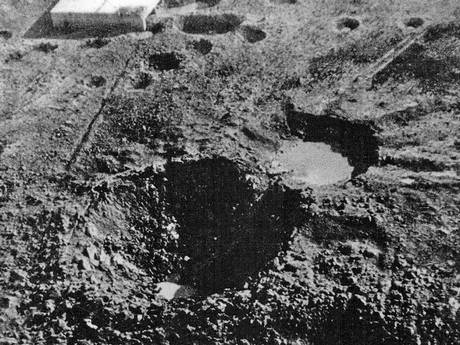
The 70 ft deep and 130 ft diameter crater which Grand Slam created in the New Forest on 13 March 1945 - with the target building in the background (Crown Copyright)

The 70 ft deep and 130 ft diameter crater which Grand Slam created in the New Forest on 13 March 1945 – with the target building in the background (Crown Copyright)

The final secrets of Britain’s largest-ever conventional weapon of war are being ‘unearthed’ by archaeologists.

Geophysics experts are using ground-penetrating radar and other high tech methods to ‘x-ray’ the ground, in a remote area of the New Forest in Hampshire, to shed new light on the most powerful top secret World War Two weapon test ever carried out in the UK.

The weapon – a bomb designed by the British aircraft and munitions inventor, Barnes Wallis, and codenamed ‘Grand Slam’ – was almost 26 foot long and weighed 22,000 pounds, substantially bigger than any other wartime explosive device ever developed by Britain.

The New Forest test is historically important because it heralded an expansion in the crucial strategic air offensive against key infrastructure targets in Nazi Germany. The first RAF bomber command Grand Slam sortie got underway within hours of the successful test of the bomb.

Four geophysical techniques – ground penetrating radar, magnetometry, electrical resistivity and electrical resistivity tomography – are being used by the archaeologists to assess the damage done to the large concrete target building which has lain buried under a vast mound of earth for the past 66 years.

January 22, 2014

Fifty years later – The making of Zulu (1964)

Filed under: Africa, Britain, History, Media — Tags: , , — Nicholas @ 14:05

Published on 20 Dec 2012

……and snappeth the spear in sunder.
Short film detailing how this great film was made.
With contributions from Lady Ellen Baker, James Booth, Glynn Edwards and others.

Update: Zulu was primarily the story of the defence of Rorke’s Drift by B Company of the 24th Regiment under temporary command of Royal Engineer Lieutenant John Chard (who was senior to Lieutenant Bromhead of the 24th). Less well-known is the larger battle of Isandlwana which happened earlier the same day, where Zulu forces defeated a much larger British force. This show investigates the site of the battle, discussing some of the reasons why the battle was quickly forgotten, as one of the worst British defeats of the Victorian era:

Published on 8 Sep 2013

We are all familiar with the famous story of a handful of British redcoats fending off thousands of Zulu warriors, made famous by the film starring Michael Caine, but this did well to mask another battle just a few miles away where 1,300 British were slaughtered by the natives in just two and a half hours. This fascinating programme looks at what went wrong for the British Empire builders on that fateful day.

« Newer PostsOlder Posts »

Powered by WordPress