
Quotulatiousness

March 19, 2014

This isn’t Cold War 2.0, it’s a return to historical norm

Filed under: Europe, History, Politics, Russia, USA — Tags: , — Nicholas @ 08:31

Jonah Goldberg asks everyone to stop talking about a new Cold War, because the old one was a unique event (or event-chain) and what we’re seeing now is more like history unfolded before the Cold War came along to freeze geopolitics for a few decades.

… the Cold War was far more than a conflict with Russia. Everyone should agree on that. Communism, anti-Communism, and anti-anti-Communism divided Americans for decades, particularly among academic and media elites. Right and Left may still argue over the merits of those divisions, but no informed person disputes that the topic of Communism — the real version and the imagined ideal — incited riots of intellectual and political disagreement in the West for a half-century.

Meanwhile, Putin’s ideology holds little such allure to Americans or the populations of the European Union. With the exception of a few cranky apologists and flacks, it’s hard to find anyone in the West openly defending Putin on the merits. And even those who come close are generally doing so in a backhanded way to criticize U.S. policies or the Obama administration. The dream of a “greater Russia” or a “Eurasian Union” simply does not put fire in the minds of men — non-Russian men, at least — the way the dream of global socialist revolution once did. And that’s a good thing.

[…]

Many have called the decade between the fall of the Soviet Union and the attacks of 9/11 a “holiday from history.” The truth is closer to the opposite. The Cold War years, while historic in a literal sense, were something of a great parentheses, a sharp departure from historical norms. Communism was a transnational ideology imposed on nationalist movements. That’s why every supposedly Communist movement eventually became nationalist once in power. Still, the rhetorical and psychological power of Communist ideology, combined with the fear of nuclear war, made international relations seem like a sharp break with how foreign affairs worked before 1945 — or 1917.

It turns out, the Berlin Wall wasn’t blocking us from a new world order, it was holding back the tide of history. Western Europe was especially slow to realize this. Its politicians and intellectuals persuaded themselves that they had created a continental “zone of peace” through diplomacy, when in reality they were taking U.S. protection for granted. They let their militaries atrophy to the point of being little more than ceremonial.

The end of the Cold War fostered the illusion that the “guns or butter” argument had been permanently settled and we “wouldn’t study war no more”. The peace dividend was always an illusion — a very attractive illusion to politicians who wanted to spend money on things that would get them re-elected — and voters rewarded them appropriately. It’s going to be psychologically difficult for the countries of the West to come to terms with the return of the traditional forces of history.

“The French Revolution was a ‘revolution of ideas’ before it became ‘a revolution of fact'”

Filed under: Books, Europe, France, History, Liberty — Tags: — Nicholas @ 07:35

Duncan Kelly reviews Revolutionary Ideas: An Intellectual History of the French Revolution from The Rights of Man to Robespierre, by Jonathan Israel.

According to this hefty new study of the French Revolution by Jonathan Israel, a professor of history at Princeton, what such events really show is the motivating power of ideas in guiding and transforming events. In his terms, the French Revolution was a “revolution of ideas” before it became “a revolution of fact”; indeed, it was three revolutions all at once.

Ideas about political equality, anticlericalism and modern republicanism grounded in “reason” motivated Radical Enlightenment thinkers such as Condorcet and Thomas Paine, while they clashed with the “moderate Enlightenment constitutional monarchism” embodied by more pro-royalist factions (the Feuillants) and aristocratic supporters such as Lafayette. Both struggled against Robespierre’s “authoritarian populism”, which for Israel prefigures modern fascism.

The radical compound in this instance might have been uniquely French but its impact spread widely. The resounding Declaration of the Rights of Man, writes Israel, was a “manifesto entirely incompatible with all ancien régime notions of social, racial, and religious hierarchy”. Revolution lent support to Caribbean struggles for black emancipation such as that of Toussaint L’Ouverture in Haiti, memorably described in CLR James’s 1938 classic The Black Jacobins. James’s book, however, is an odd omission in Israel’s otherwise compendious bibliography.

[…]

Historians have often criticised Israel for flattening out all the differences between these radical ideas except those he wants to retain and, when applied to the French Revolution, his arguments can feel like the inverse of some 19th-century Marxist schema. Instead of subterranean economic determinations, it is Radical Enlightenment that provides the means by which everything from press freedom to de-Christianisation can be slotted into a matrix requiring little in the way of extra interpretation.

What you get from such a focus on subversive editors, disenchanted priests and materialist philosophers has much in common with a more conventional account: food shortages, public debt crises and social grievances from Paris to the Vendée, combined with a plethora of radical ideas about press freedom, absolute equality, political liberty and radical democracy. Yet the vaulting ambition to ascribe such a momentous transformation to one cause still feels hubristic. The obvious parallel in this year of all years would be the thought that there might be a single idea or singular complex of ideas behind the outbreak of the first world war. Can you imagine such a claim commanding general assent?

March 18, 2014

Updating David’s sling, outraging Italian politicians

Filed under: Business, Europe, Italy, Media, Weapons — Tags: , , , — Nicholas @ 07:41

Virginia Postrel diagnoses the real reason politicians are upset about Armalite’s updated image of David’s armament:

David and the Armalite

Italian authorities were indignant when they discovered that the Illinois weapons maker ArmaLite had an advertising campaign showing Michelangelo’s David holding one of its rifles. “The advertisement image of an armed David offends and violates the law,” tweeted tourism minister Dario Franceschini. Angel Tartuferi, director of the Accademia Gallery, which houses the sculpture, agreed: “The law says that the aesthetic value of the work cannot be altered.”

This moral posturing is clearly about something other than respect for the sculpture’s “aesthetic value” or “cultural dignity.” Otherwise, officials would crack down on the David boxer shorts sold by countless Florentine vendors. And where was the outrage in 1981, when the David was flogging Rush brand poppers, amyl nitrite drugs used to enhance sexual pleasure, in magazines aimed at gay men?

It seems that it’s fine to use the David to sell things as long as you emphasize his nudity rather than his meaning.

[…]

ArmaLite’s ads broke the unwritten rules. Instead of highlighting the hero’s body, they emphatically made him a warrior. Hence Franceschini’s objection to an “armed David,” even though every David is armed. “David famously used a slingshot to defeat the giant Goliath, making the gun imagery, thought up by the Illinois-based ArmaLite, even more inappropriate,” writes Emma Hall in Ad Age.

To the contrary, the gun imagery, while incongruously machine-age, was utterly appropriate. David did not use a “slingshot.” He used a sling. As historians of ancient warfare — and readers of Malcolm Gladwell’s latest book, David and Goliath — know, a sling was no child’s toy. It was a powerful projectile weapon, a biblical equivalent of ArmaLite’s wares.

QotD: OED updated again

Filed under: Books, Britain, Humour, Quotations — Tags: — Nicholas @ 00:01

This month’s update to the Oxford Dictionary includes the words ‘c**ted’, ‘c**ting’, ‘c**tish’ and ‘c**ty’. The expletives now join the list of 750,000 English words defined by the dictionary. ‘Twerk’ and ‘Selfie’ were added at the last update.

Along with the ‘c**ty’, the words ‘Old Etonian’, ‘Rt. Hon.’ and ‘Right Honourable’ have also been included for the first time, although the choices are believed to be unrelated.

Andre Walker, “Official: Oxford Dictionary Says You Can Get ‘C**ted’ and ‘Twerk'”, Breitbart.com, 2014-03-17

March 17, 2014

Shane McGowan – amazingly still not dead

Filed under: Britain, Media — Tags: , — Nicholas @ 08:46

In City Journal, Matthew Hennessey reports the unbelievable news that Shane McGowan is still alive:

They say God takes care of fools and drunks. If so, he’s been working overtime the last few decades taking care of Shane MacGowan. As the frontman and principal songwriter of the Irish rock band the Pogues, MacGowan is as famous for his lyrics and whiskey-timbered voice as for his unlikely longevity, despite a Homeric appetite for intoxicating substances, especially, but not limited to, alcohol. Though he cuts a shambolic figure, MacGowan is still upright at 56, a feat many view as a minor miracle. His rheumy eyes and distinctive throat-clearing cackle suggest not genius, necessarily, but late-stage dipsomania; there is nary a tooth left in his head. God or something like God must be taking care of MacGowan. He’s not been doing the job himself.

Throughout the 1980s and 1990s, reports of MacGowan’s impending demise were so frequent that English author Tim Bradford felt compelled to write a book called Is Shane MacGowan Still Alive? No one, not even MacGowan, takes talk of his mortality seriously anymore. “For the last 35 years I’ve supposed to have been dead in six months,” he has said. “But when all these bastards say you’re going to be dead in six months it tends to give you an incentive not to be. . . . Let’s face it, I’ve got a charmed life. I’m a lucky bastard, know what I mean?”

Whether luck, God, or some combination of the two is responsible for MacGowan’s Promethean tolerance for self-abuse, he has nonetheless been deservedly celebrated for the vivid originality of his songwriting, for which he has often been called Ireland’s greatest living poet. Indeed, his best writing evokes the poetry of William Blake, whose claim that “the road of excess leads to the palace of wisdom” has served as a road-map for MacGowan’s public career. “If you’re asking whether drink and drugs have worked for me,” he told an interviewer in 1994, “I’ve got to say they have. I’m one with William Blake on this one. Drink and drugs and all that shit, it’s a short cut to the subconscious.”

Fans and critics could be forgiven for thinking that MacGowan’s subconscious is a place of darkness, an insane asylum, a prison cell, or a congress of libertine Irish nationalists and saucy fair maidens groping their way toward alcoholic oblivion like Earth-bound fallen angels. But it is also a religious bouillabaisse of Celtic paganism, Catholic mysticism, and “drunken Zen.”

A perfect description: “Listening to the Pogues is like getting a punk-rock telegram from Brendan Behan.”

March 16, 2014

QotD: American “cheese”

Filed under: Bureaucracy, Europe, Food, France, Health, Humour, Quotations, USA — Tags: , — Nicholas @ 10:05

Everyone thinks America Alone is about Islam and demography, but in fact it has a whole section in it on cheese, called “The Pasteurization is Prologue”. Page 181:

    I’ve never subscribed to that whole “cheese-eating surrender-monkey” sneer promoted by my National Review colleague Jonah Goldberg. As a neocon warmonger, I yield to no one in my contempt for the French, but, that said, cheese-wise I feel they have the edge.

    When I’m at the lunch counter in America and I order a cheeseburger and the waitress says, “American, Swiss or Cheddar?” I can’t tell the difference. They all taste of nothing. The only difference is that the slice of alleged Swiss is full of holes, so you’re getting less nothing for your buck. Then again, the holes also taste of nothing, and they’re less fattening. But, either way, cheese is not the battleground on which to demonstrate the superiority of the American way.

Most of the American cheeses bearing European names are bland rubbery eunuch versions of the real thing. I wouldn’t mind if this were merely the market at work, but it’s not. It’s the result of Big Government, of the Brieatollahs at the United States Department of Agriculture:

    In America, unpasteurized un-aged raw cheese that would be standard in any Continental fromagerie is banned. Americans, so zealous in defense of their liberties when it comes to guns, are happy to roll over for the nanny state when it comes to the cheese board… The French may be surrender monkeys on the battlefield, but they don’t throw their hands up and flee in terror just because the Brie’s a bit ripe. It’s the Americans who are the cheese-surrendering eating-monkeys — who insist, oh, no, the only way to deal with this sliver of Roquefort is to set up a rigorous ongoing Hans Blix-type inspections regime.

I’m not exaggerating about that. Nothing gets past their eyes, and everything gets pasteurized. That’s why American “cheesemakers” have to keep putting stuff into the “cheddar” — sun-dried tomatoes, red peppers, chocolate chips — to give it some taste, because the cheese itself has none. And, if you try to bring in anything that does taste of something, the US Government’s Brie Team Six seizes it:

    The US fate of the bright-orange, mild-tasting French cheese has been in jeopardy for months and the Food and Drug Administration has blocked all further imports.

    Why? Because US regulators determined the cantaloupe-like rind of the cheese was covered with too many cheese mites, even though the tiny bugs give mimolette its unique flavor.

    No formal ban has been put in place, but 1.5 tonnes (3,300 pounds) of cheese were blocked from being imported, and nothing is going through US customs.

“No formal ban has been put in place” — because that would involve legislators passing laws in a legislature and whatnot. So they just banned it anyway.

Mark Steyn, “Live Brie or Die!” SteynOnline.com, 2014-03-13

March 15, 2014

QotD: Sir Humphrey Appleby on the Common Market

Filed under: Britain, Europe, France, Germany, Humour, Quotations — Tags: — Nicholas @ 10:18

“We went into it to screw the French by splitting them off from the Germans. The French went in to protect their inefficient farmers from commercial competition. The Germans went in to purge themselves of genocide and apply for readmission to the human race.”

Jonathan Lynn, “Yes Minister Series: Quotes from the dialogue”, JonathanLynn.com

March 14, 2014

Iain Martin on the three phases of Tony Benn’s political career

Filed under: Britain, History, Politics — Tags: , , , , , — Nicholas @ 08:12

The death of Tony Benn was announced this morning, and the Telegraph‘s Iain Martin says that Benn’s political trajectory had three distinct phases:

The BBC‘s James Landale described it well this morning only minutes after the death of Tony Benn was announced. There were, he told the Today programme, three phases of Tony Benn the public figure. That is right, and in the second phase Benn almost destroyed the Labour Party. His death — or his reinvention as a national treasure from the late 1980s onwards — doesn’t alter that reality.

In the 1950s and 1960s Benn was part of Labour’s supposed wave of the future, serving in Wilson’s governments and embodying the technocratic approach that was going to forge a modern Britain in the “white heat of technology”. It didn’t work out like that.

[…]

But it is when Labour found itself out of power in 1979 that Benn the socialist preacher applied his considerable talents — his gift for public speaking and the denunciation of rivals — to trying to turn Labour, one of Britain’s two great parties that dominated the 20th century, from being a broad church into a party that stood only for his, by then, very dangerous brand of Left-wing extremism. In the wars of that period against Labour’s Right-wing and soft centre he did not operate alone, but he was the figurehead of a Bennite movement that created the conditions in which the SDP breakaway became necessary, splitting the Left and giving Margaret Thatcher an enormous advantage to the joy of Tories. When Labour crashed to defeat in 1983, Benn even said that the result was a good start because millions of voters had voted for an authentically socialist manifesto, which would have taken Britain back to the stone age if implemented.

From there, after a bitter interlude and a sulk, Benn began his final and, this time, wonderful transformation, during which he was elevated to the ranks of national treasure — a pipe-smoking man of letters, like a great National Trust property crossed with George Orwell. As with many journalists of my generation, I encountered him one on one only in that third phase, and found him, as many others did, a deeply courteous, amusing and interesting man. It was his defence of the Commons, against the Executive, that I liked, and when he spoke on such themes it was possible to imagine him at Cromwell’s elbow in the English Civil War, or printing off radical pamphlets before falling out with the parliamentary leadership after the King had had his head cut off.

March 13, 2014

The Pity of War was a strange programme; flashy, lopsided, inconsequentially contrarian”

Filed under: Books, Britain, Europe, Germany, History, Media, WW1 — Tags: , — Nicholas @ 08:00

In a post at the History Today site, Paul Lay describes a rebroadcast of the BBC production based on Niall Ferguson’s The Pity of War:

It featured Niall Ferguson, the Harvard historian, reviving the arguments of his 1998 book of the same name: that Britain and its Empire should have stayed out of the war to leave Europe to be dominated by the economic giant that was the Kaiser’s imperium, much as the EU is now led by the wealthy, democratic Germany of Angela Merkel. After having spent almost an hour outlining his argument, Ferguson’s thesis was then quickly shot down by a phalanx of historians of the First World War, including Gary Sheffield, Heather Jones and Hew Strachan.

The Pity of War was a strange programme; flashy, lopsided, inconsequentially contrarian. At one point it ran a brief clip of A.J.P. Taylor, doyen of television historians, in his 1977 series How Wars Begin. The BBC don’t tend to produce programmes like that anymore — a single academic historian, addressing the audience with complex arguments in real time to camera — except that they do. The best, the most instructive and original television offering so far on the outbreak of the war is that of the constitutional historian Vernon Bogdanor: his lecture entitled Diplomacy: Sir Edward Grey and the Crisis of 1914, originally broadcast last year on the BBC Parliament channel and therefore, sadly, seen by few.

)

Feminist writer picks fight with the Trans* community

Filed under: Britain, Media, Politics — Tags: , , , — Nicholas @ 07:06

Julie Burchill is a British feminist who writes for the Guardian and the Spectator, and has had spats with the Trans* community before. Her most recent provocation was in the comments section of an article at Vice, where she got particularly cranky:

Burchill made the comments on a Vice Magazine column by prominent trans activist and journalist Paris Lees, in which she talked about catcalling, and questioned whether enjoying the attention of men in the street effectively made her a “bad feminist.”

The Sugar Rush writer said: “Paris, you like it because you ARE still a YOUNG GAY BOY. And that’s what YOUNG GAY BOYS LIKE! Bless!

“Paris, if you were a BORN WOMAN, bothered since the age of 12 by GROWN MEN, you wouldn’t find it fun. You’d find it boring, wearisome, wearing. When you’re a plain old trans, ten years from now, you’ll get a big old identity crisis on, if you rely on random lechery for self-esteem.

“I bet B*tch [Paris Lees] will come up with a ‘sexy reason’ for foot-binding next. [Female Genital Mutilation], even. Didn’t I hear that a ‘transwoman’ thought we Radical Feminists were fussing about too much about FGM? What price the genital mutilation of a 7 year old brown-skinned girl child when THE MOST IMPORANT THING IN THE WORLD is big white blokes having their cocks cut off on the NHS?

[…]

She went on: “No human who did not grow up as a girl can call themselves a woman. Any more than a white human can become a black human. Delude yourselves all you like, but in the way you lot harass born women, your bully boy side always shines through. And no amount of lipstick and plastic tits can cover that up.”

She deleted the comments and posted an apology, but clearly the damage had been done.

H/T to Kathy Shaidle for the link.

March 11, 2014

“Orange army” to restore Cornwall rail line by early April

Filed under: Britain, Railways — Tags: — Nicholas @ 08:21

Remember the rather dramatic photos of the storm that hit the Cornish coast and took out part of the main railway line at Dawlish?


DAWLISH, UNITED KINGDOM – FEBRUARY 05: Railway workers inspect the main Exeter to Plymouth railway line that has been closed due to parts of it being washed away by the sea at Dawlish on February 5, 2014 in Devon, England. With high tides combined with gale force winds and further heavy rain, some parts of the UK are bracing themselves for more flooding. (Photo by Matt Cardy/Getty Images)

The effort to restore the sea wall and the railway line is going well, with a hoped-for re-opening date of 4 April:

Haberfield reckons there are two premier construction jobs in the world at the moment – the race to finish the football World Cup stadiums in Brazil and this one, the repairs to the train line that hugs the Devon coast at Dawlish after the devastation of the great storm of 4 and 5 February. “You’ll always be able to look back at this and say you were there and you helped fix it,” he says.

Haberfield is a member of the 1,000-strong “orange army” that has been working night and day to fix the hole, the 100-metre breach in a section of sea wall that supported the mainline track from London to the far south-west of Britain — and dozens of other less spectacular but nonetheless tricky breaks along a 3.7-mile stretch.

Network Rail (NR), the owner and operator of Britain’s railway infrastructure, has announced that it is expecting the line to re-open on 4 April — a huge relief to residents and business people whose lives have been disrupted by the break in the line and a vital boost for the region’s tourism industry before the Easter holidays.

The repair work to the line, which is costing around £15m, has been a triumph for imaginative thinking and teamwork. In the early days the first job was making sure that another Atlantic storm heading Devon’s way did not cause more damage to the main breach. One early idea was to rush in a rail-mounted concrete spraying machine that had been specially built to repair a tunnel in Devon and was standing idle. It shored up the sea wall, prevent further devastation and may have helped save houses that were teetering on the edge.

Another was the decision to drop a row of shipping containers in front of the seawall, each filled with 70 tonnes of rubble, to act as a temporary breakwater as more bad weather came in.


DAWLISH, UNITED KINGDOM – FEBRUARY 05: Waves crash against the seafront and the railway station that has been closed due to storm damage at Dawlish on February 5, 2014 in Devon, England. With high tides combined with gale force winds and further heavy rain, some parts of the UK are bracing themselves for more flooding. (Photo by Matt Cardy/Getty Images)

March 10, 2014

Imagine a steel-capped Hush Puppy crushing a state-funded artist’s face, forever

Filed under: Britain, Media, Politics — Tags: , , — Nicholas @ 09:32

To the barricades, comrades! We must save the artists from the pitiless destruction of the inevitable UKIP government repression:

A vision of life under The Ukip’s steel-capped Hush Puppies
How will the artist fare when The Ukip take over? The messages from HQ are far from clear

The inevitable victory of the Scottish independence campaign and the subsequent collapse of the Labour vote in the sorry remnants of the UK will see the next election won by a coalition of The Ukip and The Conservative party. Then the Bullingdon boys’ lack of appeal to the common man will eventually leave the country entirely crushed by The Ukip’s steel-capped Hush Puppy, as a pipe and cardigan version of The Golden Dawn gradually reshapes society in its own image, smothering dissent under an enormous tartan travel rug of hate.

But whether one is a supporter of The Ukip’s position on immigration or not, at least it is easy to grasp. The Ukip dislikes immigration even more than it loves smoking in pubs. But I was born here so I’m all right. What concerns me, as a professional creative, is the apparent incoherence of the anti-immigration party’s arts policy, as this will have a direct effect on my own quality of life, financial future and access to touring theatre productions should I chose to leave London and live in a region.

H/T to Perry de Havilland for the link.

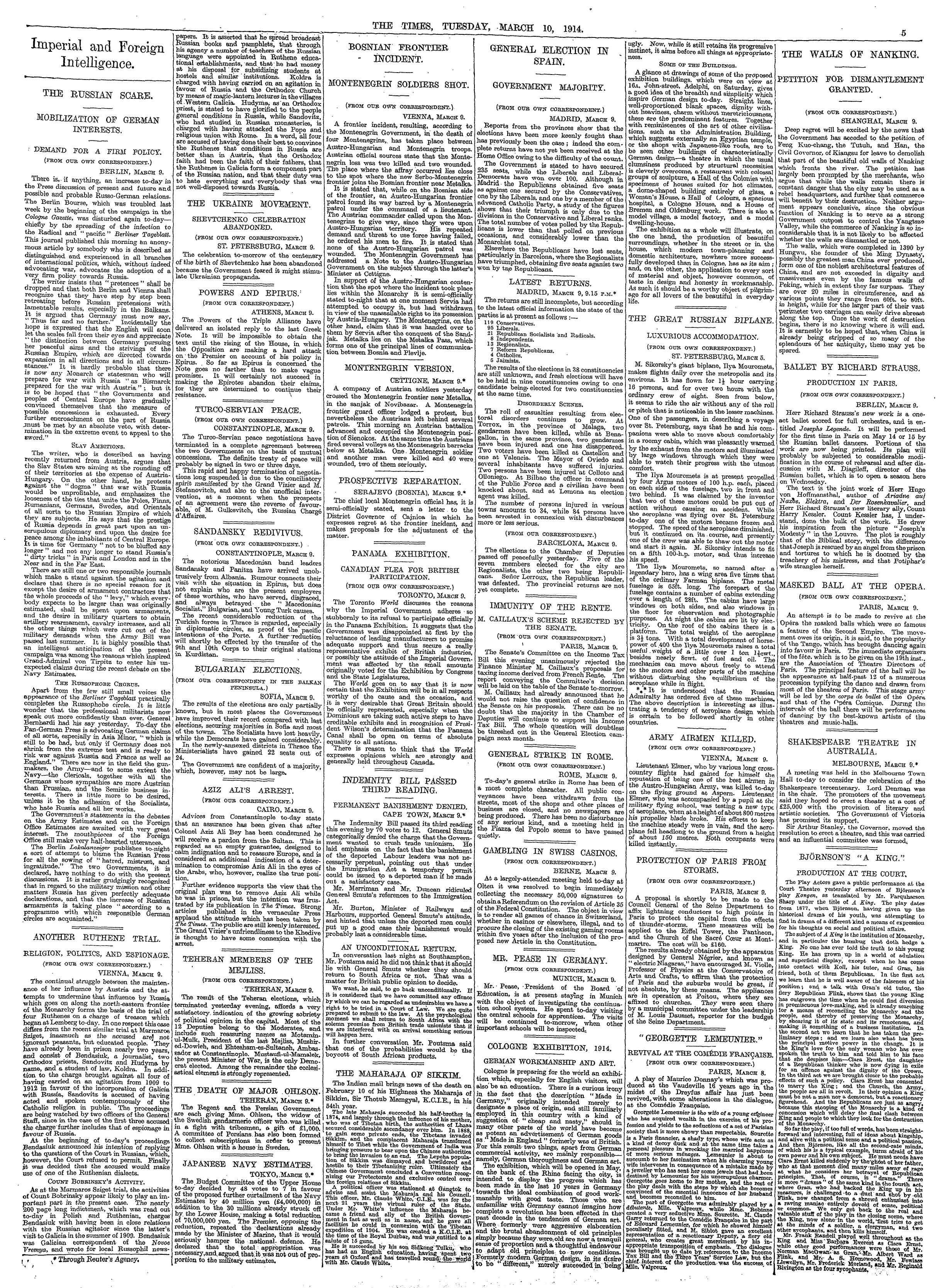
Remarkably modern headlines from 100 years ago

Filed under: Europe, France, Germany, History, Russia, WW1 — Nicholas @ 09:18

At Samizdata, Patrick Crozier talks about the situation in Europe exactly a century back, and the headlines might almost be run today:

Click to see full page

Click to see full page

Over the last few days (this is 1914 we’re talking about just in case anyone was in any doubt) a large number of articles have appeared in the German press on the threat posed by Russia. And still they come:

    There is, if anything, an increase to-day in the Press discussion of present and future and possible and probable Russo-German relations. The Berlin Bourse, which was troubled last week by the beginning of the campaign in the Cologne Gazette, was disturbed again to-day – chiefly by the spreading of the infection to the Radical and “pacific” Berliner Tageblatt. This journal published this morning an anonymous article by somebody who is described as distinguished and experienced in all branches of international politics, which, without indeed advocating war, advocates the adoption of a very firm policy towards Russia.

This is co-ordinated and there’s only one body that would be doing the co-ordination: the German government. They are preparing the population for war. The argument being used is precisely the argument being used in the corridors of power: the Russians are building up their forces and in a few years they will be too strong and it will be too late. In other words: it’s now or never.

It is not just the Russians the Germans are worried about. The Russians on their own would be fairly harmless (as indeed they proved to be) but they are in alliance with France. This leads to Germany’s worst nightmare: the prospect of a war on two fronts. This in turn leads to the development of the Schlieffen Plan with its aim to eliminate one of those fronts before the other one got going.

There is an alternative. Germany could return Alsace-Lorraine to France. At a stroke they would eliminate the one and only bone of contention in the Franco-German relationship and as a consequence break up the Franco-Russian alliance. But no.

There are good reasons why the German government isn’t so keen on such a move. By accepting self-determination in Alsace-Lorraine they would be accepting the principle of democracy. This is hardly the sort of thing that a monarchy can do. There would also be the element of losing face that weak regimes are very reluctant to do.

March 7, 2014

Turkish government threatens to ban YouTube and Facebook

Filed under: Europe, Media, Politics — Tags: , , , , — Nicholas @ 08:56

After an embarrassing leak, Prime Minister Erdogan has threatened to ban the services that carried the leaked voice recordings:

Turkey’s prime minister has threatened drastic steps to censor the Internet, including shutting down Facebook and YouTube, where audio recordings of his alleged conversations suggesting corruption have been leaked in the past weeks, dealing him a major blow ahead of this month’s local elections.

In a late-night interview Thursday, Recep Tayyip Erdogan told ATV station that his government is determined to stem the leaks he insists are being instigated by followers of an influential U.S.-based Muslim cleric. He has accused supporters of Fethullah Gulen of infiltrating police and the judiciary and of engaging in “espionage,” saying that the group even listened in on his encrypted telephone lines. The Gulen movement denies involvement.

“We are determined on the issue, regardless of what the world may say,” Erdogan said. “We won’t allow the people to be devoured by YouTube, Facebook or others. Whatever steps need to be taken we will take them without wavering.”

Gunboat diplomacy for the 21st century

Filed under: Europe, Military, Russia, USA — Tags: , , , — Nicholas @ 08:38

680News reports that a US warship will be patrolling the Black Sea:

A U.S. Navy warship is heading to the Black Sea as tensions in Ukraine continue to divide world powers, according to multiple published reports.

Turkey has given the USS Truxtun permission to pass through the Bosphorus into the Black Sea.

U.S. officials say it is a “routine” deployment that was scheduled before the crisis erupted in Ukraine.

However, the show of military hardware is coinciding with NATO’s show of military support over Baltic countries with its use of air patrols and F-15 fighter jets.

Meantime, President Barack Obama’s warnings to Russia are being brushed aside by Russian President Vladimir Putin, who appears to only be speeding up efforts to formally stake his claim to Ukraine’s Crimean Peninsula.

The USS Truxtun is a new Arleigh Burke-class guided missile destroyer, commissioned in 2009.
While we may be relatively sure that the Truxtun is a powerful vessel (the Wikipedia article describes the class as “larger and more heavily armed than most previous ships classified as guided missile cruisers”), no single ship is going to be particularly effective in putting pressure on Russia over their Ukraine deployment. The Black Sea is a small body of water, geostrategically speaking, and is totally dominated by land-based airpower. Should the situation turn grave, Truxton isn’t likely to weigh heavily in the military balance. She’s there as a token, not as a military asset.

« Newer PostsOlder Posts »

Powered by WordPress


