Quotulatiousness

March 30, 2014

Alec Guinness, my goodness!

Filed under: Britain, Media — Tags: , — Nicholas @ 09:50

Mark Steyn’s Saturday movie column is about the great Sir Alec Guinness:

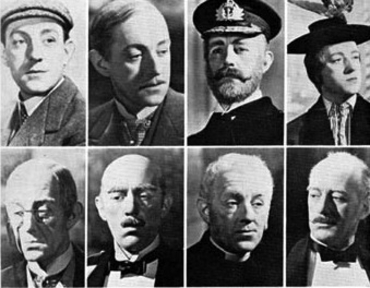
Eight Alec Guinness roles, from one film, Kind Hearts And Coronets (1949)

Eight Alec Guinness roles, from one film, Kind Hearts And Coronets (1949)

In London one hundred years ago this week — April 2nd 1914 — Sir Alec Guinness, CH, CBE entered the world as Alec Guinness de Cuffe. His mother was Agnes Cuff, and the Frenchification of her maiden name seems to have been an attempt to compensate for the blank space on the birth certificate where “Name of Father” should appear. “Alec Guinness” were his two Christian names, leading to periodic suggestions that his pa was a member of the Guinness family. Sir Alec himself took the view that he had been sired by a Scottish banker who turned up at the flat once in a while purporting to be an “uncle” and who paid for his young “nephew” to be educated privately. He was, at least in public, not much interested in his parents, neither the absent nor the present one. From this appropriately vague lineage emerged one of the most versatile British actors of the 20th century, and (via Star Wars) one of the wealthiest.

[…]

His other great military tour de force is as the carrot-topped carouser Major Jock Sinclair opposite John Mills’ by-the-book colonel in Ronald Neame’s Tunes Of Glory. An Ottawa reader who’d “sat through one mess dinner too many” wrote to me a few years ago to say that his all-time favorite Guinness movie line was Major Jock insisting, “Whisky for the gentlemen that like it, and for the gentlemen that don’t like it – whisky!” There’s a lot of Scottish dancing in the picture, and the film itself seems to reel, with Guinness’ blazing orange hair and heeland-flung accent poised brilliantly on a knife-edge of menacing heartiness.

That was unusual for him. I think it was Eileen Atkins who said that Guinness was the only actor who could do absolutely nothing in a close-up and yet you knew what he was thinking. It’s probably closer to the truth to say you knew he was thinking something, and you thought you knew pretty much what it was, but there was always the possibility that something more might be going on. A character like Colonel Nicholson has to be complex, or he simply doesn’t exist, and Guinness was a master at hinting at complexity, even when playing a piece of cardboard such as Obi-Wan. In an age of soul-barers, when Daniel Day-Lewis does Hamlet to work through his feelings about his father, Guinness remained a kind of Gypsy Rose Lee of great actors: he exposed very little, and thereby suggested that what lay underneath must be a real knockout. By the time he got to John le Carré’s George Smiley, he had mastered a unique skill: scene-stealing blankness, nicely caught on one of the early episodes of Whose Line Is It Anyway? when Jonathan Pryce, out of the blue, goes into a sly Guinness take-off — all glances off and an enigmatic smile.

He made his screen debut eight decades ago, in Evensong (1933). No one noticed. So he tried again with David Lean, as Herbert Pocke in Great Expectations (1946) and Fagin in Oliver Twist (1948), two superb performances. Then came his finest group of pictures — the Ealing years, beginning with Kind Hearts and Coronets (1949), in which he played eight different members of the d’Ascoyne family bumped off, in succession, by Dennis Price. Poor old Price actually gives the best performance, but no one cares: Kind Hearts is a novelty turn for Guinness, yet the film has a harder edge than his other Ealing films. To contemporary moviegoers, Ealing is a far more remote world than any in Star Wars — for a long time, the films were hard to get hold of and rarely aired on TV — but they show off brilliantly a youngish actor of unpromising looks but boundless inventiveness.

He had, by all accounts, a lower regard for his art than the other theatrical knights, but it served him well. And, unlike Olivier or Gielgud, Alec Guinness pulled off a unique double: he remains the only man in the galaxy to be knighted both by Her Majesty The Queen and the Jedi.
March 26, 2014

QotD: Britain’s “common culture”

Filed under: Britain, Politics, Quotations — Tags: , , , — Nicholas @ 08:22

In The Lion and the Unicorn, George Orwell wrote that the most salient fact about England’s liberal elite was “their severance from the common culture of the country”. By “the common culture” Orwell was thinking of things like beer and bingo, as well as smutty humour, the tabloid press and a distrust of the state and its officials. What connects these things, according to Orwell, is that they all have a whiff of rebelliousness about them, something that appeals to the Sancho Panza in all of us rather than the Don Quixote – “your unofficial self, the voice of the belly protesting against the soul”. These are the things ordinary people genuinely enjoy, as opposed to what they ought to enjoy. In indulging in these simple, unpretentious pleasures, they are making use of their freedom to spend their money on whatever they like, not what various authority figures think they should spend it on. “One thing one notices if one looks directly at the common people, especially in the big towns, is that they are not puritanical,” wrote Orwell. “They are inveterate gamblers, drink as much beer as their wages will permit, are devoted to bawdy jokes, and use probably the foulest language in the world.”

The reason the liberal elite are disconnected from this culture isn’t simply because it’s alien to them. It’s also because they actively disapprove of it. Unlike the common people, they are puritanical. They think gambling, drinking and bawdy humour, not to mention tabloid newspapers, are wrong and they often give vent to these feelings. Alongside a desire for a more just society, sits a yearning for a purer, less sinful society, one in which the workers spend their evenings reading self-improving books – Booker Prize-winning novels – and engaging in traditional arts and crafts, like basket making. The reason they seek political power isn’t primarily because they want to protect working-class people from being exploited by evil capitalists. They want to protect them from themselves.

Toby Young, “The Conservatives should become the party of beer, bingo and Lamborghinis”, Telegraph, 2014-03-26

Russia has seized 80% of the Ukrainian navy so far

Filed under: Europe, Military, Russia — Tags: , , — Nicholas @ 08:08

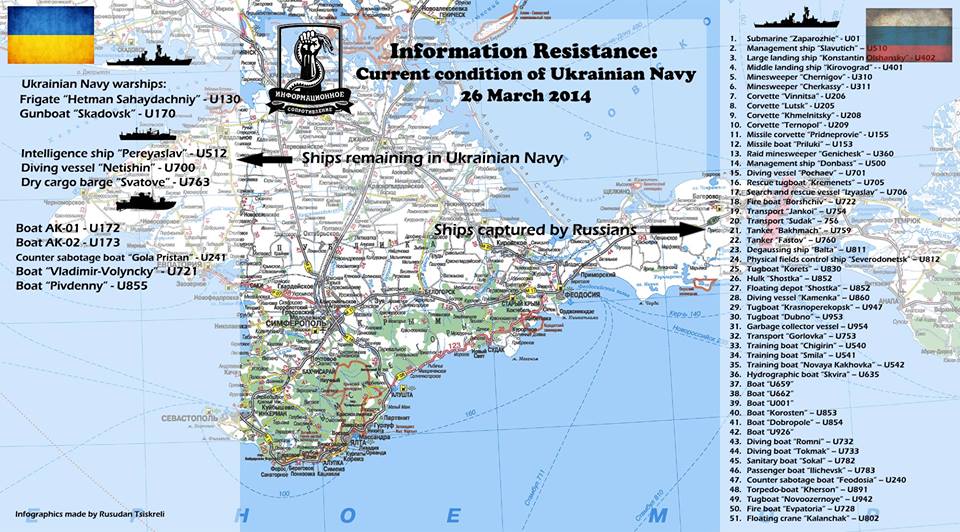
The Kyiv Post has a report including this graphic, showing the current state of Ukraine’s naval forces:

Ukraine ships captured by Russia - March 2014

Among the Ukrainian vessels reportedly captured by the Russians are submarine Zaporizhia, management ship Slavutych, landing ship Konstantin Olshansky, landing ship Kirovohrad, minesweeper Chernihiv and minesweeper Cherkasy.

The Cherkasy was the last of the ships to have been overtaken following weeks of threats and ultimatums to surrender. It was finally chased down and overtaken by the Russian navy on March 25 after failing to slip past a blockade of two ships intentionally sunk by the Russians to trap it and other vessels in a narrow gulf, keeping them from escaping into the Black Sea.

H/T to Tony Prudori for the link.

Secret Service upholds (recent) tradition in the Netherlands

Filed under: Europe, Media, USA — Tags: , , , — Nicholas @ 07:17

BBC News reports that — once again — some of the US Secret Service agents tasked with protecting the President have come to the attention of the press for reasons other than their assigned mission:

Three US Secret Service agents tasked with protecting President Barack Obama in the Netherlands have been sent home for “disciplinary reasons”.

The Washington Post reported that one was found drunk and passed out in the hallway of an Amsterdam hotel.

A Secret Service spokesman declined to give details but said the three had been put on administrative leave pending an investigation.

The service has been trying to rebuild its reputation after previous scandals.

In 2013 two agents were removed from President Obama’s security detail amid allegations of sexual harassment and misconduct.

And in 2012 several agents were dismissed following allegations that they hired prostitutes while in Cartagena, Colombia.

Secret Service spokesman Ed Donovan said the latest incident happened before President Obama’s arrival in the Netherlands on Monday for a nuclear security summit.

He said the three had been sent home for “disciplinary reasons” but declined to elaborate.

Mr Donovan added that the president’s security had not been compromised in any way.

I, Claudius by Robert Graves

Filed under: Books, Europe, History, Media — Tags: , , — Nicholas @ 00:01

March 25, 2014

NATO’s existential moment

Filed under: Europe, Military, Russia — Tags: , , , , — Nicholas @ 09:35

In the Telegraph, Con Coughlin says that if NATO doesn’t stand up to Vladimir Putin’s aggressions, it’s done for:

For anyone who still takes the security of the West seriously — and I fear I am in a distinct minority — the manner in which Russian President Vladimir Putin has effortlessly achieved his audacious land grab in the Crimea should serve as a dramatic wake-up call for Nato.

And yet, to judge by the mood music coming from the meeting of Western leaders in The Hague this week, the likelihood of Nato doing anything to dissuade Moscow’s macho man from undertaking any further acts of military adventurism in central Europe or the Baltic states does not seem at all encouraging.

[…]

When faced with a crisis, the default position of Nato member states, as we have seen recently over Libya and Syria, is to bicker amongst themselves over how to respond, rather than coming up with an effective programme that safeguards its interests.

But if Nato leaders fail to come up with an adequate response to Putin’s new mood of military aggression, they might as well dissolve the alliance and start negotiating peace terms with Moscow.

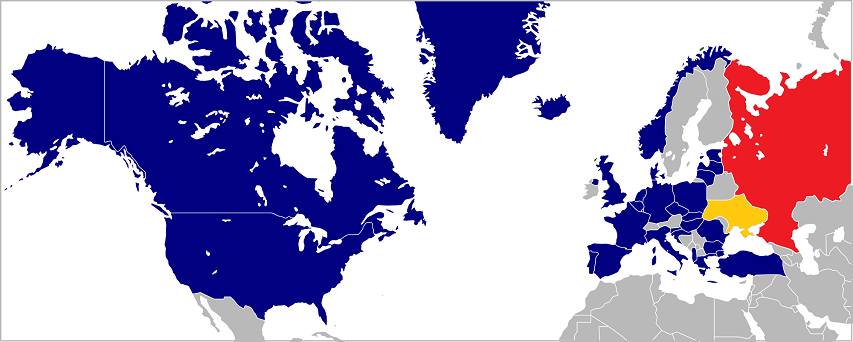
NATO member states in blue, Ukraine in yellow, Russia in red (for tradition's sake)

NATO member states in blue, Ukraine in yellow (including Crimea), Russia in red (for tradition’s sake)

Update: Poland is recalling reservists for military refresher training.

Next time you take a tray of tea and custard creams to the nice gang of Polish builders renovating your semi, they may seem a little distracted and anxious. Ask them why, and they will answer that some of them have in the last few weeks received call-up papers as army reservists.

This happened to a friend of mine in London at the end of last week. At least 7,000 reservists have been recalled to the colours for immediate exercises lasting between 10 and 30 days.

They’re told by the Polish authorities that the call-ups are “routine”: but the men say they haven’t been asked before and they’re well aware of the growing alarm in Warsaw at President Putin’s aggression. Three weeks ago, their Prime Minister, Donald Tusk, called a press conference to warn that “the world stands on the brink of conflict, the consequences of which are not foreseen… Not everyone in Europe is aware of this situation.”

My own view is that Putin was initially more concerned with righting a specific historical wrong in Crimea than starting a new Cold War. This is still probably the case despite the dawning truth that the EU/Nato Emperor really has no clothes at all.

But in the worst case scenario of a truly revanchist Russia, Poland certainly has the borders from hell. Starting from the top, it abuts Kaliningrad (the Russian exclave on the Baltic carved at the end of the war from East Prussia), Lithuania, Belarus and Ukraine.

The origins of Hound of the Baskervilles

Filed under: Books, Britain, History, Media — Tags: — Nicholas @ 08:51

In History Today, Richard Cavendish tells the story behind the best-known of Arthur Conan Doyle’s Sherlock Holmes stories:

Much ink and accusations of plagiarism have been spilled over the story’s origins. Conan Doyle’s initial inspiration came from a young journalist friend named Bertram Fletcher Robinson, nicknamed ‘Bobbles’, with whom he spent four days on a seaside golfing holiday at Cromer in Norfolk in the spring of 1901. While they were there, Robinson told Doyle the legend of a ghostly hound on Dartmoor and the two men decided to write what the latter called ‘a real creeper’ together. Robinson lived at Ipplepen, near Newton Abbot in South Devon, and the two friends went there to investigate Dartmoor. Robinson wrote later that Doyle ‘listened eagerly to my stories of the ghost hounds, of the headless riders and of the devils that lurk in the hollows – legends upon which I had been reared, for my home lay on the borders of the moor.’ They stayed at Robinson’s home and at Rowe’s Duchy Hotel at Princetown near the prison, whose governor, deputy governor, chaplain and doctor solemnly came, as Robinson noted, ‘to pay a call on Mr Sherlock Holmes’, to Doyle’s irritation. He and Robinson explored the moor together and appropriated the surname of Robinson’s coachman, Harry Baskerville.

Doyle decided early on to make the tale a Sherlock Holmes mystery, presumed to be an episode in Holmes’ earlier career, before his fatal grapple with Professor Moriarty at the Reichenbach Falls. Writing to the editor of the Strand Magazine, Herbert Greenhough Smith, to tell him about the new story, he stipulated that Fletcher Robinson’s name must appear as joint author. ‘I can answer for the yarn being all my own in my own style without dilution, since your readers like that. But he gave me the central idea and the local colour, and so I feel his name must appear.’ This was finally watered down to a note added to the first part, recording Doyle’s indebtedness to Fletcher Robinson, to whom ‘this story owes its inception’ and ‘who has helped me both in the general plot and in the local details.’ The British and American editions in book form also acknowledged Robinson’s help.

BBC to be (effectively) privatized in proposed new legislation

Filed under: Britain, Law, Media — Tags: , , , — Nicholas @ 07:09

British TV viewers are required to pay a regular license fee (which funds the BBC) or they can be prosecuted. The British government may be on the verge of changing this:

Budgets come and go, but something more far-reaching will take place in the House of Commons today; something that might change our political discourse significantly, benignly and permanently.

The Government has indicated that it will back a Bill, brought in by the backbench MP, Andrew Bridgen, to decriminalise non-payment of the Television Licence Fee. Instead of being dragged through the courts, defaulters will simply have their access to the BBC switched off — in the same way that Sky withdraws its services from those who don’t pay their subscriptions.

The practical case for the measure is unarguable. The BBC’s privileged legal position is silting up our criminal justice system. A ridiculous 180,000 people face prosecution every year over non-payment. Under the new regime, they will instead be in the position people who don’t cough up for their gas or electricity bills. A great deal of time and money will be saved.

But the real significance of the proposal is that it will, in practice, remove the BBC’s monopoly. If the penalty for non-payment of the licence fee is withdrawal of the service, rather than prosecution, then that fee ceases to be a tax and becomes a subscription. Refusal to pay is no longer a criminal act, but an exercise of consumer choice. The BBC will become, in practice, a pay-on-demand service like its rivals.

March 24, 2014

The Great Escape (with bonus Canadian content)

Filed under: Cancon, Europe, Germany, History, Military, WW2 — Tags: , — Nicholas @ 16:06

It was 70 years ago today that the “Great Escape” from Stalag Luft III took place:

March 22, 2014

Turkish Twitter users work to circumvent the government’s ban

Filed under: Europe, Government, Media — Tags: , , , — Nicholas @ 10:00

In the Guardian, Constanze Letsch reports from Istanbul as users of Twitter actively flout the government’s peevish ban of the online service:

Turkish users of Twitter, including the country’s president, have flouted a block on the social media platform by using text messaging services or disguising the location of their computers to continue posting messages on the site.

In what many Twitter users in Turkey called a “digital coup”, Telecom regulators enforced four court orders to restrict access to Twitter on Thursday night, just hours after the prime minister, Recep Tayyip Erdogan, vowed to “eradicate” the microblogging platform in an election speech.

The disruption followed previous government threats to clamp down on the social media and caused widespread outrage inside and outside Turkey. In a first reaction to the ban, Neelie Kroes, vice-president of the European commission, tweeted: “The Twitter ban in #Turkey is groundless, pointless, cowardly. Turkish people and intl community will see this as censorship. It is.”

Štefan Füle, EU commissioner for Enlargement and European Neighbourhood Policy, said in a statement: “The ban on the social platform Twitter.com in Turkey raises grave concerns and casts doubt on Turkey’s stated commitment to European values and standards.”

The hashtag #TwitterisblockedinTurkey quickly rose to the top trending term globally. According to social media agency We Are Social the number of tweets sent from Turkey went up 138% following the ban.

Night Bombers, 1943

Filed under: Britain, Germany, History, Military, WW2 — Tags: , , — Nicholas @ 00:01

Published on 30 Dec 2012

A unique record of the nightly air raids made on Germany during World War II. Archive colour footage from No. 1 Group, Royal Air Force operating Avro Lancaster bombers, in action, winter 1943. In the winter of 1943, RAF Bomber Command was sending massive raids almost every night into the heart of Germany. This is the story of one of them, an attack on Berlin. Although certain scenes had to be re-created for technical reasons, make no mistake, the raid is a real one and there are no actors.

Made by Air Commodore H.I. Cozens while station commander at Hemswell. This is the Only known colour record of the Bomber Command during WWII documenting a bombing raid targeting Berlin.

Another great find from the folks at Think Defence.

March 21, 2014

Kate Bush announces series of concerts in London

Filed under: Britain, Media — Tags: , , , — Nicholas @ 14:23

The Daily Mail describes it as a residency at the Hammersmith Apollo in London:

Kate Bush is to return to the stage in London — 35 years after she retired from touring after just six weeks on the road.

She will play a 15-date residency at the Hammersmith Apollo which was the venue for a celebrated concert film she made in 1979.

The 55-year-old made a surprise announcement about the shows — to be called Before The Dawn — on Friday morning, with the first taking place on August 26.

Bush talked about a desire to return to playing live in an interview three years ago, saying she would love to play again before she became ‘too ancient’.

She was just 20 when she completed The Tour Of Life after topping the charts with Wuthering Heights the previous year.

Over the years, theories about her absence from the stage have included her perfectionism, a fear of flying and the death of one of the tour crew, lighting director Bill Duffield, during a show.

But in a rare interview with Mojo magazine in 2011 to mark her comeback, she explained that her years of silence on the touring circuit were simply down to the sheer exertion of the ordeal.

‘It was enormously enjoyable. But physically it was absolutely exhausting,’ she said.


LONDON – 12th MAY: English singer Kate Bush performs live on stage at Hammersmith Odeon in London on the penultimate date of her European tour on 12th May 1979. (Photo by Peter Still/Redferns)

Byzantium’s secret weapon

Filed under: Europe, History, Weapons — Tags: , , — Nicholas @ 07:50

Military History Now had a guest post from Κonstantinos Karatolios talking about the Byzantine secret weapon known as “Greek Fire”:

The thousand-year Byzantine Empire could not have survived through the centuries without its powerful military. But Constantinople’s mighty army and navy didn’t just keep enemies at bay, they also helped it to expand into new territories and ultimately dominate the whole of the Mediterranean for hundreds of years. Of course, while the Byzantines’ stunning battlefield success was in part a by-product of military knowledge inherited from the old Roman Empire, it was also born out of new tactics and weaponry. One example of this is Greek fire. Also known as thalassion pyr, skeyaston pyr and medikon elaion, this incendiary liquid, which could be squirted or hurled into the ranks of an enemy, was perhaps the most fearsome of all of the empire’s armaments. Its use, whether on land or sea, verges on legend and yet almost all we know about Greek fire remains clouded in mystery. We are sure of one thing however — it was used with devastating effect throughout the whole course of the Byzantine Empire.

Here are nine little known facts about Greek fire.

I think there’s a typo in the list, as it mentions the first recorded use of the weapon by Anastasios I in 541, which was actually the middle of the reign of Justinian I. Anastasios I reigned from 491 to 518.

The Dambusters Raid – Full Documentary

Filed under: Britain, Europe, Germany, History, Military, WW2 — Tags: , , — Nicholas @ 00:01

Published on 20 Apr 2013

On May 17th, 1943 the Royal Air Force carried out one of the most remarkable raids ever undertaken by any aircrew. On that night a squadron of Lancaster heavy bombers flew at low level across a blacked out Europe, towards the four great dams that delivered water and power to the German industrial heartland of the Ruhr. The aircrews had been trained for months to carry out this most daring and courageous of raids. Against a storm of anti-aircraft fire, they calmly flew their bombers in across the reservoirs, holding a specific height and speed, to deliver their strange cylindrical bouncing bombs, to explode against the face of the dams, and blow great holes in them. The factories of the Ruhr were crippled. 1300 German civilians died, and 53 aircrew were lost. For the very first time this programme explores both sides of a raid that has become an epic in the history of World War 2.

H/T to Think Defence for the link.

March 20, 2014

Today in misunderstood income inequality stats…

Filed under: Britain, Economics, Media — Tags: , , — Nicholas @ 08:20

Tim Worstall pokes fun at a recent Oxfam report that claims that Britain’s five richest families own more than the bottom 20% of the population:

I read this and thought, “well, yes, this is obvious and what the hell’s it got to do with increasing inequality?” Of course Gerald Grosvenor (aka Duke of Westminster) has more wealth than the bottom 10 per cent of the country put together. It’s obvious that the top five families will have more than 20 per cent of all Britons. Do they think we all just got off the turnip truck or something?

They’ve also managed to entirely screw up the statistic they devised themselves by missing the point that if you’ve no debts and a £10 note then you’ve got more wealth than the bottom 10 or 20 per cent of the population has in aggregate. The bottom levels of our society have negative wealth.

[…]

Given what we classify as wealth, the poor have no assets at all. Property, financial assets (stocks, bonds etc), private sector pension plans, these are all pretty obviously wealth.

But then the state pension is also wealth: it’s a promise of a future stream of income. That is indeed wealth just as much as a share certificate or private pension is. But we don’t count that state pension as wealth in these sorts of calculations.

The right to live in a council house at a subsidised rent of the rest of your life is wealth, but that’s not counted either. Hell, the fact that we live in a country with a welfare system is a form of wealth — but we still don’t count that.

Doing this has been called (not by me, originally anyway) committing Worstall’s Fallacy. Failing to take account of the things we already do to correct a problem in arguing that more must be done to correct said problem. We already redistribute wealth by taxing the rich to provide pensions, housing, free education (only until 18 these days) and so on to people who could not otherwise afford them. But when bemoaning the amount of inequality that clearly cries out for more redistribution, we fail to note how much we’re already doing.

So Oxfam are improperly accounting for wealth and they’ve also missed the point that, given the existence of possible negative wealth, then of course one person or another in the UK will have more wealth than the entire lowest swathe.

« Newer PostsOlder Posts »

Powered by WordPress