Quotulatiousness

April 16, 2014

North Korean embassy officials upset over London hair salon ad

Filed under: Asia, Britain, Business — Tags: , , , — Nicholas @ 00:01

BBC News on the apparent diplomatic incident taking place at M&M Hair Academy in South Ealing:

Kim Jong Un bad hair day adNorth Korean officials paid a visit to a London hair salon to question why it had used their leader Kim Jong-un’s picture in a poster offering haircuts.

The poster in M&M Hair Academy in South Ealing featured the words “Bad Hair Day?” below the leader’s picture.

Barber Karim Nabbach said embassy officials were shown the door and the salon’s manager spoke to the police.

The Met Police said: “We have spoken to all parties involved and no offence has been disclosed.”

The salon put up the poster on 9 April and the next day two men claiming to be officials from the North Korean embassy visited the salon and demanded to meet the manager, Mo Nabbach.

Karim Nabbach said: “We put up posters for an offer for men’s hair cuts through the month of April. Obviously in the current news there has been this story that North Korean men are only allowed one haircut.

H/T to Eric for the link.

April 15, 2014

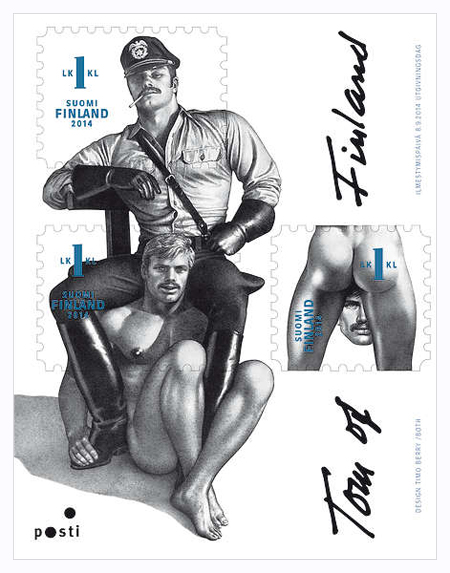
Finland to issue “Tom of Finland” erotic postage stamps

Filed under: Europe — Tags: , , , , — Nicholas @ 11:02

Unlike other Scandinavian countries, Finland isn’t noted as a trend-setter in LGBT issues: still not allowing same-sex marriage even though homosexuality was legalized in 1971. Finland also classified transvestism as an illness until 2011. Knowing that, it’s hard to credit that Itella Posti, the Finnish postal service, will be selling these stamps beginning in September.

From their English-language website:

Finland issues Tom of Finland stampsIn September-October 2014, Itella Posti will release seven new sets of stamps, containing a total of 33 new designs. It is a great collection to choose from; the subjects of the new stamps include male drawings by Tom of Finland, autumnal yard and garden scenes painted by Urpo Martikainen, and Jaakko Tähti’s photos of Finnish bridges. Other subjects for the end-of-the-year stamps include signs of sky and the change in everyday Finland — and, of course, Christmas.

The autumn’s stamp series begins September 8 with Tom of Finland, who is considered one of the most well-known Finnish artists around the world. His emphatically masculine homoerotic drawings have attained iconic status in their genre and had an influence on, for instance, pop culture and fashion. In his works, Tom of Finland utilized the self-irony and humor typical of subcultures.

During his career, Tom of Finland produced more than 3,500 drawings. The two drawings on the stamp sheet were selected by graphic artist Timo Berry, who designed the stamp, and Susanna Luoto, the Finnish representative of the foundation named after Tom of Finland operating in Los Angeles.

The drawings on the stamp sheet represent strong and confident male figures typical of their designer. “The sheet portrays a sensual life force and being proud of oneself. There is never too much of that in this northern country,” says Timo Berry. The miniature sheet contains three 1st class self-adhesive stamps.

The artist behind Tom of Finland was Touko Laaksonen (1920-1991), whose profile is extended in the exhibition Sealed with a Secret – Correspondence of Tom of Finland opening in the Postal Museum September 6. The exhibition will display the busy correspondence of Laaksonen from the early 1940s to his dying year, 1991. The exhibition will be displayed until March 29, 2015, in Museum Centre Vapriikki in the new Postal Museum to be opened in Tampere in September.

Ukraine suffering Russian version of “Death by A Thousand Cuts”

Filed under: Europe, Military, Politics, Russia — Tags: , , , — Nicholas @ 08:02

In the Telegraph, former UK ambassador Charles Crawford says that Vladimir Putin is using Ukraine as a testing ground for rebuilding a new Russian empire:


Russian President Vladimir Putin visits the Cosmonautics Memorial Museum on April 11, 2014 in Moscow, Russia. Russia celebrates the Cosmonaut Day, marking the pioneering flight into space of Yuri Gagarin on April,12,1961.

It is no exaggeration to say that the historic deal that ended the Cold War is now unravelling. That deal was simple. Russia itself (largely on its own initiative) ended the Soviet Union in favour of a bold democratic modernisation process to be achieved in partnership with Western capitals. Confrontation in Europe and around the world would be replaced by cooperation. Huge sums of Western money would be made available to Russia on generous terms, to help it move from communism to sane economic and security policies. All the other Soviet republics would become independent countries and begin their own transitions in a similar partnership spirit.

[…]

Outside Russia’s already vast borders Putin is throwing down a momentous challenge to the rest of the world: “What if Russia drops all this namby-pamby European soft-power rubbish and decides instead to reclaim one way or the other historic Russian lands?”

That question does not fit any category of thinking that today’s Western leaders and their advisers can muster. Western leaders have come to see agreed rules and interminable meetings as a source of strength. Putin sees agreed rules and boring meetings as a source of weakness. Hence the Western and wider international response is muted and uncertain. The focus is on stepping up “economic pressure” on Russia in general and key Russians in particular. There is logic to this. Europe needs Russian energy, but Russia needs European money. Russia really has moved on from the Cold War period and joined the international marketplace. It ought to be impressed by the threat of investment bans and other targeted financial measures.

That approach does not, however, address the key problem. Putin might see the Russian economy hurting and ask Russians another question: “What if we reclaim historic Russian lands but at the cost of eating turnips again for a while?” A noisy majority of Russians might think that that is a sacrifice well worth making. This gives Putin hard policy options unavailable to Western leaders, for whom any equivalent question would be electoral suicide.

Ukraine is now the luckless space where Putin is experimenting with different ways to roll back the Cold War settlement and then reassert Russian imperial power in other parts of the former Soviet Union. Crimea has been annexed, but the rest of Ukraine is far bigger and much more complicated. All sorts of methods are being deployed both in Ukraine and through a sophisticated global propaganda operation to destabilise Ukraine. The key immediate goal is to make Ukraine ungovernable except on Russia’s terms. This means preventing a new legitimate government emerging in the forthcoming elections.

April 12, 2014

The Baaaa-studs 2009 – Extreme LED Sheep Art

Filed under: Britain, Humour, Technology — Tags: — Nicholas @ 15:38

Charles Stross solves the GOP’s 2016 candidate dilemma

Filed under: Humour, Politics, Russia, USA — Tags: , , — Nicholas @ 09:40

No really:

Now, it occurs to me that the Republican Party over in the USA have a bit of a problem coming up in 2016, namely who to run against Barack Obama’s successor. Whoever they are. (Hilary is looking a little old and Al’s cardboard has mildew.) But the RNC isn’t in good shape. They don’t have anybody out front with the charisma of the Gipper (dead or alive), or the good ole’ boy appeal of George W. Bush: just a bunch of old white guys in dark suits who’re obsessed with the size of their wallets and the contents of every woman’s uterus, or vice versa. Guys who make Karl Rove look like Johnny Depp.

And so it occurred to me (after my fifth pint of IPA) to spin my speculative political satire around the fact that there is only one man on the global political scene today who has what it takes to be a plausible Republican candidate for President Of The United States at the next presidential election.

This man:

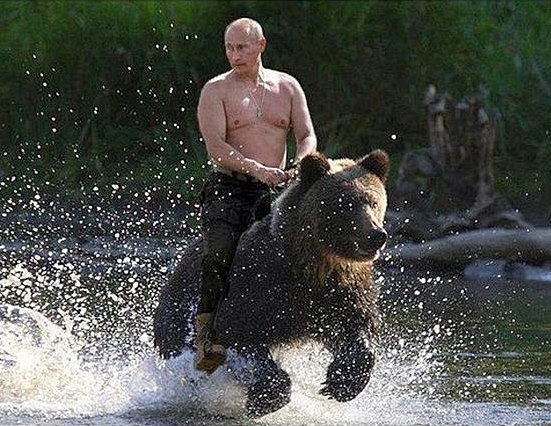
Vladimir Putin riding a bear

Vladimir Vladimirovitch Putin.

Let me enumerate the ways in which this man makes sense as a candidate. He’s only 62 years old—not as youthful as Barack Obama, but still well within the age range for POTUS. He has proven experience of leading an aggressive, declining, former military superpower bristling with nuclear weapons and suffering from eating disorders and a tendency to binge on breakaway republics when nobody is looking. As a former KGB Colonel he understands the needs of the security state like no US president before him, except possibly George H. W. Bush (a former Director of the CIA); he’s exactly the right man to be in charge of the NSA, post-Snowden. As a Russian he clearly likes his tea, so he’ll go down well with that wing of the party. Nobody can accuse him of being soft on terrorism, or communism, or gay rights. Nobody can question his virile, macho manhood either, not with his state-run press agency circulating photographs of him bareback-riding a bear. He’s an instinctive authoritarian, a daddy figure, totally in love with god, guts, and guns — and if anyone says otherwise he’ll put powdered Polonium in their soup.

Oh, but it gets better

QotD: Canada’s “small country” syndrome

Filed under: Cancon, Europe, France, Quotations — Tags: , , — Nicholas @ 09:23

It’s been a decade since Robert Fulford popularized the term: “The Longest Undefended Neurosis in the World.” It’s about as accurate a description of Canada-US relations as has ever been offered. The eagerness which, even at this late date, we lap up any mention of Canada on US media is oddly pathetic. This is the sort of behaviour typically seen in small bankrupt countries. Any mention of Portugal outside of Portugal is almost immediately reported on the state broadcaster. There is a strange cloying quality about such reports. A desperate yelling: “Hey we used to be important!”

It’s a small country thing. When a big country thinks this way you get French-style arrogance: “Hey we still are important, it’s that you lot aren’t clever enough to realize that blindingly obvious fact.”

Today Rob Ford is probably the most famous Canadian in history, save William Shatner. Neither men’s careers has done much to change international perceptions of Canada. We’re boring and probably polite. From time to time we kill seals and moose, though not necessarily in that order. As a general rule we avoid doing evil things. Short of carpet bombing a small country, which is well beyond our military capabilities, nothing we do will change these perceptions. We could annex Buffalo, something within our military capabilities, but I suspect most Americans would probably be grateful. They might throw in Rochester as a parting gift.

Richard Anderson, “Talking With Americans About Canadians”, The Gods of the Copybook Headings, 2014-04-10

April 10, 2014

Policing the language, German style

Filed under: Europe, Germany, Law — Tags: , , , , — Nicholas @ 09:24

Matthias Heitmann on the odd things that happen to avoid any hint of Nazi contamination in allowable letter combinations on license plates and to mandate equal gender presence in job titles and place names:

In Germany today, you see, there is a palpable desire to cleanse society of views officially deemed unacceptable or politically incorrect. This is most obvious when it comes to words or views associated with fascism or the far right. It’s likely that even the most liberal of Germans would oppose the right of members of the right-wing National Democratic Party to voice their strange views in public. Indeed, having embarrassingly failed to ban the party in 2003, the federal government is currently trying to outlaw the party once again. Anyone attempting to defend free speech or freedom of association in this context will find themselves accused of being a fascist sympathiser, an apologist or, even worse, disrespecting victims of the Holocaust and their descendants.

The popular fear of being accused of being a Nazi sympathiser has resulted in some strange regulations. Since the 1980s, for instance, the letter combinations ‘NS’, ‘KZ’, ‘SS’, ‘SA’ or ‘HJ’, which all potentially allude to fascist symbols or institutions, have been banned from use on car licence plates. In the past few months, there has been a heated debate about whether letter or number combinations like ‘HH’ or ‘88’ (which both allude to ‘Heil Hitler’), ‘18’ (meaning ‘Adolf Hitler’), 204 (meaning Hitler’s birthday) or even ‘GV’ (which is short for sexual intercourse) should be banned from licence plates, too. This poses something of a problem for Hamburg car owners, whose licence plates all start with ‘HH’.

[…]

It’s not only on the traditional minefield of racism and fascism that free speech has suffered in Germany. Free speech has also been knocked about by feminists, too, with their determination to impose new language and behaviour regulations. Last summer, for instance, the University of Leipzig announced plans to address its staff using only the feminine forms of words. ‘Professorin’ is due to replace older formulations like ‘Professorinnen und Professoren’ or ‘Professor/innen’. Schröder, meanwhile, admitted during a recent interview that not even the Bible is immune from linguistic tinkering. When talking to girls, for instance, the masculine ‘der Gott’ could simply become the neutral ‘das Gott’.

Interestingly, when feminist language control clashes with anti-fascist dogma, feminism seems to prevail. In the German capital, Berlin, a local parliament, heavily dominated by green and left-wing politicians, voted against naming a square in front of the Jewish Museum after the Enlightenment philosopher Moses Mendelssohn. This decision was made on the grounds that as Mendelssohn was a man, he would break the rule established in 2005 to only name streets and squares after women. This was deemed necessary in order to achieve sexual equality on the city map. As a compromise, the local parliament used Mendelssohn wife’s name alongside his own, creating ‘Moses-und-Fromet-Mendelssohn-Platz’. Although Fromet wasn’t a historic figure, she at least was a woman.

April 9, 2014

Palin – “A lot of Python was crap, it really was”

Filed under: Britain, Humour, Media — Tags: , , — Nicholas @ 08:38

The funny bits were very funny indeed, but we tend to forget the never-ending interminable repetitive repetitiveness of a lot of the other material:

Michael Palin has finally admitted what many of us have known in our hearts for some time: a lot of Monty Python‘s material was “crap.”

“People forgive you the things that don’t work. A lot of Python was crap, it really was,” said Palin, yesterday, at the launch of a tour called “Travelling To Work” announced at the London Book Fair.

“We put stuff in there that was not really that good, but fortunately there were a couple of things that everyone remembers while they’ve forgotten the dross,” he said.

Palin is dead right, of course. As a child in the 1970s I remember sitting stony-faced through entire episodes of Monty Python’s Flying Circus. But at the time, and ever since, there has existed a powerful omerta whereby no one can admit to finding Monty Python unfunny for fear of being thought humourless or not part of the gang.

Monty Python‘s inflated reputation derives as much as anything, I think, from a combination of obsessive repetition and peer pressure. That is, a lot of their sketches are not particularly funny in and of themselves, but have been conferred the status of classics as a result of being endlessly repeated by drunken students who brandish their knowledge of Python sketches as a way of acquiring cult credibility.

I know this because it’s exactly what I did myself at university in the mid-Eighties.

Yeah, well, on that last bit all I can say is “All right, it’s a fair cop, but society is to blame”.

April 8, 2014

Map of the day

Filed under: Europe, USA — Tags: , , — Nicholas @ 08:37

Here’s an interesting map. What do you think it shows? An epidemic? Outbreaks of zombies? Incidents of flashmobbing?

Click to see full-sized image at the Washington Post

Click to see full-sized image at the Washington Post

The real answer is this shows where participants in an American survey plotted the location of Ukraine. The headline of the story is “The less Americans know about Ukraine’s location, the more they want U.S. to intervene“.

Where’s Ukraine? Each dot depicts the location where a U.S. survey respondent situated Ukraine; the dots are colored based on how far removed they are from the actual country, with the most accurate responses in red and the least accurate ones in blue. (Data: Survey Sampling International; Figure: Thomas Zeitzoff/The Monkey Cage)

I’m not sure which responses worry me the most: the ones that show Ukraine in “flyover country”, Alaska, or Greenland or those that show Ukraine as an underwater modern-day Atlantis…

Update 10 April: I’m kicking myself for forgetting this Bierce quote.

Choosing when to die

Filed under: Europe, Health, Liberty — Tags: , , — Nicholas @ 06:52

Colby Cosh discusses the latest Swiss innovation to come to the tabloid newspapers’ attention:

Five or six times I must have read the story about the relatively healthy little old English lady who killed herself rather than struggle on through the “digital age”, and I still cannot quite think what to make of it. Surely there is something noble about leaving life on what are as nearly as possible one’s own terms, with some strength left, after a full, long, largely happy existence.

Unlike a lot of self-described “environmentalists”, she clearly believed the Malthusian script and took the recommended action: “The environmentalist was also worried about the damage being wrought on the planet by overcrowding and pollution.” If she was that worried about poor old Mother Earth, one might wonder why she took so long to take her leave of it.

I suppose Dignitas does its best to make sure oldies aren’t being urged to suicide by impatient heirs, but surely there is only so much the staff can do, and it is in their interest to do as little as possible. It is certainly easy to imagine ethically dubious ways of encouraging the irritability of a cranky, inconvenient old person. Oo, hardly worth the trouble of gettin’ out of bed in the morning, is it, gran? Oh, dear, are your lungs givin’ you a hard time again? Tsk, must make you want to chuck it all in sometimes. If you are a person of British descent, you take in a certain amount of this glum, boggy attitude with every meal anyway. It comes naturally.

And there is my only real concern about institutionalizing the right to die … that it will encourage a certain haste: not among the elderly or afflicted, but among their caregivers, descendents, and prospective legatees. I think you should have the right to decide when to die, but it is a situation that offers the unscrupulous and unprincipled a quicker route to impose their desires on others.

But who is ready to have the government issue packets of Nembutal every five years with Canada Pension Plan cheques? Whatever solution we decide on for the convenience of the legitimately ailing or hopeless, I want the doctors — who, after all, belong to a profession that cannot seem to stop prescribing useless antibiotics for upper respiratory infections — to have as little to do with it as possible. Physicians are not saints, and they will follow the “easier for me” heuristic, like other primates, if non-negotiable aspects of their duty are thrown open to fiddling. “Do no harm” has been at the top of the list for 2,400 years, and, please, keep in mind, it took them 2,200 of those to give up therapeutic bloodletting.

Exactly.

April 6, 2014

QotD: “[T]he effete dissipated welfare addicted gender quota apportioned peoples of Europe”

Filed under: Europe, Military, Russia, USA — Tags: , — Nicholas @ 08:47

Even if the USA picked up its toys and went home in a huff, which they won’t I might add, more’s the pity for the hapless US taxpayer, the effete dissipated welfare addicted gender quota apportioned peoples of Europe that dwell so prominently in the imaginations of Real Men From Texas (or wherever), are actually quite capable of keeping the Russian Hordes, in their rust covered jalopies with siphoned fuel tanks, from sweeping across the steppes and threatening to once again park themselves somewhere near the Fulda Gap, presumably out of nostalgia for a place with half decent food. Russia… big dick, but no shoes.

I have often said the difference between British and American arrogance is the Brits think they run the world, the Americans think they are the world. Yet somehow the world will bumble along even if either don’t get involved with spanking Putin. The US should just fixate the collective paranoia on China because that actually is something of a Good Old Fashioned Looming Threat, of the kind much loved by people like Boeing and Lockheed.

Perry de Havilland, “Russia… lets keep a sense of proportion”, Samizdata, 2014-04-06

April 3, 2014

September, 2014 – the potential start of “interesting times” in the UK

Filed under: Britain, Politics — Tags: , , — Nicholas @ 08:09

If Scotland votes in favour of separation from the United Kingdom this September, it will kick off a period of vast political uncertainty on both sides of the border:

The potential negotiations are all frighteningly close. In just six months time difficult discussions between the Scottish government and Whitehall could be getting under way. David Cameron would lead for the Rest of UK, but only as a weakened Prime Minister contemplating a legacy centred on the loss of the Union. His Westminster opponent Ed Miliband would have to contemplate the loss of many Labour MPs from north of the border. Meanwhile, Nigel Farage would presumably be jumping up and down shouting “bye-bye Scotland, close the door behind you” and stressing that England should be for the English. That view would, I suspect, be very popular after the Scots had raised two fingers at the English in the referendum.

In Scotland, once the Nationalists had woken up with a massive collective hangover, there would be bedlam too, with Salmond the victor and head of government demanding to lead for the Scots in negotiations on oil and so on. But should one man be allowed to create a separate state and dictate its constitution? Shouldn’t a wider group of founding fathers and mothers come up with a plan that Scottish voters can then be asked to approve? To help, the better Scottish MPs and peers at Westminster would very quickly have to go home to try and prevent Salmond turning the whole exercise into a massive vanity project. They would also have to stand for seats in the next Scottish parliament elections, or retire and pipe down.

All this would be taking place against a backdrop of economic uncertainty and intense emotional turbulence.

In such extraordinary circumstances, it is unlikely that English, Welsh and Northern Irish voters would put up with Scottish MPs trying to carry on as normal and then standing for election in 2015 as though nothing had happened. The Members of the Scottish Parliament would say that they now spoke for Scotland. The English, Welsh and Northern Irish at Westminster would be justified in saying later this year to those MPs from Scottish seats: what are you still doing here?

April 1, 2014

Losing a debate? Demand that your opponents be locked up!

Not, I’m afraid, an April Fool’s Day story:

Finally, someone has come up with a way to settle the debate over climate change: Put the people on the wrong side of the argument in cages.

A writer for the website Gawker recently penned a self-described “rant” on the pressing need to arrest, charge and imprison people who “deny” global warming. In fairness, Adam Weinstein doesn’t want mass arrests (besides, in a country where only 44% of Americans say there is “solid evidence” of global warming and it’s mostly due to human activity, you can’t round up every dissenter). Fact-checking scientists are spared. So is “the man on the street who thinks Rush Limbaugh is right. … You all know that man. That man is an idiot. He is too stupid to do anything other than choke the earth’s atmosphere a little more with his Mr. Pibb burps and his F-150’s gassy exhaust.”

But Weinstein’s magnanimity ends there. Someone must pay. Weinstein suggests the government simply try the troublemakers and spokespeople. You know, the usual suspects. People like Limbaugh himself as well as ringleaders of political organizations and businesses that refuse to toe the line. “Those malcontents must be punished and stopped.”

Weinstein says that this “is an argument that’s just being discussed seriously in some circles.” He credits Rochester Institute of Technology philosophy professor Lawrence Torcello for getting the ball rolling. Last month, Torcello argued that America should follow Italy’s lead. In 2009, six seismologists were convicted of poorly communicating the risks of a major earthquake. When one struck, the scientists were sentenced to six years in jail for downplaying the risks. Torcello and Weinstein want a similar approach for climate change.

This is a great standard for free speech in America. Let’s just agree that the First Amendment reads, “Nothing in this clause shall be considered binding if it contradicts legal practices in the Abruzzo region of Italy.”

The truth is this isn’t as new an outlook as Weinstein suggests. For instance, in 2009, New York Times columnist Paul Krugman insisted that “deniers” in Congress who opposed the Waxman-Markey climate change bill were committing “treason” while explaining their opposition on the House floor. (That same year, Krugman’s fellow Timesman Thomas Friedman wrote that China’s authoritarian system was preferable to ours, in part, because it lets “enlightened” leaders deal with climate change.)

March 31, 2014

Comparing NATO and Russian military spending to 2012

Filed under: Australia, Cancon, Europe, Military, Russia, USA — Tags: , — Nicholas @ 10:23

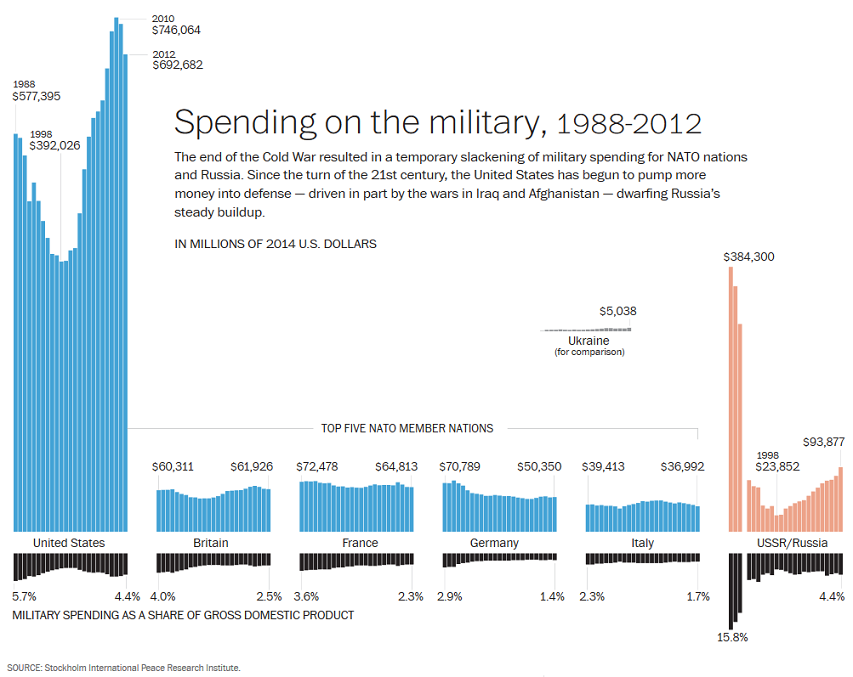
Mark Collins links to this Washington Post graphic showing a comparison of military spending in the top five NATO countries and Russia (counting Soviet spending 1988-1991). Note that the United States and Russia now each spend the same proportion of GDP on their respective military forces:

Click to see full-size graphic

Click to see full-size graphic

For reference, Canada’s military budget doesn’t crack the top 10 in NATO: we spend about US$16.5 billion per year (not even in the top 15). Mark also points out that Australia spends proportionally more than Canada … about 50% more, in fact. But it should also be noted that while Canada and Australia have a lot in common, our defence needs are significantly different: Oz is in a much more dangerous part of the world than Canada, and they don’t share a lengthy border with the world’s biggest military spender. You could probably make a viable case that Australia isn’t spending enough given the rough neighbourhood they’re in.

March 30, 2014

The rise of Vladimir Putin

Filed under: Europe, History, Politics, Russia — Tags: — Nicholas @ 10:29

BBC News charts the unlikely rise of Russian leader Vladimir Putin:

On 16 August 1999, the members of Russia’s parliament — the State Duma — met to approve the candidacy of a prime minister. They heard the candidate’s speech, they asked him a few questions, and they dutifully confirmed him in the position.

This was President Boris Yeltsin’s fifth premier in 16 months, and one confused party leader got the name wrong. He said he would support the candidacy of Stepashin — the surname of the recently sacked prime minister — rather than that of his little-known successor, before making an embarrassing correction.

If even leading Duma deputies couldn’t remember the new prime minister’s name, you couldn’t blame the rest of the world if it didn’t pay much attention to his speech. He was unlikely to head the Russian government for more than a couple of months anyway, so why bother?

That man was a former KGB officer, Vladimir Putin, and he has been in charge of the world’s largest country, as president or prime minister, ever since. Few realised it at the time, because few were listening, but that speech provided a blueprint for pretty much everything he has done, for how he would re-shape a country that was perilously close to total collapse.

Just 364 days previously, Russia had defaulted on its debt. Salaries for public sector workers and pensions were being paid months late, if at all. Basic infrastructure was collapsing. The country’s most prized assets belonged to a handful of well-connected “oligarchs”, who ran the country like a private fiefdom.

The once-mighty Russian army had lost a war in Chechnya, a place with fewer inhabitants than Russia had soldiers. Three former Warsaw Pact allies had joined Nato, bringing the Western alliance up to Russia’s borders.

Meanwhile, the country was led by Yeltsin, an irascible drunkard in fragile health. The situation was desperate, but Putin had a plan.


Russian President Vladimir Putin attends a meeting with members of the Council of the Federation on March 27, 2014 in Moscow, Russia. (Photo by Sasha Mordovets/Getty Images)

« Newer PostsOlder Posts »

Powered by WordPress