Quotulatiousness

September 24, 2014

Britain is big on Minecraft

Filed under: Britain, Gaming — Tags: — Nicholas @ 09:13

Er, sorry, I mis-spoke there … Britain is big in Minecraft:

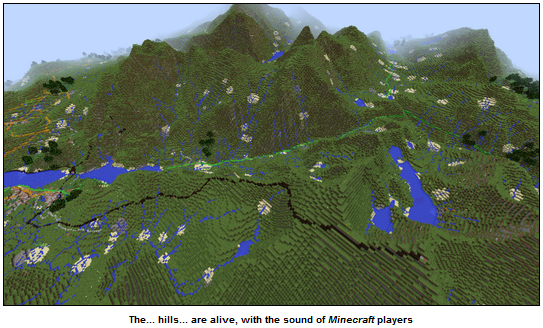
Blighty’s Ordnance Survey organisation has updated the country’s map in Minecraft, adding roads, national rail networks and houses to the digital overview.

A plucky intern at the mapping org stuck Britain into the vastly popular game this time last year. Now that he’s bagged himself a full-time position on the grad scheme, Joseph Braybrook decided to add 83 billion bricks to the map, which is now so detailed that folks can find their houses on it.

“The terrain has been doubled in scale to provide more detail. It uses 1:25 000 scale OS VectorMap District to give a smoother, more expansive appearance that is closer to real life,” Braybrook explained.

“The water features now appear in sharper detail, too, so you can see individual streams and tributaries coming off rivers. The forests and woodlands are now populated with generated trees, and the national rail network has been added. I’m looking forward to seeing if people eventually build a working railway system in game,” he added.

Britain is big in Minecraft

September 22, 2014

A Canadian Mistral? What’s the maritime equivalent of “pie in the sky”?

Filed under: Cancon, France, Military, Russia — Tags: , , — Nicholas @ 17:30

A few months back, the French amphibious assault ship Mistral took part in joint exercises with Canadian troops from the Royal 22e Régiment (the “Van Doos”). I wondered at the time if it might be an opportunity for the RCN to “kick the tires” of the Mistral with an eye to eventually adding that to their theoretical shopping list (if they ever manage to get anything built this decade). At USNI News an opinion piece by Jim Dorschner looks at the benefits to NATO if the RCN leased one of the Mistrals being built for Russia while NATO itself took on the other one:

The September decision by France to withhold delivery of two Mistral-class Landing Platforms Helicopter (LPH) building for Russia is an opportunity for NATO, the Royal Canadian Navy (RCN) and for the French shipbuilding industry and economy. France should not suffer economically for taking a stand against Russia’s aggression toward Ukraine. Rather, NATO, France and Canada can benefit if a little mutually beneficial creativity is applied.

While France desperately wants to complete the two amphibious warships — and get paid for them — NATO and Canada need the capabilities these ships can provide.

For Canada, an LPH would help buttress logistic support for the upcoming Canadian Joint Support Ship (JSS). The replacement to Canada’s fleet oilers originally required a level of expeditionary capabilities which were ultimately not included in the final ship design.

Furthermore, while one of the Russian Mistrals is already undertaking sea trials and the second is scheduled for completion in 2016, the first of three new Queenston-class JSS for the RCN will not even begin building in Vancouver until 2017 or 2018 at best, with delivery by 2019 or 2020.

It was just announced that one of the two the current support ships HMCS Protecteur and the three Tribal-class destroyers HMCS Algonquin, HMCS Athabaskan, and HMCS Iroquois will be withdrawn from service immediately, and the Queenston-class are not going to be built any sooner.

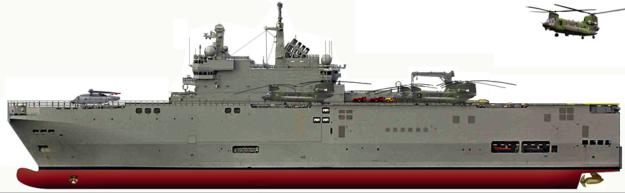
Mistral-class ship, ‘Sevastopol’ configured as a NATO/Canadian Navy ship. CASR Image

Mistral-class ship, Sevastopol configured as a NATO/Canadian Navy ship. CASR Image

A RCN Mistral could operate the full range Canadian helicopters, including CH-148 Cyclones and CH-147F Chinooks. Ideally, Canada should obtain 6-8 additional Cyclones configured for the Commando Helicopter role as part of a financial settlement with Sikorsky over the Maritime Helicopter Program (MHP). Commando Cyclones would be optimized for Special Operations, tactical assault, medical evacuation and utility missions, with troop seats in place of maritime sensors, though retaining the CH-148’s FLIR system.

The make-up of a Tailored Air Group (TAG) for the RCN LPH would depend on the mission. A mix of Commando Cyclones, Griffons and Chinooks for amphibious, SOF, Arctic support and humanitarian operations. Cyclones for maritime security and ASW task forces. Exchange aircrew from the US Marine Corps, the Royal Navy Commando Helicopter Force and the Royal Danish and Norwegian Air Forces should be embedded within the Cyclone squadron forming the core of the TAG. This is critical for building expertise and interoperability among Arctic and NATO partners. By way of building a more direct partnership, Resolute could regularly embark RDAF EH-101 Merlin tactical helicopters and MH-60S Seahawk maritime helicopters.

Not least of the challenges facing the RCN would be manning. Fortunately, Mistral was designed from the beginning to operate with a small crew – just 20 officers, 80 petty officers and 60 sailors.

The foremost challenge for Canada may be convincing the government and the public that obtaining a Mistral LPH for the RCN is sensible and affordable, despite being outside the NSPS construct. Given the challenges now emerging for NATO member states and for Canada itself, the answer is surely a resounding ‘Yes’.

Given the current government’s allergy to spending actual money on military priorities (as opposed to nice-but-cheap uniform changes for photo ops), this grand notion is probably dead in the water with no hopes of success … but it’d be a nice boost for the RCN, and nearly as useful for the Canadian Army and RCAF. But it wouldn’t win key voting blocks in Halifax or Vancouver.

September 21, 2014

Dramatic Footage of British Troops Preparing for Operation Market Garden

Filed under: Britain, History, Military, WW2 — Tags: , , — Nicholas @ 11:00

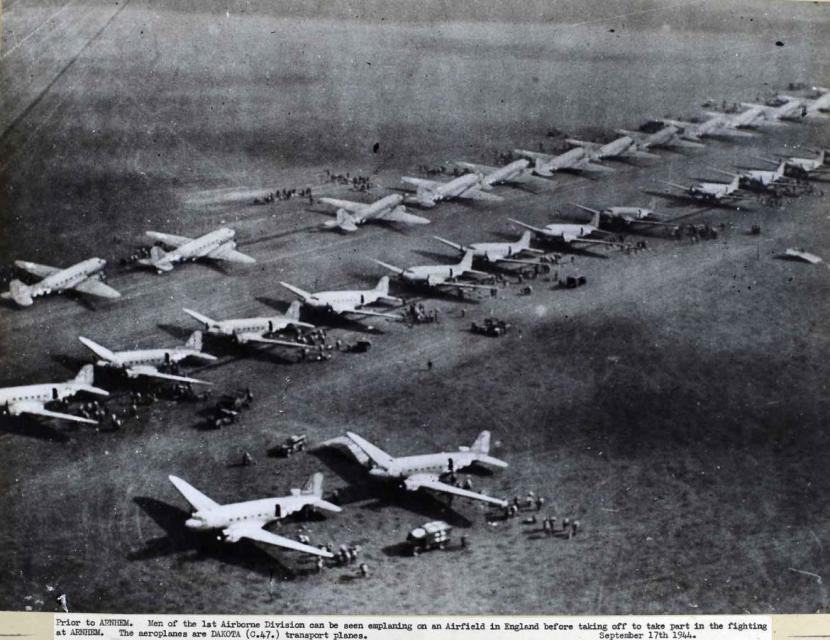
Nearly ten minutes of both British and German footage of the launch of Operation Market — the airborne assault on the Netherlands by British and American troops in September, 1944 (Operation Garden was the corresponding ground attack by Montgomery’s troops to reach the landings by one British and two American airborne divisions.

Rows-of-Dakota-Aircraft-prior-to-take-off-for-Arnhem,-Sept-17th-1944_0

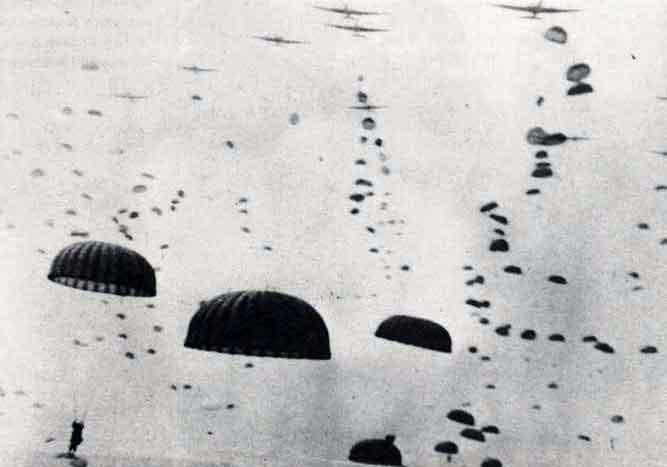
Paratroopers descend enmasse at the DZs near Arnhem, September 1944 Uploaded by: Mac Magreehan. (via Forces.TV)

Paratroopers descend enmasse at the DZs near Arnhem, September 1944 Uploaded by Mac Magreehan. (via Forces.TV)

More photos of the operation can be viewed at Forces.TV.

September 20, 2014

Russian air activity rises significantly

Filed under: Britain, Cancon, Europe, Military, Russia, USA — Tags: , , — Nicholas @ 11:14

It may just be a co-incidence (or it may be that these intrusions happen all the time but are only occasionally reported), but I fired up my Twitter client this morning, these entries were almost consecutive in my Military list:

Update: CNN talks to a White House military representative about the US and Canadian intercepts.

Two Alaskan-based F-22 fighter jets intercepted two Russian IL-78 refueling tankers, two Russian Mig-31 fighter jets and two Russian Bear long-range bombers, a statement from NORAD said. The Russian planes flew in a loop and returned toward Russia.

Two Canadian CF-18 fighter jets intercepted two Russian Bear long-range bombers in the Beaufort Sea, the statement said.

Though the planes did not enter sovereign territory, the statement said, they did enter the U.S. Air Defense Identification Zone west of Alaska and the Canadian ADIZ, according to a statement.

The ADIZ is a zone of airspace which extends approximately 200 miles from the coastline and is mainly within international airspace, according to the statement. The outer limits of the ADIZ go beyond U.S. sovereign air space.

September 19, 2014

When Royal Navy submarines fly the “Jolly Roger”

Filed under: Britain, Germany, History, Military, WW1 — Tags: , , — Nicholas @ 09:06

Ali Kefford on the origins of a colourful naval tradition:

Members of the crew of HMS Utmost with their "Jolly Roger" success flag, photographed alongside HMS Forth in Holy Loch, on their return from a year's service in the Mediterranean, 6 February 1942. (via Wikipedia)

Members of the crew of HMS Utmost with their “Jolly Roger” success flag, photographed alongside HMS Forth in Holy Loch, on their return from a year’s service in the Mediterranean, 6 February 1942. (via Wikipedia)

Sir Arthur Wilson was infamous within the Royal Navy for being an admiral with a tetchy temper. His nickname – Old ’Ard ’Art – was a bad joke about his uncaring nature.

Yet a verbal broadside he delivered in 1901 was to spawn one of the Submarine Service’s most loved and deeply ingrained traditions – the flying of the Jolly Roger flag to mark the victorious return from a successful patrol.

Wilson, later a hugely unpopular First Sea Lord, is said to have blasted the innovation of submarines, dubbing the covert way they operated as “underhand, unfair and damned un-English”.

He even went so far as to say: “They’ll never be any use in war and I’ll tell you why. I’m going to get the First Lord to announce that we intend to treat all submarines as pirate vessels in wartime and that we’ll hang all the crews.”

[…]

One hundred years ago this week, shortly after the start of the Great War, British submarine HMS E9 despatched two torpedoes at close range at Germany’s SMS Hela in a skirmish off Heligoland.

Its commanding officer, Lieutenant Commander Max Horton, had to dive immediately to avoid return fire, so he did not see the cruiser sink.

But the 13-year-old Silent Service had notched up its very first kill, confirming the deadly effectiveness of sneaking around in the deep then launching a surprise attack on an enemy.

Horton, recalling Admiral Wilson’s words, told his signaller to sew a piratical Jolly Roger flag, which flew proudly from his boat’s periscope as she sailed into Harwich, Essex.

A naval tradition was born, as the skull and crossbones went on to be the Royal Navy Submarine Service’s official emblem.

The tradition continues to today:

September 18, 2014

Scotland at the crossroads

Filed under: Britain — Tags: , , — Nicholas @ 08:52

As I’ve said before, I would prefer that Scottish voters decided to stay within the United Kingdom, but if they choose to go, let ’em. I haven’t lived in the UK for many long years (I was still a child when my family emigrated to Canada), so many of my thoughts about England and Scotland are snapshots from my early years with brief impressions gathered during all-too-few visits on holiday. As a result, I don’t feel in any way qualified to speak about the political situation there (I barely feel qualified to speak about the Canadian political scene). Today’s vote will have long-lasting effects, regardless of how many vote Yes and how many vote No. Canada today is still impacted by Quebec’s cycle of separatist activity, despite the fairly convincing result of the last Quebec election.

I still don’t really understand why Scottish “independence” will mean Scotland leaving the UK (which is within the EU) only to immediately turn around and petition for admission back into the EU … why not try actual independence instead? If ignorant, meddling bureaucrats in London are bothering you from afar, why replace them with even-more-ignorant, meddling bureaucrats in even-further-away Brussels? It seems daft.

Others see this as a golden opportunity … for England. Here’s Perry de Havilland explaining why he wants the Scots to vote Yes:

I am of the view that English political culture has become steadily more toxic, hollowed out by multiculturalism and moral relativism, resulting in shocking incidents like the Rotherham scandal. Indeed the Tory party is hardly a conservative party at all, and is increasingly interchangeable with Labour and the LibDems. The mere fact the Tories chose David Cameron as leader tells you something about the state of the Stupid Party, a man unable to win an outright majority against probably the most inept, least charismatic and most spectacularly unsuccessful Labour Prime Minster since Harold Wilson. Yet the best Cameron could manage was a coalition.

[…]

But it has long seemed clear to me that as toxic as the political culture had become in England, it is even worse in Scotland.

And so my support for an independent Scotland is not because I do not think there are many fine classical liberals and other friends of genuine liberty north of the border, but rather there are just not enough of them. It is an exercise in ‘political triage’ on my part. Much as I would love to see Scotland once again embrace Adam Smith and Hume, I cannot see that happening any time soon. I may admire those willing to stay and fight for a better Scotland than the one they will get under the likes of Salmond, but I think it is a fight they cannot win.

And that is why I support Scottish independence. I see it as a gangrenous limb in need of political amputation, or we risk loosing everything it is attached to.

Richard Anderson also thinks a Yes vote might be for the best:

Despite the frequent comparisons between Quebec in 1995 and Scotland today the situations are in fact vastly different. Quebec leaving Canada is a basic existential question. Scotland leaving the UK simply isn’t. For all my tremendous fondness for traditional Scottish culture, and the amazing accomplishments of that once magical land, the place is today a vast albeit scenic welfare trap. It took 220 years to go from Adam Smith to Trainspotting, yet that hardly captures the conceptual distance travelled. When the British Empire fell Scotland, which had its greatest years because of the Empire, fell that much harder.

Scotland leaving the UK, however emotionally traumatic, would be a political blessing to the rest of the Union. Those 40 or so reliable Labour seats vanishing, as if by magic, from Westminster and by default shifting the political spectrum significantly rightward. Perhaps rightward enough that Nigel Farage & Co scare the Cameronistas toward something resembling Thatcherism. Had Quebec separated in 1995, and the country remained together, much the same thing would have happened in Canada.

Then there’s the economics. An independent Scotland would be Greece with better drinking opportunities. An England without Scotland would, by contrast, be a resurgent economic power. It’s like kicking your deadbeat brother off the couch and onto the street. Your living room smells better and the money you saved from the repair bill can be invested in some nice ETFs. Perhaps the deadbeat will learn some responsibility in the process. You’ll learn the beauty of peace and quiet. Once upon a time Scotland was the engine that helped drive a great empire, today it’s 5 million mouths that the taxpayers of England can ill afford to feed.

More than three centuries ago Scotland sacrificed the romance of independence to practical economic necessity. It seems they are on the verge of doing the exact opposite now. They are abandoning economic reality for a romantic fantasy spiced up with vague images of a social democratic utopia. A fool and his money are soon parted. That’s a bit of wisdom the Scots of old understood so very well. The tragedy is that their descendants understand it not at all.

Update: According to the Weekly Standard, I’m totally underestimating the seismic shift if the Yes campaign wins … it’ll be Red October on the Clyde:

It is not at all far-fetched to imagine Vladimir Putin offering financial aid to a post-independence Scotland that will inevitably face severe economic challenges.

The price for that aid might include, among other things, basing rights for Russian military and naval forces. Certainly there would be little or nothing that the United Kingdom could do if an independent Scotland decided to rent its deep water submarine port at Faslane to Russia’s Northern fleet or if it let Russian maritime air patrols fly out of former RAF air bases.

That would essentially mean a shifting of NATO’s frontier hundreds of miles to the West and a revolutionary change in the balance of power in Europe.

Forensic report on the death of Richard III

Filed under: Britain, History — Tags: , — Nicholas @ 07:55

BBC News has the details:

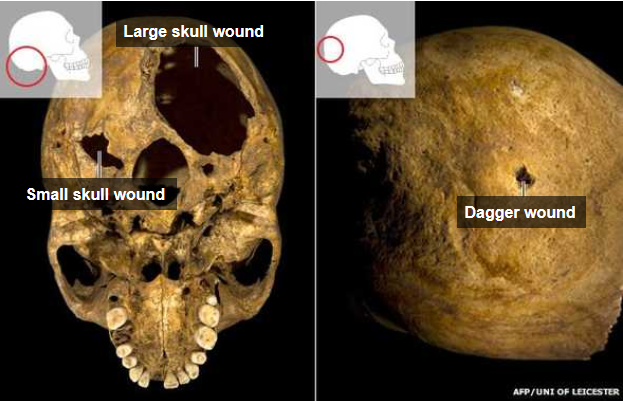
Richard III death wounds

Sarah Hainsworth, study author and professor of materials engineering, said: “Richard’s injuries represent a sustained attack or an attack by several assailants with weapons from the later medieval period.

“Wounds to the skull suggest he was not wearing a helmet, and the absence of defensive wounds on his arms and hands indicate he was still armoured at the time of his death.”

Guy Rutty, from the East Midlands pathology unit, said the two fatal injuries to the skull were likely to have been caused by a sword, a staff weapon such as halberd or bill, or the tip of an edged weapon.

He said: “Richard’s head injuries are consistent with some near-contemporary accounts of the battle, which suggest Richard abandoned his horse after it became stuck in a mire and was killed while fighting his enemies.”

September 17, 2014

Gibraltar asks for additional Royal Navy support

Filed under: Britain, Europe — Tags: , , , , — Nicholas @ 08:39

Spanish vessels have been making more frequent and blatant incursions into the waters around Gibraltar recently, and the governor has made it public that he supports the deployment of another, larger RN ship in the area to help deter these jaunts:

Governor Sir James Dutton has publicly voiced strong support for the deployment of a larger British naval vessel to patrol Gibraltar’s territorial waters.

Sir James, a retired Royal Marine with a distinguished military record, said such a move would send “a really valuable message” in the face of persistent incursions by Spanish state vessels.

“I think it should happen, I have always thought it should happen, I’ve always said it should happen,” he said during a wide-ranging interview on GBC’s Talk About Town.

Sir James said deployment of an offshore vessel would strengthen the Royal Navy’s ability to patrol British waters and stay at sea for longer periods of time.

The governor also revealed that “many” officials at the Foreign & Commonwealth Office supported such a deployment, but that other factors had to be considered including parallel demands on the UK’s limited resources.

“I would be lying if I said one is going to arrive next week, but there is a strong push for it and there is a lot of sympathy, there is a lot of support,” he said.

During the interview, Sir James said Spain was unlikely to shift in its 300-year old position on Gibraltar and that it was important to seek ways of managing the situation through diplomacy so that tensions did not escalate. He said Britain now had a “pretty slick” process of responding to Spanish incursions and said that in the more serious cases, people should not underestimate the impact of calling in the Spanish ambassador, as has happened several times over the past year.

September 16, 2014

Unexpectedly thick ice holding back Arctic shipping

Filed under: Europe, Russia — Tags: , — Nicholas @ 08:30

Girija Shettar reports on the delays to planned transits of the Northern Sea Route through the Russian Arctic:

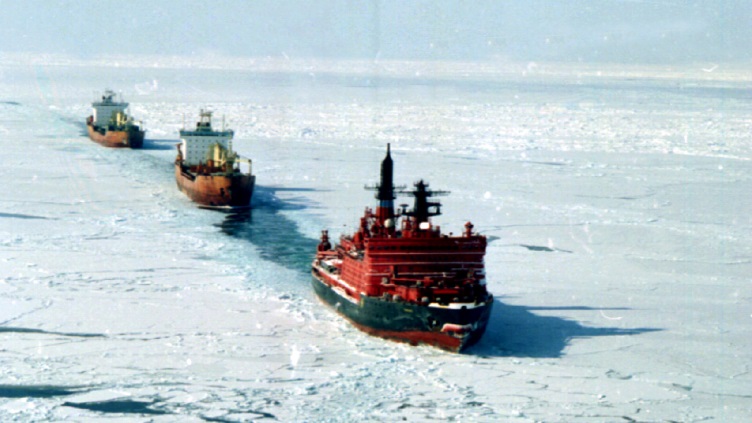
Northern Sea Route (PA photo via IHS Maritime 360)

Northern Sea Route (PA photo via IHS Maritime 360)

No transits through the Northern Sea Route (NSR) have been completed so far this year, which could bring the route’s long-term viability into question, experts have told IHS Maritime.

NSR Administration has given permission for 577 transits, but vessels navigating the NSR water area total only 99, with no completed voyages. NSR transits usually start in July and run until November.

Last year, 71 vessels transited the NSR, starting at the end of June, with the last transit at the end of November.

[…]

“We are two months late compared to 2012 and many planned cargo and passenger transits are currently being cancelled,” he said. “There’s too much ice and it seems that the Arctic ice extent will reach a decennial record high this year. I expect this will generate scepticism on the future economic viability of the route and the related investments already announced by the Arctic littoral countries.”

HMS Queen Elizabeth full build timelapse

Filed under: Britain, Military, Technology — Tags: , — Nicholas @ 07:50

Published on 15 Sep 2014

Start to finish view of the construction of HMS Queen Elizabeth Aircraft Carrier. This is the first of the two new carriers being constructed by the Aircraft Carrier Alliance for the Royal Navy at Rosyth Dockyard.

Update: That was the assembly of the ship, but how does the UK government expect to use her in service?

Published on 7 Jul 2014

This powerful video demonstrates the capabilities and effectiveness of the new Queen Elizabeth class carriers demonstrating, via amazing CGI, the workings of the carriers and the F35 Fighters.

The First Sea Lord talks about the incredible journey that the construction and original concept of the carriers has taken and what the carriers mean to the future of the Royal Navy.

The British Army and the RAF also talk about what carriers mean to them and the important role they will play in the future of defence.

These highly advanced ships will have a huge variety of roles that she will be able to perform when the first ship launches and the amazing technology that has been built into them to put them at the fore-front of the Fleet. They really will be the Jewel in the Crown of the Royal Navy.

This stunning video was show to her Majesty the Queen and other guests at the amazing naming ceremony on the 4th July.

September 15, 2014

BBC Last Night of the Proms 2014 – Jerusalem, God Save the Queen and Auld Lang Syne

Filed under: Britain, Media — Tags: , , — Nicholas @ 00:02

September 14, 2014

Latest Snowden revelation – NSA and GCHQ have full access to German telecom systems

Filed under: Britain, Europe, Germany, Technology, USA — Tags: , , , , — Nicholas @ 12:21

In The Register, Kelly Fiveash sums up the latest information from Edward Snowden:

An NSA and GCHQ surveillance programme — dubbed Treasure Map — grants US and British spooks access to the networks of German telcos such as Deutsche Telekom, according to a new stash of leaked documents from Edward Snowden.

Der Spiegel published the latest revelations today. However, Deutsche Telekom reportedly said it had found no evidence of such tampering on its system.

“We are looking into every indication of possible manipulations but have not yet found any hint of that in our investigations so far,” a spokesman at the company told Reuters.

He added: “We’re working closely with IT specialists and have also contacted German security authorities. It would be completely unacceptable if a foreign intelligence agency were to gain access to our network.”

The Register sought comment from the telco, but it hadn’t immediately got back to us at time of writing.

The Treasure Map programme was described by Snowden as “a 300,000 foot view of the internet” in a New York Times story published in November last year.

September 13, 2014

Ukraine’s PM – “We are still in a stage of war and the key aggressor is the Russian Federation”

Filed under: Europe, Military, Russia — Tags: , — Nicholas @ 11:26

In the Guardian, Martin Williams reports on the situation in eastern Ukraine:

The Russian president, Vladimir Putin, wants to destroy Ukraine as an independent country and resurrect the Soviet Union, the Ukrainian prime minister Arseny Yatseniuk has said.

Yatseniuk told a conference of European politicians his country was “in a stage of war” with Russia, as renewed clashes broke out between the Ukrainian army and pro-Russian rebels in the east and Moscow sent a second convoy of trucks into Ukraine without Kiev’s consent.

Continuous rocketfire could be heard overnight in the eastern city of Donetsk. The city council said shells had hit residential buildings near the airport, although no casualties were reported.

Ukraine’s military said it had successfully repelled a rebel attack on the government-held Donetsk airport. But a column of three Russian multiple rocket launchers was seen moving freely through the rebel-held city on Saturday morning.

Speaking at a conference in Kiev attended by European and Ukrainian politicians and business leaders, Yatseniuk praised the economic sanctions imposed on Moscow. He said: “We are still in a stage of war and the key aggressor is the Russian Federation … Putin wants another frozen conflict [in eastern Ukraine].

“His aim is not just to take Donetsk and Lugansk. His goal is to take the entire Ukraine … Russia is a threat to the global order and to the security of Europe.”

September 12, 2014

Scottish businesses face a “day of reckoning” after a Yes vote

Filed under: Britain, Business, Politics — Tags: , , , — Nicholas @ 16:04

Usually, when someone is planning to punish their political enemies, they keep quiet about it until the votes are counted. The former deputy leader of the Scottish National Party is pretty forthright about just who is going to be facing punishment if Scotland votes yes:

Former SNP deputy leader Jim Sillars has claimed there will be a “day of reckoning” for major Scottish employers such as Royal Bank of Scotland and Standard Life after a Yes vote.

Speaking from his campaign vehicle the “Margo Mobile”, Mr Sillars insisted that employers are “subverting Scotland’s democratic process” and vowed that oil giant BP would be nationalised in an independent Scotland.

Earlier this week, a number of banks, including Lloyds Banking Group and RBS, said they would look to move their headquarters south of the border in the event of a Yes vote.

Mr Sillars, who earlier this week claimed he and First Minister Alex Salmond had put their long-held personal differences behind them to campaign together for independence, also revealed that he would not retire from politics on 19 September but said he would be “staying in” if Scotland became independent.

He claimed there is talk of a “boycott” of John Lewis, banks to be split up, and new law to force Ryder Cup sponsor Standard Life to explain to unions its reasons for moving outside Scotland.

He said: “This referendum is about power, and when we get a Yes majority, we will use that power for a day of reckoning with BP and the banks.

“The heads of these companies are rich men, in cahoots with a rich English Tory Prime Minister, to keep Scotland’s poor, poorer through lies and distortions. The power they have now to subvert our democracy will come to an end with a Yes.”

If I had any investments in Scotland, I would be calling my broker to review them in the light of this pretty specific set of economic and political goals for an independent Scotland. It won’t be a safe place to invest any kind of retirement savings if Sillars represents more than a fringe of the SNP.

September 11, 2014

Would Scottish separation resemble the “Velvet Divorce” of Czechoslovakia?

Filed under: Britain, Economics, Europe — Tags: , , , , — Nicholas @ 11:40

At the Volokh Conspiracy, Ilya Somin looks at the breakup of Czechoslovakia and compares the possible UK-Scotland divorce in that context:

One relevant precedent is the experience of the “Velvet Divorce” between Slovakia and the Czech Republic, whose success is sometimes cited by Scottish independence advocates as a possible model for their own breakup with Britain. Like many Scottish nationalists, advocates of Slovak independence wanted to break away from their larger, richer, partner, in part so they could pursue more interventionist economic policies. But, with the loss of Czech subsidies, independent Slovakia ended up having to pursue much more free market-oriented policies than before, which led to impressive growth. The Czech Republic, freed from having to pay the subsidies, also pursued relatively free market policies, and both nations are among the great success stories of Eastern Europe.

Like Slovakia, an independent Scotland might adopt more free market policies out of necessity. And the rump UK (like the Czechs before it), might move in the same direction. The secession of Scotland would deprive the more interventionist Labor Party of 41 seats in the House of Commons, while costing the Conservatives only one. The center of gravity of British politics would, at least to some extent, move in a more pro-market direction, just as the Czech Republic’s did relative to those of united Czechoslovakia.

If the breakup of the UK is likely to resemble that of Czechoslovakia, this suggests that free market advocates should welcome it, while social democrats should be opposed. Obviously, other scenarios are possible. For example, famed economist Paul Krugman claims that Scottish independence is likely to result in an economic disaster, because a small country without a currency of its own cannot deal with dangerous macroeconomic crises. I lack the expertise to judge whether Krugman’s prediction is sound. But it does seem like there are obvious counterexamples of small countries that have done well without having their own currencies; Slovakia is a good example. Moreover, although Scottish independence advocates today claim that they will stick to the pound, they could reverse that decision in the future.

All of the above assumes that an independent Scotland will be able to stay in the European Union, and that there would be free trade and freedom of movement between it and the remaining United Kingdom. If the Scots get locked out of the EU or prevented from interacting freely with the UK (perhaps as a result of backlash by angry English public opinion), Scottish independence becomes a lot less viable and a lot more likely to cause serious harm on both sides of the new border.

« Newer PostsOlder Posts »

Powered by WordPress