Quotulatiousness

October 8, 2014

Russia’s oldest warship being moved to shipyard for restoration work

Filed under: History, Military, Russia, WW1 — Tags: , , , , — Nicholas @ 08:56

From the Wikipedia page:

Aurora (Russian: Авро́ра, tr. Avrora; IPA: [ɐˈvrorə]) is a 1900 Russian protected cruiser, currently preserved as a museum ship in St. Petersburg. Aurora was one of three Pallada-class cruisers, built in St. Petersburg for service in the Pacific Far East. All three ships of this class served during the Russo-Japanese War. The Aurora survived the Battle of Tsushima and was interned under U.S. protection in the Philippines, eventually returned to the Baltic Fleet. The second ship, Pallada, was sunk by the Japanese at Port Arthur in 1904. The third ship, Diana, was interned in Saigon after the Battle of the Yellow Sea. One of the first incidents of the October Revolution in Russia took place on the cruiser Aurora.

[…]

During World War I Aurora operated in the Baltic Sea performing patrols and shore bombardment tasks. In 1915, her armament was changed to fourteen 152 mm (6 in) guns. At the end of 1916, she was moved to Petrograd (the renamed St Petersburg) for a major repair. The city was brimming with revolutionary ferment and part of her crew joined the 1917 February Revolution. A revolutionary committee was created on the ship, with Aleksandr Belyshev elected as captain. Most of the crew joined the Bolsheviks, who were preparing for a Communist revolution.

At 9.45 p.m on 25 October 1917 (O.S.) a blank shot from her forecastle gun signaled the start of the assault on the Winter Palace, which was to be the beginning of the October Revolution. In summer 1918, she was relocated to Kronstadt and placed into reserve.

October 7, 2014

Spain’s silly (and dangerous) border violation stunts continue in Gibraltar

Filed under: Britain, Europe — Tags: , , , — Nicholas @ 09:18

In the Daily Express, Marco Giannangeli lists the latest border and airspace violations in Gibraltar by supposedly “friendly” Spanish agents:

It comes hours after revelations that Spanish fighter jets flew “across the bow” of a Monarch airliner packed with holidaymakers from Manchester as it was landing on the Rock.

That incident prompted Conservative MP Andrew Rosindell to challenge the British Government to finally send Spain’s Ambassador to Britain “packing back to Madrid”.

The latest incursion happened yesterday when a Spanish Government research vessel entered British Gibraltar Territorial Waters off the southern tip of Gibraltar, Europa Point, to “take samples” of the reef at 3pm local time.

It was immediately surrounded by Royal Navy patrol vessels and told to leave British waters.

The demands were ignored by the Spanish vessel, the Angeles Alvarino, which proceeded to drop probes into the water.

It is understood that the boat then performed several reckless manoeuvres and one of the survey probes actually landed on a Royal Navy Rigid-hulled Inflatable Boat, which had been sent out to the vessel.

“Once again we have witnessed an unacceptable act of aggression from Spain,’ said a furious Gibraltar Government spokesman today.

[…]

The incident outraged Government officials and prompted senior Conservative MP Andrew Rosindell, chair of the parliamentary overseas territory group, to challenge foreign secretary Philip Hammond to finally expel the Spanish Ambassador.

“It is outrageous that Spain continues to behave in such an irresponsible and bullying fashion,” he said.

“Spain refuses to let British military jets fly over Spanish airspace on the way to Gibraltar even though they are partners in Nato, yet they think it’s fine to illegally enter British airspace and potentially distract an airliner as it is trying to safely land on the Rock.

“It’s time that the British Government sent the Spanish Ambassador packing back to Madrid. We are fed up with the bullying and intimidation from Spain, and it’s time that we showed them that we are no longer prepared to put up with it.”

When the “right to be forgotten” encounters the Streisand Effect

Filed under: Europe, Law, Liberty, Media — Tags: , , , — Nicholas @ 08:58

At Techdirt, Mike Masnick reports on the first New York Times articles to be removed from Google‘s search indices under the European “right to be forgotten” regulations:

Over the weekend, the NY Times revealed that it is the latest publication to receive notification from Google that some of its results will no longer show up for searches on certain people’s names, under the whole “right to be forgotten” nuttiness going on in Europe these days. As people in our comments have pointed out in the past, it’s important to note that the stories themselves aren’t erased from Google‘s index entirely — they just won’t show up when someone searches on the particular name of the person who complained. Still, the whole effort is creating a bit of a Streisand Effect in calling new attention to the impacted articles.

In this case, the NY Times was notified of five articles that were caught up in the right to be forgotten process. Three of the five involved semi-personal stuff, so the Times decided not to reveal what those stories were (even as it gently mocks Europe for not believing in free speech):

    Of the five articles that Google informed The Times about, three are intensely personal — two wedding announcements from years ago and a brief paid death notice from 2001. Presumably, the people involved had privacy reasons for asking for the material to be hidden.

I can understand the Times‘ decision not to reveal those articles, but it still does seem odd. You can understand why people might not want their wedding announcements findable, but they were accurate at the time, so it seems bizarre to have them no longer associated with your name.

QotD: The Blue Tribe’s reaction to two famous deaths

Filed under: Britain, Politics, Quotations, USA — Tags: , , — Nicholas @ 00:01

The worst reaction I’ve ever gotten to a blog post was when I wrote about the death of Osama bin Laden. I’ve written all sorts of stuff about race and gender and politics and whatever, but that was the worst.

I didn’t come out and say I was happy he was dead. But some people interpreted it that way, and there followed a bunch of comments and emails and Facebook messages about how could I possibly be happy about the death of another human being, even if he was a bad person? Everyone, even Osama, is a human being, and we should never rejoice in the death of a fellow man. One commenter came out and said:

    I’m surprised at your reaction. As far as people I casually stalk on the internet (ie, LJ and Facebook), you are the first out of the “intelligent, reasoned and thoughtful” group to be uncomplicatedly happy about this development and not to be, say, disgusted at the reactions of the other 90% or so.

This commenter was right. Of the “intelligent, reasoned, and thoughtful” people I knew, the overwhelming emotion was conspicuous disgust that other people could be happy about his death. I hastily backtracked and said I wasn’t happy per se, just surprised and relieved that all of this was finally behind us.

And I genuinely believed that day that I had found some unexpected good in people – that everyone I knew was so humane and compassionate that they were unable to rejoice even in the death of someone who hated them and everything they stood for.

Then a few years later, Margaret Thatcher died. And on my Facebook wall – made of these same “intelligent, reasoned, and thoughtful” people – the most common response was to quote some portion of the song “Ding Dong, The Witch Is Dead”. Another popular response was to link the videos of British people spontaneously throwing parties in the street, with comments like “I wish I was there so I could join in”. From this exact same group of people, not a single expression of disgust or a “c’mon, guys, we’re all human beings here.”

I gently pointed this out at the time, and mostly got a bunch of “yeah, so what?”, combined with links to an article claiming that “the demand for respectful silence in the wake of a public figure’s death is not just misguided but dangerous”.

And that was when something clicked for me.

You can talk all you want about Islamophobia, but my friend’s “intelligent, reasoned, and thoughtful people” – her name for the Blue Tribe – can’t get together enough energy to really hate Osama, let alone Muslims in general. We understand that what he did was bad, but it didn’t anger us personally. When he died, we were able to very rationally apply our better nature and our Far Mode beliefs about how it’s never right to be happy about anyone else’s death.

On the other hand, that same group absolutely loathed Thatcher. Most of us (though not all) can agree, if the question is posed explicitly, that Osama was a worse person than Thatcher. But in terms of actual gut feeling? Osama provokes a snap judgment of “flawed human being”, Thatcher a snap judgment of “scum”.

[…]

And my hypothesis, stated plainly, is that if you’re part of the Blue Tribe, then your outgroup isn’t al-Qaeda, or Muslims, or blacks, or gays, or transpeople, or Jews, or atheists – it’s the Red Tribe.

Scott Alexander, “I Can Tolerate Anything Except The Outgroup”, Slate Star Codex, 2014-09-30.

October 5, 2014

Jeremy Clarkson riles up Argentinian car fans

Filed under: Americas, Britain, Media — Tags: , , , , , , — Nicholas @ 00:02

For a change, it isn’t anything he said:

Top Gear‘s crew has had to abandon their cars at the roadside and flee Argentina after being pelted with stones. The incident happened after it emerged they were using a vehicle with a number plate that apparently refers to the Falklands War.

A Porsche with the registration number H982 FKL, which some people suggested could refer to the Falklands conflict of 1982, was among those abandoned. BBC bosses have said the number plate was merely a coincidence and was not chosen deliberately, but it led to protests in Argentina, including a demonstration by a group of war veterans who protested outside the hotel used by the show team.

[…]

The executive producer of Top Gear, Andy Wilman, said: “Top Gear production purchased three cars for a forthcoming programme; to suggest that this car was either chosen for its number plate, or that an alternative number plate was substituted for the original, is completely untrue.”

Even if Wilman is dissembling about the license plate … just how flipping sensitive do you have to be to object to a sort-of abbreviation, in a foreign language, in the characters on a license plate? Who would ordinarily notice or care what the license plate may or may not hint at, unless someone is busy trying to stir up trouble? That said, Top Gear thrives on controversy, so it’s quite possible that they hoped they’d draw some attention, but probably not to the extent of being forced out of the country.

Update: Clarkson is now accusing the Argentine government of setting a trap for the Top Gear film crew.

The presenter was said to have infuriated locals by driving through South America in a Porsche with the numberplate H982 FKL, seen as a goading reference to the 1982 Falklands conflict.

However, Clarkson said the plate was “not the issue” — he claimed it was an unfortunate coincidence and that he removed it two days into the trip — and blamed the state government for orchestrating an ambush by mobs armed with pickaxe handles, paving stones and bricks.

“There is no question in my mind that we walked into a trap,” Clarkson said.

“We were English (apart from one Aussie camera guy and a Scottish doctor” and that was a good enough reason for the state government to send 29 people into a night filled with rage and flying bricks.”

He claimed the crew were “plainly herded into an ambush” and said: “Make no mistake, lives were at stake.”

[…]

The team were confronted at their hotel by a group claiming to be war veterans.

“Richard Hammond, James May and I bravely hid under the beds in a researcher’s room while protesters went through the hotel looking for us,” Clarkson said.

They then fled by plane to Buenos Aires — having “rounded up the girls” on the team — leaving the rest of their crew behind.

The crew were forced to make a gruelling six-hour trek to the Chilean border, abandoning the Porsche and their camera equipment at the side of the road.

QotD: “What happened to France?”

Filed under: Europe, Food, France, History, Quotations — Tags: , — Nicholas @ 00:01

Here we should pause and ask an important question: What happened to France? To that savoir faire? And to French culture? To the country that we all loved enough to make allowances to put up with the casual hauteur and the studied rudeness? Because, after all, this was la belle France, and they could teach us a thing or two. They had something worth sharing.

But when was that? When was the last time you enjoyed, say, a contemporary French film? How many must-see French actors are there? Their most famous actor has now taken out Russian citizenship (and moved to Belgium). Name a living French painter worth the wall space. Name a great French musician. A novelist, apart from Michel Houellebecq — and the French hate him. Their vaunted cuisine has become a moribund tourist performance. Unable to change, terrified of innovation, France has become the Bourbons, who famously forgot nothing and learned nothing.

The language that committees of old academics protect, like maids fussing over a cabinet of bone china, has been ransacked, seduced, and impregnated with bastard usages by movies, pop music, the Internet, and the global need to speak English. And now even some French universities have begun teaching science and computing classes in English, because no one wants to come to France to study them in French.

The pre-eminence of French culture has evaporated, before our very eyes, within a generation. The fear that innovation might damage or detract from their weighty heritage has left it like an angry child, with its eyes closed and its hands over its ears, la-la-la-ing “Je ne regrette rien.” French civilization went from the brilliant clamor of the streets to the musty hush of the museum. Instead of creating, they have dusting.

A. A. Gill, Liberté! Egalité! Fatigué!“, Vanity Fair, 2014-04

October 4, 2014

The “Herod Clause” to get free Wi-Fi

Filed under: Britain, Business, Humour, Law, Technology — Tags: , , — Nicholas @ 10:48

I missed this earlier in the week (and it smells “hoax-y”, but it’s too good to check):

A handful of Londoners in some of the capital’s busiest districts unwittingly agreed to give up their eldest child, during an experiment exploring the dangers of public Wi-Fi use.

The experiment, which was backed by European law enforcement agency Europol, involved a group of security researchers setting up a Wi-Fi hotspot in June.

When people connected to the hotspot, the terms and conditions they were asked to sign up to included a “Herod clause” promising free Wi-Fi but only if “the recipient agreed to assign their first born child to us for the duration of eternity”. Six people signed up.

F-Secure, the security firm that sponsored the experiment, has confirmed that it won’t be enforcing the clause.

“We have yet to enforce our rights under the terms and conditions but, as this is an experiment, we will be returning the children to their parents,” wrote the Finnish company in its report.

“Our legal advisor Mark Deem points out that — while terms and conditions are legally binding — it is contrary to public policy to sell children in return for free services, so the clause would not be enforceable in a court of law.”

Ultimately, the research, organised by the Cyber Security Research Institute, sought to highlight public unawareness of serious security issues concomitant with Wi-Fi usage.

Kids, don’t try this at home

Filed under: Britain, Randomness — Tags: — Nicholas @ 09:55

Published on 2 Oct 2014

#TheRidge is the brand new film from Danny Macaskill… For the first time in one of his films Danny climbs aboard a mountain bike and returns to his native home of the Isle of Skye in Scotland to take on a death-defying ride along the notorious Cuillin Ridgeline.

H/T to Roger Henry who said “Here’s some more of that insane bike-rider from Scotland […] I kept expecting to hear someone say ‘He’s fallen in the water’.”

October 3, 2014

Tour the only surviving WW2 Royal Navy destroyer with Google Maps

Filed under: Britain, History, Military — Tags: , , — Nicholas @ 00:02

This is rather cool:

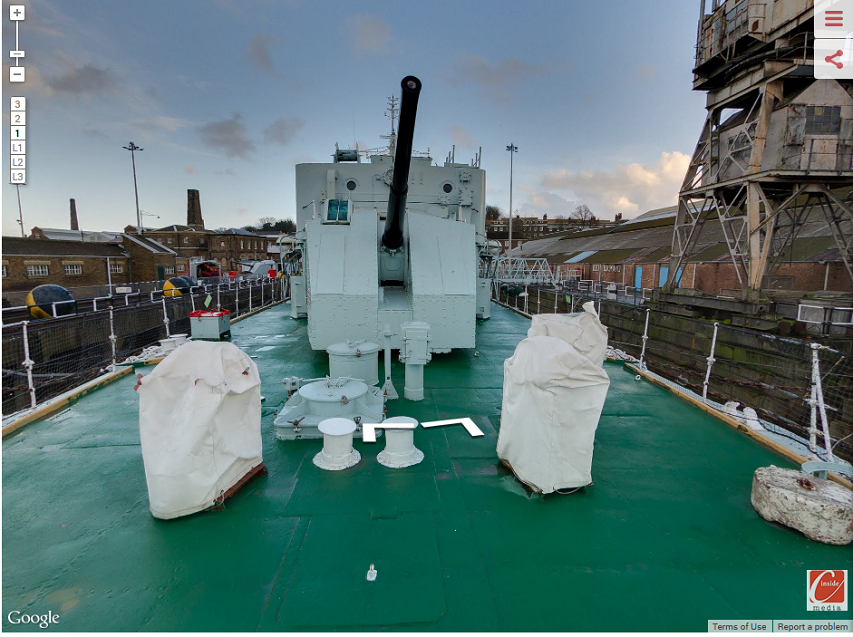
HMS Cavalier virtual tour (via Google Maps)

HMS Cavalier virtual tour (via Google Maps)

CInsideMedia has done it again with exclusive access to the Royal Navy destroyer HMS Cavalier at the Historic Dockyard, Chatham.

The class C/A destroyer celebrated her 70th anniversary on 5th April 2014, having served during World War II and then subsequently being refitted in 1957 to remove the mid-ship torpedoes and replacing them with anti-submarine squid mortars.

Following on from the massive success of CInsideMedia’s Google Maps Business View tour of HMS Ocelot, The Historic Dockyard Chatham is making it possible for anyone in the world to ‘virtually visit’ this National Destroyer Memorial and last surviving Royal Navy Second World War Destroyer.

Over two days of exclusive access, the CInsideMedia team were guided around the destroyer by the Dockyard’s Scott Belcher (Duty Manager: Visitor Operations, Security and Health and Safety) and Chris Tutt (Marketing).

The team captured over 350 panoramas meticulously capturing almost every deck of the 363 ft, 1.7 ton former Arctic Convoy vessel, including the gear room and engine room which are normally only accessible on special request due to Health & Safety and limited accessibility.

October 2, 2014

Russian TV claims Hong Kong protests are US/UK plot against … Russia

Filed under: China, Media, Russia — Tags: , , — Nicholas @ 08:32

We’re used to Russian talking points being a bit off-centre, but as Karoun Demirjian reports, the Russians are now seeing things like the Hong Kong student protests as “really” being directed against Russian interests by shadowy American and British puppetmasters:

Here in Russia, the umbrella-wielding demonstrators of Hong Kong are being presented as pawns in a Western plot to foment instability in yet another one of Moscow’s allies — and Russia wonders if it could be the ultimate target.

“Was the student protest organized by Great Britain and the USA?” state television station Russia 24 asked Tuesday, citing reports in the Chinese media that “the leaders of the movement received special training from the American intelligence services.”

[…]

“The tactics of the protesters are exactly the same as at the beginning of all ‘orange’ revolutions, which in fact were state coups,” a Russia 24 news presenter said Tuesday, referring to the signature color of Ukraine’s 2004 protests. “Besides, the White House officially confirmed through its spokesman that Washington supports the intentions of the citizens of Hong Kong to protect their basic rights and freedoms.”

Russian state media have also suggested that Britain supports the protests as a way of safeguarding its business interests in Hong Kong, especially as Beijing is “gradually abolishing benefits” for British companies located there.

Yet there is one thing missing in the Russian analysis: Any specific advice as to how China’s government should proceed. Russia’s leaders have neither cautioned China’s leaders to show restraint nor urged them toward a crackdown.

October 1, 2014

German Air Force pushed “to the very limits of its capacities”

Filed under: Europe, Germany, Middle East, Military — Tags: , , , , — Nicholas @ 08:22

German magazine Der Spiegel reports on the sad state of readiness in the German military:

Last week, a single person pushed Germany’s air force to the very limits of its capacities: Ursula von der Leyen, the country’s defense minister. Von der Leyen requested that two Transall military transport aircraft with missile defense systems be transferred to Amman, the Jordanian capital. The defense minister and a pool of reporters then flew for eight hours on Thursday morning in one of the aircraft to Erbil in Iraq’s Kurdish region. Back in Germany, the military had but a single additional Transall at its disposal.

After her arrival in Erbil, von der Leyen proceeded to the palace of the Kurdish regional government’s president. Her visit was to be concurrent with the delivery of German weapons, intended to aid the Kurds in their fight against Islamic State jihadists. Unfortunately, the machine guns and bazookas got stuck in Germany and the trainers in Bulgaria because of a dearth of available aircraft. One had been grounded because of a massive fuel leak. What could have been a shining moment for the minister instead turned into an embarrassing failure underscoring the miserable state of many of the Bundeswehr‘s most important weapons systems.

[…]

Against that backdrop and pressure from the international community, the ramshackle state of the Bundeswehr is no laughing matter in Berlin. At the moment, if Germany’s allies were to ask it to step up its participation in deployments in the Baltic states or Iraq, for example, Chancellor Merkel would likely have to politely pass, creating a highly embarrassing situation for the country. For the moment, though, most pressure related to the Bundeswehr‘s ailments has been directed at von der Leyen. Her critics argue that she has pursued a foreign and security policy vision that goes beyond the Bundeswehr‘s actual capabilities. Now she faces additional criticism that she tried to play down the military’s problems to members of parliament even though senior officials in her ministry were well aware of major shortcomings in the armed forces.

“Contrary to her own list of needed equipment, she created the impression in parliament that anything that could drive, fly or float was capable of full deployment,” said Rainer Arnold, the defense policy spokesman for the center-left Social Democrats (SPD). “But we members of parliament will not be taken for idiots.”

The defense minister hasn’t exactly been blind-sided by the criticism either — she’s known about the problems since before entering office almost a year ago. On Friday, she summoned the heads of the German army, navy and air force as well as the Inspector General of the Bundeswehr to her office for five hours of questioning, much of it centering on events in parliament last Wednesday.

H/T to Mark Collins for the link.

September 30, 2014

French restaurant food quality is declining – send in the regulators!

Filed under: Bureaucracy, Business, Europe, Food, France — Tags: , — Nicholas @ 08:07

Tim Harford on the recent French government attempt to “fix” the declining quality of food served in restaurants:

“Each time I visit the city the food gets worse and worse.” Tyler Cowen, economics professor, foodie and author of An Economist Gets Lunch, despairs of Paris. Cowen isn’t the only person to lament the state of French cuisine. This may be why — in a quintessentially French move — the nation’s government has introduced a new law in an attempt to improve standards.

The quixotic law in question is public decree No. 2014-797, more popularly known as the “fait maison” rule, in which restaurants may use a new saucepan-with-a-roof-and-chimney logo on the menu beside any dish that is made on the premises. More accurately, the restaurants must use the saucepan-with-a-roof symbol to denote house-made dishes, but the definition of house-made is rather whimsical, thanks to French legislators.

The entire affair seems unlikely to improve French cuisine but it does provide a nice lesson in practical economics: regulation is a superficially appealing answer to life’s problems but often fails to provide real solutions.

[…]

A third problem is that the regulation may produce unintended consequences. Consider a chef who offers a fresh fruit crumble alongside a selection of factory-made cakes and puddings. By law, he or she must display the fait maison logo beside the crumble, implicitly damning all his or her other dishes. Such chefs might decide to offer no house-made dishes at all, rather than bring unwelcome questions to the forefront of their customers’ minds.

Policymaking is flawed and crude while the world is subtle and unpredictable. That is why regulations are often rigged from the start, are only peripherally related to the real matter of concern and have a tendency to backfire.

September 28, 2014

The “Live Bait Squadron” in the Broad Fourteens

Filed under: Britain, History, Military, WW1 — Tags: , , — Nicholas @ 12:20

Antoine Vanner recounts the tragic story of the sinking of three Royal Navy armoured cruisers (HMS Aboukir, HMS Hogue, and HMS Cressy) early in the First World War:

Despite this “wake up call” regarding vulnerability of warships at low speed the Royal Navy initiated a patrol of the northern entrance of the English Channel with five obsolete Cressy class armoured cruisers. This group was known as “Cruiser Force C” and the patrol area they were assigned to was in the shallow waters off the Dutch coast known as the “Broad Fourteens”. The logic of maintaining a patrol in the area was unassailable as a fast German raiding force of destroyers could wreak havoc on British maritime supply lines between the English Coast and Northern France should they enter the Channel. Though destroyers and light cruisers would have been more suited to the task it was believed that destroyers would be unable to maintain the patrol in bad weather and insufficient modern light cruisers were available. The solution was to deploy old armoured cruisers which had at least got the necessary station-keeping capability. This was perhaps their only positive attribute.

The vulnerability of these cruisers was recognised by many senior officers, not only because of their obsolescence but because of their manning. Taken hastily from reserve – which meant they had been unmanned and poorly, if at all, maintained – on outbreak of war they were quickly overhauled and put back in service. Originally capable of 21 knots they now found it hard to make 15. Crews were in short supply, leading the ships to be manned by reservists, many middle-aged, many of them pensioners, who had not previously served or exercised together as units. In addition, nine naval cadets, some as young as 15, were allocated to each ship, being taken directly from the Royal Naval College. The general view of Cruiser Force C’s fighting potential was summed up in the nickname it quickly acquired – the “Live Bait Squadron”.

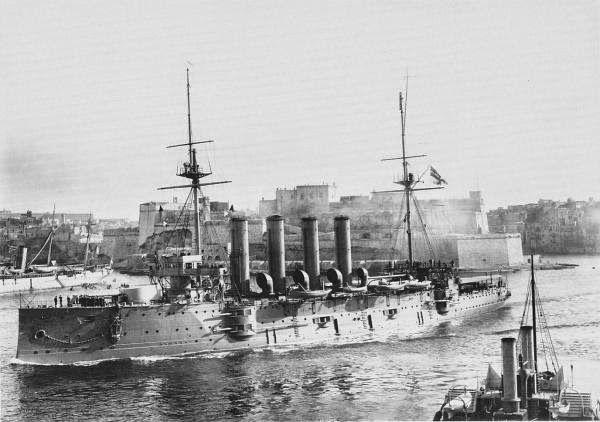
HMS Aboukir at Malta - note 6" weapons in casemates along sides

HMS Aboukir at Malta – note 6″ weapons in casemates along sides

Britain’s armoured cruisers can be fairly described as the most unsuccessful and unfortunate type of warship ever employed by the Royal Navy. The 34 vessels of this type that were in service at the outbreak of war had entered service between 1902 and 1908 – they were not old ships. Of these 34, a total of 13 were to be lost in the next four years. Intended to form part of the battle fleet, they had been rendered obsolete by the advent of the almost equally-disastrous battle-cruiser concept. The earlier classes – the six ships of the Cressy class being the oldest – had very limited offensive capability, especially in rough weather. They were large – and expensive – ships and they needed large crews.

[…]

At dawn on September 22nd U-9 surfaced to find the storm over, the sea calm but for a slow swell. Smoke was seen on the horizon and the U-9’s engines were immediately shut down to get rid of their exhaust plume. A quick appraisal led Weddingen to order diving but he continues to observe through his periscope. Three vessels were approaching – the Aboukir, Cressy and Hogue – and Weddingen steered on his electric motors towards the central vessel, Aboukir.

Undetected, U-9 came within 600 yards of Aboukir’s port bow before firing a torpedo. As this was still running Weddingen took his craft down to 50 feet, then heard “a dull thud, followed by a shrill-toned crash”. Cheering erupted on U-9.

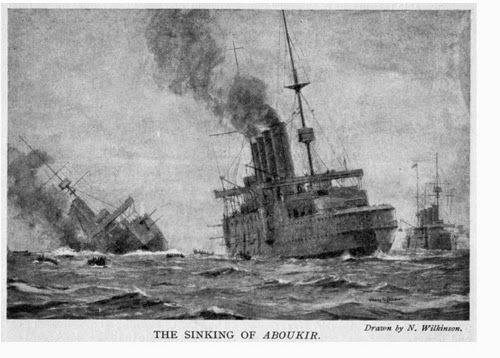
Aboukir sinking - as depicted by the famous British maritime painter Norman Wilkinson the Hogue dropping boats to pick up survivors

Aboukir sinking – as depicted by the famous British maritime painter Norman Wilkinson
the Hogue dropping boats to pick up survivors

September 26, 2014

QotD: English regional governance

Filed under: Britain, Government, Humour, Quotations — Tags: — Nicholas @ 00:01

It is an attractive idea to bring back the traditional counties of England. It is also an attractive idea to dig up the body of the man who abolished them, Edward Heath, and stick his head on a pike, but that won’t happen either. The counties are just too small.

So if we are to have petty kingdoms, let them at least be kingdoms. Men have loved the Kingdom of Mercia. Men have died for the Kingdom of East Anglia — notably at the hands of men of Mercia, but there you go. Men of all the ancient nations of the Saxon have followed the greatest of the Kings of Wessex to glorious victory against the Vikings. Divide and conquer that, Eurocrats! Also it would serve the Vikings right for subjecting me to all those irritating pictorial instructions.

Natalie Solent, “Restore the Heptarchy!”, Samizdata, 2014-09-20.

September 25, 2014

Roll of Honour at the Tower of London, 24 September, 2014

Filed under: Britain, History, Personal, WW1 — Nicholas @ 08:57

Roll of Honour at the Tower of London

Roll of Honour 24 September 2014

Private William Penman who died in 1915 at Le Touret (25 years old) was Elizabeth’s great uncle. Private Walter Porteous who died in 1917 at Passchendaele (18 years old) was my great uncle.

Dear Sir/Madam,

Thank you for submitting a name for the Roll of Honour at the Tower of London. We are delighted to confirm that your nomination will be included at the ceremony on the 24th of September.

The list of 180 names will be read from the poppy-filled Tower moat at sunset, starting at 7:25pm (19.25). The names will be read the order in which they were submitted and validated.

We regret we are unable to make changes to the reading lists.

At the end of the reading, which will take about 20-30 minutes, an Army bugler will play the Last Post.

If you would like to watch, you can get a good view from the area in front of the Tower ticket desks on Tower Hill.

We will be filming the ceremony and posting the video online. This site is currently under construction, we will let you know when it goes live.

We are also adding the lists of names being read each night at http://rollofhonour.tumblr.com/ so that they can be seen and remembered from anywhere in the world.

« Newer PostsOlder Posts »

Powered by WordPress