
Quotulatiousness

September 11, 2014

Evolution versus revolution in the design of HMS Queen Elizabeth

Filed under: Britain, Military — Tags: , , , — Nicholas @ 00:02

Peter Roberts analyzes the design trade-offs of the Queen Elizabeth class for the Royal United Services Institute:
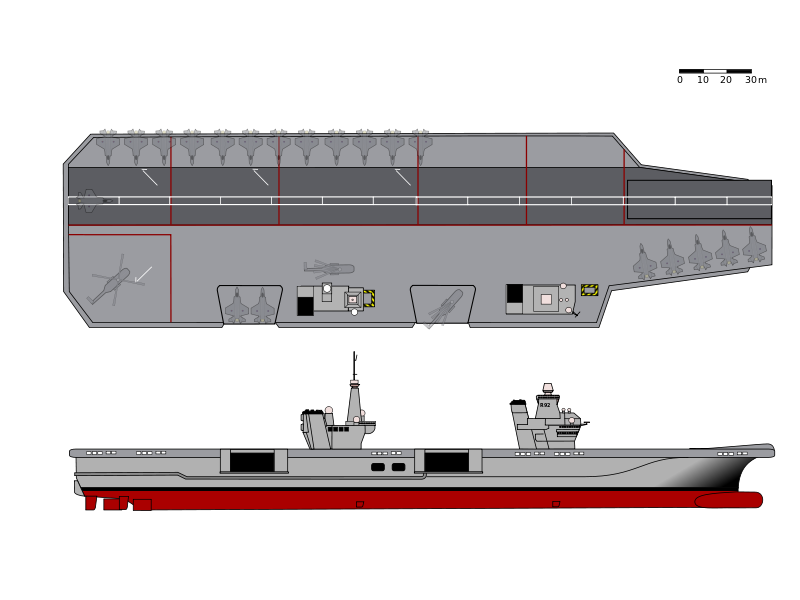
Queen Elizabeth class side and overhead views

Queen Elizabeth class side and overhead views

The most important change in the Queen Elizabeth class is the open acknowledgement of the primacy of running costs at the heart of the project – manifest in crew numbers, unmanned monitoring and power generation. The UK carriers are platforms designed by economists, not warriors.

The largest costs for running maritime platforms are manpower and fuel. In terms of manpower, the Queen Elizabeth will have a crew of 650 with an additional thousand berths available for the air group. By comparison, the American Nimitz class and new Gerald Ford class, which displace around 40,000 tonnes more, are crewed by 6,000 and 4,500 personnel respectively. The French Charles de Gaulle, which in terms of tonnage is about a third smaller its British counterpart, carries a crew of around 2,500. The UK figures were driven by the necessity to avoid increasing the manpower bill of the Royal Navy. As such, the 650 figure is exactly the same as the preceding Invincible class. Allowing the same complement to effectively operate a vessel three times the size of her predecessor has forced some innovative thinking.

The use of automation and remote monitoring has been essential to meet the manpower restrictions. Cameras and monitoring equipment have been built into almost every system in the new ships. From machinery spaces to bilge areas, remote performance monitoring has allowed a marked reduction in the manpower requirements of the ships. Whilst this makes good sense in financial terms, it does not in terms of pure war-fighting capability. Naval vessels differ significantly from their commercial counterparts in terms of damage control and fire-fighting. These roles are remarkably manpower intensive. The experiences of major damage in the Falklands conflict have been reinforced at intervals by peacetime incidents on HMS Nottingham (2002) and Endurance (2008), which required the efforts of the full ship’s complement to remain afloat. The damage-control capabilities of the UK carrier platforms should, therefore, be a primary concern.

[…]

There is one further element that has not been well considered in the Carrier-Enabled Power Projection doctrine of the Royal Navy and the MoD. Protection of these assets from threats has effectively been taken ‘on-risk’, and against all operational analysis. The self defence capabilities of these ships are extremely limited. The provision of close-in weapon systems and automatic small-calibre guns does not guarantee adequate protection against a small scale naval threat, let alone a shore-based one. Naval doctrine instead requires protection of the carriers by destroyers and frigates. This is a cost-effective solution provided that the task group has the necessary units to provide such protection. But there is no evidence that the projected Royal Navy combined frigate/destroyer force could do so.

The Queen Elizabeth class is therefore an interesting example of innovation: rather than in the sense of equipment and capability, it might be more relevant to think about how risk to the platforms is being dealt with in an ‘innovative’ manner.

The second ship in the class, HMS Prince of Wales just reached a major milestone in construction:
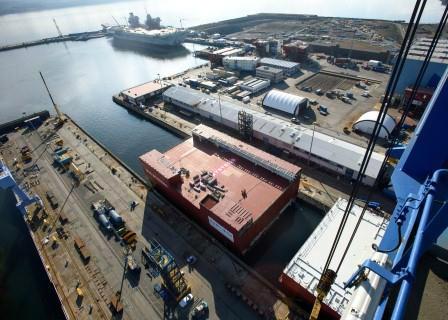
HMS Prince of Wales hull sections

Construction of HMS Prince of Wales, the second of two new aircraft carriers for the UK Royal Navy, has moved forward with the docking of two of the ship’s largest hull sections – Lower Block 02 and Lower Block 03.

The movement of the blocks into the dock at Rosyth marks the beginning of the ship’s assembly phase and comes only days after Prime Minister David Cameron announced that HMS Prince of Wales will enter into service, ensuring that the UK will always have one aircraft carrier available.

Ian Booth, Managing Director at the Aircraft Carrier Alliance, said: “Every milestone in the carrier programme is hugely significant and the recent announcement that HMS Prince of Wales will enter service means there is a real sense of excitement as we start to bring the second ship together. Everyone working across the Alliance is incredibly proud of the work undertaken so far, in what is currently one of the biggest engineering projects in the country, and we remain focused on delivering both ships to the highest standards.”
September 10, 2014

NATO’s “aim” problem

Filed under: Europe, Military, USA — Tags: , , — Nicholas @ 10:35

James Holmes explains why “aim” isn’t good enough for NATO members:

The Naval Diplomat is not from Missouri, America’s Show-Me State. But I’m in a show-me state of mind following last week’s NATO summit in another Newport — Newport, Wales. Lofty words were said. The summit communiqué pledges, for instance, to restore some sanity to defense spending.

NATO long ago fixed the standard for defense spending at 2 percent of GDP. Few meet the standard, but at Newport the NATO-European powers put everyone on notice that they’re really, truly serious about it. The small minority that already comply — Great Britain (for the moment) and Greece, alongside the United States — will “aim to continue to do so.” The majority that don’t vow to arrest further slippage. And they will “aim to increase defense expenditure in real terms as GDP grows,” and “aim to move towards the 2% guideline within a decade,” helping field viable forces.

Aim being the keyword — or, more accurately, the key diplomatic weasel word — in these passages. How many European allies will fulfill their commitment, and how many will avail themselves of the escape clause? Barry Pavel of the Atlantic Council observes charitably that the uptick in budgets is “not going to happen across the entire alliance, but it’s useful for framing incentives for some nations to start to contribute more.” And that tepid prediction comes from someone who’s presumably a NATO enthusiast.

So let me get this straight. NATO-Europe resolutely promises to try … to build up to a level that barely qualifies as peacetime defense spending … over the next decade … if GDPs expand to permit it. Wow. As a matter of alliance management, think about the message the Newport communiqué telegraphs. To us in North America, it indicates that Europe sees itself inhabiting entirely tranquil surroundings, untroubled by anything like, say, Russian aggression against an Eastern European neighbor.

Ruining royal reputations – it didn’t start on Fleet Street

Filed under: Books, Europe, France, History, Media — Tags: — Nicholas @ 00:02

In Maclean’s, Patricia Treble reviews a new book by Jonathan Beckman, called How to Ruin a Queen: Marie Antoinette and the Diamond Necklace Affair:

Three years before revolutionaries toppled Louis XVI and his Austrian-born wife, Marie Antoinette, France was mesmerized with a different tumult. Cardinal Louis de Rohan, scion of one of the nation’s grandest families, was in court, accused of stealing a famously expensive necklace from jewellers who’d created it. He claimed he’d acted at the behest of the queen, who then reneged on paying for the gaudy 2,800-carat piece. The resultant scandal solidified Marie Antoinette’s reputation for unbounded extravagance.

Yet, as Jonathan Beckman, explains in a masterful new account of the diamond necklace affair, nothing is as it appeared. There are fake royals, forged letters and disappearing gems as well as kidnappings, trysts and even a duel involving poisoned pigs. If the tale was fictional, it would be dismissed as an overwrought fantasy, yet in Beckman’s hands, its machinations unfold as an audacious caper that will enthrall readers much as the original events captivated Europe.

September 9, 2014

UK re-runs Canada’s 1995 near-death experience

Filed under: Britain, Cancon, History — Tags: , , — Nicholas @ 09:32

Andrew Coyne points out some of the parallels between the 1995 referendum in Quebec and this month’s referendum in Scotland:

It has been an entertaining, if unnerving, couple of weeks, recalling the referendum of 1995 and speculating about what would have happened had the separatists won. Now, thanks to the Scots, we may be about to find out.

Next week’s referendum on Scottish independence is indeed looking eerily reminiscent of the 1995 near-disaster: the same early complacency in the No camp, the same unbridled panic as the Yes side surges in the polls; the same unappealing mix of threats (“one million jobs”) and accounting on the No side, the same fraudulent claims (“we’re subsidizing the English”) and utopian fantasies on the Yes; the same blurring of the lines on both sides, independence made to look like the status quo (“we’ll keep the pound”) even as the status quo is made to look like independence (“devo-max” is the British term for special status). Add a charismatic Yes leader and an unpopular, seemingly disengaged prime minister, and the picture is complete.

Learning nothing from our experience, the Brits made all the same strategic errors we did, first conferring an unwarranted legitimacy on the separatist project, then attempting to pacify it with powers and money, only to watch it grow more ravenous in response. They have ended up in the same game of heads-I-win, tails-you-lose: a No vote simply marks the launch of the next campaign, while a Yes, supposedly, is forever.

[…]

We should not underestimate how much of separatism’s decline in this country can be explained by sheer exhaustion, especially post-Clarity Act. A great many soft nationalists, for whom it retains a romantic appeal, were persuaded it was simply too arduous an undertaking, full of too much uncertainty and upheaval. But if that premise appeared to have been debunked — if the British pull off the same quick divorce that the Czechs and Slovaks did in the 1990s — we might yet see the issue resurface. You see, the Parti Quebecois would crow? It is just as we told you. And Britain, of all places, has proved it.

This is why NATO countries are not supplying weapons to Ukraine

Filed under: Europe, Military, Weapons — Tags: , , , — Nicholas @ 08:48

It’s not about a sudden sensitivity to Russian feelings: NATO is not providing up-to-date weapons and ammunition for excellent practical reasons:

The Ukrainian armed forces use Soviet weapons systems. These are well-designed, solid, easy to use for a conscript army, and although the Ukrainian inventory may be aging, Soviet arms production was never geared to high-tech generational obsolescence. They build simple, solid and cheap because they have to. NATO countries are casualty-averse and never commit a platoon where a Hellfire missile is available. On the other hand, Soviet doctrine never varied much from the World War II stories of tank attacks shoving the flaming hulks of the first wave out of the way, for the second wave to be destroyed in turn, until the Germans ran out of ammunition. Almost anything NATO could supply would be very hard to employ on the battlefield without training, and time for training is what the Ukrainians do not have.

In this sense, “training” doesn’t just mean “here’s the operator’s manual.” It means that the whole operational and tactical doctrine of the army has to be redesigned around the new weapons systems.

It’s not just the actual weapons, training and doctrine, either. Not to be unkind about it but Ukraine’s armed forces are almost completely hollowed out by official neglect, underfunding, and corruption. Back in May, Sarah Chayes reported on the pitiful state of Ukrainian military preparedness:

In a 2012 analysis Leonid Polyakov, another senior defense official, detailed the corrupt workings with remarkable candor. Chronic underfunding “enhanced the role of the human factor” in choosing among operational priorities. Ostensibly outdated equipment was sold “at unreasonably understated prices” in return for kickbacks. Officers even auctioned off defense ministry land. Gradually, Kyiv began requiring the military to cover more of its own costs, forcing senior officers into business, “which is…inconsistent with the armed forces’ mission,” and opened multiple avenues for corruption. Commanders took to “using military equipment, infrastructure, and…personnel [to] build private houses, [or] make repairs in their apartments.” Procurement fraud was rife, as were bribes to get into and through military academies, and for desirable assignments.

So even if Ukraine had taken advantage of NATO equipment, training, and support, much of the new kit would have disappeared into the same criminal enterprises which sold off so much of the old kit.

Russian FSB lured Estonian official into a trap

Filed under: Europe, Military, Russia — Tags: , , — Nicholas @ 08:26

In the Guardian, Julian Borger updates the situation in Estonia after the kidnapping of Eston Kohver by Russian forces:

The Estonian intelligence official seized by Russia thought he was going to meet an informant in a secluded spot on the border as part of an organised crime investigation but instead walked into an FSB trap, according to Estonian security sources.

Eston Kohver went to the arranged meeting at 9am on Friday in woodland near the village of Miikse, about five miles north of the official Luhamaa border post. He had armed backup in the form of Estonian security officers nearby but they were unable to react in time because of the use of flash grenades and because their communications were jammed.

By the time they realised what has happening, Kohver had been dragged into the woods on the Russian side of the border by a group of gunmen.

Kohver is now in Moscow where he is awaiting formal charges. Russian media have suggested he could be accused of spying; a pistol, a recording device and €5,000 in cash were displayed on Russian television as evidence.

Estonian security sources confirmed that all the items were Kohver’s but said it was entirely routine for him to be carrying them. The recording device and the cash were intended for the informant he thought he would be meeting.

The Russian-Ukrainian War

Filed under: Europe, Military, Russia — Tags: , , , — Nicholas @ 08:16

Paul Goble summarizes Konstantin Gaaze’s ten questions and answers about the war between Russia and Ukraine:

Gaaze’s first question is “Why did we (they) act as we (they) did with them (us)?” His answer: “President Putin considers that the Ukrainian state exists only because he agrees to its existence.” Consequently, “Moscow has acted from the false hypothesis that ‘Ukraine is not a state,’” something for which several thousand people have already paid with their lives.

But Kiev, the Moscow writer says, has also operated from a false hypothesis.” Ukrainian leaders believed that “Russia will not provide essential assistance to the local uprising in the east of Ukraine because it is intimidated by Western sanctions.” But Moscow isn’t, and it has intervened. Consequently, Ukraine has had to fight, and many have suffered as well.

His second question is “What has been obtained and how did the war end?” In Gaaze’s view, “the east of Ukraine belongs to people whose names we in fact do not know. Kiev has lost part of its territory but forever have been marginalized the future of the non-existence Novorossiya.”

“It will never become part of Russia,” Gaaze says, but “in the near term, it will not be part of Ukraine either. Millions of people thus are condemned to live in an enormous Transdniestria, to live between two armies, one of which (the Russian) is committed to destroy the other (the Ukrainian).” The first is only waiting for the order to do so.

Gaaze’s third question is this: “Was Putin fighting with Ukraine or with the West?” the answer is with both, but the results are different. “Kiev did not lose the war, but it did not win it either. The West,” in contrast, “lost the first round of the new Cold War. Moscow did what it wanted,” while the West did not act decisively because of various fears about the future.

“But the first round of the cold war is not the entire war,” Gaaze says. The West can recover. NATO can rearm. “There will be other rounds,” and Russia “will not be able to win them.”

September 7, 2014

Amazon and the taxman

Filed under: Britain, Business — Tags: , — Nicholas @ 11:52

Tim Worstall discusses how Amazon structures its business to meet various efficiency targets, a major one being the need to be as tax-efficient as possible. This upsets many political commentators, who all seem to believe that businesses should structure their activities to pay as much tax as possible:

… it’s exactly the tax laws that create one of those synergies that keeps Amazon as the one single company (even if with many different divisions and P&L centres). Because if it were a series of separate companies then those mature businesses, the ones making profits, could not simply switch their profits over to the subsidisation of those newer businesses. Instead, they would have to declare those profits, 35% would float off towards Uncle Sam and thus there would be less of that free cash flow to invest in those newer businesses.

The way the tax laws work are what keeps Amazon from splitting out those profitable businesses from those ones not yet mature enough to be making a profit.

Which brings me to the second point, one more about British political economy. We have a prolific commentator over here who insists on two separate points. I’ll not name him in order to spare his blushes but he’s often referred to as the UK’s leading tax expert. The first thing he insists upon is that Amazon doesn’t pay very much corporation tax (entirely true) but also that it ought to. The second is that many companies have vast amounts of cash, profits they have made in the past, which they don’t know what to do with. Those cash reserves should therefore be taxed away so that they can be spent on what our tax expert thinks are good uses for other peoples’ money. What I enjoy so much about this is that he manages to believe both things together. A company like Amazon, which obviously does know what to do with its free cash flow, should be taxed more. And companies that don’t know what to do with their free cash flow should also be taxed more.

It’s as if the only answer to anything ever is higher tax rates. Rather like if all you’ve got is a hammer then everything gets treated as a nail. I can’t help thinking that the views of a leading expert in anything, let alone tax, ought to be a little more subtle than that.

Combat situation in Ukraine

Filed under: Europe, Military, Russia — Tags: — Nicholas @ 11:13

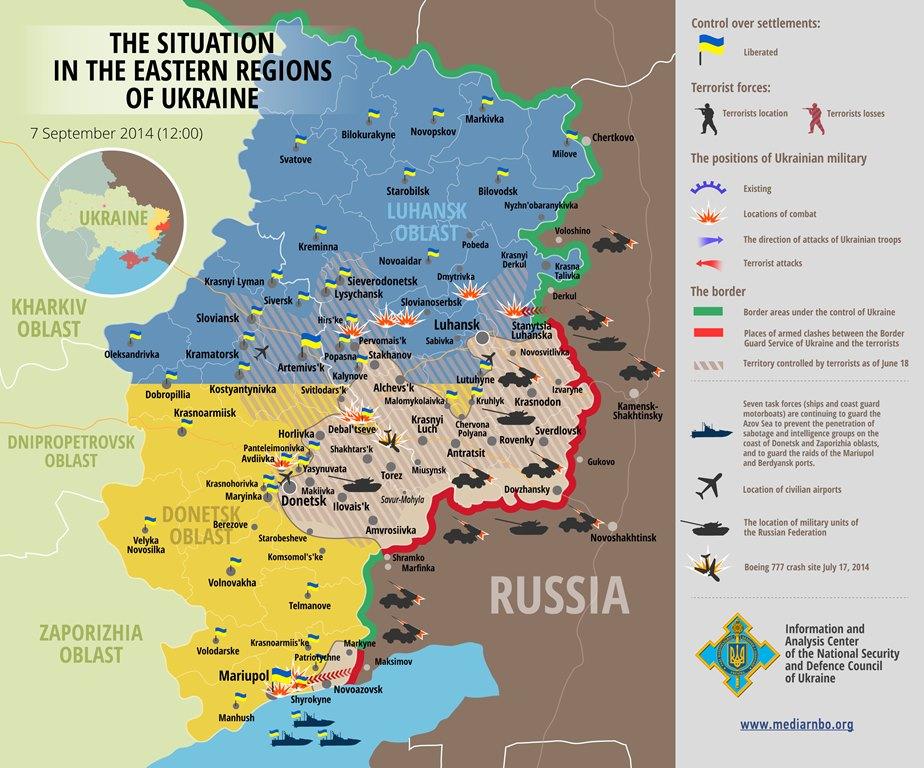
Current situation map released on Twitter by the Ministry of Foreign Affairs of Ukraine:

Ukraine situation 20140907

September 6, 2014

Estonian intelligence official kidnapped by Russian FSB

Filed under: Europe, Military, Russia — Tags: , , — Nicholas @ 11:14

Russia appears to be willing to test the patience of all of its European neighbours, as Estonia lodges a formal complaint that one of their intelligence officers has been captured by Russian FSB troops on Estonian territory:

A strange incident near the Russian-Estonian border on Friday ended with an Estonian intelligence officer in Russian custody and the two countries trading sharply contradictory allegations about what happened.

Estonia’s president and prime minister, among other officials, said the officer had been kidnapped at gunpoint from their territory and forced across the border in a blatant violation of sovereignty. The Russian Federal Security Service said the officer was in Russia and engaged in a clandestine operation when he was detained.

The episode threatened to heighten tensions between Russia and the NATO alliance, to which Estonia belongs, at a time when relations are already severely strained over the conflict in Ukraine. It came just two days after President Obama gave a speech in Tallinn, the Estonian capital, pledging that NATO would defend the Baltics against Russian aggression and suggesting that any attack on them would lead to war with the West.

Although the intelligence officer was apparently detained around 9 a.m., the Russian security service, known as the F.S.B., did not acknowledge the incident until Friday evening, when it issued a statement to three Russian news agencies.

Senior Estonian officials, including the director of the country’s Internal Security Service, held a news conference in the late afternoon, saying the officer had been abducted after unknown assailants set off a stun grenade and jammed communication signals. At the time of his capture, the officer was investigating a criminal case in the area of Luhamaa, Estonia, a little more than a mile from the border with Russia, officials said, according to Estonian news reports.

Update, 7 September: The Interpreter‘s Ukraine Liveblog included this information today.

Eston Kohver, an Estonian intelligence officer who was, according to Estonia, abducted and taken across the border to Russia yesterday, has appeared in Moscow, where he is being detained. The Estonian authorities reported that smoke grenades were used and that there were signs of a violent struggle. In addition, it was reported that communications signals in the area were jammed at the time of the reported abduction.

Meanwhile the FSB claimed yesterday that Kohver had been arrested on Russian territory, in the Pskov region.

Interfax reports that Russia’s state-owned Channel One announced today that the Lefortovo Court has approved Kohver’s detention on suspicion of espionage.

Here is video from Russia’s Ruptly news agency showing Kohver being taken out of a car and into a pre-trial detention centre (known in Russia as SIZO). The footage also shows a display of the items that the FSB has claimed that were found on Kohver including 5,000 euros in cash and a Taurus pistol.

HMS Prince of Wales will join the fleet after all

Filed under: Britain, Military — Tags: , , — Nicholas @ 11:03

British PM David Cameron announced that the under-construction aircraft carrier HMS Prince of Wales will be active after completion, reversing the decision from the SDSR in 2010:

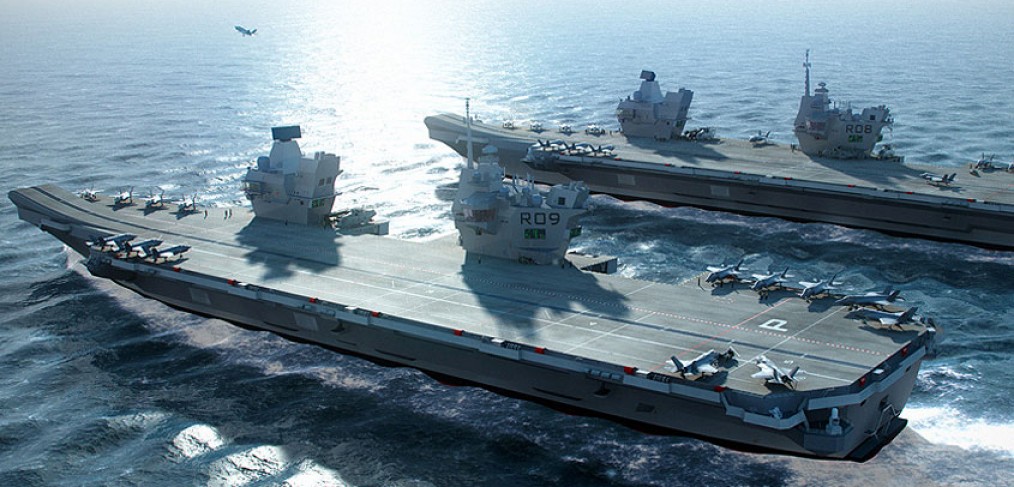
HMS Queen Elizabeth and HMS Prince of Wales

At the close of the NATO summit in Wales this week David Cameron delivered the good news that the Royal Navy will be allowed to retain the second aircraft carrier HMS Prince of Wales. This was another U-turn, reversing one of the many mistaken decisions of Cameron’s 2010 Defence Review that stated the ship would be mothballed or sold. Although undoubtedly good news for the navy, and more importantly the defence of the UK, it is difficult not to be cynical about the entire situation and timing of the announcement.

[…]

The announcement was not accompanied by much detail and leaves a lot of unanswered questions. The RN and its major procurement projects must successfully navigate a general election and the 2015 Defence Review before we can be really certain about HMS Prince of Wales’ future. The biggest unknown is how will the costs of the second carrier be carried by the RN, have the additional costs been found by cuts elsewhere or has this been funded by new money?

The photo above is a computer generated fantasy, apart from the fact carriers would rarely sail in such close formation, it is highly unlikely the RN will ever have the resources to field both carriers simultaneously. Generating the extra crew that the second carrier needs will be one of the first challenges for the RN, already in the throes of a manpower crisis. Although the carrier in refit or maintenance will not require anything like a full crew, it will still require an overlap of manning.

As noted earlier this week, the Royal Navy has shrunk from 38,730 to 33,330 since 2010. It’s going to be a scramble to train (and retain) enough skilled personnel to crew even HMS Queen Elizabeth, never mind at least a cadre for the second aircraft carrier.

Update, 7 September: An interesting, but not surprising revelation from Ali Kefford (retweeted by @NavyLookout).

September 5, 2014

Casting blame over Rotherham

At Samizdata, Perry de Havilland unflinchingly points the finger of blame:

The English ‘fascist‘ movement is a bit like a bowel movement, smelly but easily disposed of. In truth they are so trivial in terms of their support or intellectual influence that I cannot escape the notion they get as much publicity as they do primarily to keep them as a boogieman to be pointed at by their equally irrelevant confrères on the loony left.

The Rotherham scandal is not about comically half witted and pleasingly unphotogenic fascists (sorry Ed Temple). It is not about Islam or Pakistanis (sorry BNP, EDL et al.). It is not even about immigration (sorry UKIP). It is entirely about how the political culture pushed unfailingly by the BBC and Guardian (and the increasingly indistinguishable Telegraph and other formerly ‘Tory’ papers) for decades has so completely enervated British institutions along with all the mainstream political parties, that such thugs could not be dealt with. We do not need more laws, we have more than enough to deal with what happened. What we need is the preposterous culture of political correctness and its obsession with race to be flushed down the toilet.

So my caring sharing multicultural leftie chums… Rotherham? That is entirely down to you. Yes, YOU

In international affairs, perceptions matter a lot

Filed under: Europe, Russia, USA — Tags: , , — Nicholas @ 14:07

In today’s Goldberg File email (update: now available online here), Jonah Goldberg talks about the problem President Obama faces on the international stage:

… the Obama administration has wittingly or unwittingly sent the signal that our reign as the enforcer of the Pax Americana is over. Or, less starkly, we have sent the signal that it might be over. This is an important distinction. When it comes to power politics, perception matters as much as reality. Vladimir Putin, the Chinese Politburo, the Islamic State, Assad, the Iranians, Solomon Grundy, the stinking Diaz Brothers, Simon Bar Sinister, and that sweet-smelling cloud that steals your hemoglobin are all going to test America and the system around it to see how much they can get away with. It’s like Gandhi’s famous advice about going to prison. “On the first day, find the biggest, meanest-looking MoFo you can and beat the crap out of him. That will send the signal no one should mess with you.” (“Um, are you sure that was Gandhi? Remember Aristotle’s warning: ‘Some quotations on the Internet are unreliable.'” — The Couch).

The reason this is such a dangerous moment is that the mere act of testing the system encourages others to test it as well. In prison, when you’re a pushover for one guy, everyone gets the idea that they can take the apple brown betty off your lunch tray. It’s also how riots and lootings start. One person smashes a window on the hunch he can get away with it. Others watch. When nothing happens to the smasher, the idea becomes contagious.

This gets us to the heart of the damage Barack Obama has done. A superpower can cruise on perception for a very long time. Perception is relatively inexpensive. Sure, you gotta float some ships around. Yeah, you might have to run some military exercises. But as long as people think you’re sustaining a Pax Americana you are, in fact, sustaining a Pax Americana. But once you let that perception waver, you’re suddenly faced with a terrible set of choices. You can’t tell the world you’re still in charge, you have to show them. If you just talk about red lines and then do nothing to enforce them, further talk becomes worse than useless, it becomes provocative. If you opt to demonstrate your power, you risk failing and confirming weakness. You also risk a horrible escalation as the bad actors respond not with surrender but with even more testing. Does anyone think Putin would be the first to blink at this point if Obama sent troops to Ukraine?

Obama could do everything right starting today (Stop laughing!) and in a sense it would still be too late. It’s always more expensive to put down a riot than to prevent it. And it’s not entirely clear to me that the American people are willing to pay that price right now. It’s much clearer that this president has no interest in asking them to.

NATO – “they spent all their money on buying Ferraris and now they have no gas money”

Filed under: Europe, Military, Russia, USA — Tags: , , — Nicholas @ 08:34

Philip Ewing reports on the chances of improved military “readiness” among the NATO allies:

With President Barack Obama in Europe this week for a major NATO summit, the White House hopes the growl of the Russian bear on Europe’s eastern flank means the moment is right for some long-sought reforms to the alliance. But the outlook appears dim for anything beyond incremental steps at best.

The major reason is one that has frustrated policymakers over the past several administrations: Most European nations would love a stouter defense structure — so long as they don’t have to pay for it.

The North Atlantic Treaty Organization requires that member nations devote at least 2 percent of their economies to defense spending, yet today only four do: the U.S., Britain, Greece and Estonia. Although this week’s summit in Wales appears likely to yield a “pledge” in support of increased spending in the wake of Russia’s invasion of Ukraine, no one expects a serious effort from members other than those most directly threatened, including Latvia, Lithuania and Poland.

[…]

Obama and U.S. officials also are focused on bolstering European military “readiness,” particularly as U.S. spending declines. NATO relies on the U.S. for critical military capabilities such as surveillance, in-flight refueling and transportation. European militaries field top-rate troops, ships and aircraft but keep only weeks’ or even days’ worth of munitions on hand. In NATO’s 2011 campaign against Libya, many nations ran out of munitions and the French began dropping concrete bombs.

“It’s sort of like they spent all their money on buying Ferraris and now they have no gas money,” Benitez said. “There are many allies that literally aren’t flying their planes because they can’t afford to. They have very advanced fleets, but their fleets aren’t leaving port because they can’t afford to.”

Tracey Thorn describes the performance of Kate Bush

Filed under: Britain, Media — Tags: , , — Nicholas @ 00:02

In the New Statesman, Tracey Thorn laments that she’s lost an excuse for not doing live performances herself and loses herself in the performance at the Hammersmith Apollo in London:

Six straight songs and then, just as we are relaxing, the stage transforms, and the drama begins: a multi-sensory performance of “The Ninth Wave”, the suite of songs that forms side two of The Hounds of Love (1985). There’s Kate on screen in a life jacket, apparently slipping away from us, singing “And Dream of Sheep”, one of her most beautiful songs.

I should probably write this somewhere more formal – my will, perhaps – but in case I forget, let me say here that I would be happy for you to play this song at my funeral. I weep as she sings it, partly because I’m imagining my own funeral, but also because we are witnessing a struggle between life and death, where a drowning woman yearns to be saved, to return to her beloved family. “Let me live!” she cries a few songs later. Overwhelming and exhilarating as they are, all the special effects – Kate in a tank, a helicopter search beam strafing the audience – are in the service of the songs and the story.

Why is it so moving? Well, because when finally she is brought back it is not just the fictional heroine, but Kate herself who has survived the years, and those cold seas, and returned to us. The two strands, family love and audience love, intertwine as she shows us how both mean so much to her. “D’you know what?/I love you better now,” she sings, as the first half ends and we wipe our tears.

Part two is calmer, more reflective, consisting of one side of the recent album Aerial (2005). Reprieved from death, she now revels in the simple, sensuous pleasures of life. Birdsong on a summer afternoon. The setting of the sun and the rising of the moon. In more conventional hands this could be merely decorous and pastoral, even a little twee, but somehow she has found a way to transform contentment into euphoria. The mood is hypnotic, rhythmic and trancey, and the stage dazzles with images of light and flight; less genteel garden party, more full-on midsummer rave, it could be the ultimate blissed-out headliner of a blistering, sunny Glastonbury.

And her singing voice, which I so worried about? It is a thing of wonder, any youthful shrillness replaced by a richer, occasionally gravelly tone, and with a full-throated power unbelievable in someone who has so rarely sung live. All I can think is that she must have been practising, on her own in a barn somewhere, for the past 35 years. Practising, planning, waiting for all the stars to align – her own desire, the cast of collaborators, the right time and place – in order for this to happen. And it is an ecstatic triumph, a truly extraordinary achievement.

« Newer PostsOlder Posts »

Powered by WordPress


