Quotulatiousness

September 5, 2014

QotD: TV documentaries

Filed under: Britain, Humour, Media, Quotations — Tags: — Nicholas @ 00:01

Is it just me or are almost all TV documentaries completely unwatchable these days? I remember when I first started this job I’d review one almost every fortnight. Always there’d be something worth watching: on the horrors of the Pacific or the Eastern Front, say; or castles; or Churchill; or medieval sword techniques. But now it’s all crap like The Hidden World of Georgian Needlecraft or In The Footsteps of Twelve Forgotten South American Civilisations Which All Look The Same or A Brooding, Long-Haired Scottish Geographer Shouts From Inside A Volcano Why Climate Change Is Worse Than Ever.

The presenters have got more annoying too. I mean, I’m not saying some of the old ones weren’t infuriating with their hand-waving and tics and mannerisms and wheezings. But the new ones are just vacuous, unformed squits. They make you yearn for a reverse Logan’s Run world, where everyone under 30 is executed for being so tiresome. A lot of them are women, obviously, chosen mainly for their simpering looks and charming speech impediments and unerring knack for fronting the dullest imaginable subject matter.

No doubt the people responsible for commissioning this drivel think they’re redressing the balance, in much the same way progressive historians do when they demand we empathise with medieval peasants rather than learning about what Edward I did to the Welsh and the Scots. Well, I can’t speak for all oppressed women here, but I think I can for my wife. They’re not going, ‘Oh, good. Finally a documentary with my name on it, about what it was like to be a woman’s maidservant in Elizabethan York.’ They’re going, ‘Who is that irritating little cow? Why is she on the screen putting on that little-girl-lost voice for my husband? And why the hell isn’t this documentary about something actually interesting, like, say, castles, or Churchill or medieval sword techniques?’

James Delingpole, “The glories of John Betjeman. And why we need more English eccentrics – eg me – on TV”, JamesDelingpole.com, 2014-09-04.

September 4, 2014

“David Cameron mouths foolish nothings” while “Obama … resembles a spineless invertebrate”

Filed under: Britain, Europe, Middle East, Russia, USA — Tags: , , , — Nicholas @ 07:25

Historian Max Hastings pours out the scorn toward British PM David Cameron and American President Barack Obama for their dithering and unwillingness to grapple with real world problems like the invasion of Ukraine and the rise of ISIS:

Suddenly, the world seems a frightening place. The beheading of a second American hostage by jihadist fanatics and the threat that a British aid worker will suffer the same fate has shocked the peoples of the West, as have few events since the Cold War.

We are uncertain how the Western Powers should respond.

At such moments, we turn to our national leaders for wisdom, reassurance and decision. Instead, we get posturing, dithering and waffle.

David Cameron mouths foolish nothings, proclaiming that Britain would commit ‘all the assets we have’, including our ‘military prowess’ against the Muslim extremists.

More serious, the President of the United States seems supine in the face of the gravest threats to international order in a generation.

Barack Obama boldly strides golf course fairways, while apparently washing his hands of the job the American people — and, by association, the civilised world — pay him for: to strive to lead us into the paths of righteousness.

To borrow P. G. Wodehouse’s phrase, however intelligent Obama may be, he resembles a spineless invertebrate.

Update: Speaking of scorn, here’s Jonah Goldberg yesterday (H/T to Jim Geraghty for the link).

This was always nonsense, but then again so much of the hype about Obama in the early days of his presidency was nonsensical. Still it does contribute to the poignancy of the moment. I’m referring specifically to the Islamic State and their celebration of slavery. MEMRI has excerpts of Facebook chats between British and French supporters of the group as they discuss the great news that you can buy Yazidi women as sex slaves.

[…]

It’s also worth noting that the president has done everything he can to claim that his domestic political opponents are engaged in a “war on women.” He won an election largely because he convinced enough women — and pliant journalists — to take this bilge seriously. Just this week the head of his party went on at great length to claim that the Republican governor of Wisconsin has been “giving women the back of his hand.”

Oh, and let us not forget, the president and his supporters work very hard to paint their domestic political opponents as religious extremists because some private businesses and religious groups don’t want to pay for procedures that violate their conscience.

Now compare this to the people who are celebrating the fact their faith allows them to enslave women.

Just think about it for a moment. The president surely knows about this. His administration surely knows about this. And yet, the president — this modern incarnation of Lincoln, protector of women and opponent of domestic religious extremism — defines his goal for the Islamic State as reducing it to a “manageable problem.” Does this mean that if the group renounces any designs on attacking the U.S. homeland (an impossibility given the tenets of their faith and ambition for a global caliphate) he will stand by as they continue to barter women as sex slaves and breeders? This is the same man who campaigned in Berlin as a “citizen of the world” and champion of global community.

Forgive me, but the term, “Lincolnesque” doesn’t immediately spring to mind.

September 3, 2014

A full agenda at this weekend’s NATO summit

Filed under: Britain, Cancon, Europe, Military, Russia — Tags: , , , — Nicholas @ 08:58

In the Guardian, Patrick Wintour says that the upcoming NATO summit is a sign that with all the tension around the world, this is the most relevant the organization has been in decades:

The last time the UK hosted a Nato summit was in 1990, when Margaret Thatcher was prime minister, the cold war was coming to an end, and the alliance was questioning its relevance in a multipolar world where soft power might count more than hard power. The old chestnut about Nato’s purpose voiced by the first Nato secretary general, Lord Ismay — “to keep the Russians out, the Americans in” — looked hopelessly anachronistic. Russia famously had become a country with which the west felt it could do business.

A quarter of a century later, Putin’s actions, and the ever more grisly new threats posed by Islamic militants, has given Nato a new lease of life. Indeed, Nato is now so relevant that David Cameron’s chief task as host to this week’s summit in Wales has been to ensure that the agenda does not burst at the seams. Discussions will range across the Russian advance in Ukraine and expansionist threat to the Baltics, the Nato withdrawal from Afghanistan next year, the possibility of wider alliance air strikes in northern Iraq against Islamic State (Isis), the need for Nato to produce a viable rapid reaction force in Europe as well as respond to the threats of hybrid warfare and terrorism.

Cameron has ensured that the crisis posed by Isis — made even more pertinent by the latest beheading and the threat to a British citizen — will be discussed both at a working dinner on Thursday evening, and then again on Friday as the 28 members discuss asymmetric warfare, and how to respond to threat of terrorism.

Diplomatic efforts in advance of the summit may help the Canadian government save a bit of face, too:

A face-saving compromise may be on the way for reluctant allies, including Canada, who are unwilling to boost defence spending to meet the NATO standard.

A spokesman for Prime Minister Stephen Harper says the final statement at the Wales Summit later this week will describe the long-standing expectation that members nations spend at least two per cent of their gross domestic product on defence as an “aspirational target.”

That seems enough to satisfy the Harper government, which has balked at pressure from both the United States and Britain to substantially boost the military’s budget slashed in the drive towards next year’s balanced budget and anticipated election.

Jason MacDonald, the prime minister’s director of communications, said late Tuesday that the government is willing to spend more “on measures that meet actual operational needs, in response to global issues.”

He says Canada is not prepared to meet “an arbitrary target.”

The language not only puts out an embarrassing political fire, given the prime minister’s harsh condemnation of Russia, but it may also be enough to placate the Americans.

Canada has taken a tough rhetorical line toward the Soviets Russians lately, but Stephen Harper’s government has reduced military spending to such a degree that he risks being seen as “All hat and no cattle” as the Texan saying has it.

Britain’s shrinking armed forces

Filed under: Britain, Military — Tags: , , — Nicholas @ 08:30

The Secretary of State for Defence was asked in Parliament for a breakdown of the members of the British army, Royal Navy and Royal Air Force. The detailed reply shows some significant changes:

Royal Navy/Royal Marines

Year Total, all ranks
2010 38,730
2011 37,660
2012 35,540
2013 33,960
2014 33,330

Army

Year Total, all ranks
2010 108,920
2011 106,240
2012 104,250
2013 99,730
2014 91,070

Royal Air Force

Year Total, all ranks
2010 44,050
2011 42,460
2012 40,000
2013 37,030
2014 35,230

This may be the only part of British government spending that would actually meet the definition of “austerity”. For reference, the Canadian Armed Forces have about 43,500 regulars across the Canadian Army, Royal Canadian Navy, and Royal Canadian Air Force.

September 2, 2014

Tsar Vladimir I

Filed under: Europe, Russia — Tags: , , — Nicholas @ 15:44

One of the problems that Western politicians have in dealing with Vladimir Putin is that they can’t decide what he wants or even why he wants them. They’re struggling because they keep misreading individual actions as being either nationalistic or ethnic, when they should really be described as “imperialistic”. Putin is trying to recreate the old USSR, but without the Communist Party running things — he’s trying to recreate Imperial Russia:

Americans have been grasping to find explanations for Russian President Vladimir Putin’s serial aggressions in Europe. We keep searching for bumper stickers we can understand, so we gravitate to simple explanations like “geopolitics” or “nationalism,” not least because such notions promise solutions. (If it’s about geopolitics, cutting a deal with Putin will stop this; if it’s about nationalism, it’ll burn itself out when Putin has recaptured enough ethnic Russians around his borders.)

And, of course, there’s always “realism.” In this month’s Foreign Affairs, John Mearsheimer argues the Russo-Ukraine war is basically the West’s fault. (We expanded NATO, we supported the Maidan protesters, we were generally just mean to Russia, etc.) It’s a classic Mearsheimer piece: a beautifully-written, attention-seeking exercise that insists on the brilliance of realists while bucking the innate moral sense of most normal human beings. (Consider, for example, his 1993 Deep Thoughts about how maybe it would be good for Ukraine and Germany to develop active nuclear weapons programs.)

That doesn’t mean I disagree with the overall evaluation that America’s Russia policy since 1992 — insofar as we’ve had one — has been remarkably obtuse. (That pretty much describes most of our foreign policy since the end of the Cold War, but I will not digress here.) I, too, objected to expanding NATO, deplored the arrogance of people like Madeleine Albright, and lamented the repeated lost opportunities to bring Moscow closer to the Western family to which it belongs by both heritage and history.

Very little of what’s happened in the past 20 years, however, has much to do with what’s going on in Ukraine right now. And nothing excuses Russia’s war against a peaceful neighbor, especially not arid theories of realism or flawed historical analogies.

Putin is not a realist: very few national leaders are. Realism is much loved by political scientists, but actual nations almost never practice it. Nor is Putin a nationalist: indeed, he hardly seems to understand the concept, or he would not have embarked on his current path.

British government “austerity”

Filed under: Britain, Economics, Media — Tags: , , , , — Nicholas @ 14:29

Theodore Dalrymple explains why changing the name of something does not actually change the thing being described, no matter how much politicians or journalists wish it did:

… some errors are important, and one sees them more insistently the older one grows. For example, the other day I read an article in Le Monde about the forthcoming referendum in Scotland on independence from the United Kingdom. The author of the article was clearly sympathetic to the cause of independence, but that was not the cause of my irritation with the article, nor the fact that he quoted an old man, a former trade union militant, who said that he was in favor of independence, among other reasons, because the United Kingdom was the fourth most unequal country in the world. If old men in Scotland can be as ignorant of the world as that, it is an interesting sociological observation; and the author of the article is almost certainly right that those in favor of Scottish independence favor a state even more extensive in the name of equality than the one that they already have.

No, I was irritated rather by the fact that the author of the article accepted that the policy of the present British government can properly be described as one of austerity. What the alleged austerity amounts to is this: that in the current year the government will borrow only one in six of the pounds it spends instead of one in five, as it did last year. As to the reasons for this less than startling decline in its borrowing requirements, it was not because the government was spending less but because it was receiving more taxes, from the speculative housing bubble which it has done much to fuel. If that bubble should burst, the borrowing necessary to maintain current levels of expenditure (already very high) would rise again, possibly higher than ever.

This is not a question of whether the economic policy followed by the government is the right one or not: perhaps it is and perhaps it isn’t. It is a question of the honest use of words. One would not say of a man who passed from smoking sixty cigarettes a day to fifty that he had given up smoking, or that he had exercised great self-denial. And one would not, or rather should not, say of an organization that had balanced its budget once in fifty years (the British government) that it was practicing austerity merely because it had to borrow a slightly lower percentage of what it spent than it did the year before. This is to deprive words of their meaning.

But does this matter? As the philosopher Bishop Butler once said, everything is what it is and not another thing. A budget deficit is a budget deficit, whether you call it profligacy or austerity. A thing is not changed by being called something different.

Unfortunately, matters are not quite as clear-cut as that. In human affairs, words matter, as much because of their connotations as of their denotations. Austerity means stern treatment and self-discipline. It means harshness and astringency. Needless to say, harshness in their government is not what most people look or will vote for. If reducing the rate at which you overspend and accumulate debt is called austerity, no one will dare go any further in that direction, though it were the right direction in which to go. Words, said Hobbes, are wise men’s counters but the money of fools: so that many men will take the name for the thing itself. Whether more active attempts to balance the budget would be advisable I leave to economists to decide (they can’t, of course).

September 1, 2014

Unionists fumble by letting Labour drive the “No” campaign in Scotland

Filed under: Britain, Politics — Tags: , , , — Nicholas @ 09:13

In the Telegraph, Sean Thomas says that the self-loathing tradition among Labour intelligentsia makes Labour the worst possible party to make the case for union, even though Labour stands to lose far more electorally than any other party:

It’s often been observed that a certain type of British Lefty hates Britain – and that they reserve particularly hatred for Englishness. Back in 1941 George Orwell made this acute remark:

    England is perhaps the only great country whose intellectuals are ashamed of their own nationality. In left-wing circles it is always felt that there is something slightly disgraceful in being an Englishman and that it is a duty to snigger at every English institution.

So what’s new? The difference today is that this shame and self-hatred now dominates Left-wing thought, whereas it was once balanced by the decent Left: who were proud to inherit the noble traditions of radical English patriotism.

[…] The latest polls show that the United Kingdom is close to breaking up. This is a remarkable state of affairs when you consider that, a year ago, polls were two to one against partition. How has this occurred? Because we have allowed the British Labour party to lead the No debate.

This was a disastrous decision, given that, as Orwell noted, Labourites and Lefties revile and deride so many of the things perceived as quintessentially British. Take your pick from the monarchy, the flag, the Army, the history of rampant conquest, the biggest empire in the world, the supremacy of the English language, anyone who lives in the countryside, the national anthem, the City of London, the Royal Navy, a nuclear deterrent, the lion and the unicorn, duffing up the French, eating loads of beef — all this, for Lefties, is a source of shame.

The result, north of the Border, is plain to see. Whenever the passionate and patriotic SNP asks the No campaign for a positive vision of the UK (instead of dry economic facts, and negative fear-mongering) all we hear is silence, or maybe a quiet murmur about “the NHS”. Yes, the NHS. For many Lefties, the NHS &mdah; an average European health system with several notable flaws — is the only good thing about Britain. It’s like saying we should keep the United Kingdom because of PAYE. Thus we tiptoe towards the dissolution of the nation.

There is a deep irony here. If Scotland secedes it will hurt the Labour Party more than anyone, electorally. But such is the subconscious hatred of Britain and Britishness in Lefty hearts, I believe many of them think that’s a price worth paying: just to kick the “Tory Unionists” in the nuts, just to deliver the final death-blow to British “delusions of grandeur”.

August 31, 2014

Combat situation in Ukraine

Filed under: Europe, Military, Russia — Tags: — Nicholas @ 10:41

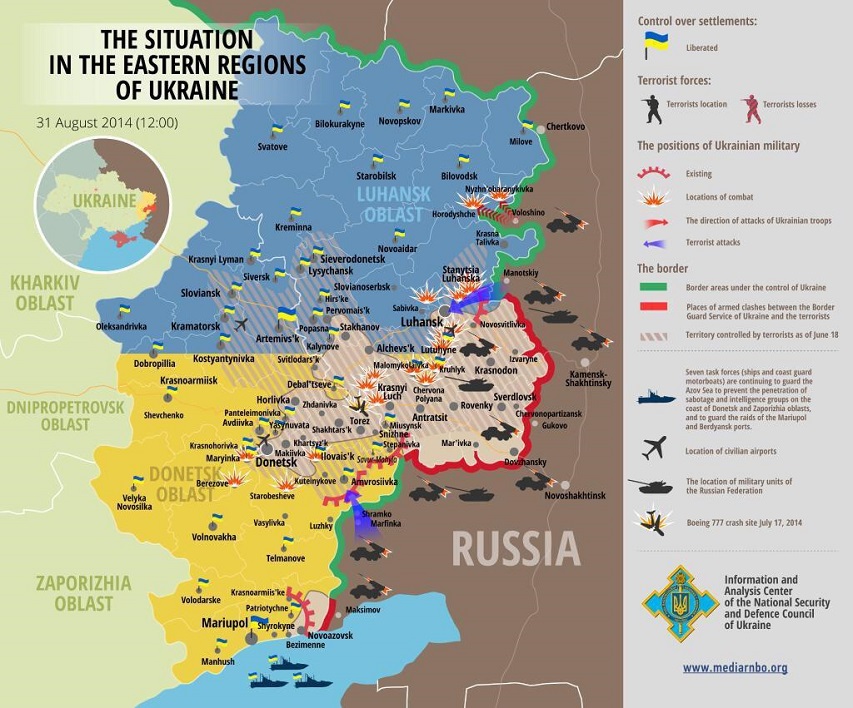
Current situation map released on Twitter by the Ministry of Foreign Affairs of Ukraine:

Ukraine situation 20140831

NATO’s assistance for the Kurds – the spirit may be willing, but the military is weak

Filed under: Europe, Germany, Middle East, Military — Tags: , , — Nicholas @ 10:29

Strategy Page explains why NATO aid for the Kurds in northern Iraq may not be sufficient or even timely:

The recent ISIL (al Qaeda in Iraq and Syria) misbehavior (mass murder and so on) in Syria and Iraq has caused a public uproar in Europe and generated demands that NATO send forces to try and stop all the killing. The German government responded on August 20th with a pledge to send weapons to the Kurds who are fighting ISIL in northern Iraq. But Germany was reluctant to send warplanes or troops. A few days later a German Defense Ministry readiness report was leaked and it made it clear why even getting weapons to the Kurds would be difficult. The report showed that only 8 percent of 109 Eurofighter (similar to the U.S. F-15), 11 percent of 67 CH-53 transport helicopters, and 10 percent of 33 NH90 helicopters were fully operational (not sidelined for upgrades, repairs or other problems.) However 38 percent of 56 C-160 twin turboprop transports were available. This made it possible to fly some weapons into northern Iraq, but not much else. Normally a combat ready military has at least half, and more normally over 70 percent of its warplanes ready to go. While this situation shocked many, those who have followed European military trends since the 1980s were not surprised.

The problem is that the European NATO members never spent as heavily on their armed forces as did the United States and Russia, especially after 1991. Britain and France are still heavy spenders, but not enough to make up for what the rest of European NATO members are not doing. European NATO members are aware of this problem, but it has never been a high enough national priority to actually fix.

There was some hope in the decade after September 11, 2001 as the need to deal with international Islamic terrorism changed the armed forces of Europe in unexpected ways. More money was spent on the military and many of the troops got some combat experience. Now the Europeans have more capable and professional forces than they have had for many decades. None of this was expected. But in the last few years these changes have begun to fade. Thus the shocking readiness numbers for German aircraft.

[…]

For example, in 2008 the German parliament was in an uproar over a report depicting German soldiers as physically unfit for military service. It was found that 40 percent of the troops were overweight, compared to 35 percent of their civilian counterparts (of the same gender and age). The investigation also found that the troops exercised less (including participation in sports), and smoked more (70 percent of them) than their civilian counterparts. The military now encourages sports and physical fitness, and discourages smoking, but those efforts did not appear to be working.

When other Europeans looked around they found that it was not just a German problem. It was worse than that. Most European military organizations were basically make-work programs. It’s long been known that many European soldiers are not really fit for action. They are mainly uniformed civil servants. One reason many are not ready for combat, or even peacekeeping, operations, is that they don’t have the equipment or the training. And that’s because up-to-date gear, and training, are expensive. A disproportionate amount of money is spent on payroll. That keeps the unemployment rate down more effectively than buying needed equipment, or paying for the fuel and spare parts needed to support training.

Update: Some supplies and weapons are getting to the Kurdish forces. Here’s the Operation IMPACT page at the Canadian government website:

Operation IMPACT is the Canadian Armed Forces (CAF) provision of strategic airlift to assist in the delivery of critical military supplies to security forces in Iraq fighting the Islamic State of Iraq and the Levant (ISIL).

Hundreds of thousands of Iraqis have been threatened and displaced by the militants of ISIL that began seizing territory in northern Iraq earlier this year. This support will enable security forces in Iraq to provide effective protection to Iraqis faced with ISIL aggression.

Canadian Air Task Force Iraq

One Royal Canadian Air Force (RCAF) CC-130J Hercules transport aircraft and one CC-177 Globemaster III strategic airlifter have been committed to transport military supplies donated by allies. Approximately 100 Canadian Armed Forces personnel are deployed, including air crew, ground crew and logistical support personnel.

The aircraft, along with those of contributing allies, will work from staging locations in the Mediterranean and in Eastern Europe.

The CC-130 aircraft is used for a wide range of missions, including troop transport, tactical airlift and aircrew training. The CC-177 Globemaster III specializes in rapid delivery of troops and cargo for operations taking place in Canada or abroad.

Both aircraft and their personnel will remain deployed as long as the Government of Canada deems necessary.

August 28, 2014

Feeding Tommy Atkins – WW1 food for British troops in the trenches

Filed under: Britain, Food, History, Military, WW1 — Tags: — Nicholas @ 13:16

In the Express last week, Adrian Lee reports on a new exhibit at the Imperial War Museum in London:

They say an army marches on its stomach, so feeding the two million men who were in the trenches at the height of the First World War was some task. It was a great achievement that in the entire conflict not one British soldier starved to death.

Yet no one should think that the Tommies enjoyed the food that was served up by the military. According to the wags on the frontline, the biggest threat to life was not German bullets but the appalling rations.

Most despised was Maconochie, named after the company in Aberdeen that made this concoction of barely recognisable chunks of fatty meat and vegetables in thin gravy.

When served hot, as per the instructions on the tin, it was said to be barely edible. Eaten cold for days on end in the trenches, where a warm meal was usually no more than a fantasy, it was said to be disgusting.

It was the stated aim of the British Army that each soldier should consume 4,000 calories a day. At the frontline, where conditions were frequently appalling, daily rations comprised 9oz of tinned meat (today it would be known as corned beef but during the First World War it was called bully beef) or the hated Maconochie.

Additionally the men received biscuits (made from salt, flour and water and likened by the long-suffering troops to dog biscuits). They were produced under government contract by Huntley & Palmers, which in 1914 was the world’s largest biscuit manufacturer. The notoriously hard biscuits could crack teeth if they were not first soaked in tea or water.

None dare call it an invasion

Filed under: Europe, Military, Russia — Tags: , , — Nicholas @ 09:49

The battles between Ukraine forces and Russian-backed rebels were one thing: you could make a case for it being a “local” issue if you didn’t want to draw attention to it (for fear the Russians might cut off your natural gas supply). It’s quite a different thing when the Ukrainians are fighting Russian soldiers rather than irregulars and paramilitaries:

Russian forces in two armored columns captured a key southeastern coastal town near the Russian border Thursday after Ukrainian forces retreated in the face of superior firepower, a Ukrainian military spokesman said.

The two Russian columns, including tanks and armored fighting vehicles, entered the town of Novoazovsk on the Sea of Azov after a battle in which Ukrainian army positions came under fire from Grad rockets launched from Russian territory, according to the spokesman, Col. Andriy Lysenko.

“Our border servicemen and guardsmen retreated as they did not have heavy equipment,” Lysenko said in a statement.

Ukrainian authorities have denounced the latest fighting as a Russian invasion of their territory, intended to prop up pro-Moscow separatists who have been losing ground to Ukrainian forces and to open a new front in the southeastern corner of Ukraine.

Ukrainian officials said earlier that Ukrainian troops were battling combined Russian and separatist forces on the new southern front around Novoazovsk, about eight miles west of the Russian border. The Ukrainian military also said Russian troops were increasing surveillance from northern Crimea, the autonomous Ukrainian peninsula annexed by Moscow in March.

Among western countries, Canada (of all places) has become snarky about the situation:

August 27, 2014

The Congress System, the Holy Alliance and the re-ordering of Europe in the nineteenth century

Filed under: Europe, History, Russia — Tags: , , , , — Nicholas @ 09:37

In my ongoing origins of World War 1 series, I took a bit of time to discuss the Congress of Vienna and the diplomatic and political system it created for nearly one hundred years of (by European standards) peaceful co-existence. Not that it completely prevented wars (see the rest of the series for a partial accounting of them), but that it provided a framework within which the great powers could attempt to order affairs without needing to go to war quite as often. In the current issue of History Today, Stella Ghervas goes into more detail about the congress itself and the system it gave birth to:

Emperor Napoleon was defeated in May 1814 and Cossacks marched along the Champs-Elysées into Paris. The victorious Great Powers (Russia, Great Britain, Austria and Prussia) invited the other states of Europe to send plenipotentiaries to Vienna for a peace conference. At the end of the summer, emperors, kings, princes, ministers and representatives converged on the Austrian capital, crowding the walled city. The first priority of the Congress of Vienna was to deal with territorial issues: a new configuration of German states, the reorganisation of central Europe, the borders of central Italy and territorial transfers in Scandinavia. Though the allies came close to blows over the partition of Poland, by February 1815 they had averted a new war thanks to a series of adroit compromises. There had been other pressing matters to settle: the rights of German Jews, the abolition of the slave trade and navigation on European rivers, not to mention the restoration of the Bourbon royal family in France, Spain and Naples, the constitution of Switzerland, issues of diplomatic precedence and, last but not least, the foundation of a new German confederation to replace the defunct Holy Roman Empire.

[…]

Surprisingly, the Russian view on peace in Europe proved by far the most elaborate. Three months after the final act of the Congress, Tsar Alexander proposed a treaty to his partners, the Holy Alliance. This short and unusual document, with Christian overtones, was signed in Paris on September 1815 by the monarchs of Austria, Prussia and Russia. There is a polarised interpretation, especially in France, that the ‘Holy Alliance’ (in a broad sense) had only been a regression, both social and political. Castlereagh joked that it was a ‘piece of sublime mysticism and nonsense’, even though he recommended Britain to undersign it. Correctly interpreting this document is key to understanding the European order after 1815.

While there was undoubtedly a mystical air to the zeitgeist, we should not stop at the religious resonances of the treaty of the Holy Alliance, because it also contained some realpolitik. The three signatory monarchs (the tsar of Russia, the emperor of Austria and the king of Prussia) were putting their respective Orthodox, Protestant and Catholic faiths on an equal footing. This was nothing short of a backstage revolution, since they relieved de facto the pope from his political role of arbiter of the Continent, which he had held since the Middle Ages. It is thus ironic that the ‘religious’ treaty of the Holy Alliance liberated European politics from ecclesiastical influence, making it a founding act of the secular era of ‘international relations’.

There was, furthermore, a second twist to the idea of ‘Christian’ Europe. Since the sultan of the Ottoman Empire was a Muslim, the tsar could conveniently have it both ways: either he could consider the sultan as a legitimate monarch and be his friend; or else think of him as a non-Christian and become his enemy. As a matter of course, Russia still had territorial ambitions south, in the direction of Constantinople. In this ambiguity lies the prelude to the Eastern Question, the struggle between the Great Powers over the fate of the Ottoman Empire (the ‘sick man of Europe’), as well as the control of the straits connecting the Black Sea to the Mediterranean. Much to his credit, Tsar Alexander did not profit from that ambiguity, but his brother and successor Nicholas soon started a new Russo-Turkish war (1828-29).

August 25, 2014

Counting down to Scotland’s decision

Filed under: Britain, Humour, Politics — Tags: , , , — Nicholas @ 08:23

While I’d prefer to see Scotland stay as part of the United Kingdom, lots of Scots would prefer to be independent of the UK. What I don’t understand is the idea that Scotland needs to be free, independent, and pleading and begging to be accepted into the EU. Isn’t that just trading distant uncaring bureaucrats in London for even more distant, even more uncaring bureaucrats in Brussels?

There are plenty of English cheerleaders for the “no” side, but there are also folks in England who’d prefer to see Scotland go off on its own:

In polite society, the correct opinion to hold about Scottish independence is that the Union must stay together. But I’ve been wondering: might not England thrive, freed from the yoke of those whining, kilted leeches? The more you think about it, the more persuasive the argument seems to be.

I’ve been invited to debate this question — whether or not we long-suffering Sassenachs would be better off without our sponging Caledonian neighbours — in early September, at a debate held by the Chartered Institute of Public Relations.

[…]

Let’s consider for a moment how Scotland herself might fare. In my view, she would be well served by some time alone to consider who she really is. Historically, Scotland was renowned across the world for entrepreneurial spirit and engineering genius. Both reputations have been lost after a century of Labour government and the overweening arrogance and control freakery of the trades unions.

These days, Scotland is more commonly associated with work-shy dole scroungers and skag-addled prostitutes than with the industriousness of Adam Smith or with its glorious pre-Reformation spirituality. Sorry, no offence, but it’s true.

[…]

Returning to England, then, let us imagine a Kingdom relieved of burdensome Scottish misanthropy. Surely it would experience an almost immediate burst of post-divorce gaiety. Think of our city centres, free of garrulous Glaswegian drunks slurping Buckfast tonic wine, or English literary festivals liberated from sour, spiky-haired Caledonian lesbians hawking grim thrillers about child abuse.

And here’s one last, even more delicious prospect: right-on Scottish stand-up comedians permanently banished to Edinburgh, where their ancient jokes about Thatcher or the Pope will make their equally ossified Stalinist audiences laugh so bitterly that Scotland’s famously dedicated healthcare workers will be left mopping up the leakage.

It makes you wonder whether we shouldn’t offer up Liverpool as well, to sweeten the deal. After all, the north of England is in a similarly bad state. What do you reckon of my modest proposal? Would a taste of the Calvinist lash persuade that feckless and conceited community to get off its behind and look for work? Why not let Holyrood underwrite their disability benefits bill for a while, and see what happens?

August 24, 2014

200th anniversary of the only foreign occupation of Washington DC

Filed under: Britain, Cancon, History, USA — Tags: , , , — Nicholas @ 11:14

In History Today, Graeme Garrard tells the tale of the burning of Washington in 1814:

When James Madison, fourth President of the United States and ‘Father of the Constitution’, signed a declaration of war against Britain on June 18th, 1812 he could scarcely have imagined that two years later he would be fleeing from his burning capital before the invading enemy. At the start of the ‘War of 1812’, the first the US had declared on another nation, his friend and predecessor as president, Thomas Jefferson, had smugly declared that the war against Britain’s colonies in what is today Canada would be ‘a mere matter of marching’. As Madison abandoned the White House on horseback with his entourage and raced towards Virginia on August 24th, 1814 he stopped and looked back as he beheld the ruined city of Washington. The smoke from flames that engulfed it could be seen as far away as Baltimore, Maryland. Although he left no personal account of his feelings about these shattering events, the normally imperturbable president must have been deeply shaken by the turn they had taken, as were most Americans. What his many domestic critics had derisively branded ‘Mr Madison’s War’ had led to the only foreign occupation of the US capital in its history. Soldiers and marines under Major-General Robert Ross and Rear Admiral Sir George Cockburn put Washington’s public buildings, including the Senate, the House of Representatives, the Library of Congress, the Treasury building, the State and War Departments, the historic Navy Yard and the President’s House (as the White House was then known), to the torch. Exactly two centuries later, few people in the United States or Britain are aware of this national humiliation, the ‘greatest disgrace ever dealt to American arms’.

Why were the British so determined to burn the government buildings in Washington? Revenge for the Americans having done the same thing to York the previous year:

The Americans were as dejected and enraged as the British were elated by the effects of the occupation. The reserved and stoical Madison returned to Washington as soon as the British had departed. Unable to live in the President’s House, he took up residence at the home of his brother-in-law. His wife soon joined him, exclaiming when she saw the ruined capital: ‘Such destruction, such devastation!’ The secretary of state James Monroe, Madison’s successor as president, cursed the British troops as ‘all damn’d rascals from highest to lowest’ for torching the capital. He seems to have forgotten that American troops had done much the same in 1813 when they occupied the undefended city of York (now Toronto), the capital of Upper Canada (now the province of Ontario). Then they had burned the colony’s legislative and judicial buildings, plundered its public library and destroyed private property. Indeed, the Governor General and military Commander-in-Chief of British North America during the war, Lieutenant-General Sir George Prévost, wrote that, as a ‘just retribution, the proud capital at Washington has experienced a similar fate’. When the news reached London a month later of the British retaliation, guns outside Parliament and the Tower of London boomed a joyous salute, a reaction echoed throughout the colonies of British North America, particularly in York.

Who is to blame for the outbreak of World War One? (Part twelve of a series)

Filed under: Europe, History, WW1 — Tags: , , , , , — Nicholas @ 00:02

You can catch up on the earlier posts in this series here (now with hopefully helpful descriptions):

  1. Why it’s so difficult to answer the question “Who is to blame?”
  2. Looking back to 1814
  3. Bismarck, his life and works
  4. France isolated, Britain’s global responsibilities
  5. Austria, Austria-Hungary, and the Balkan quagmire
  6. The Anglo-German naval race, Jackie Fisher, and HMS Dreadnought
  7. War with Japan, revolution at home: Russia’s self-inflicted miseries
  8. The First Balkan War
  9. The Second Balkan War
  10. The Entente Cordiale, Moroccan crises, and the influence of public opinion
  11. The Bosnian crisis of 1908

Who’s at the wheel? The less-than-transparent-or-unified governments of 1914

A common reaction (among both modern historians and lay readers) to the apparent incoherence of the decision-making process in the various great powers’ capitals is to ask just who exactly was in command when such-and-such a decision was taken. This reflects on our modern day belief that power has an identifiable source, and that actors had clear direction from a central authority. As Christopher Clark takes pains to outline in The Sleepwalkers this was not true even of the more centralized great powers:

… even a very cursory look at the governments of early twentieth-century Europe reveals that the executive structures from which policies emerged were far from unified. Policy-making was not the prerogative of single sovereign individuals. Initiatives with a bearing on the course of a country’s policy could and did emanate from quite peripheral locations in the political structure. Factional alignments, functional frictions within government, economic or financial constraints and the volatile chemistry of public opinion all exerted a constantly varying pressure on decision-making processes. As the power to shape decisions shifted from one node in the executive structure to another, there were corresponding oscillations in the tone and orientation of policy. This chaos of competing voices is crucial to understanding the periodic agitation of the European system during the last pre-war years. It also helps to explain why the July Crisis of 1914 became the most complex and opaque political crisis of modern times.

In The War That Ended Peace, Margaret MacMillan writes:

Old institutions and values were under attack and new ways and new attitudes were emerging. Their world was changing, perhaps too fast, and they had to attempt to make sense of it. “What were they thinking?” is a question often asked about the Europeans who went to war in 1914. The ideas that influenced their view of the world, what they took for granted without discussion (what the historian James Joll called “unspoken assumptions”), what was changing and what was not, all are important parts of the context within which war, even a general European war, became a possible option in 1914.

The uneasy state of the Serbian state

Serbia had been practically an independent state since shrugging off the last Ottoman military occupation in 1867 and that independence was formally recognized by the great powers in 1878 at the Congress of Berlin which was the peace conference called to end the Russo-Turkish War (which we briefly looked at in part two). One of the provisions of the treaty that strongly displeased the Serbs was that they were forbidden to take over Bosnia, which instead was placed in the care of the Austro-Hungarian empire: the Serbs had gone to war with the Ottomans in 1876 by proclaiming a union with Bosnia. The Austrians and the other great powers preferred a weakened Ottoman empire to retain titular possession of Bosnia than to allow an upstart principality to claim it.
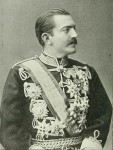
King Milan of Serbia (via Wikipedia)

King Milan of Serbia (via Wikipedia)

Serbia became a kingdom in 1882 under King Milan I. Milan had been adopted into the ruling Obrenović family after the death of his father in combat against the Ottomans. When Prince Mihailo Obrenović was assassinated in 1868, Milan was the eventual choice to succeed his adopted father. Milan remained king until he unexpectedly abdicated the throne in favour of his son Alexander in 1889. Despite having given up the throne, he returned to Serbia and eventually was appointed commander-in-chief of the Serbian army. He left that post in protest at his son’s marriage to Draga Mašin in 1900 and was banished for his pains. He died in 1901.
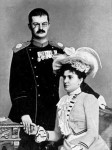
King Alexander and Queen Draga of Serbia (via Wikipedia)

King Alexander and Queen Draga of Serbia (via Wikipedia)

King Alexander I did not long survive his father, being assassinated by members of an army conspiracy in 1903. The King had been ruling ever more harshly, creating much resentment through his arbitrary decrees and proclamations. The conspiracy was lead by Captain Dragutin Dimitrijević (nicknamed “Apis”), who would also later found the secret organization Ujedinjenje ili smrt! known as the Black Hand. The assassinations were so gory that Quentin Tarantino might have directed the scene if it was written by George R.R. Martin (as described by Christopher Clark):

According to one account, the king, flabby, bespectacled and incongruously dressed in his red silk shirt, emerged with his arms around the queen. The couple were cut down in a hail of shots at point-blank range. Petrović [the king’s adjutant], who drew a concealed revolver in a final hopeless bid to protect his master (or so it was later claimed), was also killed. An orgy of gratuitous violence followed. The corpses were stabbed with swords, torn with a bayonet, partially dismembered and hacked with an axe until they were mutilated beyond recognition, according to the later testimony of the king’s traumatized Italian barber, who was ordered to collect the bodies and dress them for burial. The body of the queen was hoisted to the railing of the bedroom window and tossed, virtually naked and slimy with gore, into the gardens. It was reported that as the assassins attempted to do the same with Alexandar, one of his hands closed momentarily around the railing. An officer hacked through the fist with a sabre and the body fell, with a sprinkle of severed digits, to the earth. By the time the assassins had gathered in the gardens to have a smoke and inspect the results of their handiwork, it had begun to rain.
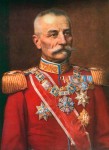
King Peter I of Serbia (via Wikipedia)

King Peter I of Serbia (via Wikipedia)

King Alexander and Queen Draga had no children and the Queen’s brother was widely assumed to be the heir-presumptive. Both of the queen’s brothers and several government officials were killed in the purge following the assassinations. These actions ended the Obrenović dynasty, as Alexander was succeeded by King Peter I, of the Karađorđević dynasty (Serbia had the misfortune of having two rival royal families from the early 1800’s to the assassination of Alexander I). King Peter’s father had been Prince of Serbia until his abdication in 1858, after which the family lived in exile. Under the pseudonym Pierre or Peter Kara, Peter had served as a junior officer on the French side in the Franco-Prussian War. Using a different pseudonym, he lead a guerilla unit against Ottoman troops in Bosnia and Herzegovina between 1875 and 1878. In 1883, he married the eldest daughter of the King of Montenegro. Through the connection between the royal families of Russia and Montenegro, two of his sons were enrolled in the Russian military academy.

Whether through fear of suffering the same kind of violent death as his predecessor or through a genuine belief in liberalization, King Peter’s early reign was marked by a return to more democratic representation and parliamentary control of the government. The Austrian government had been on relatively good terms with the former king, and viewed the increasing democratization in Serbia as a dangerous trend (for fear it would give more impetus to demands for autonomy not only in Bosnia, but also in other Slavic areas of the empire). The Wikipedia entry for King Peter’s reign is just a tad over-enthusiastic:

The Western-educated King attempted to liberalize Serbia with the goal of creating a Western-style constitutional monarchy. King Petar I became gradually very popular for his commitment to parliamentary democracy that, in spite of certain influence of military cliques in political life, functioned properly. The 1903 Constitution was a revised version of 1888 Constitution, based on the Belgian Constitution of 1831, considered as one of the most liberal in Europe.The governments were chosen from the parliamentary majority, mostly from People’s Radical Party (Narodna radikalna stranka) led by Nikola P. Pašić and Independent Radical Party (Samostalna radikalna stranka), led by Ljubomir Stojanović. King Peter himself was in favor of a broader coalition government that would boost Serbian democracy and help pursue an independent course in foreign policy. In contrast to Austrophile Obrenović dynasty, King Peter I was relying on Russia and France, which provoked rising hostility from expansionist-minded Austria-Hungary. King Peter I of Serbia paid two solemn visits to Saint-Petersbourg and Paris in 1910 and 1911 respectively, greeted as a hero of both democracy and national independence in the troublesome Balkans.

The reign of King Peter I Karadjordjević from 1903 to 1914, is remembered as the “Golden Age of Serbia” or the “Era of Pericles in Serbia”, due to the unrestricted political freedoms, free press, and cultural ascendancy among South Slavs who finally saw in democratic Serbia a Piedmont of South Slavs. King Peter I was supportive to the movement of Yugoslav unification, hosting in Belgrade various cultural gatherings. Grand School of Belgrade was upgraded into Belgrade University in 1905, with scholars of international renown such as Jovan Cvijić, Mihailo Petrović, Slobodan Jovanović, Jovan M. Žujović, Bogdan Popović, Jovan Skerlić, Sima Lozanić, Branislav Petronijević and several others.

The Black Hand: Serbia’s “plausibly deniable” interference in Bosnian affairs

The leader of the 1903 coup d’etat, former Captain, now Colonel Dragutin “Apis” Dimitrijević was in a key position indeed — he was the head of the Serbian Military Intelligence service in 1914. From that important post, he was able to conduct covert operations against the neighbouring empires with an eye to destabilization and eventual military action. In 1911, Apis established Ujedinjenje ili smrt! (the Black Hand) to enable him to conduct operations separate from — but with goals aligned with — the formal state organization. Another semi-secret pan-Slavic organization set up a few years earlier became a very valuable tool in the hands of Apis: Mlada Bosna (Young Bosnia).

Margaret MacMillan in The War That Ended Peace describes the kind of operations “Apis” set up and operated against Austria-Hungary and the Ottomans:

Within Serbia itself there was considerable support for the Young Bosnians and their activities. For a decade or more, parts of the Serbian government had encouraged the activities of quasi-military and conspiratorial organizations on the soil of Serbia’s enemies, whether the Ottoman Empire or Austria-Hungary. The army provided money and weapons for armed Serbian bands in Macedonia and smuggled weapons into Bosnia much as Iran does today with Hezbollah in Lebanon.

Margaret MacMillan describes the typical members of the Young Bosnians, who were of a type that we probably recognize more readily now than at any time since 1914:

[They] were mostly young Serb and Croat peasant boys who had left the countryside to study and work in the towns and cities of the Dual Monarchy and Serbia. While they had put on suits in place of their traditional dress and condemned the conservatism of their elders, they nevertheless found much in the modern world bewildering and disturbing. It is hard not to compare them to the extreme groups among Islamic fundamentalists such as Al Qaeda a century later. Like those later fanatics, the Young Bosnians were usually fiercely puritanical, despising such things as alcohol and sexual intercourse. They hated Austria-Hungary in part because they blamed it for corrupting its South Slav subjects. Few of the Young Bosnians had regular jobs. Rather they depended on handouts from their families, with whom they had usually quarreled. They shared their few possessions, slept on each other’s floors, and spent hours over a single cup of coffee in cheap cafés arguing about life and politics. They were idealistic, and passionately committed to liberating Bosnia from foreign rule and to building a new and fairer world. Strongly influenced by the great Russian revolutionaries and anarchists, the Young Bosnians believed that they could only achieve their goals through violence and, if necessary, the sacrifice of their own lives.

Apis and his Bosnian operators were determined to take advantage of the announced visit by Archduke Franz Ferdinand to the Bosnian capital of Sarajevo in June, 1914. The Archduke was the heir-presumptive to the throne of the Dual Monarchy and (contrary to what a lot of people believed at the time) a moderate who hoped to use his visit to reduce tension between the monarchy and the Slavic people in the southern fringe of the empire. He had already spoken against the empire taking military action against Serbia on more than one occasion after provocation … if he were not on the scene, Apis calculated, the chances of war went up significantly.

The stage is set, the pieces are starting to fall into place, and the curtain is about to go up.

« Newer PostsOlder Posts »
July 2026
S M T W T F S
 1234
567891011
12131415161718
19202122232425
262728293031  
  • Recent Comments
  • Red Ensign Brigade
    RedEnsign.gif
  • Categories
  • Most frequently used tags
  • Archives
  • Powered by WordPress