Quotulatiousness

August 23, 2014

Defining the “best tank of World War 2”

Filed under: Britain, France, Germany, History, Military, Russia, Technology, USA, WW2 — Tags: , , — Nicholas @ 11:14

Nigel Davies revisits one of the perpetual debates among amateur WW2 historians:

Let us start with the issue of tanks from the perspective of propaganda. More rubbish has been written about who had the best tanks during the Second World War than about any other topic to do with that war. Again and again you get supposedly serious historians talking about how the Germans started the Second World War with overwhelming tank superiority; that the Allies were only brought back into the race by the arrival of the Sherman tank; and how German technology leapt ahead again at the end of the Second World War to give them unrivalled vehicles. All these statements are of course completely incorrect.

One of the problems of course, is ‘best tank when, and for what?’

Comparing what was available in 1939/40 to what was being produced in 1945 (say a Panzer III or Matilda II with a Centurion or Stalin), is worse than useless. There is no comparison. Only the Panzer IV was actually produced throughout the war: and the heavily armoured final version of the tank — with a long barrelled 75mm gun capable of taking on almost every tank yet operational in mid 1945 — bore only a passing resemblance to the lightly armoured tank with a short barrelled infantry support gun — of with minimal ability to do more than scratch the paint of a CharB in 1939/40.

SOMUA 35 tank at Bovington Tank Museum (via Wikipedia)

SOMUA 35 tank at Bovington Tank Museum (via Wikipedia)

It’s relatively easy to do a quick measurables test comparing one tank against another: thickness and location of the armour, size and muzzle velocity of the main gun, engine horsepower, road speed, etc., but the very best tank on all of those measurements could still be beaten by an enemy using better combat tactics: the French SOMUA 35 and the British Matilda II were the best tanks in the world in 1939 and 1940 respectively (according to Davies). In spite of the superior measurables, the SOMUA 35 was incredibly limited by having the tank commander also be the gunner and loader and it lacked a radio for communication (and even if they had been so equipped, the already overworked tank commander would have had to be the radio operator, too). The Matilda was designed as an infantry tank, so it was very heavily armoured, but relatively slow and somewhat undergunned (the 40mm main gun only had solid shot for anti-armour use: there was no high explosive round for softer targets).

Matilda II at Yad la-Shiryon Museum (via Wikipedia)

Matilda II at Yad la-Shiryon Museum (via Wikipedia)

The Matilda and its successor the Valentine would probably still the best Allied tanks in the world in early 1941, when they swept Italian forces before them, and several times fought the German African corps to a standstill. The German response to their shocking failures in 1940, had been to upgrade the Panzer III and IV with slightly improved armour, and the short barreled 50 mm gun. But they were still on a losing wicket engaging the British infantry tanks in any sort of close terrain, such as in the siege of Tobruk. Fortunately for Rommel, out in the open terrain of the desert he could deploy his tanks behind screens of high-powered anti-tank guns, which the British tanks lacked the long-range high explosive shells to engage effectively.

It also helped that too many British cavalry officers in the desert war still had a “tally ho!” attitude and were frequently drawn into unsupported tank charges against German or Italian tanks who were able to draw the fast but lightly armoured British cruisers into easy killing range of their anti-tank guns.

M4A1 Sherman tank at Canadian Forces Base Borden (via Wikipedia)

M4A1 Sherman tank at Canadian Forces Base Borden (via Wikipedia)

This is where the myth of the value of the Sherman tank comes from. The Sherman arrived at a time when it’s armour and weapon were on a par with the Panzer III and IV tanks that it was facing. Despite the fact that its 75 mm gun was greatly inferior as an anti-tank weapon to the new British six pounder guns that were starting to equip British tanks, the high explosive shell that the Sherman could fire was incredibly useful for engaging Rommel’s 88 mm guns at long-distance in the flat desert terrain.

For several months, it seemed as though the mechanically reliable Sherman would be a war winner, despite its notable tendency to explode in flames whenever it was hit. (Allied troops refer to it as a Ronson — “lights first time every time”. German troops just referred to it as a “Tommy Cooker”.) But this concept was fantasy, which could be easily demonstrated within a few months, though it took the US government another two years to admit it.

[…]

T-34/85 at musée des blindés de Saumur (via Wikipedia)

T-34/85 at musée des blindés de Saumur (via Wikipedia)

In all of this so far, I have barely mentioned the Russians at all. Their T34 tank was possibly the single most effective of the war, and was the breakthrough that forced everyone else to rethink their designs. So we can say without a shadow of a doubt that the T34 was the best tank of the war for almost two years — from the time of Barbarossa (June 22, 1941) until the appearance of the Panther at Kursk (July 5, 1943). It certainly held this title unchallenged by the Sherman and Churchill tanks that appeared during its reign, and probably by the Tiger as well.

The Tiger is a problem for this sort of discussion, because it re-introduces the concept of ‘what for’ into the debate. The Tiger was a far superior heavy infantry support or assault tank to the T34, but a far inferior battlefield manoeuvre or pursuit tank. In fact the Tiger was so slow and limited in cross country ability, that it was actually more effective as a defensive weapon once the Germans were thrown back on that approach, than it had been for re-igniting their Blitzkreig glory days.

He sums up the post with a league table of “best tanks” for given years and purposes:

Having noted the necessary division between medium cruisers and heavy assault/infantry support tanks however, we can still make a fair summary.

So, in contrast to what many history books and documentaries will tell you, the French had the best tanks in 1939, and the British had the best tanks of 1940 and 1945. Also in contrast to what many history books will tell you, the Shermans effective front-line role can best be defined as the few months between the battle of Alamein, and the arrival of Tiger tanks in Tunisia. All attempts to use it after that in Italy or northern France just demonstrated how pathetic it was in modern engagements. Even the British Firefly version with the 17 pounder, was extremely vulnerable to any German tank. In fact it is amusing to note, that they came into their own for the blitzkrieg across open country in pursuit of the defeated German armies across France; which has a direct parallel to the inferior German tanks pursuing the defeated French in 1940. (The equally inadequate British Cromwell tanks, being significantly faster, were actually still better at this pursuit than the Shermans.) The best tank of the Sherman’s period of functional use, of course being the T34.

So our list of ‘best tanks’ could go something like this.
1939 — Best cruiser – Somua 35, Best support – CharB.
1940 — Best support becomes Matilda II.
1941 — Best cruiser initially Panzer III/IV with short 50mm guns, becomes T34 when Russia enters the war.
1942 — Best support is Tiger.
1943 — Best cruiser is Panther.
1944 — Best support is Tiger II.
1945 — Best ‘all purpose’ is Centurion.

August 20, 2014

Britain’s railway system under private and public ownership

Filed under: Britain, Economics, Railways — Tags: , , — Nicholas @ 08:13

At the Adam Smith Institute blog, Ben Southwood asks the question “What would we consider a successful railway system?”

Under many measures, the railways have performed remarkably since privatisation. It is not surprising that the British public would nevertheless like to renationalise them, given how ignorant we know they are, but it’s at least slightly surprising that large sections of the intelligentsia seem to agree.

Last year I wrote a very short piece on the issue, pointing out the basic facts: the UK has had two eras of private railways, both extremely successful, and a long period of extremely unsuccessful state control. Franchising probably isn’t the ideal way of running the rail system privately, but it seems like even a relatively bad private system outperforms the state.

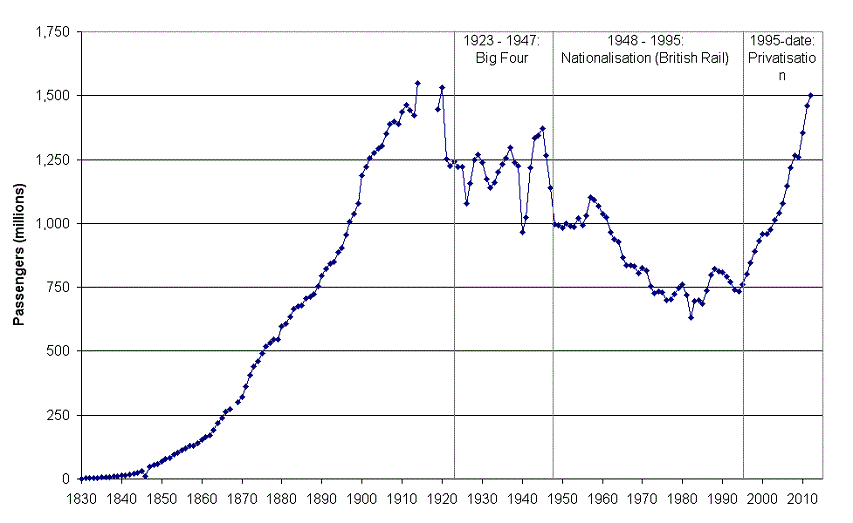
British railway passengers 1830-2010

Short history: approximately free market in rail until 1913, built mainly with private capital. Government control/direction during the war. Government decides the railways aren’t making enough profit in 1923 and reorganises them into bigger regional monopolies. These aren’t very successful (in a very difficult macro environment) so it nationalises them — along with everything else — in the late 1940s.

By the 1960s the government runs railways into the ground to the point it essentially needs to destroy or mothball half the network. Government re-privatises the railways in 1995 — at this point passenger journeys have reached half the level they were at in 1913. Within 15 years they’ve made back the ground lost in the previous eighty.

The radical nineteenth century notion of “policing by consent”

Filed under: Britain, History, Law, USA — Tags: — Nicholas @ 07:55

Techdirt‘s Tim Cushing links to an interesting post by Jason Kottke discussing the radical-for-the-time (and apparently radical for right now) idea of policing by consent:

The UK Parliament passed the first Metropolitan Police Act in 1829. The act was introduced by Home Secretary Sir Robert Peel, who undertook a study of crime and policing, which resulted in his belief that the keys to building an effective police force were to 1) make it professional (most prior policing had been volunteer in nature); 2) organize as a civilian force, not as a paramilitary force; and 3) make the police accountable to the public. The Metropolitan Police, whose officers were referred to as “bobbies” after Peel, was extremely successful and became the model for the modern urban police force, both in the UK and around the world, including in the United States.

At the heart of the Metropolitan Police’s charter were a set of rules either written by Peel or drawn up at some later date by the two founding Commissioners: The Nine Principles of Policing.

On 3 December, 2012, the Home Office released the following statement in response to a Freedom of Information request:

When saying ‘policing by consent’, the Home Secretary was referring to a long standing philosophy of British policing, known as the Robert Peel’s 9 Principles of Policing. However, there is no evidence of any link to Robert Peel and it was likely devised by the first Commissioners of Police of the Metropolis (Charles Rowan and Richard Mayne). The principles which were set out in the ‘General Instructions’ that were issued to every new police officer from 1829 were:

  1. To prevent crime and disorder, as an alternative to their repression by military force and severity of legal punishment.
  2. To recognise always that the power of the police to fulfil their functions and duties is dependent on public approval of their existence, actions and behaviour and on their ability to secure and maintain public respect.
  3. To recognise always that to secure and maintain the respect and approval of the public means also the securing of the willing co-operation of the public in the task of securing observance of laws.
  4. To recognise always that the extent to which the co-operation of the public can be secured diminishes proportionately the necessity of the use of physical force and compulsion for achieving police objectives.
  5. To seek and preserve public favour, not by pandering to public opinion; but by constantly demonstrating absolutely impartial service to law, in complete independence of policy, and without regard to the justice or injustice of the substance of individual laws, by ready offering of individual service and friendship to all members of the public without regard to their wealth or social standing, by ready exercise of courtesy and friendly good humour; and by ready offering of individual sacrifice in protecting and preserving life.
  6. To use physical force only when the exercise of persuasion, advice and warning is found to be insufficient to obtain public co-operation to an extent necessary to secure observance of law or to restore order, and to use only the minimum degree of physical force which is necessary on any particular occasion for achieving a police objective.
  7. To maintain at all times a relationship with the public that gives reality to the historic tradition that the police are the public and that the public are the police, the police being only members of the public who are paid to give full time attention to duties which are incumbent on every citizen in the interests of community welfare and existence.
  8. To recognise always the need for strict adherence to police-executive functions, and to refrain from even seeming to usurp the powers of the judiciary of avenging individuals or the State, and of authoritatively judging guilt and punishing the guilty.
  9. To recognise always that the test of police efficiency is the absence of crime and disorder, and not the visible evidence of police action in dealing with them.

Essentially, as explained by the notable police historian Charles Reith in his ‘New Study of Police History ‘in 1956, it was a philosophy of policing ‘unique in history and throughout the world because it derived not from fear but almost exclusively from public co-operation with the police, induced by them designedly by behaviour which secures and maintains for them the approval, respect and affection of the public’.

It should be noted that it refers to the power of the police coming from the common consent of the public, as opposed to the power of the state. It does not mean the consent of an individual. No individual can chose to withdraw his or her consent from the police, or from a law.

Tim Cushing comments on the US interpretation in current use:

You can choose anything on this list and find its correlating inversion on display in the US. Not once is “officer safety” cited as a reason to use physical force. Not once does the list make a demand for unearned respect. And above all, it makes it clear that this power is granted by the consent of the public, not provided by the State. What the public gives, it can rescind. The government’s only involvement is administrative.

US police forces talk a good game in mission statements about “honor” and “integrity,” but not once do they acknowledge the fact that they are servants of the public or that they are, in fact, just the public in different clothing. They are part of the government, an institution which derives from the consent of the governed. But there is no way to revoke that consent. Police unions and government officials continue to shelter misbehaving officers and any punishments handed down are delayed and largely ineffective in deterring future misconduct. With rare exceptions, police officials circle the wagons when one of theirs is accused of excessive force or criminal activity. The public is treated as irritating, ungrateful outsiders who don’t realize how difficult it is to be a cop and who are better surveilled than heard.

August 19, 2014

The Prime Minister’s statement on the 72nd anniversary of Operation Jubilee

Filed under: Cancon, Europe, France, History, Military, WW2 — Tags: — Nicholas @ 08:51

It was a bloody shambles, but we still remember the bravery and sacrifice of the troops who went ashore at Dieppe in 1942:

On August 19, 1942, nearly 5,000 Canadian troops, along with British and American Allies, undertook a raid on Dieppe to test new equipment, probe the strength of German defences and gain the experience necessary for a larger amphibious assault.

The majority of the forces that attacked that day at five different points along the 16 km front encountered stiff resistance, unexpected obstacles, and a well-entrenched, well-prepared enemy. The Canadians fought on, through machine gun fire, mortar barrages, and sniper and air attacks.

The lessons learned at Dieppe and subsequent landings proved invaluable for the D-Day invasion and were instrumental in saving countless lives on June 6, 1944. Sadly, the Raid on Dieppe came at a steep price for Canadian participants, with 916 making the ultimate sacrifice and 1,900 taken as prisoners of war.

On this solemn day, let us remember the courage and sacrifice of the thousands of Canadians who fought with bravery and determination at Dieppe to free Europe from Nazi tyranny and ensure the peace and freedom that we enjoy today.

Lest we forget.

August 18, 2014

Worstall confirms that “the UK would lose 3 million jobs in the year it left the European Union”

Filed under: Britain, Business, Economics, Europe — Tags: , , — Nicholas @ 09:15

There you go … proof positive that the UK cannot possibly, under any circumstances, leave the European Union. Except for the fact that the UK would lose 3 million jobs in the year even if it stayed with the EU, because that’s how many jobs it normally loses in a year:

UK Would Not Lose 3 Million Jobs If It Left The European Union

Well, of course, the UK would lose 3 million jobs in the year it left the European Union because the UK loses 3 million jobs each and every year. Roughly 10% of all jobs are destroyed in a year and the economy, generally, tends to create 3 million jobs a year as well. But that’s not the point at contention here which is the oft repeated claim that because we left the EU then therefore the UK economy would suddenly be bereft of 3 million jobs, that 10% of the workforce. And sadly this claim is a common one and it just goes to show that there’s lies, damned lies and then there’s politics.

The way we’re supposed to understand the contention is that there’s three million who make their living making things that are then exported to our partners in the European Union. And we’re then to make the leap to the idea that if we did leave the EU then absolutely none of those jobs would exist: leaving the EU would be the same as never exporting another thing to the EU. This is of course entirely nonsense as any even random reading of our mutual histories would indicate: what became the UK has been exporting to the Continent ever since there’s actually been the technology to facilitate trade. Further too: there have been finds in shipwrecks in the Eastern Mediterranean of Cornish tin dating from 1,000 BC, so it’s not just bloodthirsty and drunken louts that we’ve been exporting all these years.

“It’s strange that the oldest literature becomes the model for the digital age”

Filed under: Books, Greece, History, Media — Tags: , — Nicholas @ 09:04

Harvard University Press is putting all 520 volumes of the Loeb Classical Library online beginning in September:

When James Loeb designed his soon-to-be-launched series of Greek and Roman texts at the turn of the twentieth century, he envisioned the production of volumes that could easily fit in readers’ coat pockets. A century later, that compact format is still one of the collection’s hallmarks. Beginning in September, however, the iconic books will be far handier than Loeb had hoped: users of the Loeb Classical Library (LCL) will have the entire collection at their fingertips. After five years of dedicated work on the part of the library’s trustees and Harvard University Press (HUP), which has overseen LCL since its creator’s death in 1933, the more than 520 volumes of literature that make up the series will be accessible online. Besides allowing users to browse the digitized volumes, which retain the unique side-by-side view of the original text and its English translation, the Digital Loeb Classical Library will enable readers to search for words and phrases across the entire corpus, to annotate content, to share notes and reading lists with others, and to create their own libraries using personal workspaces.

LCL managing editor Michael Sullivan, whose position was created earlier this year to supervise the virtual library, said that the digitization project is “a major leap forward in the history of the Loeb.” According to HUP executive editor-at-large Sharmila Sen, the launch of the digital LCL marks “a moment of rebirth” for the historic collection. She explained that in the years preceding the library’s 2011 centenary, the trustees and HUP administrators began to think about how to make the LCL “relevant to the twenty-first century.” Even though online databases of Greek and Latin literature have existed for years, said the library’s general editor, Jeffrey Henderson, a classics professor at Boston University, the digital Loeb will be unprecedented in its accessibility and scope: for the first time, readers without knowledge of Greek and Latin will be able to explore a vast range of the classical literary heritage online through high-quality, modern translations. He added that the project, which cost the LCL foundation more than $1 million, will serve as a model for the digitization of other HUP series, noting, “It’s strange that the oldest literature becomes the model for the digital age.”

Consolidating a vast literary corpus involving two different alphabets into an interconnected, elegant, and easy-to-use website required much behind-the-scenes work, Sen said. Designing the software for the digital library and transferring the data have concluded, she noted, but the project overseers view the current product — which will be available by subscription to institutions and individuals — as only a 1.0 version. The website will be a dynamic workspace, Henderson pointed out, adding that user feedback will help the editors increase its functionality.

H/T to Colby Cosh for the link.

Who is to blame for the outbreak of World War One? (Part eleven of a series)

Filed under: Europe, Germany, History, Russia, WW1 — Tags: , , , , — Nicholas @ 00:01

You can catch up on the earlier posts in this series here (now with hopefully helpful descriptions):

  1. Why it’s so difficult to answer the question “Who is to blame?”
  2. Looking back to 1814
  3. Bismarck, his life and works
  4. France isolated, Britain’s global responsibilities
  5. Austria, Austria-Hungary, and the Balkan quagmire
  6. The Anglo-German naval race, Jackie Fisher, and HMS Dreadnought
  7. War with Japan, revolution at home: Russia’s self-inflicted miseries
  8. The First Balkan War
  9. The Second Balkan War
  10. The Entente Cordiale, Moroccan crises, and the influence of public opinion

We left the Austro-Hungarian Empire in a state of ferment back in part five, having undergone a near-death constitutional stroke in 1867, resulting in a bi-polar domestic and even world outlook to accommodate the newly redefined Dual Monarchy, and dangerously inconsistent treatment of their respective ethnic, linguistic, and religious minorities in the Cisleithanic (Austrian) and Transleithanic (Hungarian) “halves” of the empire. This might not have mattered much in the long run if the empire hadn’t been summarily extended in 1908 with the addition of new territory on the southern border of the empire.

Administration turns into annexation

Under the terms of the 1878 Treaty of Berlin, Austria-Hungary had been administering the Ottoman provinces of Bosnia and Herzegovina, with the provision that they would be returned at some future date when the stability of the occupied territories had been re-established. In 1908, however, something happened which drove the Austro-Hungarians into a panic: the somnolent Ottoman government was faced with a revolutionary movement called the Young Turks.

Since 1878, the Sultan had ruled without a parliament, having suspended the General Assembly and ending the short-lived First Constitutional Era. The Young Turks were an unlikely alliance of Turkish nationalists, reformers, pro-Western modernizers, and certain national minorities including Armenians and Greeks: in short, anyone with a grievance against the Sultan, the administration, or the general state of life in the empire. The Young Turks forced the Sultan to restore the 1876 constitution and recall the general assembly. They also announced plans to call elections throughout the empire, including the Austrian-occupied territories.

Map of South-Eastern Europe after the Congress of Berlin, 1878 (via Wikipedia)

Map of South-Eastern Europe after the Congress of Berlin, 1878 (via Wikipedia)

Austro-Hungarian foreign minister Count Alois von Aehrenthal (via Wikipedia)

Austro-Hungarian foreign minister Count Alois von Aehrenthal (via Wikipedia)

Bosnia and Herzegovina had no existing representation of any sort — with the Ottomans or with the Austrians — and it was feared that the Young Turks, having created representation in the two vilayets would then demand their return to Ottoman control. Austria’s foreign minister, Count Alois von Aehrenthal began to make urgent plans to annex Bosnia and Herzegovina. In The Sleepwalkers, Christopher Clark outlines Aehrenthal’s actions:

In order to forestall any such complications [a push by the Young Turks to reclaim the provinces], Aehrenthal moved quickly to prepare the ground for annexation. The Ottomans were bought out of their nominal sovereignty with a handsome indemnity. Much more important were the Russians, upon whose acquiescence the whole project depended. Aehrenthal was a firm believer in the importance of good relations with Russia — as Austrian ambassador in St. Petersburg during the years 1899-1906, he had helped to consolidate the Austro-Russian rapprochement. Securing the agreement of the Russian foreign minister, Alexandr Izvolsky, was easy. The Russians had no objection to the formalization of Austria-Hungary’s status in Bosnia-Herzegovina, provided St. Petersburg received something in return. Indeed it was Izvolsky, with the support of Tsar Nicholas II, who proposed that the annexation of Bosnia-Herzegovina be exchanged for Austrian support for improved Russian access to the Turkish Straits.

Russian foreign minister Count Alexandr Petrovich Izvolsky (via Wikipedia)

Russian foreign minister Count Alexandr Petrovich Izvolsky (via Wikipedia)

In 1908, having successfully negotiated Russian support for the move, Austria-Hungary swallowed the two provinces and added them to the empire. Then things went horribly, horribly wrong for Aehrenthal and Austria-Hungary. The reaction to annexation was far more angry and widespread than Aehrenthal had expected, the other Treaty signatories demanded answers … and Izvolsky bolted for cover:

Despite these preparations, Aehrenthal’s announcement of the annexation on 5 October 1908 triggered a major European crisis. Izvolsky denied having reached any agreement with Aehrenthal. He subsequently even denied that he had been advised in advance of Aehrenthal’s intentions, and demanded that an international conference be convened to clarify the status of Bosnia-Herzegovina.

In his recent article in History Today, Vernon Bogdanor explains the reaction to this less-than-legal Austro-Hungarian swallowing act:

The annexation […] was a breach of the treaty and of international law. It would have significant consequences. The first was that it made non-Slav rule in Bosnia appear permanent, since the Austro-Hungarian Empire was far more durable than the Ottoman Empire. The annexation was a particular blow to the independent south Slav state of Serbia, which objected. Second, the annexation made the southern Slav issue an international problem, since it involved Serbia’s ally, Russia, which saw itself as the protector of the Slavs. In March 1909 Austria demanded, under threat of war, that Serbia accept the annexation, while Germany told Russia that, in case of war, it would take Austria’s side.

Britain helped persuade Serbia and Russia to back down. The great powers accepted the annexation. The Kaiser, unwisely perhaps, boasted in Vienna in 1910 that he had come to Austria’s side as a ‘knight in shining armour’.

The deciding factor in settling the issue of annexation turned out to be the active involvement of the German government in providing diplomatic pressure on Russia, as Christopher Clark explains:

The issue was resolved only by the “St. Petersburg note” of March 1909, in which the Germans demanded that the Russians at last recognize the annexation and urge Serbia to do likewise. If they did not, Chancellor Bülow warned, then things would “take their course”. This formulation hinted not just at the possibility of an Austrian war on Serbia, but, more importantly, at the possibility that the Germans would release the documents proving Izvolsky’s complicity in the original annexation deal. Izvolsky immediately backed down.

At the time, Aehrenthal took the blame for this fiasco, at least to some degree for his preference for secret deals and understandings. He may have been correct that there was no chance that the other signatories to the Treaty of Berlin would accept the Austrian proposal, but when it all became public, it tarnished his reputation directly and Austria-Hungary’s reputation generally.

Russia hardly came out improved in standing either. As Christopher Clark put it, “the evidence suggests that the crisis took the course that it did because Izvolsky lied in the most extravagant fashion in order to save his job and reputation.” This embarrassing incident at least partially explains why Russia became far more concerned about the fate of the south Slavic populations — having signally failed them once in 1908, Russia could not afford to look like they were going to fail them in future conflicts without forfeiting any influence or control over events in the Balkans. Clark explains the toxic combination of official misinformation, rising political awareness of the Russian middle classes, and the indirect power of the newspapers:

Intense public emotions were invested in Russia’s status as protector of the lesser Slavic peoples, and underlying these in the minds of the key decision-makers was a deepening preoccupation with the question of access to the Turkish Straits. Misled by Izvolksy and fired up by chauvinist popular emotion, the Russian government and public opinion interpreted the annexation as a brutal betrayal of the understanding between the two powers, an unforgivable humiliation and an unacceptable provocation in a sphere of vital interest. In the years that followed the Bosnian crisis, the Russians launched a programme of military investment so substantial that it triggered a European arms race.

Another important question in the wake of the annexation crisis was how Austria-Hungary would placate Serbia. Margaret MacMillan, in The War That Ended Peace outlines the rather small pickings Serbia was offered:

The most difficult issue to settle in the aftermath of the annexation was the question of compensation for Serbia, complicated by the fact that Russia was backing Serbia’s demands and Germany was supporting Austria-Hungary. The most Aehrenthal was prepared to offer Serbia was some economic concessions such as access to a port on the Adriatic, but only if Serbia recognized the annexation and agreed to live on peaceful terms with Austria-Hungary. The Serbian government remained intransigent and, as spring melted the snows in the Balkans, the talk of war mounted again around Europe’s capitals. […] In St. Petersburg, Stolypin, who remained opposed to war, told the British ambassador at the start of March that Russian public opinion was so firmly in support of Serbia that the government would not be able to resist coming to its defense: “Russia would have, in that case, to mobilise, and a general conflagration would then be imminent.”

War was averted in 1908, but the issues that arose (or were exacerbated) during the Bosnian crisis were almost all still significant in 1914. As a dress rehearsal, 1908 went down fairly well: only diplomatic force was exerted, but it showed some of the limits of mere diplomacy and foreshadowed the crisis of July 1914.

August 17, 2014

“Down on the Farm” by Charles Stross

Filed under: Books, Britain, Bureaucracy, Humour, Media — Tags: , , — Nicholas @ 10:06

I’m quite a fan of the “Laundry” series of SF/horror stories by Charles Stross. I thought I’d read all of them (well, all that have been released, anyway), but a discussion thread on the Lois McMaster Bujold mailing list alerted me that I hadn’t read “Down on the Farm“, which is available for free on the Tor.com website:

Ah, the joy of summer: here in the south-east of England it’s the season of mosquitoes, sunburn, and water shortages. I’m a city boy, so you can add stifling pollution to the list as a million outwardly mobile families start their Chelsea tractors and race to their holiday camps. And that’s before we consider the hellish environs of the Tube (far more literally hellish than anyone realizes, unless they’ve looked at a Transport for London journey planner and recognized the recondite geometry underlying the superimposed sigils of the underground map).

But I digress…

One morning, my deputy head of department wanders into my office. It’s a cramped office, and I’m busy practicing my Frisbee throw with a stack of beer mats and a dart-board decorated with various cabinet ministers. “Bob,” Andy pauses to pluck a moist cardboard square out of the air as I sit up, guiltily: “a job’s just come up that you might like to look at—I think it’s right up your street.”

The first law of Bureaucracy is, show no curiosity outside your cubicle. It’s like the first rule of every army that’s ever bashed a square: never volunteer.

If you ask questions (or volunteer) it will be taken as a sign of inactivity, and the devil, in the person of your line manager (or your sergeant) will find a task for your idle hands. What’s more, you’d better believe it’ll be less appealing than whatever you were doing before (creatively idling, for instance), because inactivity is a crime against organization and must be punished. It goes double here in the Laundry, that branch of the British secret state tasked with defending the realm from the scum of the multiverse, using the tools of applied computational demonology: volunteer for the wrong job and you can end up with soul-sucking horrors from beyond spacetime using your brain for a midnight snack. But I don’t think I could get away with feigning overwork right now, and besides: he’s packaged it up as a mystery. Andy knows how to bait my hook, damn it.

August 14, 2014

The decline of the British pub won’t be stopped by more rules and regulations

Filed under: Britain, Business — Tags: , , , — Nicholas @ 10:01

In sp!ked, Rossa Minogue agrees with the Campaign for Real Ale that the British pub as a fixture of daily life is in rapid decline, but warns that CAMRA’s proposed remedy will not turn things around:

Britain’s pubs are in peril. In 1982, there were almost 68,000 pubs in the UK; today there are fewer than 55,000. They continue to close at a rate of 31 a week.

Pubs in the suburbs are said to be worst affected, with three per cent of all suburban pubs having closed in the past six months alone. A report by the Campaign for Real Ale (CAMRA) blames the closures on lax planning regulations that allow pubs to be bought and converted into other kinds of businesses without having to seek permission from the local council. CAMRA’s answer is to call for more planning regulations that would make it difficult to convert your favourite boozer into a Tesco Metro. Publicans have blamed cheap supermarket booze for eating into their revenues and have backed calls for minimum pricing to make drinking at home less attractive. There are no doubt many other factors at work. The ubiquity of mobile phones, for one, makes it easier to arrange a meeting with a friend at short notice, which means the idea of being the ‘regular’ who pops into a ‘local’ unannounced in the hope of bumping into someone one knows is becoming a thing of the past.

Further regulation, however, is not the answer. In fact, as demonstrated by their enthusiastic support for the smoking ban, CAMRA has failed to see that regulations are one of the main things that are killing pubs. Stricter planning laws would do little to address the underlying reasons why pubs are closing. After all, if pubs were drawing the crowds they needed to be viable, why would they be selling up in the first place? Rising rents have been cited as a cause, but the businesses lining up to take over pub premises don’t seem to have a problem paying them.

Pub culture is under threat, but not by greedy property developers desperate to turn every suburban highstreet into a row of Costa Coffees. Rather, the threat comes from the degradation of public life, a process nudged along by a state that disapproves of our habits.

Who is to blame for the outbreak of World War One? (Part ten of a series)

Filed under: Africa, Britain, Europe, France, Germany, History, Military, Russia, WW1 — Tags: , , , — Nicholas @ 00:02

We’re edging ever close to the start of the Great War (no, I don’t know exactly how many more parts this will take … but we’re more than halfway there, I think). You can catch up on the earlier posts in this series here (now with hopefully helpful descriptions):

  1. Why it’s so difficult to answer the question “Who is to blame?”
  2. Looking back to 1814
  3. Bismarck, his life and works
  4. France isolated, Britain’s global responsibilities
  5. Austria, Austria-Hungary, and the Balkan quagmire
  6. The Anglo-German naval race, Jackie Fisher, and HMS Dreadnought
  7. War with Japan, revolution at home: Russia’s self-inflicted miseries
  8. The First Balkan War
  9. The Second Balkan War

The Balkans were the setting for two major wars among the regional powers (Serbia, Greece, Montenegro, Bulgaria, Rumania, and the Ottoman Empire), but the wars had not spread to the rest of the continent. This run of good luck was not going to last much longer. We turn our attention to Britain, France, and Russia … as unlikely a set of allies as you’d find in the 1880s, now in the process of discovering a common threat in Europe.

Sir Edward Grey and Britain’s progress from “splendid isolation” to official ambivalence

The British government had spent most of the previous century staying out of continental disputes, only rarely becoming politically or militarily involved. Late in the nineteenth century, this began to change, and Britain started paying closer attention to what was happening on the continent and moving slowly toward re-engagement. While the British and the French had spent more time as enemies or as mutually distrustful neutrals, France was now looking across the Channel for much more than mere neutrality.
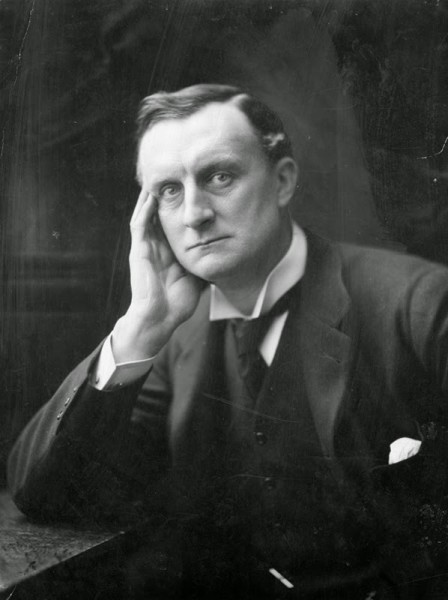
Sir Edward Grey, British Foreign Secretary 1905-1916

Sir Edward Grey, British Foreign Secretary 1905-1916

A key figure in negotiating Britain’s relationship with France was Sir Edward Grey, who was Foreign Secretary from 1905 onwards (despite the minor difficulty of speaking no other languages and having no interest in visiting other countries). In retrospect, the degree of freedom he was allowed in this role is amazing, especially as he didn’t seem to think he was required to let the prime minister, the cabinet, or parliament know what he was doing until he’d arranged things largely to his own satisfaction. Huw Strachan assigns most of the responsibility for the deepening relationship with France to Grey:

Sir Edward Grey had become foreign secretary on the formation of the Liberal government in December 1905, and remained in post until the end of 1916, so becoming the longest-serving holder of the post. Sir Edward brought diplomatic gravitas to his work in 1914. He had already convened the meeting of ambassadors that had contained and concluded the two Balkan wars of 1912-13. When the assassination of Archduke Franz Ferdinand at Sarajevo on June 28 prompted a third Balkan crisis, it seemed unlikely to have any direct effect on British interests, but Sir Edward might still prove central to its resolution. If the “concert of Europe”, the international order created in 1814-15 after the Napoleonic wars, still had life, the foreign secretary was the person best placed to animate it.

Sir Edward’s qualifications for such responsibility were of recent coinage. Notoriously idle as a young man, he had been sent down from Oxford, but returned to get a third in jurisprudence. He entered politics as much through Whig inheritance as ambition. He spoke no foreign language and, when foreign secretary, never travelled abroad – or at least not until he had to accompany King George V to Paris in April 1914. He seemed happier as a country gentleman, enjoying his enthusiasms of fishing and ornithology. His first wife increasingly refused to come to London, remaining at Fallodon, the family seat in Northumberland. Their life together was chaste and childless, but not unaffectionate.

Soon after becoming Foreign Secretary, Grey was careful to assure Russian ambassador Count Alexander Benckendorff that he wanted a closer and less fraught relationship with St. Petersburg. Britain’s long-running dispute with the expanding Russian Empire in Asia stood in the way of any co-operation between the two great powers: the “Great Game” across central Asia had been in progress for nearly a century and neither side trusted the other. British concerns that any advance of Russian interests across that vast swathe of land were part of long term plans to destabilize the Indian frontier and eventually to absorb India. Whether these fears were realistic is beside the point: they had driven Raj policy in India despite the low chance of them turning into actual dangers. The disagreements were partially settled with the Anglo-Russian Convention in 1907, where both Russian and British regional interests were codified:

Formally signed by Count Alexander Izvolsky, Foreign Minister of the Russian Empire, and Sir Arthur Nicolson, the British Ambassador to Russia, the British-Russian Convention of 1907 stipulated the following:

  1. That Persia would be split into three zones: A Russian zone in the north, a British zone in the southeast, and a neutral “buffer” zone in the remaining land.
  2. That Britain may not seek concessions “beyond a line starting from Qasr-e Shirin, passing through Isfahan, Yezd (Yazd), Kakhk, and ending at a point on the Persian frontier at the intersection of the Russian and Afghan frontiers.”
  3. That Russia must follow the reverse of guideline number two.
  4. That Afghanistan was a British protectorate and for Russia to cease any communication with the Emir.

A separate treaty was drawn up to resolve disputes regarding Tibet. However, these terms eventually proved problematic, as they “drew attention to a whole range of minor issues that remained unsolved”.
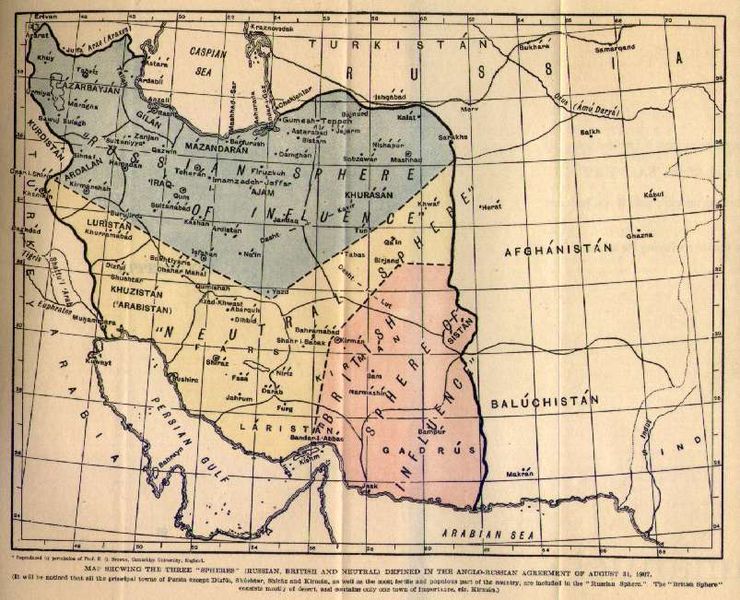
Anglo-Russian spheres of influence in Persia, 1907 (via Wikipedia)

Anglo-Russian spheres of influence in Persia, 1907 (via Wikipedia)

While the convention did not resolve every outstanding issue between the two imperial powers, it smoothed the path to further negotiations on European issues. One of the things the two had to consider was the expansion of German activity in Ottoman territory, especially the Baghdad Railway project, which threatened to extend German influence deep into the oil producing regions of Mesopotamia just as Britain was contemplating switching the Royal Navy from coal to oil. German engineers and financiers had already proven their worth to the Ottomans by building the Anatolian Railway in the 1890s, connecting Constantinople with Ankara and Konya.

Vernon Bogdanor’s recent History Today article explains Grey’s role in bringing Britain into the war alongside the French and Russians:

The growth of German power posed a challenge to an international system based on the Concert of Europe, developed at the Congress of Vienna following the defeat of Napoleon, whereby members could call a conference to resolve diplomatic issues, a system Britain, and particularly the Liberals in government in 1914, were committed to defend. Sir Edward Grey had been foreign secretary since 1905, a position he retained until 1916, the longest continuous tenure in modern times. He was a right-leaning Liberal who found himself subject to more criticism from his own backbenchers than from Conservative opponents. In his handling of foreign policy his critics alleged that Grey had abandoned the idea of the Concert of Europe and was worshipping what John Bright had called ‘the foul idol’ of the balance of power. They suggested that he was making Britain part of an alliance system, the Triple Entente, with France and Russia and that he was concealing his policies from Parliament, the public and even from Cabinet colleagues. By helping to divide Europe into two armed camps he was increasing the likelihood of war.

On his appointment in December 1905 Grey had indeed maintained the loose Anglo-French entente of 1904, which the Conservatives of the previous government had negotiated. He extended that policy by negotiating an entente with France’s ally, Russia, in 1907. In 1905 France was embroiled in a conflict with Germany over rival claims in Morocco. The French had essentially said to Lord Lansdowne, Grey’s Conservative predecessor: ‘Suppose this conflict leads to war – if you are to support us, let us consult together on naval matters to consider how your support can be made effective.’ The Conservatives had responded that, while they would discuss contingency plans, they could not make any commitments.

Grey continued the naval conversations and extended them to include military dialogue. He informed the prime minister, Sir Henry Campbell Bannerman, and two senior ministers of these talks, but not the rest of the Cabinet. Nevertheless, Britain could not be committed to military action without the approval of both Cabinet and Parliament. In November 1912, at the insistence of the Cabinet, there was an exchange of letters between Grey and the French ambassador, Paul Cambon, making it explicit that Britain was under no commitment, except to consult, were France to be threatened. In 1914, furthermore, the French never suggested that Britain was under any sort of obligation to support them, only that it would be the honourable course of action.

Romancing the bear, romancing the lion: France breaks out of imposed isolation

As I discussed back in part four of this series, the French had been left diplomatically isolated in Europe by German Chancellor Otto von Bismarck, but that began to change as Kaiser Wilhelm II took the throne and started imposing his will on German foreign policy. French money opened opportunities for French diplomacy, to the long-term benefit of French security. The Franco-Russian alliance was signed in 1894, signifying the end of French encirclement (Bismarck’s policy) and the start of German encirclement (Kaiser Wilhelm’s nightmare).
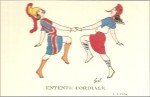
Britannia and Marianne dancing together on a 1904 French postcard: a celebration of the signing of the Entente Cordiale. (via Wikipedia)

Britannia and Marianne dancing together on a 1904 French postcard: a celebration of the signing of the Entente Cordiale. (via Wikipedia)

Anglo-French diplomatic efforts took longer to come to fruition, but by 1904, the Entente Cordiale was more than just a pleasant diplomatic nicety, although it fell short of the full alliance France had hoped for. Among other things, the agreement traded French acceptance of Britain’s position in Egypt for British acceptance of France’s position in Morocco, along with some border adjustments in west Africa, fishing rights off the coast of Newfoundland, and other issues. The Entente also allowed the two great powers to avoid being involved in the Russo-Japanese War (discussed in part seven), where they were each allied to the opposing powers. Each side saw the agreement in rather different terms, with the French believing it was the next best thing to an alliance, but as British foreign ministry staffer Eyre Crowe expressed it: “The fundamental fact of course is that the Entente is not an alliance. For purposes of ultimate emergencies it may be found to have no substance at all. For the Entente is nothing more than a frame of mind, a view of general policy which is shared by the governments of two countries, but which may be, or become, so vague as to lose all content.”

French public opinion was still ambivalent at best about Britain — the PR and humanitarian disaster that was the Boer War had only just faded from the headlines, and there was still much resentment over the Fashoda incident — but the French government recognized the importance of gaining British support (and the British government was conscious of how low their international reputation had gone). Huw Strachan:

The previous Conservative government had in 1895 moved from “splendid isolation” to embrace the need to form alliances. But it was Sir Edward who narrowed these options by excluding the possibility of a deal with Germany. As a Liberal Imperialist, concerned by the evidence of British decline in the South African war, Sir Edward increasingly fixed Britain to France and then to Russia. The latter relationship may have looked frayed by 1914, but that with France was buttressed by military and naval talks. The result was not so much a balance of power in Europe as the isolation of Germany.

Moroccan crises and using the Kaiser as a bargaining chip

The First Moroccan Crisis of 1905-6 was a potential flashpoint between the Entente Cordiale and the German Empire. Germany was hoping to split the Entente or at least to gain territorial concessions in exchange for a resolution. Kaiser Wilhelm was on a cruise to the Mediterranean and had been intending to bypass Tangier, but the situation was manipulated by the Foreign Office in Berlin so that he eventually felt he had to put in an appearance. In The War That Ended Peace, Margaret MacMillan describes the scene:

Although Bülow had repeatedly advised him to stick to polite formalities, Wilhelm got carried away in the excitement of the moment. To Kaid Maclean, the former British soldier who was the sultan’s trusted advisor, he said, “I do not acknowledge any agreement that has been come to. I come here as one Sovereign [sic] paying a visit to another perfectly independent sovereign. You can tell [the] Sultan this.” Bülow had also advised his master not to say anything at all to the French representative in Tangier, but Wilhelm was unable to resist reiterating to the Frenchman that Morocco was an independent country and that, furthermore, he expected France to recognize Germany’s legitimate interests there. “When the Minister tried to argue with me,” the Kaiser told Bülow, “I said ‘Good Morning’ and left him standing.” Wilhelm did not stay for the lavish banquet which the Moroccans had prepared for him but before he set off on his return ride to the shore, he found time to advise the sultan’s uncle that Morocco should make sure that its reforms were in accordance with the Koran. (The Kaiser, ever since his trip to the Middle East in 1898, had seen himself as the protector of all Muslims.) The Hamburg sailed on to Gibraltar, where one of its escort ships accidentally managed to ram a British cruiser.

Tension rose so high that both Germany and France were looking to their mobilization timetables (France cancelled all military leave and Germany started moving reserve units to the frontier) before the diplomats were able to agree to meet at the conference table rather than the battlefield. The Algeciras Conference lasted from January to April, 1906, and the French generally had the better of the negotiations (with support from Britain, Russia, Italy, Spain, and the United States) while the Germans found themselves supported only by the Austro-Hungarian delegation. France ended up making a few token concessions, but overall retained their position in Morocco.

The Agadir Crisis of 1911 was the second incident in Morocco, where Germany tried a little bit of literal gunboat diplomacy with the gunboat SMS Panther. The port of Agadir was closed to foreign trade, but the Panther (and later the light cruiser SMS Berlin) was sent to “protect German nationals” in southern Morocco from rebel forces. A minor problem turned out to be that there were no conveniently threatened Germans in the region. Margaret MacMillan:

The Foreign Ministry only got round to getting support for its claim that German interests and German subjects were in danger in the south of Morocco a couple of weeks before the Panther arrived off Agadir, when it asked a dozen German firms to sign a petition (which most of them did not bother to read) requesting German intervention. When the German Chancellor, Bethmann, produced this story in the Reichstag he was met with laughter. Nor were there any German nationals in Agadir itself. The local representative of the Warburg interests who was some seventy miles to the north started southwards on the evening of July 1. After a hard journey by horse along a rocky track, he arrived at Agadir on July 4 and waved his arms to no effect from the beach to attract the attention of the Panther and the Berlin. The sole representative of the Germans under threat in southern Morocco was finally spotted and picked up the next day.

France reacted to the German provocation, despite efforts by Sir Edward Grey to restrain them: eventually he recognized that “what the French contemplate doing is not wise, but we cannot under our agreement interfere”. German public opinion, on the other hand, was ecstatic:

After its setbacks earlier on in Morocco and in the race for colonies in general, with the fears of encirclement in Europe by the Entente powers, Germany was showing that it mattered. “The German dreamer awakes after sleeping for twenty years like the sleeping beauty,” said one newspaper.

[…]

In Germany, public opinion, which had been largely indifferent to colonies ten years earlier, now was seized with their importance. The German government, which was already under considerable pressure from those German businesses with interests in Morocco, felt that it had much to gain by taking a firm stand. […] The temptation for Germany’s new Chancellor, Theobald von Bethmann-Holweg, and his colleagues to have a good international crisis to bring all Germans together in support of their government was considerable.

Eventually, after negotiations, France and Germany signed the Treaty of Fez, which granted France Germany’s recognition of her rights in Morocco in exchange for ceded French territory in French Equatorial Africa (which was annexed to the existing German colony in Togoland), including direct access to the Congo River. In addition, Spain was granted rights to a portion of northern Morocco which became Spanish Morocco.

Not part of the treaty terms, but of rather greater significance in the near future, France and Britain agreed to share responsibility for the naval defence of France: the Royal Navy took on the responsibility for defending the north coast of France, while the French navy redeployed almost all ships to the western Mediterranean with the explicit agreement to defend British interests in the region.

I’m finding each successive part of this blog series to be taking longer to put together, and not from a lack of material! I’m hoping to have the next installment posted sometime this weekend or early next week.

August 12, 2014

The very different American and British baby booms

Filed under: Books, Britain, History, Media, USA — Tags: , , — Nicholas @ 00:02

In sp!ked, Jennie Bristow reviews P.J. O’Rourke’s latest book, The Baby Boom: How It Got That Way (And It Wasn’t My Fault) (And I’ll Never Do It Again).

For the British ‘Baby Boom’ was very different to its American sibling, in both respects of the word. Demographically, Britain – like many other Western countries immediately after the Second World War – experienced a spike in the birthrate, but this dropped back quickly until the mid-1950s, when there was a less dramatic, but more sustained, bulge over the next 10 years.

[…]

Size isn’t everything, however, and the other aspect of the Baby Boom label is the period of prosperity and growth that followed the war in the US. O’Rourke’s introduction to the UK edition of The Baby Boom points out another fact that tends to be ignored in the slating of the British Baby Boomers – that ‘postwar experience in America was very different from postwar experience in a place where war, in fact, occurred. That is, we had the “post-” and you had the war.’

[…]

Throughout the book, O’Rourke’s fond accounts of growing up during the Fifties, which are generally amusing and often stylistically annoying, hammer home the space, freedom, affluence and indulgence enjoyed by the American Baby Boomers as children. In Britain, accounts of the so-called ‘Golden Age’ of the Fifties tend to extend to children playing by the river and neighbours leaving their front doors unlocked, glossing over the more drab reality that kids did not have anything to play with inside, and that most homes were not worth burgling.

Given the divergence in experience between the British and American Baby Boomers, one might wonder how the American debate, about the problems of the Boomers’ size, wealth and health (which, many grumble, means they will live ‘too long’, robbing younger generations of their fair share of pensions and healthcare resources), became plonked on to Little Britain with scant regard for the differences.

The answer lies partly in what the US Boomers did share with their counterparts in the UK, and in parts of Europe, too. This was the experience of growing up in the tumultuous Sixties, when youth appeared to be in the vanguard of a cultural revolution that swept aside established norms and values, rejecting the authority of tradition and, above all, of adults.

Swiftly demolishing another great myth about the Sixties, O’Rourke points out that, in reality, ‘the Baby Boom was the tailgate party, not the team on the field’: ‘There was a lot of “talkin’ ‘bout my generation” (Pete Townshend, born 1945), but it wasn’t my generation that was causing “What’s Going On” (Marvin Gaye, born 1939) during the “Youthquake” (a coinage from Punch, edited by people born when mastodons roamed the earth).’

August 11, 2014

Ordinary British life before August 1914

Filed under: Britain, History, WW1 — Tags: , , — Nicholas @ 10:35

The Telegraph has an interesting series of short articles drawn from their 1914 archive, showing ordinary life in Britain before the start of World War One. This isn’t the upper-crust’s way of life we tend to see in TV and movie presentations of the immediate pre-war era:

A month before the outbreak of war Henley Regatta opened in “brilliant fashion”, The Daily Telegraph reported, with record crowds and “perfect” weather. It presents an image of Edwardian Britain as we fondly imagine it to have been, before the sudden cloudburst of August 1914.

Of course, the reality was far different for the 99 per cent of people who did not own land, collect rents or vacation at Biarritz and Marienbad. Most Edwardians worked in dark, noisy factories, cut hay in fields, toiled down dirty and dangerous mines; had bones bent by rickets and lungs racked by tuberculosis. Life expectancy then was 49 years for a man and 53 years for a woman, compared with 79 and 82 years today. They lived in back to back tenements or jerry-built terraces, wore cloth caps or bonnets (rather than boaters, bowlers and toppers) and they had never taken a holiday — beyond a day trip to Brighton or Blackpool — in their entire lives.

The country was a seething mass of social tension and violent confrontations. It was a land torn and dislocated by the struggle of increasingly militant suffragettes; strikes in mills, mines and on the railways; the constitutional battle between Lords and Commons; and the threat of civil war in Ireland.

Readers of the Telegraph — as a glance at the archives will reveal — were far better informed about the true state of their nation and the world than our sugary sentimental view allows us. In a dramatic scoop, the paper had published an exclusive interview with Kaiser Wilhelm II in October 1908 in which the Kaiser had expressed alarmingly frank — and hostile — views about his mother’s native land (the Kaiser’s mama, Empress Victoria, was Queen Victoria’s eldest daughter). In this interview the Kaiser accused “you English” of being “mad, mad, mad as March hares” for fearing that the construction of Germany’s High Seas Fleet was aimed at challenging the Royal Navy’s command of the world’s oceans. Implausibly, he claimed that Germany’s real target was the rising sun of Japan.

H/T to Marian L. Tupy for the link.

August 10, 2014

Who is to blame for the outbreak of World War One? (Part nine of a series)

Filed under: Europe, History, WW1 — Tags: , , — Nicholas @ 00:02

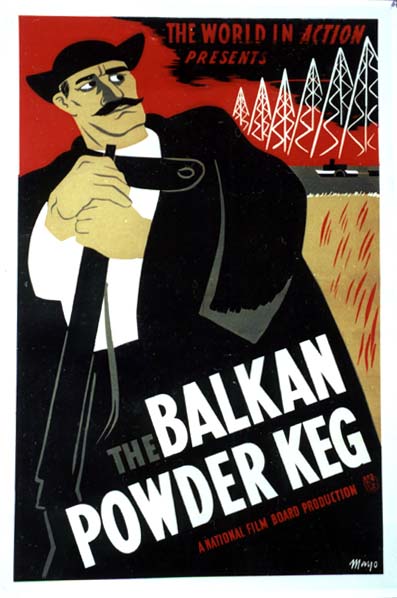
Balkan Powder KegThe “Balkan powder keg”. Is there a more over-used description from writers trying to describe the origins of World War One? Like most clichés, there’s more than just a hint of truth to it. Part eight of this (long, long) series discussed the start of a series of “small wars” that ended up being very significant as escalators leading towards the beginning of the Great War. You can catch up on the earlier posts in this series here: part one, part two, part three, part four, part five, part six, part seven and part eight. The Balkans are picturesque as heck, a tangled mass of ethnic, religious, and national interests, and a ready source of trouble for the rest of Europe. But right up to the end of July, 1914, most sensible people thought the most recent set of troubles would be resolved soon. After all, this was the age of reason, and nobody wanted to go to war over silly tribal differences…

Second Balkan War – The falling-out of the thieves

Shortly after the amazing success of the Balkan League’s fight against the Ottoman Empire, the victorious Balkan powers fell out over the spoils and went at it again, this time redrawing the borders to Bulgaria’s severe disadvantage (thanks in part to Romania joining in the fun). The war wasn’t inevitable, but the seeds were planted almost from the start of the fighting during the First Balkan War: secret agreements between the League allies to partition the yet-to-be-conquered lands were rapidly made obsolete by the facts on the ground: Serbia and Greece faced weaker opposition and therefore took lands promised beforehand to Bulgaria. Bulgaria anticipated its allies would live up to the terms of their agreements, but both Serbia and Greece coveted the territory each had gained (that had been secretly promised to Bulgaria before hostilities commenced) more than they valued the continued goodwill of the Bulgarians.

Having active grievances — and much more significantly, an active and recently victorious army — the Bulgarians decided to take by force what their former allies were denying them diplomatically. Unfortunately for Bulgaria, the Greeks and Serbians also had active and recently victorious armies … and the advantage of already occupying the disputed territories. In addition, the Ottoman Empire noticed a great opportunity to rectify some of the unfortunate mistakes made during the first war, and joined in the melee. Perhaps even more importantly, the Rumanians noticed that they had a golden-but-fleeting chance to re-arrange their border with Bulgaria in a more pleasing fashion, and also entered the lists.

Land operations against Bulgaria in the Second Balkan War, 1913 (via Wikipedia)

Land operations against Bulgaria in the Second Balkan War, 1913 (via Wikipedia)

Given the forces aligned against Bulgaria, it should be no surprise that despite having the advantage of launching the initial attacks, the end results (as documented in the August 1913 Treaty of Bucharest and the September 1913 Treaty of Constantinople) were not what Bulgarian leaders had hoped for.

Bulgarian defeat at the hands of the Serbs and the other powers was not pre-ordained: the one thing that could have changed the course of the Balkan Wars was the direct intervention of Russia. Both Bulgaria and Serbia were clients of the string-pullers in St. Petersburg, but at some point the Russians had to make a clear choice between their “little brothers” in Sofia or those in Belgrade. In The Sleepwalkers, Christopher Clark describes that point of decision:

There was one strategic choice that Sazonov and his colleagues would eventually be forced to confront. Should Russia support Bulgaria or Serbia? Of the two countries, Bulgaria was clearly the more strategically important. Its location on the Black Sea and Bosphorus coasts made it an important partner. The defeat of Ottoman forces in the Russo-Turkish War of 1877-8 had created the conditions for the emergence, under Russian custodianship, of a self-governing Bulgarian state under the nominal suzerainty of the Ottoman Porte. Bulgaria was thus historically a client state of St. Petersburg. But Sofia never became the obedient satellite that the Russians had wished for. Russophile and “western” political factions competed for control of foreign policy (as indeed they still do today) and the leadership exploited the country’s strategically sensitive location by transferring their allegiances from one power to another.

[…]

In March 1910, delegations from Sofia and Belgrade visited St. Petersburg within two weeks of each other for high-level talks. The Bulgarians pressed their Russian interlocutors to abandon Serbia and commit clearly to Sofia — only on this basis would a stable coalition of Balkan states emerge. It was impossible, the Bulgarian premier Malinov told Izvolsky, for the Russians to create a Great Bulgaria and a Great Serbia at the same time:

    Once you decide to go with us for the sake of your own interests, we will easily settle the Macedonian question with the Serbs. As soon as this is understood in Belgrade — and you must make it clear in order to be understood — the Serbs will become more conciliatory.

The Serbs, however, were more successful in securing Russian support for their aims. Alexander Izvolsky (the Russian Foreign Minister) assured King Peter that, when push came to shove, Serbia enjoyed Russia’s complete confidence and support. This had the temporary advantages of satisfying the Serbs and the Russian domestic press: although the decision was not formally announced, the press were pushing continuously for Russian support for Serbia and the Russian government understood the strength of this opinion among the rising Russian middle class (small, but influential).

As we get closer to the actual outbreak of World War One, the individual conflicts and events gain a greater share of the attention: what might have been a minor issue a few years earlier now attracted the interest and (sometimes) the involvement of the great powers, who in turn were finding it harder to stay aloof from “trivia”. Russia’s deliberate pot-stirring in the Balkans may at the time have seemed a cheap and easy way to divert press attention away from legitimate domestic issues and onto “safer” foreign concerns. But such activities had a way of perpetuating themselves, and Russia of all the great powers, could least afford to risk its remaining prestige in battles and disputes well beyond the reach of their own military power. The easy option of making the Balkans seem more important lead to the understanding among the “chattering classes” of Moscow and St. Petersburg that any setback to Serbian aspirations somehow directly affronted Russia and therefore required direct Russian involvement.

An easy way to redirect the newspapers to foreign affairs somehow became a lever with which Serbian extremists could move Russia (against her own best interests) into positions of confrontation with Austria (and Germany). I’m not trying to imply that editorial writers in Russia controlled Russian foreign policy, but that the evidence is that after the 1905 revolution, Russian leaders were dangerously aware of and willing to risk much to channel the power of the press (but lacked the skill to do so in ways that were not in the end catastrophic).

August 6, 2014

Who is to blame for the outbreak of World War One? (Part eight of a series)

Filed under: Africa, Europe, History, Italy, Military, WW1 — Tags: , , — Nicholas @ 00:02

We’re getting closer to the end of the series now … you can catch up to the earlier posts here: part one, part two, part three, part four, part five, part six, and part seven. The previous post touched on Russia’s disaster in the far east and the dangerous domestic situation it faced after the war. In this post we discover that Italy could be at least as perfidious as “Perfidious Albion”, and that the Balkans are a hell of a place to wage a war.

Italy tips the first domino … in Africa

In The Sleepwalkers, Christopher Clark talks about a war I don’t think I’d ever heard of … an Italian campaign against the Ottoman Empire:

At the end of September 1911, only six months after the foundation of Ujedinjenje ili smrt! [“Union or death!” aka The Black Hand], Italy launched an invasion of Libya. This unprovoked attack one one of the integral provinces of the Ottoman Empire triggered a cascade of opportunistic attacks on Ottoman-controlled territory in the Balkans.

Italy’s attack on the Ottoman Empire was literally planned to steal what is now Libya and incorporate it into a new Italian Empire. Although the formal war was over in thirteen months, indigenous Arabs were still fighting back twenty years later. This attack broke the public-but-informal international understandings about leaving the remaining parts of the Ottoman Empire alone to prevent the risk of great power struggles breaking out. Britain and France had gone to war in 1854 to ensure that Russia did not gain access to the straits and thus a warm-water route to the Mediterranean and the coastlines of southern Europe, but the outcome of both the 1870-71 Franco-Prussian War and the 1877-78 Russo-Turkish War (and the secret Reinsurance Treaty with Germany) meant that Russia’s hands were largely free as long as Constantinople and the straits were not directly attacked. Italy’s attack broke with that understanding, and could be said to have started the most recent (and also most fatal) scramble for territory in the Balkans.

However, Italy did not act completely outside the norm for a would-be great power: they had an understanding with the French government that was formalized in a secret treaty in 1902 — Italy would not oppose French designs on Tunisia in exchange for French acceptance of Italy’s similar hopes for Tripolitania and Cyrenaica (modern day Libya). Italy’s attack was only possible because of the anomaly of the British position in Egypt: although still formally part of the Ottoman Empire, day-to-day Egyptian affairs were run by or overseen by British officials. Egypt was militarily occupied, but not a colony of the British Empire, and the country was — in theory — still run by the government of the Khedive. The Ottomans could not move formed bodies of troops through Egypt, and the Ottoman navy did not have the ships to transport them from Anatolia directly to Libya. This gave Italy the opportunity to concentrate against the weaker Ottoman forces.

The otherwise obscure Italo-Turkish War was interesting for several reasons, as the Wikipedia article notes:

Italian airships bomb Ottoman troops in Libya

Italian airships bomb Ottoman troops in Libya (via Wikipedia)

Although minor, the war was a significant precursor of the First World War as it sparked nationalism in the Balkan states. Seeing how easily the Italians had defeated the weakened Ottomans, the members of the Balkan League attacked the Ottoman Empire before the war with Italy had ended.

The Italo-Turkish War saw numerous technological changes, notably the airplane. On October 23, 1911, an Italian pilot, Captain Carlo Piazza, flew over Turkish lines on the world’s first aerial reconnaissance mission, and on November 1, the first ever aerial bomb was dropped by Sottotenente Giulio Gavotti, on Turkish troops in Libya, from an early model of Etrich Taube aircraft. The Turks, lacking anti-aircraft weapons, were the first to shoot down an aeroplane by rifle fire.

It was also in this conflict that the future first president of Turkey and leader of the Turkish War of Independence, Mustafa Kemal Atatürk, distinguished himself militarily as a young officer during the Battle of Tobruk.

Although Italy ended up with possession of the disputed land, it did not come easily or cheaply:

The invasion of Libya was a costly enterprise for Italy. Instead of the 30 million lire a month judged sufficient at its beginning, it reached a cost of 80 million a month for a much longer period than was originally estimated. The war cost Italy 1.3 billion lire, nearly a billion more than Giovanni Giolitti estimated before the war. This ruined ten years of fiscal prudence.

After the withdrawal of the Ottoman army the Italians could easily extend their occupation of the country, seizing East Tripolitania, Ghadames, the Djebel and Fezzan with Murzuk during 1913. The outbreak of the First World War with the necessity to bring back the troops to Italy, the proclamation of the Jihad by the Ottomans and the uprising of the Libyans in Tripolitania forced the Italians to abandon all occupied territory and to entrench themselves in Tripoli, Derna, and on the coast of Cyrenaica. The Italian control over much of the interior of Libya remained ineffective until the late 1920s, when forces under the Generals Pietro Badoglio and Rodolfo Graziani waged bloody pacification campaigns. Resistance petered out only after the execution of the rebel leader Omar Mukhtar on September 15, 1931. The result of the Italian colonisation for the Libyan population was that by the mid-1930s it had been cut in half due to emigration, famine, and war casualties. The Libyan population in 1950 was at the same level as in 1911, approximately 1.5 million in 1911.

The war ended well — at least geographically speaking — for Italy, having gained title not only to Libya but also to the Dodecanese: a group of twelve large and about 150 small islands in the Aegean Sea. The largest and most economically valuable island was Rhodes, which became a useful base for Italian forces for more than 40 years. The treaty ending the Italo-Turkish War required Italy to vacate the islands, but due to both fuzzy wording and the dissolution of the Ottoman Empire at the end of the First World War, Italy managed to retain possession.

The Ottoman tide ebbs

A German map of the Balkans, showing the borders as of 1905 (via Wikiepedia)

A German map of the Balkans, showing the borders as of 1905 (via Wikipedia)

The remaining Ottoman territories in Europe were under constant pressure both from external forces (Austria and Russia) and internal linguistic, religious, and cultural separatist movements. Austria preferred to view the separatists as potential new provinces for the Dual Monarchy, while Russia saw the possibility of new independent Russophile political groupings that might allow indirect Russian access to the Mediterranean, bypassing Constantinople (or, perhaps more realistically, additional bases from which to launch an attack against the straits).

Italy’s attack was the first domino falling. Christopher Clark writes:

The First World War was the Third Balkan War before it became the First World War. How as this possible? Conflicts and crises on the south-eastern periphery, where the Ottoman Empire abutted Christian Europe, were nothing new. The European system had always accommodated them without endangering the peace of the continent as a whole. But the last years before 1914 saw fundamental change. In the autumn of 1911, Italy launched a war of conquest on an African province of the Ottoman Empire, triggering a chain of opportunistic assaults on Ottoman territories across the Balkans. The system of geopolitical balances that had enabled local conflicts to be contained was swept away. In the aftermath of the two Balkan Wars of 1912 and 1913, Austria-Hungary faced a new and threatening situation on its south-eastern periphery, while the retreat of Ottoman power raised strategic questions that Russian diplomats and policy-makers found it impossible to ignore.

Margaret MacMillan, in The War That Ended Peace:

It was in the Balkans […] that the greatest dangers were to arise: two wars among its nations, one in 1912 and a second in 1913, nearly pulled the great powers in. Diplomacy, bluff and brinksmanship in the end saved the peace but although Europeans could not know it, they had had a dress rehearsal for the summer of 1914. As they say in the theatre, if that last run-through goes well, the opening night will be a disaster.

The First Balkan War of 1912 — A Pan-Slavic triumph

To some, the Balkans were a comic opera assemblage of exotic uniforms, passionate actors, indecipherable languages, a bit of bloodshed, but no real source of international danger or worry. Margaret MacMillan explains that much happened beneath the surface of the above-ground culture: much that portended danger to the entire region and beyond.

To the rest of Europe the Balkan states were something of a joke, the setting for tales of romance such as the Prisoner of Zenda or operettas (Montenegro was the inspiration for the The Merry Widow), but their politics were deadly serious — and frequently deadly with terrorist plots, violence and assassinations. In 1903 King Peter’s unpopular predecessor as King of Serbia and his equally unpopular wife had been thrown from the windows of the palace and their corpses hacked to pieces. […] The growth of national movements had welded peoples together but it had also divided Orthodox from Catholic or Muslim, Albanians from Slaves, and Croats, Serbs, Slovenes, Bulgarians or Macedonians from each other. While the peoples of the Balkans had coexisted and intermingled, often for long periods of peace through the centuries, the establishment of national states in the nineteenth century had too often been accompanied by burning of villages, massacres, expulsions of minorities and lasting vendettas.

Politicians who had ridden to power by playing on nationalism and with promises of national glory found they were in the grip of forces they could not always control. Secret societies, modelling themselves on an eclectic mix which included Freemasonry, the underground Carbonari, who had worked for Italian unity, the terrorists who more recently had frightened much of Europe, and old-style banditry, proliferated throughout the Balkans, weaving their way into civilian and military institutions of the states.

In addition to the ethnic, proto-national, cultural, and religious aspects of Balkan conflict, it was also an inter-generational conflict:

The younger generation who were attracted to the secret societies were often more extreme than their elders and frequently at odds with them. “Our fathers, our tyrants,” said a Bosnian radical nationalist, “have created this world on their model and are now forcing us to live in it.” The young members were in love with violence and prepared to destroy even their own traditional values and institutions in order to build the new Greater Serbia, Bulgaria, or Greece. (Even if they had not read Nietzsche, which many of them had, they too had heard that God was dead and that European civilization must be destroyed in order to free humankind.) In the last years before 1914, the authorities in the Balkan states either tolerated or were powerless to control the activities of their own young radicals who carried out assassinations and terrorist attacks on Ottoman or Austrian-Hungarian official as oppressors of the Slavs, on their own leaders whom they judged to be insufficiently devoted to the nationalist cause, or simply on ordinary citizens who happened to be in the wrong religion or the wrong ethnicity in the wrong place.

French map of the territorial changes due to the First Balkan War (via Wikipedia)

French map of the territorial changes due to the First Balkan War (via Wikipedia)

Comic opera states or not, they proved to be more than a match for their Ottoman overlords. Taking advantage of the Italian attack on Libya, Serbia allied with Bulgaria, Greece, and Montenegro to invade and capture much of the Balkan peninsula, stopping just a few miles outside Constantinople. The First Balkan War triggered vast population shifts, as nearly half a million Muslims fled from the conquered territory to escape religious persecution (and many thousands died through privation, disease, and starvation. Between the actual combat between military forces, forced evacuations, and the early use of genocidal policies, several million people were forced out of their homes and moved at gunpoint to wherever the armed groups wanted them to go. Cultural patterns nearly a millennia old were uprooted and dispersed to suit the tastes of local warlords and jumped-up military leaders.

And there it might have ended, but the unexpectedly successful campaign by the Balkan League left just a few too many loose ends, which almost immediately led to conflict among the victorious allies. Since I’ve already tipped you to the fact that there was more than one Balkan War, you probably won’t be surprised to find that the Second Balkan War happened quite soon after the first one. But that’s a tale for another day.

August 5, 2014

More thoughts on the origins of the Great War

Filed under: Europe, Germany, History, WW1 — Tags: , — Nicholas @ 14:50

No, not another part in the continuing series … still working on those. Over at Gods of the Copybook Headings, Richard Anderson has been following that series and kindly allows that I’ve (so far) managed to be “about as succinct as you can get with this period of European history”. Thanks! (Richard is a tough marker when it comes to history: this is relatively high praise … at least I think it is…)

He also amplifies a few things to which I may not have given enough emphasis:

Flow charting these events isn’t easy. The take away from all this isn’t the details, it’s how finely balanced global politics was a hundred years ago. By contrast the Cold War, for all its implied terror, was remarkably static. At least if you were a North American or European. The Soviet Bloc gave a tremendous illusion of permanence that fooled so many otherwise intelligent and educated people. The bi-polar nature of global politics between 1945 and 1990 made the rules fairly clear for everyone involved. In 1914 nothing was especially clear and so much could have turned out differently had one leader, one diplomat, made a different decision at a crucial moment. Here are some of the terrible ifs:

If a statesman of the skill and stature of Bismarck had been at the helm of Germany, would there have been a war?

If Britain had made a firm commitment to France, backed by a sizable army, would Germany have taken the risk of expanding the war westward?

If Russia’s railways had been anywhere near as efficient as those of Germany, would the German General Staff have been so confident in the von Schlieffen plan?

If Austria-Hungary had been a more stable polity would it have acted so aggressively against Serbia?

If there had been no Austria-Hungary would Eastern Europe have been such a tripwire?

What the hell was Bethmann-Hollweg thinking when he issued the blank cheque?

Unlike in the sciences there is no control group in history. What if is a traditional parlour game for both professional and amateur historians. It cannot be answered definitely because there is no way to re-run events. Even if time travel were possible we’re still confronted with the problem of complexity. In changing one variable all the others are changed, to more degree or another, at the same time. That applies to the life of nations as much as of individuals and small groups. One small mistake at just the right moment and everything changes forever.

« Newer PostsOlder Posts »

Powered by WordPress