
The Tank Museum
Published 28 Oct 2022How much do you know about the Panhard EBR? Join David Willey for this week’s Tank Chat as he covers the development, design and use of this French armoured car.
(more…)
February 11, 2023
Tank Chats #167 | French Panhard EBR | The Tank Museum
Comments Off on Tank Chats #167 | French Panhard EBR | The Tank Museum
February 10, 2023
Hitler’s Jazz Band – WW2 Documentary Special
World War Two
Published 9 Feb 2023Does Adolf Hitler like Duke Ellington? No, and nor do many National Socialists. But the story of the music in the Third Reich is more complicated than you might think. What if we told you that Joseph Goebbels has tried to create a Nazi-approved swing band tasked with bringing the Jazz War to the Allies?
(more…)
Comments Off on Hitler’s Jazz Band – WW2 Documentary Special
QotD: Before Star Wars or the MCU there was … the Arthurian Narrative Universe
I’m referring to the obsession with knights and their adventures — and especially those linked to King Arthur and his Round Table. These were the most popular stories in Europe for hundreds of years. Readers couldn’t get enough of them, and even as the stories got stale and predictable, the audience demanded more and more.
The situation is almost exactly the same as the Marvel Cinematic Universe. We have a major character named King Arthur, but he was linked to numerous spinoffs and sequels. The other heroes connected to him soon established their own brands — including Lancelot, Merlin, Gawain, Tristan, Percival, and many others. Readers who enjoyed one of the heroes, often became fans of others.
If you make a list, the Arthurian Narrative Universe (ANU) has more than fifty protagonists. Not all of them became major brands, but that’s no different from the movie business, where even Disney can’t keep every superhero on the payroll.
Even more to the point, these stories were business initiatives, expected to enrich their owners. It’s hardly a coincidence that the most influential collection of stories about King Arthur in English, Le Morte d’Arthur published in 1485, originated as a profit-making venture by the earliest commercial publisher in Britain.
William Caxton was not only the first person to set up a printing press in England, but also the first retailer of printed books in the country. He acquired the manuscript of Le Morte d’Arthur from Thomas Malory, the Stan Lee of his day, and turned it into the single most influential secular British book between the time of Chaucer and the rise of Shakespeare.
He didn’t do it because he loved English history. (The painful truth is that very little — in fact next to nothing — in the Arthurian tales comes from documented historical events.) He didn’t even publish the book because he loved a good story. Caxton wanted to make a buck — or a pound sterling, I ought to say. He had identified the right brand franchise, much like the Walt Disney Company in the current day, and would milk it for all it was worth.
But here’s the most amazing thing about his brand franchise: Arthurian stories had been circulating in manuscript for more than 300 years at this point. And many of the details in these narratives are much older than that, reaching back to accounts of knights who fought in the Crusades, if not earlier.
We can trace the story of Lancelot and his adulterous romance with Queen Guinevere at least back to 1180. The story of the knights’ quest for the Holy Grail dates at least back to 1190. The first mention of King Arthur is no later than 828 AD.
Stop and consider the implications. King Arthur was the most popular brand franchise in secular narratives when he was 650 years old!
Of course, it was absurd. Nobody undertook knightly adventures of this sort during the Renaissance, but storytellers pretended otherwise. Everything about these narratives was outdated, unrealistic, and repetitive — the people who read these tales didn’t own suits of armor or compete in jousting tournaments. Those things had disappeared from society. But the audience still wanted these stories, so the same plots and characters got recycled again and again.
Ted Gioia, “Don Quixote Tells Us How the Star Wars Franchise Ends”, The Honest Broker, 2022-11-09.
Comments Off on QotD: Before Star Wars or the MCU there was … the Arthurian Narrative Universe
February 9, 2023
QotD: Collecting taxes, Medieval-style
(Note: for a more detailed primer on what this kind of apparatus can look like, check out Wayne Lee’s (@MilHist_Lee) talk “Reaping the Rewards: How the Governor, the Priest, the Taxman, and the Garrison Secure Victory in World History” here. He’s got some specific points he’s driving at, but the first half of the talk is a broad overview of the problems you face as a suddenly successful king. Also, the whole thing is fascinating.)
In a pre-modern society, this task – assembling and organizing the literate bureaucrats you need to run a state – is very difficult. Literacy is often very low, so the number of individuals with the necessary skills is minuscule. Training new literate bureaucrats is expensive, as is paying the ones you have, creating a catch-22 where the king has no money because he has no tax collectors and he has no tax collectors because he has no money. Looking at how states form is thus often a question of looking at how this low-administration equilibrium is broken. The administrators you need might be found in civic elites who are persuaded to do the job in exchange for power, or in a co-opted religious hierarchy of educated priests, for instance.
Vassalage represents another response to the problem, which is the attempt to – as much as possible – do without. Let’s specify terms: I am using “vassalage” here because it is specific in a way that the more commonly used “feudalism” is not. I am not (yet) referring to how peasants (in Westeros the “smallfolk”) interact with lords (which is better termed “manorialism” than as part of feudalism anyway), but rather how military aristocrats (knights, lords, etc) interact with each other.
So let us say you are a king who has suddenly come into a lot of land, probably by bloody conquest. You need to extract revenue from that land in order to pay for the armies you used to conquer it, but you don’t have a pile of literate bureaucrats to collect those taxes and no easy way to get some. By handing out that land to your military retainers as fiefs (they become your vassals), you can solve a bunch of problems at once. First, you pay off your military retainers for their service with something you have that is valuable (land). Second, by extracting certain promises (called “homage”) from them, you ensure that they will continue to fight for you. And third, you are partitioning your land into smaller and smaller chunks until you get them in chunks small enough to be administered directly, with only a very, very minimal bureaucratic apparatus. Your new vassals, of course, may do the same with their new land, further fragmenting the political system.
This is the system in Westeros, albeit after generations of inheritance (such that families, rather than individuals, serve as the chief political unit). The Westerosi term for a vassal is a “bannerman”. Greater military aristocrats with larger holding are lords, while lesser ones are landed knights. Landed knights often hold significant lands and a keep (fortified manner house), which would make them something more akin to European castellans or barons than, say, a 14th century English Knight Banneret (who is unlikely to have been given permission to fortify his home, known as a license to crenellate). What is missing from this system are the vast majority of knights, who would not have had any kind of fortified dwelling or castle, but would have instead been maintained as part of the household of some more senior member of the aristocracy. A handful of landless knights show up in Game of Thrones, but they should be by far the majority and make up most of the armies.
There’s one final missing ingredient here, which is castles, something Westeros has in abundance. Castles – in the absence of castle-breaking cannon – shift power downward in this system, because they allow vassals to effectively resist their lieges. That may not manifest in open rebellion so much as a refusal to go on campaign or supply troops. This is important, because it makes lieges as dependent on their vassals as vassals are on their lieges.
Bret Devereaux, “New Acquisitions: How It Wasn’t: Game of Thrones and the Middle Ages, Part III”, A Collection of Unmitigated Pedantry, 2019-06-12.
Comments Off on QotD: Collecting taxes, Medieval-style
February 8, 2023
“Smoking has been a net gain for the Treasury ever since King James I started taxing it heavily in the 1600s”
Christopher Snowden asks whether we should believe the consistent claims of public health advocates on how much things they disapprove of (smoking, drinking, etc.) “cost” the taxpayer:
If smoking costs the taxpayers £173 billion, then how much does widespread forced feeding of office pastries cost?
If you say that a certain activity costs society £10 billion a year, most people would assume that if that activity disappears, society will save £10 billion a year.
They might have different ideas of what “society” means. Some will assume that the £10 billion is a cost to taxpayers while others will assume that some of the cost is borne by private individuals and businesses. But the majority will, quite reasonably, assume that the cost is to other people, i.e. those who do not participate in the activity.
And nearly everyone will assume that the £10 billion is money in the conventional sense of cash that can be exchanged for goods and services.
But when it comes to estimates from “public health” campaigners about the cost of drinking/smoking/obesity, all these assumptions would be wrong. Most of the “costs” are to the people engaged in the activity and they are not financial costs. Taxpayers would not pay less tax if they disappeared. In general, they would pay more.
Last month I mentioned an estimate of the “cost” of gambling in the UK and said:
These studies have no merit as economic research. They are purely driven by advocacy. The hope is that the average person will wrongly assume that the costs are to taxpayers and agitate for change.
The main aim of these Big Numbers is to convince the public that heavily-taxed activities place a burden on society that exceeds the tax revenue, thereby justifying yet more taxes and prohibitions.
In the case of smoking, this has become more and more difficult. Smoking has been a net gain for the Treasury ever since King James I started taxing it heavily in the 1600s. Today, as the smoking rate dwindles and tobacco duty rises ever higher, anti-smoking campaigners have got their work cut out duping non-smokers into thinking otherwise.
Tobacco duty brings in about £12 billion a year. For years, groups like Action on Smoking and Health (ASH) used a figure of £13.74 billion as the “cost of smoking”. This came from a flimsy Policy Exchange report which included £5.4 billion as the cost of smoking breaks and £4.8 billion as the cost of lost productivity due to premature mortality. Neither of these are costs to the taxpayer. They are not even external costs, i.e. costs to non-smokers.
Last year, in a review commissioned by the Department of Health, Javed Khan came up with a figure of “around £17 billion” as the “societal cost” of smoking. This included “reduced employment levels” (£5.69 billion) and “reduced wages for smokers” (£6.04 billion). Again, these costs fall on smokers themselves and are not external costs. They are, in other words, none of the government’s business.
Last week, a report commissioned by Action on Smoking and Health (ASH) pulled out all the stops and announced that the cost of smoking to Britain was now — wait for it! — £173 billion. Go big or go home, eh?
Comments Off on “Smoking has been a net gain for the Treasury ever since King James I started taxing it heavily in the 1600s”
The ghastly Thirty Years’ War in Europe
In The Critic, Peter Caddick-Adams outlines the state of Europe four hundred years ago:
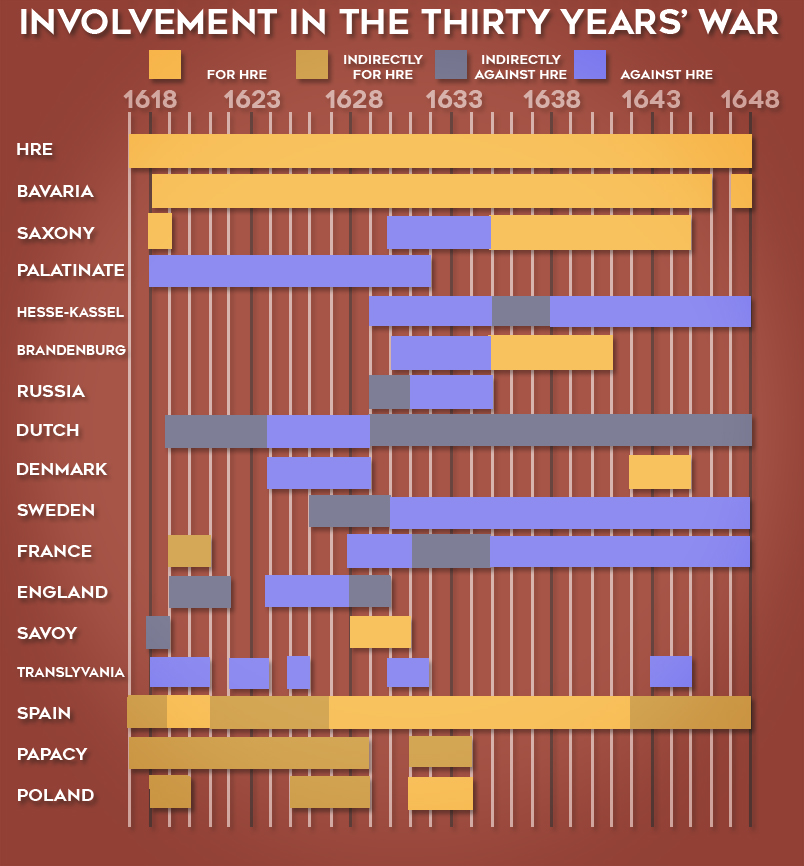
A war as long and as complex requires something like this to help keep the narrative somewhat understandable.
Exactly four hundred years ago, a dark shadow was slithering across mainland Europe. It stretched its bleak, cold presence into each hearth and home. Everything it touched turned to ruin. Musket and rapier, smoke and fire, ruled supreme. Nothing was immune. Animals and children starved to death, mothers and adolescent girls were abused and tortured. The lucky ones died, alongside their brothers and fathers, slain in battle. Possessions were looted, crops destroyed, barns and houses burned. There seemed no end to the evil and pestilence. Sixteen generations ago, many believed the end of the world had arrived.
This was not a tale of Middle Earth. The place was central Europe in the early 17th century. In 1618 the future Holy Roman emperor Ferdinand II, a zealous follower of the Jesuits, had attempted to restore the Catholic Church as the only religion in the Empire and exterminate any form of religious dissent. Protestant nobles in Bohemia and Austria rose up in rebellion. The conflict soon widened, fuelled by the political ambitions of adjacent powers. In Europe’s heartland, three denominations fought it out: Roman Catholicism, Lutheranism and Calvinism.
The result was an interwoven tangle of diplomatic plot twists, temporary alliances and coalitions, as princes, bishops and potentates beseeched outside powers to help. The struggle, which lasted for thirty years, boiled down to the Roman Catholic and Habsburg-led Holy Roman Empire, fighting an incongruous array of Protestant towns and statelets, aided by the anti-Catholic powers of Sweden under Gustavus Adolphus, and the United Netherlands. France and Spain also took advantage of the distractions of war to indulge in their own sub-campaigns. Britain took no formal part but was about to become embroiled in her own civil war.
The principal battleground for this collective contest of arms centred on the towns and principalities of what would become Germany, northern Italy, the Netherlands and the Czech Republic. The war devastated many regions on a scale unseen again until 1944–45. For example, at Magdeburg on the River Elbe, 20,000 of 25,000 inhabitants died, with 1,700 of its 1,900 buildings ruined. In Czech Bohemia, 40 per cent of the population perished, with 100 towns and more than a thousand villages laid waste. At Nordlingen in 1634, around 16,000 soldiers were killed in a single day’s battle. The town took three centuries for its population to return to pre-war levels. Refugees from smaller settlements swelled the many walled cities, increasing hunger and spreading disease.
Too diminutive to defend themselves, all states hired mercenaries, of whom a huge number flourished in the era, enticed by the prospect of quick wealth in exchange for proficiency with sword and musket. Employed by every antagonist, but beholden to no one, these armed brigands — regiments would be too grand a term for the uniformed thugs they were — roamed at will. With their pikes and their muskets, they plundered the countryside in search of booty, food and transport. In their wake, they left burning towns, ruined villages, pillaged farms. Lead was stripped from houses and church roofs for ammunition.
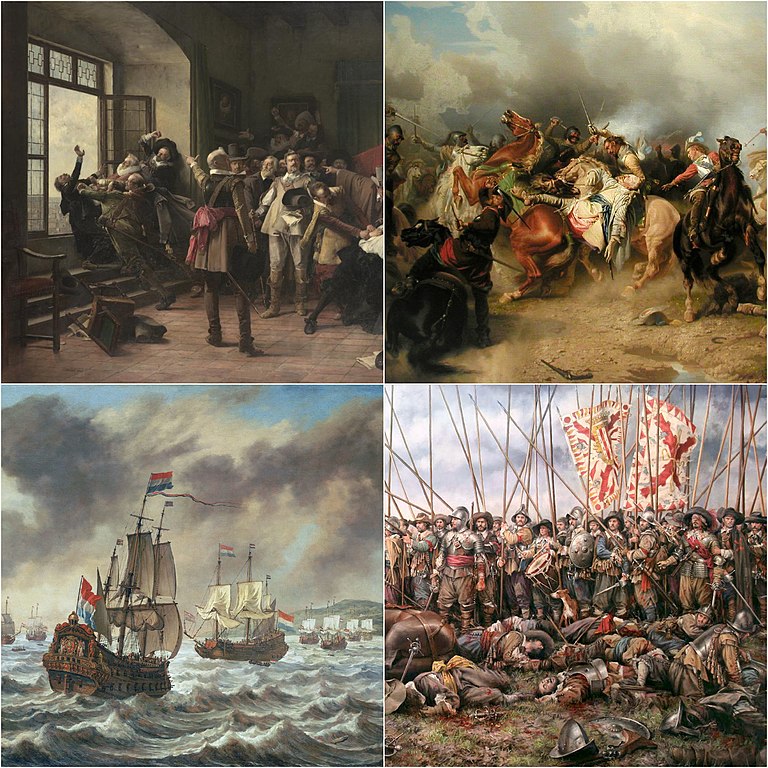
Left to right:
The Defenestration of Prague (23 May, 1618), The death of Gustavus Adolphus at Lützen (16 November, 1632), Dutch warships prior to the Battle of the Downs (21 October, 1639), and The Battle of Rocroi (19 May, 1643).
Collage by David Dijkgraaf via Wikimedia Commons.When in the winter of 1634 Swedish mercenaries were refused food and wine by the inhabitants of Linden, a tiny Bavarian settlement, they raped and looted their way through the village, leaving it uninhabitable. Across Europe, travellers noted the human and animal carcasses that decorated the meadows, streams polluted by the dead and rotting crops, presided over only by ravens and wolves. No respect was shown for the lifeless. Survivors stripped corpses of clothing and valuables; if lucky, the deceased were tossed into unmarked mass graves, since lost to history.
Having triggered the war, Ferdinand predeceased its end. We can never know how many died in Europe’s last major conflagration triggered by religion. Archives perished in the flames, and survivors were not interested in computations. Historians now put the death toll at between 8 and 12 million. Probably 500,000 perished in battle, with the rest, mostly civilians, expiring through starvation and disease. We think these casualties may equate to as much as 20 per cent of mainland Europe’s population and perhaps one-third of those in modern Germany, bringing the Thirty Years’ War a potency similar to the Black Death or either world war. The region did not recover for at least three generations.
Economic activity, land use and ownership altered terminally. When the exhausted powers finally met in October 1648 at Osnabrück and Münster in the German province of Westphalia to end the directionless slaughter, of whom self-serving militias were the only beneficiaries, Europe’s balance of power had shifted tectonically. Fresh rules of conflict and the legitimacy of a new network of 300 sovereign states, independent from a Holy Roman Emperor or a Pope, marked the struggle as a watershed moment, leading to the Enlightenment and an era that disappeared only with Napoleon.
Comments Off on The ghastly Thirty Years’ War in Europe
February 7, 2023
The Soviet Union Adopts an SMG: Degtyarev’s PPD-34/38
Forgotten Weapons
Published 21 Oct 2022The Soviet Union adopted its first submachine gun in 1935 after trials of some 14 different design in 1932/33. The winner of the trials was Vasily Degtyarev, once of the Soviet Union’s most prolific firearms designers. His model 1934 was a simple blowback gun reminiscent of the MP-28,II albeit with different trigger and magazine systems. The PPD34 used a 25-round box magazine, chambered for 7.62x25mm Tokarev. It was put into slow production, with just 3,300 or so produced by the end of 1938. During that time, Degtyarev made a number of small improvements to the gun, smoothing out the teething problems that are always found in new production systems. This improved version was designated the PPD34-38.
During the time, the submachine gun was not considered a priority by the Red Army. The leading generals did not see the value in the class of arms, and actually pulled all the PPDs from service in 1939 and had them put into storage. Only a few months later, the Red Army would be given a grim demonstration of SMG effectiveness when they closed the border into Finland and encountered determined Finnish resistance with kp/31 Suomi SMGs.
Some Suomis were captured by Soviet troops, and were very well liked — for obvious reasons. The inevitable inquiry into why the Red Army did not have such a weapon led to a frantic re-issuing of PPDs and production of as many as possible. At Stalin’s direction, the Suomi drum magazine was copied and adapted to the PPD34-38 as well. This required the addition of a short feed tower to fit the magazine well initially deigned for a standard box magazine. While PPD34-38 production continued, the PPD40 was quickly designed and put into production alongside the older model. Eventually, both were replaced in service by the PPSh-41, which was truly designed for mass industrial production.
(more…)
Comments Off on The Soviet Union Adopts an SMG: Degtyarev’s PPD-34/38
February 6, 2023
Why Traditional English Cheddar Is Aged In Caves | Regional Eats
Food Insider
Published 9 Oct 2019The earliest record of cheddar anywhere is at Cheddar, in Somerset, in 1170. The land around this village has been at the heart of English cheesemaking since the 15th century. Today, as many Cheddar producers have upscaled and require more land, there is only one traditional cheesemaker left in the village.
(more…)
Comments Off on Why Traditional English Cheddar Is Aged In Caves | Regional Eats
February 5, 2023
Leningrad: NO STEP BACK! – Week 232 – February 4, 1944
World War Two
Published 4 Feb 2023The Allies begin a new operation in the Pacific this week: assaulting the Marshall Islands. They also make big attacks from their beachhead in Italy at Anzio, but these are called off after only a few days in the face of heavy enemy resistance. However, in the USSR there are several successes against the Axis, as they are pushed back both in the far north and the far south of the front, and still surrounded near Korsun.
(more…)
Comments Off on Leningrad: NO STEP BACK! – Week 232 – February 4, 1944
This 1970s tank simulator drives through a tiny world
Tom Scott
Published 17 Oct 2022At the Swiss Military Museum in Full, there’s the last remaining example of a 1970s tank-driving simulator. But there’s no virtual worlds here: it’s connected to a real camera and a real miniature model. ■ More about the museum: https://www.festungsmuseum.ch/
(more…)
Comments Off on This 1970s tank simulator drives through a tiny world
QotD: Annual cycles of plenty and scarcity in pre-modern agricultural societies
That has more than just economic impacts because the family unit becomes more vulnerable as that food stockpile dwindles. Malnutrition brings on a host of other threats: elevated risk of death from injury or disease most notably. Repeated malnutrition also has devastating long-term effects on young children […] Consequently, we see seasonal mortality patterns in agricultural communities which tend to follow harvest cycles; when the harvest is poor, the family starts to run low on food before the next harvest, which leads to rationing the remaining food, which leads to malnutrition. That malnutrition is not evenly distributed though: the working age adults need to be strong enough to bring in the next harvest when it comes (or to be doing additional non-farming labor to supplement the family), so the short rations are going to go to the children and the elderly. Which in turn means that “lean” years are marked by increased mortality especially among the children and the elderly, the former of which is how the rural population “regulates” to its food production in the absence of modern birth control (but, as an aside: this doesn’t lead to pure Malthusian dynamics – a lot more influences the food production ceiling than just available land. You can have low-equilibrium or high-equilibrium systems, especially when looking at the availability of certain sorts of farming capital or access to trade at distance. I cannot stress this enough: Malthus was wrong; yes, interestingly, usefully wrong – but still wrong. The big plagues sometimes pointed to as evidence of Malthusian crises have as much if not more to do with rising trade interconnectedness than declining nutritional standards). This creates yearly cycles of plenty and vulnerability […]
Next to that little cycle, we also have a “big” cycle of generations. The ratio of labor-to-food-requirements varies as generations are born, age and die; it isn’t constant. The family is at its peak labor effectiveness at the point when the youngest generation is physically mature but hasn’t yet begun having children (the exact age-range there is going to vary by nuptial patterns, see below) and at its most vulnerable when the youngest generation is immature. By way of example, let’s imagine a family (I’m going to use Roman names because they make gender very clear, but this is a completely made-up family): we have Gaius (M, 45), his wife, Cornelia (39, F), his mother Tullia (64, F) and their children Gaius (21, M), Secundus (19, M), Julia1 (16, F) and Julia2 (14, F). That family has three male laborers, three female laborers (Tullia being in her twilight years, we don’t count), all effectively adults in that sense, against 7 mouths to feed. But let’s fast-forward fifteen years. Gaius is now 60 and slowing down, Cornelia is 54; Tullia, we may assume has passed. But Gaius now 36 is married to Clodia (20, F; welcome to Roman marriage patterns), with two children Gaius (3, M) and Julia3 (1, F); Julia1 and Julia2 are married and now in different households and Secundus, recognizing that the family’s financial situation is never going to allow him to marry and set up a household has left for the Big City. So we now have the labor of two women and a man-and-a-half (since Gaius the Elder is quite old) against six mouths and the situation is likely to get worse in the following years as Gaius-the-Younger and Clodia have more children and Gaius-the-Elder gets older. The point of all of this is to note that just as risk and vulnerability peak and subside on a yearly basis in cycles, they also do this on a generational basis in cycles.
(An aside: the exact structure of these generational patterns follow on marriage patterns which differ somewhat culture to culture. In just about every subsistence farming culture I’ve seen, women marry young (by modern standards) often in their mid-to-late teens, or early twenties; that doesn’t vary much (marriage ages tend to be younger, paradoxically, for wealthier people in these societies, by the by). But marriage-ages for men vary quite a lot, from societies where men’s age at first marriage is in the early 20s to societies like Roman and Greece where it is in the late 20s to mid-thirties. At Rome during the Republic, the expectation seems to have been that a Roman man would complete the bulk of their military service – in their twenties and possibly early thirties – before starting a household; something with implications for Roman household vulnerability. Check out Rosenstein, op. cit. on this).
On top of these cycles of vulnerability, you have truly unpredictable risk. Crops can fail in so many ways. In areas without irrigated rivers, a dry spell at the wrong time is enough; for places with rivers, flooding becomes a concern because the fields have to be set close to the water-table. Pests and crop blights are also a potential risk factor, as of course is conflict.
So instead of imagining a farm with a “standard” yield, imagine a farm with a standard grain consumption. Most years, the farm’s production (bolstered by other activities like sharecropping that we’ll talk about later) exceed that consumption, with the remainder being surplus available for sale, trade or as gifts to neighbors and friends. Some years, the farm’s production falls short, creating that shortfall. Meanwhile families tend to grow to the size the farm can support, rather than to the labor needs the farm has, which tends to mean too many hands (and mouths) and not enough land. Which in turn causes the family to ride a line of fairly high risk in many cases.
All of this is to stress that these farmers are looking to manage risk through cycles of vulnerability […]
I led in with all of that risk and vulnerability because without it just about nothing these farmers do makes a lot of sense; once you understand that they are managing risk, everything falls into place.
Most modern folks think in terms of profit maximization; we take for granted that we will still be alive tomorrow and instead ask how we can maximize how much money we have then (this is, admittedly, a lot less true for the least fortunate among us). We thus tend to favor efficient systems, even if they are vulnerable. From this perspective, ancient farmers – as we’ll see – look very silly, but this is a trap, albeit one that even some very august ancient scholars have fallen into. These are not irrational, unthinking people; they are poor, not stupid – those are not the same things.
But because these households wobble on the edge of disaster continually, that changes the calculus. These small subsistence farmers generally seek to minimize risk, rather than maximize profits. After all, improving yields by 5% doesn’t mean much if everyone starves to death in the third year because of a tail-risk that wasn’t mitigated. Moreover, for most of these farmers, working harder and farming more generally doesn’t offer a route out of the small farming class – these societies typically lack that kind of mobility (and also generally lack the massive wealth-creation potential of industrial power which powers that kind of mobility). Consequently, there is little gain to taking risks and much to lose. So as we’ll see, these farmers generally sacrifice efficiency for greater margins of safety, every time.
Bret Devereaux, “Collections: Bread, How Did They Make It? Part I: Farmers!”, A collection of Unmitigated Pedantry, 2020-07-24.
Comments Off on QotD: Annual cycles of plenty and scarcity in pre-modern agricultural societies
February 4, 2023
Poland’s Descent into Civil War – War Against Humanity 097
World War Two
Published 2 Feb 2023Poland, occupied, abandoned or even threatened by her allies is left to fight her own war. A war that under the influence of internal and external forces looks more and more like a full blown civil war inside the world war.
(more…)
Comments Off on Poland’s Descent into Civil War – War Against Humanity 097
A lobster tale (that does not involve Jordan Peterson)
In the latest Age of Invention newsletter, Anton Howes relates some of his recent research on the Parliament of 1621 (promising much more in future newsletters) and highlights one of the Royal monopolies that came under challenge in the life of that Parliament:

European lobster (Hommarus gammarus)
Photo by Bart Braun via Wikimedia Commons.
One of the great things about the 1621 Parliament, as a historian of invention, is that MPs summoned dozens of patentees before them, to examine whether their patents were “grievances” — illegal and oppressive monopolies that ought to be declared void. Because of these proceedings, along with the back-and-forth of debate between patentees and their enemies, we can learn some fascinating details about particular industries.
Like how 1610s London had a supply of fresh lobsters. The patent in question was acquired in 1616 by one Paul Bassano, who had learned of a Dutch method of keeping lobsters fresh — essentially, to use a custom-made broad-bottomed ship containing a well of seawater, in which the lobsters could be kept alive. Bassano, in his petitions to the House of Commons, made it very clear that he was not the original inventor and had imported the technique. This was exactly the sort of thing that early monopoly patents were supposed to encourage: technological transfer, and not just original invention.
The problem was that the patent didn’t just cover the use of the new technique. It gave Bassano and his partners a monopoly over all imported lobsters too. This was grounded in a kind of industrial policy, whereby blocking the Dutch-caught lobsters would allow Bassano to compete. He noted that Dutch sailors were much hardier and needed fewer provisions than the English, and that capital was available there at interest rates of just 4-5%, so that a return on sales of just 10% allowed for a healthy profit. In England, by comparison, interest rates of about 10% meant that he needed a return on sales of at least 15%, especially given the occasional loss of ships and goods to the capriciousness of the sea — he noted that he had already lost two ships to the rocks.
At the same time, patent monopolies were designed to nurture expertise. Bassano noted that he still needed to rely on the Dutch, who were forced to sell to the English market either through him or by working on his ships. But he had been paying his English sailors higher wages, so that over time the trade would come to be dominated by the English. (This training element was a key reason that most patents tended to be given for 14 or 21 years — the duration of two or three apprenticeships — though Bassano’s was somewhat unusual in that it was to last for a whopping 31.)
But the blocking of competing imports — especially foodstuffs, which were necessaries of life — could be very controversial, especially when done by patent rather than parliamentary statute. Monopolies could lawfully only be given for entirely new industries, as they otherwise infringed on people’s pre-existing practices and trades. Bassano had worked out a way to avoid complaints, however, which was essentially to make a deal with the fishmongers who had previously imported lobsters, taking them into his partnership. He offered them a win-win, which they readily accepted. In fact, the 1616 patent came with the explicit support of the Fishmongers’ Company.
It sounds like it became a large enterprise, and I suspect that it probably did lower the price of lobsters in London, bringing them in regularly and fresh. With a fleet of twenty ships, and otherwise supplementing their catch with those caught by the Dutch, Bassano boasted of how he was able to send a fully laden ship to the city every day (wind-permitting). This stood in stark contrast to the state of things before, when a Dutch ship might have arrived with a fresh catch only every few weeks or months, and when they felt that scarcity would have driven the prices high.
Comments Off on A lobster tale (that does not involve Jordan Peterson)
February 3, 2023
“Lady of The Dark” – Milunka Savić – Sabaton History 117
Sabaton History
Published 2 Feb 2023One of the most badass and decorated soldiers of the Great War was a woman. Serving first in the Balkan Wars, this Serbian war heroin became a celebrity when she won the Karađorđe’s Star — the highest Serbian decoration — in 1914 and 1916. Those weren’t her only decorations either — watch to find out more.
(more…)
Comments Off on “Lady of The Dark” – Milunka Savić – Sabaton History 117
Tank Chats #166 | SOMUA S35 | The Tank Museum
The Tank Museum
Published 14 Oct 2022Join David Willey in this week’s Tank Chat as he details the history of the SOMUA S35, a French cavalry tank of the Second World War.
(more…)
Comments Off on Tank Chats #166 | SOMUA S35 | The Tank Museum


