
WW2TV
Published 8 May 2024The Liri Valley: Canada’s Breakthrough to Rome
With Mark Zuehlke
Part of our “Italy 1944 – Monte Cassino and Beyond” series
• Monte Cassino and BeyondFor the Allied armies fighting their way up the Italian boot in early 1944. Rome was the prize that could only be won through one of the greatest offensives of the war. The Liri Valley was a long, flat corridor through miles of rugged mountains. At one end stood the formidable Monte Cassino, at the other, Rome. In May 1944, I Canadian Corps drops up this valley toward the Italian capital, facing the infamous Hitler Line — a bastion of concrete bunkers fronted by wide swaths of tangled barbed wire, minefields, and “Tobruk” weapon pits. The ensuing battle resulted in Canada’s single bloodiest day of the Italian campaign. But the sacrifice of young Canadians during the twenty-four days of relentless combat it took to clear the valley paved the way for the Allies to take Rome.
Mark Zuehlke is an award-winning author generally considered to be Canada’s foremost popular military historian. His Canadian Battle Series is the most exhaustive recounting of the battles and campaigns fought by any nation during World War II to have been written by a single author.
(more…)
May 9, 2024
The Liri Valley: Canada’s Breakthrough to Rome
May 5, 2024
Allied Victory in Berlin, Italy, and Burma! – WW2 – Week 297 – May 4, 1945
World War Two
Published 4 May 2024So much goes on this week, and this is the longest episode of the war by like 15 minutes. But there’s so much to cover! The Battle of Berlin ends; the war in Italy ends; the war in Burma ends- well, it ends officially, though there are still tens of thousands of Japanese soldiers scattered around Burma. And there’s a whole lot more to these stores and a whole lot more stories this week in the war. You can’t miss this one.
01:27 The End of the War in Italy
03:40 Western Allied Advances
07:02 Relief Operations in the Netherlands
15:45 Hitler’s Death and the Surrender of Berlin
24:20 Walther Wenck’s Retreat
28:00 The Polish Situation
31:09 What About Prague?
32:44 The End of the Burma Campaign
36:04 THE FIGHT FOR TARAKAN ISLAND BEGINS
37:24 Okinawa
40:11 Other Notes
41:04 Summary
41:43 Conclusion
(more…)
April 28, 2024
The Battle of Berlin! – WW2 – Week 296 – April 27, 1945
World War Two
Published 27 Apr 2024The battle for the German capital rages on all week, as the Soviets get ever closer to the Reich Chancellery, under which lies Hitler’s bunker. Berlin is surrounded, but can it be relieved? There are also Allied advances in East Prussia, Czechoslovakia, and in Western Germany, but beyond that, it looks like the Axis lines have completely collapsed in Italy. The Allies are also advancing — and quickly — in Burma toward Rangoon, though not much at all on Okinawa, and it is the Japanese who are on the move in Western Hunan. It’s a real rollercoaster of a week.
Chapters
01:10 Recap
01:43 Soviets fight their way into Berlin
07:45 Berlin surrounded
10:28 Rokossovsky advances
12:48 Göring and Himmler betray Hitler
13:57 Fighting on the Eastern Front
15:23 Allied advance in the West
15:51 German collapse in Italy
17:31 4th Corps racing through Burma
19:36 The Battle of Western Hunan
21:40 Okinawa and the Philippines
22:59 Notes
23:59 Conclusion
(more…)
April 26, 2024
Guns for the Pope’s Police: Mazzocchi Pinfire Revolver
Forgotten Weapons
Published Jan 22, 2024The revolver we are looking at today is a 9mm pinfire revolver adopted for the Papal Gendarmerie in 1868. At that time, the Papal States controlled roughly the same amount of territory as Switzerland today, and had its own armed forced for internal security — the Papal Gendarmerie. The Papal States had previously adopted a 12mm Lefaucheux revolver for its army, but this was deemed too bulky for the Gendarmes. So in 1867, they went looking for a smaller new pistol. The Mazzocchi brothers in Rome had been official armorers to the Vatican for three generations (their shop was actually located in Castel St Angelo until 1850!), and they won the contract for the Gendarmerie with this revolver model. A total of 2500 were made in 1868 and 1869, at 50 Papal Lira each.
(more…)
April 21, 2024
300,000 Germans Surrender in the Ruhr – WW2 – Week 295 – April 20, 1945
World War Two
Published 20 Apr 2024The Soviet drive on Berlin continues, but it is now very much a race between the forces of Georgy Zhukov and those of Ivan Konev. In the west, over 300,000 Germans surrender to the Allies as the Ruhr Pocket is eliminated, though there are advances by all Allied armies this week on the whole Western Front. There is even an Allied breakthrough in Italy, though on Okinawa American attacks get nowhere. The Japanese are advancing in China, and in Burma the Allied drive for Rangoon continues.
(more…)
April 16, 2024
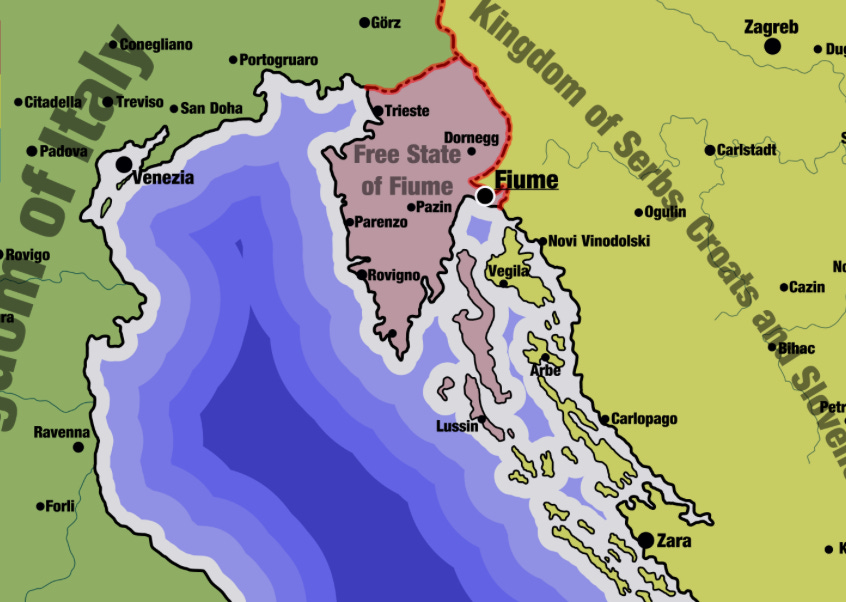
Gabriele D’Annunzio’s Impresa – the 1919 occupation of Fiume
Ned Donovan on the turbulent history of the Adriatic port of Fiume (today the Croatian city of Rijeka) after the end of the First World War:
Fiume was a port on the Adriatic coast with several thousand residents, almost half of whom were ethnic Italians that had been under Austro-Hungarian rule for several hundred years after it once having been a Venetian trade port. By some quirk, Fiume was missed in the Treaty of London, probably because it had never been envisioned by the Allies that the Austro-Hungarian Empire would ever truly disintegrate and the rump of it that would remain required a sea port in some form. The city’s other residents were ethnically Serbian and Croatian, who knew the city as Rijeka (as you will find it named on a map today). All of this complexity meant that the fate of Fiume became a major topic of controversy during the Versailles Peace Conference. President Woodrow Wilson had become so unsure of what to do that he proposed the place become a free city and the headquarters of the nascent League of Nations, under the jurisdiction of no country.
By September 1919 there was still no conclusion as to the fate of Fiume. Events had overtaken the place and through the Treaty of St Germain, the Austro-Hungarian Empire had been dissolved after the abdication of the final Habsburg Emperor Charles I. Once again, Fiume had not been mentioned in the treaty and the country it had been set aside for no longer existed. The city’s fate was still at play.
Enter Gabriele D’Annunzio, an aristocrat from Abruzzo on the eastern coast of Italy. Born in 1863, he was a handsome and intelligent child and was nurtured by his family to be exceptional, with a predictable side effect of immense selfishness. As a teenager, he had begun to dabble in poetry and it was praised by authors unaware of his age. At university he began to be associated with Italian irredentism, a philosophy that yearned for all ethnic Italians to live in one country – by retaking places under foreign rule like Corsica, Malta, Dalmatia and even Nice.
[…]
The Italian government’s lack of interest [in Fiume] was unacceptable to D’Annunzio and he made clear he would take action to prevent it becoming part of Yugoslavia by default. With his fame and pedigree he was able to quickly assemble a small private force of ex-soldiers, who he quickly took to calling his “legionaries”. In September 1919 after the Treaty of St Germain was signed, his small legion of a few hundred marched from near Venice to Fiume in what they called the Impresa – the Enterprise. By the time he had reached Fiume, the “army” numbered in the thousands, the vanguard crying “Fiume or Death” with D’Annunzio at its head in a red Fiat.
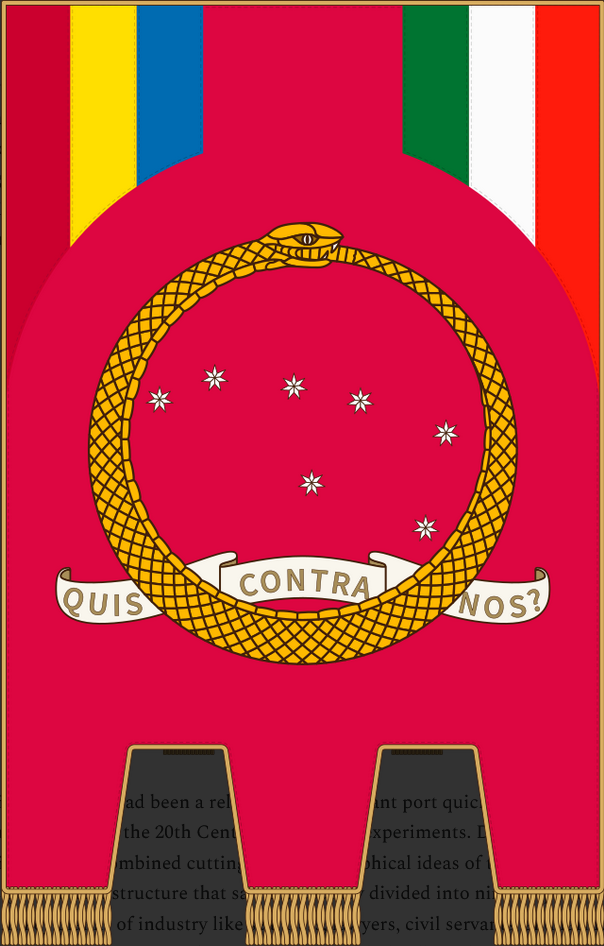
A flag designed by Gabriele D’Annunzio for the would-be independent state of Fiume, 1919.
The only thing that stood in his way was the garrison of the Entente, soldiers who had been given orders to prevent D’Annunzio’s invasion by any means necessary. But amongst the garrison’s leaders were many [Italian officers] sympathetic to D’Annunzio’s vision, some even artists themselves and before long most of the defenders had deserted to join the poet’s army. On the 12th September 1919, Gabriele D’Annunzio proclaimed that he had annexed Fiume to the Kingdom of Italy as the “Regency of Carnaro” – of which he was the Regent. The Italian government was thoroughly unimpressed and refused to recognise their newest purported land, demanding the plotters give up. Instead, D’Annunzio took matters into his own hands and set up a government and designed a flag (to the right).
The citizens of what had been a relatively unimportant port quickly found themselves in the midst of one of the 20th Century’s strangest experiments. D’Annunzio instituted a constitution that combined cutting-edge philosophical ideas of the time with a curious government structure that saw the country divided into nine corporations to represent key planks of industry like seafarers, lawyers, civil servants, and farmers. There was a 10th corporation that existed only symbolically and represented who D’Annunzio called the “Supermen” and was reserved largely for him and his fellow poets.
These corporations selected members for a state council, which was joined by “The Council of the Best” and made up of local councillors elected under universal suffrage. Together these institutions were instructed to carry out a radical agenda that sought an ideal society of industry and creativity. From all over the world, famous intellectuals and oddities migrated to Fiume. One of D’Annunzio’s closest advisers was the Italian pilot Guido Keller, who was named the new country’s first “Secretary of Action” – the first action he took was to institute nationwide yoga classes which he sometimes led in the nude and encouraged all to join. When not teaching yoga, Keller would often sleep in a tree in Fiume with his semi-tame pet eagle and at least one romantic partner.
If citizens weren’t interested in yoga, they could take up karate taught by the Japanese poet Harukichi Shimoi, who had translated Dante’s works into Japanese. Shimoi, who quickly became known to the government of Fiume as “Comrade Samurai” was a keen believer in Fiume’s vision and saw it as the closest the modern world had come to putting into practice the old Japanese art of Bushido.
The whole thing would have felt like a fever dream to an outsider. If a tourist was to visit the city, they would have found foreign spies from across the world checking into hotels and rubbing shoulders with members of the Irish republican movement while others did copious amounts of cocaine, another national pastime in Fiume. The most fashionable residents of Fiume carried little gold containers of the powder, and D’Annunzio himself was said to have a voracious habit for it. Sex was everywhere one turned and the city had seen a huge inward migration of prostitutes and pimps within days of D’Annunzio’s arrival. Almost every day was a festival, and it was an odd evening if the harbour of Fiume did not see dozens of fireworks burst above it, watched on by D’Annunzio’s uniformed paramilitaries.
D’Annunzio himself lived in a palace overlooking the city, Osbert Sitwell describes walking up a steep hill to a Renaissance-style square palazzo which inside was filled with plaster flowerpots the poet had installed and planted with palms and cacti. D’Annunzio would cloister himself in his rooms for 18 hours a day and without food. Immaculate guards hid amongst the shrubs to ensure he would not be disturbed. In D’Annunzio’s study, facing the sea, he sat with statutes of saints and with French windows onto the state balcony. When he wanted to interact with his people he would wait for a crowd to form over some issue, walk to the balcony and then ask what they wanted.
April 14, 2024
Soviets Take Vienna and Königsberg – WW2 – Week 294 – April 13, 1945
World War Two
Published 13 Apr 2024The prizes of Vienna and Königsberg fall to the Soviets as they continue what seems an inexorable advance. In the West the Allies advance to the Elbe River, but there they are stopped by command. The big news in their national papers this week is the death of American President Franklin Roosevelt, which provokes rejoicing in Hitler’s bunker. The Allied fighting dash for Rangoon continues in Burma, as does the American advance on Okinawa, although Japanese resistance is stiffening and they are beginning counterattacks.
Chapters
00:32 Recap
01:05 Operation Grapeshot
01:57 Roosevelt Dies
06:01 Soviet Attack Plans for Berlin
12:45 Stalin’s Suspicions
14:31 The fall of Königsberg
17:02 The fall of Vienna
18:38 Japanese Resistance on Okinawa
20:34 The War in China
21:09 Burma and the Philippines
22:38 Summary
22:57 Conclusion
25:05 Memorial
(more…)
April 6, 2024
Italian Communists, the French in Indochina, and the fate of Italy’s army – WW2 – OOTF 34
World War Two
Published 5 Apr 2024What happened to Italian soldiers overseas after the fall of Mussolini? What about the French soldiers left over in Indochina after the Japanese “occupation by invitation”? And, what did the Allies think of the Italian Communist movement and its partisan forces?
(more…)
March 28, 2024
The History of Fish Sauce – Garum and Beyond!
Tasting History with Max Miller
Published Dec 26, 2023Sweet frittata-like patina of pears with classic ancient Roman flavors and sprinkled with long pepper
City/Region: Rome
Time Period: 1st CenturyThis patina de piris is one of over a dozen recipes for similar dishes in Apicius’ De re coquinaria, a staple for ancient Roman recipes. It would have probably been part of mensa secunda, or second meal. Not a second breakfast, it was the final course in a larger meal and usually consisted of sweets, pastries, nuts, and egg dishes, kind of like a modern dessert course.
I finally made my own true ancient Roman garum in the summer of 2023, from chopped up fish pieces and salt to clear amber umami-laden liquid. There’s no fishiness in this surprisingly sweet dish, just a saltiness and savory umami notes that complements the other very ancient Roman flavors.
As with all ancient recipes, this is my interpretation and you can change things up how you like. I separated my eggs before beating them, but you could just whisk them up whole and add them like that.
(more…)
March 24, 2024
Chiang versus Mountbatten – WW2 – Week 291 – March 23, 1945
World War Two
Published 23 Mar 2024Chiang Kai-Shek is demanding his Chinese troops back from Burma, but this doesn’t fit well with Mountbatten’s plans for the region. In Burma, Bill Slim’s forces liberate Mandalay this week and make plans to head south for Rangoon. There’s also friction elsewhere in Allied command — between the Soviets and the Western Allies — over Italy. In the field in Europe, the Soviets advance all along the eastern front, and in the west, the Allies secure another Rhine crossing, and they also launch a double operation to send even more men across the river in force.
0:00 Intro
0:53 Recap
1:20 Iwo Jima
2:15 Plans for Okinawa
3:53 Mandalay liberated and plans for Burma
08:19 Allied Machinations about Italy
10:25 Soviet advances all along the Eastern Front
16:55 Plans for Operation Grapeshot
17:45 Four Allied Operations in the west
23:25 Summary + Conclusion
(more…)
March 22, 2024
Rome conquered Greece … militarily, anyway
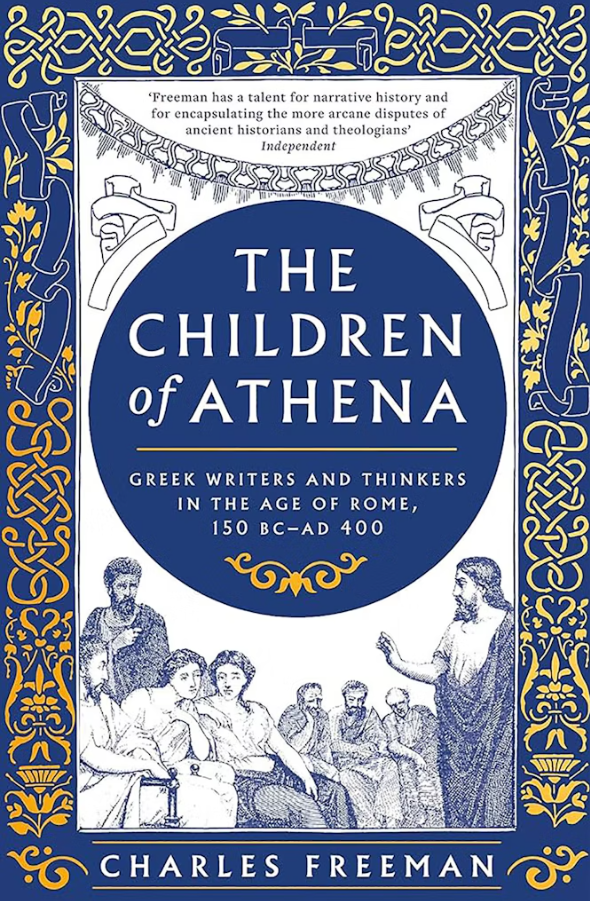
In The Critic, Gavin McCormick reviews Charles Freeman’s new book The Children of Athena: Greek writers and thinkers in the age of Rome, 150BC – 400AD:
“To a wise man,” said the first-century wonderworker Apollonius of Tyana, “everywhere is Greece.” That is to say, Greece is not a mere place, but a special state of mind. For Apollonius, on his extensive travels around the Greco-Roman world, the purported truth of this maxim is seldom open to doubt.
The author of Apollonius’s colourful biography, Philostratus, depicts his hero as not just a philosopher but also an impossibly accomplished champion of culture — a confounder of logic and expectations who could vanish in plain sight, now fascinating Roman emperors and foreign sages, now inspiring whole towns into acts of celebration and renewal. The guiding ideology that drove this hero is a heady mix of philosophy, religion, magic and political insouciance — or, to give it another name, Hellenism.
In the context of the third-century world, where Christianity was an increasingly noteworthy presence in the towns and cities of the Roman empire, pagans such as Philostratus were keen to highlight what their own tradition had to offer.
In fact, he seems almost to present his hero as a pagan rival to Jesus. And, in turn, Apollonius — in his successful renewal of the shrines and local cults of Hellas — seems to hint at what Philostratus would like to see happen in his own contemporary context.
Despite living under Rome, Apollonius (and Philostratus) wants to celebrate an emphatically Greek form of culture. The celebration of Greek culture in the Roman world was, of course, nothing new, and it was something the Romans themselves had long enjoyed.
Alongside their admiration for Greek literature, philosophy, art and architecture, there was the successful movement known as the “Second Sophistic” — whose parade of Greek-speaking intellectuals left a heavy imprint on the public life of the High Roman Empire.
But it is striking nonetheless that the virtues of Hellas — not Rome itself — were what many educated citizens of the empire turned to when they thought of cultural renewal. Indeed his was precisely the route taken later in the fourth century by the last pagan emperor of Rome, himself a champion of all things Greek, Julian the so-called Apostate.
Charles Freeman’s latest book, Children of Athena, is a highly readable tour through the lives and accomplishments of some of the great exponents of Greek culture under Rome. He introduces readers to a bracingly varied and energetic cast of characters — the geographers, doctors, polymaths, botanists, satirists, and orators are just part of the repertoire. In an early chapter, we meet the brilliant Greek historian Polybius, who wrote in the tradition of Herodotus and Thucydides, while training his sights on the rise of Rome in his own time.
March 17, 2024
Smiling Albert Takes Command – WW2 – Week 290 – March 16, 1945
World War Two
Published 16 Mar 2024After the Allies took a Rhine Bridge last week, Adolf Hitler has again shuffled his commanders, moving Kesselring to the west. Meanwhile, the German offensive in Hungary comes to its end — and it does not end well for the Germans. The Japanese are nearly defeated on Iwo Jima, are feeling a bit of desperation in Burma, but are far, far from defeated on Luzon.
01:02 Recap
01:33 Remagen Bridge and the Western Front
06:44 Army Group Courland and 3rd Belorussian Front
10:23 Konev’s new attacks
11:29 Operation Spring Awakening ends
15:00 A German surrender in Italy?
17:01 Japanese being ground down on Iwo Jima
18:12 The war in the Philippines
20:48 The war in Burma
23:07 Summary
23:36 Conclusion
(more…)
March 12, 2024
QotD: Isaiah Berlin on Niccolò Machiavelli
When asked about Machiavelli’s reputation, people use terms like “amoral”, “cynical”, “unethical”, or “unprincipled”. But this is incorrect. Machiavelli did believe in moral virtues, just not Christian or Humanistic ones.
What did he actually believe?
In 1953, the British philosopher Isaiah Berlin delivered a lecture titled “The Originality of Machiavelli”.
Berlin began by posing a simple question: Why has Machiavelli unsettled so many people over the years?
Machiavelli believed that the Italy of his day was both materially and morally weak. He saw vice, corruption, weakness, and, as Berlin says, “lives unworthy of human beings”. It’s worth noting here that around the time that Machiavelli died in 1527, the Age of Exploration was just kicking off, and adventurers from Italy and elsewhere in Europe were in the process of transforming the world. Even the shrewdest individuals aren’t always the best judges of their own time.
So what did Machiavelli want? He wanted a strong and glorious society. Something akin to Athens at its height, or Sparta, or the kingdoms of David and Solomon. But really, Machiavelli’s ideal was the Roman Republic.
To build a good state, a well-governed state, men require “inner moral strength, magnanimity, vigour, vitality, generosity, loyalty, above all public spirit, civic sense, dedication to security, power, glory”.
According to Machiavelli, these are the Roman virtues.
In contrast, the ideals of Christianity are “charity, mercy, sacrifice, love of God, forgiveness of enemies, contempt for the goods of this world, faith in the hereafter”.
Machiavelli wrote that one must choose between Roman and Christian virtues. If you choose Christianity, you are selecting a moral framework that is not favorable to building and preserving a strong state.
Machiavelli does not say that humility, compassion, and kindness are bad or unimportant. He actually agrees that they are, in fact, good and righteous virtues. He simply says that if you adhere to them, then you will be overrun by more unscrupulous men.
In some instances, Machiavelli would say, rulers may have to commit war crimes in order to ensure the survival of their state. As one Machiavelli translator has put it: “Men cannot afford justice in any sense that transcends their own preservation”.
From Berlin’s lecture:
If you object to the political methods recommended because they seem to you morally detestable … Machiavelli has no answer, no argument … But you must not make yourself responsible for the lives of others or expect good fortune; you must expect to be ignored or destroyed.
In a famous passage, Machiavelli writes that Christianity has made men “weak”, easy prey to “wicked men”, since they “think more about enduring their injuries than about avenging them”. He compares Christianity (or Humanism) unfavorably with Paganism, which made men more “ferocious”.
“One can save one’s soul,” writes Berlin, “or one can found or maintain or service a great and glorious state; but not always both at once.”
Again, Machiavelli’s tone is descriptive. He is not making claims about how things should be, but rather how things are. Although it is clear what his preference is.
He writes that Christian virtues are “praiseworthy”. And that it is right to praise them. But he says they are dead ends when it comes to statecraft.
Machiavelli wrote:
Any man who under all conditions insists on making it his business to be good, will surely be destroyed among so many who are not good. Hence a prince … must acquire the power to be not good, and understand when to use it and when not to use it, in accord with necessity.
To create a strong state, one cannot hold delusions about human nature:
Everything that occurs in the world, in every epoch, has something that corresponds to it in the ancient times. The reason is that these things were done by men, who have and have always had the same passions.
Rob Henderson, “The Machiavellian Maze”, Rob Henderson’s Newsletter, 2023-12-09.
March 10, 2024
German Blunder Hands Allies a Rhine Crossing – WW2 – Week 289 – March 9, 1945
World War Two
Published 9 Mar 2024The Allies manage to take an intact bridge over the mighty Rhine at Remagen, a major piece of luck; the Germans launch a new offensive in Hungary, and the Allies end one in Italy. Over in Burma, Meiktila falls, sabotaging the entire Japanese supply system for the country, and on Iwo Jima the fight continues, bloodier than ever for both sides.
00:59 Recap
01:35 The Fall of Meiktila
03:46 The fight on Iwo Jima
05:27 Advances on the Western Front
07:44 The Rhine River
10:05 Remagen Bridge
16:20 Operation Encore
17:10 Rokossovsky and Zhukov attack
18:09 Operation Spring Awakening
21:57 Notes to end the week
23:42 Conclusion
(more…)
March 9, 2024
The Jewish Avengers Who Hunted Nazi Murderers
World War Two
Published Mar 8, 2024In March 1945, the first Jewish unit in the Allied forces reaches the frontline. Before fighting the Nazis, the men spent years battling against the policies of the British government. After the war, they will take vengeance on the perpetrators of the Holocaust and join the Zionist movement in building and fighting for Israel.
(more…)


