
seangabb
Published Feb 25, 2024This course provides an exploration of Rome’s formative years, its rise to power in the Mediterranean, and the exceptional challenges it faced during the wars with Carthage.
• Growth of Tensions between Rival Powers
• Differences of Civilisation
• The Outbreak of War
• The Course of War
• Growth of Roman Sea Power
• The End and Significance of the War
(more…)
February 26, 2024
Rome: Part 4 – The First Punic War 264-241 BC
Comments Off on Rome: Part 4 – The First Punic War 264-241 BC
February 25, 2024
Iwo Jima! – WW2 – Week 287 – February 24, 1945
World War Two
Published 24 Feb 2024This week the Battle of Iwo Jima begins and American forces raise the Stars and Stripes on Mount Suribachi. Elsewhere, the Allies fight the stiff Japanese defences in Manila. The Red Army continues fighting through East Prussia and Pomerania as Stalin plans the next stage of the advance on the Reich. There are Allied advances in Western Europe and Italy too.
00:01 Intro
00:54 Recap
01:16 Iwo Jima Begins
06:32 The war in the Philippines
07:56 The Battle of Manila
11:12 Fighting in Burma
12:14 Operation Grenade
13:46 Operation Encore
14:38 Soviet plans for new offensives
21:28 Moscow Commission Meets
(more…)
Comments Off on Iwo Jima! – WW2 – Week 287 – February 24, 1945
February 21, 2024
“There’s a moral imperative to go dig out that villa … It could be the greatest archaeological treasure on earth”
In City Journal, Nicholas Wade discusses the technical side of the ongoing attempts to read one of the Herculaneum scrolls:
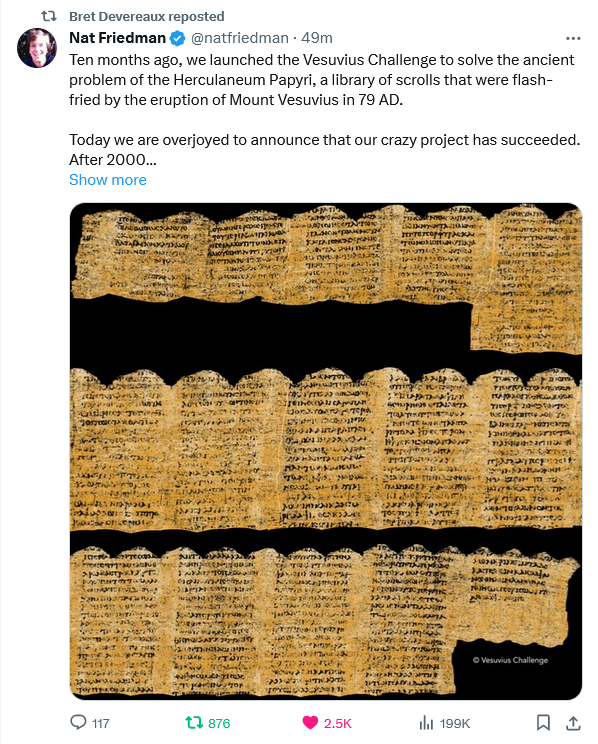
A computer scientist has labored for 21 years to read carbonized ancient scrolls that are too brittle to open. His efforts stand at last on the brink of unlocking a vast new vista into the world of ancient Greece and Rome.
Brent Seales, of the University of Kentucky, has developed methods for scanning scrolls with computer tomography, unwrapping them virtually with computer software, and visualizing the ink with artificial intelligence. Building on his methods, contestants recently vied for a $700,000 prize to generate readable sections of a scroll from Herculaneum, the Roman town buried in hot volcanic mud from the eruption of Vesuvius in 79 A.D.
The last 15 columns — about 5 percent—of the unwrapped scroll can now be read and are being translated by a team of classical scholars. Their work is hard, as many words are missing and many letters are too faint to be read. “I have a translation but I’m not happy with it,” says a member of the team, Richard Janko of the University of Michigan. The scholars recently spent a session debating whether a letter in the ancient Greek manuscript was an omicron or a pi.
[…]
Seales has had to overcome daunting obstacles to reach this point, not all of them technical. The Italian authorities declined to make any of the scrolls available, especially to a lone computer scientist with no standing in the field. Seales realized that he had to build a coalition of papyrologists and conservationists to acquire the necessary standing to gain access to the scrolls. He was eventually able to x-ray a Herculaneum scroll in Paris, one of six that had been given to Napoleon. To find an x-ray source powerful enough to image the scroll without heating it, he had to buy time on the Diamond particle accelerator at Harwell, England.
In 2009, his x-rays showed for the first time the internal structure of a scroll, a daunting topography of a once-flat surface tugged and twisted in every direction. Then came the task of writing software that would trace the crumpled spiral of the scroll, follow its warped path around the central axis, assign each segment to its right position on the papyrus strip, and virtually flatten the entire surface. But this prodigious labor only brought to light a more formidable problem: no letters were visible on the x-rayed surface.
Seales and his colleagues achieved their first notable success in 2016, not with Napoleon’s Herculaneum scroll but with a small, charred fragment from a synagogue at the En-Gedi excavation site on the shore of the Dead Sea. Virtually unwrapped by the Seales software, the En-Gedi scroll turned out to contain the first two chapters of Leviticus. The text was identical to that of the Masoretic text, the authoritative version of the Hebrew Bible — and, at nearly 2,000 years old, its earliest instance.
The ink used by the Hebrew scribes was presumably laden with metal, and the letters stood out clearly against their parchment background. But the Herculaneum scroll was proving far harder to read. Its ink is carbon-based and almost impossible for x-rays to distinguish from the carbonized papyrus on which it is written. The Seales team developed machine-learning programs — a type of artificial intelligence — that scanned the unrolled surface looking for patterns that might relate to letters. It was here that Seales found use for the fragments from scrolls that earlier scholars had destroyed in trying to open them. The machine-learning programs were trained to compare a fragment holding written text with an x-ray scan of the same fragment, so that from the statistical properties of the papyrus fibers they could estimate the probability of the presence of ink.
Comments Off on “There’s a moral imperative to go dig out that villa … It could be the greatest archaeological treasure on earth”
February 20, 2024
Rome: Part 3 – The Expansion of Roman Power
seangabb
Published Feb 18, 2024This course provides an exploration of Rome’s formative years, its rise to power in the Mediterranean, and the exceptional challenges it faced during the wars with Carthage.
Lecture 3: The Expansion of Roman Power
• The Conquest of Central Italy
• The Gallic Sack of 390 BC
• The Conquest of the Greek Cities
• Relations with Carthage
(more…)
Comments Off on Rome: Part 3 – The Expansion of Roman Power
February 17, 2024
Breda 37: Italy’s Forgotten Heavy Machine Gun
Forgotten Weapons
Published Nov 11, 2023The Breda Model 37 was Italy’s standard heavy machine gun (which meant a rifle-caliber gun fired only from a tripod) during World War Two. It was chambered for the 8x59mm cartridge, as Italy used a two-cartridge system at the time, with 6.5mm for rifles and the heavier 8mm for machine guns to exploit their longer effective range. Production began in 1937 and continued until the end of the war, with a batch being made for German use after the Italian armistice in 1943. Pre-war it was also sold to Portugal as the m/938. It remained in Italian use after the war as well, eventually replaced by the MG42/59.
The Breda 37 is a durable, reliable, and overall very good design. It uses 20-round feed strips, with the quite unusual feature of placing fired cases back into the strips rather than ejecting them out of the gun. It is a relatively unknown gun today, but this is not because of any inferiority on its part.
(more…)
Comments Off on Breda 37: Italy’s Forgotten Heavy Machine Gun
February 15, 2024
Artillery! A WW2 Special
World War Two
Published 14 Feb 2024The modern artillery of the Great War was responsible for the vast majority of military deaths in that conflict, but how has artillery developed from that war to this one? Today we take a look at some of the artillery of WW2.
(more…)
Comments Off on Artillery! A WW2 Special
The Big Picture – NATO: Partners in Peace (1954)
Army University Press
Published Nov 13, 2023NATO: Partners in Peace follows the creation and impact of the North Atlantic Treaty Organization (NATO). Created in April 1949 with twelve founding members, this organization’s goal was to protect the inherent rights of individual states through collective defense. In this episode from The Big Picture series, General Dwight D. Eisenhower offers a speech before he deploys to Europe to become the first Supreme Allied Commander Europe (SACEUR). This is followed with footage of the buildup and training of European forces. Once Eisenhower leaves NATO to campaign for the presidency, General Matthew Ridgway replaces him as NATO commander. One significant problem NATO forces faced was the fact that each nation had its own weapon systems and ammunition, an issue the U.S. wanted to address with the standardization of the 7.62mm cartridge. Perhaps as a deterrent to the Soviet Union, NATO: Partners in Peace depicts new weapons that could be used against a large enemy force such as remote-controlled missiles, napalm bombs, and the massive atomic cannon.
Comments Off on The Big Picture – NATO: Partners in Peace (1954)
February 9, 2024
Rome: Part 2 – Consolidation of the Republic
seangabb
Published Feb 8, 2024This course provides an exploration of Rome’s formative years, its rise to power in the Mediterranean, and the exceptional challenges it faced during the wars with Carthage.
Lecture 2: Consolidation of the Republic
• The Roman Revolution against the Kings
• How Brutus put his own sons to death
• How Horatius kept the Bridge
• Scaevola and Lars Porsena
• The Roman Constitution: an Overview
(more…)
Comments Off on Rome: Part 2 – Consolidation of the Republic
The (so-far limited) ability to read the Herculaneum Papyri may vastly increase our knowledge about the Roman world
Colby Cosh on the achievement of the three young researchers who were awarded the Vesuvius Challenge prize earlier this month, and what it might mean for classicists and other academics:
On Monday morning, Farritor and two other young Vesuvius Challenge notables, Youssef Nader and Julian Schillinger, were announced as winners of the grand prize. Nader and Schillinger had, like Farritor, already won Vesuvius Challenge prizes for smaller technical discoveries, and Nader had in fact been a mere heartbeat behind Farritor in producing the same “porphyras” from the same scan. After Farritor nabbed his US$40,000 “first letters” prize, the three decided to combine their efforts to net the big fish.
The result is a text that represents about five per cent of one of the thousands of scrolls recovered — and there may be more not yet recovered — from the Villa of the Papyri. The enormous villa was owned by an unknown Roman notable, but there are clues that one of its librarians was the Epicurean philosopher Philodemus of Gadara, who lived from around 110 to 35 BC. Until his identity was connected with the library, Philodemus did not receive too much attention even from classicists. But the Vesuvius Challenge efforts have now yielded fragments of what has to be an Epicurean text — one which discusses the delights of music and food, and condemns an unnamed adversary, possibly a Stoic, for failing to give a philosophical account of sensual pleasure.
The recovery of dozens more of the works of Philodemus would be — one might now say “will be” — a world-changing event for the classics. We know Philodemus was close to Calpurnius Piso (101-43 BC), the father-in-law of Julius Caesar and a likely owner of the doomed villa. He almost certainly had a front-row seat for the prelude to the end of the Roman Republic. We know he wrote works on religion, on natural philosophy and on history: even his thoughts on music and poetry would be of marked interest.
But nobody knows what else, what copies of older works, may be lurking in Philodemus’s library. At this moment antiquarians know the titles of dozens of lost plays by Aeschylus and Sophocles and Euripides and Aristophanes; we are missing major works of Aristotle and Euclid and Archimedes and Eratosthenes. We know that Sulla wrote his memoirs and that Cato the Elder wrote a seven-book history of Rome. Any of these old writings, or others of equal significance, may materialize suddenly out of oblivion now, thanks to the Vesuvius Challenge. It’s an impressive triumph for the idea of prize-giving as an approach to solving scientific problems, and the news release from the challenge offers a discussion of what the funding team got right and where the project will go next.
Comments Off on The (so-far limited) ability to read the Herculaneum Papyri may vastly increase our knowledge about the Roman world
February 8, 2024
Beretta 1915: The first of the Beretta pistols
Forgotten Weapons
Published Jun 22, 2016The Italian military went into WWI having already adopted a semiautomatic sidearm — the Model 1910 Glisenti (and its somewhat simplified Brixia cousin). However, the 1910 Glisenti was a very complex design, and much too expensive to be practical for the needs of the global cataclysm that was the Great War. In response to a need for something cheaper, Tulio Marengoni of the Beretta company designed the Model 1915, a simple blowback handgun chambered for the 9mm Glisenti cartridge.
Only 15,300 of the Model 1915 pistol were made, because even they proved to be a bit more than the military really needed. One of their most interesting mechanical features is a pair of manual safeties — one on the back of the frame to lock the hammer and one on the left side to block the trigger. This proved a bit redundant, and the gun overall was rather large and heavy. In 1917 a scaled-down version in .32 ACP (7.65mm) was introduced which would be produced in much larger numbers. The 1915/17 would also omit the rather unnecessary hammer safety.
It is important to note that while the 9mm Glisenti cartridge is dimensionally interchangeable with 9×19 Parabellum, pistols designed for the Glisenti cartridge should never be used with standard 9×19 ammunition, as it is nearly 50% more powerful than the Glisenti specs, and doing so will quickly cause damage (and potentially catastrophic failure).
Comments Off on Beretta 1915: The first of the Beretta pistols
February 5, 2024
The Vesuvius Challenge prize has been awarded!
Scrolling through Twit-, er, I mean “X” this morning brought me this amazing piece of news for classical scholars:
We received many excellent submissions for the Vesuvius Challenge Grand Prize, several in the final minutes before the midnight deadline on January 1st.
We presented these submissions to the review team, and they were met with widespread amazement. We spent the month of January carefully reviewing all submissions. Our team of eminent papyrologists worked day and night to review 15 columns of text in anonymized submissions, while the technical team audited and reproduced the submitted code and methods.
There was one submission that stood out clearly from the rest. Working independently, each member of our team of papyrologists recovered more text from this submission than any other. Remarkably, the entry achieved the criteria we set when announcing the Vesuvius Challenge in March: 4 passages of 140 characters each, with at least 85% of characters recoverable. This was not a given: most of us on the organizing team assigned a less than 30% probability of success when we announced these criteria! And in addition, the submission includes another 11 (!) columns of text — more than 2000 characters total.
The results of this review were clear and unanimous: the Vesuvius Challenge Grand Prize of $700,000 is awarded to a team of three for their excellent submission. Congratulations to Youssef Nader, Luke Farritor, and Julian Schilliger!
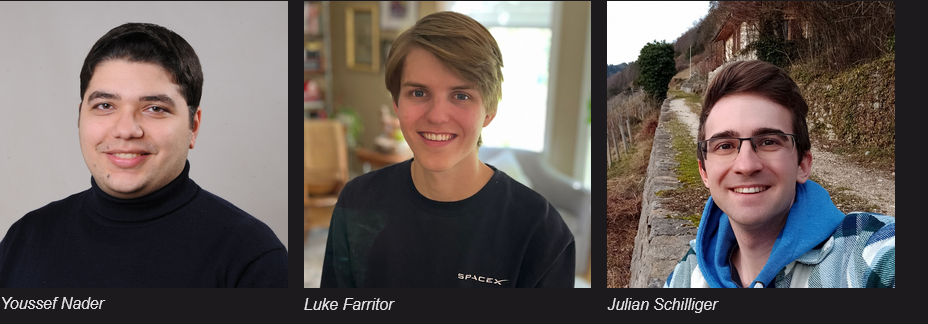
Much more information at the Vesuvius Challenge site.
February 1, 2024
Rome: Part 1 – Mythical Origins to the Founding of the Republic
seangabb
Published 31 Jan 2024This course provides an exploration of Rome’s formative years, its rise to power in the Mediterranean, and the exceptional challenges it faced during the wars with Carthage.
Lecture 1: Mythical Beginnings and the Founding of Rome (753 BC – 509 BC)
• What is said by the archaeology and modern research on the origins of Rome
• The lack of authentic literary history of Rome in its early period
• Legend of Romulus and Remus
• The establishment of Rome’s early monarchy
• Transition to the Roman Republic
(more…)
Comments Off on Rome: Part 1 – Mythical Origins to the Founding of the Republic
December 31, 2023
Budapest Under Siege – WW2 – Week 279 – December 30, 1944
World War Two
Published 30 Dec 2023In the west, the Allies break the siege of Bastogne, but the fight for the Ardennes continues. and British commander Bernard Montgomery is maneuvering to take command of the Western Front ground forces. In Hungary Budapest is cut off by the Soviets and under siege, with hundreds of thousands of civilians still in the city. The fight in Italy is winding down for the winter, but the fight in the Philippines continues. In fact, American landings on Luzon are planned to go off soon.
00:00 INTRO
01:22 The Siege of Bastogne
03:10 The failure of 5th and 6th Panzer Armies
06:11 Montgomery wants command
09:27 Guderian appeals to Hitler, “stop the Ardennes Offensive!”
12:11 Budapest surrounded and under siege
17:04 Wrapping up the Gothic Line Campaign
19:29 Churchill in Athens
20:30 The fight in the Philippines
23:07 SUMMARY
(more…)
Comments Off on Budapest Under Siege – WW2 – Week 279 – December 30, 1944
December 29, 2023
The Christianization of England
Ed West‘s Christmas Day post recounted the beginnings of organized Christianity in England, thanks to the efforts of Roman missionaries sent by Pope Gregory I:
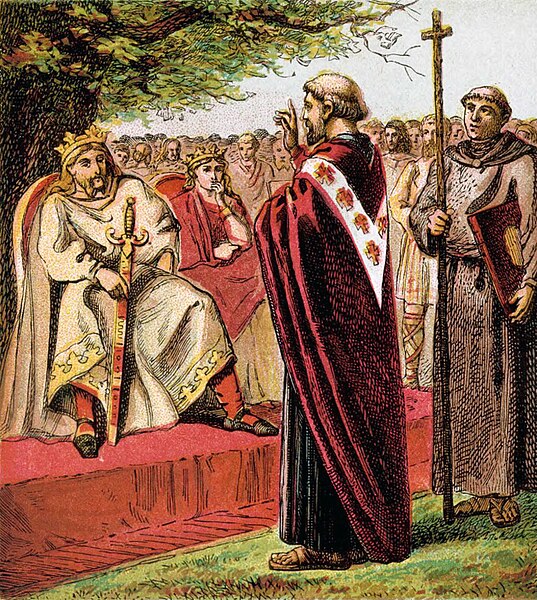
“Saint Augustine and the Saxons”
Illustration by Joseph Martin Kronheim from Pictures of English History, 1868 via Wikimedia Commons.
The story begins in sixth century Rome, once a city of a million people but now shrunk to a desolate town of a few thousand, no longer the capital of a great empire of even enjoying basic plumbing — a few decades earlier its aqueducts had been destroyed in the recent wars between the Goths and Byzantines, a final blow to the great city of antiquity. Under Pope Gregory I, the Church had effectively taken over what was left of the town, establishing it as the western headquarters of Christianity.
Rome was just one of five major Christian centres. Constantinople, the capital of the surviving eastern Roman Empire, was by this point far larger, and also claimed leadership of the Christian world — eventually the two would split in the Great Schism, but this was many centuries away. The other three great Christian centres — Jerusalem, Alexandria, and Antioch — would soon fall to Islam, a turn of events that would strengthen Rome’s spiritual position. And it was this Roman version of Christianity which came to shape the Anglo-Saxon world.
Gregory was a great reformer who is viewed by some historians as a sort of bridge between Late Antiquity and the Middle Ages, the founder of a new and reborn Rome, now a spiritual rather than a military empire. He is also the subject of the one great stories of early English history.
One day during the 570s, several years before he became pontiff, Gregory was walking around the marketplace when he spotted a pair of blond-haired pagan slave boys for sale. Thinking it tragic that such innocent-looking children should be ignorant of the Lord, he asked a trader where they came from, and was told they were “Anglii”, Angles. Gregory, who was fond of a pun, replied “Non Angli, sed Angeli” (not Angles, but angels), a bit of wordplay that still works fourteen centuries later. Not content with this, he asked what region they came from and was told “Deira” (today’s Yorkshire). “No,” he said, warming to the theme and presumably laughing to himself, “de ira” — they are blessed.
Impressed with his own punning, Gregory decided that the Angles and Saxons should be shown the true way. A further embellishment has the Pope punning on the name of the king of Deira, Elle, by saying he’d sing “hallelujah” if they were converted, but it seems dubious; in fact, the Anglo-Saxons were very fond of wordplay, which features a great deal in their surviving literature and without spoiling the story, we probably need to be slightly sceptical about whether Gregory actually said any of this.
The Pope ordered an abbot called Augustine to go to Kent to convert the heathens. We can only imagine how Augustine, having enjoyed a relatively nice life at a Benedictine monastery in Rome, must have felt about his new posting to some cold, faraway island, and he initially gave up halfway through his trip, leaving his entourage in southern Gaul while he went back to Rome to beg Gregory to call the thing off.
Yet he continued, and the island must have seemed like an unimaginably grim posting for the priest. Still, in the misery-ridden squalor that was sixth-century Britain, Kent was perhaps as good as it gets, in large part due to its links to the continent.
Gaul had been overrun by the Franks in the fifth century, but had essentially maintained Roman institutions and culture; the Frankish king Clovis had converted to Catholicism a century before, following relentless pressure from his wife, and then as now people in Britain tended to ape the fashions of those across the water.
The barbarians of Britain were grouped into tribes led by chieftains, the word for their warlords, cyning, eventually evolving into its modern usage of “king”. There were initially at least twelve small kingdoms, and various smaller tribal groupings, although by Augustine’s time a series of hostile takeovers had reduced this to eight — Kent, Sussex, Essex, and Wessex (the West Country and Thames Valley), East Anglia, Mercia (the Midlands), Bernicia (the far North), and Deira (Yorkshire).
In 597, when the Italian delegation finally finished their long trip, Kent was ruled by King Ethelbert, supposedly a great-grandson of the semi-mythical Hengest. The king of Kent was married to a strong-willed Frankish princess called Bertha, and luckily for Augustine, Bertha was a Christian. She had only agreed to marry Ethelbert on condition that she was allowed to practise her religion, and to keep her own personal bishop.
Bertha persuaded her husband to talk to the missionary, but the king was perhaps paranoid that the Italian would try to bamboozle him with witchcraft, only agreeing to meet him under an oak tree, which to the early English had magical properties that could overpower the foreigner’s sorcery. (Oak trees had a strong association with religion and mysticism throughout Europe, being seen as the king of the trees and associated with Woden, Zeus, Jupiter, and all the other alpha male gods.)
Eventually, and persuaded by his wife, Ethelbert allowed Augustine to baptise 10,000 Kentish men on Christmas Day, 597, according to the chronicles. This is probably a wild exaggeration; 10,000 is often used as a figure in medieval history, and usually just means “quite a lot of people”.
Comments Off on The Christianization of England
December 24, 2023
The Siege of Bastogne Begins – WW2 – Week 278 – December 23, 1944
World War Two
Published 23 Dec 2023The German Ardennes Offensive, called by the Allies the Battle of the Bulge, is in full swing in Luxembourg and Belgium this week, and the Germans have the key junction town of Bastogne under siege. On the Allied side there comes a large American surrender, plans for counterattacks, and tension growing between British and American Commands. The fight in both Italy and the Philippines continues, and in Hungary the Soviets have nearly surrounded Budapest.
00:26 Intro
01:06 The Battle of the Bulge
03:54 The Malmedy Massacre
06:25 Bastogne
10:00 American Surrender on Schnee Eifel
12:06 Patton plans a counterattack
15:44 Bernard Montgomery and Omar Bradley
18:12 The Red Army advances around Budapest
21:39 Fighting in Italy and Greece
22:45 Leyte and Mindoro
25:07 Conclusion
(more…)
Comments Off on The Siege of Bastogne Begins – WW2 – Week 278 – December 23, 1944


