
[The Nazis], being Social Darwinists to the core, applied the military principle of Auftragstaktik to civilian life. “Mission-oriented” tactics means that the overall commanders leave as much as possible to the on-the-spot commanders, be they officers or noncoms, on the theory that properly-trained leaders will have a much better understanding of what needs to be done, and how to do it, than some general back at HQ. It’s the main reason the Wehrmacht could keep fighting so well, for so long, in the face of overwhelming opposition — tasks that would fall to an American company, or a Russian regiment, were often undertaken by a Wehrmacht platoon under the command of a senior corporal.
Obviously civilian life isn’t as goal-directed as the military in wartime, but a similar principle applied — given a vague set of generalized objectives from the top (Kershaw’s famous “working towards the Führer” thesis), everyone at every level was encouraged to move the ball downfield as he saw fit … with the added twist that, in the absence of a clearly defined, military-style chain of command, the various “subordinates” would ruthlessly battle it out with each other, Darwin-style, for bureaucratic supremacy.
Thus the Nazis’ infamous plate-of-spaghetti org charts. I’m not an expert, but I’m pretty sure there were more than a few guys who held wildly different ranks in various different organizations simultaneously. He might be a mere patrolman in the Order Police, but an officer in the SS, a noncom in the SA (you could be in both, at least in the early days), and so forth. I wouldn’t be surprised if there was more than one guy who technically reported to himself, somewhere deep in the bowels of the RHSA [Reich Security Main Office]. You could spend a lifetime trying to sort this stuff out …
Severian, “The Crisis of the Third Decade”, Rotten Chestnuts, 2021-03-18.
November 5, 2023
QotD: The Auftragstaktik principle of the Third Reich
November 4, 2023
MKb-42(H) Assault Rifle with ZF-41 scope
Forgotten Weapons
Published 31 Aug 2014The MKb-42(H), or Maschinenkarabiner-42 (Haenel), was the first production iteration of the German Sturmgewehr. It was chambered for the then-new 8x33mm kurz cartridge, and fired both semiauto and full-auto from an open bolt. Approximately 11,000 of these were made before production changed to the closed-bolt MP43.
(more…)
November 3, 2023
Understanding Combined Arms Warfare
Army University Press
Published 24 Mar 2023Designed to support the U.S. Army Captains Career Course, “Understanding Combined Arms Warfare” defines and outlines the important aspects of modern combined arms operations. This is not a complete history of combined arms warfare. It is intended to highlight the most important aspects of the subject.
The beginning of the documentary establishes a common understanding of combined arms warfare by discussing doctrinal and equipment developments in World War I. The second part compares the development of French and German Army mechanization during the interwar period and describes how each country fared during the Battle of France in 1940. The film concludes by showing how the United States applied combined arms operations in the European Theater in World War II.
(more…)
October 31, 2023
As we’re always told in a pious tone of voice, “violence never settles anything”
Chris Bray, ever the iconoclast, begs to differ:
One of the things everyone knows about Gaza is that the Israeli attack is just creating more violence, as the next generation of Palestinians watches the bombs fall. Inevitably, the story goes, the young are learning hate and rage, and will pay it forward. Here’s the upscale think tank version of the argument, under the headline, “Israel risks creating a newly traumatized and radicalized generation of Palestinians”:
What will remain of Gaza’s population, and among Palestinians elsewhere in the occupied West Bank and East Jerusalem and inside Israel proper, will be a newly traumatized and radicalized generation of youth, none of whom were born or of voting age when Hamas was elected … As a result, Hamas’s self-declared raison d’etre — “resisting the [Israeli] occupation with all means and methods” — will only grow in the minds of Palestinian youth. This will render unsuccessful Israel’s attempts to eliminate Hamas militarily.
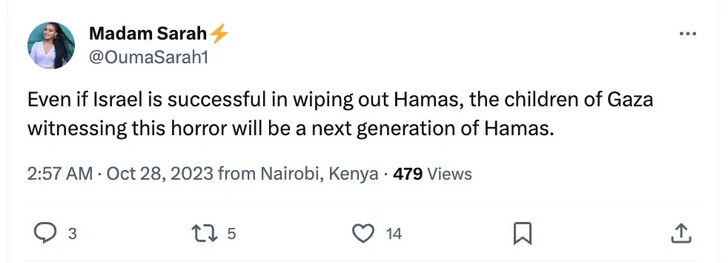
Here’s an example of the Twitter rando version, which you’ll see over and over again if you engage with social media at all:
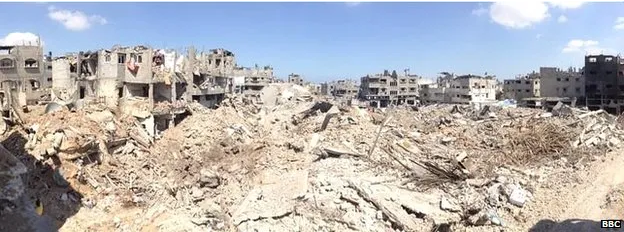
But is that true? Without advocating for brutality, I find myself looking for historical examples and mostly coming up with the opposite. To start managing the “yes, but” up front, there are many ways of waging war, and the extractive nation-building warfare of an imperial constabulary — low-grade fighting, prolonged counterinsurgency without decisive violence — does seem to often lead to more violence and “blowback” over time. But what Israel is doing now in Gaza seems like something else entirely.
If this violence will create “the next generation of Hamas”, then the children of the Germans who were firebombed in Dresden and Hamburg should be constantly strapping on suicide vests and attacking Ramstein air base. After the Wounded Knee massacre, it shouldn’t be safe for white settlers to live near the Lakota, and South Dakota should be a hellscape. Or consider North Vietnam, which won its war: “The US carried out more than a million bombing raids during the 20-year conflict, dropping some 5 million tonnes of ordnance on the Southeast Asian country.” After the war, a substantial Vietnamese population resettled in California. Violence trains the next generation to hate, right? So the Vietnamese must constantly attack Orange County.
The horror of total war has mostly not seemed to produce more violence. It seems to have mostly left later generations brutalized and horrified, and highly unlikely to go on fighting. Waging war decisively seems to be historically … decisive? The experience of crushing defeat seems to be a cycle-breaker, and even a horrifyingly costly victory — as for the North Vietnamese — seems to limit the appetite of next generations for more war.
Japan nurtured a profoundly violent warrior culture for a long time, with the nation’s soldiers serving as brutal invaders and horrible occupiers, then faced a ghastly campaign of firebombing and two nuclear bombs. Japan no longer has a brutal martial culture; the next generations didn’t become the new warriors. The currently popular theory says that they had to: the children witnessing this horror will be the next generation of militants, because trauma teaches violence. Tomorrow’s Hamas comes from today’s JDAMs. The people who lost World War II don’t seem to prove that theory.
Someone is going to say in the comments that I have blood on my fangs, but the point isn’t to cheerlead for the killing in Gaza. The point is to consider evidence about what comes next, and to ask what the comparable examples are. Is it factually true that youth, traumatized by war, become the violent next generation? We ran this experiment a lot in the twentieth century, and I think we have some strong hints at a consistent answer.
As Robert Heinlein had retired Lt. Col. Jean V. Dubois say to his History and Moral Philosophy class in Starship Troopers:
Anyone who clings to the historically untrue — and thoroughly immoral — doctrine that “violence never settles anything” I would advise to conjure the ghosts of Napoleon Bonaparte and the Duke of Wellington and let them debate it. The ghost of Hitler could referee, and the jury might well be the Dodo, the Great Auk and the Passenger Pigeon. Violence, naked force, has settled more issues in history than has any other factor, and the contrary opinion is wishful thinking at its worst. Breeds that forget this basic truth have always paid for it with their lives and their freedoms.
October 29, 2023
The Battle of Leyte Gulf – WW2 – Week 270 – October 28, 1944
World War Two
Published 28 Oct 2023This is it — the big showdown between US and Japanese Navies, and the largest naval battle ever fought in terms of total tonnage. American landings on Leyte itself are still in progress, and the Soviets’ Debrecen Operation comes to its end.
(more…)
QotD: Leni Riefenstahl’s Triumph of the Will
Ah, if only it weren’t for that awkward patch …
In the 1930s, Fräulein Riefenstahl put her formidable film-making talents to the cause of the Third Reich, and, after attending the Reichsparteitag des Willens in 1934, produced one of the most remarkable films ever made: Triumph Of The Will.
Go back to that scuba-diving disembarkation scene in Ray Müller’s The Wonderful Horrible Life Of Leni Riefenstahl. In theory, it could all be a setup, and the participants chewed over how best to do it beforehand and did fifteen takes: anyone who’s worked in documentaries knows how phony the whole business is. But the point is it seems careless — as if it happened, and the camera happened to be there to record it.
There’s no sense of that in any frame of Triumph Of The Will. Granted that audiences were a lot less media savvy in 1934, and granted that a people dumb enough to fall for National Socialism will fall for anything, it’s still hard to believe that even in its day anyone accepted what remained Fräulein Riefenstahl’s official explanation to the end — that this was just a “documentary record” of the 1934 annual party convention. Early on, we see the Führer‘s motorcade driving through Nuremberg, with what seems like the entire citizenry jammed on to the streets to greet him. Riefenstahl’s camera shoots Hitler (if you’ll forgive the expression) from directly behind him, a sequence which for some reason always reminds me of Gore Vidal’s boast that only very famous people such as himself know what the back of their heads look like. There’s a fabulous moment when the great man — Adolf, not Gore — is responding to the Hitler salutes offered up by the crowds with his campy little elbow-bend and wrist-flip and, as his Mercedes moves forward, the sun catches his fingers and fills the palm, first bathing it in glory and then making it appear as if the Führer‘s hand is the very source of the sunlight itself. Did the director just get lucky? Did the sun just happen to hit? Seconds later, we cut to a long shot of Hitler in the Mercedes continuing down the street. There’s no camera in the car, although the scene we’ve just witnessed could only have been filmed by someone in the back seat. Another minute goes by, and we’re back to the close-up of the Führer‘s neck.
Did she stop the car, get out and film the long shot, and then get back in? Did Leni get Adolf to do re-takes? Or maybe she made the entire population of Nuremberg re-take the scene; maybe they staged the procession twice. If Hitler was unusually agreeable about taking direction, it was because this was never a filmed record of an event so much as an event created for the film. Whatever Triumph Of The Will is, it’s not a documentary. Its language is that of feature films — not Warner Brothers gangster movies or John Ford westerns, but rather the supersized genres, the epics and musicals where huge columns of the great unwieldy messy mass of humanity get tidied and organized — and, if that isn’t the essence of totalitarianism, what is? Riefenstahl has the same superb command of the crowd as Busby Berkeley, the same flair for human geometry (though Berkeley would have drawn the line at giving the gentlemen of the chorus as swishy a parade step as Hitler’s personal SS bodyguard do).
Mark Steyn, “Triumph of the Will”, SteynOnline, 2019-09-07.
October 22, 2023
SS Commando Coup in Hungary – WW2 – Week 269 – October 21, 1944
World War Two
Published 21 Oct 2023The Germans engineer a coup in Hungary to keep the Hungarian army in the war, but the Allies have finally entered Germany in force, taking Aachen in the west. The Soviets liberate Belgrade in the east, and launch new attacks in Baltics, and at the other end of the world come American landings in the Philippines, and the recall of Vinegar Joe Stilwell from China.
00:00 Intro
01:00 Recap
01:21 Raids on the Philippines
04:42 The Invasion of Leyte
06:11 Joe Stilwell is recalled from China
08:12 The Battle of Aachen
12:24 Battle of the Scheldt
14:03 Soviet attacks in the Baltics
16:23 Horthy’s fall- a coup in Hungary
19:45 Germans close in on Slovakia
21:55 Belgrade Liberated
24:47 Summary
25:01 Conclusion
(more…)
October 17, 2023
Why WW1 Cavalry Was Essential On The Battlefield
The Great War
Published 13 Oct 2023The First World War was a catalyst for modern warfare with tanks, poison gas, flamethrowers and more. Cavalry didn’t have a place anymore on the modern battlefield – or so the common misconception goes. In this video we show how useful cavalry still was in WW1.
(more…)
October 16, 2023
The Allied Rape Wave of 1944 – War Against Humanity 116
World War Two
Published 12 Oct 2023Since the earliest days of humanity, where there has been war, there has been rape. This war is no different. As vast armies battle across Europe, the chaos in their wake breeds an epidemic of rape. In its action and its punishment the European rape wave is also highly racialised. It adds up to a storm of suffering.
(more…)
October 15, 2023
The Isolation of Army Group North – WW2 – Week 268 – October 14, 1944
World War Two
Published 14 Oct 2023Churchill, Stalin, and Roosevelt meet at the Moscow Conference and talk about future “spheres of influence” in the Balkans. They also make plans for the future of Poland. In the field the Soviet Red Army completes the isolation of Army Group North and also advances in Hungary and Yugoslavia. The Allies enter Aachen in the west and cross the Rubicon in Italy. The Americans are still fighting the Japanese on Peleliu, and this week also make raids against Japanese airfields ahead of next week’s invasion of the Philippines.
01:00 Recap
01:22 The Moscow Conference begins
03:43 Isolating Army Group North
06:29 Soviet advances toward Belgrade
08:14 The Debrecen Operation
13:20 Horthy and Hungary
14:30 Chiang Kai-shek accuses Joe Stilwell
16:19 American raids on Formosa
19:29 The fight for Peleliu continues
20:01 Antwerp and Aachen
22:01 The Allies cross the Rubicon
(more…)
October 13, 2023
Elvira, the Party Girl Double Agent
World War Two
Published 11 Oct 2023She’s the gambler with a hotline to the Abwehr. The party girl tearing up the London social scene. Now she’s doing her bit to hold back the Panzer divisions and pave the way for D-Day. This is the story of Elvira Concepcion Josefina de la Fuente Chaudoir, Double Cross’s most flamboyant double agent.
(more…)
Gewehr 43
Forgotten Weapons
Published 13 Oct 2013German ordnance began looking for a military self-loading rifle to augment the K98k as early as the 1930s, although the pressures of war initially made that development a second priority. By 1941, though, two competing designs from the Walther and Mauser companies had been developed to the point of mass production, as the Gewehr 41(W) and Gewehr 41(M) rifles. These both shared a gas-trap operating system to comply with an HWa requirement that no gas ports be drilled into the barrels. When it came to locking systems, the two designs differed greatly, with the Walther being the more successful of the two. Thousands of examples of both designs were put into field testing, mostly in the East, and it became clear that the gas-trap system was not suitable for combat. The Walther company responded with a new version of their design which used a much more modern short-stroke gas piston, basically copied from the Soviet SVT-40 rifle.
The G43 was very quickly recognized as a significant improvement over the G41(W), and was very quickly put into production, with approximately 400,000 being manufactured by the end of the war. Well, I found an example of the G43 that I could shoot (thank you, Mike) and took it out for some video …
(more…)
October 11, 2023
How Britain Broke Hitler’s Brain
World War Two
Published 10 Oct 2023In a re-upload of one of our D-Day 24 Hour videos, Astrid introduces you to the war’s most effective counter-espionage and deception programme, The Double Cross system. Today she’ll talk about their operations before and during D-Day and introduce you to some of the most important double agents. Their mission: fool the Führer.
(more…)
October 8, 2023
The End of the Warsaw Uprising – WW2 – Week 267 – October 7, 1944
World War Two
Published 7 Oct 2023The Warsaw Uprising comes to its conclusion, a tragic one for the Poles. In the field in Europe, there are Allied attacks toward Aachen, Bologna, and Debrecen, while in China the Japanese have begun a new phase of their Ichi Go Offensive.
(more…)
October 7, 2023
Eastern Front Tank Warfare 1944
World War Two
In this conflict, we’ve seen armored warfare on a greater scale than anything before or since. Indy takes a look at some of the tanks slugging it out on the Eastern Front, from the long-serving Panzer III and IV, to the newer and more powerful Tiger and T-34 85, and the monstrous IS-2.
(more…)


