
World War Two
Published 9 Dec 2023This is a very busy week of the war. In the west, the Americans manage to reach the Roer River in force, but haven’t taken any of its dams; in Italy, the Allies liberate Ravenna; the Soviet advance in Hungary continues, and the Soviets even set up a new Hungarian government; martial law is declared in Greece; the Japanese make a corridor to Indochina; the fighting on Leyte continues, and the kamikaze menace becomes ever more worrisome.
00:00 INTRO
01:10 British intelligence failure
01:55 Allies reach the Roer River
05:35 Problems with Devers’ 6th Army Group
07:41 Allies liberate Ravenna
08:50 Soviet advances in Hungary
12:10 Soviets set up a new Hungarian government
13:47 A deadly demonstration and martial law in Greece
18:33 Japanese establish a corridor to Indochina
19:59 Leyte and kamikaze attacks
23:45 CONCLUSION
(more…)
December 10, 2023
Can the Americans Stop the Kamikazes? – WW2 – Week 276 – December 9, 1944
December 3, 2023
Was Hürtgen Forest Worth it? WW2 – Week 275 – December 2, 1944
World War Two
Published 2 Dec 2023The bulk of the fight for Hürtgen Forest is now over, and today we look at the results. We also look at Soviet plans for their January offensive. In the field this week, the Red Army is still fighting in Hungary, the Allies are still trying to reach the Roer River in the west, and in the Pacific Theater the kamikaze menace is wreaking havoc with Allied scheduling.
00:00 INTRO
01:06 Soviet Offensive Plans for 1945
03:12 Red Army attacks in Hungary
06:19 The Port of Antwerp is clear for use
07:23 The Battle of Hurtgen Forest is Over
12:20 Allied advances to the Roer
14:19 Tension builds in Greece
15:32 The aerial situation in the Philippines
21:36 CONCLUSION
(more…)
December 2, 2023
Original FG42: A Detailed Comparison of the 1st and 2nd Patterns
Forgotten Weapons
Published 16 Aug 2023Today we are looking at examples of the first (Type E) and second pattern (Type G) FG42, comparing their construction and disassembling both to get a close look at the internal differences. Despite sharing the basic mechanism, these two models share zero parts in common, not even the bayonets or magazines. We will also discuss the developmental path of the FG-42, and why the majority of production was the 2nd pattern but the vast majority of combat use was the 1st pattern …
(more…)
QotD: Western media and Putin’s war
Regarding [Vladimir Putin’s] Magical Mystery War, I’m going with the stoyak that the casualty counts peddled by the [western media] is part of a very very old playbook which various Western observers have peddled since 1905-that of Russian stupidity and indifference to casualties. Russia loses a war? They’re stupid gopniks who flung their soldiers into meat grinders until they rebelled (1905 or 1917). Russia wins a war? They’re stupid gopniks who flung their soldiers into meat grinders until they won (1945, 2023). Note that you can effortlessly pivot your propaganda when it becomes obvious in hindsight the outcome of the war. This becomes very important when [Putin] negotiates his 18th century kabiniettskreig ending to the war, since nobody in the West, especially AINO, understands how a cabinet war is fought, much less ends. They will claim that they foiled Putin’s plan for conquering all Ukraine (which he never has wanted) by killing hundreds of thousands of poor, oppressed, stupid, vodka-fueled gopniks used as cannon fodder who simply overwhelmed the valiant forces of good by sheer numbers. Not by superior strategy or tactics, or weapons, but the good ol’ Russian sledgehammer. Just like Hitler’s excuse in 1945, when Ivan was knock knock knockin’ on his bunker door. His generals who survived carried that piece of gospel West when the US Army started studying how to fight the Reds and asked the Germans how they did it. Their answer was happily embraced by the next generation of Very Clever Boys in the 1960s and carried forward to today’s Fistagon — Wunderwaffen.
Pickle Rick, commenting on “Friday Mailbag”, Founding Questions, 2023-12-01.
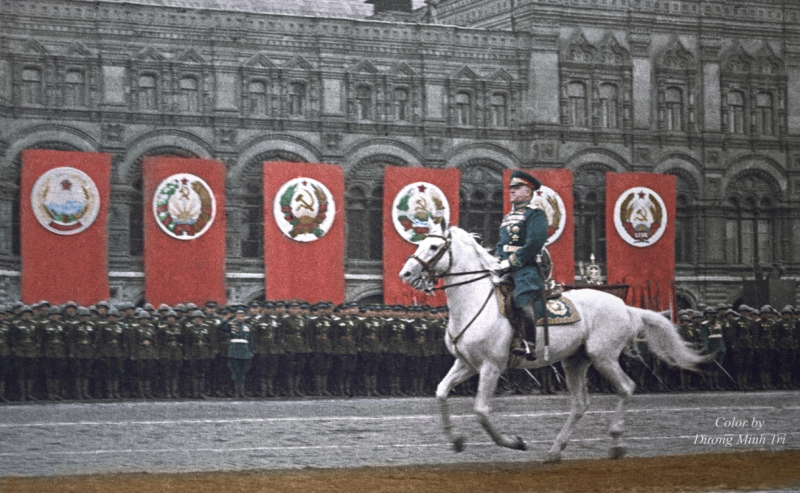
Rick agreed to me posting this quote as long as I included this colourized photo of Marshal of the Soviet Union Georgy Zhukov (“because it’s gangsta as FUCK”)
December 1, 2023
Gregorian – “Stairway To Heaven”
gregorianmusiccom
Published 20 Jun 2015We proudly present the new fan-video “Stairway to Heaven” performed and made by members of the Gregorian-music.com fan club.
(more…)
November 26, 2023
General Patton’s Metz Obsession – WW2 – Week 274 – November 25, 1944
World War Two
Published 25 Nov 2023Metz finally falls to Patton’s 3rd Army, but boy, it’s taken some time. To the south, the Allies also take Belfort and Strasbourg, and to the north Operation Queen continues trying to reach the Roer River. The Soviets complete their conquest of the islands in the Gulf of Riga and continue advancing in Hungary to the south, but it’s the Axis Powers — the Japanese — who are advancing in China, taking Dushan and Nanning.
01:15 Operation Queen Continues
04:49 9th Army attacks toward the Roer
05:54 Pattons 3rd Army takes Metz
09:22 Allies take Belfort, Mulhouse, and Strasbourg
13:56 8th Army Attacks in Italy
15:42 Soviet advances and German indecision
18:05 Japanese take Dushan and Nanning
19:21 The fight for Peleliu ends
21:43 Notes from all over
22:23 Conclusion
(more…)
November 24, 2023
The Man Who Started the Cold War
World War Two
Published 23 Nov 2023What if I told you that a new conflict will sweep the globe in less than a year? It will open not with gunshots but with silent, shadowy espionage. The man who will kick off the Cold War is a quiet Canadian pilot, millionaire, and spymaster. A trusted aide to Churchill and FDR. I bet you haven’t heard this name before: William Stephenson.
(more…)
November 19, 2023
How Himmler Learned to Love the Russians – WW2 – Week 273 – November 18, 1944
World War Two
Published 18 Nov 2023Heinrich Himmler wants to build an Army of Soviet POWs, but that has some problems; Patrick Hurley becomes US Ambassador to China, but even before that he’s in hot water with Chiang Kai-Shek; and in the field in the west, the Allies launch Operation Queen to try to cross the Roer River and reach the Rhine.
(more…)
Last Ditch Innovation: The Development of the Gerat 06 and Gerat 06H Rifles
Forgotten Weapons
Published 19 Nov 2012I’m very happy today to present a video we did in cooperation with Oleg Volk, which I’ve titled “Last Ditch Innovation”. It is a look at two late-WW2 German prototype rifles which are the evolutionary grandparents of the CETME and the H&K series of roller-delayed firearms (91, 93, MP5, etc). Thanks to some very generous friends, we have examples of both guns to disassemble and shoot … so sit back, relax, and enjoy the show.
November 14, 2023
Inside T-72: A Commander’s Perspective | Tank Chats Reloaded
The Tank Museum
Published 21 Jul 2023A fast tank with a low profile and a big gun, the T-72 is a classic Soviet designed Main Battle Tank, in use all over the world. In this video, we talk to Dag Patchett, a former T-72 commander and get his impressions of a tank built in the Cold War era but still very much in service.
(more…)
November 12, 2023
The Futile Fight in Hurtgen Forest – WW2 – Week 272 – November 11, 1944
World War Two
Published 11 Nov 2023The struggle for Hurtgen forest, one tiny piece at a time, continues. The Allies have, however, secured Walcheren Island, and also launch Operation Queen to try and reach and cross the Roer River, and further south even launch a new offensive aiming for Metz. Things are not going well for the Americans on Leyte, though, but they’re even worse for the Chinese as both Guilin and Liuzhou fall to the Japanese. As for the Soviets, they are busy making big plans for a gigantic offensive to drive in to Germany when the new year comes.
(more…)
November 10, 2023
Luftwaffe Drilling and US M6 Survival Rifle
Forgotten Weapons
Published 8 Sept 2014Today we’re looking at a pair of military survival rifles. One is a Luftwaffe M30 drilling — the most finely finished and luxurious survival rifle ever issued by a military force. The other is a US Air Force M6 survival gun — spartan and utilitarian — the polar opposite of the M30.
(more…)
November 9, 2023
Remembering Weimar
In The Critic, Darren O’Byrne reviews some recent books on German society between the Armistice of 1918 and the rise of Hitler, including Frank McDonough’s The Weimar Years: Rise and Fall 1918–1933.
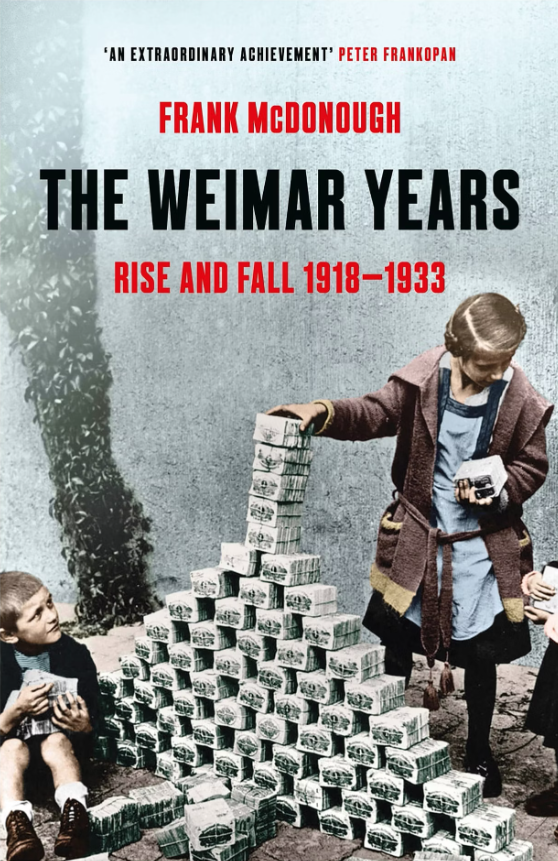
One of the latest additions to the canon is Frank McDonough’s The Weimar Years (1918–33). A prequel to his two-volume narrative history of the Third Reich, The Hitler Years, it sets out to explain the Nazis’ rise to power by examining the reasons why democracy failed in Germany. Like the earliest histories of the period, the Republic is not examined on its own terms but rather as a kind of backstory to what followed, the numerous crises that befell it being used to explain the ultimate catastrophe.
Structured chronologically, the book provides a devastating, play-by-play account of why, for McDonough, democracy stood little chance in Germany. Defeat in World War I, the Kaiser’s abdication and the humiliating terms of the Versailles treaties challenged the legitimacy of the Republic from the start, as did its failure to contain political violence. Crippling inflation and mounting government debt, exacerbated by the obligation to pay reparations to the Allies, hampered German economic recovery from the start and threatened to wipe out the middle classes.
A degree of economic stability did return in the mid-1920s, but the country experienced its second “once-in-a-lifetime” economic crisis in the early 1930s, causing further instability and ultimately paving the way for Hitler. It’s a well-known story, skilfully retold for a contemporary audience by one of the foremost authorities on modern German history.
Does McDonough tell us anything we didn’t already know? The answer, in short, is no. In comparison to other recent histories of the period, more attention is paid here to high politics than Weimar’s cultural achievements, which are mentioned, but this tends to disrupt the flow of what is otherwise a high-paced, edge-of-the-seat political history of Germany’s first democracy. Despite being nearly 600 pages in length, the book’s focus is quite narrow, with little attention paid to what was happening below the national level in the federal states.
This may seem like an inane criticism. Who, after all, would demand to read more about Buckinghamshire in a political history of interwar Britain? However, the Weimar Republic, like Germany today, was a federation. Understanding what was happening in states like Prussia, which contained three-fifths of Germany’s population, is crucial to understanding the country as a whole.
Indeed, McDonough places some of the blame for Weimar’s collapse on the Social Democrats, who he argues should have participated in more national governments. Prussia was governed by an SPD-led coalition for most of the Weimar years, though, yet the Republic still fell. McDonough sees another reason for this fall in the failure to purge the military and civil service of hostile elements.
Again, Prussia replaced a considerable number of these officials with others loyal to the new democratic order, yet the Republic still fell. The book’s rigid focus on high politics, in short, obscures an understanding of the more structural reasons why democracy failed.
Unlike most history books, however, The Weimar Years is a genuine page-turner, full of lessons for those who want to learn something about the present from the past. It’s also a beautiful book to hold, full of period photos that help bring the story alive. This all makes the book worth reading, even if there’s not much in it that can’t be found in other histories of the period.
November 6, 2023
The Army Door Knocker | Pak 35/36 | Anti-Tank Chats
The Tank Museum
Published 14 Jul 2023In this video, we look at the Pak 35/36, the German Army’s first anti-tank gun. Obsolete by 1941, it picked up the nickname Heeresanklopfgerat – the army door knocker – after its inability to penetrate tank armour. In spite of this, it carried on in service until 1945. Chris Copson talks you through the gun and its history.
(more…)
QotD: The “German Catastrophe”
The obvious frame for this book is what has been fittingly termed the German Catastrophe: the fate of Germany in the late 19th and early 20th century, as viewed from the perspective of German nationalists who were not Nazis — the perspective of people like Ernst Jünger.
Germany had entered modernity without democracy. The Kaiserreich (German Empire) had united the many small German states, aggressively worked to catch up with industrialization, built a state to rival France and Great Britain, and remained authoritarian throughout. Commoners had negligible political influence. They did get social insurance, but not through their own political power but granted top-down, as an appeasement to undermine socialist movements. Civil marriage, secularized state education, prospering state universities and a long series of modernizing laws kept increasing state power. And that meant executive power. There were parties, a parliament and a newly homogenized judiciary, but they had little power to check the executive.
And this entire development was accompanied by a lot of theorizing about this new German nation. Much of this theorizing ended up justifying authoritarianism, by making quickly-spreading myths about how obedience to authority, respect for aristocracy and love for tradition were uniquely German traits that set Germans apart from the French and the Jews and other dubious foreigners. Such myths, and opposition to them, colored the German population’s hard work to get accustomed to industrialization, urbanization, education, rapid population growth, militarization, national media and various culture wars.
This had seemed to work okay-ish while Bismarck, wielding both enormous ruthlessness and enormous political acumen, had navigated Germany through the trials and tribulations of the late 19th century, largely at the expense of France. But in 1890, Emperor Wilhelm II had taken over authority with less ruthlessness and much less political acumen. While his populace remained nearly unable to influence politics, Wilhelm II made critical political mistakes, especially in dealing with other European powers.
These mistakes culminated in the first World War. You know how that one went.
Germany’s defeat led into Germany’s first real democracy. Everyone was very obviously new to this. The right attacked the new state, falsely claiming it had needlessly capitulated. The left also attacked the new state, because it wasn’t Soviet-Union-like enough. There was a lot of political violence. The massive damage incurred in the war, and the restrictions and reparations Germany had accepted in the peace settlement, put massive strains on an already fragile political system. Elections were tumultuous and frequent. Hyperinflation caused a huge crisis in 1923, and the Great Depression of 1929 was another huge disaster for Germany. Overall, the abolition of authoritarianism was widely felt to be a mistake.
This seeming mistake was fixed when Hitler stepped in. And you know how that one went.
Anonymous, “Your Book Review: On the Marble Cliffs”, Astral Codex Ten, 2023-07-28.


