
World War Two
Published 11 Jan 2024The Soviets are just about to kick off a series of enormous offensives all along the Eastern Front. Here’s a look at the forces who are to attack, and those who will be defending.
(more…)
January 12, 2024
Eastern Front Deployments, January 11, 1945 – a WW2 Special
Comments Off on Eastern Front Deployments, January 11, 1945 – a WW2 Special
January 7, 2024
1945 Begins! – WW2 – Week 280 – January 6, 1945
World War Two
Published 6 Jan 2024The Germans launch a new offensive, Operation Nordwind, in Alsace, even as their offensive in the Ardennes is stalled. The Allies in the west don’t just have to fight these, they are also having serious issues amongst themselves in High Command that threaten their unity. The siege of Budapest is in full swing and is a hard, fought, bloody battle, and the Soviets and the Americans have big plans for new offensives soon to kick off in Eastern Europe and the Philippines (respectively).
00:00 INTRO
01:20 The Siege of Budapest
04:51 German defense plans in the East
06:38 Montgomery versus Eisenhower
08:32 Eisenhower versus the French
10:35 New German Offensive in Alsace
13:49 Monty’s plans for the press
15:04 The Battle of the Bulge
17:45 Preparations for the Luzon Landings
20:56 Notes to end the week
21:51 Summary and conclusion
(more…)
Comments Off on 1945 Begins! – WW2 – Week 280 – January 6, 1945
December 31, 2023
Budapest Under Siege – WW2 – Week 279 – December 30, 1944
World War Two
Published 30 Dec 2023In the west, the Allies break the siege of Bastogne, but the fight for the Ardennes continues. and British commander Bernard Montgomery is maneuvering to take command of the Western Front ground forces. In Hungary Budapest is cut off by the Soviets and under siege, with hundreds of thousands of civilians still in the city. The fight in Italy is winding down for the winter, but the fight in the Philippines continues. In fact, American landings on Luzon are planned to go off soon.
00:00 INTRO
01:22 The Siege of Bastogne
03:10 The failure of 5th and 6th Panzer Armies
06:11 Montgomery wants command
09:27 Guderian appeals to Hitler, “stop the Ardennes Offensive!”
12:11 Budapest surrounded and under siege
17:04 Wrapping up the Gothic Line Campaign
19:29 Churchill in Athens
20:30 The fight in the Philippines
23:07 SUMMARY
(more…)
Comments Off on Budapest Under Siege – WW2 – Week 279 – December 30, 1944
December 29, 2023
The Soviet follow-on operation after Bagration
Big Serge discusses the state of the Germans on the Eastern Front at the end of the massive Soviet attacks that collapsed Army Group Centre in 1944:
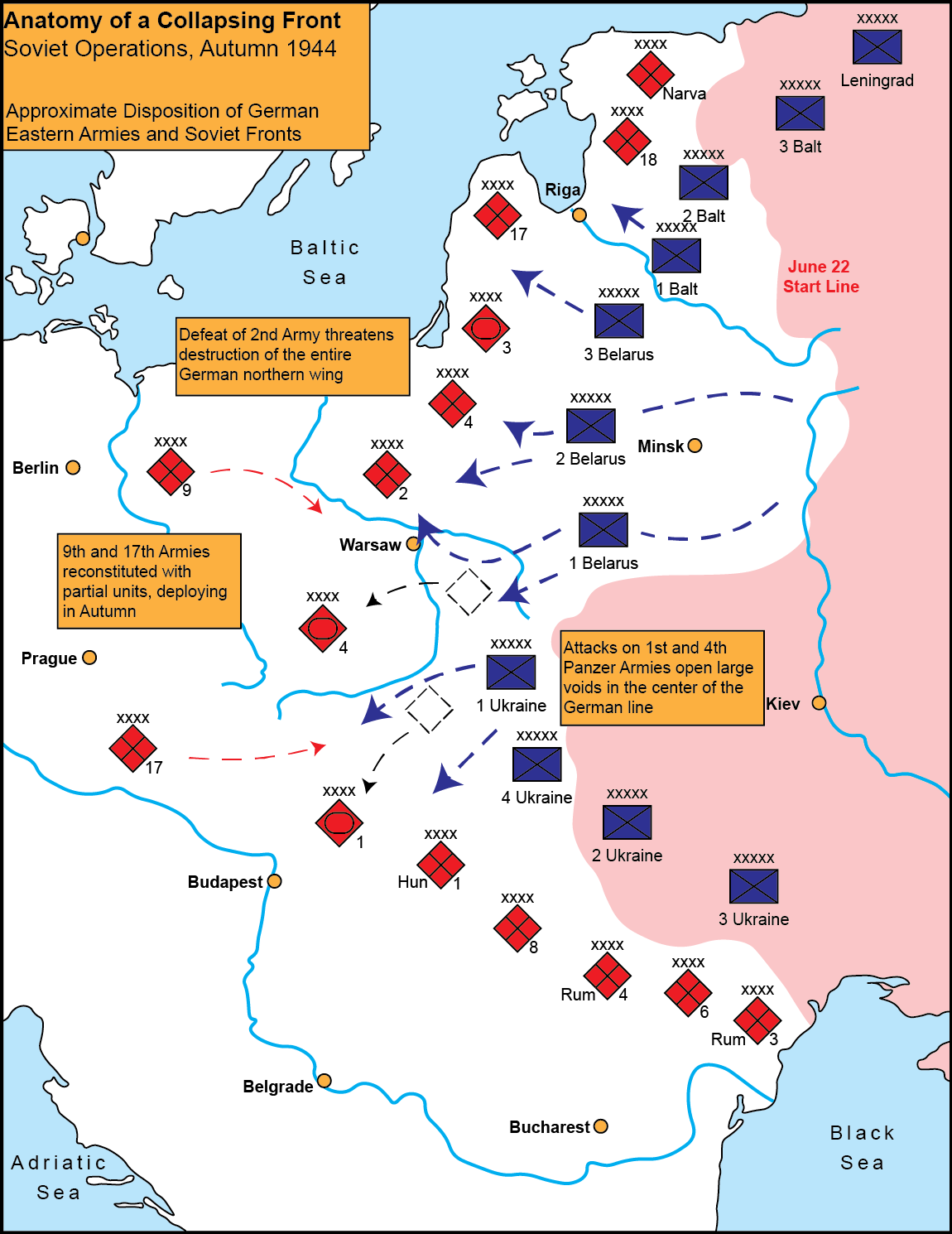
But now, as Bagration began to run out of momentum, the Soviets really did put Model’s army group in the crosshairs with an enormous follow up offensive — the second phase of their summer blockbuster. Model’s army group consisted of two Panzer Armies (the 4th and 1st), and an allied Hungarian force guarding the southern flank. On paper, a pair of Panzer Armies was a formidable force, but like all German units at this stage in the war they were understrength, and by this point they were already bleeding strength as panzer divisions were scrambled north to try and slow down Operation Bagration.
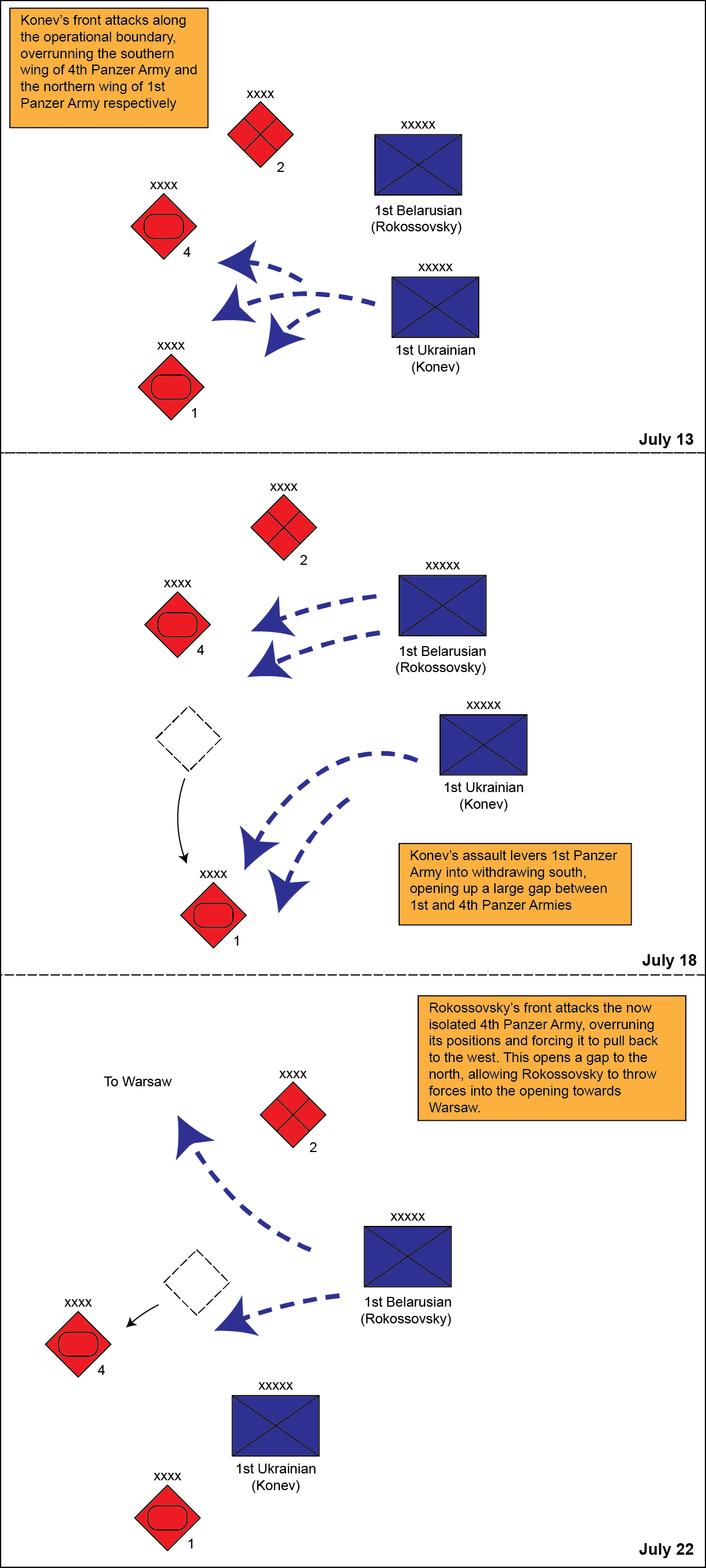
Arrayed against Model’s force were two Soviet Fronts (the equivalent of an Army Group) under a pair of the Red Army’s best operators. The lead off assault came on July 13, with Marshal Ivan Konev’s 1st Ukrainian Front forcing positions in the interstitial zone between Model’s two Panzer Armies. Konev’s intention was to split the two armies apart, force a penetration between them, and then curl into the rear to encircle one, or if possible both of them. Therefore, Konev’s initial assault was highly concentrated, with as much as 70 percent of his artillery and 90 percent of his armor assembled in a few narrow sectors selected for breaching.
With this level of force concentration by the attackers, there was really little that the Germans could do. Nevertheless, a somewhat lethargic and stiff German response helped make the disaster even worse. 4th Panzer Army headquarters initially believed Konev’s opening assault to be only a local attack – later defensively arguing that “there were as yet no signs of the attack being extended to other sections of the front” — and so attempted to respond with local counterattacks by its own reserves. As a result, by the second day of the Soviet offensive the Panzer Army had already committed all of its organic reserves while failing to withdraw from defensive positions that were already compromised. By the time they realized that Konev was launching a serious offensive operation, it was too late. Konev had already bashed into critical seams in the German front, turning his forces into a giant splitting wedge, in place to pry the whole front open.
[…]
What the Soviets had achieved with their enormous assaults on Army Group North Ukraine was remarkable. By precisely targeting the seams in the German formations, the initial attacks had pried open the German position like a clam, forcing the two panzer armies to retreat in opposite directions — the 1st pulling back to the south towards Hungary, and the 4th withdrawing westward towards Krakow. These diverging withdrawals opened enormous voids in the German line — the official German history of the war simply refers to this sequence of events as “the loss of a continuous front”. In a war where the enemy wielded vast mechanized forces, such gaps were fatal.
Rokossovsky and Konev had essentially overrun an entire German army group — and the best equipped group in the east, at that — in the space of about ten days, wedging the German line open and creating vast voids to drive into. Most importantly, Rokossovsky now faced one of the more tantalizing opportunities of the entire war. A great space now beckoned him to drive north towards Warsaw, and in his path was only the tired remnant of German second army — a force with no armor whatsoever, caught completely out of position.
Any wargamer could look at the map as Rokossovsky saw it and see that the opportunity to win a seminal, world-historical victory was now within reach. A sharp drive on Warsaw would put him in position to not only capture the city (a major transportation, administrative, and supply base), but also smash through the threadbare German 2nd Army and drive to the Baltic Coast. If he could achieve this, fully half of the German eastern forces would be encircled — the entirety of Army Group North (still fighting on the Baltic Coast) and everything that remained of Army Group Center. Rokossovksy now saw little standing between his powerful Front and one of the greatest encirclements — perhaps the greatest — of all time. No less than six German armies were sitting, naked and vulnerable, on the proverbial silver platter.
The Eastern Front was on the verge of total collapse. If Rokossovsky could bash through Warsaw (a seemingly simple proposition, given the enormous overmatch that he enjoyed over German 2nd Army), he would wipe out half the German eastern army and face no meaningful German forces between him and Berlin.
Comments Off on The Soviet follow-on operation after Bagration
QotD: The Hanoverian “reverse takeover of the British monarchy by the Germans”
Why, though, did Germans feel such a special affinity with “die Königin“? The most obvious reason is that the Royal Family is, to a great extent, of German extraction. The connections go back more than a thousand years to the Anglo-Saxons, but in modern times they begin with George I and the House of Hanover. This reverse takeover of the British monarchy by the Germans transformed the institution in countless ways. They may be summarised in four words: music, the military, the constitution and Christmas.
Music was a language that united the English and the Germans. The key figure was, of course, Handel — the first and pre-eminent but by no means the last Anglo-German composer. Born in Halle, Georg Friedrich Händel had briefly been George I’s Kapellmeister in Hanover yet had already established himself in England before the Prince Elector of Hanover inherited the British throne in 1714.
In London — then in the process of overtaking Paris and Amsterdam to become the commercial capital of Europe — he discovered hitherto undreamt-of possibilities. There he founded three opera companies, for which he supplied more than 40 operas, and adapted a baroque Italian art form, the oratorio, to suit English Protestant tastes.
His coronation music, such as the anthem, “Zadok the Priest”, imbued the Hanoverian dynasty with a new and splendid kind of sacral majesty. But he also added to its lustre by providing the musical accompaniment for new kinds of public entertainment, such as his Music for the Royal Fireworks: 12,000 people came to the first performance.
Along with music, the Germans brought a focus on military life. Whereas for the British Isles, the Civil War and the subsequent conflicts in Scotland and Ireland had been something of an aberration, war was second nature to German princes. Among them, George II was not unusual in leading his men into battle, although he was the last British monarch to do so.
Still, the legacy of such Teutonic martial prowess was visible in the late Queen’s obsequies: uniforms and decorations, pomp and circumstance, accompanied by funeral marches composed by a German, Ludwig van Beethoven. Ironically, the German state now avoids any public spectacle that could be construed as militaristic, yet most Germans harbour boundless admiration for the way that the British monarchy enlists the ceremonial genius of the armed services.
Even more important was the German contribution to the uniquely British creation of constitutional monarchy.
Each successive dynasty has left its mark on the monarchy’s evolution: from the Anglo-Saxons and Normans (the common law) to the Plantagenets (Magna Carta and Parliament) and Tudors (the Reformation). Only the Stuarts failed this test, at least until 1688. Even after the Glorious Revolution, the Bill of Rights and other laws that conferred statutory control over the royal prerogative, the constitutional settlement still hung in the balance when Queen Anne, the last Stuart ruler, died in 1714.
Coming from a region dominated by the theory and practice of absolute monarchy, the Hanoverians had no choice but to adapt immediately and seamlessly to the realities of politics in Britain, where their role was strictly limited. Robert Walpole and the long Whig ascendancy, during which the doctrine of parliamentary sovereignty embedded itself irrevocably, could not have taken place without the acquiescence and active support of the new dynasty.
George III has been accused of attempting to reverse this process. The charge is unjust. Rather, as Andrew Roberts demonstrates in his new biography, he was “a monarch who understood his extensive rights and duties under the constitution”. He still had the right to refuse royal assent to parliamentary bills, but in half a century he never once exercised his veto (the last monarch to do so was the Stuart, Queen Anne in 1708).
At a time when enlightened despotism was de rigueur on the Continent, the Hanoverians were content to participate in an unprecedented constitutional experiment in their newly acquired United Kingdom. It was neither the first Brexit, nor the last, but it happened courtesy of a Royal Family that was still very German.
Daniel Johnson, “Why Germany mourned our Queen”, The Critic, 2022-10-30.
Comments Off on QotD: The Hanoverian “reverse takeover of the British monarchy by the Germans”
December 28, 2023
War-winning expertise of 1918, completely forgotten by 1939
Dr. Robert Lyman writes about the shocking contrasts between the British Army (including the Canadian and Australian Corps) during the Hundred Days campaign of 1918 and the British Expeditionary Force that was driven from the continent at Dunkirk:
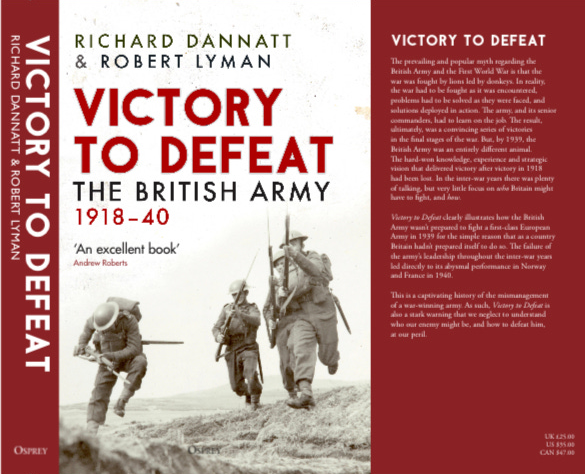
There was a fleeting moment during the One Hundred Days battles that ended the First World War in France in which successful all-arms manoeuvre by the British and Commonwealth armies, able to overturn the deadlock of previous years of trench stalemate, was glimpsed. But the moment, for the British Army at least, was not understood for what it was. With hindsight we can see that it was the birth of modern warfare, in which armour, infantry, artillery and air power are welded together able successfully to fight and win a campaign against a similarly-equipped enemy. Unfortunately in the intervening two decades the British Army simply forgot how to fight a peer adversary in intensive combat. It did not recognise 1918 for what it was; a defining moment in the development of warfare that needed capturing and translating into a doctrine on which the future of the British Army could be built. The tragedy of the inter-war years therefore was that much of what had been learned at such high cost in blood and treasure between 1914 and 1918 was simply forgotten. It provides a warning for our modern Army that once it goes, the ability to fight intensively at campaign level is incredibly hard to recover. The book that General Lord Dannatt and I have written traces the catastrophic loss of fighting knowledge after the end of the war, and explains the reasons for it. Knowledge so expensively learned vanished very quickly as the Army quickly adjusted back to its pre-war raison d’etre: imperial policing. Unsurprisingly, it was what many military men wanted: a return to the certainties of 1914. It was certainly what the government wanted: no more wartime extravagance of taxpayer’s scarce resources. The Great War was seen by nearly everyone to be a never-to-be-repeated aberration.
The British and Commonwealth armies were dramatically successful in 1918 and defeated the German Armies on the battlefield. Far from the “stab in the back” myth assiduously by the Nazis and others, the Allies fatally stabbed the German Army in the chest in 1918. The memoirs of those who experienced action are helpful in demonstrating just how far the British and Commonwealth armies had moved since the black days of 1 July 1916. The 27-year old Second Lieutenant Duff Cooper, of the 3rd Battalion The Grenadier Guards, waited with the men of 10 platoon at Saulty on the Somme for the opening phase of the advance to the much-vaunted Hindenburg Line. His diaries show that his experience was as far distant from those of the Somme in 1916 as night is from day. There is no sense in Cooper’s diaries that either he or his men felt anything but equal to the task. They were expecting a hard fight, but not a slaughter. Why? Because they had confidence in the training, their tactics of forward infiltration, their platoon weapons and a palpable sense that the army was operating as one. They were confident that their enemy could be beaten.
[…]
It would take the next war for dynamic warfare to be fully developed. It would be mastered in the first place by the losers in 1918 – the German Army. The moment the war ended the ideas and approaches that had been developed at great expense were discarded as irrelevant to the peace. They weren’t written down to be used as the basis for training the post-war army. Flanders was seen as a horrific aberration in the history of warfare, which no-right thinking individual would ever attempt to repeat. Combined with a sudden raft of new operational commitments – in the remnants of the Ottoman Empire, Russia and Ireland – the British Army quickly reverted to its pre-1914 role as imperial policemen. No attempt was made to capture the lessons of the First World War until 1932 and where warfighting was considered it tended to be about the role of the tank on the future battlefield. This debate took place in the public arena by advocates writing newspaper articles to advance their arguments. These ideas were half-heartedly taken up by the Army in the later half of the 1920s but quietly dropped in the early 1930s. The debates about the tank and the nature of future war were bizarrely not regarded as existential to the Army and they were left to die away on the periphery of military life.
The 1920s and 1903s were a low point in national considerations about the purpose of the British Army. The British Army quickly forgot what it had so painfully learnt and it was this, more than anything else, that led to a failure to appreciate what the Wehrmacht was doing in France in 1940 and North Africa in 1941-42.
Comments Off on War-winning expertise of 1918, completely forgotten by 1939
December 24, 2023
The Siege of Bastogne Begins – WW2 – Week 278 – December 23, 1944
World War Two
Published 23 Dec 2023The German Ardennes Offensive, called by the Allies the Battle of the Bulge, is in full swing in Luxembourg and Belgium this week, and the Germans have the key junction town of Bastogne under siege. On the Allied side there comes a large American surrender, plans for counterattacks, and tension growing between British and American Commands. The fight in both Italy and the Philippines continues, and in Hungary the Soviets have nearly surrounded Budapest.
00:26 Intro
01:06 The Battle of the Bulge
03:54 The Malmedy Massacre
06:25 Bastogne
10:00 American Surrender on Schnee Eifel
12:06 Patton plans a counterattack
15:44 Bernard Montgomery and Omar Bradley
18:12 The Red Army advances around Budapest
21:39 Fighting in Italy and Greece
22:45 Leyte and Mindoro
25:07 Conclusion
(more…)
Comments Off on The Siege of Bastogne Begins – WW2 – Week 278 – December 23, 1944
December 22, 2023
Camouflage
World War Two
Published Dec 19, 2023Camouflage comes in many forms, shapes, disguises, and even processes, for there are indeed many ways to hide your soldiers, guns, tanks, and even ships at sea. Today we take a wee look at camouflage during the war.
(more…)
Comments Off on Camouflage
December 21, 2023
The Battle of Ortona
Army University Press
Published 20 Dec 2023Between 20 and 28 December 1943, the idyllic Adriatic resort town of Ortona, Italy was the scene of some of the most intense urban combat in the Mediterranean Theater. Soldiers of the First Canadian Infantry Division fought German Falschirmjager for control of the city, the eastern anchor of the Gustav Line. The Army University Films Team is proud to present, The Battle of Ortona, as told by Major Jayson Geroux of the Canadian Armed Forces.
Comments Off on The Battle of Ortona
December 20, 2023
Eat Like a Medieval Nun – Hildegard of Bingen’s Cookies of Joy
Tasting History with Max Miller
Published 5 Sept 2023
(more…)
Comments Off on Eat Like a Medieval Nun – Hildegard of Bingen’s Cookies of Joy
December 18, 2023
Battle Taxis | Evolution of the Armoured Personnel Carrier
The Tank Museum
Published 8 Sept 2023Tanks and infantry need to operate together. Tanks provide firepower and protection, the infantry support and protect the tanks. In this video, we look at that vital component of the equation, the Armoured Personnel Carrier and its transition into the modern Infantry Fighting Vehicle.
(more…)
Comments Off on Battle Taxis | Evolution of the Armoured Personnel Carrier
December 17, 2023
The Battle of the Bulge Begins – WW2 – Week 277 – December 16, 1944
World War Two
Published 16 Dec 2023Adolf Hitler’s Ardennes counteroffensive finally goes off this week, and it does indeed catch the Allies by surprise, and they suspend other offensive operations in the west. They are still attacking in Italy, and the Soviets are still advancing in Hungary, trying to cut off Budapest. In the Far East, there are Allied landings on Mindoro, and they are also on the march in Burma, hoping to pin down the enemy.
0:00 Intro
0:55 Recap
1:22 Street fighting in Athens
04:07 Operation Queen ends
06:33 Autumn Mist Offensive plans
09:51 Allied intelligence failures
12:26 The Ardennes Offensive Begins
16:57 Allied attacks in Italy and Soviet plans to surround Budapest
20:07 The Allied offensive in Burma
22:10 Mindoro Landings
24:33 Summary
25:14 Conclusion
(more…)
Comments Off on The Battle of the Bulge Begins – WW2 – Week 277 – December 16, 1944
December 13, 2023
How Churchill Started the Cold War in Greece in 1944 – War Against Humanity 121
World War Two
Published 12 Dec 2023You might think that the Cold War starts after this war ends. But already, as the Germans withdraw from Greece, the ideologically opposed Greek resistance groups ELAS and EDES are at each others’ throats. It all culminates in Athens in December 1944; British troops fire some of the first shots of the Cold War as Greece descends into Civil War.
(more…)
Comments Off on How Churchill Started the Cold War in Greece in 1944 – War Against Humanity 121
December 12, 2023
La trahison des intellectuels modernes
Niall Ferguson explains why the situation in Europe in the late 1920s persuaded Julien Benda to publish the famous La trahison des clercs … and how similar the situation in western academia is to a century ago:
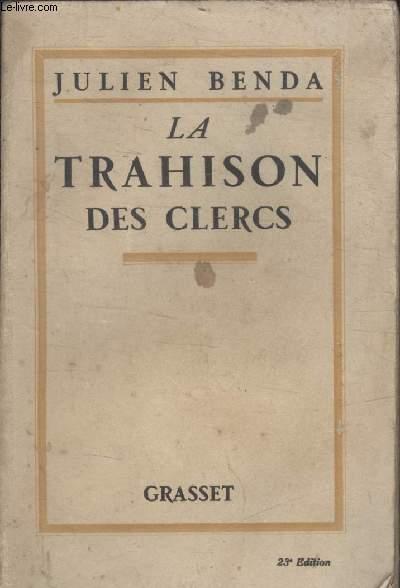
In 1927 the French philosopher Julien Benda published La trahison des clercs — “The Treason of the Intellectuals” — which condemned the descent of European intellectuals into extreme nationalism and racism. By that point, although Benito Mussolini had been in power in Italy for five years, Adolf Hitler was still six years away from power in Germany and 13 years away from victory over France. But already Benda could see the pernicious role that many European academics were playing in politics.
Those who were meant to pursue the life of the mind, he wrote, had ushered in “the age of the intellectual organization of political hatreds”. And those hatreds were already moving from the realm of the ideas into the realm of violence — with results that would be catastrophic for all of Europe.
A century later, American academia has gone in the opposite political direction — leftward instead of rightward — but has ended up in much the same place. The question is whether we — unlike the Germans — can do something about it.
For nearly ten years, rather like Benda, I have marveled at the treason of my fellow intellectuals. I have also witnessed the willingness of trustees, donors, and alumni to tolerate the politicization of American universities by an illiberal coalition of “woke” progressives, adherents of “critical race theory”, and apologists for Islamist extremism.
Throughout that period, friends assured me that I was exaggerating. Who could possibly object to more diversity, equity, and inclusion on campus? In any case, weren’t American universities always left-leaning? Were my concerns perhaps just another sign that I was the kind of conservative who had no real future in the academy?
Such arguments fell apart after October 7, as the response of “radical” students and professors to the Hamas atrocities against Israel revealed the realities of contemporary campus life. That hostility to Israeli policy in Gaza regularly slides into antisemitism is now impossible to deny.
I cannot stop thinking of the son of a Jewish friend of mine, who is a graduate student at one of the Ivy League colleges. Just this week, he went to the desk assigned to him to find, carefully placed under his computer keyboard, a note with the words “ZIONIST KIKE!!!” in red and green letters.
Just as disturbing as such incidents — and there are too many to recount — has been the dismally confused responses of university leaders.
Comments Off on La trahison des intellectuels modernes
QotD: “Natural hierarchies” don’t work in distributed systems
Politics, being a distributed system, doesn’t work like that. Neither does the corporate world, which is why both invariably end up dominated by sociopathic, sexually deviant shitweasels. Whereas the social interaction in a bar, in a pickup basketball game, in a church group, whatever, naturally bends towards a baboon troop, “social” interaction in a distributed power structure bends towards whoever has the time, energy, and sheer Wille zur Macht, as our friend above would put it, to dominate it.
Example: Even at the height of his power, when he really could have liquidated everyone in the room with a wave of his hand, Joe Stalin didn’t win arguments with his nomenklatura by threatening to have them all shot. Rather, he outworked them. Even when he exercised the most raw power any one human being is capable of wielding, Stalin’s work ethic was legendary – he spent a minimum of fifteen hours a day at his desk, every day, 365 days a year. He simply ground down all lesser men with the sheer force of his leather ass and cast-iron bladder … and compared to Stalin, when it came to paperwork, all men were lesser men.
That’s a cast of mind, reinforced by the habits of a lifetime. Stalin was also a dominant personality by the end, of course, but he certainly didn’t start that way – he was cringingly servile to Lenin, for instance, and even once to Trotsky, which is probably the main reason Trotsky had to die when you come right down to it.
Hitler was the same way, in his own special, bizarre way. While no one would ever accuse Hitler of an overactive work ethic when it comes to government – those who study these things still can’t get their heads around it, the fact that for long, critical periods the Third Reich basically didn’t have a government – but he could wear you down with the best of them when it came to party speeches, organizing, propaganda. No one worked harder at that stuff than Corporal Hitler … and no one knuckled under to authority faster, which is why he remained Corporal Hitler despite four years on the Western Front.
Combine them, and you get the Big Man On Campus thoroughly dominated by the deviant sociopathic shitweasels. The BMOC dominates every personal interaction; therefore, he thinks it’s the rules which get him where he is. Society is set up, he thinks, to produce people such as himself. And since that society is also set up such that the deviant sociopathic shitweasels (we should probably acronymize that; hereafter, DSS) do the boring shit like student government, when the DSS pass some bizarre law the BMOC just rolls with it …
Severian, “Bio-Marxism Grab Bag”, Founding Questions, 2021-01-21.
Comments Off on QotD: “Natural hierarchies” don’t work in distributed systems


