
World War Two
Published 10 Jul 2025In this special “Out of the Bullpen” episode, we answer your burning questions about Weimar Germany’s most turbulent years. From clandestine military pacts with the Soviets to the creative ways Germany sidestepped Versailles, we dig into aspects which shaped a republic on the brink.
(more…)
July 11, 2025
Why Didn’t France and Britain Stop Germany’s Secret Rearmament? – Out of the Bullpen 001
Comments Off on Why Didn’t France and Britain Stop Germany’s Secret Rearmament? – Out of the Bullpen 001
July 10, 2025
The Prussian defeats at Jena and Auerstadt in 1806
At Dead Carl and You, Kiran Pfitzner describes the disastrous 1806 campaign that knocked Prussia out of the war against Napoleon and shattered the military reputation of the army built by Frederick the Great:
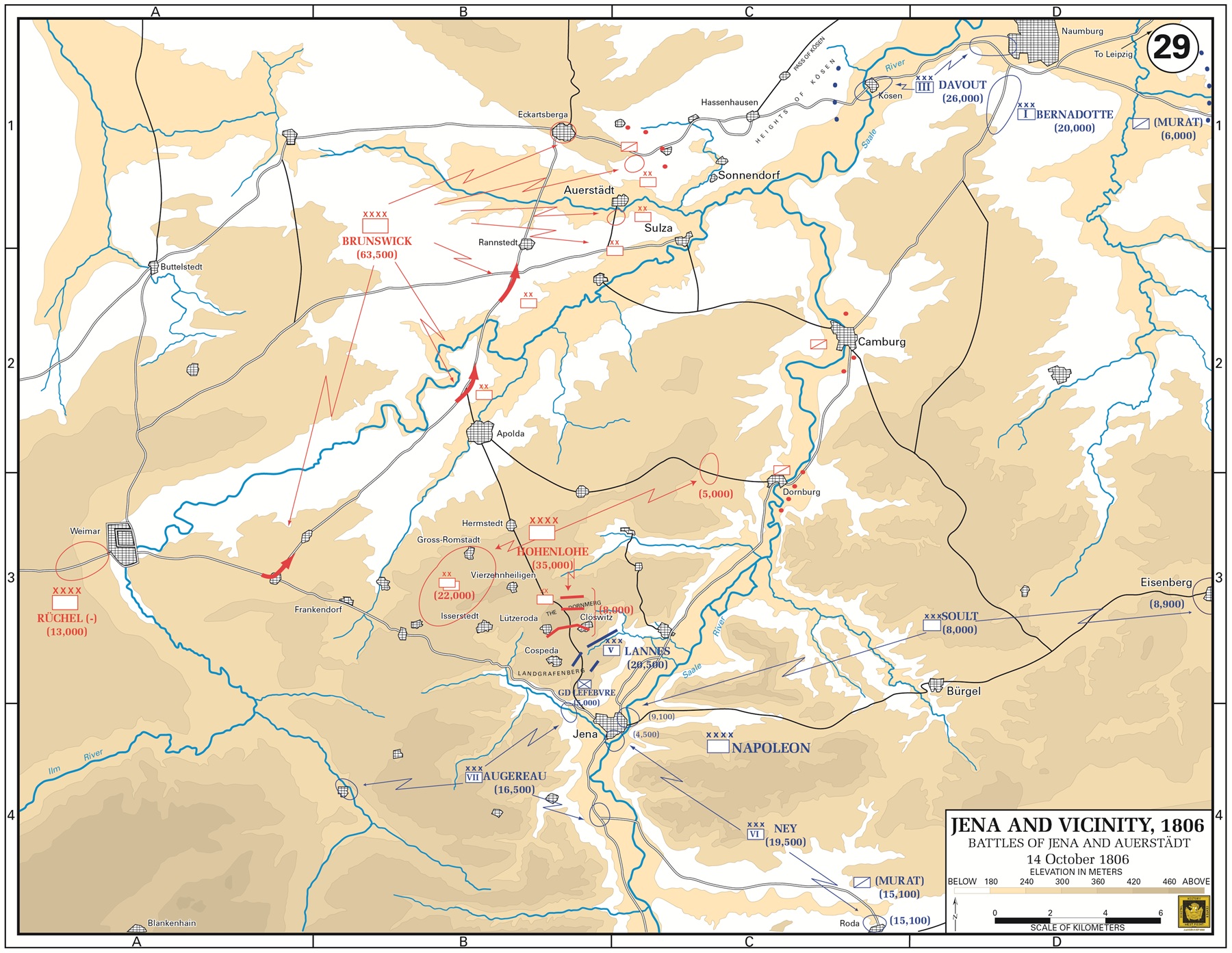
In brief, the course of the 1806 campaign was that the Prussians met the French at Saalfeld and were initially defeated. The Prussians therefore decided to retreat before meeting Napoleon himself in battle. However, poor command organization and irresolution ended up dividing and delaying the Prussian forces. Thus, the rearguard ended up meeting the French main body under Napoleon which was able to overwhelm it at Jena.
The battle itself was not especially punishing, but the relentless pursuit of the French cavalry yielded many prisoners and prevented the reconstitution of the army. On the same day, the Prussian main body had encountered a French corps under Marshal Davout at Auerstedt, but failed to overcome it in a series of piecemeal attacks that cost it the lives of its commanders. The Prussians were demoralized enough that an attack from the outnumbered French was enough to force the main body into disorder. The arrival of fleeing forces from Jena spread a general panic and prevented any chance of recovery. From there, the campaign was a matter of pursuit and capitulation — within weeks the French were parading through the streets of Berlin. This humiliating defeat gave Clausewitz impetus to seek an understanding of the nature of war. How could the vaunted Prussian army, envy of the world in the days of Frederick the Great (still within living memory), be so summarily dispatched?
It was clear to virtually all military thinkers of the time that war had changed. To many, Napoleon was utilizing a higher, more perfect form of war than had been previously known. Clausewitz instead recognized that Napoleon was not refining war, but recognizing that changes in social conditions had enabled fighting with more energy and violence than had been possible in the cabinet wars of the 18th century. This had proven significant because the limitations of the 18th century made maneuver and logistics central to skilled generalship. Battles were important, but much that was won or lost in a battle could be subsequently lost or won outside it.
The removal of these restrictions drastically increased the importance of battle as it was able to produce results that could not be compensated for actions outside of it. Skilled generalship was therefore no longer a matter of outmaneuvering the enemy or protecting your supply lines while threatening his, but of bringing maximum force to the point of battle. Initiative, coordination, and aggression become the key traits of an officer. Thus, more expansively, the task of the officer is to recognize changes to the character of war and so understand what is required in practice. Neither history nor experience can anticipate these developments — it falls to the judgment of the individual to recognize them.
This framing shows clearly the mistakes of the Prussians. Operating in the old paradigm, they sought to make good with maneuver what they had lost in the opening battle of the campaign. They had divided their forces under the assumption the French would be unable or unwilling to aggressively pursue their retreat. At the same time, when they engaged the French, they showed caution entirely congruent with a cabinet army but fatally out of place when facing a Napoleonic force. On numerous occasions, the French made serious blunders that went unpunished because the Prussians failed to take the initiative and capitalize on them.
Nowhere is this more clear than in the failure of the Prussian main body to overcome the single corps it faced at Auerstedt. While outnumbering the French, the Prussian attacked piecemeal, becoming demoralized under French fire. The morale of the Prussians was substantially more brittle on account of their relative lack of nationalism — the state and therefore the army were not objects of any great affection by those subject to them. While this would require social reforms to remedy, Auerstedt had nevertheless been an opportunity for the Prussians. They had a French corps outnumbered more than two-to-one and merely needed to bring that force to bear to inflict a serious defeat. A Prussian victory would have positioned the main body to receive the retreating forces from Jena, allowing another confrontation with Napoleon on at least equal terms. Timidity and irresolution therefore played as big a part in the disaster as did the deeper defects.
In part, this must be ascribed to the advanced age of Prussian leadership. The senior commanders at both Jena and Auerstedt were over seventy. Not only did this ensure continuity with older forms of war, but men of such an age were unlikely to have the energy to campaign aggressively — by contrast, Napoleon and his marshals were three or four decades younger. The Prussian leaders did not lack physical courage, as their valiant deaths attest, but exposing oneself to danger is not the same quality that is needed for decisive and energetic action over an extended period of time.
The Prussian strategy deserves further criticism because by that point Bonaparte’s character was well known. There was no justification to have any illusions as to what the consequences of defeat would be. Prussia’s status amongst the great powers — if not its very existence as an independent state — would be determined by the confrontation. Leaving troops in Silesian fortresses or Polish garrisons (through which Prussia’s available forces were reduced by half) meant narrowing the odds of victory in pursuit of things that could be no substitute for victory and no comfort in defeat.
Comments Off on The Prussian defeats at Jena and Auerstadt in 1806
July 6, 2025
Day Six – Breakout – Ten Days in Sedan
World War Two
Published 5 Jul 2025May 15 1940 — Ten Days in Sedan, continues as our WW2 Blitzkrieg documentary follows Germany’s drive through France. Today French 2nd Army chief Charles Huntziger faces a pivotal choice: try and contain the German bridgeheads at Sedan, where Heinz Guderian is trying desperately to breakout, or pivot south to shield the Maginot forts he still trusts. His choice may just decide the fate of France.
(more…)
Comments Off on Day Six – Breakout – Ten Days in Sedan
Steyr-Solothurn S2-200: the Austrian MG30 and Hungarian 31M
Forgotten Weapons
Published 23 Sept 2024The S2-200 was developed by Louis Stange at the Rheinmetall company in Germany in the late 1920s. Because Germany was not allowed to be doing this sort of arms development at the time, Rheinmetall bought a controlling stake in the Swiss firm Solothurn AG, to make the product deniably Swiss. The gun itself is recoil operated, with a rotating locking collar connecting the bolt and barrel, rather like the Hotchkiss Portative. It was a design that had some early influence on the German MG34, although the German military declined to adopt it. Instead, it was taken into service in 8x56mm by both Austria (as the MG30) and Hungary (as the 31M). A third purchaser was El Salvador, which purchased 47 examples in 7x57mm caliber.
After the anschluss in 1938, the Austrian guns were integrated into the Wehrmacht, where they were primarily used by mountain troops. Hungary did later make a version in 7.92x57mm, designated the 43M.
(more…)
Comments Off on Steyr-Solothurn S2-200: the Austrian MG30 and Hungarian 31M
June 30, 2025
Day Five – Massive Allied Air Attack – Ten Days in Sedan
World War Two
Published 28 Jun 2025May 14 1940. The blitzkrieg continues in today’s episode of Ten Days in Sedan. British and French bombers roar over Sedan, braving curtains of flak and German fighters in a bid to smash Guderian’s hastily built bridges across the Meuse. Further north, French infantry and tanks battle against the German crossings at Houx, Dinant, and Monthermé. German general Erwin Rommel has a narrow escape as the French nearly blow him and his tank to pieces!
(more…)
Comments Off on Day Five – Massive Allied Air Attack – Ten Days in Sedan
June 27, 2025
Germany’s Constitution, Erotica, and a Pastor’s Dignity – Rise of Hitler 19, July 1931
World War Two
Published 26 Jun 2025A rogue preacher breaks into the Reichstag and steals silverware, banned erotica, and the 1848 German Constitution. As Germany’s banks collapse and panic spreads, the press is captivated by the strange tale of Walter Wohlgemuth: pastor, thief, and accidental symbol of a republic in crisis.
(more…)
Comments Off on Germany’s Constitution, Erotica, and a Pastor’s Dignity – Rise of Hitler 19, July 1931
June 26, 2025
German police raid homes to counteract online “hate speech” by “digital arsonists”
Things are getting worse for free speech in Germany, as eugyppius reports:
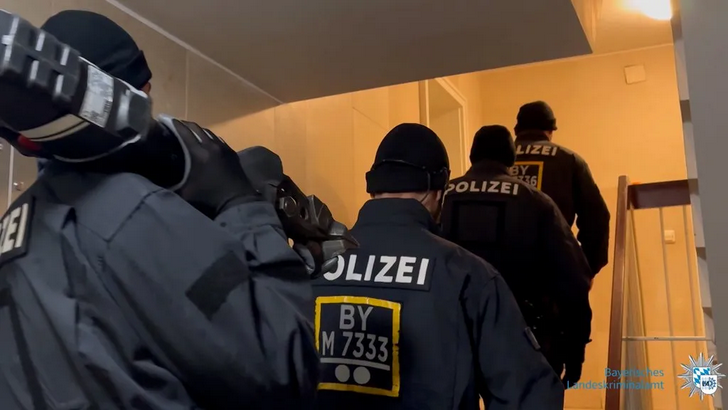
Apollo News reports on the newest, most irregular German holiday, which consists of the police conducting coordinated raids on and interrogations of ordinary people who are alleged to have said rude things on the internet:
On Tuesday morning police across Germany conducted raids targeting “hate speech and incitement” on the internet. According to the news agency dpa, there are currently 170 operations underway, including house searches and other measures. Those accused are charged with insulting politicians and inciting hatred …
The Federal Criminal Police Office (BKA) is in charge of the operation … In North Rhine-Westphalia, several police authorities struck simultaneously at 6 a.m. Police from Düsseldorf, Dortmund, Gelsenkirchen, Cologne, Bielefeld, Münster, Hagen, and Bonn are among those involved. Fourteen suspects are to be questioned and two search warrants executed.1 The individuals in question frequently express themselves on social media, such as on X.
… The Action Day against alleged hate posts has been taking place regularly for years. On June 18, the BKA joined forces with the reporting center “REspect!” to participate in the “International Day Against Hate and Incitement”. People were called upon to report posts that allegedly spread hate.
Today was the twelfth such “Action Day against Hate and Incitement on the Internet”. That is only an approximate title; it varies slightly across press sources. This dubious ritual began in 2016, after Merkel opened the German borders to the entirety of the developing world and our politicians grew tired of people calling them imbeciles online. Police are very open that the goal of these coordinated Action Days is intimidation – or, as they put it, “deterrence”.
Our federal police love this holiday so much they often celebrate it twice a year, which is why are already on the twelfth such day, even though we have only had nine years since the establishment of this custom. Sometimes our betters even throw in bonus action days that for some reason don’t count, as during Covid when they conducted a special “Action Day against Political Hate Postings” after the seventh “Nationwide Action Day against Hate Postings” but before the eighth “Nationwide Action Day against Hate Postings”. Who knows how many such action days we have really had, especially considering that since 2020 the broader EU has adopted this sporadic holiday and occasionally coordinates its own Continent-wide “Action Day against Hatred and Incitement on the Internet”.
[…]
By calling these Action Days idiotic, I don’t mean to minimise them. They are borderline illegal, for they exploit what should be purely investigative tactics (interrogations, house searches) to scare and punish people in advance of any criminal conviction. The emphasis is not only on right-leaning posters, but invariably and most disgracefully on ordinary people with relatively little social media reach, whose posts in many cases have been seen a mere handful of times. The message is clear: They can get you, whoever you are; they can get anybody. Living in a country whose authorities amuse themselves by periodically harassing their own citizens in this way is disturbing. It’s an absolute scandal that all the major political parties support this, save for Alternative für Deutschland. It’s a reason to vote AfD all by itself.
Comments Off on German police raid homes to counteract online “hate speech” by “digital arsonists”
June 22, 2025
Day Four – The Meuse Must Hold! – Ten Days in Sedan
World War Two
Published 21 Jun 2025May 13, 1940: In today’s episode of our WW2 documentary, Ten Days in Sedan, the German Blitzkrieg reaches its climax. Guderian’s Panzers launch a daring river assault as the Luftwaffe pounds French lines into chaos. Away from Sedan itself, Rommel and Reinhardt strike further north, opening new fronts. France scrambles to counterattack, but the German bridgeheads are growing fast.
00:00 Intro
00:48 French Defences, German Air Assault
04:13 Guderian Crosses The Meuse
08:25 Hartlieb’s Houx Crossing
11:28 Rommel Crosses At Dinant
16:04 Einhardt Crosses At Monthermé
19:15 Summary & Conclusion
(more…)
Comments Off on Day Four – The Meuse Must Hold! – Ten Days in Sedan
June 15, 2025
Day Three – Guderian, Rommel, and The Race to Cross The Meuse – Ten Days in Sedan
World War Two
Published 14 Jun 2025May 12, 1940: Blitzkrieg, WW2’s new form of war, arrives in Sedan as Heinz Guderian’s Panzers capture the town and prepare to cross the river. Further north, Erwin Rommel drives toward the Meuse in the face of fierce French resistance. With the Luftwaffe dominating the skies and French reinforcements en route, the battle for Sedan is about to ignite.
Comments Off on Day Three – Guderian, Rommel, and The Race to Cross The Meuse – Ten Days in Sedan
June 14, 2025
Surviving on Tulip Bulbs during World War 2 – Dutch Hunger Winter
Tasting History with Max Miller
Published 14 Jan 2025Mashed potatoes, red cabbage, carrots, kale, and tulip bulbs
City/Region: The Netherlands
Time Period: 1945The Netherlands was relatively well off for food during much of WWII up until the harsh winter of 1944-1945. A combination of factors like German occupation, extreme weather conditions, and lack of Allied relief resulted in the population existing on only 500 calories a day. Tulips, a major Dutch export, were stored as dried bulbs, and the government issued documents that instructed people on how to prepare them safely.
If you make this dish, be sure to use organic bulbs and remove the yellow sprout in the center of the bulb completely as described in the instructions below. The yellow center is what can make you sick.
The flavor of the dish comes from the vegetables, and the unique flavor of the bulbs is lost in everything else. Save at least one bulb back before you mash it to taste it. Different varieties of tulip bulbs are supposed to have different flavors, and mine had a kind of earthy metallic sweet taste that was quite unlike anything I’ve ever had.
Stamppot with Tulip Bulbs
1 kg of vegetables, 1/2 kg of potatoes, 1/2 kg tulip bulbs, salt, oil.
Clean and finely chop the vegetables. Scrub the potatoes and quarter them. Clean the tulip bulbs. Put everything in a pot with a little water and salt. Boil for 30 to 45 minutes. Mash everything and add oil to taste.
— Dutch State Office for Preparation of Food Distribution, 1945
Comments Off on Surviving on Tulip Bulbs during World War 2 – Dutch Hunger Winter
June 10, 2025
How Moscow Got the Atomic Bomb – W2W 31
TimeGhost History
Published 8 Jun 2025In 1949, the Soviet Union detonates its first atomic bomb — years ahead of Western expectations. This episode dives into how the USSR mobilized former Nazi scientists, forced Soviet physicists into secret cities, and relied on intelligence from spies like Klaus Fuchs. While Stalin pushes for rapid progress, Beria enforces brutal discipline, and Soviet scientists race to meet an impossible deadline. The nuclear balance of power is about to shift — forever.
(more…)
Comments Off on How Moscow Got the Atomic Bomb – W2W 31
June 8, 2025
Day Two – Panzers Stuck in Europe‘s Biggest Traffic Jam! – Ten Days in Sedan
World War Two
Published 7 Jun 2025May 11, 1940: Our WW2 documentary continues as the Battle of France rages and German Panzers rumble through the Ardennes. The Battle of Sedan is on the horizon and Heinz Guderian has one objective: break the French defences! But all is not well for the Germans as Europe’s largest-ever traffic jam threatens to stall the Blitzkrieg.
00:00 Intro
00:51 The Ardennes Advance
08:55 The Air War
15:05 Conclusion
(more…)
Comments Off on Day Two – Panzers Stuck in Europe‘s Biggest Traffic Jam! – Ten Days in Sedan
The Canadian Retribution at Normandy | History Traveler Episode 196
The History Underground
Published 16 Feb 2022Throughout the Battle of Normandy, the Canadians of the 3rd Infantry Division and the Germans of the 12th SS Panzer Division found themselves locked in a battle of attrition that would mark some of the most vicious fighting of the entire campaign. After suffering a blow at Buron and Authie (as seen in the last episode) the fight shifted over to a place that has now become legendary in Canadian military history: Bretteville-l’Orgueilleuse. In this episode, we’re joined by Paul Woodadge of @WW2TV to show a small part of one of the most epic fights in the battle to take Normandy.
(more…)
Comments Off on The Canadian Retribution at Normandy | History Traveler Episode 196
June 7, 2025
The US President Saves Germany – Rise of Hitler 18 – June 1931
World War Two
Published 5 Jun 2025In June 1931, Germany teeters on the edge of collapse — facing riots, unemployment, and a banking crisis. Amidst chaos and international pressure, US President Herbert Hoover offers a dramatic moratorium on war debts, giving Germany a critical lifeline. Can this American intervention stabilize the Weimar Republic, or is disaster still on the horizon? Explore how global politics, economic turmoil, and desperate diplomacy shape a nation’s fate.
(more…)
Comments Off on The US President Saves Germany – Rise of Hitler 18 – June 1931
The 12th SS Massacre of the Canadians in Normandy | History Traveler Episode 195
The History Underground
Published 9 Feb 2022In the days after D-Day, the Canadians of the 3rd Infantry Division found themselves up against the German 12th SS Panzer Division as they were making their way south through Normandy. Tragically, some of these men would find themselves as the victims of one the battle’s worst atrocities at a place called Abbey Ardenne. In this episode, we’re joining Paul Woodadge of @WW2TV as we retrace the final steps of these men as they made their way to a tragic fate at the hands of Kurt Meyer and a division of the most fanatical fighters that Germany threw into the Battle of Normandy.
(more…)
Comments Off on The 12th SS Massacre of the Canadians in Normandy | History Traveler Episode 195


