
Published on 22 Oct 2016
Start your free trial of the Great Courses Plus at: http://ow.ly/KUvh30491YZ
Indy is sitting int he chair of wisdom again and answers all your questions about the First World War. This week we talk about technical and tactical innovation, pals battalions and the German officers in the Ottoman Army.
October 23, 2016
Technical vs. Tactical Innovation – German Officers in the Ottoman Army I OUT OF THE TRENCHES
Comments Off on Technical vs. Tactical Innovation – German Officers in the Ottoman Army I OUT OF THE TRENCHES
October 12, 2016
QotD: The fine art of self-deception
… we are all capable of believing things which we know to be untrue, and then, when we are finally proved wrong, impudently twisting the facts so as to show that we were right. Intellectually, it is possible to carry on this process for an indefinite time: the only check on it is that sooner or later a false belief bumps up against solid reality, usually on a battlefield.
When one looks at the all-prevailing schizophrenia of democratic societies, the lies that have to be told for vote-catching purposes, the silence about major issues, the distortions of the press, it is tempting to believe that in totalitarian countries there is less humbug, more facing of the facts. There, at least, the ruling groups are not dependent on popular favour and can utter the truth crudely and brutally. Goering could say ‘Guns before butter’, while his democratic opposite numbers had to wrap the same sentiment up in hundreds of hypocritical words.
Actually, however, the avoidance of reality is much the same everywhere, and has much the same consequences. The Russian people were taught for years that they were better off than everybody else, and propaganda posters showed Russian families sitting down to abundant meal while the proletariat of other countries starved in the gutter. Meanwhile the workers in the western countries were so much better off than those of the U.S.S.R. that non-contact between Soviet citizens and outsiders had to be a guiding principle of policy. Then, as a result of the war, millions of ordinary Russians penetrated far into Europe, and when they return home the original avoidance of reality will inevitably be paid for in frictions of various kinds. The Germans and the Japanese lost the war quite largely because their rulers were unable to see facts which were plain to any dispassionate eye.
To see what is in front of one’s nose needs a constant struggle. One thing that helps toward it is to keep a diary, or, at any rate, to keep some kind of record of one’s opinions about important events. Otherwise, when some particularly absurd belief is exploded by events, one may simply forget that one ever held it. Political predictions are usually wrong. But even when one makes a correct one, to discover why one was right can be very illuminating. In general, one is only right when either wish or fear coincides with reality. If one recognizes this, one cannot, of course, get rid of one’s subjective feelings, but one can to some extent insulate them from one’s thinking and make predictions cold-bloodedly, by the book of arithmetic. In private life most people are fairly realistic. When one is making out one’s weekly budget, two and two invariably make four. Politics, on the other hand, is a sort of sub-atomic or non-Euclidean word where it is quite easy for the part to be greater than the whole or for two objects to be in the same place simultaneously. Hence the contradictions and absurdities I have chronicled above, all finally traceable to a secret belief that one’s political opinions, unlike the weekly budget, will not have to be tested against solid reality.
George Orwell, “In Front of Your Nose”, Tribune, 1946-03-22.
Comments Off on QotD: The fine art of self-deception
October 1, 2016
Falkenhayn Crosses The Carpathians – The Battle of Sibiu I THE GREAT WAR Week 114
Published on 29 Sep 2016
Erich von Falkenhayn had been fired from his position as Chief-of-Staff but he had a new task: Leading the combined Austro-German forces into Romania. So, this week 100 years ago Falkenhayn crosses the Carpathian mountains into Transylvania where they met fierce Romanian resistance. At the same time the British attacked at the Somme again and failed to utilise their new weapon: the tank.
Comments Off on Falkenhayn Crosses The Carpathians – The Battle of Sibiu I THE GREAT WAR Week 114
September 30, 2016
Net contributors to the EU budget
A rather revealing post at Guido Fawkes:
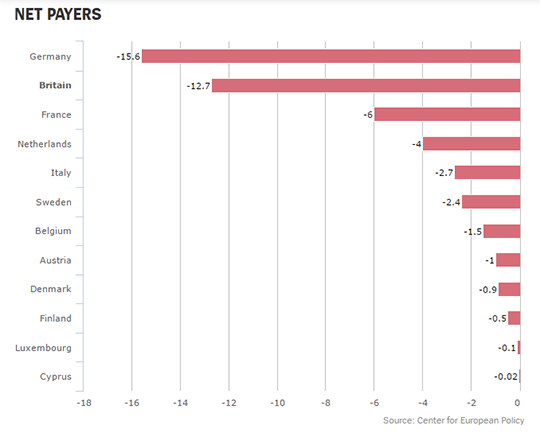
Liam Fox told the Spectator that Germany risks becoming the world’s biggest cash machine after Brexit because it may end up paying for a failing European Union that is in danger of imploding:
“If I were a German politician I would be worried that, without Britain, Germany has the potential to become the greatest ATM in global history.”
They’ve figured this out for themselves…
Of the 28 current members of the EU it may surprise co-conspirators to learn that only 12 countries were net contributors. Ireland has become the the thirteenth net contributor for the first time since it joined in 1973, hitherto it has been a net beneficiary to the order of €50 billion. Expect Irish attitudes to the EU to change as that equation changes.
Comments Off on Net contributors to the EU budget
September 2, 2016
Romania Joins The War I THE GREAT WAR Week 110
Published on 1 Sep 2016
After more than two years of carnage, the war is still growing as Romania joins the war. The moments seems right to them as the Russians steamrolled the Austro-Hungarian Army on the Eastern front this summer. But can the unproven and under equipped Romanian Army really seize the moment? The German High Command wants to make sure that Romania regrets joining the Entente and sends two of their best generals: Erich von Falkenhayn and August von Mackensen.
Comments Off on Romania Joins The War I THE GREAT WAR Week 110
August 28, 2016
German War Aims – War Economy I OUT OF THE TRENCHES
Published on 27 Aug 2016
It’s time for the Chair of Wisdom again and this week we talk about the German war aims and the war economy.
Comments Off on German War Aims – War Economy I OUT OF THE TRENCHES
August 20, 2016
QotD: Violence in wartime – the great exception
War is the great exception, the great legitimizer of murder, the one arena in which ordinary humans routinely become killers. The special prevalence of the killer-ape myth in our time doubtless owes something to the horror and visibility of 20th-century war.
Campaigns of genocide and repressions such as the Nazi Holocaust, Stalin’s engineered famines, the Ankha massacres in Cambodia, and “ethnic cleansing” in Yugoslavia loom even larger in the popular mind than war as support for the myth of man the killer. But they should not; such atrocities are invariably conceived and planned by selected, tiny minorities far fewer than 0.5% of the population.
We have seen that in normal circumstances, human beings are not killers; and, in fact, most have instincts which make it extremely difficult for them to engage in lethal violence. How do we reconcile this with the continuing pattern of human violence in war? And, to restate to one of our original questions, what is belief in the myth of man the killer doing to us?
We shall soon see that the answers to these two questions are intimately related — because there is a crucial commonality between war and genocide, one not shared with the comparatively negligible lethalities of criminals and the individually insane. Both war and genocide depend, critically, on the habit of killing on orders. Pierson observes, tellingly, that atrocities “are generally initiated by overcontrolled personality types in second-in-command positions, not by undercontrolled personality types.” Terrorism, too, depends on the habit of obedience; it is not Osama bin Laden who died in the 9/11 attack but his minions.
This is part of what Hannah Arendt was describing when, after the Nuremberg trials, she penned her unforgettable phrase “the banality of evil”. The instinct that facilitated the atrocities at Belsen-Bergen and Treblinka and Dachau was not a red-handed delight in murder, but rather uncritical submission to the orders of alpha males — even when those orders were for horror and death.
Human beings are social primates with social instincts. One of those instincts is docility, a predisposition to obey the tribe leader and other dominant males. This was originally adaptive; fewer status fights meant more able bodies in the tribe or hunting band. It was especially important that bachelor males, unmarried 15-to-25 year-old men, obey orders even when those orders involved risk and killing. These bachelors were the tribe’s hunters, warriors, scouts, and risk-takers; a band would flourish best if they were both aggressive towards outsiders and amenable to social control.
Over most of human evolutionary history, the multiplier effect of docility was limited by the small size (250 or less, usually much less) of human social units. But when a single alpha male or cooperating group of alpha males could command the aggressive bachelor males of a large city or entire nation, the rules changed. Warfare and genocide became possible.
Actually, neither war nor genocide needs more than a comparative handful of murderers — not much larger a cohort than the half-percent to percent that commits lethal violence in peacetime. Both, however, require the obedience of a large supporting population. Factories must work overtime. Ammunition trucks must be driven where the bullets are needed. People must agree not to see, not to hear, not to notice certain things. Orders must be obeyed.
Eric S. Raymond, “The Myth of Man the Killer”, Armed and Dangerous, 2003-07-15.
Comments Off on QotD: Violence in wartime – the great exception
August 9, 2016
The British Naval Blockade of Germany I THE GREAT WAR Special
Published on 8 Aug 2016
The big and decisive naval battle that the Royal Navy had hoped for did not happen during World War 1. But another naval strategy slowly but surely ground the German economy down.
Comments Off on The British Naval Blockade of Germany I THE GREAT WAR Special
August 5, 2016
Germany’s Grandeur – Analyzing the War Effort I THE GREAT WAR Week 106
Published on 4 Aug 2016
It has been two years since the global escalation that lead to World War 1. Three of the biggest battles in history are fought simultaneously now and there is no end in sight. When asked about the state of the war, the nations are still determined but the German position is still full of grandiose exaggerations.
Comments Off on Germany’s Grandeur – Analyzing the War Effort I THE GREAT WAR Week 106
July 25, 2016
The Evolution of German Infantry Tactics I OUT OF THE ETHER
Published on 24 Jul 2016
Indy sits on the Chair of Wisdom and reads out some of the best comments we get every month. This week, we deal with the evolution of German Infantry Tactics.
Comments Off on The Evolution of German Infantry Tactics I OUT OF THE ETHER
July 17, 2016
Mission Tactics – Barbed Wire Placement I OUT OF THE TRENCHES
Published on 16 Jul 2016
Indy answers your questions about World War 1 again. In this week’s episode we talk about mission tactics, how to deal with your own barbed wire and what Indy is excited about in Battlefield 1.
Comments Off on Mission Tactics – Barbed Wire Placement I OUT OF THE TRENCHES
July 15, 2016
Meatgrinder At The Somme – Battle of Mametz Wood I THE GREAT WAR – Week 103
Published on 14 Jul 2016
The stalemate of the Somme continues as the uncoordinated British attacks only gain little ground. This war of attrition was costly for the defending Germans too though. German Chief of Staff Erich von Falkenhayn demanded that every meter lost should be recovered immediately. The same stalemate continued at the Battle of Verdun where the Germans attacked with poison gas this week 100 years ago.
Comments Off on Meatgrinder At The Somme – Battle of Mametz Wood I THE GREAT WAR – Week 103
July 12, 2016
Mexico in WW1 – The Mexican Revolution I THE GREAT WAR Special
Published on 11 Jul 2016
The full text of the Zimmerman Telegram: https://en.wikipedia.org/wiki/Zimmerm…
Mexico was mainly focussing on internal struggles and the Mexican Revolution during World War 1. But Germany’s stance against the USA actually brought the country into the international spotlight. After the decoding of the Zimmerman Telegram, sent by the Germans to Mexico, was decoded it was clear that Germany wanted to bring Mexico into the war – against the United States.
Comments Off on Mexico in WW1 – The Mexican Revolution I THE GREAT WAR Special
July 3, 2016
Marines – Schutztruppe – Artillery Sound I OUT OF THE TRENCHES
Published on 2 Jul 2016
Indy sits in the chair of wisdom again to answer your questions about World War 1. This time we talk about the German Schutztruppe, the Marines and the sound of artillery shells.
Comments Off on Marines – Schutztruppe – Artillery Sound I OUT OF THE TRENCHES
June 30, 2016
“The Last Day of June 1934”
The Last Day of June 1934
Al StewartThe morning is humming, it’s a quarter past nine
I should be working down in the vines
Yeah, but I’m lying here with a good friend of mine
Watching the sun in her hair
I pick the grapes from the hills to the sea
The fields of France are a home to me
Ah, but today lying here is such a good place to be
I can’t go anywhere
And as we slip in and out of embrace
Like some old and familiar place
Reflecting all of my dreams in her face like before
On the last day of June 1934Just out of Cambridge in a narrow country lane
A bottle-green Bentley in the driving rain
Slips and skids round a corner, then pulls straight again
Heads up the drive to the door
The lights of the party shine over the fields
Where lovers and dancers watch catherine wheels
And argue realities digging their heels
In a world that’s finished with war
And a lost wind of summer blows into the streets
Past the tramps in the alleyways, the rich in silk sheets
Europe lies sleeping,
you feel her heartbeats through the floor
On the last day of June 19…On the night that Ernst Roehm died voices rang out
In the rolling Bavarian hills
And swept through the cities and danced in the gutters
Grown strong like the joining of wills
Oh echoed away like a roar in the distance
In moonlight carved out of steel
Singing “All the lonely, so long and so long
You don’t know me how long, how I long
You can’t hold me, I’m strong now I’m strong
Stronger than your law”I sit here now by the banks of the Rhine
Dipping my feet in the cold stream of time
And I know I’m a dreamer, I know I’m out of line
With the people I see everywhere
The couples pass by me, they’re looking so good
Their arms round each other, they head for the woods
They don’t care who Ernst Roehm was, no reason they should
Just a shadow that hangs in the air
But I thought I saw him cross over the hill
With a whole ghostly army of men at his heel
And struck in the moment it seemed to be real like before
On the last day of June 1934
Comments Off on “The Last Day of June 1934”


