
Published on 16 Feb 2017
After breaking off diplomatic relations, the tensions between the US and Germany are still strong. This week the so called Yarrowdale prisoners become pawns in the power play between the great powers. At the same time, the Russian air force is bombing targets all over the north Eastern Front and little skirmishes happen on the overall quiet Western Front.
February 17, 2017
Russian Bombing On The Eastern Front – US Prisoners of War I THE GREAT WAR Week 134
Comments Off on Russian Bombing On The Eastern Front – US Prisoners of War I THE GREAT WAR Week 134
Railways Of The Great War With Michael Portillo Part 1 A Railway War Begins
Published on 9 Feb 2015
In the run up to the 100 yr anniversary of the end of the First World War Michael Portillo travels across France and Belgium to find out the history of raiways of the past and present….
Comments Off on Railways Of The Great War With Michael Portillo Part 1 A Railway War Begins
February 14, 2017
February 11, 2017
QotD: The Nazi Final Solution in Denmark and Bulgaria
… most nations of Central and Eastern Europe were occupied by or allied with Germany during this period. The Nazis made it clear that deporting their Jews to the concentration camps in Nazi territory was a condition for continued good relations; a serious threat, when bad relations could turn a protectorate-type situation into an outright invasion and occupation.
Pride of place goes to Denmark and Bulgaria, both of which resisted all Nazi demands despite the Germans having almost complete power over them. Most people have heard the legend of how, when the Germans ordered that all Jews must wear gold stars, the King of Denmark said he would wear one too. These kinds of actions weren’t just symbolic; without cooperation from the Gentile population and common knowledge of who was or wasn’t Jewish, the Nazis had no good way to round people up for concentration camps. Nothing happened until 1943, when Himmler became so annoyed that he sent his personal agent Rolf Gunther to clean things up. Gunther tried hard but found the going impossible. Danish police refused to go door-to-door rounding up Jews, and when Gunther imported police from Germany, the Danes told them that they couldn’t break into apartments or else they would arrest them for breaking and entering. Then the Danish police tipped off Danish Jews not to open their doors to knocks since those might be German police. When it became clear that the Nazis weren’t going to accept any more delays, Danish fishermen offered to ferry Jews to neutral Sweden for free. In the end the Nazis only got a few hundred Danish Jews, and the Danish government made such a “fuss” (Arendt’s word) about them that the Nazis agreed to send them all to Theresienstadt, their less-murderous-than-usual camp, and let Red Cross observers in to make sure they were treated well. In the end, only 48 Danish Jews died in the entire Holocaust.
Bulgaria’s resistance was less immediately heroic, and looked less like the king proudly proclaiming his identity with oppressed people everywhere than with the whole government just dragging their feet so long that nothing got done. Eichmann sent an agent named Theodor Dannecker to get them moving, but as per Arendt:
not until about six months later did they take the first step in the direction of “radical” measures – the introduction of the Jewish badge. For the Nazis, even this turned out to be a great disappointment. In the first place, as they dutifully reported, the badge was only a “very little star”; second, most Jews simply did not wear it; and, third, those who did wear it received “so many manifestations of sympathy from the misled population that they actually are proud of their sign” – as Walter Schellenberg, Chief of Counterintelligence in the R.S.H.A., wrote in an S.D. report transmitted to the Foreign Office in November, 1942. Whereupon the Bulgarian government revoked the decree. Under great German pressure, the Bulgarian government finally decided to expel all Jews from Sofia to rural areas, but this measure was definitely not what the Germans demanded, since it dispersed the Jews instead of concentrating them.
The Bulgarians continued their policy of vaguely agreeing in principle to Nazi demands and then doing nothing, all the way until the Russians invaded and the time of danger was over. The result was that not a single Bulgarian Jew died in the Holocaust.
Scott Alexander, “Book review: Eichmann in Jerusalem”, Slate Star Codex, 2017-01-30.
Comments Off on QotD: The Nazi Final Solution in Denmark and Bulgaria
February 7, 2017
The Hindenburg Line – Ludendorff’s Defence In Depth I THE GREAT WAR Special
Published on 6 Feb 2017
1916, the Year of Battles, had strained Germany’s resources everywhere but especially on the Western Front they needed to defend their captured territory against an ever growing number of Entente Forces. Erich Ludendorff decided to shorten the front line where possible and built a new “Defence In Depth” line: The Siegfried Line. This defensive network was supposed to grind the Entente forces down while freeing up more German resources.
Comments Off on The Hindenburg Line – Ludendorff’s Defence In Depth I THE GREAT WAR Special
February 6, 2017
QotD: General officer ranks in the Waterloo campaign
There were a lot of generals involved in the campaign in northern France and Flanders that began on June 14, 1815, and culminated in the memorable Battle of Waterloo on June 18th. Altogether there were 240 of them, to command nearly 360,000 troops. And since the troops came from a lot of different armies — British, French, Prussian, Netherlands, Hanover, Brunswick, and a few others, telling the generals apart can be a bit confusing.
[…]
Note that the rank structure is not really comparable to that prevailing today in the U.S. Army. The functional equivalent of a British major general or a French general de brigade or marechal de camp would actually be brigadier general based on their commands. The French rank system was actually much more complicated than may appear from the table. To begin with, the highest actual rank in the army was general de division. Marechal de l’Empire was technically a distinction, not a rank. Now it gets really complicated. A corps commander who was officially a general de division might by courtesy be designated a general de corps d’armee. However, a general de division might also sometimes be referred to as a lieutenant-general, particularly if he was functioning in a staff position. Meanwhile, the chief-of-staff of the army was designated major general. In addition, an officer commanding a brigade was more likely to be designated a marechal de camp (i.e., “field marshal”) rather than general de brigade, which was reserved for officers with special duties, such as the commanders of the regiments of the Garde Imperial. This complexity had developed as a result of the Revolution, which favored functional titles for military officers, chef de battailon for example, rather than major. Unfortunately, staff personnel often required rank, so the old Royal hierarchical titles of rank survived for a long time alongside the functional Revolutionary ones.
Further complicating matters was the fact that in all the armies an officer’s social rank was often used rather than his military rank. Thus, although Wellington was a Field Marshal he was usually referred to as “His Grace, the Duke” without his military rank. In Wellington’s case this could become quite complicated, as he was a duke thrice over, the Portuguese and Spanish having created him such even before the British, and he was also a Prince of the Netherlands. As each of these gave him a different title, references to him in Portuguese, Spanish, or Dutch works can easily become obscure. For example, to the Portuguese he was the Duque de Douro, and one Portuguese language history of the Peninsular War nowhere uses any other name for him. Then there is the problem of multiple ranks. Wellington, for example, was a field marshal in the British, Prussian, Netherlands, and Portuguese armies, as well as being a Capitan General in the Spanish Army. Although none of the other officers in the campaign had so many different ranks, several held more than one. For example, the Prince of Orange was a Dutch field marshal and a general in the British Army, while the Duke of Brunswick, who commanded his division in his capacity as duke, was also a lieutenant-general in the British Army.
Al Nofi, “Al Nofi’s CIC”, Strategy Page, 2000-02-01.
Comments Off on QotD: General officer ranks in the Waterloo campaign
February 3, 2017
Germany Resumes Unrestricted Submarine Warfare I THE GREAT WAR Week 132
Published on 2 Feb 2017
This week 100 years ago, Germany goes all in and resumes unrestricted submarine warfare, their goal is to starve Britain out of the war before Germany cannot continue the war. All doubts are brushed aside and all shipping around the British Isles will be sunk without warning. At the same time, the economic situation in Russia gets worse and worse and winter prevents any major action.
Comments Off on Germany Resumes Unrestricted Submarine Warfare I THE GREAT WAR Week 132
January 27, 2017
Nivelle’s Spring Offensive – Royal Conspiracy In Greece I THE GREAT WAR Week 131
Published on 26 Jan 2017
Germany is about to unleash unrestricted submarine warfare again which might draw the United States into the conflict – but the Germans are not worried. The German Kaiser is instigating with his sister in Greece and Nivelle has big plans for a decisive battle in spring.
Comments Off on Nivelle’s Spring Offensive – Royal Conspiracy In Greece I THE GREAT WAR Week 131
January 22, 2017
German Jäger Corps – Russian Steamroller – Pickelhaube I OUT OF THE TRENCHES
Published on 20 Jan 2017
Indy sits in the chair of wisdom again to answer your questions about the First World War. This time we talk about the German Jäger Corps, the Pickelhaube and compare the Russian Army of WW1 to the Soviet Army of WW2.
Comments Off on German Jäger Corps – Russian Steamroller – Pickelhaube I OUT OF THE TRENCHES
January 16, 2017
100 years ago today
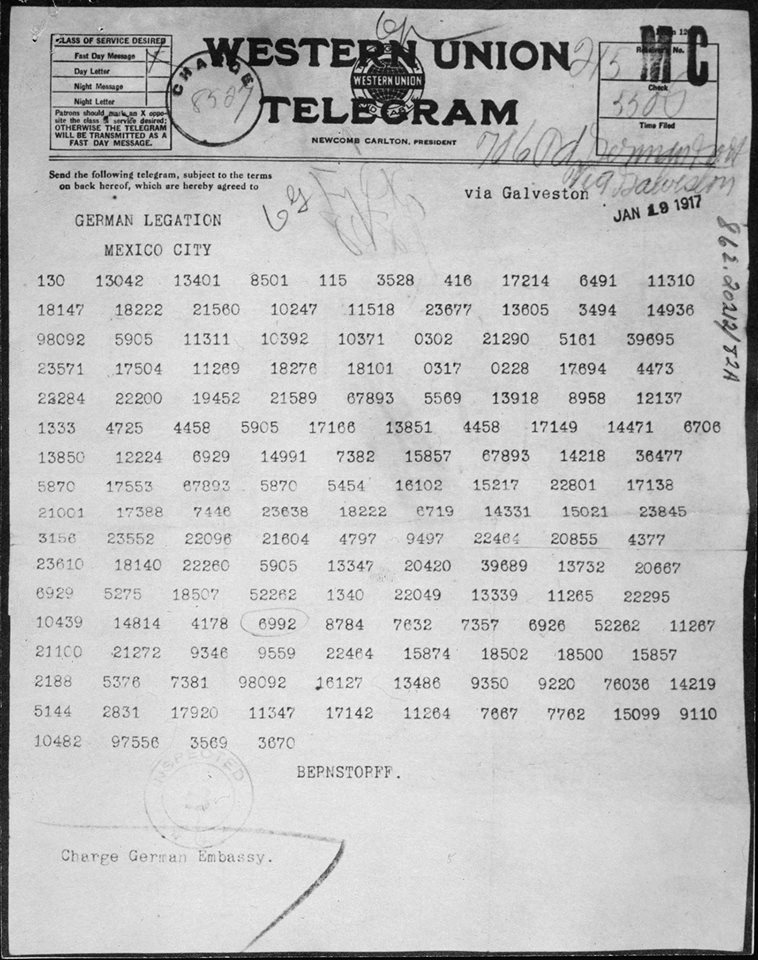
From the Facebook page of The Great War:
On this day 100 years ago, a coded telegram was sent by German foreign secretary Arthur Zimmermann to German Ambassador to Mexico, Heinrich von Eckardt. In this telegram, Zimmermann instructed von Eckardt to offer Mexico a military alliance and financial support against the United States should they not remain neutral. This was a possibility since Germany was about to unleash unrestricted submarine warfare by February 1, 1917.
To understand this telegram, it is important to understand that talks about military cooperation and even a military alliance between Mexico and the German Empire had been going on since 1915 already.
The telegram was sent via the American undersea cable since the German cable was interrupted by the British when the war broke out. US President Woodrow Wilson had offered the Germans to use their cable for diplomatic correspondence. What neither Wilson nor the Germans knew: The cable was monitored by the British intelligence at a relay station in England. Furthermore, the British codebreakers of Room 40 had already cracked the German encryption.
The biggest challenge for the British now was to reveal the content of this telegram without admitting that they were monitoring the cable while ensuring it had the desired impact.
Comments Off on 100 years ago today
January 15, 2017
American Elections – Ottoman Sultan – Austro-German Relations I OUT OF THE TRENCHES
Published on 14 Jan 2017
It’s time for the Chair of Wisdom again where Indy sits to answer all of your questions about World War 1. This week we talk about the 1916 presidential elections in the US, the Ottoman Sultan Mehmed V and the relations between Germany and Austria-Hungary.
Comments Off on American Elections – Ottoman Sultan – Austro-German Relations I OUT OF THE TRENCHES
January 5, 2017
Windrad umgefallen
Drone footage of a collapsed wind turbine in Germany from last month:
H/T to Donna Laframboise, who said:
And on December 27, in neighbouring Germany, a third turbine collapsed completely. After one of its blades failed, the nearly 100-meter (330-foot) structure buckled about 15 meters up. At roughly the height of a 30-storey apartment building, it came crashing to the ground with such force that its gear box was embedded nearly 2 meters (6 feet) deep.
Robert Tunna has uploaded a stunning YouTube video of the spectacular mess (taken with a camera-equipped drone).
We’re told that a June maintenance check on this particular turbine found no issues. Which means that National Geographic’s claim of “nearly zero” operational costs is mistaken. Wind turbines, like other expensive machinery, require ongoing maintenance. Without regular cleaning, dust accumulates and poses a fire hazard. Minus adequate lubrication, mechanical systems overheat, posing a different kind of fire hazard.
Since wind turbines are usually erected in sparsely populated areas, large amounts of fossil-fueled driving from one installation to the next is part of the maintenance picture. Repairs sometimes involve the rental of expensive cranes. In Germany alone, 26,000 individual turbines now require routine servicing. Hauling away tons of unwieldy wreckage isn’t free, either. The economic damage of last week’s incident in Germany is estimated to be half a million euros.
Comments Off on Windrad umgefallen
January 3, 2017
QotD: The “best” tank
I actually just finished a book that will be out in May next year called Armored Champion which is a general look at tank warfare in World War 2 that puts it into a broader context. One of the things I did in the new book Armored Champion is try to distinguish between what I call “tankers choice” and “commanders choice.” And what I mean by that is the tankers choice is what the tanker wants, the individual tank crew wants. The individual tank crew obviously wants a tank that is extremely powerful, very well armored, had a very powerful gun. So if you compare a Tiger or a Panther or a Sherman, the tanker is going to want the most powerful tank available. The commanders choice is very different, because the commander wants combat power. And combat power doesn’t necessarily come from the best technology because in many cases the best technology has issues.
So the Tiger during World War 2 cost the Germans something in the neighborhood of 300,000 Reich marks. You can buy a Stug III assault gun for about 70,000 Reich marks or a Panzer IV tank for about 100,000 Reich marks. So in other words you can get three Panzer IV tanks for every Tiger that you buy. And on top of it, the Tiger, because it was so big it was extremely unreliable. Things like the Stug III and Panzer IV had about double the reliability of Tiger. So if you’re a German senior commander, it’s an open question whether you want a force built up entirely of Tigers because they are unreliable and expensive so you are not going to get a lot of them. You’re going to get a lot more Panzer IV or Stug III vehicles for your Reich marks. So in that book I’m trying to compare those type of issues. And you know, that comes up with the Sherman. One reason there is 11,000 US tanks and tank destroyers In Germany in April 1945 is because the US decided to concentrate on a tank that was extremely reliable and relatively economical to build. And I don’t think anyone would claim that the Sherman was the best tank from the perspective of the tank crew, it didn’t have the best armor, it didn’t have the best gun, but from commanders perspective it was an excellent weapon. There were just lots and lots of them, so they gave the commander a lot of battlefield power. That can’t be said for a lot of the better German tanks because they simply were too expensive to be built in large numbers and they weren’t reliable enough, you couldn’t count on them. So it depends on the perspective that you are looking at it from.
“Interview with Steven Zaloga”, Tank and AFV News, 2015-01-27.
Comments Off on QotD: The “best” tank
December 25, 2016
Starving For Total War – Turnip Winter 1916 I THE GREAT WAR Special
Published on 24 Dec 2016
While 1916 still looked good for the Central Powers militarily, the civilian population at home, especially in the cities, was starving to death. The British Naval Blockade, harvest failure, a desolate supply situation and the demands of the army created a situation in which the people were forced to eat turnips, a crop usually reserved for farm animals.
Comments Off on Starving For Total War – Turnip Winter 1916 I THE GREAT WAR Special
December 23, 2016
They Did Not Pass – The Battle Of Verdun Ends I THE GREAT WAR Week 126
Published on 22 Dec 2016
The Battle of Verdun ended after 299 days. With a final French offensive the Germans lose Vacherauville and Louvemont. This means that the front line is basically back to where it was in February 1916. 300,000 men were killed and another 700,000 were wounded or missing in an area roughly equal to the size of all the London parks combined.
Comments Off on They Did Not Pass – The Battle Of Verdun Ends I THE GREAT WAR Week 126


