
Published on 22 Apr 2017
In this week’s episode, Indy talks about flamethrower units, the handling of war prisoners and different types of artillery fuses.
April 22, 2017
Flamethrower Units – Handling of Prisoners – Artillery Fuses I OUT OF THE TRENCHES
Comments Off on Flamethrower Units – Handling of Prisoners – Artillery Fuses I OUT OF THE TRENCHES
April 21, 2017
The Nivelle Offensive – Carnage At The Chemin Des Dames I THE GREAT WAR Week 143
Published on 20 Apr 2017
French Commander Robert Nivelle was sure that his offensive would bring the final victory against Germany. He scaled up his successful plan from Verdun which had worked so well and even when other generals questioned the very idea of the offensive, he would refuse to alter it or call it off. The Germans knew that the French were coming and were well prepared. And so the disaster at the Chemin Des Dames unfolded.
Comments Off on The Nivelle Offensive – Carnage At The Chemin Des Dames I THE GREAT WAR Week 143
April 19, 2017
QotD: Hubris and Nemesis, or pride goeth before the fall
Few things are more likely to precede defeat than the conviction that you are on the verge of victory. One hundred years ago, in the spring of 1917, Germany had every reason to believe that it would triumph over its enemies in the First World War. France had been bled white in repeated attacks on the German army’s fortified lines, England was suffering from shortages of both munitions and military manpower, and Russia was descending into a revolution that would, within a year, enable Germany and its Austro-Hungarian allies to shift enormous numbers of troops and guns to the Western Front. Yet the entry of the United States into the war on April 6, 1917, proved to be the counterweight that shifted the balance. By the autumn of 1918, the fond hope of Germany victory had been exposed as a delusion. The ultimate result of the Kaiser’s war was the destruction of the Kaiser’s empire, and of much else besides.
What is true in war is true also in politics. Hubris is nearly always the precedent to unexpected defeat. In 1964, Lyndon Johnson won a landslide victory; less than four years later, LBJ could not even win his own party’s nomination for re-election. In 1972, Richard Nixon was re-elected in a landslide; less than two years later, he was forced to resign from office. More recently, after George W. Bush’s 2004 re-election, some imagined that this victory was the harbinger of a “permanent Republican majority” — a GOP electoral hegemony based on a so-called “center-right” realignment — but two years later, Democrats captured control of Congress and in 2008 Barack Obama was elected president. Obama’s success in turn led Democrats to become overconfident, and Hillary Clinton’s supporters believed they were “on the right side of history,” as rock singer Bruce Springsteen told a rally in Philadelphia on the eve of the 2016 election. Unfortunately for Democrats, history disagreed.
Robert Stacy McCain, “Why Is the ‘Right Side of History’ Losing?”, The American Spectator, 2017-04-05.
Comments Off on QotD: Hubris and Nemesis, or pride goeth before the fall
April 18, 2017
Western Front Artillery At The Outbreak of World War 1 I THE GREAT WAR Special
Published on 17 Apr 2017
World War 1 was a war of artillery, 75% of casualties are attributed to artillery fire. And since the late 19th century the development of field canons, howitzers and mortars had made rapid progress. We are taking a look at the standard artillery pieces of the German, French and British Army at the outbreak of the war in this first part of a new series.
Comments Off on Western Front Artillery At The Outbreak of World War 1 I THE GREAT WAR Special
April 16, 2017
QotD: The fascination of Hitler and Nazi Germany
This morning I read Marina Fontaine’s review of Downfall (http://marinafontaine.blogspot.com/2017/03/netflix-review-downfall.html), yes, including mention of that scene, the one that’s been recaptioned several gazillion times, some with more humor than others. In the review, she asks why the fascination? What is it with the Nazis and Hitler?
I have a theory. It is purely mine, based on reading a metric crap-ton about all manner of things (and don’t ask me for cites because this stuff has stewed so long in the back of my head I no longer remember where I originally read whatever triggered any particular piece. You can get most of the raw facts off Wikipedia). It is also a very broad generalization. Coming years will determine whether or not it is correct in the big picture. I’m not optimistic (I hope I’ve got this horribly wrong. I fear I haven’t).
Okay. So.
The ongoing fascination with Hitler and Nazi Germany.
Simply put, it’s the most well-documented and acknowledged demonstration of the allure of evil and how easy it is for a more or less civilized people to descend into utter brutality. As such, it holds an unclean fascination not helped by uniforms that were designed to look good as well as be practical (or by the simple fact that evil, when done effectively, is sexy. Because it is invariably power, and untrammeled power at that. We’re human. Power attracts and corrupts us. The wiser among us acknowledge this so we can fight the effect).
The various Communist regimes can be dismissed as “not counting” because to the minds of those who do the dismissing, Russia, China, North Korea, and Eastern Europe “weren’t civilized”, and so Communism/Socialism would work just fine implemented by civilized people (they usually point to one of the Nordic nations when they do this). These same people are a big part of why the wrong lesson keeps being drawn from Nazi Germany.
The problem was not nationalism. It was not even the disgusting racial laws. Those laws could never have been passed, much less enforced, without the one big thing Socialism, Communism, and yes, Nazism have in common.
The supremacy of the state.
[…]
That bare listing of facts accounts for the rise of Hitler, but not the continuing notion that the Nazis were conservative (only if you define ‘conservative’ as ‘nationalist’). That one comes from two sources. One was Soviet propaganda aimed at making Communist and Nazi ideologies seem much more distinct than they actually were. The other was Allied propaganda aimed at much the same thing. It wouldn’t do, after all, to have people realize they were allied with a dictator every bit as vile as Hitler.
So in American and British media, the evil of the Nazis was played up, while the evil of the Communists was minimized where it couldn’t be silenced altogether. The Communist plants and fellow-travelers in both nations helped.
They were – and are – almost the same. Both demand an all-powerful state. The state determines who is deserving and provides for the deserving. The state dehumanizes the undeserving prior to eliminating them. The state determines the direction of industry (in the case of the Nazis, by requiring business owners to support the regime where the Communists took over the businesses). The state cares for you – but if you’re no use to the state, your care will be an unmarked grave in a prison camp/work camp/concentration camp/gulag. All hail the state.
Kate Paulk, “The Ease of Evil”, guest-posting at According to Hoyt, 2017-03-21.
Comments Off on QotD: The fascination of Hitler and Nazi Germany
April 10, 2017
Small Arms of WWI Primer 022: German T-Gewehr Anti-Tank Rifle
Published on Mar 29, 2016
Othais and Mae delve into the story of this WWI classic. Complete with history, function, and live fire demonstration.
C&Rsenal presents its WWI Primer series; covering the firearms of this historic conflict one at a time in honor of the centennial anniversary. Join us every other Tuesday!
Cartridge: 13.2x92mmR
Capacity: 1 rnd
Length: 5.5′
weight: 37.7 lbsAdditional reading:
Das Tankgewehr Mauser M 1918
Wolfgang KernDWJ – 1972 – Volume 4
Die Panzerbuchse 18
K. D. Meyer
Comments Off on Small Arms of WWI Primer 022: German T-Gewehr Anti-Tank Rifle
April 7, 2017
Some people build boats as a hobby … this guy built a Fokker Dreidecker I
At The Register, the story of Dr Peter Brueggemann’s quest to build a close replica of the kind of WW1 aircraft made famous by the Red Baron:
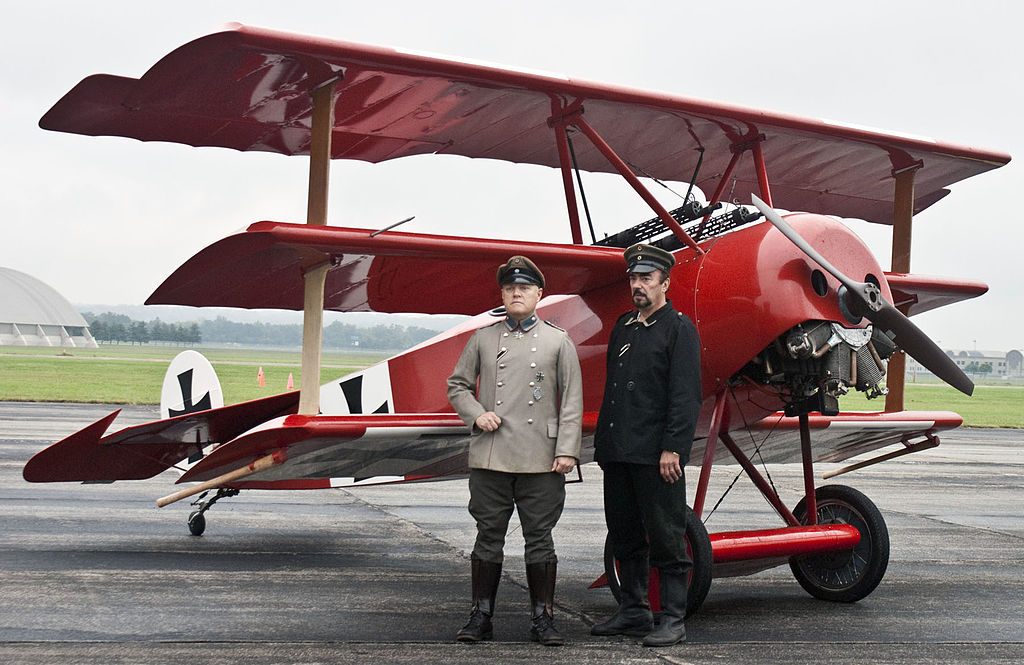
World War I Dawn Patrol Rendezvous DAYTON, Ohio — Reenactors stand in front of a Fokker Dr. I during the World War I Dawn Patrol Rendezvous at the National Museum of the U.S. Air Force, 8 August 2009. (U.S. Air Force photo, via Wikimedia)
A German orthopaedic surgeon in Norfolk has spent £70,000 building himself a flyable full-size replica of the Red Baron’s Fokker Triplane.
Dr Peter Brueggemann built the First World War-era aircraft by hand – even though when he started he couldn’t fly, as ITV News reported.
The bright red Fokker Dreidecker I (German for “three-decker”, or triplane) was built to a set of technical drawings prepared by an American aviation fanatic in the 1970s. No original Dr.Is exist, though a number of replicas have been put together during the 20th century.
Dr Brueggemann even acquired the title of baron from the Principality of Sealand, ready for when his Fokker makes its planned first flight this summer.
He told the telly station: “Being a surgeon has certainly helped and I have used surgical equipment like needles and forceps when stitching materials to the ribs of the plane.”
[…]
Fokker copied the original Dr.I design from British company Sopwith. During the early stages of air fighting in WWI, rate of climb was deemed vitally important. As aeronautical science was still in its infancy – aircraft were built from plywood and canvas, while the relatively primitive rotary engines of the day were only capable of around 110hp – the easiest way of increasing the amount of lift available was to add more wings.
First seeing action in early 1917, the Sopwith Triplane was an instant success. However, a captured example shown to Anthony Fokker, prompting German development of their own version. The first pre-production Dr.I was issued to a frontline unit in August 1917 and proved an instant hit. German fighter squadron commander Manfred von Richthofen recommended the Dr.1 be issued to as many frontline units as possible.
Comments Off on Some people build boats as a hobby … this guy built a Fokker Dreidecker I
March 30, 2017
How Germany’s Victories weakened the Japanese in World War 2
Published on 24 Mar 2017
This video gives you a short glimpse on how the war in Europe had a detrimental effect on the Japanese Economy.
Military History Visualized provides a series of short narrative and visual presentations like documentaries based on academic literature or sometimes primary sources. Videos are intended as introduction to military history, but also contain a lot of details for history buffs. Since the aim is to keep the episodes short and comprehensive some details are often cut.
Comments Off on How Germany’s Victories weakened the Japanese in World War 2
March 27, 2017
Catherine the Great – VI: Succession – Extra History
Published on 4 Mar 2017
The optimism that marked Catherine the Great’s early years turned on its head. She oversaw the partition and final dissolution of the Polish-Lithuanian Commonwealth. She also alienated her son in the same way her own mother once did, leaving him ill-equipped to succeed her.
Comments Off on Catherine the Great – VI: Succession – Extra History
March 22, 2017
The Backbone of Total War – Trains in WW1 I THE GREAT WAR Special
Published on 21 Mar 2017
Without trains, the modern armies of World War 1 were not able to move their troops en masse. Without trains, the soldiers at the front didn’t have food or ammunition and without trains, the soldiers wouldn’t make it to the nearest hospital. Trains were the backbone of the new, industrialised war of the 20th century.
Comments Off on The Backbone of Total War – Trains in WW1 I THE GREAT WAR Special
March 14, 2017
QotD: Individual conscience and collective guilt
I’m sure there are good men in Saudi Arabia who find it abhorrent and painful that women can’t drive, for instance. I’m also sure they enforce that rule on their women because they don’t want them fined or imprisoned or worse. They can’t DO anything. Not as individuals. And they’re too busy feeding their families to organize and run campaigns [to] free women. Also, there have been some men who have organized and tried to make a difference, but there weren’t enough of them. That “grain of sand” stuff only works dramatically in movies. In real life, it’s more one generation raising the other; one friend talking to the other – until the balance TIPS.
And once it does making them feel guilty would be a counterproductive. Sorry for breaking Godwin’s law, but did we persecute ALL of the German people for Hitler’s crimes? No. Could any of them have spoken up? Many did. But most people who were alive at that time were good people caught in a social mechanic they couldn’t break out of – not individually. And they weren’t connected enough to form cohesive groups.
While we’re speaking of Germany, look at collective guilt and collective punishment for “crimes” that people supposedly committed which no individual could have stopped. If you’ve studied the mechanics of the avalanche leading to WWI (I have. There’s a novel about the Red Baron and time traveling started, and it will eventually get done) there was a certain unstoppable force to it. It was going to start sometime. Someone was going to fire the first shot.
It was Germany. They invaded other countries. The “Hun” entered European mythology of the early twentieth for reasons both good and bad. (Google WWI Belgian Nuns, for instance. Much of it was propaganda, but a lot of it, doubtless, happened.)
When they lost the war, they were treated as if they and they alone and they collectively were guilty. The penalty levied was so high they could not and would not pay and that it was crushing the man in the street.
There were other reasons leading to the rise of Hitler. However, THAT punishment facilitated it. It might not have happened without it. The “in for a lamb, in for a sheep” is a normal human reaction. If you’re held constantly guilty of things you did NOT do and could not have changed, you’re going to DO something anyway. I mean, how can it get worse?
To a certain type of woman – or man, though we’re only giving some tenured college professor males that kind of power – it is sweet to be able to play the victim ad nauseam. Particularly when you’ve never actually been victimized. And it is great to be able to make men squirm with stories of past injustice and feel guilty for things they are either way too young to have done (anyone born after the fifties, pretty much) or could not have changed if they tried, but which many of them mitigated in small ways.
And to a certain type of man – or woman, but in this case it doesn’t apply – it’s a great feeling to go around apologizing for the crimes of your ancestors. If you feel your accomplishments are diminished by theirs, apologizing gives a quick leveling. You recognize they did wrong, therefore you must be better than them. It’s a stupid feeling that ignores that you’re probably also doing things that your descendants will apologize for, but hey, it’s much better than actually trying to achieve something. Less work. Instant boost.
This dynamic gives power to passive-aggressives and bullies, the exact type of person you don’t want to have any power. And it makes good people feel like they’re bad and if they’re bad they might as well act it. It can, for instance, make young men very attracted to religions that DO oppress women (and no, sorry, that’s not most main line Christian religions, where you can leave if you want to.) Frankly, I think it’s a miracle more of my son’s generation hasn’t converted to one of those. I think it’s a witness to their essential decency, given the books, the movies and everything else designed to make them feel guilty for crimes they never committed.
Sarah Hoyt, “The Sharp Edge of Guilt, a blast from the past March 2010”, According to Hoyt, 2015-06-05.
Comments Off on QotD: Individual conscience and collective guilt
March 3, 2017
Conrad Loses His Job – Nivelle’s Coup I THE GREAT WAR Week 136
Published on 2 Mar 2017
The new Austro-Hungarian Kaiser is not happy about his Empire’s dependence on the German ally. And he is also not happy about their own military decisions and over the winter has worked to replace key positions with his own men. The last step in that process is convincing Conrad von Hötzendorf to take a position on the Italian Front. At the same time, French Commander Robert Nivelle is trying to get control over the British Armies on the Western Front and the Zimmermann Telegram is released to the press.
Comments Off on Conrad Loses His Job – Nivelle’s Coup I THE GREAT WAR Week 136
March 2, 2017
Catherine the Great – II: Not Quite Empress Yet – Extra History
Published on 4 Feb 2017
Sophia’s excitement to meet her future husband deflated when she realized Peter III was a boor who cared nothing about Russia. By contrast, she threw herself into learning the culture with such vigor that she earned the love of the people. She was rechristened Catherine and married Peter… but when he became emperor, his mistakes and her popularity began to add up to a crisis situation.
Comments Off on Catherine the Great – II: Not Quite Empress Yet – Extra History
February 23, 2017
Catherine the Great – I: Not Quite Catherine Yet – Extra History
Published on Jan 28, 2017
Before she became Catherine the Great, legendary empress of Russia, she was a smart but lonely girl named Sophia. Her mother ignored her until family connections proposed a marriage between Sophia and the presumptive heir to the Russian throne – and suddenly she was thrown from her quiet life in a backwoods mansion to the center of a cutthroat political world.
Comments Off on Catherine the Great – I: Not Quite Catherine Yet – Extra History
February 17, 2017
Industrial policy example – Kingston, Ontario
David Warren remembers when the government tampered with the free market to “save an industry” in Kingston:
Once upon a time, many years ago, I scrapped into one of these “no-brainer” political deals. The remains of the locomotive manufacturing business in Kingston, Ontario — whose century-old products I had glimpsed, still on the rails in India — were now on the block. A monster German corporation was offering to buy them, for the very purpose of competing, in Canada, with a (hugely subsidized, monopolist) Canadian corporation. The government stepped in, to “save” a Canadian industry, retroactively change the ground rules, and kick in more subsidies so that the Canadian monopolists, based in Montreal, could take over instead. This was accompanied by nationalist rhetoric, and Kingston was thrilled. Critics like me were unofficially deflected with bigoted anti-German blather held over from the last World War.
But I knew exactly what was going to happen. The local works, which would have been expanded by the foreign owner, were soon closed by the new Canadian owner, after studies had been commissioned to “prove” it was uneconomic. The latter’s last possible domestic competitor was thus snuffed out. The locals, whose lives had been for generations part of a proud Kingston enterprise, had been suckered. The politicians had told them it was little Canada versus big Germany. In reality, it was pretty little Kingston versus big ugly Montreal.
That is how the world works, with politics, so that whenever I hear of a big new national no-brainer scheme, my first thought is, which innocents are getting mooshed today?
Comments Off on Industrial policy example – Kingston, Ontario


