
Published on 6 May 2017
The Tankgewehr antitank rifle was developed by the Mauser company and adopted by the Imperial German military as an emergency measure to counter the introduction of tanks to the WW1 battlefield. The question is, did they really work? Could a 13.2mm AP bullet from a Tankgewehr really perforate the armor of a British tank? Well today we find out!
The armor on a British tank was steel plate of 6mm, 8mm, and 12mm thickness, through-hardened to Brinell 440-480. We have replicated this with a plate of AR450 (ie, Brinell 450) armor, which we will be shooting at a distance of 50 yards. The ammunition we are using is original 1918 production German AP, and the rifle is a Tankgewehr captured by Allied troops late in the war and brought home as a souvenir.
This video was only made possible with help from three very helpful folks:
MOA Targets provided the steel (and on short notice!): https://www.moatargets.com
Mike Carrick of Arms Heritage Magazine provided use of the T-Gewehr: https://armsheritagemagazine.com
Hayes Otoupalik provided the original ammunition: http://www.hayesotoupalik.com
June 10, 2017
Could a Tankgewehr Really Take Out a British MkIV Tank?
June 9, 2017
The Battle of Messines – Explosion Beneath Hill 60 I THE GREAT WAR Week 150
Published on 8 Jun 2017
In the early morning of June 7 the area around Messines Ridge is shattered by huge explosions beneath the German positions. Miners and sappers had dug tunnels and filled them up with tons of explosives. Up to 10,000 German soldiers are killed in this inferno. At the same time, the Romanian Army seems to be in shape for an attack against the Germans again and the 10th Battle of the Isonzo continues.
June 6, 2017
Where was the Luftwaffe on D-Day? – German Response to Operation Overlord, Normandy
Published on 26 May 2017
The 73 Anniversary of D-Day is nearly upon us so let us talk about the Luftwaffe‘s involvement in the Battle of Normandy!
D-Day in Colour
Published on 1 May 2017
(c) D-Day in Colour (2004), narrated by John Hurt
D-Day, 6th June 1944: the launch of Operation Overlord. The battle that began the liberation of Europe. The last moment the German Army might have rescued the fate of Adolf Hitler. The beginning of the end of the Second World War. D-Day is a date permanently etched in our nation’s memory.
From the makers of Britain At War In Colour, this documentary takes an in-depth look at the events and experiences of the greatest sea-borne invasion in history, focusing on the personal stories of those involved including not only the men in combat but also the family and friends anxiously awaiting news of their loved ones.
Narrated by John Hurt, D-Day In Colour relives the events of those decisive yet perilous days and reflects on the private triumphs and personal tragedies that proved crucial to the outcome of the Second World War. It provides an intimate first-hand account of the arduous months and crucial hours that shaped the future peace of the civilised world. The vivid colour film and personal witness material combine with original sound archive to illustrate the reality of battle, the complexity of human emotions and the sacrifices that were made in the fateful summer of 1944.
QotD: Comparing general staff “systems”
Throughout the 20th century and into the 21st there have been, largely, two staff systems:
- The continental system ~ which is used by most European armies and also used by the American and many, many Asian armies;
- The imperial, or British staff system which was used by the Canadian Army throughout most of the 20th century.
The two are fundamentally different.
The continental system is based on the great and impressive German General Staff system which grew up in the 19th century based on lessons learned in the Napoleonic Wars and then relearned in inter alia the Franco-Prussian Wars. The imperial system came later and reflected British thinking about what the Germans had formalized.
The best way to see the difference is to look at how the commanders and staff relate. In a French or German battalion ~ at least this was the case a few years ago ~ a company (100 to 150 soldiers) is commanded by a captain; there are only two or three officers in the company. The battalion, three, for or five companies, is commander by a lieutenant colonel, and there is a major deputy commander. The battalion staff consists of:
- S1 – personnel officer – a captain
- S2 – intelligence officer – a captain, sometimes a major
- S3 – operations officer – a major
- S4 – logistics officer – a major
- S5 – plans officer – a captain, often a major
For the German captain, company commander, looking “up the chain,” all he sees is higher ranks and he will never be blamed for being unsure if the commanding officer or the operations officer is the real “boss.” Ditto for French and American officers whose command-staff relationships are very, very similar. One of the great strengths of the German General Staff system was it “coherence.” The staff, at every level, was part of a single, coherent whole that stretched top to bottom from Berlin to the smallest battalion in the field. It is part of what made the German General Staff so famous and so feared by enemy armies. But the British, especially in 1914-18, saw a flaw in the continental system. The soldiers and commanders in the battalions and brigades in the trenches saw the general staff as being too remote, and even comfortable ~ removed from the horrors of combat and, consequently, many felt, making poor staff decisions. The system of the staff out-ranking subordinate commanders extends all the way to the top of the US Army and most European armies. Higher rank staff officers tend to build bigger and bigger HQs, too.
The British adapted the imperial system so that is was always crystal clear that commanders, from company up, always outranked and “out-appointed” the staff. Consider a British or Canadian battalion, also with, say, five companies. Like the US or European battalion the commanding officer is a lieutenant colonel, but each company commander is a major and the staff are:
- Adjutant (S1/personnel) – a captain
- Intelligence officer (S2) – a lieutenant, maybe a captain
- Operations officer (S3 and S5) – a captain, but, after about 1944 usually a major by “misemploying” the HQ Company commander
- Quartermaster (s4) – a captain
So a British or Australian or Canadian or Indian major, company commander, looking “up the chain” saw that there was no one between him (or her) and the CO except officers of equal or lower rank. The same applied, top to bottom: Field Marshal Montgomery’s (famously able) chief of staff was a major general … but you can be 100% certain that when Major-General Sir Francis Wilfred “Freddie” de Guingand, a two star level officer, phoned General (four stars) Henry Duncan Graham “Harry” Crerar, commander of the 1st Canadian Army in 1944/45 was wakened up and took the call because Monty’s chief-of-staff only dealt with important people and important matters. Rank didn’t really matter: de Guingand didn’t need any more stars ~ his appointment and ability both spoke (loudly) for themselves.
One result was that imperial (Commonwealth) armies tended to have smaller and lower ranked HQs, top to bottom.
There is no empirical proof that the continental staff system is better than the imperial one. The German General Staff was, indeed, superb, but that didn’t help, in 1944/45 when the German divisions and regiments and battalions were being defeated in detail on the front lines. Ditto in Korea and Vietnam: large numbers of excellent staff officers and superior communications systems didn’t help (and may have hindered) when the (first French and then) American brigades and battalions were being beaten in the jungles and rice paddies. The British, too, were defeated in battle ~ Dunkirk, Hong Kong, Singapore ~ but there is no evidence that bad operational staff work was to blame.
Ted Campbell, “The foundation (2)”, Ted Campbell’s Point of View, 2017-02-21.
June 4, 2017
Exploring the Romagne 14-18 Museum in France I THE GREAT WAR Special
Published on 3 Jun 2017
Check out Jean-Paul’s museum or book him as a guide if you want to explore the Verdun or Meuse-Argonnes region: http://www.romagne14-18.com/index.php/de/
This winter we went to the Meuse region in France and explored the battlefield of Verdun and the Meuse-Argonne Offensive. Jean-Paul was our guide there and also showed us his impressive collection of WW1 relics that he all found in the area over the last decades.
Intro to the Solow Model of Economic Growth
Published on 28 Mar 2016
Here’s a quick growth conundrum, to get you thinking.
Consider two countries at the close of World War II — Germany and Japan. At that point, they’ve both suffered heavy population losses. Both countries have had their infrastructure devastated. So logically, the losing countries should’ve been in a post-war economic quagmire.
So why wasn’t that the case at all?
Following WWII, Germany and Japan were growing twice, sometimes three times, the rate of the winning countries, such as the United States.
Similarly, think of this quandary: in past videos, we explained to you that one of the keys to economic growth is a country’s institutions. With that in mind, think of China’s growth rate. China’s been growing at a breakneck pace — reported at 7 to 10% per year.
On the other hand, countries like the United States, Canada, and France have been growing at about 2% per year. Aside from their advantages in physical and human capital, there’s no question that the institutions in these countries are better than those in China.
So, just as we said about Germany and Japan — why the growth?
To answer that, we turn to today’s video on the Solow model of economic growth.
The Solow model was named after Robert Solow, the 1987 winner of the Nobel Prize in Economics. Among other things, the Solow model helps us understand the nuances and dynamics of growth. The model also lets us distinguish between two types of growth: catching up growth and cutting edge growth. As you’ll soon see, a country can grow much faster when it’s catching up, as opposed to when it’s already growing at the cutting edge.
That said, this video will allow you to see a simplified version of the model. It’ll describe growth as a function of a few specific variables: labor, education, physical capital, and ideas.
So watch this new installment, get your feet wet with the Solow model, and next time, we’ll drill down into one of its variables: physical capital.
Helpful links:
Puzzle of Growth: http://bit.ly/1T5yq18
Importance of Institutions: http://bit.ly/25kbzne
Rise and Fall of the Chinese Economy: http://bit.ly/1SfRpDL
May 21, 2017
The Hero Of Tannenberg – Paul von Hindenburg I WHO DID WHAT IN WW1?
Published on 20 May 2017
Paul von Hindenburg’s military career was already over when World War 1 broke out. He fought in legendary German battles like Königgrätz [and] Sedan and now was retired. But he returned in 1914 and became a living legend after the victory over the Russians at Tannenberg 1914. During the war he and Erich Ludendorff turned Germany in a de facto military dictatorship to steer the entire country through this total war. But Germany still lost and Hindenburg was also responsible for setting up the Dolchstoßlegende – the myth of the stab in the back of the undefeated German Army.
May 19, 2017
Tenth Battle of The Isonzo River – Trotsky Arrives in Petrograd I THE GREAT WAR Week 147
Published on 18 May 2017
The Italian Front has been quiet over the winter and while the Austrians used the time to improve their defences, the Italian Army prepared another offensive near the Isonzo River. At the same time, Leon Trotsky arrives in Petrograd which will ensure the further complication of the situation in Russia after the Revolution.
May 16, 2017
The Virtual Lorenz machine
At The Register, Gareth Corfield discusses the new virtual coding device simulating the WW2 German Lorenz cipher machine:
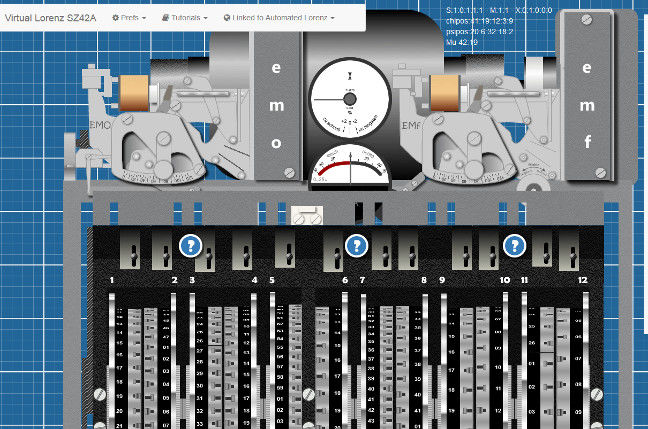
The National Museum of Computing has put an emulation of an “unbreakable” Second World War German cipher machine online for world+dog to admire.
The Virtual Lorenz machine has been launched in honour of WW2 codebreaker Bill Tutte, the man who broke the crypto used in the twelve-rotor cipher machine.
As The National Museum of Computing (TNMOC) puts it, Tutte’s work “shortened the conflict” – even though he had never even seen the cipher machine or its crypto scheme, the breaking of which the museum added was “the greatest intellectual feat of the war”.
TNMOC unveiled the Virtual Lorenz today to celebrate Tutte’s 100th birthday. Built by computing chap Martin Gillow, the simulation accurately reproduces the whirring of the cipher wheels (you might want to turn it down as the “background whirr” is a little too realistic).
The BBC profiled the “gifted mathematician” a few years ago, highlighting how the Lorenz machine whose secrets Tutte cracked was “several degrees more advanced than Enigma”, the cipher famously cracked by Tutte’s colleague Alan Turing. Tutte cracked the Lorenz in about six months, reverse-engineering its workings by reading intercepted Lorenz messages. When the Allies wanted to fool Hitler into believing the D-Day landings would take place in a false location, our ability to read Lorenz was critical for confirming that the ruse had worked – saving thousands of soldiers, sailors and airmen’s lives.
[…]
The Virtual Lorenz can be found here. Word to the wise – it’s not on an HTTPS site, so if you’re hoping to use it to thwart GCHQ, you might want to think again.
May 12, 2017
The Macedonian Standoff – The Five Nation Army Is Repelled I THE GREAT WAR Week 146
Published on 11 May 2017
Italy, France, Serbia, Britain and Russia joined forces at the Macedonian Front and the “five nation army” wants to break through the lines held by Bulgaria with some German support. But the Bulgarian defences can withstand the attack and so Maurice Sarrail is forced to abandon all hopes for a breakthrough. Meanwhile another offensive is about to proceed at the Italian front which had been quiet all winter.
May 9, 2017
US Joins WW1 – Spring Offensives 1917 I THE GREAT WAR Summary Part 9
Published on 8 May 2017
After a rather quiet winter, the war erupts into action in 1917. Not only do the United States join the war after weeks of unrestricted submarine warfare and the uncovering of the Zimmermann Telegram. The British and French launch their own spring offensives. In the East, chaos spreads in post-revolutionary Russia and Lenin returns from exile. And in Mesopotamia the British take Baghdad.
May 8, 2017
Spanish Civil War – Lessons NOT Learned – The British, French & US
Published on 28 Mar 2017
The Spanish Civil War (1936-1939) was probably the most significant war between the First and the Second World War. [M]any important lessons were learned and NOT learned by the British, French, US, German, Italian and Soviet Forces.
Military History Visualized provides a series of short narrative and visual presentations like documentaries based on academic literature or sometimes primary sources. Videos are intended as introduction to military history, but also contain a lot of details for history buffs. Since the aim is to keep the episodes short and comprehensive some details are often cut.
April 30, 2017
Fight For Air Supremacy – Bloody April 1917 I THE GREAT WAR Special feat. Real Engineering
Published on 29 Apr 2017
Check out Real Engineering and their video about WW1 airplanes: https://www.youtube.com/watch?v=MI08NGCgISE
Meet us and see original WW1 airplanes: http://bit.ly/TGWStowMaries
“Bloody April” was the result of two competing aviation strategies: The more defence oriented German Luftstreitkräfte and the more offensive oriented British Royal Flying Corps. The RFC needed air reconnaissance for the Battle of Arras and the Germans needed to deny them them. With the superior German Albatross D.III fighters, the German Jagdstaffeln inflicted heavy losses on the RFC.
April 25, 2017
German Trade Submarines – Beutepanzer Upgrades – Dan Carlin I OUT OF THE TRENCHES
Published on 24 Apr 2017
Check out Dan Carlin’s Podcast about WW1: http://bit.ly/DanCarlinArmageddon
It’s Chair of Wisdom Time again and this week we talk about German Trade Submarines (Deutschland class), Beutepanzer upgrades and Dan Carlin’s Blueprint for Armageddon series.


